Princess Anne EXPOSES Meghan’s College Records! REAL AGE Revealed As Harry Is Left SPEECHLESS Today!
The Silent Confrontation: Inside the Room Where the Royal Narrative Shattered
There are moments in the centuries-old history of the British monarchy where the polished veneer of public relations gives way to the unyielding weight of institutional reality. Such a moment occurred behind closed doors at a private apartment within the palace walls, far from the glare of television cameras and the frantic messaging of transatlantic publicity agents.
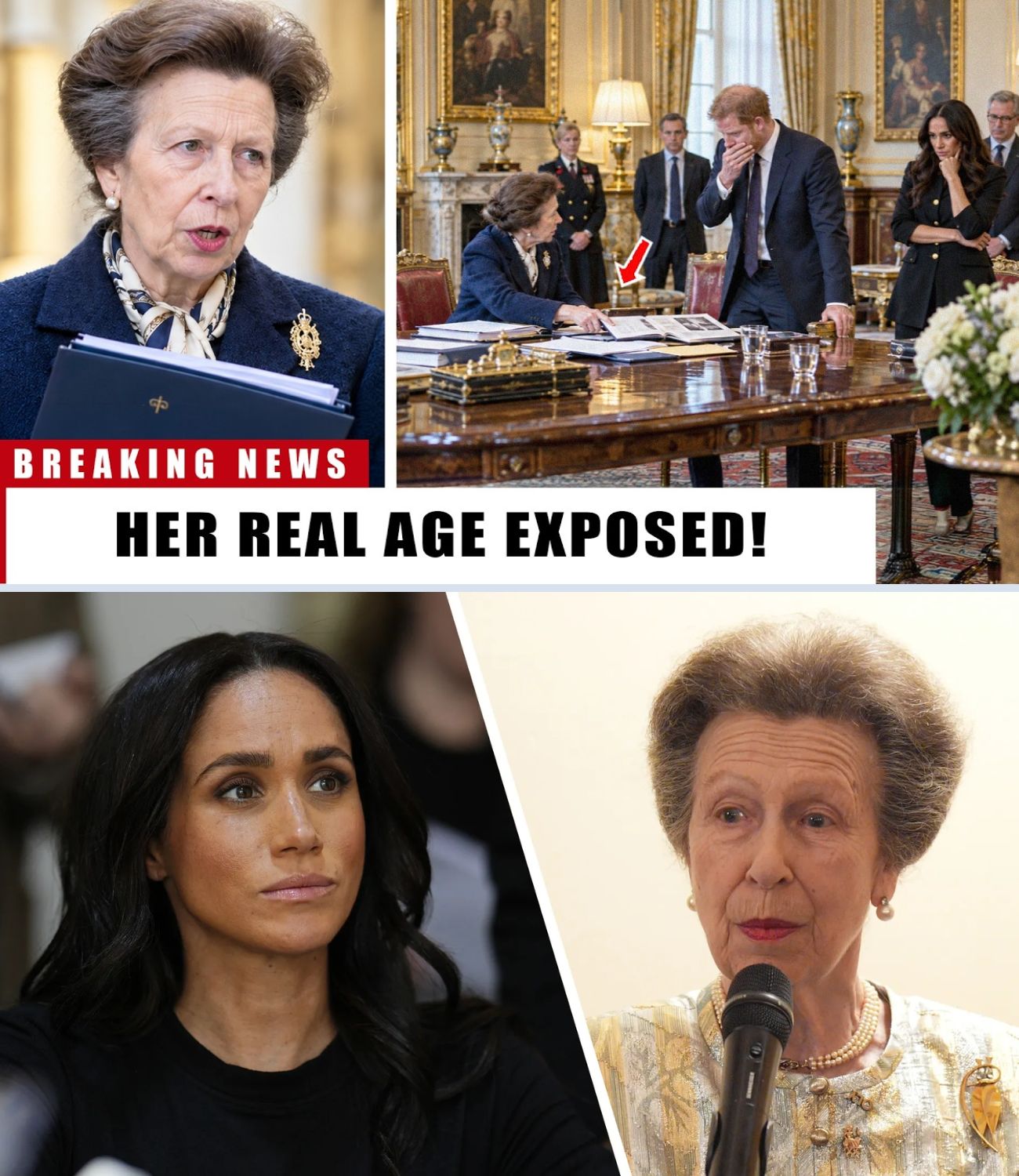
No emergency summit had been called by the press office. No anonymous leaks were whispered to Sunday newspaper columnists. Instead, Princess Anne—the former monarch’s most trusted confidant and a working royal whose dedication to sovereign duty is absolute—performed an act far more lethal to a curated public image than any tabloid headline could ever hope to be. She walked across the room, placed a single navy blue archival folder flat upon the polished mahogany table, and pushed it across the grain toward Prince Harry without uttering a single word.
Inside that folder lay no internet gossip, no fan-forum arithmetic, and no blurry scans of teenage yearbooks. What rested under Harry’s fingertips were authenticated registrar records from Northwestern University, verified copies of early Screen Actors Guild registration forms originating from California, and stamped identity questionnaires dating back to the late 1990s.
For the Duke of Sussex, turning those pages was not merely an uncomfortable family disagreement; it was the exact second a carefully constructed, multi-million-pound Hollywood biography hit a concrete wall of hard, unyielding facts. And as the silence in the room deepened, the staggering scale of an institutional vetting failure began to lay bare.
Chapter I: The Mathematics of Myth-Making
To understand why that single folder caused an internal earthquake at the heart of the establishment, one must examine the baseline narrative that the world had been instructed to accept without question.
For half a decade, the official biographical narrative presented Meghan Markle as a self-made rising star. The world was sold a streamlined, triumphant trajectory: an independent young woman navigating elite academic halls, transitioning effortlessly into humanitarian advocacy, conquering the entertainment industry, and finally stepping into the ancient machinery of the British royal family. It was a biography polished to absolute perfection, designed to cast any inquiry into dates, timelines, or prior professional associations as an act of petty hostility or out-of-touch prejudice.
Yet, the papers resting inside Anne’s navy blue binder told a radically different story.
When biographers and investigative researchers cross-reference official university matriculation logs with early theatrical casting surveys, a chronological puzzle emerges. Consider, for instance, the widely circulated anecdote regarding a teenage job scooping ice cream or working at a yogurt shop in Los Angeles during the mid-1990s—an interview staple where the young protagonist supposedly crossed paths with a television star whose breakthrough commercial did not even broadcast until 1997. If the official birth year of 1981 is applied to that timeline, basic mathematics dictates an inconsistency that no amount of public relations spin can easily reconcile.
More damning still were the early union disclosures and administrative questionnaires retrieved from Californian archives. Documents submitted under penalty of perjury to labor guilds require precise legal declarations of age and identity. The dates stamped on those forms pointed toward a timeline that pre-dated the official narrative by years, suggesting an identity adjustment executed long before a royal romance ever blossomed at Soho House.
When Harry looked at those pages, he was not looking at hostile British tabloid clippings compiled by detractors. He was looking at official American records, legally executed decades prior, which simply refused to align with the story he had spent years aggressively defending against his own blood relatives.
Chapter II: The Breakdown of Sovereign Vetting
The revelation of these discrepancies raises a profound and uncomfortable question: How did such a glaring divergence slip past the formidable security and vetting apparatus of the British state?
When an outsider marries into the senior ranks of the British royal family, the process is far more rigorous than a high-society wedding. It involves entering an ancient constitutional framework that guards state secrets, manages vast tracts of sovereign land, and maintains a line of succession dictated by common law. Under normal operating protocols, royal protection officers, diplomatic liaisons, and private secretaries conduct exhaustive institutional due diligence. Birth certificates are audited, university transcripts verified, financial liabilities reviewed, and prior legal relationships inspected.
By 2018, the British state was allocating millions of pounds annually toward security details, official travel, and public event management for the newly formed ducal household. When public funds and sovereign security are staked on an individual, basic identifying facts are not optional trivia; they are a fundamental constitutional requirement.
Yet, during the whirlwind courtship between 2016 and 2018, that entire protective machinery was effectively paralysed. Palace courtiers who should have demanded verified background files found themselves cowed by the political climate within Kensington Palace. Every time an administrative adviser raised a standard question regarding past legal representation, guild disclosures, or chronological timelines, it was met with immediate, explosive pushback.
Prince Harry treated routine verification procedures as a personal assault on the woman he loved. The operational mantra echoing through the corridors was simple: whatever the bride wanted, the bride got. Fearing accusations of institutional racism or being branded out-of-touch with modern sensibilities, veteran officials backed down, rubber-stamped the summaries, and accepted an edited personal history. It was a catastrophic failure of institutional security—and Princess Anne was the one person unwilling to let it stand.
Chapter III: The Erasure of the Past
To appreciate the sheer tenacity required to compile that dossier, one must look at the private history that the polished royal narrative worked so exhaustively to erase.
In the fairy-tale version broadcast across global networks, the Duchess arrived at the palace gates as a solitary pioneer, entirely detached from family scaffolding. But back in California, an entire family was left holding the physical receipts of a very different reality. Thomas Markle, a seasoned Hollywood lighting director who earned a comfortable living on major television sets, has stated repeatedly on the record that he funded every single step of his daughter’s upbringing. He paid the steep tuition fees for private schooling at Immaculate Heart, covered daily expenses, drove her to auditions, and financed her education at Northwestern University.
The moment the royal romance accelerated, however, those familial ties became an inconvenient liability. Thomas Markle, along with older siblings Samantha and Thomas Jr., was instructed to maintain absolute silence. Witnesses who possessed childhood photographs, school reports, and tuition receipts were effectively locked outside the palace perimeter because their lived memories contradicted the scripted biography.
A similar pattern of calculated narrative pruning unfolded in Toronto during the filming of Suits. While fellow cast members maintained permanent residences in Los Angeles and commuted across the border, a detached base was established in Canada, cultivating a separate social circle while the first husband, Trevor Engelson, remained behind in California trying to produce feature films.
When Engelson and Markle married in Jamaica, guests were strictly forbidden from taking casual photographs, and reports later confirmed that personal wedding footage and home videos were systematically gathered and destroyed. In the calculus of aggressive personal branding, physical documentation is a hazard. If an entire life story is being refashioned for a global stage, old chapters must be spliced, edited, and permanently burned before the next audience arrives.
Chapter IV: An Institutional Audit, Not a Family Spat
When Princess Anne placed those documents before the sovereign trustees, she did not approach the matter as an emotional family dispute. She framed it as an administrative audit of sovereign compliance.
Anne oversees numerous military regiments and views the Crown not as a launchpad for individual reinvention, but as a permanent ledger belonging to the British people. To her mind, allowing a sanitized, unverified biography to sit unchallenged within official palace records represented a direct insult to the legacy of the late Queen.
Knowing that any public confrontation would immediately trigger a tidal wave of counter-briefings from California accusing the family of prejudice and cruelty, Anne bypassed the palace press office entirely. She took the dossier directly to the senior institutional trustees and the keeper of the privy purse, laying the Northwestern matriculation logs, California union filings, and 1997 casting papers side-by-side with the official royal biographies.
The question she posed was devastating in its simplicity: On what legal authority was an unverified, edited timeline permitted into the permanent state archives?
The response was swift and absolute. Anne instructed the legal custodians of the royal collection to lock down the biographical files immediately. No palace staffer, external publicist, or digital manager was permitted to amend or retroactively rewrite the historical record. The Crown was officially stepping back, refusing to act as an accomplice to a manufactured personal history.
Chapter V: The Visual Severance and Commercial Fallout
The public manifestation of this total institutional severance was not long in coming. At a major formal memorial gathering watched by millions across international feeds, Prince Harry stepped into the aisle seeking a familiar opening, his posture betraying the quiet desperation of a man whose safety net had vanished.
And then there was Princess Anne. Standing in full ceremonial uniform, rigid as iron, she looked straight ahead, treating the Duke’s presence as if he were an empty space. When he moved closer, expecting a customary familial nod, Anne’s physical barrier went up like a portcullis. Her shoulders did not soften; her chin did not drop an inch. The ten-second interaction obliterated the lingering illusion that the palace was privately seeking reconciliation behind the scenes. It demonstrated to the global public that the doors had been bolted shut.
Across the Atlantic, the damage control machinery seized up entirely. The traditional playbook of weaponising victimhood against nervous press secretaries failed because Anne operates entirely outside the metrics of digital engagement and celebrity magazine approval.
Almost immediately, the commercial reality in Hollywood began to shift. In the entertainment capital, power is measured by returned phone calls and viable development deals. As whispers of the archived discrepancies circulated among high-level studio executives, the corporate silence set in. Major talent agency contacts quietly walked away from negotiations, production schedules for lifestyle programs were delayed indefinitely, and prominent corporate partners distanced themselves from joint filings.
The entire Sussex commercial enterprise had rested on a single foundational pillar: the prestige of royal association combined with the moral high ground of a misunderstood modern outsider. The moment authentic archival records proved the foundational narrative was heavily edited, that moral high ground evaporated, leaving commercial backers exposed to unwanted scrutiny.
Conclusion: The Supremacy of the Written Record
When the dust settles on the disputed years and the sealed archives, the events surrounding Princess Anne’s quiet dossier reveal a truth far larger than a Hollywood biography or a family rift.
In the modern entertainment ecosystem, personal history is elastic. One can discard former associates, shred wedding tapes, rewrite timelines, and present a cleaner, more glamorous persona to the next receptive audience. That philosophy serves well when pitching streaming series or marketing lifestyle goods.
Yet, stepping across the threshold of an ancient constitutional monarchy is an entirely different endeavor. A thousand-year-old institution does not run on the rhythm of a twenty-four-hour news cycle; it rests upon parchment rolls, parish registers, and the unyielding permanence of the written record. Every title, privilege, and state-backed protection relies upon absolute, uncompromised transparency before the law.
The late Queen Elizabeth II famously observed during a moment of profound familial transition that recollections may vary. But Princess Anne understood the deeper axiom underlying her mother’s words: recollections may fade and narratives may be spun, but records do not lie. By allowing the facts to speak for themselves through an immutable ledger, the Crown reaffirmed a timeless principle—that no amount of celebrity leverage or public relations spin can ever force an ancient institution to trade its sovereign dignity for an illusion.
You Might Also Enjoy

“We Thought They Would Negotiate”—What Argentine Soldiers Said When The British Attacked Goose Green

“You’ll Never Finish My Ruck March, Limey” — US Sergeant Who Challenged the SAS, Then Fell Out First






