Princess Anne & William CONFIRM Queen Camilla’s Sentence Is FINAL — And The Reason SHOCKED All!
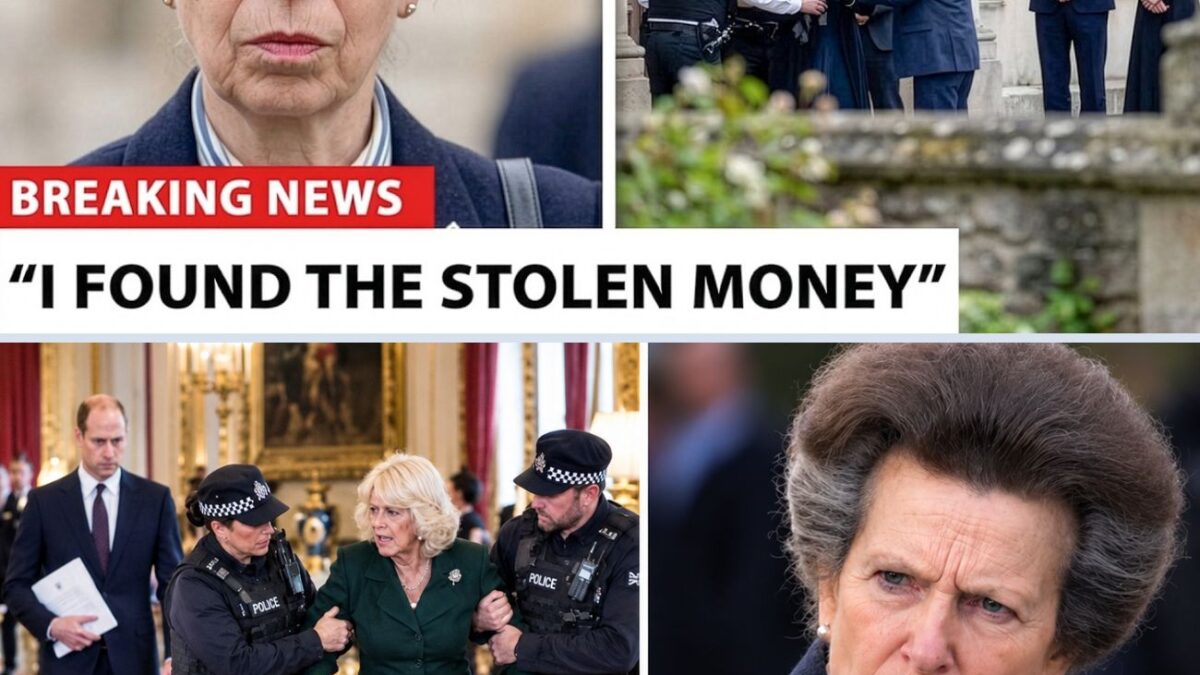
The Vaults of St. James’s: Inside the 400-Page Audit That Shattered the House of Windsor
In the freezing silence of an English midnight, deep beneath the heavily protected administrative vaults of St. James’s Palace, a confidential sovereign audit uncovered something truly terrifying. It was not a tabloid rumor or a leaked whisper, but a collection of red-ribbon-bound ledgers that threatened to shake the modern British monarchy to its ancient foundations. Forensic Treasury accountants revealed years of systematic, unauthorized financial movements where millions of pounds had been secretly drained from a private charitable trust created in the sacred memory of the late Queen Elizabeth II. The target of this alleged covert operation was none other than Catherine, the Princess of Wales.
The machinery behind this covert campaign was built with remarkable precision. For months, financial transactions were cleverly disguised as ordinary discretionary retainers and standard charitable grants. However, once forensic investigators peeled back the layers of administrative camouflage, the truth became glaringly evident. They uncovered what appeared to be an extraordinary, highly sophisticated conspiracy. The cryptographic paper trail was irrefutable: millions of pounds drawn from accounts associated with the late Queen’s legacy had allegedly been diverted into a shadow operation designed to turn public and institutional opinion against Catherine and ultimately prevent her from ever assuming the full role of Queen Consort..

The Web of Influence and Fleet Street Strategy
From late 2023 through the spring of 2026, the money allegedly moved like a shadow through a complex network of overseas foundations, passing into boutique constitutional advisory firms and private public relations consultancies operating in London, Geneva, and Washington. These transactions were far from ordinary royal expenses. Forensic records reportedly detailed specific targeted payments linked to legal white papers designed to quietly challenge Catherine’s position in the monarchy. Retainers were also allegedly directed toward selected aristocratic historians and media strategists tasked with cultivating damaging narratives throughout Fleet Street.
The campaign sought to portray Catherine’s influence as provincial and cast doubt on her aristocratic background, actively promoting arguments within palace circles that the title of Queen should eventually be legally restricted, weakened, or placed in indefinite suspension after the current reign. This organized, heavily financed preemptive attack against the future female head of the royal family was particularly disturbing because it allegedly operated from within the very shadows of the sovereign household itself.
When Prince William first saw the verified dossier inside the reinforced security study at Adelaide Cottage, his reaction was not explosive anger. An almost unbearable silence filled the room. For the future king, this was not merely an accounting irregularity or another bitter dispute over palace finances; it represented a direct and potentially devastating attack on his marriage, his future as sovereign, and most importantly, on his children. Catherine sat beside him, visibly shaken as she flipped through the densely stamped pages. She understood with chilling clarity that the alleged campaign aimed to weaken the very foundations of her children’s future, placing the continuity of their young dynasty at absolute risk.
The Alliance at Gatcombe Park
William’s response was the cold, resolute determination of an heir preparing to confront a serious threat. According to the dossier, the money trail did not vanish into the distant margins of rogue palace courtiers; it allegedly led directly to the administrative machinery surrounding Queen Camilla. Encrypted authorizations and diverted transfers reportedly pointed firmly toward senior advisers closely connected to the Queen Consort’s private office at Clarence House. Realizing he needed someone with unwavering authority, William drove to Gatcombe Park to consult Anne, the Princess Royal.
When William laid the 400-page audit on the heavy oak library table, Princess Anne remained silent for nearly two full hours, examining every single transfer and scrutinizing every ledger entry with forensic concentration. As the guardian of Queen Elizabeth II’s private memory, Anne was uncompromising. The idea that her mother’s charitable legacy could have been twisted into a financial weapon for dynastic sabotage was, to Anne, an unforgivable violation. When she finally closed the heavy leather dossier, her knuckles were white, her jaw rigid, and her voice carrying an absolute icy determination: whatever corruption had taken root would be eliminated completely, permanently, and without a royal pardon. In that very room, Anne and William formed an unbreakable alliance.
The Windsor Castle Confrontation
The tragedy of the unfolding crisis was King Charles III’s extraordinary isolation. Exhausted by relentless medical treatments, the 77-year-old monarch had desperately sought domestic stability, choosing to ignore the expanding influence Camilla had built around his reign. Eventually, however, the confrontation became unavoidable, arranged behind the heavily secured mahogany doors of the private state dining room at Windsor Castle. Around the polished table sat the four individuals whose decisions would determine the monarchy’s future: a fragile King Charles, an impeccably tailored Queen Camilla wearing defensive armor, an unyielding Princess Anne in formal uniform, and a stern Prince William.
With calculated precision, William pushed the certified audit dossier across the polished table. He presented the evidence with the cold precision of a lead investigator, linking unauthorized payments directly to the anti-Catherine briefing campaigns. Camilla responded with furious resistance, attempting to portray the dossier as a distorted interpretation of administrative discretion and denying any personal authorization.
Her defense collapsed instantly when Princess Anne calmly opened the dossier to an unredacted appendix containing direct communications between Camilla’s principal private secretary and overseas PR operatives detailing plans to relegate Catherine to an unprecedented, lower status after Charles’s death. Anne looked at Camilla with absolute contempt, asking how she could finance an effort to destroy her own family using money entrusted to preserve Queen Elizabeth’s memory.
For King Charles, the revelation landed like an emotional execution. Reading the pages, he realized his home had been a gilded illusion and that his wife had helped orchestrate a campaign against his daughter-in-law. The composure that had defined Charles for decades broke apart. Staring across the table through tear-filled lips, he quietly asked, “How could you do this to my family? How could you do this to my mother?”
Covering his face, the king wept openly. As Camilla reached out with trembling fingers to place a hand on his arm, King Charles recoiled, his entire body pulling away as if the contact had become poisonous. In that instant, the last vestiges of her influence completely disappeared.
The Final Judgment and Internal Exile
In that suffocating silence, Princess Anne and Prince William delivered their final decision. Weakened by his condition, King Charles formally surrendered his authority, signing a sweeping executive order transferring all responsibility for domestic discipline and financial oversight directly to Anne and William. There would be no bargaining and no private royal pardon.
Under the new sovereign order, Camilla was immediately and permanently removed from every patronage, trust, and foundation associated with the late Queen. Senior aides connected to the back-channel operation were dismissed without honors or pensions, and a strict financial lock was imposed on private royal accounts, requiring joint authorization from William and Anne for any funds to leave. Furthermore, to prevent a public scandal while the king’s health remained fragile, Camilla was placed in internal exile. Stripped of her active court life and confined mostly to her private country residence in Wiltshire, she was reduced to a ceremonial figure under constant surveillance, permanently excluded from high-level succession meetings.
Later that evening, when Prince William returned to Adelaide Cottage, the oppressive sense of impending catastrophe lifted as he embraced Catherine. Upstairs, their children slept peacefully, unaware of the historic battle fought to protect their inheritance. While Buckingham Palace’s public relations machinery continued broadcasting choreographed images of royal unity, those familiar with the true realities of the crown knew the truth: the moral direction and intensely protected future of the British monarchy now rest irrevocably with Princess Catherine.
You Might Also Enjoy

“We Thought They Would Negotiate”—What Argentine Soldiers Said When The British Attacked Goose Green

“You’ll Never Finish My Ruck March, Limey” — US Sergeant Who Challenged the SAS, Then Fell Out First






