Princess Diana’s Marriage Was Crueler Than the World Ever Knew
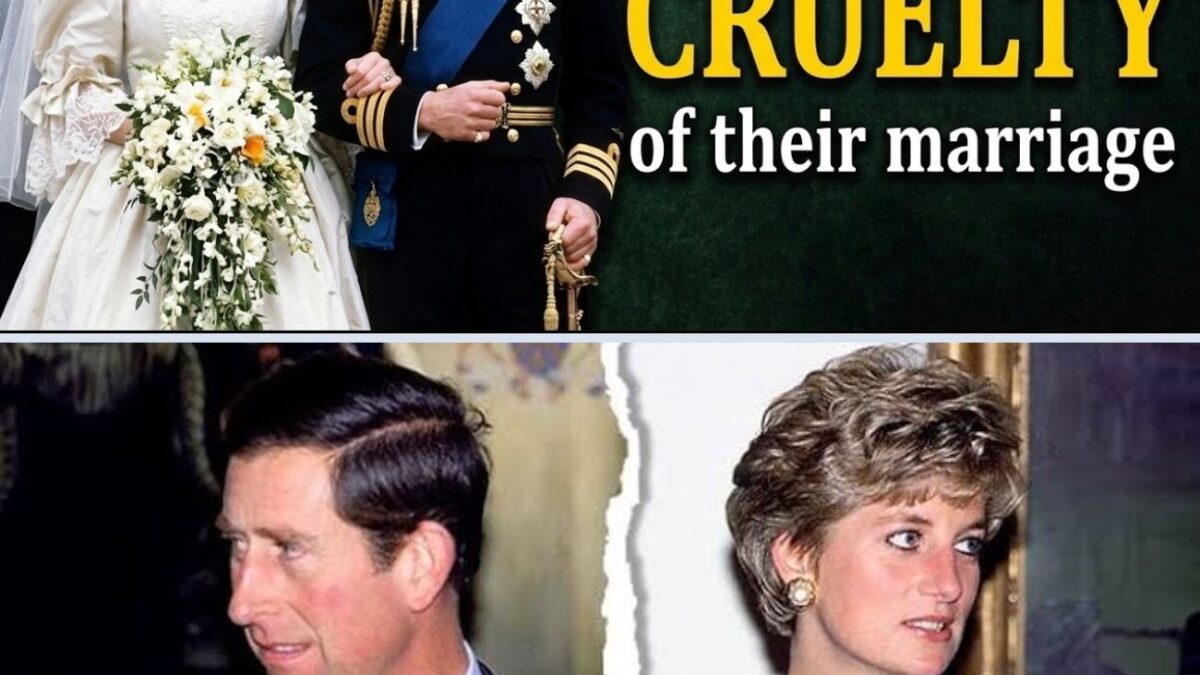
Princess Diana’s marriage was even more disturbing than you think. July 29th, 1981, 750 million people in 74 countries stopped what they were doing to watch a 19-year-old kindergarten teacher become a princess. 600,000 people lined the streets of London in person. Inside St. Paul’s Cathedral, a 25-ft silk taffeta train pulled behind her like something out of a storybook. And when the newly married Prince and Princess of Wales stepped onto the Buckingham Palace balcony and kissed for the cameras, the first time a royal couple had ever done that in public, the world exhaled. It looked like the fairy tale had actually happened. A commoner had married her prince. The girl who worked at a nursery school was now officially one of the most famous women alive.
That is the version everyone watched. It is not the version that was true. In the same 24 hours that the world was falling in love with that balcony kiss, the bride already knew about a pair of cufflinks she hadn’t seen yet, engraved with two interlocking letter C’s that her new husband would wear on their honeymoon. She already knew, because she had said it to a friend the night before the wedding, that the man she was marrying had told her point-blank that he did not love her. She had already months earlier purged after a dress fitting, the first documented episode of an eating disorder that would define the next 13 years of her life.
None of that made it onto the balcony. None of it made it into the 7,500 hours of television coverage. What the cameras filmed was a wedding. What was actually happening was something else: a marriage between two people who both seemed to have understood before they ever reached the altar that it wasn’t going to work, conducted in front of the largest audience in television history because by the time either of them fully grasped what they were doing, backing out was no longer an option anyone with any power was willing to consider.
This isn’t the story of a tragic accident in a Paris tunnel. This is the story of the 13 years before that, the actual marriage. And the more you look at how it was built, who built it, and what it was actually like to live inside it, the more disturbing it gets.
Chapter 1: The manufacturing of a candidate. To understand what was wrong with this marriage, you have to go back further than the wedding, further even than the engagement, to the actual mechanics of how Diana Spencer became a candidate for Princess of Wales in the first place. Because candidate is the correct word. This was not in any conventional sense a courtship between two people who fell for each other and decided to build a life together. This was a search conducted with the seriousness of a hiring process for a specific kind of woman to fill a specific kind of role. And Diana was selected because she fit the specifications with almost unnerving precision.
Charles had, by his own reported admission, set himself the goal years earlier of being married by 30. He turned 30 in November 1978 and missed that self-imposed deadline. By the time he met Diana as a serious romantic prospect in July 1980, the pressure from the press, from his family, and reportedly from his father, Prince Philip in particular, had become acute. What the palace and the press wanted in a future princess of Wales was by every account from the period remarkably narrow: young, aristocratic, English, Protestant, and—this is the part that gets glossed over—virginal, or at least presumed to be, because the future mother of the heir to the throne could not credibly carry any hint of a romantic past.
Diana, at 19, checked every box. She came from one of England’s oldest aristocratic families, the Spencers, whose estate at Althorp had produced companions to the royal family for generations. She had, by all accounts, no serious romantic history to speak of. And she was young enough—several accounts describe her as strikingly, almost jarringly young next to the rest of Charles’s social circle—that she posed no threat to anyone already established in his life.
That last part matters more than it sounds like it should, because one of the people already established in Charles’s life was Camilla Parker Bowles. Camilla and Charles had a romantic history that predated Diana by years. By 1980, Camilla was married to Andrew Parker Bowles, and Charles’s relationship with her had, by most credible accounts, never fully ended, even after her marriage. Multiple biographers drawing on sources close to the couple have described Camilla as actively encouraging the match between Charles and Diana. Not out of generosity, but because a teenager fresh out of school with no experience of the world represented essentially no competition. A young, malleable, adoring wife who wouldn’t ask uncomfortable questions was from that vantage point the ideal arrangement. Diana wasn’t chosen instead of Camilla. In the coldest possible reading of the situation, Diana appears to have been selected, at least in part, because she made it easier for Camilla to stay.
There is a detail about Camilla’s own family history that borders on the uncanny, and it’s real, not embellishment. Camilla Shand’s great-great-grandmother was a woman named Alice Keppel, the acknowledged mistress of King Edward VII, Charles’s own great-great-grandfather. According to biographer Rebecca Tyrrell, Camilla grew up knowing that story and treating it as, in Tyrrell’s word, talismanic—something she was proud of, something she brought up to school friends as a child.
When Camilla met Charles at a polo match at Windsor Great Park in the early 1970s, she is widely reported to have introduced herself by referencing the connection directly, telling him her great-grandmother had been mistress to his great-great-grandfather and effectively suggesting the two of them pick up where their ancestors left off. Charles was reportedly immediately taken with her, a woman who rode, hunted, swore, smoked, and treated him like an ordinary man rather than a future king, which by most accounts he found genuinely intoxicating. After a childhood of formality, he joined the Royal Navy in 1971 and wasn’t in a position to commit to her. She went back to an old boyfriend, a cavalry officer named Andrew Parker Bowles, and married him in 1973.
So, by the time Charles met a 19-year-old Diana Spencer in any serious romantic sense, Camilla had already been positioned in his life for the better part of a decade, a relationship literally styled by her own family’s telling after a royal mistress arrangement going back four generations. Diana wasn’t marrying into a fresh start. She was marrying into a pattern that Camilla’s own family had been quietly rehearsing since before Diana was born.
Watch what actually happened once the relationship became public. In September 1980, tabloid photographers caught Diana at the Young England kindergarten where she worked, and the resulting photographs—in which the light behind her revealed the outline of her legs through her skirt—set off a media frenzy. Prince Philip is reported to have written to his son around this time, warning him that the intensity of the coverage was damaging Diana’s reputation and that Charles needed to either propose or end things to protect her. Charles later described receiving that letter as receiving an order. Read that again. The engagement that would define the rest of both of their lives and eventually end in a divorce that reshaped the modern monarchy appears to have been triggered less by a declaration of love than by a father telling his son to manage a public relations problem before it got worse.
Charles proposed in early February 1981 at Windsor Castle. By his own account, he expected Diana to take time to consider what she was agreeing to: the scrutiny, the loss of an ordinary life, the demands of an institution she had never actually lived inside. She didn’t hesitate. She said yes immediately. She was 19 years old, and the man proposing to her was 32—a gap of nearly 13 years, and one that at the time almost nobody in the press or the public treated as remarkable. It was, by the standards of 1981 aristocratic marriages, not considered unusual. What made people uneasy even then wasn’t the age gap on paper. It was watching in real time how little the two of them actually seemed to know each other.
Diana told biographer Andrew Morton years later that in the roughly six months between the start of their courtship and the proposal, she and Charles had met in person only about 13 times. 13 meetings. That’s the entire dossier of lived experience the decision was built on on both sides.
It’s also worth noting, because it says something about how long Diana had actually been in Charles’s orbit before any of this became romantic, that the two of them first met in 1977 when Diana was just 16 and Charles, then 29, was visiting Althorp as a guest of her older sister Sarah, whom he was dating at the time. Charles reportedly told Andrew Morton he remembered thinking she was a very jolly and amusing and attractive 16-year-old, great fun, bouncy, and full of life. He was describing a teenager in a context where she was at that point associated with her sister, not with him. It would be four more years before that changed. But it’s a detail worth sitting with, because it means the age gap wasn’t simply 13 years on a marriage certificate. It was 13 years that had already been visible to both families since Diana was a schoolgirl.
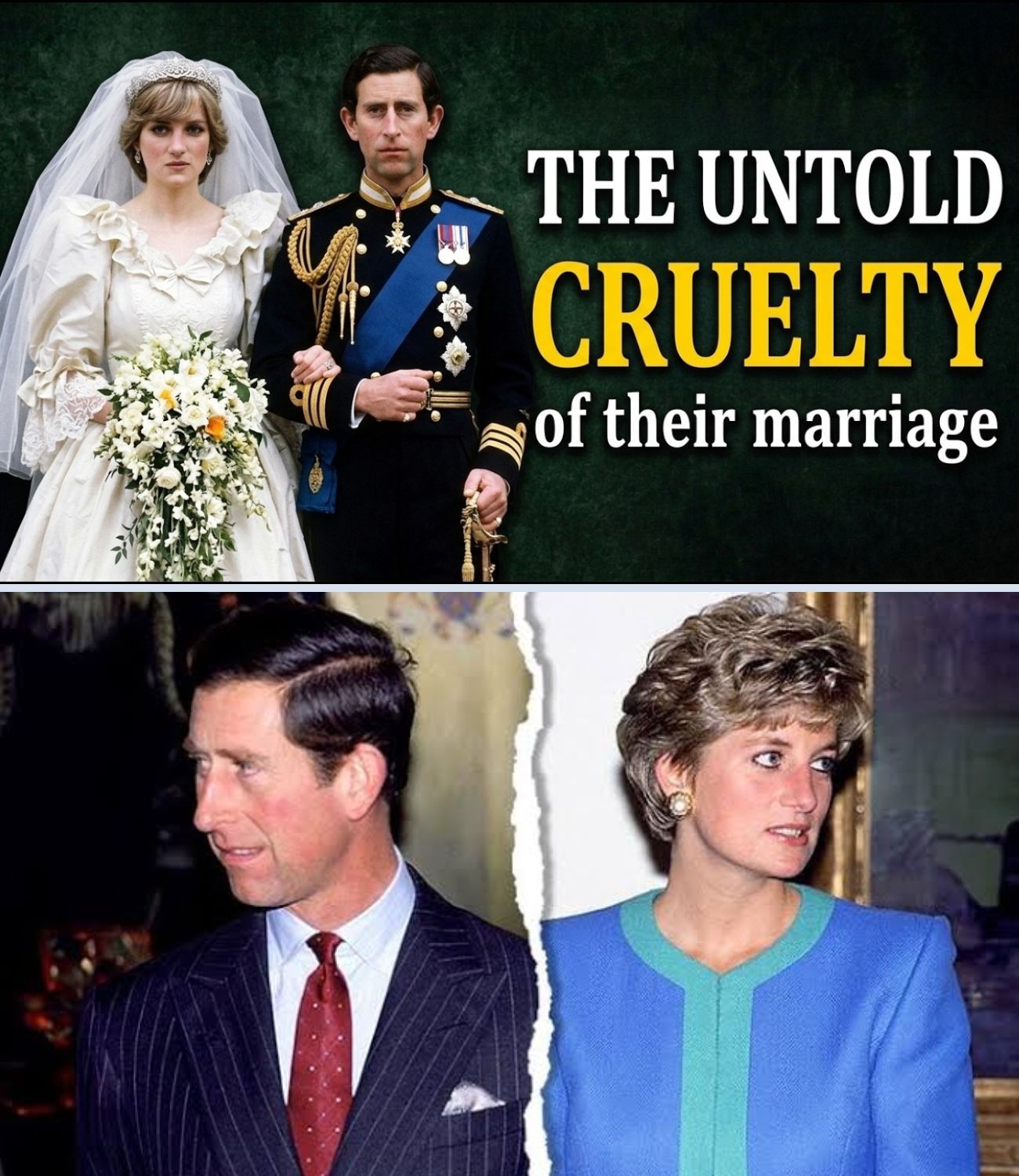
And once the engagement was formally announced on the 24th of February 1981, both of them, by Charles’s own later account, understood there was no realistic way out. He reportedly told friends years afterward that he had desperately wanted to get out of the wedding once he understood during the engagement itself just how awful the prospects were, having had no chance to get to know Diana beforehand. His stated reasoning for not calling it off wasn’t that his feelings changed. It was that withdrawing at that point, with the engagement already public and the machinery of a state wedding already turning, would have been, in his own reported word, cataclysmic. He used a word you’d use to describe a natural disaster to describe the prospect of telling the truth about his own wedding.
There is a detail from Diana’s own recollection of the proposal itself relayed to Morton that deserves more attention than it usually gets, because it reads almost like a premonition. She recalled Charles telling her,
“Seriously, you do realize that one day you will be queen.”
And she said something inside her responded with a thought she didn’t say out loud:
“You won’t be queen, but you’ll have a tough role.”
Whatever that moment actually was—nerves, intuition, or simply a woman’s honest read of a man she barely knew—it’s a strange thing to have sitting in the same memory as her own acceptance of his proposal. She said yes, and some part of her by her own account already suspected the title itself was never actually going to be the point.
Chapter 2: Whatever love means. If you want the moment this marriage told you exactly what it was before a single vow had been exchanged, it’s on video and you can still watch it today. It’s the engagement interview filmed the day the news broke in February 1981. And it has become one of the most re-examined 30 seconds of tape in modern royal history, not because it was scandalous at the time, but because of how differently it reads with everything we now know.
The interviewer asks the newly engaged couple to sum up how they’re feeling. Charles goes first, just delighted and happy, adding:
“I’m amazed that she’s been brave enough to take me on.”
It’s self-deprecating, a little awkward, the kind of thing a nervous public figure says on camera. Then the interviewer pushes for something warmer.
“And I suppose in love?”
Diana answers instantly:
“Yes, of course.”
Charles’s response, delivered with a small laugh, was:
“Whatever love means.”
At the time, it barely registered as a story. Royal historians have since cautioned against reading too much cynicism into the line on its own. Charles was, by several biographers’ accounts, a man prone to overthinking questions like this out loud, and some have argued the comment reflects a genuine, almost philosophical uncertainty about the word love rather than a calculated dig at his fiancé. That’s a fair point and worth including here rather than flattening into a simple villain moment.
But what makes the line worth dwelling on isn’t just what Charles meant. It’s what it did to Diana and the fact that it wasn’t a one-off. Diana recorded hours of audio for Andrew Morton in 1991, material that later surfaced publicly in different forms, including the documentary Diana: In Her Own Words. On those tapes, she described the engagement interview like this:
“We had this ghastly interview the day we announced our engagement, and this ridiculous man said, ‘Are you in love?’ I thought, ‘What a thick question.’ So, I said, ‘Yes, of course we are.’ And Charles turned around and said, ‘Whatever love means.’ And that threw me completely. I thought, ‘What a strange answer.’ It traumatized me. Not annoyed me, not upset me for the afternoon.”
“Traumatized.” That’s the word she chose. Years later, still processing a sentence her fiancé said to a television camera on the day they announced they were getting married.
And it wasn’t isolated. According to the same tapes, when Charles actually proposed to her privately at Windsor weeks earlier and Diana told him,
“I love you so much. I love you so much.”
His reported reply was nearly identical:
“Whatever love means.”
Twice at the two most significant relationship milestones a couple can have—the private proposal and the public announcement—the same man gave apparently unprompted the same non-answer to the same question. If it happened once, it’s an awkward, overanalytical remark from a man uncomfortable with sentiment. If it happened twice in nearly identical language, it starts to look less like a slip and more like an honest answer that nobody in the room was equipped to actually hear, because the wedding was already six months away and being planned by a nation.
Here’s the disturbing part that the engagement interview clip alone doesn’t capture: both of them, by the most credible reconstructions available, seemed to have walked into this marriage already knowing on some level that it wasn’t a love match and got married anyway in front of three-quarters of a billion people because the apparatus around them—family, press, monarchy, protocol—had already decided the wedding was happening. Charles’s own later description of feeling trapped between the devil and the deep blue sea isn’t the language of a man swept up in romance. It’s the language of a man executing an obligation he’d already concluded he didn’t actually want.
Even the wedding day itself carries a small strange footnote that fits this pattern of two people going through motions that had already outrun their own certainty. At the altar of St. Paul’s Cathedral in front of 3,500 guests and a television audience of three-quarters of a billion, Diana got Charles’s name wrong. Instead of Charles Philip Arthur George, she said Philip Charles Arthur George, reversing his first two names. The BBC’s own contemporaneous account attributed it to simple wedding day nerves, and it almost certainly was exactly that. There’s no serious claim anywhere that it was anything more sinister than a very young, very overwhelmed bride stumbling over an unfamiliar string of names under enormous pressure. Charles fumbled his own vows moments later, saying, “Thy goods” instead of “my worldly goods.” Neither error meant anything on its own. But it is a strange bit of trivia to know, given everything else, that at the exact ceremonial moment meant to bind these two people together for life in front of the largest audience ever assembled for a wedding, the bride briefly could not get the groom’s own name in the right order.
Chapter 3: The honeymoon that wasn’t really a honeymoon. So the wedding happens, the balcony kiss happens, and then Charles and Diana leave for a honeymoon that on paper sounds like the final chapter of the fairy tale: 12 days cruising the Mediterranean aboard the royal yacht Britannia followed by time at Balmoral. In practice, according to multiple accounts, including Diana’s own and that of Charles’s former valet, it was something closer to a controlled demonstration of exactly how present Camilla Parker Bowles was going to remain in this marriage, delivered to a 20-year-old bride with nowhere to go and no one to talk to in the middle of the sea.
Start with the phone calls. Stephen Barry, who worked as Charles’s valet, later told biographer Tina Brown—whose reporting forms the basis for much of what’s publicly known about this period—that during the Mediterranean leg of the honeymoon, Charles found ways to call Camilla (who was still married to Andrew Parker Bowles at the time) from the ship. According to Barry, the prince simply had to be in constant contact with Camilla, or he couldn’t function properly. If he went without his daily phone call, he would become tetty and ill-tempered. Read that sentence again and remember where they were. This is a description of a man on his honeymoon on a yacht with his brand new wife becoming irritable if he didn’t get to speak to another woman.
Then there are the cufflinks. According to the account Diana gave on the Morton tapes, later used in the documentary Diana: In Her Own Words, a pair of cufflinks turned up on Charles’s wrists during the honeymoon, engraved with two interlocking C’s styled almost identically to the Chanel logo.
“On our honeymoon, cufflinks arrive on his wrist,”
she said.
“Two C’s entwined like the Chanel C’s. Got it in one. I knew exactly. So I said, ‘Camilla gave you those, didn’t she?’ He said, ‘Yes. So what’s wrong? They’re a present from a friend.’ And boy, did we have a row.”
Reporting drawing on the same tapes also describes Diana discovering photographs of Camilla falling out of Charles’s diary during the same trip and describes her nights on the honeymoon as consumed by anxious, obsessive thoughts about the other woman:
“At night, I dreamt of Camilla the whole time. I was obsessed by Camilla totally.”
Meanwhile, in a letter reportedly written during the same cruise, Charles describes spending his time reading alone on deck while, in his words, Diana dashes about chatting up all the sailors and the cooks in the galley. Sit with that image for a second, because it’s the whole marriage in miniature. Two people on the same boat on their honeymoon experiencing two completely different honeymoons. One of them is defending a gift from another woman and retreating to read alone. The other is 20 years old, isolated at sea, discovering evidence of a rival relationship she has no way to verify, confront properly, or escape from, because there is no getting off a royal yacht in the middle of the Mediterranean.
This is a genuinely uncomfortable thing to say plainly, but it needs to be said plainly: the fairy tale wedding’s own honeymoon was, by the bride’s own later account, the moment she first understood the marriage was already compromised, and there was no version of the next 13 years where that understanding was ever going to be resolved in her favor, because the other party in the situation—Camilla—was never actually removed from the equation. She was simply managed around.
It’s also worth being honest about what came next, because this story is not a simple tale of one faithful spouse and one unfaithful one. By most credible chronologies of the marriage, both Charles and Diana appear to have begun extramarital relationships around the same year, 1986—five years into the marriage, two years after the birth of Prince Harry. Charles is widely reported to have resumed his relationship with Camilla Parker Bowles around this time. Diana, according to multiple biographical accounts, began a relationship with a British army officer named James Hewitt during the same period. Neither of these facts cancels out the other, and neither excuses what came before it: a 19-year-old married into a household where her husband’s former ongoing attachment had already shown up on the honeymoon. But it’s important to the honesty of this video to say plainly that by the mid-1980s, this had become a marriage in which both people had, by the available evidence, already emotionally and physically moved on from each other in secret years before either of them said so publicly. What makes the earlier years so much more disturbing isn’t that Diana was the only one who ever strayed from the marriage. It’s that the conditions that made the marriage unworkable in the first place were set years before she did.
Chapter 4: The staircase and the silence. By the time Diana was pregnant with her first child, Prince William, in 1982, the marriage was less than a year old, and she was already, by her own later account, in genuine crisis. What happened at Sandringham that year is one of the most disturbing single episodes in the entire history of this marriage, not primarily because of the act itself, but because of how the people around her responded to it—or more precisely, how they didn’t.
According to the account Diana gave to Andrew Morton, published in the 25th anniversary edition of Diana: Her True Story, she went to Charles at Sandringham in a state of what she described as genuine desperation.
“I told Charles I felt so desperate and I was crying my eyes out,”
she recalled.
“And he said, ‘I’m not going to listen. You’re always doing this to me. I’m going riding now.'”
According to Diana, Charles left to go riding, and in that state, she threw herself down a staircase.
“So, I threw myself down the stairs,”
she told Morton.
“The Queen comes out absolutely horrified, shaking. She was so frightened. I knew I wasn’t going to lose the baby, quite bruised around the stomach.”
When Charles returned from his ride, according to Diana’s account, his reaction was, in her words, just dismissal. Total dismissal. He just carried on out of the door.
This was less than a year into the marriage. The woman on that staircase had been a nursery school teacher 18 months earlier with an ordinary flat, ordinary friends, and an ordinary life. She was now four months pregnant with a future king inside a palace, married to a man who had told her before the wedding that he didn’t love her. And this was how her distress was being received by the person closest to her.
There is genuine debate, even among people sympathetic to Diana, about how to characterize the specific incident. Some accounts describe it as a serious act of self-harm. Others frame it, as Diana herself sometimes did, as a desperate cry for help rather than a considered attempt to end her life or the pregnancy. And it’s worth holding that distinction honestly rather than flattening it for shock value. What is not in dispute—because it comes directly from Diana’s own recorded account—is the Queen’s genuine visible horror at finding her daughter-in-law like that, and the fact that whatever fear or concern that horror represented inside the family, it apparently did not translate into any meaningful change in how the situation was handled going forward.
This was not the only such incident. According to Diana’s own later disclosures, over the following years, she experienced further episodes of self-harm during periods of acute distress in the marriage—again, described with real caution here because the specifics are genuinely sensitive, and this is not a detail this channel is going to sensationalize with gratuitous specifics. The pattern that matters for this story isn’t the details of any single incident. It’s what Diana said repeatedly and consistently about how those episodes were received by the people around her: as evidence that she was unstable, difficult, crying wolf, rather than as a young woman barely into her 20s, thrust into an institution with no preparation, married to a man who had told her before the wedding that he did not love her, signaling as clearly as she knew how that something was seriously wrong.
That gap between what Diana was actually communicating and what the institution around her chose to hear is, in a lot of ways, the real subject of this entire text. It shows up again and again in different forms for the next decade. One measure of just how alone she actually was inside that gap: by multiple later accounts, Diana spent years cycling through what’s been described as a revolving door of astrologers, clairvoyants, and spiritual advisers, seeking, in the absence of any real institutional support, some outside source of clarity about a marriage and a family that had left her feeling completely undermined. Most of them, according to people who knew her, told her little she didn’t already know herself. That detail matters less for what it says about Diana’s beliefs and more for what it says about the vacuum she was operating in: a future queen consort married into one of the most resourced families on earth, reduced to seeking guidance from psychics because nobody closer to her inside the family or its medical and pastoral apparatus was providing anything she found genuinely useful.
Part of what made that gap so wide is something that gets mentioned less often than the individual incidents themselves: Diana appears to have received remarkably little in the way of formal preparation for what she was walking into. She had no aristocratic training in statecraft, no experience with the press machinery that would follow her every movement for the rest of her life, and, by her own account, no real guidance from the institution on how to cope with any of it. She was 20 years old, newly married into arguably the most scrutinized family on the planet, expected to perform a public role with total composure while receiving, according to virtually every account of this period, minimal structured emotional or psychological support from the family she’d married into. She had quit her job at the Young England kindergarten the moment the engagement was announced and moved into Buckingham Palace to wait out the five months until the wedding—five months in which, by her own later account, she was largely left to adjust to an entirely new life on her own with no formal orientation to the institution she was about to become the public face of. Compare that to the machinery that exists today around modern royal spouses: media training, security briefings, protocol officers, a much more visible network of institutional support. The gap becomes even starker in hindsight. Diana wasn’t failed by one cruel moment on a staircase. She was failed by the absence of any real system designed to catch her before she got there.
Chapter 5: A coat on a hanger. The eating disorder is probably the single most publicly known fact about the private cost of this marriage, thanks largely to Diana’s own 1995 Panorama interview, where she spoke about it directly for the first time on camera. But the way she described it in that interview deserves more attention than it usually gets, because she wasn’t just disclosing an illness. She was naming specifically how the institution around her used that illness against her.
“I didn’t like myself. I was ashamed I couldn’t cope with the pressures,”
she said.
“I had bulimia for a number of years, and that’s like a secret disease. It’s a repetitive pattern which is very destructive to yourself.”
So far, that’s a fairly standard, if still painful, account of living with an eating disorder. But then she went further, and this is the line that matters most for understanding the marriage as a system rather than a series of isolated bad moments:
“It was a symptom of what was going on in my marriage. I was crying out for help, but giving the wrong signals, and people were using my bulimia as a coat on a hanger. They decided that was the problem. Diana was unstable.”
Read what she’s actually describing there. She’s saying that the people around her—and by most reconstructions of this period, that includes courtiers, royal aides, and to some degree the family itself—took a symptom of a much larger problem and repackaged it as the problem itself. If Diana was unstable, if Diana had an eating issue, then the marriage’s failures could be explained as her illness rather than as a structural situation involving a husband who was by his own admission still emotionally entangled with another woman and an institution that had put a 19-year-old into that situation with essentially no support system. According to reporting drawing on later-released material, Diana herself said she believed Charles had told the Queen about her bulimia, and that the explanation the family settled on for the marriage’s difficulties was, in her words, that it must be so difficult for Charles dealing with a wife who had an eating disorder, rather than any examination of what might have caused it.
By 1985, Diana has also described a related and equally telling episode involving William, then not yet three years old, who—almost certainly echoing language he had absorbed from adults around her—reportedly told her she was the most selfish woman he had ever met. A toddler does not invent that phrase. Somewhere in Diana’s own household, in the year or two after that Sandringham staircase, “selfish” had apparently become the word the people around her three-year-old son were using to describe his mother’s illness. The postnatal depression compounded all of it. By the time she consulted Dr. MacGlashan in February 1983, Diana was 21 years old, roughly six months past the birth of her first child, still deep in the bulimia, and—per the reporting on that consultation—already showing signs of the anxiety and low self-esteem that would recur throughout the marriage. She had been, by most accounts of her pre-marriage life, an unremarkable but genuinely contented young woman before any of this, sharing a flat with friends, working a modest job, living an ordinary early-20s life. Within about 18 months of her wedding, that same young woman was a princess, a mother, an international object of fascination, and a psychiatric patient whose doctors were reportedly more focused on the political implications of her illness than on her recovery from it.
There’s a letter written in February 1983 by the psychotherapist Dr. Alan MacGlashan, who was brought in to examine Diana after she reportedly distanced herself from the royal family’s usual medical specialists. What the letter reportedly documents through later reporting on the file is a genuinely uncomfortable detail: some of the medical professionals involved in her care at the time appear to have been concerned less with Diana’s own welfare as a patient than with what her condition might mean for the stability and public image of the royal household. If accurate, that is about as clear a description as you could ask for of an institution treating a person as a liability to be managed rather than a human being to be helped. She was 21 years old, newly a mother, and, by several accounts, already experiencing postnatal depression on top of the bulimia and the anxiety, and the apparatus built to protect her seems to have been oriented at least in significant part around protecting the institution from her.
Prince William himself decades later spoke publicly about his mother’s bulimia for the first time in a 2017 documentary about eating disorders.
“We need to normalize the conversation about mental health,”
he said, describing his mother’s willingness to speak about her own illness as incredibly brave. It’s a small, humane coda to an otherwise bleak chapter—a son grown now, finally able to say in public what an entire institution around his mother had spent years treating as an embarrassment to be contained rather than an illness to be treated. It came decades too late to help her, but it’s worth including because it’s one of the only points in this entire story where someone close to the situation directly, unambiguously validated what Diana had been saying about herself the whole time.
Chapter 6: The tour that looked like a triumph. Before we get to the surveillance, there’s one more piece of public versus private worth walking through in detail, because it might be the single clearest visual proof of everything this video has been arguing so far. And it happened on camera in front of the world’s press in March and April 1983. Charles and Diana’s six-week tour of Australia and New Zealand, undertaken with nine-month-old Prince William in tow, is remembered today as an unqualified triumph: Diana mania at its absolute peak, crowds numbering in the hundreds of thousands, roughly a million people turning out across Australia just to catch a glimpse of her. Reporters at the time described scenes of genuine mania. In 35-degree heat outside Brisbane’s town hall, 100,000 people packed the streets chanting, “Diana! Diana!”—some of them groaning audibly whenever Charles’s body blocked their view of his wife. At one dinner, Charles made a joke to the assembled crowd that has aged in an almost unbearably revealing way:
“I’ve come to the conclusion it would have been far easier to have had two wives, to have covered both sides of the street, and I could have walked down the middle directing the operation.”
He said it as a joke. It’s also read, plainly, as a fairly exact description of a man watching his own public function get absorbed by his wife’s popularity in real time and trying to laugh it off in front of a room full of people.
What almost nobody watching from the crowd could see was what was happening to Diana behind the scenes. Arriving at Alice Springs at the start of the tour, contemporaneous press reports describe a 21-year-old princess who looked, in one reporter’s words, uneasy, even glum, staring at the tarmac with downcast eyes through much of the arrival photo session—a stark contrast to the beaming, confident figure who would dominate headlines only weeks later. Her own biographer, Andrew Morton, later wrote that she had arrived petrified of facing the crowds, and according to multiple retrospective accounts of the tour, her bulimia worsened considerably under the stress of it, including by some accounts during a visit to Uluru, where the heat and the physical toll of the illness left her visibly struggling, and where Charles’s response, rather than concern, was reported irritation that she needed to slow the schedule down. And underneath all of it sat the dynamic that would define the rest of the marriage: Charles’s own reported jealousy of his wife’s popularity, which by several accounts began in earnest on this specific trip. Diana itself confirmed years later in her Panorama interview that her husband had been jealous of the attention she received.
What the tour produced, in other words, was two entirely separate realities occupying the same six weeks. To the public watching the coverage, it was proof that the fairy tale was thriving: a young mother captivating two entire countries, her marriage stronger than ever. To the two people actually living it, it was, by nearly every available account, the moment an eating disorder got measurably worse, a husband’s resentment of his own wife’s popularity took clear shape, and a 21-year-old who had arrived visibly frightened discovered that once the cameras were rolling, absolutely none of that was allowed to show.
Chapter 7: The state was listening. Now, here’s where the story goes somewhere most people don’t expect, because up to this point, everything has been about the interior of a marriage—what was said between two people and how a family responded. This next part is about the fact that this marriage was quite literally being surveilled by the British state, and neither party seems to have had any real ability to stop it.
In 1992, tabloids published a transcript of an intercepted phone call that became known as “Squidgate”—a New Year’s Eve 1989 conversation between Diana and a man named James Gilby, in which he repeatedly told her he loved her and called her by the pet name “Squidy.” The following year, 1993, a second intercepted recording surfaced: “Camillagate.” This one was an intimate 1989 phone call between Charles and Camilla, which became notorious enough that it doesn’t need repeating in detail here, except to say that its content—an extended, unmistakably intimate conversation between two married people, each married to someone else—left very little ambiguity about the nature of their relationship at the time. Between the two leaked recordings, by early 1993, millions of tabloid readers had effectively heard both Diana’s and Charles’s private voices confirm what neither of them had yet said in public.
What’s disturbing here isn’t really the content of either recording. It’s how those recordings apparently came to exist and to leak in the first place. Diana’s former bodyguard, Ken Wharfe—who served in that role from 1987 to 1993—told an inquest years later that the Squidgate tape was recorded by GCHQ, Britain’s signals intelligence agency, as part of routine monitoring of the royal family, ostensibly for security reasons given the ongoing threat from Irish Republican paramilitary groups, and that it was then, according to Wharfe’s account, deliberately broadcast and allowed to circulate until amateur radio enthusiasts picked it up and passed it to the press. If that account is accurate, it means a British intelligence agency intercepted a private conversation involving the future queen consort of the United Kingdom, and that recording ended up on the front pages not by accident, but through a chain of events that at least one person close to the situation has directly described as deliberate.
Whether or not every detail of that account holds up to full scrutiny—and it’s worth flagging that Wharfe’s version, while widely reported, has not been independently confirmed by GCHQ or the British government—what is well documented is Diana’s own response to the environment she believed she was living in. According to multiple accounts from this period, she came to distrust not just the tabloid press, but the palace’s own security and intelligence apparatus, to the point that in 1993, she hired independent electronic surveillance experts to sweep her private apartments at Kensington Palace for hidden listening devices. Think about what that means. This is a woman who, by that point, believed with apparently good reason that her own home provided to her by the institution she had married into might be bugged by that same institution or its associated services. That is not the interior anxiety of a fairy tale. That is the daily reality of someone living inside a surveillance state she couldn’t opt out of.
According to Wharfe’s later testimony, this wasn’t Diana’s paranoia running ahead of the facts either. He described a genuine, well-founded distrust running in both directions between Diana and the palace machinery around her, including a belief which she reportedly held that private secretaries serving the Queen and Prince Philip were, in her words as relayed by those close to her, sharpening their knives against her. Whether or not every element of that belief was accurate, it describes a woman who had come to understand her marriage not just as a private relationship that had broken down, but as a contest being waged with real institutional resources inside a family and estate apparatus that had far more tools available to it than she did. A private citizen going through a difficult marriage can at least assume their phone isn’t being monitored by a signals intelligence agency; Diana didn’t have that assumption available to her, and by 1993 she’d stopped extending it.
Chapter 8: Three of us and a fourth you didn’t know about. By 1995, the marriage had already been formally separated for three years—Charles and Diana announced their separation in December 1992—but it hadn’t yet ended in divorce, and both of them had by then given their sides of the story publicly in strikingly different ways.
Charles had sat for an interview with his biographer Jonathan Dimbleby in June 1994, broadcast to mark the 25th anniversary of his investiture as Prince of Wales, in which he was asked directly whether he had tried to be faithful and honorable to Diana.
“Yes, absolutely,”
he said. Pressed further—”And you were?”—he answered:
“Yes, until it became irretrievably broken down, us both having tried.”
He described Camilla on camera as “a great friend of mine, a friend for a very long time.” It was the first time the heir to the British throne had publicly admitted to adultery in modern royal history, watched by an estimated 20 million people, and it landed just two days before an event meant to celebrate his own institutional standing.
There’s a small, sharp footnote to that broadcast that tells you everything about how Diana had learned to fight back inside a system she couldn’t otherwise control. On the same night the documentary aired, Diana attended a Vanity Fair gala at the Serpentine Gallery wearing a striking off-the-shoulder black dress that the press immediately and permanently nicknamed the “revenge dress.” She said nothing to reporters. She didn’t have to. 20 million people had just watched her husband confess to adultery on television, and the next morning’s front pages were entirely about her dress instead.
Diana’s own answer came 17 months later, in November 1995, in the Panorama interview with a young BBC journalist named Martin Bashir. Where Charles had confirmed infidelity only in the abstract once it became clear the marriage was over, Diana was asked about Camilla by name directly and gave the single most quoted answer of her public life. Asked directly whether Camilla Parker Bowles had been a factor in the breakdown of the marriage, Diana replied:
“Well, there were three of us in this marriage, so it was a bit crowded.”
It’s a devastating line precisely because of how calm and controlled it is: no tears, no accusation, just a simple restatement of arithmetic that the entire country understood instantly. It became, and remains, the defining sound bite of the entire divorce.
Here’s the part almost nobody knew for another 25 years: in 2020 and 2021, an independent investigation led by the retired judge Lord Dyson found that Martin Bashir had secured that interview—arguably the single most consequential piece of television in the modern history of the British monarchy—through deception. Bashir had commissioned fake bank statements designed to convince Diana’s brother, Charles Spencer, that people close to the royal family were being paid to spy on Diana, in order to gain her trust and access. The Dyson report concluded that Bashir had deceived his way into the interview and that the BBC had subsequently been, in the report’s own words, “woefully ineffective” in investigating his conduct once concerns were raised at the time.
Sit with the layers of that for a second, because this is genuinely one of the strangest and most disturbing parts of this entire story: the interview in which Diana finally spoke for herself on her own terms about the reality of her marriage, the interview that gave her the “three of us in this marriage” line that let the public hear directly from her instead of through tabloid intermediaries, was itself obtained through a fabricated conspiracy theory engineered by the journalist interviewing her to manipulate a grieving, isolated, and by that point deeply paranoid young woman into trusting him. Some reporting drawing on people close to Diana at the time has even suggested that Bashir’s fabrications extended further into elaborate and false claims involving other members of her staff and household, feeding into her genuine and growing fears about who around her could be trusted. Whatever the full extent of it, the documented core is damning enough on its own: even the moment where Diana appeared to finally seize control of her own narrative was, underneath the surface, another instance of someone else manipulating her for their own purposes. She spent 13 years having her private life narrated by other people—the palace, the tabloids, her husband’s allies. It turns out that even the interview where she seemed to finally take that narration back from them was itself built on a lie she didn’t know she was being told.
Prince William addressed this directly in 2021 following the release of the Dyson report in a public statement that was notably blunt for a member of the royal family. He said the Panorama interview had contributed significantly to the deterioration of his parents’ relationship and that it waged a campaign of lies which contributed to his parents’ separation. He went further, arguing that the interview should never be aired again because, in his words, it had been secured through false claims that had played on her fears and fueled paranoia. That is William in his own adult life publicly stating that a piece of journalism widely credited with letting his mother tell her truth had, according to his own understanding, actively deepened her paranoia and fear at one of the most vulnerable points in her life in service of one journalist’s career. It’s a genuinely rare thing: a grown son decades later having to publicly relitigate whether his mother’s most famous and most human moment of public honesty was itself an act of exploitation.
Chapter 9: The divorce and what was actually settled. The Panorama interview effectively ended any remaining ambiguity about the marriage’s future. Within weeks, the Queen reportedly wrote to both Charles and Diana urging an early divorce, and in July 1996 the terms were finalized. The divorce itself was made final that August. Diana received a reported lump-sum settlement in the region of 17 million pounds along with an office at Kensington Palace and a continued public role, but she lost the style “Her Royal Highness,” becoming instead Diana, Princess of Wales—a distinction Charles was reportedly the one who insisted on removing, even though the Queen herself was said to be willing to let Diana keep it, and one that struck many close observers as a deliberately petty final word on a 15-year relationship.
According to her former butler, Paul Burrell, it was Prince William, then 14, who talked his mother through the loss of the title, reportedly telling her:
“I don’t care what you’re called. You’re still mummy.”
And he promised to restore the title to her himself one day once he became king. Diana and Charles were given equal shared custody of William and Harry—an arrangement both sides described as relatively straightforward, in part because the boys’ time was already largely structured around boarding school terms rather than a single custodial household.
It’s worth being precise here about what actually changed and what didn’t. The divorce ended the legal marriage. It did not end the underlying dynamic that had defined it from the very beginning: a young woman brought into an institution that valued her usefulness to its image far more than her well-being as a person, managed rather than supported through crisis after crisis, and ultimately released from the marriage still carrying the consequences of everything that had happened inside it. Camilla and Charles would not marry until 2005, nearly a decade after Diana’s death. But the relationship that had shadowed the entire 13-year marriage—present on the honeymoon, present in the cufflinks, present in the surveillance tapes, present in Diana’s own words to Panorama—was by every account still ongoing at the moment the divorce was finalized.
Closing the balcony. Go back to where we started: July 1981, the Buckingham Palace balcony, the kiss that 750 million people watched and believed. It is worth asking now what that image actually was. It wasn’t a lie, exactly; the kiss happened, the marriage was real, and the wedding was not staged. But it was a snapshot taken at the exact moment when the widest possible gap existed between what the public was being shown and what the two people in that photograph already knew about each other and about themselves.
He had already told her he didn’t love her. She had already found the cufflink story waiting for her on the honeymoon that hadn’t even happened yet. The institution that arranged the whole thing already understood it was managing a public relations exercise as much as a marriage. Diana spent the next 13 years finding out piece by piece exactly how true that was: through a staircase at Sandringham nobody meaningfully responded to, through an eating disorder her own family reportedly used to explain away a marriage’s failures, through tapped phone calls she had to hire outside experts to search her own home for, and finally through a television interview that let her tell her side of the story to the entire world, only for it to come out decades later that even that moment of apparent honesty had been built on someone else’s fabrication.
The fairy tale wedding was real. Almost everything the fairy tale implied about what came after it was not. What makes this particular story so much harder to sit with than most royal history isn’t any single revelation in it—not the cufflinks, not the staircase, not the intercepted phone calls, not even the fabricated conspiracy theory that got Bashir into that room in 1995. It’s the pattern that connects all of them. Over and over again across 13 years, the people and institutions with the most power to actually help Diana—a husband, a mother-in-law, palace doctors, royal aides, eventually even a journalist who presented himself as her ally—responded to her distress by managing the optics of it rather than addressing the cause of it. She wasn’t misunderstood by accident; she was, by a fairly consistent and repeated pattern of behavior from the people around her, understood perfectly well and treated as a problem to be contained rather than a person to be supported.
The staircase, the bulimia, the surveillance, the fake bank statements—none of them individually explain the whole marriage. Together, they describe an institution that had at every turn more capacity to protect its own image than to protect the 20-year-old it had brought into the family to serve that image in the first place. She spent the years after her divorce becoming, by nearly universal consensus, warmer, more independent, and more effective in her humanitarian work than she had ever been permitted to be as a fully institutionalized royal wife: the landmine campaigns, the AIDS work at a time when public figures were still afraid to be photographed touching HIV-positive patients, the sense that she had finally found a version of public life that was actually hers.
That part of the story deserves its own video, and maybe we’ll do it. But it’s worth remembering, watching that later chapter, that the woman who built it had spent the 13 years immediately before it inside a marriage that had been, almost from its very first honeymoon photograph, something considerably darker than the fairy tale the entire world had been sold. And it’s worth remembering, too, that almost none of what you’ve just heard was a secret because no one involved ever spoke. It was a secret because the people who could have spoken—a husband, a family, a medical establishment, eventually even a journalist claiming to be on her side—each had their own reasons to prefer the fairy tale over the truth, right up until the truth became unavoidable.
Diana told her side of it piece by piece for over a decade: to a biographer, to a documentary crew, to a television audience of millions. The story was never actually hidden; it was simply, for a very long time, more convenient for almost everyone around her not to listen.
You Might Also Enjoy

“We Thought They Would Negotiate”—What Argentine Soldiers Said When The British Attacked Goose Green

“You’ll Never Finish My Ruck March, Limey” — US Sergeant Who Challenged the SAS, Then Fell Out First






