Princess Margaret’s FUNERAL Was Much More Tragic Than You Thought
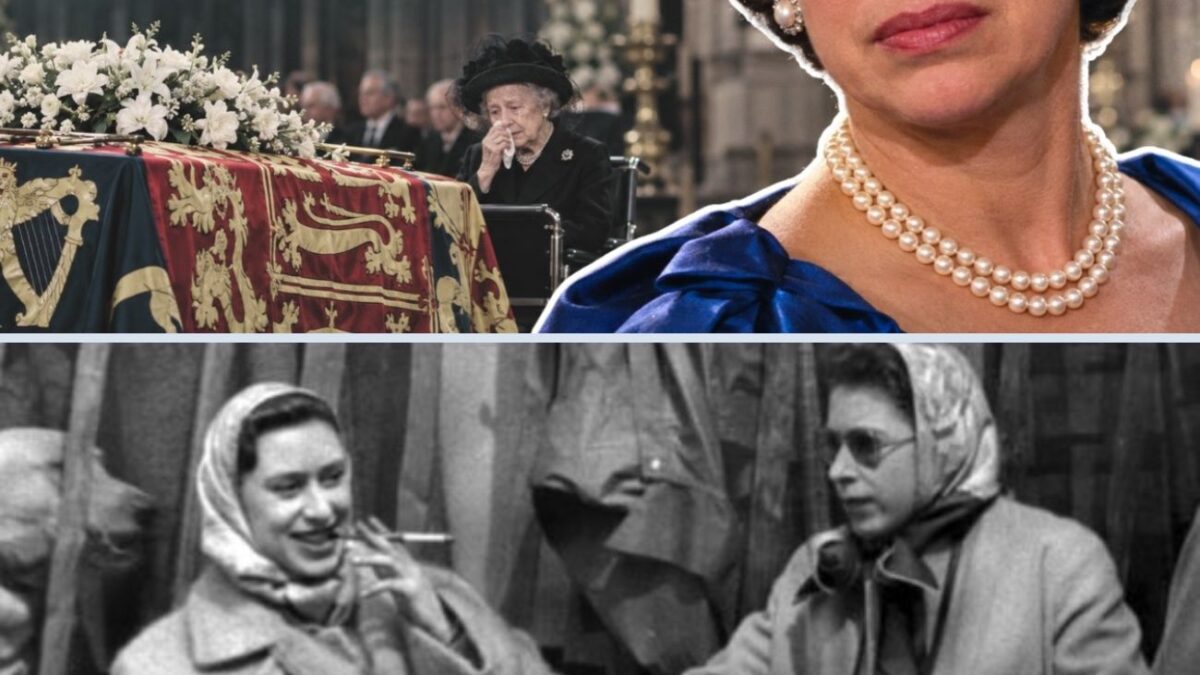
On February 15th, 2002, ashes were carried into St. George’s Chapel, Windsor Castle. The woman reduced to those ashes had been the most glamorous princess in the world. Photographed in Dior, chased by tabloids, adored across continents. She was told she could not marry the man she loved. She married someone else, and that marriage collapsed publicly. She spent her final years partially blind, burned, and in a wheelchair. But the date was the detail nobody could explain. Her funeral fell on the exact day in the exact chapel where her father was buried 50 years earlier.
Princess Margaret’s funeral was not a state occasion. There were no gun carriages rolling through London, no million-strong crowds pressed against barricades, no heads of state flying in from foreign capitals. Several hundred mourners gathered inside St. George’s Chapel: family, close friends, household staff, a small number of official representatives. Five years earlier, Diana’s funeral at Westminster Abbey had drawn around 2,000 mourners inside the church alone and an estimated 2 billion television viewers across the world. Margaret’s service was officially described as private. The word was accurate. It was also a quiet institutional verdict, the final measure of something the monarchy had spent 50 years building. The slow, careful repositioning of a woman who had once been the second most famous royal on earth into someone the crown could bury modestly without spectacle on a freezing Friday in February, while the rest of the world barely paused to notice.
In the front row sat the Queen Mother. She was 101 years old. She had been brought to the chapel in a wheelchair, frail, visibly diminished, the sheer effort of attendance written across her face and posture. Her younger daughter’s coffin was carried past her, draped in the royal standard, and placed before the altar in the same nave where on February 15th, 1952, the coffin of King George VI had rested, in exactly the same position, the same date, the same stone floor, the same family in the pews, now 50 years older and one person fewer. The Queen Mother had buried her husband in this chapel half a century ago. Now she was watching her own daughter’s coffin settle into the same silence. She would be dead herself within 7 weeks, gone by the end of March, as if the effort of surviving this funeral was the last thing her body could sustain.
That date, February 15th, was not chosen deliberately. The royal household selected it based on ruling and protocol after Margaret died on February 9th at King Edward VII’s Hospital in London. The coincidence was accidental, a quirk of calendars and logistics. But accidental is not the same as meaningless. February 15th, 1952 was the day the old world ended for Princess Margaret. Her father’s death 9 days before that funeral had turned her 21-year-old sister into Queen Elizabeth II, turned her mother into the Queen Mother, and turned Margaret into something the British monarchy had never developed a clear plan for: a younger sibling too senior to be ignored, too junior to be given real authority, and too visible to ever truly be free.
Princess Margaret Rose was born on August 21st, 1930 at Glamis Castle in Scotland, reportedly the first member of the royal family born in Scotland in more than 300 years. Her father was then the Duke of York, the quiet and reluctant second son of King George V. Nobody expected him to become king. Nobody imagined Margaret would ever become anything more than a minor royal figure, free to marry well, live comfortably on a private estate, and stay comfortably out of public scrutiny. The family unit in those early years was tight and warm. “Us four,” they called themselves: the Duke, the Duchess, Princess Elizabeth, and Princess Margaret. Margaret was the lively one, the sharp one, the one with the singing voice and the devastating gift for mimicry that could reportedly reduce the entire household staff to helpless laughter. Elizabeth was the dutiful heir in training. Margaret was the younger sister who made the family feel like a family instead of an institution.
Then Edward VIII abdicated in December 1936 over his determination to marry Wallis Simpson, and Margaret’s world cracked open without warning. She was 6 years old. Her father, who had never sought the throne and reportedly dreaded it, became King George VI almost overnight. The family moved from the relative comfort of their London home at 145 Piccadilly into Buckingham Palace, a building with more than 700 rooms, a staff numbering in the hundreds, and a daily operational rhythm governed by centuries of protocol. The intimate unit of four was swallowed whole by an institution that ran on ceremony, hierarchy, public performance, and control.
Margaret’s entire childhood was reshaped not by anything she did, but by the decision of an uncle she barely understood. The abdication made Elizabeth the heir presumptive. It made Margaret the spare. And it introduced a principle into her life that she would never escape: the crown’s authority over royal marriages. Edward had abdicated precisely because the institution refused to accept his choice of wife. That principle—that the monarchy held the right to determine who its members could and could not marry—would be applied to Margaret before she turned 25 with consequences that would follow her into the grave.
During the war years, the two princesses were moved to Windsor Castle for safety while London endured the Blitz. They performed in Christmas pantomimes for small audiences of household staff and recovering soldiers, studied French and history with private tutors, and grew up inside a medieval fortress whose corridors were patrolled by armed guards and whose tall windows were blacked out against the threat of German air raids. It was a childhood simultaneously privileged and confined. A castle with hundreds of rooms, but almost nowhere to go. A family surrounded by servants but isolated from normal life.
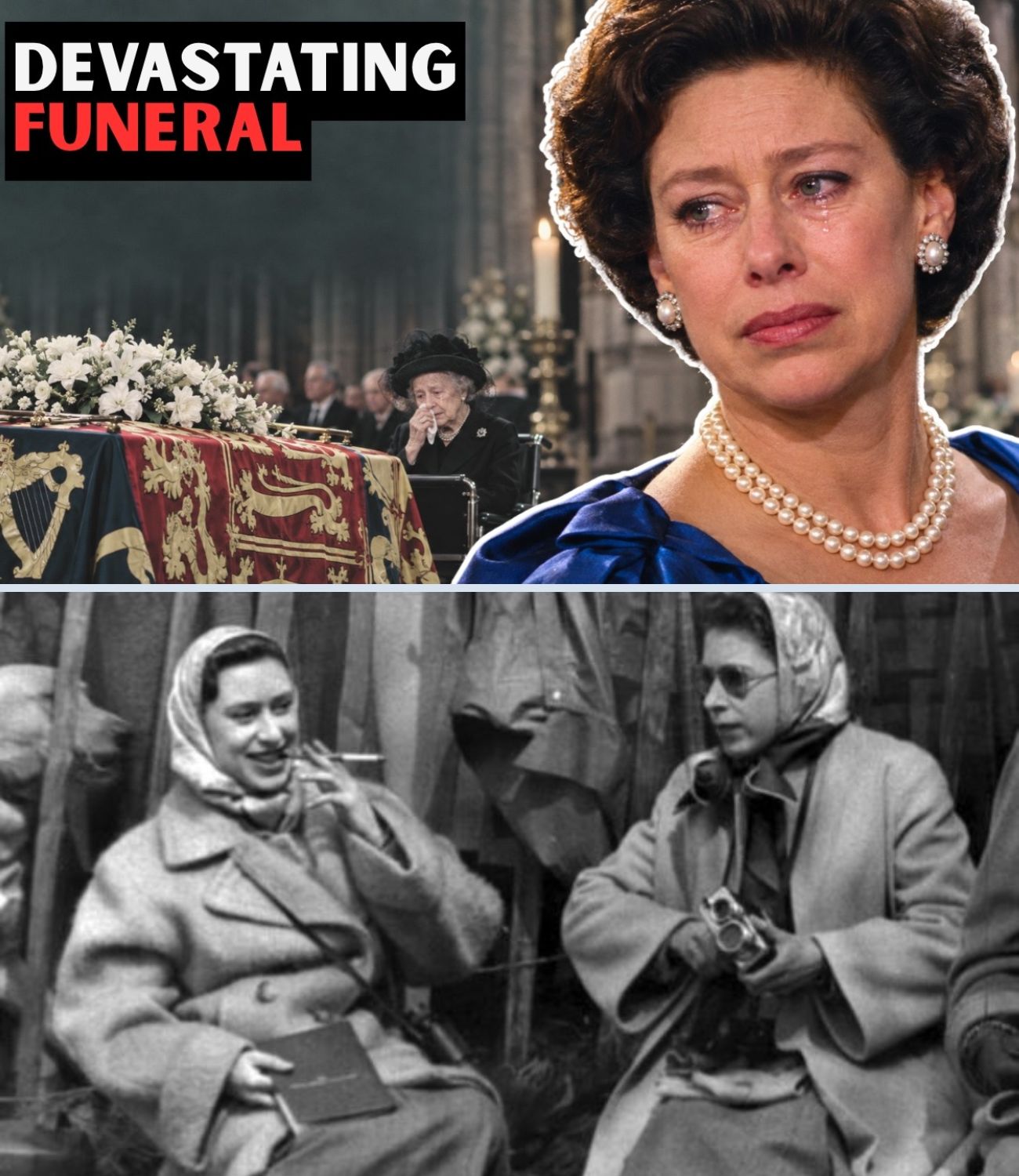
Margaret grew into a teenager known for her rebellious energy, her sharp impatience with stiff protocol, and her fierce closeness to her father. George VI’s health was already declining. Years of accumulated stress, a severe stammer that made public speaking an ordeal, and a lifetime of heavy smoking were slowly destroying his lungs. But the family maintained its routines and projected continuity while the king quietly deteriorated behind the walls.
Among the king’s personal staff during these years was a man named Group Captain Peter Townsend, a Royal Air Force war hero who had been decorated for extraordinary bravery during the Battle of Britain. Townsend served as equerry to the king, a daily companion, a trusted aide, a constant presence inside palace life. He was 16 years older than Margaret and he was married with two sons. Townsend’s first marriage ended in divorce in 1952, the same year George VI died. By then, Margaret and Townsend had reportedly been emotionally close for several years. The attachment had developed inside the royal household itself, nurtured by daily proximity in palace corridors, shared family routines, country weekends at Royal Lodge in Windsor, and the quiet domestic rhythms that governed life at court when cameras were absent. Townsend later described Margaret as irresistible.
The relationship was known within the family, tolerated in private corridors, and entirely invisible to the general public. That invisibility shattered on June 2nd, 1953, the day of Queen Elizabeth’s coronation at Westminster Abbey. After the ceremony, press photographers captured a brief, devastating moment outside the abbey. Margaret, standing near Townsend in the crowd, reportedly reached over and brushed a piece of lint from his Royal Air Force uniform lapel. The gesture was small, instinctive, and unmistakably intimate: the kind of touch that belongs to someone you love, not someone you work beside. The cameras caught it. The newspapers printed it across front pages. And the crisis that would define the rest of Margaret’s life detonated in full public view.
The problem was never that Margaret loved Townsend. The problem was that Peter Townsend was a divorced man. The Church of England, of which the Queen was Supreme Governor, did not formally recognize remarriage after divorce. The Royal Marriages Act of 1772 required any descendant of King George II under the age of 25 to obtain the sovereign’s explicit consent before marrying. Margaret was 22. She needed her sister’s permission. And behind the queen stood a wall of advisers, senior politicians, and churchmen who made it quietly but unmistakably clear that such permission would not come easily, if it came at all.
The irony was suffocating enough to fill the entire chapel. The Church of England had been founded in 1534 specifically because Henry VIII demanded the right to divorce Catherine of Aragon and marry Anne Boleyn. The entire institution—its bishops, its cathedrals, its prayer books, its moral authority—existed because a king had once insisted on ending one marriage to begin another. Four centuries later, the same church told a princess she could not marry a man because someone else had divorced him first.
The prime minister of the day, Anthony Eden, was himself a divorced man who had remarried. He reportedly advised the crown against permitting the match. Sir Alan Lascelles, known within the household as Tommy, the Queen’s formidable private secretary, was even more forceful in his opposition. Lascelles reportedly considered the Townsend relationship a direct threat to the stability of the institution and worked methodically behind the scenes to ensure it could not survive. Margaret, by several later accounts, never forgave him. The man who helped kill the relationship continued serving the crown without consequence. Margaret continued living inside it without remedy.
Margaret was told she could wait. Under the Royal Marriages Act, members of the royal family over 25 could marry without the sovereign’s consent provided they gave formal notice to the Privy Council and Parliament did not raise an objection within 12 months. The institutional plan became delay. Townsend was reassigned to a diplomatic posting in Brussels. Removed from the household, removed from daily contact with Margaret, removed from her physical world by a continent and a bureaucratic transfer dressed up as a career opportunity. The assumption among palace advisers was that distance and time would weaken the emotional attachment.
They were wrong about the attachment, but the institutional pressure did not weaken either. By 1955, Margaret had turned 25. She was legally entitled to notify Parliament. But she was told—and the precise details of who delivered the message, in what room, and in what exact terms, remain debated among historians and biographers—that if she married Townsend, she would almost certainly forfeit her civil list income, her position in the line of succession, and potentially her right to live in royal residences. Love was priced. The price was money, home, rank, and identity.
On October 31st, 1955, Margaret released a public statement. The language was careful, institutional, and quietly devastating in its formality:
“I would like it to be known that I have decided not to marry Group Captain Peter Townsend. Mindful of the church’s teaching that Christian marriage is indissoluble and conscious of my duty to the Commonwealth, I have resolved to put these considerations before any others.”
The words “mindful” and “conscious of my duty” read less like a woman speaking from her heart and more like a palace drafting a press release through a woman’s mouth. Whether Margaret composed those sentences entirely herself or whether they were shaped and polished by royal advisers remains disputed to this day. What is beyond dispute is the result. She gave up the man she loved. The institution secured the outcome it wanted.
The statement was printed in every newspaper in the country. The crisis ended and Margaret was left standing inside the system that had taken the one thing she asked for, offering nothing of comparable value in return. Public sympathy was enormous and immediate. Margaret became almost overnight a figure of genuine romantic tragedy: the beautiful young princess who had sacrificed personal love for institutional duty. Letters of support arrived at Clarence House. Newspapers that had pressured her to give Townsend up now praised her nobility, but sympathy did not change the constitutional rules that had trapped her. And grief did not come with a job description or a replacement purpose.
Margaret remained a senior royal without a constitutional function, without a husband, without a clear future, and without any institutional answer to the question the crown stubbornly refused to confront: What exactly was she supposed to do with the next 40 years of her life? The monarchy had taken the one decision that mattered to her. It offered nothing equivalent in return, only more patronages, more ribbon cuttings, more charity dinners, more years of decorative public service inside a system that had already proven it would overrule her on the only question she cared about.
What followed was a kind of brilliant, self-destructive reinvention. Margaret became the most glamorous woman in Britain. She wore Christian Dior. She attended the sharpest nightclubs in London, frequented theatre openings and gallery previews, and moved through a social world that mixed aristocrats with artists, actors, musicians, and photographers. She drank freely. She smoked through a long ivory cigarette holder that became her most recognizable visual trademark, as identifiable as any crown. She was witty, cutting, unpredictable, and socially magnetic in a way that no other member of the royal family could match. The press adored her for it. For several years, the monarchy was content to let Margaret play the role of the glamorous, modern princess because her energy and style made the institution appear vibrant and contemporary without requiring it to actually change a single rule.
Then she met Anthony Armstrong-Jones. He was a society photographer, talented, ambitious, charming, and entirely outside the usual aristocratic pool from which royal consorts were traditionally selected. Their courtship was intense and mostly private. They became engaged in late 1959, and the wedding was set for May 6th, 1960 at Westminster Abbey. It was the first royal wedding ever broadcast live on television. An estimated 300 million people watched the ceremony across the world. Margaret wore the Poltimore tiara, which she had purchased herself at auction in 1959. Armstrong-Jones was created Earl of Snowdon.
The following year, the public believed they were witnessing a genuine fairy tale. The princess, denied one love story, had been given another, grander and more modern. The institution exhaled with visible relief. Two children followed quickly: David, Viscount Linley, born in November 1961, and Lady Sarah Armstrong-Jones, born in May 1964. The young family settled into a large apartment at Kensington Palace, staffed with butlers, maids, a dresser, a private secretary, and a nanny for the children. Snowdon continued working as a photographer and designer. Margaret maintained her official duties: overseas tours representing the crown, patronage of charities and cultural organisations, hospital openings, regimental visits, and the relentless calendar of engagements that defined senior royal life.
The couple moved together through a creative bohemian social circle of artists, actors, and writers that the palace tolerated because it made the monarchy appear culturally connected to the modern world. Behind the doors at Kensington Palace, the marriage was quietly disintegrating. Accounts from later biographies differ on the specific incidents, and allegation has been layered upon counter-allegation by friends of both parties, but the broad pattern is consistent and well documented: reported affairs on both sides, volatile confrontations followed by long frozen silences, and the particular cruelty of two intensely strong-willed personalities trapped inside a public union that neither could easily dissolve without institutional consequences.
Snowdon reportedly left handwritten notes for Margaret, cataloging her personal faults. Margaret reportedly responded with a coldness that could freeze a room. The household staff at Kensington Palace became unwilling witnesses to a marriage fracturing along every private seam, while the couple continued appearing together at public functions as if nothing had changed. The palace looked like a home. It was becoming a theater.
Margaret’s private escape from all of it was Mustique. Her close friend Colin Tennant, later Lord Glenconner, had given her a plot of land on the small Caribbean island as a wedding gift around 1960. She designed and built a villa there called Les Jolies Eaux, and it became the one place on earth where Margaret appeared to shed the institution entirely. She swam, sunbathed, entertained friends late into the tropical night, and lived without the suffocating royal etiquette that governed her existence everywhere else. It was freedom in physical form. But freedom for a princess under constant tabloid surveillance came with a risk that Margaret either did not calculate or chose to accept. The island was private. It was not invisible.
In the mid-1970s, Margaret began a relationship with Roddy Llewellyn, a landscape gardener 17 years younger than her. The affair was widely known on Mustique, but had not yet crossed into the British press. That changed decisively in 1976 when a tabloid newspaper published photographs of Margaret and Llewellyn together on the island: Margaret in a swimsuit, Llewellyn shirtless beside her, the tropical setting unmistakable in its intimacy. The pictures were not sexually explicit. They did not need to be. The already hollow marriage to Snowdon was now publicly, irreparably exposed as finished.
The divorce was finalized in 1978, the first divorce of a senior member of the British royal family in the modern era. The institution that had prevented Margaret from marrying a divorced man in 1955 could do nothing to prevent her from becoming a divorced woman 23 years later. The Church of England’s teaching on Christian marriage being indissoluble, cited so solemnly in Margaret’s own public statement, had no operational clause for this particular situation. The crown handled the contradiction the way it always handled contradictions: by absorbing the damage quietly and redirecting public attention elsewhere.
Margaret did not recover easily from the wreckage. She kept her apartment at Kensington Palace, her royal title, her precedence in the order of the family, and her annual civil list income. On paper, almost nothing changed. In practice, everything had shifted. The public role was steadily shrinking. The press that had once celebrated her glamour now described her routinely as difficult, self-indulgent, and unjustifiably expensive. The tabloid culture of the 1980s was faster, crueler, and more invasive than anything Margaret had faced before, and she had become an easy, reliable target: a divorced princess who drank too much, smoked too heavily, appeared at fewer and fewer public engagements, and seemed to carry a visible bitterness into every room she entered. The charisma that had once made her the most electric member of the royal family was turning inward, consuming itself.
Then Diana arrived. Prince Charles married Lady Diana Spencer in July 1981, and the monarchy suddenly had a new gravitational center: younger, more beautiful, more instinctively skilled at manufacturing public sympathy than Margaret had ever wanted to be. Diana became the new princess the world watched. Margaret was pushed further toward the institutional margins with every magazine cover Diana appeared on. The monarchy that had once depended on Margaret’s star power now had a brighter, cheaper replacement. Margaret was still performing duties, still living at Kensington Palace, still carrying the title, but the relevance was draining away year by year. She was becoming exactly what the institution had quietly wanted for decades: invisible enough to stop generating problems.
The physical collapse arrived in 1998. Margaret suffered her first major stroke while staying at Les Jolies Eaux on Mustique. The island that represented her only freedom became the place where her body started to betray her. Further strokes followed over the next 2 years. Her vision deteriorated severely until she lost the ability to read and could barely identify faces across a room. The woman who had once been defined by her visual presence—the sharp assessing eyes, the Dior silhouettes, the cigarette holder angled with theatrical precision, the devastating glance that could command an entire party—could no longer see the world she had once dominated.
Before her death, Margaret transferred Les Jolies Eaux to her son David to avoid inheritance tax. He sold it in 1999 for a reported £2.4 million. The villa that had represented her single physical escape from the weight of the institution, the house Colin Tennant’s wedding gift had made possible, the rooms where she had swam and danced and lived without permission from anyone—was gone while she was still alive because her body could no longer make the journey across the Atlantic. The freedom was liquidated. The trap remained unchanged.
Then came the burn. In early 2001, Margaret badly scalded both feet in a bath. The precise cause has never been fully clarified. Some accounts say the water was dangerously overheated. Others suggest that neurological damage from her strokes had destroyed her ability to feel temperature. The injury was severe enough to devastate her already limited mobility and confined her almost entirely to a wheelchair. Photographs from the Queen Mother’s 101st birthday celebration in August 2001 show Margaret gaunt, hollowed, slumped in a wheelchair behind dark glasses, visibly diminished beyond recognition. She bore no physical resemblance to the woman who had worn the Poltimore tiara at Westminster Abbey, who had danced at London’s sharpest parties, who had made the monarchy feel alive and dangerous and modern. That woman was gone. The transformation was not a metaphor. It was a medical catastrophe documented in photographs the world could see.
Peter Townsend had died in 1995 at home in France at the age of 80. He had married a Belgian woman named Marie-Luce Jamagne, had children and lived quietly far from the British press. He and Margaret reportedly exchanged private letters over the years following their forced separation, though the content of those letters has never been made public. The man the institution removed from Margaret’s life in 1955 was gone 7 years before she died. She outlived the love she had been denied. She did not outlive the consequences of the denial.
Margaret died on February 9th, 2002 at King Edward VII’s Hospital in London. She was 71. The cause of death was a final stroke, the last in a series that had been dismantling her body for 4 years. Six days later, her funeral was held at St. George’s Chapel, Windsor Castle. The date fell by accident, by the mathematics of ruling, by whatever force governs the architecture of grief: on the 50th anniversary of her father’s funeral.
In the same building, the queen stood in the chapel as both grieving sister and reigning sovereign, the same dual identity that had defined her relationship with Margaret for exactly half a century. The Queen Mother sat in her wheelchair near the front, a mother of 101, watching her younger daughter’s coffin being carried past her. Anthony Armstrong-Jones, Earl of Snowdon, the ex-husband, was present somewhere in the congregation. Decades of private wreckage compressed into a few feet of physical proximity to the coffin of the woman he had married in front of 300 million witnesses and divorced in front of the entire country. David Linley and Lady Sarah Chatto, Margaret’s two children, sat near the front.
The congregation was small by royal standards. No crowds lined the streets outside. No global broadcast commanded billions of viewers. The institution that had shaped Margaret, constrained her, celebrated her when convenient, punished her when necessary, and gradually moved her to the margins of public life, buried her with appropriate discretion. The word “private” had never sounded quite so much like a final institutional judgment.
After the service, Margaret’s body was taken to Slough Crematorium, a functional municipal building in an ordinary commuter town west of London, unremarkable in every respect. The most glamorous princess of her generation was cremated in a facility that most people drive past on the motorway without a second thought. She was reportedly the first senior member of the British royal family to be cremated since Princess Louise, Duchess of Argyll in 1939. The choice had been Margaret’s, and some accounts suggest the reasoning was specific and deliberate. Cremation would allow her ashes to eventually be placed beside her father in the memorial chapel at Windsor. The woman who had been forcibly separated from the man she loved by the institution wanted in death to be physically reunited with the parent whose early death had made the institution her permanent cage.
Her ashes were placed initially in the royal vault beneath St. George’s Chapel. They stayed there for exactly 7 weeks. On March 30th, 2002, the Queen Mother died at Royal Lodge, Windsor at the age of 101. Her funeral on April 9th was a full ceremonial state occasion: gun carriages through London, military escorts, foreign dignitaries, vast crowds lining the processional route, the complete elaborate apparatus of royal mourning deployed for the woman who had been the last Queen Empress. Her body was interred in the King George VI Memorial Chapel, a small, quiet side chapel within St. George’s that had been constructed specifically to hold her husband’s remains after his death in 1952.
And when the Queen Mother was laid to rest beside George VI, Margaret’s ashes were moved from the royal vault and placed alongside both her parents. Father, mother, and younger daughter together at last inside a space no larger than a modest sitting room. The family that had defined every boundary, every permission, every denial, and every loss of Margaret’s life was finally reunited in a way the institution had spent five decades preventing.
In 2006, Christie’s auction house sold a collection of Margaret’s personal possessions. Among the lots was the Poltimore tiara, the piece she had worn on her wedding day at Westminster Abbey in 1960, the day 300 million people watched and the monarchy presented its preferred version of Margaret’s future to the world. The tiara sold for approximately £926,000 to an anonymous buyer. A jewel that had once crowned a public fairy tale was sold to the highest bidder long after the fairy tale, the marriage, and the institution’s carefully preferred version of Margaret’s story had all collapsed beyond repair.
Lord Snowdon continued working as a photographer well into old age, remarried, and died in 2017 at the age of 86. David Linley became a respected furniture maker and eventually inherited his father’s title, becoming the second Earl of Snowdon. Lady Sarah Chatto became a painter. Both children chose lives defined by personal craft rather than public spectacle, as if the central lesson of their mother’s existence was that institutional visibility was itself the trap.
The apartment at Kensington Palace was eventually reallocated to other members of the royal family. Les Jolies Eaux still stands on Mustique, now owned by strangers, its walls holding no official memory of the princess who built the house to escape the family that would never fully let her go.
Margaret’s reputation has shifted considerably since her cremation. Biographies have re-examined her life with more compassion and nuance than the tabloid press ever extended during her lifetime. A widely watched television dramatisation introduced her story to millions of viewers who had never seen the young woman in Dior or the broken woman in the wheelchair. The central question that structures every reassessment is the one the institution never answered while Margaret was alive: What was she for?
She was too royal to live freely and too secondary to hold real power. She was denied the marriage that might have made her happy and handed the marriage that made her miserable. She was given palaces, jewels, titles, servants, income, and an official diary of engagements, and none of it added up to a purpose that could sustain a human life. The monarchy needed her visible enough to be useful and quiet enough not to generate embarrassment. When she was neither, it let her drift. When she drifted too publicly, it pulled her back. When she finally broke, it buried her privately and moved on.
St. George’s Chapel still stands at Windsor Castle. Tourists pass through it throughout the year. Most of them know it as a royal chapel, a place of weddings, christenings, and state services. Very few of them pause at the King George VI Memorial Chapel, a modest space set off to the side behind an iron gate, easy to walk past without a thought.
Inside that small chamber, three members of the same family rest together. A king who never expected or wanted to reign and who died at 56. A queen who outlived her husband by 50 years and her younger daughter by 7 weeks. And a princess who was born inside the most famous family on earth, was told she could not love the person she chose, was given a replacement life the institution approved and then watched that replacement collapse in front of the entire country, and who spent her final years unable to see, unable to walk unaided, and burned by bath water she could no longer feel.
Her ashes are there now, beside her father, in the same chapel where both their funerals were held. The date on the calendar reads the same: February 15th, 50 years apart. Two funerals in the same cold stone. The first one made Margaret the spare. The second one proved exactly what that word cost her.
You Might Also Enjoy

“We Thought They Would Negotiate”—What Argentine Soldiers Said When The British Attacked Goose Green

“You’ll Never Finish My Ruck March, Limey” — US Sergeant Who Challenged the SAS, Then Fell Out First






