Queen Alexandra’s Youngest Sister Gave Birth in Secret Her Daughter Has Never Been Identified
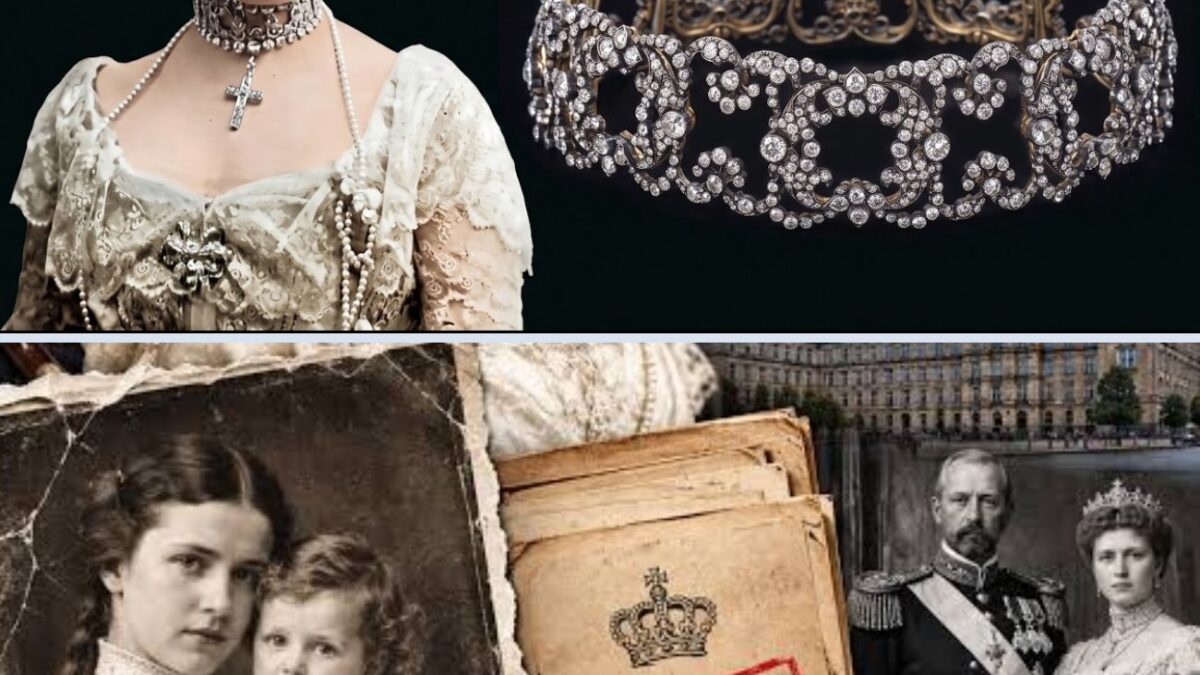
In November 2017, Christie’s in London offered a diamond choker in its important jewels sale. It had been made in Vienna around 1890 by Köchert, jewelers to the Habsburg court. It was an openwork band of scrolling garlands and stylized flowers set with old-cut diamonds in silver and gold. It could be worn close around the throat or lifted onto the head as a tiara. The seller was identified only as a European royal household. The estimate was 17 to 26,000 pounds. It sold for 137,500, more than five times the top estimate.
Jewel historians have identified that choker in portraits of a woman few in the room would have recognized. She was the youngest daughter of a king of Denmark. One of her sisters became queen of the United Kingdom. Another became empress of Russia. And late in 1871, at 18, she gave birth in secret to a daughter she would not raise. The Danish court has never confirmed it. The child’s identity has never been proven. And the young officer who fathered her was dead within two months of her birth.
This is the story of Princess Thyra of Denmark. What her family managed to hide, what it could not, and the jewels that came with the life she lived afterwards.
Thyra Amalie Caroline Charlotte Anna was born in Copenhagen on the 29th of September 1853, the fifth child of Prince Christian and Princess Louise. Two months before her birth, a new law of succession had made her father heir to the Danish throne. King Frederick the Seventh had no legitimate children. In the London Protocol of 1852, the great powers had already settled the succession on Christian, a prince of the Glücksburg line whose wife was a niece of an earlier Danish king.
Then came 1863.
In March, Thyra’s eldest sister, Alexandra, married Albert Edward, Prince of Wales and heir to the British throne at St. George’s Chapel, Windsor. Weeks later, her brother Wilhelm was elected King of the Hellenes and took the name George. In November, King Frederick died and Thyra’s father became King Christian the Ninth.
The new reign began with a war. By the end of 1864, Denmark had been defeated by Prussia and Austria and had lost the Duchies of Schleswig, Holstein, and Lauenburg. In 1866, Thyra’s sister, Dagmar, married the heir to the Russian throne, the future Alexander the Third, and became Maria Feodorovna. Dagmar would be Empress from 1881 and Alexandra would be Queen from 1901. So, by the time Thyra was 13, a small and recently defeated kingdom had one daughter married to the future King of Britain and another to the future Tsar.
Thyra was the last of the three daughters still at home. Her mother, Queen Louise, wanted her youngest to marry as well as her sisters had.
Wilhelm Freeman Marcher came from a different Denmark. His parish record shows he was born on the 19th of October, 1839 at Trudsholm, a farm in Zealand where his father was the tenant. Census returns list him there as an infant and again at six. At 10, the census finds him in Copenhagen as a schoolboy living with an uncle who was a major in the cavalry in the barracks of the Guard Hussars. He followed his uncle into the cavalry. By 1871, he was a lieutenant in the Guard Hussars and unmarried.
Dansk Biografisk Leksikon, Denmark’s national biography, describes him as one of the officers on duty at court. He was 14 years older than the king’s youngest daughter.
No surviving record tells us how their attachment began or how long it lasted. No letters between them are known. Novels have filled that silence. The documents do not. What the national biography records, drawing on the Danish author Bo Bramsen, is brief. At 17, Princess Thyra had a love affair with an officer at court and she became pregnant. The same entry adds that the episode was, naturally, kept as secret as possible.
The method was distance. Thyra’s brother, George, was King of Greece, a long journey from Copenhagen. Retellings often say the princess fled. She did not. She traveled with her mother. Copenhagen newspapers of the time, as read by a Danish researcher, show the queen and the princess sailing that August on a royal ship with a lady-in-waiting on an unannounced royal journey.
Their route took them first to Rumpenheim, the Hesse family seat near Frankfurt, where Queen Louise’s relations gathered. From there, they went to Mon Repos, the Greek royal villa on Corfu. Half a century later, George’s grandson, Prince Philip, the future Duke of Edinburgh, would be born in that house. From Corfu, they went on to Athens, where they had arrived by early November.
Then the princess did not come home. The public was told she was ill. Which illness is disputed. Most retellings say jaundice, but the researcher who went back to the newspapers found scarlet fever instead. The original notice has not yet been produced. Either way, an illness explained an absence that would last many months.
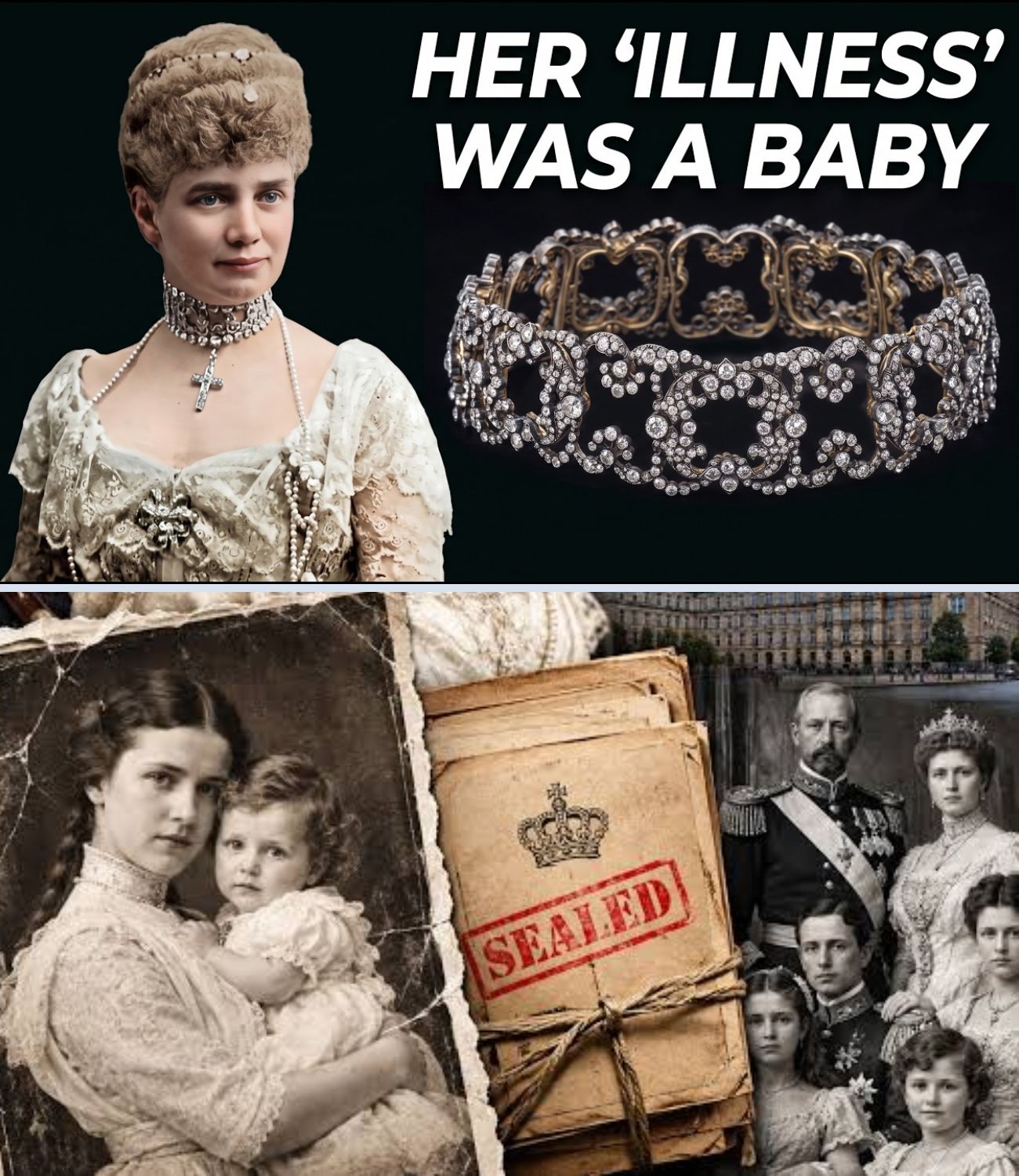
In December, King Christian himself traveled south with Thyra’s youngest brother, Waldemar. Late in 1871, in Athens, Thyra gave birth to a girl. She was 18. The exact date is uncertain.
Accounts range from early November to around Christmas. The outcome is recorded. The child was adopted in Denmark. Nothing tells us whether Thyra held her daughter or for how long. The royal party stayed in Athens into the spring of 1872, and it was summer before Thyra saw Copenhagen again.
In Copenhagen, Marcher’s circumstances had already changed. According to a Danish genealogist’s transcriptions, he was moved from his regiment to the war ministry in November 1871. In early January 1872, he took his own life in his quarters at the Hussar barracks.
He was 32. No burial record has yet been traced.
The fullest account of his death comes from a private diary. In 1926, Count Frits Ahlefeldt Laurvig, known in Copenhagen as the theater count, wrote down what he had been told by the officer who found Marcher. The diary has since been published by Denmark’s theater museum.
Whether Thyra was told of his death and when is not recorded. She was still in Greece.
The year she came home, Thyra met the man she would eventually marry. Ernest Augustus, born in 1845, was Crown Prince of Hanover, a crown prince without a kingdom. His father, the blind King George V, had sided with Austria in 1866 and lost his throne when Prussia annexed Hanover. The family lived in exile in Austria and never renounced their claim.
Ernest Augustus did keep one British title. He was Duke of Cumberland and Teviotdale, a peer of the United Kingdom.
According to the national biography, Ernest Augustus fell in love with Thyra in 1872 and held to it. In 1874, he proposed in Copenhagen and she refused him. The biography quotes her reason in her own words. “He has no nose, you know.” It adds that political objections from her brother-in-law, the Prince of Wales, may also have played a part.
The biography also notes that the events of 1871 did not stop her mother and her sisters, Alexandra above all, from working hard to find her a husband. Several candidates were considered. In 1878, newspapers even listed the widowed King of the Netherlands, a man a year older than her father.
And all the while, somewhere in Denmark, a girl was growing up. Who was she? Ask that question today and you will get a confident answer. She was Kate Jørgensen, raised by a couple named Jørgensen in Odense, and she lived until 1964.
Part of that is true because there was such a woman. Indexes of Danish records give her names as Marie Catherine Johansine Regine Jørgensen, born on the 8th of November, 1871. In 1902, she married Frode Ployen-Holstein, a lieutenant born the year after her, and the couple appear together in the Danish census of 1921. She died in 1964.
But no birth, baptismal, or adoption record linking her to Thyra has ever been found. Her connection to the princess rests on retellings, not documents. The date most often given for Thyra’s delivery, the 8th of November, is Kate’s recorded birthday. No independent source fixes the princess’s labor to that day.
The diary of 1926 points somewhere else. Ahlefeldt-Laurvig wrote that in Copenhagen, no one was in any doubt about what had happened to the princess. The secret the family had taken to Athens to protect was, in its own capital, common knowledge. The city even joked about it.
The diarist records a joke that played on the lieutenant’s surname, and it is from that joke that we know how Copenhagen pronounced it. Marker.
Of the child, he wrote that she had been born on the long journey abroad, and that she was believed to have been entrusted to a woman he called Mademoiselle Lescay.
That is not a married couple in Odense. It is an unmarried woman named by a man writing from inside Copenhagen society. He was repeating what others believed, and his diary cannot settle the question. But it shows that the famous answer is not the only one, and neither answer has a document behind it. Thyra’s daughter may have been Kate Jorgensen. She may have been someone else. The honest answer is that we do not know who she was.
The diary makes one more claim, and it reaches into the rest of Thyra’s life. Ahlefeldt-Laurvig had read the private journals of Andreas Frederik Krieger, a former Danish government minister. On his reading of them, the only reason the royal family accepted Thyra’s eventual marriage was that she had had a child by Marcher.
Four years after her refusal, Ernest Augustus was still waiting. On the 22nd of September, 1878, Alexandra and Queen Louise arranged for the two to meet at Frankfurt. This time it was settled at once. Thyra wrote to her sister in Russia that they were both heartily happy.
So, the record holds two accounts. One, second-hand, describes a match accepted out of necessity. The other, in Thyra’s own hand, describes happiness. The documents do not choose between them, and neither will we.
On the 11th of October, King Christian wrote to the German Crown Prince, then acting as regent in Berlin, about the match. The engagement was proclaimed at Fredensborg on the 19th of November. On the 21st of December, 1878, they married in the chapel of Christiansborg Palace in Copenhagen.
Newspapers described the bride in plain white silk with diamond jewelry. German diplomats stayed away on orders from Berlin. Six weeks later, on the 4th of February, 1879, Bismarck published an agreement with Austria canceling Article 5 of the Peace of Prague. This was the clause that had promised the people of North Schleswig a vote on whether to return to Denmark. In Denmark, it was taken as Berlin’s answer to the Hanover wedding.
In 1921, the historian Arga Fries showed that the agreement was dated the 11th of October, 1878, before the engagement was made public.
Newspapers of the day reported the wedding presents. From her parents, a riviera of large diamonds with a diamond cross. From the bridegroom, a set of diamonds and sapphires. From the emperor and empress of Russia, a bracelet of five rows of pearls and diamonds. From Dagmar and her husband, sapphires and diamonds. From Queen Victoria, an Indian shawl and a pearl medallion with her own portrait.
That last gift carried a history. The family Thyra was marrying into had fought Queen Victoria herself over jewels and won. In 1837, when Victoria became queen, the throne of Hanover passed to her uncle, Ernest Augustus, the bridegroom’s grandfather. He claimed the jewels of Queen Charlotte, Victoria’s grandmother, which Charlotte had left to the House of Hanover. The dispute outlived him. A commission finally ruled against Victoria and in 1858, the Hanoverian stones that could be identified were taken out of her jewelry and returned.
According to the Royal Collection, Victoria then had a new necklace made at a cost of 65 pounds. It used 28 diamonds taken from two of her garter badges and a sword hilt. It became the coronation necklace. The first queen to wear it at a coronation in 1902 was Thyra’s sister, Alexandra.
When Prussia took Hanover in 1866, Queen Charlotte’s jewels went into exile with the family. Thyra’s marriage settlement, as the newspapers reported it, made her position clear. She brought a dowry of 120,000 krona and received an allowance of 50,000 marks a year. Jewels belonging to the Hanoverian house were to return to her husband’s family after her death. Much of what she wore as crown Princess of Hanover was never hers to keep.
The couple made their home at Gmunden in Upper Austria on the shore of the Traunsee, where in the 1880s the family built Schloss Cumberland. They had six children: Marie Louise, who married Prince Max of Baden; Georg Wilhelm; Alexandra, later Grand Duchess of Mecklenburg-Schwerin; Olga; Christian; and Ernst August.
The choker from the sale room was made in Vienna around 1890, when Thyra was in her late 30s and the mother of six. How it came to her, whether by purchase, gift, or inheritance is not recorded. No inventory has been found that names her as its owner. What survives is its appearance in portraits of her as identified by jewel historians and its later history.
One image of Thyra in jewels is documented beyond dispute. In the Royal Collection, there is a miniature by the Danish painter Johannes Zehngraf, cataloged as Thyra, Duchess of Cumberland. She wears a white dress, a diamond star at her breast, a rose corsage, and at her throat a pearl choker hung with a cross. On the back, the frame carries a monogram, TC.
Denmark kept her image, too. Rosenborg Castle holds a portrait of her painted by Hans Cannon in 1877, the year before her marriage, and a Zehngraf miniature of 1899. At Christiansborg, Laurits Tuxen’s great group portrait of Christian IX and Queen Louise among their family, painted between 1883 and 1886, places her among her brothers and sisters. In 1904, the Munich painter Friedrich August von Kaulbach painted her again.
The years at Gmunden brought grief. Two of her three sons died before her. Christian died in 1901 still in his teens. In May 1912, her eldest brother King Frederick VIII of Denmark died in Hamburg. Georg Wilhelm set out by car for his uncle’s funeral and was killed in an accident on the way. He was 31.
In May 1913, her youngest son Ernst August married the German Emperor’s only daughter Victoria Louise of Prussia in Berlin. Among the guests were two of Thyra’s nephews, King George V, Alexandra’s son, and Tsar Nicholas II, Dagmar’s son. It was one of the last times Europe’s crowned cousins gathered before the war.
That autumn, Ernst August became Duke of Brunswick. The house that had taken Hanover from his grandfather was now his family.
The war undid much of it. Under the Titles Deprivation Act of 1917, Thyra’s husband lost his British dukedom. In November 1918, her son gave up the throne of Brunswick. In the same week, her son-in-law Max of Baden, then Germany’s last Imperial Chancellor, announced the Kaiser’s abdication.
Her husband died at Gmunden in 1923. The choker passed to Victoria Louise. In 1999, it appeared at another wedding worn as a tiara by a bride named Thyra von Westernhagen when she married Prince Heinrich of Hanover. 18 years later, it was sold at Christie’s.
Thyra died at Gmunden on the 26th of February 1933 at the age of 79 and was buried there. She had outlived Wilhelm Marcher by 61 years.
The woman most often named as her daughter died in 1964. Genealogical records place her grave in Asnæs churchyard in Zealand. No known document shows that the two women ever met.
Before 1975, the story survived only in private papers, in Krieger’s journals, and in accounts diary. It reached print that year in Bo Bramsen’s history of the House of Glücksburg. That was more than a century after the journey to Athens and more than 40 years after Thyra’s death.
The Danish court has never confirmed it. What remains is uneven. A parish record of a lieutenant’s birth, a diary written more than half a century after the events it describes, a letter in which a princess says she is happy, a miniature of her in pearls, and a diamond choker sold in London in 2017 to a buyer who has never been named.
You Might Also Enjoy

“We Thought They Would Negotiate”—What Argentine Soldiers Said When The British Attacked Goose Green

“You’ll Never Finish My Ruck March, Limey” — US Sergeant Who Challenged the SAS, Then Fell Out First






