Queen Camillas Daughter GOES SILENT After DNA BOMBSHELL Exposes Her Real Father And DESTROYS Family
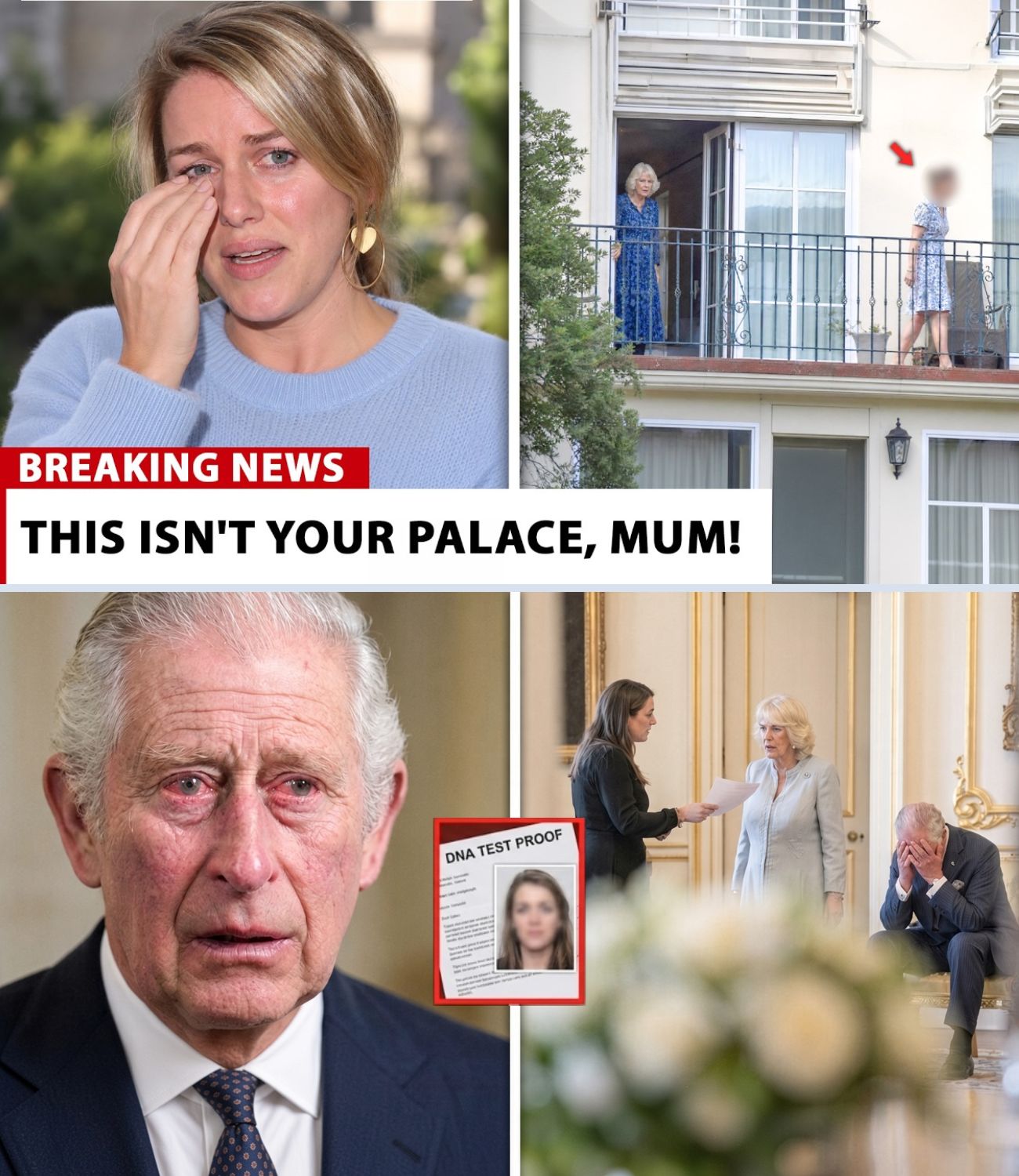
THE WINDSOR DNA EARTHQUAKE: How a Routine Medical Test Exposed Queen Camilla’s 40-Year Secret and Triggered an Unprecedented Palace Civil War
In the rarefied, heavily guarded ecosystem of the British establishment, secrets are rarely buried out of malice; they are sealed away out of sheer, unadulterated necessity. For decades, the public narrative surrounding the ascent of Queen Camilla has been polished to a high sheen—a tale of long-suffering patience, enduring romance, and a couple who weathered the unforgiving storms of the late twentieth century to finally claim their place upon the throne. Yet, history has a peculiar habit of unraveling precisely when the tapestry looks most complete. And sometimes, the instrument of destruction is not a tabloid reporter, a disgruntled courtier, or a leaked memo, but something entirely beyond the control of palace spin doctors: the cold, unyielding mathematics of human genetics.
The story that has quietly paralyzed the inner sanctums of Windsor and Clarence House does not read like a conventional royal scandal. It reads like a psychological thriller, anchored by a piece of evidence that no amount of royal spin, non-disclosure agreements, or high-priced legal muscle can ever wish away. At the epicenter of this seismic tremor is not a restless prince or an ambitious duchess, but Laura Lopes—Camilla’s fiercely private daughter, a woman who spent her entire adult life running as fast and as far away from the gilded cage of the crown as geography would allow.
For Laura, the catastrophic fracture of her existence did not begin with a midnight tip-off to the press or a whisper in the corridors of power. It began inside a sterile, high-end private medical clinic in London during what was supposed to be a standard, run-of-the-mill health check.
The Envelope on the Kitchen Table
Like millions of people navigating middle age, Laura Lopes had booked a routine hereditary health screening—a proactive battery of blood tests and genomic sequencing designed to map out potential future health risks, screen for latent predispositions, and offer peace of mind regarding long-term wellness. Because of her unique familial proximity to the throne as the daughter of the Queen Consort, her medical profile had long been insulated by extra-layers of administrative security protocols within private London pathology networks.
Yet, data is entirely indifferent to protocol. When the laboratory technicians ran her sequenced DNA through the diagnostic panels, the software flagged an anomalous marker. Running cross-database comparisons to isolate familial genetic traits, the system did something unexpected: it matched her primary paternal genetic markers directly against a restricted, highly secure baseline dataset—the internal genetic archive of the Windsor family.
For the senior scientist staring at the monitor, the realization must have felt like looking into an operational abyss. The data did not merely rule out retired Brigadier Andrew Parker Bowles as Laura’s biological father; it pointed with absolute, mathematical certainty toward the reigning sovereign of the United Kingdom.
According to accounts circulating within elite circles, the laboratory did not place a casual telephone call to Laura’s mobile phone. The consequences were simply too volatile. Instead, a heavy, confidential dossier bearing red-wax security seals was dispatched directly to her country home via a discrete private courier.
There were no velvet-trimmed advisors waiting in the driveway, no crisis management teams holding briefcases, and no palace lawyers rushing to intercept the delivery. There was only a solitary woman sitting at her wooden kitchen table in the quiet English countryside, tearing open an envelope that would systematically detonate every foundational truth she had ever been told about her identity.
As she unfolded the diagnostic report, the sheer weight of the revelation settled over the room. The man who had taught her to ride a bicycle, walked her down the aisle, and paid for her schooling was not the man who had passed down half of her biological code. That man sat upon the British throne. And the woman who raised her—the mother who had endured decades of public vilification, fought her way through the treacherous waters of the establishment, and ultimately captured the crown—had known the truth every single second of every single day for half a century.
Every birthday greeting, every comforting childhood reassurance, and every family holiday now stood revealed as a carefully constructed prop in a monstrously sophisticated deception. And worse still, Laura knew instantly where the blame belonged. She did not drive to Wiltshire to confront Andrew Parker Bowles; she did not seek counsel from her brother Tom. She aimed her fury squarely at the architect of the illusion, climbing into her car and pointing the bonnet straight toward the heavy iron gates of Clarence House.
The Breach at Clarence House
To understand why Laura’s unannounced arrival at the King’s official London residence caused immediate, unmitigated panic among the household staff, one must understand how fiercely she had guarded her independence. Throughout her adult life, Laura had maintained a deliberate, icy distance from the royal machine. She rarely attended major state functions, refused to pose for glossy magazine spreads, and treated the glittering trappings of the court with undisguised contempt.
When she arrived at Clarence House that afternoon, the usual protocol of polite announcements and appointments evaporated. Security guards, recognizing her face, instinctively moved to open the gates. Inside the building, flustered administrative assistants and private secretaries attempted to block her path, murmuring that the Queen was resting or occupied with state papers. Laura reportedly fixed them with a look so glacial and absolute that the courtiers involuntarily retreated, clearing the hallway as if parting the waters.
She did not wait to be ushered into a formal drawing room. Pushing open the heavy mahogany doors of the private morning room so hard that they rattled against their brass hinges, she found her mother sitting quietly with a cup of tea.
There were no polite pleasantries, no cautious throat-clearing, and no gentle preamble. Laura walked directly to the table, pulled the heavy medical dossier from her handbag, and dropped it onto the polished wood.
“Don’t you dare lie to me,” she said, her voice dropping to a dangerous, measured whisper.
When Camilla instinctively reached for the well-worn playbook of institutional survival—attempting to deflect with defensive platitudes about “different times,” “unimaginable pressure,” and “protecting the family”—Laura shattered the defense with brutal precision.
Reports of the exchange suggest that Laura did not allow her mother to hide behind noble intentions. She called the deception what it was: a self-serving, calculated maneuver designed to secure Camilla’s lifelong ambition of power and proximity to the crown, executed by using an innocent child as a disposable pawn. Camilla had hidden the pregnancy in the turbulent early 1970s precisely because acknowledging the true paternity would have blown up her social standing, scandalized the establishment, and forced Charles into an impossible corner long before the nation was prepared to stomach their romance.
Instead of facing the music half a century ago, Camilla had chosen to let Andrew Parker Bowles unknowingly raise another man’s child, permitted her daughter to grow up under a false premise, and woven a web of silence so dense that it survived decades of public scrutiny, intense biographical research, and two historic royal divorces.
“You didn’t do it to protect me,” Laura reportedly snapped back. “You did it to protect yourself.”
The King’s Collapse and the Ultimate Betrayal
The confrontation reached its absolute zenith when King Charles himself walked into the room. Returning from a round of medical procedures, exhausted and worn down by the perpetual strain of his reign, the sovereign stepped into an atmosphere thick with emotional shrapnel. Seeing his wife visibly shaken and his stepdaughter standing in a state of icy fury, the King asked the obvious question: what on earth was happening?
Laura turned her gaze toward the man she had regarded merely as an awkward family connection by marriage. The question she delivered was arguably the sharpest blade ever unsheathed within the modern royal household:
“Did you know?”
If Charles had known all along, it meant the monarch was an active accomplice in a staggering constitutional and moral fraud—a man who willingly allowed another gentleman to play the father to his biological child simply to avoid public scandal. If Charles had not known, it meant Camilla had lied to her own soulmate, keeping his flesh and blood entirely out of his orbit whilst he spent decades fighting his own mother, the British establishment, and public opinion to make her his queen.
Either way, the moral foundation of their reign was reduced to ash.
According to accounts leaking from the margins of the palace, the King stared at the open medical dossier, took in the immutable genetic data, and completely broke down. The monarch of the United Kingdom—a man bound by centuries of stoic tradition and iron-willed self-restraint—reportedly covered his face with his hands and wept openly in front of his stepdaughter. The painful irony was inescapable: Charles had spent his entire life subjugating his personal happiness to the cold, unyielding demands of the institution, only to discover that the one person he had trusted as his ultimate sanctuary had been constructing a monumental lie right beneath his nose.
Yet, amidst the weeping and the desperate damage control, Camilla’s institutional instincts never truly switched off. Even as her daughter stood before her shattered, the Queen Consort’s mind reportedly raced toward containment, fixating on PR strategies, damage limitation, and silencing fixers.
That reflex sealed the final break.
Laura made it explicitly clear that she wanted no part of their titles, no share in their wealth, and no formal recognition within the line of succession. She stated bluntly that biology does not automatically manufacture a father, nor does a crown make a mother. And then, she delivered a parting ultimatum that reportedly left the palace legal team sweating through their linen shirts: if any attempt was made by royal fixers to smear her name, discredit the medical findings, or drag her into a managed media narrative to salvage the crown’s reputation, she would bypass the tabloids entirely and release the unedited, certified diagnostic files directly to major international news networks.
It was the ultimate nuclear option. For an institution whose entire survival relies upon the controlled curation of truth, a weaponized medical file held by a woman who had completely cut ties with the firm represents an existential threat from which there is no recovery.
The Weight of a Shattered Identity
For Laura Lopes, the weeks and months following that afternoon at Clarence House have been defined by a quiet, agonizing reconstruction of reality. The human cost of such a revelation defies easy quantification. When your entire genetic architecture is redrawn overnight, every single memory of childhood must be passed through a harsh, unforgiving sieve.
The man she called Daddy—who taught her how to fish, sat patiently through school assemblies, and walked her down the aisle—remains her true father in every metric that genuinely matters, regardless of what a laboratory printout states. But the chilling realization that the biological architect of her existence drifted through the exact same social circles, attended the same family gatherings, and sat in the same rooms for decades without ever uttering a single word of recognition is a betrayal so profound it defies ordinary language.
And what of Andrew Parker Bowles? Now in his twilight years, the retired cavalry officer has maintained a dignified silence throughout his life, having weathered the humiliating media storms of the 1990s with old-school aristocratic fortitude. The notion that one of the daughters he raised with steadfast devotion may not be his blood introduces a tragic, Shakespearean layer of cruelty to a man who already sacrificed so much for the altar of high-society marriage.
Meanwhile, the palace has retreated into its familiar, ancient posture of defensive isolation. There have been no public statements, no late-night television interviews, and no emotional appeals from Clarence House. The courtiers have battened down the hatches, lawyers have been placed on retainer, and the great machinery of royal reputation management is working overtime to maintain the illusion of unbroken stability.
Yet, beneath that polished veneer, the psychological atmosphere has shifted permanently. Camilla finds herself increasingly isolated, her hard-fought throne suddenly feeling remarkably precarious. The loyalties she spent half a century cultivating have been exposed as conditional, and the one person who possessed both the moral high ground and the unvarnished truth has simply turned around, walked out the door, and locked it from the outside.
In the end, Laura Lopes achieved something that generations of political republicans, hostile tabloid editors, and bitter royal rivals could never quite manage. She didn’t try to tear down the monarchy with protests or petitions. She simply demanded the truth, rejected the gilded theatre, and walked away into the quiet dignity of her own life. In doing so, she proved a timeless, devastating truth about the House of Windsor: no matter how high the palace walls are built, and no matter how tightly the archives are guarded, the truth has a remarkable way of tearing through stone.
You Might Also Enjoy

“We Thought They Would Negotiate”—What Argentine Soldiers Said When The British Attacked Goose Green

“You’ll Never Finish My Ruck March, Limey” — US Sergeant Who Challenged the SAS, Then Fell Out First






