Queen Victoria’s Marriage Was Much CRUELER Than You Thought
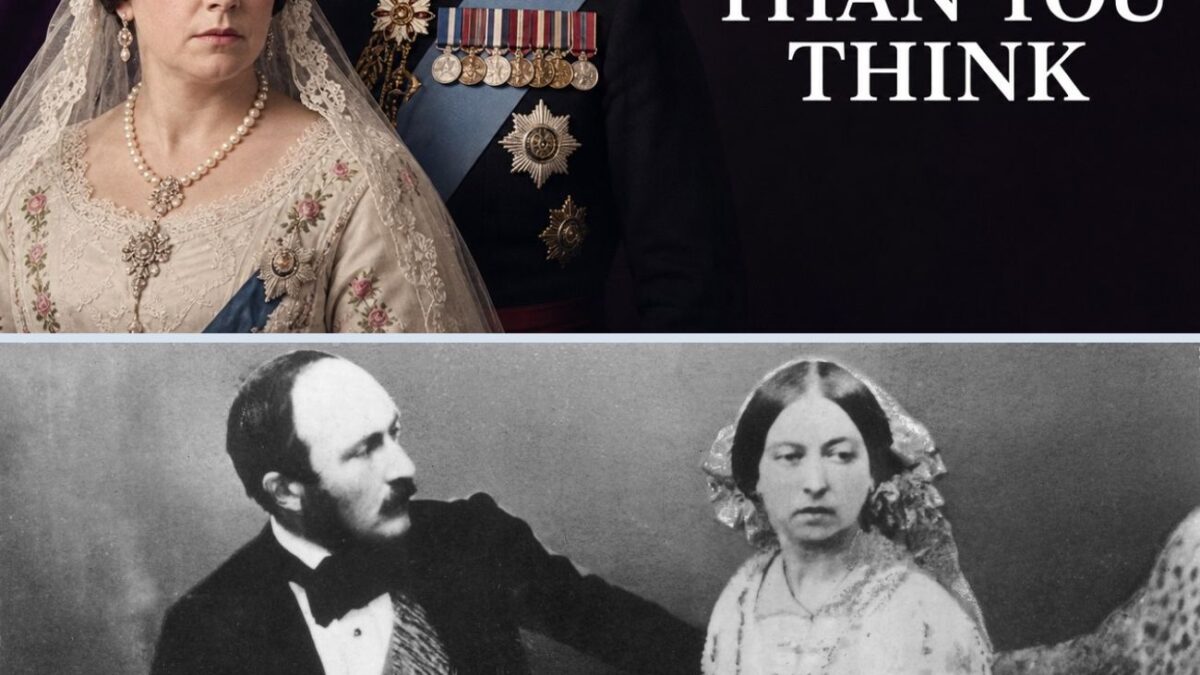
You know the portrait, Victoria in her wedding veil, orange blossom in her hair, painted as a gift for the husband she adored. The founding image of Victorian marriage, she sat for it five years after Albert removed the woman who raised her. Baroness Lehzen left Buckingham Palace at dawn, leaving a letter instead of a goodbye. Victoria wasn’t consulted. She was told it was a health matter. Her husband ended arguments by leaving the room and writing her memorandanda about her character. She outlived him by forty years and she chose who burned the diaries.
She proposed to him. She had to. That was the rule and it’s the first thing that tells you what kind of marriage this was going to be. A reigning queen could not be asked. On the 15th of October 1839, Victoria sent for her cousin Albert of Saxe-Coburg and Gotha. And in a private room at Windsor, she said the words herself. She wrote it down that night the way she wrote everything down. Five days earlier, she’d watched him come up the staircase after a rough crossing from Belgium and recorded her verdict in her journal:
“Albert was beautiful.”
She was 20 years old. She had been queen for two years and four months and she had already learned that being the most powerful person in a room is not the same as being in charge of your own life.
That lesson came from Kensington Palace and it’s the reason the rest of this story works the way it does. Victoria grew up inside a system. Her father died before she was a year old. Her mother, the Duchess of Kent, ran the household with Sir John Conroy, an ambitious Irish officer who understood that whoever controlled the girl would control the throne. So they controlled her. She was never left alone. She was never allowed downstairs unaccompanied. She slept in her mother’s bedroom until the morning she became queen, not as a child, but as a teenager, a young woman, right up to the age of 18.
When she was 16 and seriously ill at Ramsgate, Conroy came into her room and pressed her to sign a paper making him her private secretary when she succeeded. She was too weak to fight him properly. She refused anyway. Her governess Baroness Louise Lehzen stood in the room and backed her. Remember Lehzen? She’s the loadbearing wall in this house. Lehzen was the daughter of a Hanoverian pastor. She had no money, no rank of her own until George IV made her a Hanoverian baroness so the heir presumptive wouldn’t be tutored by a commoner. She had one asset and it was Victoria’s absolute trust. She was the one adult in Kensington who was not trying to convert the girl into leverage. And Victoria repaid her the way isolated children do: totally and permanently.
Now watch what Victoria did with her first hour of freedom. On the 20th of June 1837, William IV died and the 18-year-old queen received the news alone in her dressing gown in a sitting room with her mother excluded. That was deliberate. Within a day, she had ordered her bed moved out of her mother’s room. Within weeks, Conroy was frozen out of her household entirely. The Duchess of Kent was given apartments far from her daughters and communicated with her by note. Lehzen got the rooms next door and something close to the role of private secretary. Sit with that arrangement for a second because it’s going to be reversed almost exactly.
The first two years of her reign were not a triumph. In 1839, she convinced herself that one of her mother’s ladies, Lady Flora Hastings, was pregnant by Conroy. Lady Flora submitted to a physical examination to prove otherwise. She had a tumor. She died that July and the press turned on the queen with real venom. Then when Lord Melbourne’s government wobbled and Robert Peel asked her to change the Whig ladies of her bedchamber, Victoria simply refused and the resulting standoff kept Melbourne in office. It was constitutionally indefensible and personally very satisfying. She was hissed at Ascot. There were shouts of “Mrs. Melbourne.” So when Albert came up that staircase in October, he was walking into a situation that needed him. A young queen was unpopular, emotionally dependent on an elderly prime minister and visibly in need of the one thing the British public forgives everything for: a wedding.
None of which was an accident. The match had been in preparation since 1836, engineered by her uncle Leopold, King of the Belgians, and Leopold’s physician turned fixer, Baron Christian Stockmar. Coburg was a small German duchy with almost no money and an extraordinary export business in royal spouses. Albert was the product. From adolescence, he was coached, educated, and pointed at the British throne like a piece of ordinance. He arrived with his own damage. When Albert was five, his mother, Louise, was removed from the family after adultery allegations that ran in both directions. His father’s conduct was notorious, and she was sent away and divorced. He never saw her again. She died when he was 12.
The boy grew into a young man with a horror of scandal, a distaste for loose court society, and a very particular set of ideas about what happens when a woman’s feelings are allowed to run the household. Several biographers have drawn the line from Louise to how he later handled his wife. It’s an interpretation, not a document, but it fits the behavior. He also did not particularly want the job. He wrote to Stockmar before the engagement warning that he was not going to be kept waiting indefinitely for a decision, and his letters from that period read less like a man in love than a man assessing terms. That changed somewhat after the proposal. The early letters between them are warm and Victoria’s journal in the weeks before the wedding is genuinely besotted. She liked looking at him. She said so constantly.
Then parliament got involved and the humiliation started before the marriage did. Precedents said a royal consort got £50,000 a year. The Commons voted Albert £30,000. It was partly a Tory attack on Melbourne, partly ordinary English suspicion of penniless Germans, and it stung Albert for the rest of his life. Parliament also declined to give him a formal rank. Victoria wanted him made king consort and was told bluntly to drop it. He would enter the country as a foreign prince with no British title, no seat, no defined function, and an income the newspapers described as charity.
And his wife made it worse. Albert asked to choose his own household, reasonably since it was the only staff he’d have. Victoria refused. She installed George Anson, Melbourne’s own private secretary, as Albert’s. She kept Lehzen in charge of the domestic side of the palace. She decided the honeymoon. Albert suggested a proper stay at Windsor. She wrote back that he was forgetting she was the sovereign and that business could not stop. They got two days. In May 1840, three months married, Albert wrote to an old university friend, Prince William of Löwenstein, that:
“He was very happy and very contented, and that the difficulty was that he was only the husband and not the master in the house.”
Keep that sentence. He fixed it..
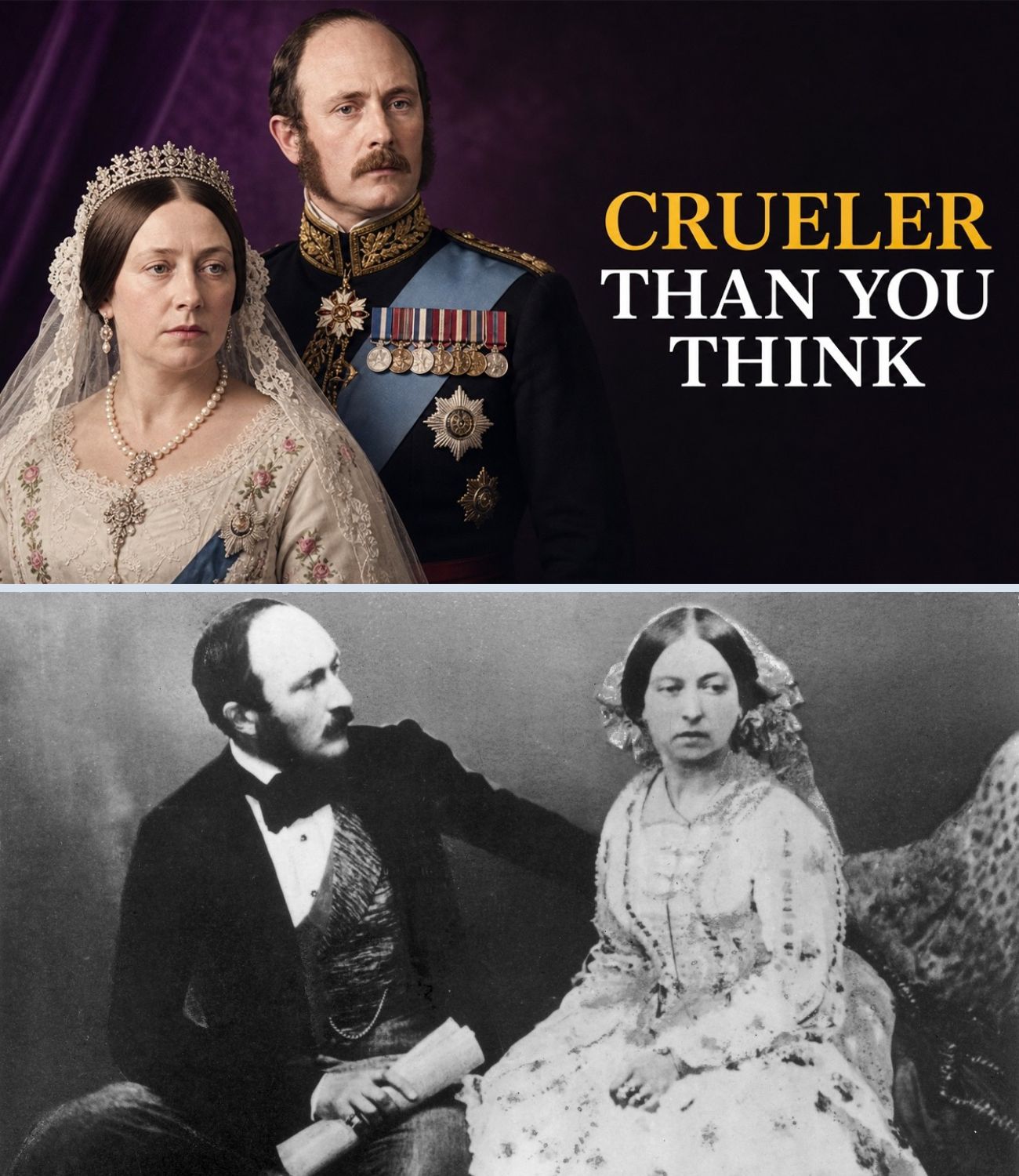
The wedding itself on the 10th of February 1840 at the Chapel Royal, St. James’s Palace, was the last time the power in this marriage was visibly, unambiguously hers. She chose everything. The dress was white satin woven in Spitalfields with a deep flounce of Honiton lace from Devon, a village industry that was collapsing and which she deliberately revived by ordering the flounce and then having the pattern destroyed so it could never be copied. A wedding dress as trade policy. The train ran 18 feet. She wore a wreath of orange blossom instead of a tiara, the Turkish diamonds the sultan had sent her, and a sapphire brooch Albert had given her the day before. The white dress is why every western bride since has worn white. She was not the first royal to marry in white, but she was the first one photographed by an entire press industry, and the image took.
The guest list is more revealing than the lace. She kept the Tories out almost entirely because she was still furious about the bedchamber business and she said openly she didn’t want them there. The Duke of Wellington had to be argued into an invitation. Her mother was present but marginal. Conroy was nowhere. This was not a national ceremony of reconciliation. It was a young woman using the most watched day of her life to settle scores in public with people who had spent a decade telling her what to do.
Three days later, she wrote her journal entry for the 13th of February. Ordinary domestic content: Albert helping her put on her stockings and then sitting and watching him shave. Small, silly, physically affectionate. The kind of thing a happy 20-year-old writes. You can read it today only because Lord Esher had typed transcripts made of the early volumes for a book of his own. It does not appear in the version her daughter Beatrice produced after her death. Beatrice copied the journals out by hand and burned the originals as she went, and that entry did not survive the copying. The earliest surviving evidence of what this marriage actually felt like from the inside is a passage somebody decided to remove. That’s the pattern of this marriage in miniature, and it started early.
Victoria was pregnant within weeks of the wedding and she hated it. She would spend the next 17 years pregnant nine times and she never made peace with any of it. Decades later, writing to her married daughter in Prussia, she called it the shadow side of marriage and told her plainly that she found babies unlovely and pregnancy a form of confinement. She was not a woman who wanted a large family. She got one anyway because there was no reliable way not to and because a queen who stopped producing heirs was failing at the job. Each pregnancy did something to the balance of power. It took her out of the room.
The first time was in the summer of 1840. A teenager named Edward Oxford fired two pistols at the royal carriage on Constitution Hill. Nobody was hurt. The pistols may not even have been loaded with ball, and the political effect was immediate. Parliament, suddenly aware that a pregnant queen might die and leave an infant on the throne, passed a Regency Act naming Albert as regent. Six months earlier, the Commons had refused him a title and cut his allowance. Now he was one accident away from running the country. He had been in England less than a year.
From there he moved steadily and he moved through paperwork. Anson, the private secretary Victoria had imposed on him, became his ally instead of her monitor. Stockmar, Uncle Leopold’s man, moved into the palace and wrote memoranda on how badly it was run. And he was right. The royal households were a museum of dead offices. One department was responsible for laying a fire and another for lighting it. Windows were cleaned on the inside by one authority and on the outside by a different one. Albert reorganized the whole thing, and while he was cutting waste, he was also learning where every key in the building was.
Then he took the boxes. The dispatch boxes were the queen’s daily contact with her government, every ministerial paper, every foreign dispatch. Albert began sitting beside her while she worked through them. He blotted her signatures. He drafted her replies. Within a few years, he had his own key. Victoria’s ministers noticed that the answers coming back from the palace had a German thoroughness to them, and that the handwriting was frequently not hers. She let him. That matters. She was not tricked. She had been dependent on Melbourne, and Melbourne was aging out of office. And Albert was cleverer than Melbourne, and unlike Melbourne, permanent. She wrote about how much easier everything was now that he helped.
What she did not agree to was the removal of Lehzen. The two of them detested each other from the start. Albert saw a middle-aged German governess with no constitutional standing running the private side of the palace and holding a claim on his wife’s loyalty that predated him. Lehzen saw a 20-year-old foreigner taking apart the household she had protected since Kensington. Albert wrote about her to his brother Ernst and called her “the hag.” To Stockmar, he was more clinical: Lehzen was “an intriguer drunk on power,” and Victoria—this is the line worth holding on to—had a naturally fine character that had been warped in many respects by wrong upbringing. There could be no improvement, he wrote, until Victoria saw Lehzen as she really was. Improvement. That is the vocabulary of a man who has decided his wife is a project.
The break came over a sick child. In the winter of 1841 into 1842, the infant Princess Royal was ill and not thriving. The nursery was Lehzen’s territory. Albert blamed her and blamed the doctor, and there was a serious quarrel. Rather than have it out loud, he did what he did for the rest of the marriage: he withdrew and put it in writing. In the surviving note, he told Victoria:
“Take the child away and do as she liked, and that if the child died, she would have it on her conscience.”
The child recovered. She grew up to be an empress. What did not recover was Lehzen’s position.
Albert arranged her departure in July 1842 without consulting his wife. And the reason presented to Victoria was Lehzen’s health. She needed rest. She wanted to go to Germany. It was all for the best. Stockmar was brought in to reassure the queen, and Victoria’s journal records that she was upset but comforted. Lehzen went along with it. She always protected Victoria, including from the knowledge of what was being done to her. On the morning of the 30th of September 1842, Lehzen left the palace without a farewell, leaving a letter behind. She took an £800 pension and a carriage and settled with her sister at Bückeburg, where she covered the walls of her house with portraits of the queen. They wrote to each other for the rest of Lehzen’s life, and Victoria visited her twice on trips to Germany.
The public got two versions, and neither was true. Charles Greville, who knew everyone, noted in his diary that she was leaving for her health, as she said, for five or six months, and that nobody expected her back. The Times reported a lady visiting friends abroad. Stockmar, years later, was the one who said it plainly: It had not been easy for the prince to get rid of her, and if she’d been sensible enough to submit to him, she could have stayed in the palace until she died. Submit. Same idea, different word.
So, here is the queen of the largest empire on earth, four years into her marriage, and the two people who raised her have both been removed from her daily life. Her mother by her own choice, her governess by her husband’s. Conroy’s system had wanted her isolated and controlled. Albert’s system produced isolation and control, too. But it came with tenderness, competence, shared work, and nine children. Which is why nobody at the time called it what it was, and why she didn’t either.
And he built her houses she could not leave. Osborne on the Isle of Wight, bought in 1845 and rebuilt to Albert’s design with the builder Thomas Cubitt. Balmoral, leased in 1848 and bought outright in 1852, remodeled to Albert’s specifications with tartan on more surfaces than a person would think possible. They were paid for privately, which is exactly the point. They were not state property. They belonged to the family and they were far from London, from ministers, from society, from anyone. He sold the Brighton Pavilion to help fund Osborne. The queen’s private life was relocated to islands and highlands on estates he designed on a timetable he set. She loved them. She loved them for the rest of her life, which is the part that makes this hard to narrate as a simple crime because there was real happiness in it. The letters and the journals are not the record of a miserable woman. They are the record of a woman who found the arrangement restrictive and adored the man imposing it, sometimes in the same sentence.
He was genuinely gifted. He reformed the royal finances, chaired commissions, took on the housing of the working poor when that was not fashionable. And he was patient with the children in a way she was not. And in 1851, he pulled off the single most successful public project of the century. The Great Exhibition was his. He drove it through committees and hostile newspapers that predicted riots, foreign agitators, and the collapse of the glass building on everyone’s heads. On the 1st of May 1851, the Crystal Palace opened in Hyde Park, and 6 million people came through it over 5 months, and it made a profit. And the profit bought the land in South Kensington that became the museums. Victoria’s journal that day is the happiest writing she ever produced. She was overwhelmed. She wrote:
“The day belonged to her beloved husband and it was the proudest and happiest of her life.”
She went back to the exhibition dozens of times.
Look at what that success actually did to the marriage. It confirmed him as the serious one. It confirmed her as the wife of a great man, which is precisely the myth this story is about. He was by 1851 doing the work of a monarch without the standing of one, and the resentment that produced never left him. The English press still called him “the German.” Six years later in 1857, the problem was finally addressed, and how it was addressed tells you where the power actually sat. She could not persuade Parliament to give him a title. So she gave him one herself by letters patent in June 1857: Prince Consort, created by his wife because no other authority in the country would do it. 17 years of marriage and the man who ran her correspondence chose her houses, dismissed her governess, and blotted her signature still held nothing except what she personally handed him. That was the marriage: two people who could not stop being each other’s only real source of authority.
By then he was exhausted and something in his health was already wrong. He was doing the boxes, the estates, the commissions, the children’s education, and increasingly her business as well. He had begun telling Stockmar he did not expect to live long and that he would not cling to life. Victoria was still by every account physically devoted to him and emotionally volatile in ways he had spent two decades trying to regulate. Then in the space of nine months in 1861, she lost her mother, her husband, and any capacity to forgive her eldest son.
The Duchess of Kent died at Frogmore on the 16th of March 1861, and the reconciliation had already happened years earlier. Albert had engineered that too, quietly bringing mother and daughter back into contact after the Conroy years. Going through her mother’s papers, Victoria found the letters and the keepsakes of a woman who had loved her, and it broke something. She collapsed into a grief her household found excessive and her husband found alarming. He wrote to their daughter in Prussia about it in terms that were sympathetic and clinical at once. He also took over her work entirely for weeks because someone had to. That word again, her feelings treated as a condition to be managed.
There is a thread running through Albert’s private correspondence about Victoria’s temperament, and it is the ugliest thing in this story. When she raged, he did not treat it as anger. He treated it as inheritance. Her grandfather, George III, had lost his reason, and the fear of that madness reappearing sat under the surface of the family. Albert, in his memoranda to her after quarrels, told her that her self-control was the problem, that she was harming herself, that he would leave the room rather than engage. Several biographers have concluded that he deliberately used the family history as leverage. Others read it as a genuinely frightened husband trying to protect a wife he thought was ill. The letters support both readings, and the one she burned would probably have settled it. She was not mad. She was a woman with a formidable temper and no legal, social, or practical means of ever being alone.
Then came the Curragh. That autumn, the Prince of Wales, Bertie, 19 and by universal family agreement a disappointment, was sent to army camp in Ireland. His fellow officers put an actress named Nelly Clifton in his bed. The story reached London in November, and Albert received it as a catastrophe. He wrote to his son a letter of enormous, grinding misery, telling him he had inflicted the greatest pain of his life. He was already unwell. On the 25th of November, he traveled to Cambridge anyway and walked with Bertie in the rain for hours having it out.
He died at Windsor on the 14th of December 1861 at 42. The official cause was typhoid fever. Modern historians are divided. Several argue the sheer length of his decline points to chronic abdominal disease, Crohn’s, or a cancer with typhoid as a final infection. The Victorian public was told typhoid and bad drains. Victoria was told something else by herself: she decided Bertie had killed his father. She wrote to her daughter that she never could and never would look at him without a shudder. She sent him abroad. She kept him out of state business for decades, which is one reason he arrived on the throne in 1901 as a 60-year-old man with no experience of governing.
And then the widow did something nobody expected. She disappeared and she did not come back for years. She refused to open parliament in person. She would not hold drawing rooms. She moved the court to Osborne and Balmoral and made her ministers travel hundreds of miles to Scotland to conduct the business of an empire in a house full of tartan. Punch ran mock advertisements for a missing monarch. Republican clubs multiplied. In 1871, a pamphlet was circulating that itemized what the country was paying for a queen who wouldn’t appear.
Everyone read this as prostration. Read it again. A woman who had never in her life been permitted to be alone, whose mother controlled her bedroom and whose husband controlled her correspondence, spent the next decade refusing to be looked at, and dared the country to make her. The blue room at Windsor, where Albert died, was kept as it had been. Hot water was brought up. His clothes were laid out. A photograph of him on his deathbed hung above her side of the bed. She commissioned the mausoleum at Frogmore within days and had her own effigy carved in 1862 at 43, so that when she was finally laid beside him, she would be his age. That effigy sat in storage for 39 years.
The shrine is real. So is what she built next to it. She started publishing. In 1868, she brought out Leaves from the Journal of Our Life in the Highlands, her own diary, lightly dressed, about picnics and gillies and Albert in Scotland, and it sold enormously, far better than the establishment thought decent. She commissioned General Grey’s authorized account of Albert’s early years in 1867 and then Theodore Martin’s five-volume life published between 1875 and 1880, and she supervised it line by line. Martin was working for her. She chose the documents. She corrected the manuscript. The woman whose journal entries would later be censored spent 20 years censoring her own husband into a saint.
And she took a servant into the center of her life. John Brown, the Balmoral gillie, came south in 1865 and became indispensable. He handled her physically and conversationally in a way nobody at court dared. He was blunt with her. He called her “woman.” Her children loathed him. The papers called her Mrs. Brown. And a satirical pamphlet imagined a Highland marriage. There is no evidence they married. The claim that a Scottish minister confessed to performing a secret ceremony surfaced long afterward and rests on thin ground, and historians remain split on whether the relationship was romantic at all. What is documented is the arrangement. She kept a man beside her who was answerable only to her, whom her family could not remove for 18 years in direct defiance of everyone whose approval she had spent her life managing. She had watched her husband dismiss the one servant she loved. She never let it happen again.
She also came back out. Disraeli understood what to sell her, and in 1876 she became Empress of India, and by the jubilees of 1887 and 1897 the invisible widow had been rebuilt as the mother of the world’s largest empire. She was ruling ministers by then in a way Albert never managed because she outlasted all of them. So what was the marriage finally? Not a love story and not a captivity. It was a merger between two people who had no one else. She gave him the only power he ever held and he gave her a system that ran her life, and both of them were completely dependent on the arrangement. Neither could leave.
Then came the archive, and the archive is where the myth was finished. Victoria left instructions that her journals be transcribed by her youngest daughter. Beatrice, the one child never allowed a life of her own, spent more than 30 years copying them out by hand, removing anything that might cause pain and burning the originals as she finished each volume. She completed 111 volumes. George V and Queen Mary deplored it and did not stop her. What survives in Victoria’s own hand covers her girlhood and almost nothing after. Bertie as king destroyed the John Brown material and swept away the statues. In 1907, two men, Arthur Benson and Lord Esher, published a selection of her letters that amounted to a tiny fraction of what existed, and they kept the politics and cut the domestic life almost entirely. Four separate people edited this woman. Three of them were doing what she asked because she had planned for it.
In December 1897, she wrote out her funeral instructions. White dress and a white veil over her face. Her wedding veil, the same lace from the 1840 portrait, the one she’d worn again for the Diamond Jubilee that year. And she wrote a second private list for her doctor, Sir James Reid, because she knew her family would object. She died at Osborne in January 1901. Reid had charge of the body until the coffin was sealed. In went Albert’s dressing gown and a plaster cast of his hand. Then, when the family had left the room, Reid carried out the rest. On the third finger of her right hand, he placed a plain gold wedding ring that had belonged to John Brown’s mother. Into her left hand, he put a photograph of Brown and a lock of his hair wrapped in tissue paper and covered it over with the flowers Queen Alexandra had brought.
Look at the portrait again. The veil, the orange blossom, the gift for her husband who would shortly send her governess away in the dark and tell her it was a health matter. She wore that veil to her grave over a hand nobody was allowed to see.
You Might Also Enjoy

“We Thought They Would Negotiate”—What Argentine Soldiers Said When The British Attacked Goose Green

“You’ll Never Finish My Ruck March, Limey” — US Sergeant Who Challenged the SAS, Then Fell Out First






