SHE FOLLOWED ME! Rory McIlroy SHUTS DOWN Meg at His £9M Wentworth Mansion, WARNS Harry About Prenup
EXCLUSIVE: The Wentworth Showdown—How a Shut Door and a Secret Warning Pushed Harry and Meghan to the Brink
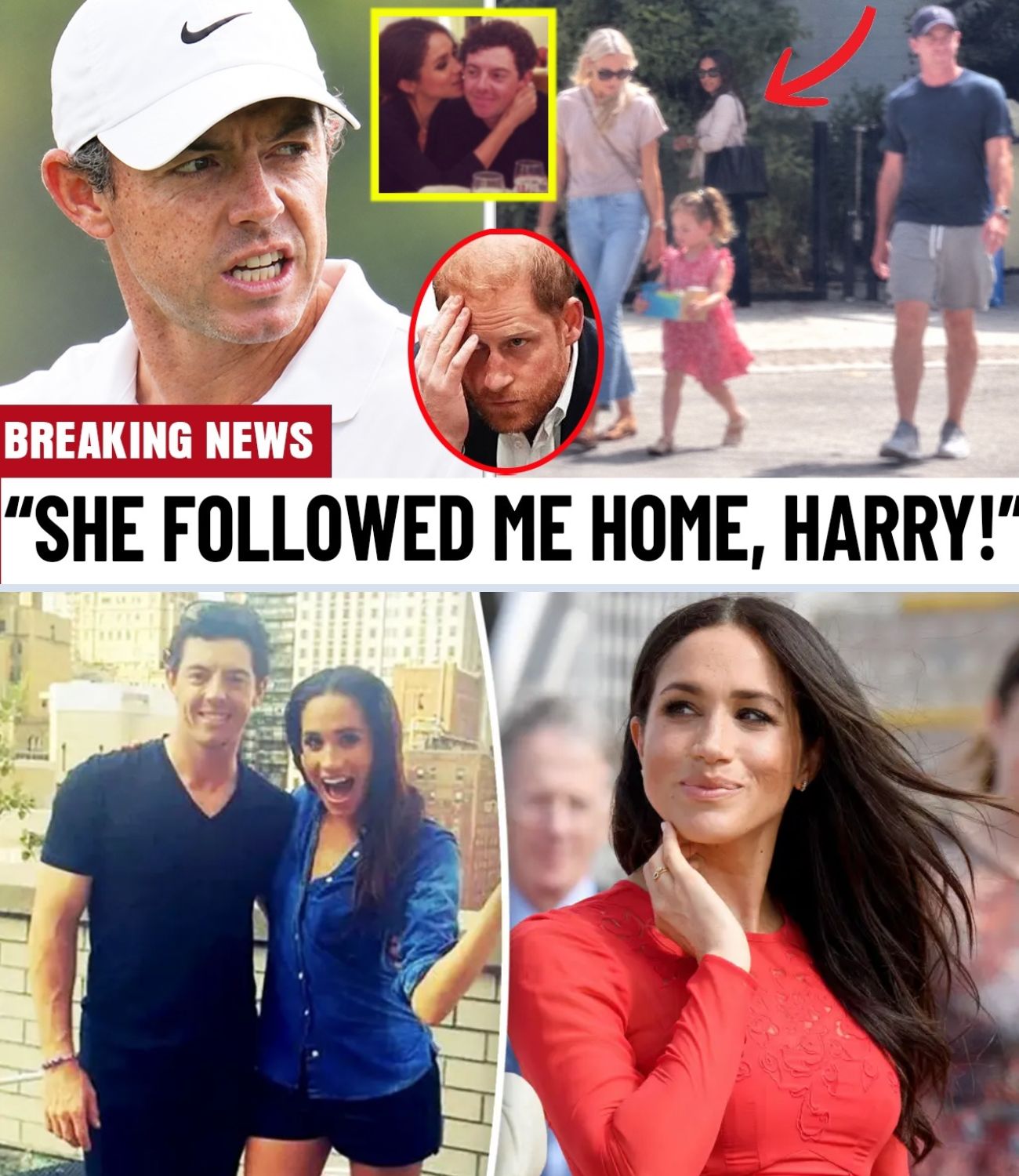
The first thing Meghan Markle noticed was not Rory McIlroy standing in the doorway of his sprawling £9 million Wentworth estate. It was his wife, Erica Stoll, watching with steely resolve from the polished hallway behind him. The second thing the Duchess of Sussex noticed was that neither of them was smiling. By the time Meghan fully grasped why the formidable iron gates were closing, they had already shut firmly behind her car.
The afternoon she had painstakingly arranged as a discreet, charming reunion was about to become a staggering humiliation—one she could neither charm her way out of nor easily explain to her husband. Rory had not invited her. That was the singular, devastating point he intended to make before another word was exchanged on his doorstep.
“Meghan,” he said, keeping one firm hand on the open door, his voice devoid of the transatlantic warmth she had anticipated. “You were told this wasn’t a good time.”
She deployed the kind of warm, practised laugh that had once made awkward Hollywood introductions look entirely effortless. “Rory, please. I was nearby. I thought ten minutes between old friends couldn’t possibly cause a crisis.”
“Then you should have called.”
“I did call. You called somebody who works with somebody who knows me. That’s not the same thing.”
The flawless smile remained plastered on her face for another agonising second. Then, it vanished completely. Beyond the doorway lay a pristine hall, framed family photographs, and the fiercely guarded quiet life Rory had spent years protecting from the relentless noise of fame. Meghan had arrived prepared to discuss a potential property near Wentworth, perhaps local schools, and the practical, glittering advantages of being closer to the London elite. She had absolutely not prepared to be treated like an unwelcome, intrusive stranger.
Erica moved forward. She didn’t step up to join a shouting match; she simply stood shoulder-to-shoulder with her husband. She delivered only four words, but they carried the weight of a slammed vault.
“Our daughter is home.”
Meghan glanced toward the hall, attempting a pivot to graciousness. “Of course, I would never disturb her.”
“Then don’t,” Erica answered.
There was no shouting. For Meghan, that made the exchange infinitely worse. A raised voice could be easily dismissed as temper, and a temper could eventually be forgiven. Calm, unblinking refusal left her with absolutely nowhere to hide.
Rory stepped outside, drawing the heavy oak door almost shut behind him, facing Meghan alone on the stone path. He had one piercing question. “Did Harry know you were coming here?”
Meghan looked at him, the silence stretching. She didn’t answer.
Rory’s expression shifted. He had his answer. “Because I spoke to Harry,” he said, his voice lowering to a sharp register. “And I told him this house was not available. Not as a meeting place, not as a temporary address, not as the beginning of some arrangement you haven’t explained to Erica or me.”
“Harry doesn’t make all my decisions,” she fired back.
“No,” Rory replied coolly. “But he’s the one who will have to live with the consequences of them.”
It was the first time that afternoon Meghan looked genuinely, profoundly unsettled. Rory, seizing the momentum, continued before she could mount a defence. “I told him something else. I told him to sit down with an independent lawyer, go through every single agreement he has signed, and work out exactly what belongs to him, what belongs to your businesses, and what he has already sacrificed. I told him that if there is a prenuptial agreement, he should read every page of it again. And I told him to stop confusing loyalty with an obligation to surrender everything.”
Meghan’s eyes narrowed. “You have no right to interfere in my marriage.”
“I have every right to decide who comes to my front door.”
For a long, tense moment, neither spoke. The Surrey air felt suddenly frigid. Then Erica opened the door just a fraction behind Rory, placed a hand lightly on his arm, and said, “That’s enough.” It was not a plea for her husband to step down; it was a devastating final declaration that Meghan would never be invited inside.
Rory nodded. Meghan turned sharply towards her waiting car, keeping her head defiantly high until she reached the passenger door. Only then did she look back. “Harry will hear about this.”
“He should,” Rory shot back. “He should hear the whole thing.”
What made this encounter so intensely explosive was not the refusal itself. Wealthy, high-profile households refuse unexpected visitors every single day. It was the heavy history hanging over that particular Surrey doorstep. It was a history that began bizarrely with a bucket of ice water in New York and was now ending with a Prince whose old friendships had become disastrously entangled with a marriage, a sprawling business empire, and a desperate need to recover something vital he had lost along the way.
Twelve years earlier, Rory McIlroy and Meghan Markle had inhabited very different echelons of celebrity. In the sweltering summer of 2014, he was the golden boy of golf, internationally successful, and newly free from a high-profile engagement. Meghan was a working actress on Suits, ambitious, climbing the ladder, and eagerly building a network far beyond basic cable television. The ALS Ice Bucket Challenge had provided an unlikely intersection. Rory nominated her, she accepted, and the famously playful video of him tipping freezing water over her head became a viral moment.
To Rory, it was a fleeting bit of charity PR. Meghan, it seemed, had convinced herself that this distant familiarity was a golden ticket that never expired.
Currently residing with Harry and their children in the Cotswolds, Meghan saw the picturesque countryside as a beautiful, albeit temporary, retreat from California. The public PR line was simple: family, good schools, privacy, and a quieter life. Behind the glossy, highly curated photographs, however, the couple were wrestling with the exact same crises they had tried to leave behind in America. Meghan craved proximity to power. London meant heavy-hitting advisers, deep-pocketed investors, A-list events, and a different stratosphere of social opportunity. A gated estate in Wentworth meant prestige, ultimate discretion, and wealthy neighbours accustomed to brokering massive deals away from the prying lenses of the paparazzi.
Rory McIlroy, sitting squarely at the epicentre of that elite world, appeared to offer a convenient, familiar point of entry.
She had started with a message. Friendly, dripping with nostalgia. She mentioned the ice bucket challenge, asked fondly after Erica and the children, and casually suggested they catch up now that she was back on British soil. Rory read it between gruelling training sessions and left it decisively unanswered. Another message followed via an intermediary, this one explicitly about properties and the “difficulties” of finding a secure location for the Sussex children. Rory asked his office to respond politely but firmly: the family was not available to assist.
Harry knew absolutely none of this when Rory’s name flashed on his phone.
The call came in the early evening. Harry was standing by a window overlooking the rolling Cotswolds, watching the dying light fall over fields that looked far too peaceful for the bitter argument he had just survived with his wife. Seeing Rory’s name brought a wave of relief. An old mate from the real world, far beyond the suffocating grip of the Palace, felt like a lifeline compared to dealing with yet another slick Hollywood lawyer or stiff royal official.
They exchanged standard pleasantries. Rory asked after Archie and Lilibet. Harry asked about the golf tour. Then, the temperature of the call plummeted.
“I’ve been getting messages about Wentworth,” Rory said.
Harry frowned, confused. “What sort of messages? About property?”
“About introductions. About whether your family could be closer to us. Meghan’s been looking at options. Harry, I’m not offering our home or our contacts. Erica and I have worked bloody hard to make this place private. I need you to understand that.”
Harry felt the familiar, hot prickle of defensive irritation—the sensation of being judged before he even had a chance to explain himself. “Nobody’s asking to move into your spare bedroom.”
“Good. Then there shouldn’t be a problem when I say no.”
A heavy silence followed. Rory could have hung up, washed his hands of the drama, and walked away. Instead, he asked Harry a question that cut right to the bone. “When was the last time you looked at your own financial position without somebody else telling you what it meant?”
Harry let out a sharp, defensive laugh. “That’s a strange question from a golfer.”
“It’s a question from a man who knows exactly how fast money can disappear when everybody around you has a different plan for spending it,” Rory countered, his tone deadly serious. “Find a lawyer who answers only to you. Read your agreements. Understand the commitments you’re tied to. And ask yourself whether the life you have right now is the life you actually thought you were choosing.”
The very next morning, Meghan breezed into the kitchen and announced she had an appointment near Virginia Water. Harry, buried in dull correspondence from his sprawling legal team, barely glanced up. He asked if she wanted company. She brushed him off. “No, it would be easier alone.” He kissed her cheek, returned to his endless paperwork, and entirely failed to register that she hadn’t named whose house she was targeting.
When the disaster at the Wentworth gates concluded, Rory walked back into his sprawling kitchen to find Erica staring into a mug of cold tea.
“Is she gone?” Erica asked. “Yes.” “Will she come back?” “No. You can’t know that, but I’ll make sure she understands.”
Rory pulled out his phone and fired off a blunt text to Harry, asking for an urgent call. He didn’t embellish. He didn’t mention Meghan’s entitled tone or the frosty standoff on the path. He simply stated that there had been an unexpected visit, the household had declined entry, and they needed to speak before things spiralled.
Harry rang back within seconds. “What happened?”
“Your wife came to my house. She told me she had a meeting. She didn’t have one with me.”
“Did you let her in?”
“No.”
Harry’s voice hardened, the royal prince suddenly emerging. “You left her standing outside.”
“I spoke to her outside. Erica was here. Our daughter was home. We had already said no.”
“She’s my wife, Rory.”
“And Erica is mine.”
The brutal simplicity of the answer stopped Harry dead in his tracks. It was an immovable boundary. He walked into his study and shut the heavy oak door.
“I’m not calling to humiliate her,” Rory continued, his voice softening slightly. “I’m calling because I think you deserve to know that a refusal was given, and she came anyway.”
Harry stared blankly at the wall. “What exactly did she want?”
“She talked about property, being nearby, the children, the difficulties of settling in. But she didn’t tell me what she expected me to do. That’s why I couldn’t agree to anything. She’s under pressure.”
“So are you,” Harry muttered. “It’s complicated.”
“I know. That’s exactly why I told you to get independent advice. If there’s an agreement, know what it says. If there isn’t, know what that means. Don’t let anybody—including me—tell you what your position is without a lawyer looking at the actual documents.”
When Meghan finally returned to the Cotswolds, running on pure adrenaline and simmering rage, she found Harry waiting in the sitting room. The silence in the house was deafening. On the antique coffee table lay a printed email from Rory, and beside it, a thick, ominous folder of financial and legal documents Harry had hastily ordered his core advisers to assemble.
Meghan froze just inside the doorway. “You spoke to him.”
“He called me.”
“Of course he did. He wanted to spin his version first.”
Harry finally looked up, his eyes exhausted. “Why didn’t you tell me you were going there?”
“I told you I had a meeting.”
“You didn’t have a meeting, Meghan. You went to speak to someone I’ve known for years, and he told you no.”
“I wanted to understand why!”
Harry rubbed his temples. “That’s exactly the problem. You decided his ‘no’ wasn’t an answer.”
Meghan dropped her designer bag onto an armchair. “And now you’re taking his side.”
“I’m trying to understand what happened.”
“What happened is that a man who once called me a friend treated me like an absolute intruder. His wife stood there looking at me as if I had crawled out of the gutter to steal the silver, and then he had the sheer nerve to lecture you about our marriage.”
Harry didn’t take the bait. Meghan’s eyes drifted to the table, landing on the thick manila folder. She instantly understood that Rory’s stinging words had travelled far beyond the Wentworth gates.
“What is that?” she demanded. “Documents.” “Whose documents?” “Ours. Mine. The businesses. I want to know where everything stands.”
“You know where everything stands,” she snapped. “I know what I’m told in endless PR meetings. That’s not the same thing.”
The sentence landed with the devastating force of a physical blow. Meghan stepped toward the table, reaching for the folder, but Harry placed his hand firmly over it. He didn’t snatch it away, nor did he accuse her of financial foul play. He just held his ground. “I need to read it myself,” he said quietly.
“What do you think you’re going to find?” she asked, her voice trembling slightly. “I don’t know. That’s why I’m looking.”
That night, Prince Harry sat alone in the dark, bathed only in the yellow glow of a reading lamp, poring over the papers. There were no cinematic betrayals hidden in the margins. No secret offshore accounts or forged signatures. What truly terrified him was the sheer accumulation of their choices. Layer upon layer of corporate structures, massive overheads, PR retainers, and desperate projections. Each contract had seemed like a minor compromise at the time. Bound together, they described a life that required relentless, exhausting hustle just to keep the lights on. Was he actually free, or had he just swapped one golden cage for a heavily mortgaged corporate one?
The next day, Harry arranged a covert consultation with a completely independent London solicitor. No Hollywood agents. No Sussex-approved crisis managers. Just a man wanting to understand his own life.
When Meghan found out, she confronted him, calendar printout in hand. “Who is this lawyer? Independent of whom? Both of us? You hired someone without telling me because a golfer told you to?”
“I did it because I should have done it years ago,” Harry replied evenly.
“You sound exactly like your family,” she hissed—the ultimate trump card she had used for years to bring him back into line.
But this time, Harry didn’t flinch. “Sometimes my family was wrong. Sometimes they were right. I need to be allowed to work out the bloody difference.”
Days later, away from the prying eyes of the press, Harry met Rory one last time at a spectacularly ordinary country hotel. No cameras, no staff, no publicists. Just two men and a pot of untouched coffee.
“You think I’ve made a mess of everything,” Harry said finally.
Rory shook his head. “I think you’ve made decisions that cost far more than you ever expected. Making a mistake and being a mistake aren’t the same thing. You left the UK because you thought it was right for your family. But you have to be brutally honest about what you lost to get here.”
Harry’s jaw locked. “Everyone talks about what I lost. Tell me what I gained.”
Rory didn’t flinch. “You get to decide what happens to you now. Do you actually do that, Harry?”
Harry looked down at his hands. “Not always.”
“Then start there,” Rory advised softly. “Not with a headline, not with a Netflix deal. With the decisions you can actually control. Talk to Meghan about what life she wants when the cameras are turned off. And tell her what you want. If they don’t match, at least you’re finally dealing with the truth.”
Harry drove back to the Cotswolds in absolute silence. He walked through the front door to find Meghan surrounded by yet another mountain of proposals for a new media venture. She looked up, her face instantly hardening. “You went back to him.”
“I went to talk about me. About us.”
Harry sat down. For the first time in years, he didn’t let the conversation spiral into a victimhood competition. He asked the single most dangerous question of their marriage: “What do you want our life to look like in five years?”
Meghan blinked, entirely disarmed. She had braced for a screaming match about Wentworth. “I want the children secure. I want us successful. I want to stop having to explain ourselves.”
“Where do you want to live?” “Somewhere we can build things.” “Do you want to keep building things if it means we never have a single quiet year?” Harry asked desperately. “I want a life, Meghan. Not a PR strategy for defending the last mistake and financing the next one.”
She stared at him, aghast. “You think I’ve turned our marriage into a business?”
“I think we’ve both let the business become much bigger than the marriage.”
They talked long into the night. Voices were raised, tears were shed. They spoke of the isolating, bone-deep loneliness of the Palace, and the equally terrifying isolation of Hollywood independence. They didn’t solve everything. But the next morning, Meghan took the glossy brochures for the Wentworth estate and quietly buried them in the bottom of a drawer.
Rory McIlroy had utterly refused to open his doors to the Sussexes. He hadn’t promised to rescue a Prince, nor had he offered them a golden ticket into British high society. Instead, he had offered something far more valuable, and far more painful: a boundary, a hard question, and a mirror. And for the first time since leaving the Royal Family, Prince Harry had finally found the courage to look into it.
You Might Also Enjoy

“We Thought They Would Negotiate”—What Argentine Soldiers Said When The British Attacked Goose Green

“You’ll Never Finish My Ruck March, Limey” — US Sergeant Who Challenged the SAS, Then Fell Out First






