“SPITTING BRICKS!” Prince William FURY at Earl Spencer & Prince Harry exposed as Tina Brown speaks
SPITTING BRICKS: Prince William’s Fury Explodes as Tina Brown and Lady Colin Campbell Shred Earl Spencer’s ‘Swan Song’ Lies and Expose the Ultimate Royal Betrayal
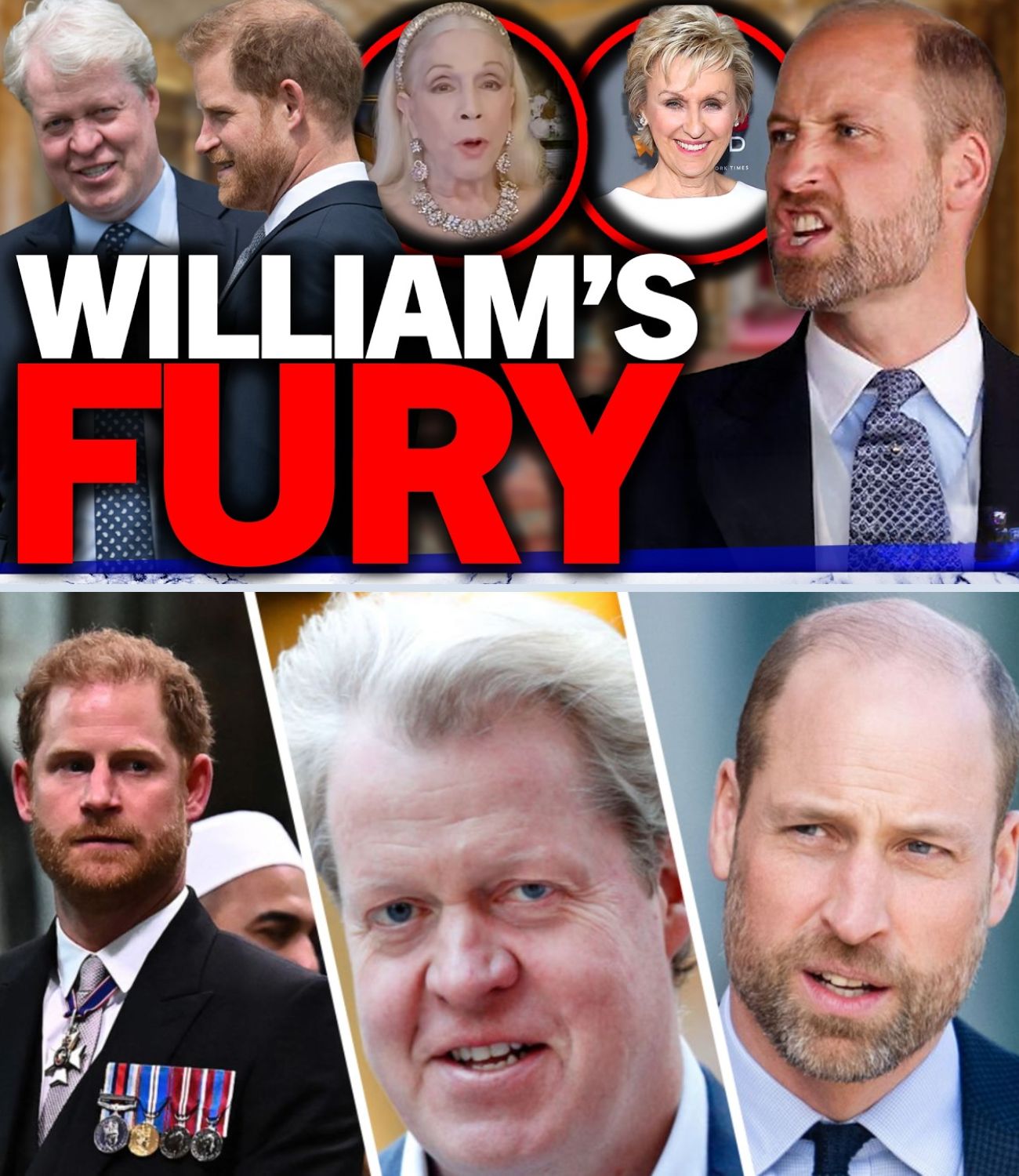
In the rarefied and often cut-throat world of British aristocratic publishing, few events generate quite the same level of incandescent fury as a self-serving memoir penned by a member of the inner circle. When royal biographer Tina Brown sat down for a high-profile interview with Princess Diana’s younger brother, Earl Charles Spencer, to discuss his latest literary offering, Swan Song, observers anticipated a certain amount of theatrical smoothing over of past family trauma. What actually transpired on screen, however, was nothing short of an absolute public execution.
Dissected forensically on Dan Wootton’s Outspoken platform by the indomitable Lady Colin Campbell—affectionately known to royal watchers as Lady C—the interview laid bare a staggering catalogue of falsehoods, historical revisions, and breathtaking hypocrisy. At the epicentre of this boiling scandal is Prince William, who is reportedly spitting bricks over what he perceives as a profound, unforgivable betrayal by both his maternal uncle and his estranged brother, Prince Harry.
As the paper trails are scrutinized and the gloss is stripped away from decades of carefully cultivated victimhood, a darker, far more complex reality is emerging. This is the definitive account of how Earl Spencer’s ill-fated media blitz unravelled, igniting a fresh war at the heart of the British establishment.
Prince William’s Incandescent Rage: The Swan Song Betrayal
To understand the sheer magnitude of the frostbite currently gripping Kensington Palace, one must first examine how the inner workings of the Spencer family are perceived by the future King. Prince William has long maintained an obsessive, fiercely guarded boundary when it comes to the privacy of his mother’s memory and his own immediate family. For months, whispers had circulated through London society that Earl Spencer was preparing a new book that touched upon the shadows of the past.
Yet, when Tina Brown pressed the Earl during their interview regarding how Prince William and Prince Harry reacted to the news of Swan Song, the response was evasive, slippery, and revealing. Spencer awkwardly attempted to claim that out of respect for their privacy, he would not disclose exact conversations, insisting that everything was “normal” and that they were accustomed to him operating on his own terms.
Behind closed doors, the reality was entirely antithetical to the Earl’s breezy assurances. Sources close to the royal household confirmed that Prince William was utterly blindsided and incandescent with rage. To the Prince of Wales, publishing speculative or revisionist accounts that drag his late mother’s tumultuous marriage back into the public glare—without so much as a respectful consultation with her direct heirs—constitutes a complete breach of trust.
William views the book not as a tribute, but as a opportunistic commercial enterprise that weaponizes family history for personal relevance. When combined with Earl Spencer’s ongoing alignment with Prince Harry’s transatlantic mudslinging, the Prince of Wales considers it an active act of hostility. The family lines, already strained to breaking point, have hardened into impenetrable steel.
Rewriting History: Who Really Pursued Whom?
Perhaps the most egregious element of Earl Spencer’s media tour has been his relentless effort to paint King Charles III as an indifferent, almost tyrannical figure who allegedly celebrated Diana’s death like a lottery win, while portraying his late sister as a perpetual, blameless victim trapped by a ruthless institution. During his conversation with Tina Brown, Spencer leaned heavily into this tired narrative, even dragging up the infamous video of King Charles losing his temper over a leaking fountain pen during the accession period—conveniently omitting the crushing weight of grief the new monarch was carrying at the exact moment he lost his mother.
Lady Colin Campbell, possessing the institutional memory of someone who chronicled the 1980s and 90s royal court before mainstream biographers even grasped the players, wasted no time dismantling these falsehoods piece by piece.
“He is a liar, and he lies with astonishing ease,” Lady C remarked during her blistering analysis on Outspoken.
For decades, the hallowed public myth has maintained that a naive, innocent Diana Spencer was hunted down and pushed into an unequal marriage by a cold royal establishment. But the historical record, backed by those who lived through the era, paints a radically different picture. It was, in truth, Diana who actively pursued Charles.
The courtship began at a Sussex estate party hosted by Robert de Passe—whose wife, Philippa, served as one of the Queen’s ladies-in-waiting, and whose family was deeply embedded in the royal orbit. As Charles sat quietly on a bale of hay following the tragic assassination of Lord Mountbatten, a young Diana approached him. According to accounts drawn directly from Diana’s own admissions, she looked at the grieving prince and said, “Oh, sir, I saw you at Lord Mountbatten’s funeral, you looked so lonely, and my heart went out to you.”
Knowing Charles’s vulnerability to sincere sympathy, the gesture struck a deep chord. From there, the Spencer family machinery swung into high gear. Robert Fellowes—Diana’s brother-in-law, who served as the Queen’s assistant private secretary—helped facilitate her introduction into the inner fold at Balmoral. Diana famously boasted of passing the rigorous “Balmoral test,” feigning an ardent passion for country sports, fishing, stalking, and rural isolation.
Yet, the moment the engagement ring was secured, the script changed entirely. To watch Earl Spencer now sanitise this history—erasing Diana’s own agency and aggressive pursuit of the Prince of Wales while casting her brother as her heroic protector—is viewed by royal historians as an insult to the truth.
The Althorp Agony: How Earl Spencer Locked the Door on Diana
If Earl Spencer’s historical revisionism regarding the engagement is disingenuous, his recounting of his relationship with Diana in the years immediately preceding her death is nothing short of hypocritical.
During the interview, Tina Brown pressed Spencer on a deeply painful chapter of family history: the period following Diana’s divorce from Charles when she sought refuge. Hounded relentlessly by predatory tabloid press packs and desperate for a quiet sanctuary, Diana formally asked her brother if she could move into the Garden House on the ancestral Althorp estate. It was a modest, three-room dwelling where she hoped to find peace.
Spencer famously turned her down, citing security concerns and logistics. In his book and subsequent interviews, he attempted to launder this decision as an act of protective prudence, claiming local police warned him that the house was too close to the road and vulnerable to paparazzi or terrorists.
Lady C and legal sources exposed the full rot behind that excuse. The truth, revealed through court documents and contemporaneous letters, is far harsher. When Diana made her desperate plea for shelter, Spencer did not simply convey police advice; he treated his own sister like an incoming commercial tenant. Archives show that while he offered alternative properties on the sprawling estate, he made it abundantly clear in writing that she would have to pay full commercial rent for them.
Worse still, evidence emerged during legal disclosures that Diana had written him a deeply personal, desperate letter during one of their periods of alienation, which Spencer unceremoniously returned to her unopened. Even more damning, newly surfaced accounts from family staff indicated that Spencer’s own mother had warned him prior to Diana’s requests: “Make sure you don’t give it to her. It will be a complete disaster.” In choosing to heed cold administrative caution—and later capitalizing on her tragic memory for biographical profit—Earl Spencer demonstrated a callous self-interest that has left those who truly loved Diana sickened.
Piers Morgan and the Legal Minefield of Publishing Lies
While Earl Spencer attempts to style himself as an elder statesman of aristocratic decorum, his reckless disregard for the truth has landed him squarely in the crosshairs of aggressive legal retaliation.
During his press tour for Swan Song, Spencer made the brazen, easily disprovable claim that outspoken broadcaster Piers Morgan was not taking legal action against him. The assertion was designed to project an air of untouchable impunity, suggesting that critics questioning his factual accuracy were merely barking into the wind.
The response from Piers Morgan was swift, merciless, and backed by irrefutable documentary evidence. Morgan’s legal representatives at the powerhouse firm Shillings immediately thrust the actual correspondence between their offices and Penguin Random House—the publishing giant behind Swan Song—into the public domain. The letters detailed clear warnings regarding defamatory falsehoods contained within Spencer’s text, specifically targeting the Earl’s distortions surrounding historical interactions and editorial timelines.
Legal experts note that while libel laws in the United Kingdom present high hurdles regarding proof of financial loss, the publication of blatant untruths by mainstream publishing houses creates a ticking time bomb. Furthermore, as Lady C pointed out, if the matter were ever foolishly dragged into an open courtroom, it could inadvertently throw open Pandora’s box, potentially dragging figures like Prince Harry into depositions to testify on related privacy and media claims—a prospect that terrifies both the publisher and the Sussex camp. Spencer’s habit of casually fabricating narratives for dramatic effect has finally caught up with him, leaving his publishers scrambling to contain the fallout.
Press Manipulation and the Hypocrisy of the Aristocracy
Perhaps the most glaring irony of the entire Swan Song promotional campaign is the pious moralizing over media manipulation. Earl Spencer spent substantial airtime decrying the aggressive tactics of the British tabloid press—specifically targeting outlets like the Daily Mail—while lamenting that his words were twisted or that publishers forced his hand regarding serialization.
Here, too, the Earl’s narrative collapsed under basic professional scrutiny. Publishing industry insiders were quick to point out a fundamental rule of authorial contracts: the final decision regarding where a book is serialized in extracts always rests entirely with the author. A publisher may negotiate terms, but an author holds absolute veto power over the venue. For instance, an author hailing from Merseyside would instantly veto serialization in The Sun due to the city’s fierce, historic boycott over the Hillsborough disaster.
For Spencer to whine that unflattering excerpts landed in aggressive newspapers because “the publisher chose it” is a cowardly evasion of responsibility. He chose the platforms because they guaranteed maximum visibility and financial return, all while maintaining a sanctimonious veneer of detachment.
This duality mirrors the exact hypocrisy embodied by Prince Harry and Meghan Markle across the Atlantic. For years, the Sussexes have built an entire multi-million-dollar industry on attacking the British media while simultaneously dispatching private PR teams to plant breathless, highly curated leaks in those exact same publications whenever their commercial ventures stumble.
As Sir David English, the legendary former editor-in-chief of Associated Newspapers, once observed of Diana herself: had she not been born a Princess of Wales, she would have made one of the most brilliant press agents in modern British history, possessing an unmatched innate understanding of how to manage headlines to her advantage. To pretend that the Spencers were passive, innocent victims swept up by a predatory fourth estate is an insult to the intelligence of the British public.
Conclusion: The House of Cards Falls
As the dust settles on Tina Brown’s explosive interview and Lady Colin Campbell’s merciless deconstruction, the broader landscape of the royal soap opera has shifted decisively.
Earl Spencer’s attempt to launch a triumphant literary comeback has instead backfired into a public relations disaster, exposing a legacy of family alienation, historical falsification, and slippery untruths. In trying to rescue the floundering narrative of his exiled nephew, Prince Harry, the Earl has only succeeded in drawing intense, unforgiving scrutiny onto his own dark corners.
For Prince William, the situation reinforces a grim lesson learned long ago: in the high-stakes game of modern celebrity and royal survival, familial loyalty is all too frequently traded for a publishing advance and a headline. As the palace gates remain firmly bolted and the British establishment closes ranks against opportunistic revisionism, one thing is abundantly clear. The era of getting away with unchallenged historical fiction is over. Earl Spencer wanted to sing a swan song; instead, he has played the final, discordant notes of his own credibility.
You Might Also Enjoy

“We Thought They Would Negotiate”—What Argentine Soldiers Said When The British Attacked Goose Green

“You’ll Never Finish My Ruck March, Limey” — US Sergeant Who Challenged the SAS, Then Fell Out First






