Sussex SCANDAL! Meghan CRIMINAL CHARGES: US Authorities Investigate Archewell!
The Quiet Storm Gathering Over Montecito
For years, the glossy corporate and philanthropic machinery constructed by Prince Harry and Meghan Markle has projected an image of untouchable modern influence. Operating from the sun-drenched sanctuary of Montecito, California, the Duke and Duchess of Sussex have built a sprawling empire centered on media production, high-profile speaking engagements, and, above all else, their flagship philanthropic entity: the Archewell Foundation, later operating alongside or under variants such as Archewell Philanthropies. Yet, beneath the meticulously curated press releases, the heartwarming impact reports, and the star-studded virtual galas, a darker, more turbulent reality has begun to break through the surface.
Whispers that have circulated quietly through the corridors of Washington and the financial districts of California are no longer confined to internet message boards or speculative gossip columns. Behind closed doors, serious questions are being asked about the paper trail left behind by the couple’s charitable vehicles. As financial analysts, tax experts, and watchdog groups scrutinize public filings, a picture has emerged of a foundation struggling to maintain the pristine administrative transparency expected of entities handling millions of dollars in public and intermediary funds.
What began as localized murmurs about administrative oversight has steadily escalated into a broader narrative involving federal interest, missing documentation, and intense public skepticism. For a brand that relies so heavily on moral authority and institutional prestige, the shadow of potential regulatory or tax investigations represents a crisis unlike any they have faced before. As the pressure mounts, observers on both sides of the Atlantic are left asking a singular, pressing question: how did a philanthropic powerhouse find itself mired in such deep administrative chaos?
The Genesis of Bureaucratic Blunders
To understand the current storm, one must rewind to the administrative stumbles that first placed Archewell under the microscope of state authorities. The warning signs were flashed publicly when the charity was officially designated as “delinquent” by the California Department of Justice due to unpaid registration fees and a failure to submit mandatory annual renewal documents on time. While representatives for the foundation scrambled to rectify the clerical oversight, pointing to misplaced paperwork and technical hiccups, the damage to their public credibility was already done.
In the rigid world of American non-profit governance, missing a filing deadline is not treated as a minor inconvenience. It is an immediate red flag that triggers automatic restrictions on fundraising and spending capabilities. For a brief, humiliating window, the foundation was legally barred from soliciting or disbursing funds within its home state—an embarrassing public relations stumble that pierced the armor of invulnerability the Sussexes had meticulously cultivated.
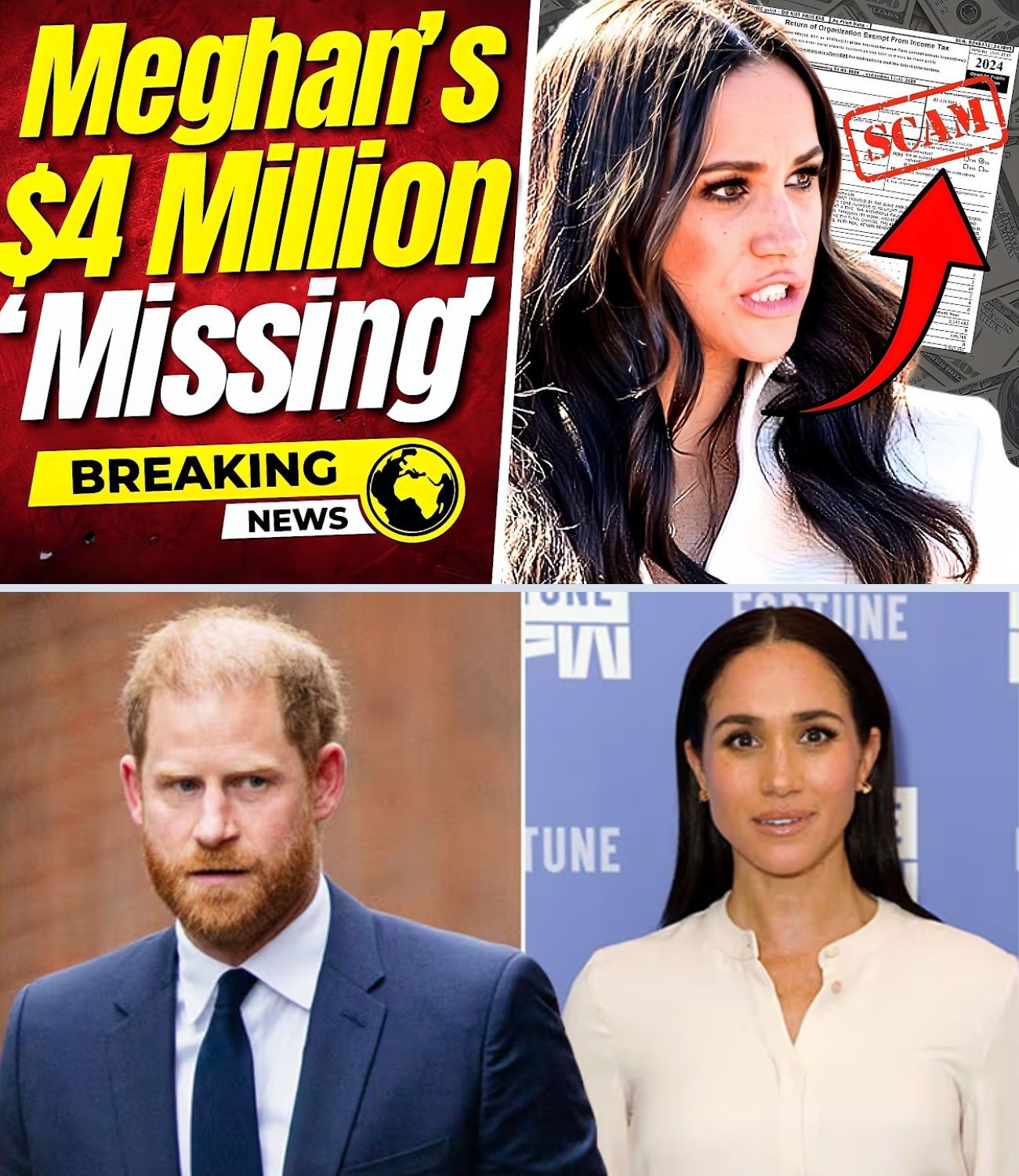
Though fees were eventually paid and compliance status ostensibly restored, the incident cracked open Pandora’s box. Financial journalists and independent researchers began pulling public tax returns—specifically the IRS Form 990 filings—to examine how the foundation was managing its incoming and outgoing capital. What they discovered inside those multi-page federal documents did little to quell the mounting suspicions. Instead, it gave rise to deeper inquiries regarding massive financial discrepancies that defy simple clerical explanations.
The Mystery of the Missing Millions
At the heart of the most damaging allegations lies a striking mathematical puzzle involving a multi-million-dollar donation funneled through an intermediary donor-advised fund. Records indicated that Fidelity Charitable, a massive philanthropic intermediary allowing anonymous donors to channel wealth to specific charities, reported distributing a notable sum—pegged by critics and investigators around the $6 million mark—intended for or originating in connection with the Sussexes’ foundation during the 2022 and 2023 financial cycles.
Yet, when financial sleuths cross-referenced this figure against the public Form 990 tax returns filed by Archewell, a glaring mismatch allegedly appeared. According to critics tracking the line items, the reported incoming contributions did not cleanly reflect the grand totals trumpeted by intermediary platforms, leading to fiery public accusations that millions in donations had vanished into an accounting black hole.
Defenders of the foundation rushed to push back against the “missing millions” narrative, insisting that all funds were fully accounted for across subsequent reporting periods and that multi-year accounting shifts often create temporary discrepancies in public view. However, accounting experts note that in the black-and-white world of federal tax compliance, numbers must balance with absolute precision. When an intermediary publicly logs a massive multi-million-dollar distribution to a specific recipient organisation, federal tax forms are expected to mirror that reality without requiring convoluted cross-year justifications.
The confusion was further compounded by the foundation’s shifting nomenclature. Transitioning documents between the Archewell Foundation and Archewell Philanthropies left casual observers and rigorous auditors alike chasing a moving target. For a charity striving to project absolute virtue, the inability to present a seamless, easily verifiable ledger invited intense hostility from watchdogs who argue that transparency should never require decoding.
The CharityWatch Verdict: Marketing Versus Accountability
As frustration over opaque reporting reached a boiling point, independent oversight institutions stepped into the fray. Chief among them was CharityWatch, a highly respected watchdog organisation known for applying rigorous, unsparing criteria to American non-profits.
In its public assessments, CharityWatch declined to award the Sussexes’ philanthropic entity a clean bill of health, instead slapping the organisation with a nondisclosure ““?”” rating. The rationale behind this harsh grade cuts straight to the core of modern celebrity philanthropy: a glossy marketing document is never a substitute for an independent, certified public audit.
CharityWatch pointed out that while Archewell routinely publishes aesthetically pleasing “Impact Reports” designed to highlight selected programs, showcase community outreach, and project an image of overwhelming success, these self-prepared brochures are not subjected to independent audits conducted in accordance with Generally Accepted Accounting Principles (GAAP). They are crafted to shape public perception, not to ensure strict financial accountability.
Furthermore, the watchdog highlighted vaugely reported expenses, lumpy early contributions that heavily skewed long-term financial averages, and an extraordinarily tight-knit board structure that critics argue lacks the independent oversight and robust governance expected of entities entrusted with vast sums of public capital. When an organisation relies on self-curated impact narratives rather than independent third-party verification, it inevitably invites suspicion. For federal investigators keeping an eye on the non-profit sector, a lack of independent auditing transparency is often the flashing neon sign that prompts a closer look under the hood.
Political Crosswinds and High-Profile Interference
The controversy surrounding Archewell’s financial filings transcended ordinary bureaucratic friction when high-profile political figures unexpectedly waded into the fray. Most notably, California Governor Gavin Newsom found himself drawn into the media storm when public commentary surfaced addressing the foundation’s compliance status.
Observers expressed astonishment when defenders or associated voices seemed eager to downplay the delinquency notices as harmless paperwork errors common to many startup charities. To critics, the sudden emergence of high-level political shielding only fuelled cynical theories about institutional protection. Cynics openly questioned whether the Sussexes wielded an outsized level of political influence or enjoyed unspoken royal grace that insulated them from the harsher penalties usually reserved for lesser-known delinquent entities.
In the court of public opinion, these political crosswinds created a toxic perception. Ordinary citizens struggling to navigate rigid tax codes watched in frustration as multi-millionaires tangled in filing errors appeared to receive kid-glove treatment from state authorities. Whether those assumptions were grounded in administrative reality or fueled by anti-Sussex sentiment, the political noise ensured that the financial affairs of Archewell remained front-page news, drawing the uncomfortably sharp gaze of federal tax enforcers.
The Spectre of Federal Scrutiny
While state-level delinquency notices created a noisy public relations nightmare, the whispers that truly caused panic behind the scenes involved federal authorities. Reports began swirling across independent media networks and investigative circles that the Internal Revenue Service (IRS)—specifically units tasked with examining high-value non-profit compliance, potential charity fraud, and financial irregularities—had quietly initiated preliminary inquiries into the structure and transactions of the foundation.
In the United States, an IRS audit or investigation into a high-profile non-profit is rarely announced with a fanfare of trumpets. Federal investigators typically operate in profound secrecy, methodically subpoenaing bank records, tracing intermediary transfers, and analyzing multi-year Form 990 filings before ever tipping their hand to the public. The use of terms like “quiet investigation” by commentators reflects this standard law enforcement methodology.
Allegations touching upon potential financial discrepancies, unrecorded massive donations, and complex cross-border fund movements inevitably push investigative units to examine whether civil tax penalties, governance restructuring, or even more serious criminal charges might eventually loom on the horizon. While no official, verified criminal indictments have been formally lodged by federal prosecutors, legal experts emphasize that financial discrepancies of this magnitude cannot simply be brushed aside with a revised press release.
The sheer complexity of tracking funds channeled through international donor-advised funds, combined with the foundation’s administrative stumbles, provides federal auditors with a labyrinth of transactions to unpack. For a couple accustomed to controlling their own narrative through prime-time interviews and curated streaming documentaries, the prospect of facing federal tax investigators who operate entirely outside their sphere of influence represents an existential threat.
Transatlantic Retreat and the Flight from Accountability
As the walls of administrative and financial scrutiny appeared to close in on their American operations, eagle-eyed observers noted a curious shift in the physical movements of the Duke and Duchess. Rumours and reports of sudden travel back toward the United Kingdom and Europe sparked intense speculation across royal commentary circles.
Skeptics were quick to ask whether the sudden transatlantic flights were motivated by more than just routine family matters or unannounced business ventures. In the realm of internet sleuthing and tabloid analysis, cynical commentators openly theorized whether relocating across the Atlantic was calculated to create geographical distance from the growing noise of American regulatory bodies. Of course, changing continents does not grant immunity from federal tax laws or IRS jurisdiction; American citizens and domestically registered entities remain bound by US financial statutes regardless of where they choose to lay their heads.
Nevertheless, the timing of these movements did little to quell the narrative that the Sussexes were feeling the heat. At the exact same time that financial watchdogs were highlighting unanswered questions about missing donations, the physical absence of the couple from their primary operational base added fuel to the fire.
The Ultimate Test of Transparency
As the dust begins to settle on another tumultuous chapter in the ongoing saga of Prince Harry and Meghan Markle, the reality facing their philanthropic enterprise is stark. The golden era of unchallenged, self-narrated celebrity philanthropy appears to be facing a harsh reckoning.
The questions raised by CharityWatch, the anomalies identified in public tax filings, and the persistent smoke of federal investigative interest have combined to create an atmosphere of profound vulnerability. For an organisation that pledged to “show up and do good,” the inability to present an unassailable financial ledger has severely undermined their moral standing.
Whether the current inquiries ultimately culminate in severe legal penalties or simply fade away as a painful lesson in bureaucratic compliance, the damage to the Archewell brand is profound. The public and financial watchdogs have made it abundantly clear that royal titles and Hollywood glamour do not exempt anyone from the unyielding laws of financial accountability. As the federal clock ticks and the paper trail is subjected to microscopic examination, Meghan Markle and Prince Harry are discovering a fundamental truth of modern life: when it comes to taxes, transparency, and federal authority, not even a duke and duchess can outrun the paperwork.
You Might Also Enjoy

“We Thought They Would Negotiate”—What Argentine Soldiers Said When The British Attacked Goose Green

“You’ll Never Finish My Ruck March, Limey” — US Sergeant Who Challenged the SAS, Then Fell Out First






