“Tea Won’t Save You in a Fight” — The Combatives Instructor Who Mocked SAS, Then His Mat Broke Him
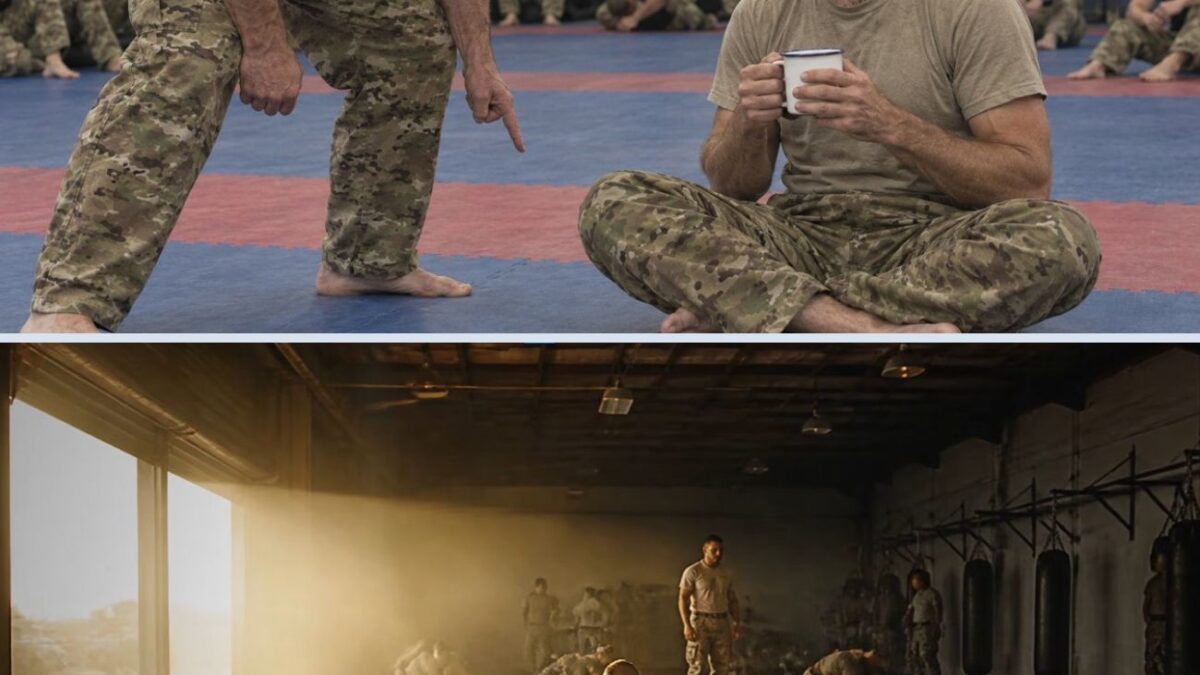
The gym at Fort Benning smelled of chalk and old sweat and the particular rubber tang that comes off of a tar mat after 10,000 hours of boots and bare feet. On a Tuesday morning in the autumn of a year that does not need to be named, 14 men in black army t-shirts are sitting cross-legged in a horseshoe around a square of red and blue waiting for the visitors to be put in their place. Master Sergeant Dwight Ballard is already standing in the middle of the square. He is broad in the way men become when they have squatted for 22 years, his head shaved to the grain. One ear a solid knot of cartilage from a decade of under hooks and he is pointing at the lean bearded man standing at the edge of the mat with a chipped white enamel mug in his left hand.
“Tea won’t save you in a fight, Staff Sergeant,” he says loud enough for the back row. “You lot are schoolgirls in shorts. Put the cup down and let me show your boys what a real soldier does on a mat.”
The bearded man does not put the cup down. He lifts it, takes a slow mouthful, holds it in his cheek a bit longer than a man ever needs to hold tea, and swallows. He looks past Ballard’s shoulder at the punching bags on the back wall and offers the Master Sergeant something that is not quite a smile. He says nothing. He does not even shift his weight. Behind him, three other men in borrowed physical training kit watch the exchange with the particular stillness that is not patience and is not fear. One of them, the youngest, glances sideways at his Staff Sergeant for a cue and does not get one because the cue has already been given by the fact that Price is still drinking his tea.
He would remember saying it. The Master Sergeant, with his two tours and his Pan American bronze and the laminated photograph taped inside his locker door, would remember every word he had just put into that room. He would be made to because by the time the sun had moved three handspans across the roll-up door of the combatives gym, and then by the time it had crossed the rangers to the shoot house on the far side of the base, the man he had called a schoolgirl in shorts was going to do three things in front of Ballard’s own cadre that no man on that mat had ever seen done. The master sergeant was going to be the one holding the stopwatch when the last of them happened. He had said tea would not save anyone in a fight. He was about to find out that the man drinking it was not planning to be in a fight. He was planning to end one.
To understand why those words landed in that room the way they did, you have to understand the man who said them. Because a clown’s contempt is worthless. And nobody at Fort Benning that morning thought the master sergeant was a clown. Dwight Ballard had been in the army for 22 years. He had done two tours in Iraq as an infantry squad leader. One of them in the bad months west of Baghdad. And he had the kind of quiet-eyed competence under contact that cannot be taught in a schoolhouse. He had come off the line in 2010 with a chest full of ribbons and a knee that would not take a sprint anymore. And he had done what a certain kind of soldier does when the running is over. He had learned to fight on the floor.
He had earned his modern army combatives program instructor qualification, then his level two, then three, then four, which in the small world of army grappling is the master trainer certificate. And almost nobody holds it. He had placed bronze at the Pan American Nogi Championships at a weight division where men do not place by accident. He had sat on the working group that wrote the standing to ground transition curriculum now taught across the entire force. He had, in short, built the thing he was about to try to break a man with.
The British were at Benning because an exchange had been signed between a saber squadron at Craden Hill and a sister formation at Benning. And nine men from B Squadron had flown out to spend eight days looking at American doctrine and letting the Americans look at theirs. The signatures were on Colonel Mercer’s desk, and the Colonel had not thought about them since. Captain Vaughn was running the trip. Staff Sergeant Price was running the men. That morning, Ballard had walked into his own gym an hour early, which was not unusual. He had touched the corner of the laminated photograph taped inside his locker door, which was also not unusual, and he had told his cadre they were about to get a visit from the guys from across the pond, the ones who think selection is a hiking club in Wales. The cadre had laughed because that is what cadres do when the master trainer makes a joke, and the youngest of them, Specialist Keener, had clipped his GoPro to the mat edge where it always lived.
Price walked in at 08:55 with his three men behind him, and a mug of tea in his left hand. He was lean in the way working men are lean, not athletes, with medium-length curly brown hair, a full beard, a tangent of T-shirt, borrowed training shorts because the Americans had put them in level four gees, and Price had looked at the gee, looked at the quartermaster, and asked if there was anything else. He had drawn kit instead. The cadre watched him come in with the mug, and read it as arrogance, which is how most people read a man who is simply doing what he does every morning.
Sergeant Delano, Ballard’s second, saw it differently, and did not say so. Delano was the one in the cadre who kept a cheap spiral notebook of every roll he had lost, with the date and the man and the submission written in capital letters. The notebook was nearly empty. He had lost 11 rolls in nine years, and he could tell you the week of each one. He watched Price take a slow mouthful of tea, and set the mug down on the folding table where the first aid kit lived, and he noticed that the staff sergeant did not look at Ballard once while he was doing it, and he felt the small cold thing a professional feels when he is about to watch something he would rather not watch.
“Gents,” Ballard said loud, hands on hips, voice pitched for the back row and the GoPro, “today you’re going to see what 20 years of doing this for a living looks like against what a hobby looks like.”
He grinned. The cadre grinned back.
“Our friends across the pond think a cup of hot leaves is a combat multiplier. Let’s see if we can’t correct that for them before lunch.”
That was when he said the line in full, the one about schoolgirls in shorts, and the room went very quiet in the particular way a room goes quiet when the man in the middle has just overcommitted, and only one person in the room knows it. Price took another mouthful of tea.
The combatives gym at Fort Benning is a long rectangle with roll-up doors at one end and a wall of hanging bags at the other. And the floor between them is tatami mat laid out in alternating squares of blue and red, so that an instructor standing in the middle can call a man to a color and know every student will find him. The strip lights overhead were the kind that hum when you listen for it. There was a folding table against the side wall with a trauma kit and a stack of mouthguards in plastic cups. There was a whiteboard with the day’s rotation written in Ballard’s hand. There was now a chipped white enamel mug sitting next to the trauma kit, its tea gone cool, forgotten by everyone in the room except the man who had set it down.
Captain Rodri Vaughn was leaning against the back wall with his arms folded. He was the troop commander, and he had a paperback stuffed into the back pocket of his training shorts, which was embarrassing, and which he did not care about. He was reading the room the way officers read rooms, counting the cadre, counting the exits, noting that the GoPro on the mat edge had a little red light that said recording, noting that Ballard had placed himself in the center square and his second at the 4:00, which was the arrangement a man used when he intended to be the one doing the work. He caught Price’s eye across the mat and did not do anything with his face. Price did not do anything back. That was the entire conversation.
Corporal Idris Blake was crouched on the blue line tying the laces of a trainer he was not going to need. Because that is what Blake did with his hands when he wanted to look at a room without looking at it. His left thumbnail was black. It had been black since a doorway in a town he was not allowed to name in 2016 when the frame had come down the wrong way and taken the nail with it. He had grown it back and then not let it grow back properly because a man likes a reminder. He was watching the cadre. He was counting the ones who moved like wrestlers and the ones who moved like fighters, which are not the same. And he had already decided which three in the horseshoe were dangerous and which three were pretending.
Trooper Milo Hartridge was the youngest on the trip. He had his sister’s last postcard half written in his Bergen back at the barracks and he was trying very hard not to look like he was 24. He was doing a bad job of it. He stretched his hip flexors the way the videos online had told him to and he waited for his staff sergeant to tell him what the morning was going to be.
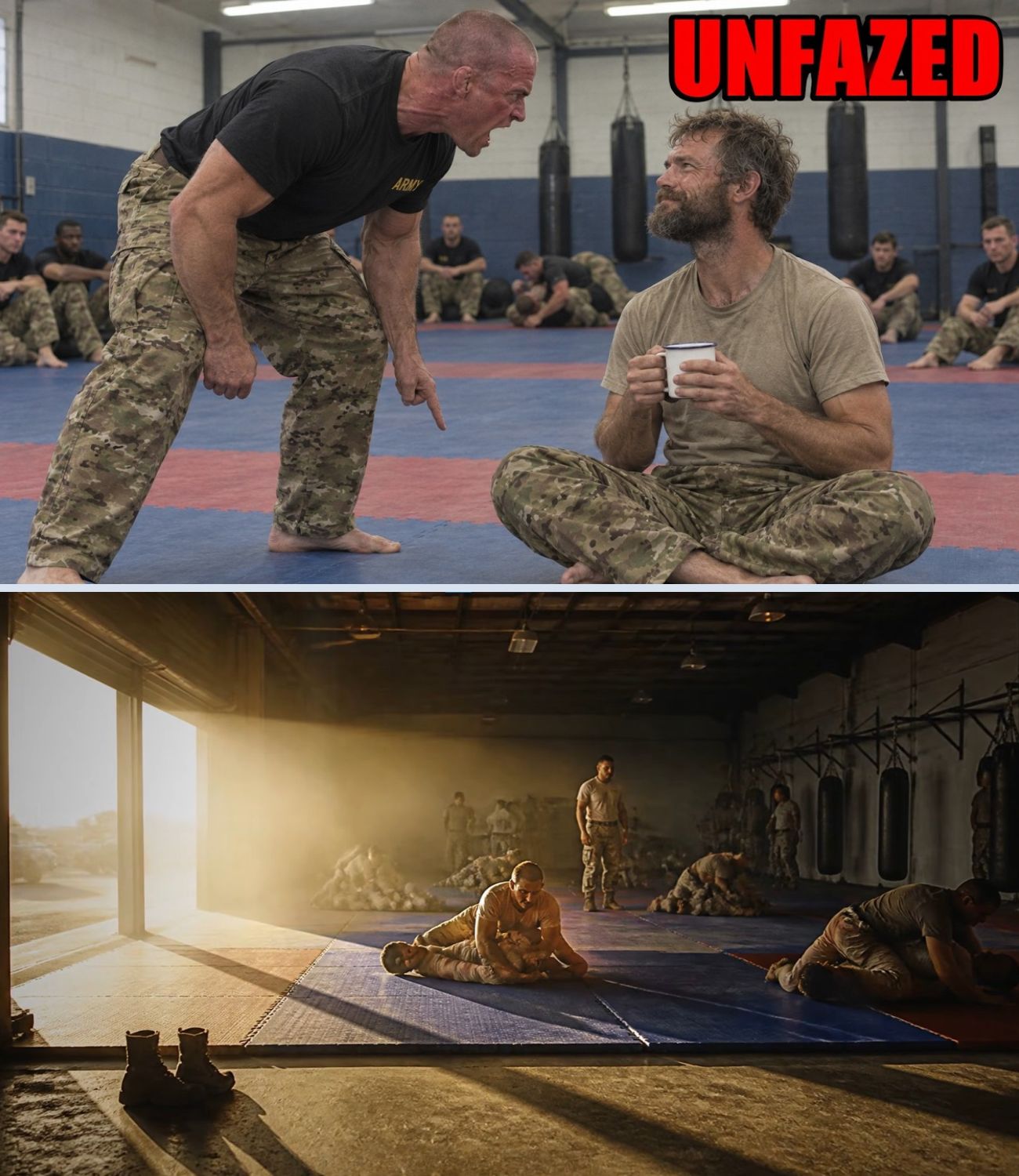
Ballard called a warm-up. Shrimps down the mat, then Grambys, then an inside trip drill from a collar tie cadre leading, visitors following. The British did it. They did it in the slightly wrong way of men who had learned the moves on a different continent for a different reason. Their shrimps were shorter. Their trips did not look for the beautiful finish. They looked for the knee drop that would put a man’s head on concrete if there had been concrete under the mat. Ballard watched them and he smirked because to a man who had placed at the Pan Americans, the technique looked crude. And he was not wrong about the technique. He was wrong about what the technique was for.
Price walked past Hartridge once during the drill and said something quietly, three or four words in the trooper’s ear. Hartridge nodded. On his next trip, he stopped reaching for the far leg and dropped his elbow across the throat instead, hard, and his partner tapped the mat before his back had finished finding it. The partner looked up at the ceiling for a second as if the ceiling had done it. Price had already walked on. The Americans were in level four gears, white and heavy and expensive. The British were in borrowed t-shirts and shorts. That is the only time that difference is going to be mentioned in this story because the difference did not matter and nobody in the gym was going to pretend it did by the end of the morning.
Ballard clapped his hands. The warm-up stopped. He walked to the folding table, picked up a stopwatch on a lanyard, and put the lanyard around his neck. He said he was going to run a short demonstration round, three rolls, three minutes each, cadre picking the matchups, winner declared by submission or dominant position at the bell. He said it would be instructive for the visitors to see where the real work was done. He said, and this is the line Delano wrote in the notebook later without being asked to, that he would take the first roll himself because the staff sergeant seemed to think his cup of tea was more interesting than the mat.
Across the base, past the Rangers, past the ammunition sheds and the burn pit and the long low building where the breaching charges lived, there was a shoot house. It was a plywood and plasterboard structure built to a US doctrinal footprint, four rooms, two corridors, a staircase, a small outbuilding. It had a run time written in grease pencil on the door jamb for the cadre’s own best effort through it on standard close quarters battle. The number on that jamb was 4 minutes 20. Nobody in the gym was thinking about the shoot house yet. The stopwatch, however, was now around the master sergeant’s neck and it was going to stay there for the rest of the day. The gun was loaded. It was not going to go off in the gym.
Ballard did the thing he always did before a roll. He did not do it where anyone could see. He did it in his head. The small inward tap on the corner of the laminated photograph in the locker, the one of him with the bronze medal and his daughter on his shoulders, the one with his wife’s thumb in the corner because she had taken the picture badly on purpose. He touched it in his mind and he stepped to the center of the red square and he rolled his shoulders.
Across the mat, Price walked back to the folding table. He picked up the enamel mug, drank the last of the cold tea in one go without flinching, set the mug down with the handle facing out the way a working man set some mug down and handed nothing to anybody because there was nothing left to hand. Then he walked onto the mat barefoot in a tangent of T-shirt and borrowed shorts and stood opposite the master sergeant with his hands loose at his sides.
Delano called it.
“Ready, set, go.”
Ballard moved. He was good. He was better than good. He closed the distance the way a man closes it who has done it 10,000 times. Hands up, posture low, left foot leading. Looking for the collar tie that fed every tool in his toolkit. His hand got there. He had the tie. He had the frame. He stepped in for the inside trip that lived on the first page of the curriculum he had helped write.
Price was not where the trip needed him to be. He had let the tie happen because the tie was not the problem. He had let the step happen because the step was not the problem. In the instant Ballard’s weight committed to the inside leg, Price’s elbow came down across the master sergeant’s collarbone. Not hard enough to break it, hard enough to tell the bone it could be broken, and his right knee rotated out, and his left hand found the back of Ballard’s neck in a position that was not any grip in any curriculum anybody in the room had been taught.
Ballard went down, not thrown, dropped. His back hit the red square, and his head did not because Price’s hand was still on his neck controlling the fall, which was a courtesy. In the half second it took the master sergeant to understand that he was already on his back, Price had put a shin across his throat, not his neck, his throat, with weight on it, and his hand on Ballard’s near wrist, and the other hand simply pointing at the mat beside Ballard’s head.
Ballard tapped. He tapped because the shin on his throat was not loose, and because the man owning it was not moving, and because he had been in the position long enough to know that the next thing was going to be a crush he could not time out of, and a professional taps.
The clock in Delano’s hand read 11 seconds. Delano did not say the number.
“Reset,” he said in the voice he used when he had seen something he did not want to call out in front of the cadre.
Ballard sat up. He blinked twice. He looked at the ceiling the way Hartridge’s warm-up partner had looked at the ceiling earlier, as if the ceiling owed him an answer, and he stood up and walked back to his starting square. Specialist Keener, behind the GoPro, had not breathed since go. He breathed now. He did not check the camera. He already knew what the camera had got. The cadre was quiet. They were quiet in the specific way a cadre goes quiet when the master trainer has been put on his back in 11 seconds by a man in borrowed shorts, and nobody in the horseshoe wanted to be the first one to move his face.
Delano looked at the notebook in his head and did not write in it yet. He was waiting to see whether this going to be the sort of day where one entry would do. Vaughn at the back wall had not changed position. Blake had finished tying his laces. Hartridge was looking at his staff sergeant with the particular stillness of a young man who had just learned something he was not going to be able to unlearn.
“Again,” Ballard said.
He said it clipped. He said it with the stopwatch tapping against his sternum. He had called the man drinking tea a schoolgirl in shorts. He had been on his back in the time it took to say the sentence. He did not yet know that this was the easiest humiliation he was going to receive today, and that was only the first time that morning he would be wrong.
Ballard stood in his square and did the quiet, honest, dangerous thing a competent man does when he has been hurt in public. He adjusted. He told himself the first roll had been a cold start, that the staff sergeant had got a lucky angle, that the shin had come in on a window he had opened by committing too hard to the trip. All of those things were true. None of them was the thing that had happened. He said, loud enough for the horseshoe, that the first roll had been jujitsu, and that was fine, but the army did not teach jujitsu for medals, it taught combatives for the field. And so the next drill was going to be edged weapons defense.
He called for the training knives. Keena handed him two rubber trainers from the plastic bin by the mat edge. They were the standard trainers, blue plastic serrated edge, weighted to feel honest in the hand. Ballard held one up for the cadre. He said that in a real knife fight the defender had to control the arm, close the distance, and end the problem before the problem ended him. He said this was where real training showed. He said this was where the hobby ended. He asked Price if he wanted to attack or defend.
“Attack, if that suits you,” Price said.
It was the first full sentence anyone on the British side had said in the gym all morning. Price said it quietly. He took the blue trainer in his right hand, flipped it once in his palm to feel the weight, and let his hand drop to his thigh.
Delano called it.
Ballard stepped in. He was good at this. He had taught this drill 500 times. He knew the angles and he knew the feeds, and he had broken his own trainers in gyms from Fort Lewis to Ramstein doing this exact exchange. He expected a committed slash, a thrust, a feed he could redirect. He did not get a feed. He got a man who walked straight at him with the trainer low and did not telegraph anything. And when the master sergeant’s hand came up to meet the arm he thought was going to come, the arm was not where the hand was. The trainer touched the soft part of Ballard’s left side below the plate line three times in a count that was not 1 2 3 because the three touches overlapped. Price’s left hand had meanwhile gone to the master sergeant’s throat and stopped a hair short of the trachea, which was the courtesy of a man who understood that this was a demonstration and that mats have rules even when corridors do not.
Ballard stepped back. He was blinking. He had not seen the knife do what the knife had done. He had seen a man walk at him and then he had been dead three times in the kidneys and once at the throat. And the whole exchange had taken less time than a sentence takes to end. Delano did not call reset. Price had already stepped back on his own. He flipped the trainer again and offered it back to the master sergeant handle first, which was not a performance, it was simply how the regiment hands a weapon back. Hartridge at the mat edge did a small involuntary thing with his mouth that was not quite a smile and was not quite anything else. The schoolgirls, the master sergeant had called them. The schoolgirl had just put the training knife into his liver three times before his hand had reached the forearm it had been reaching for and across the mat on the folding table the chipped enamel mug was still sitting with its handle facing out patient as a tool.
Delano wrote one word in the notebook in his head. He did not open the real notebook not yet. Ballard said again his voice had changed not louder lower the cadre which had been quiet became quieter. The ratchet in Delano’s chest clicked up one tooth and the master sergeant had now been wrong twice and the morning was not yet half gone.
Ballard did the thing a master trainer does when he has been embarrassed twice. He went back to the mat he knew. He said the next round would be a full roll five minutes ground only submission to end it and he said it with the stopwatch in his hand and the lanyard tight around his neck. He said it was time to see what the Englishman did when the fight did not end in a courtesy.
Price was not English he was Welsh and the correction did not matter and he did not make it. He nodded once. He walked to the center of the red square and he sat down which is what a man does on a mat when he is giving up the stand up because he does not need the stand up and he does not want the round to be about who was taller. He put his hands on his knees.
Vaughn at the back wall moved for the first time all morning. He uncrossed his arms. That was all he did.
Delano called it.
Ballard engaged he was in his element now. He passed to half guard in nine seconds the way a professional passes to half guard with the near side under hook and the cross face that lives in his cadre’s muscle memory. He felt the position settle. He felt the staff sergeant’s hip on the wrong side. He drove to mount. He got mount. He got mount in under 30 seconds against a man he had decided was a hobbyist and for one honest beat, the master sergeant of the combatives program believed that the first two rolls had been accidents, and the real work was finally happening.
Price let him have mount. He let him have mount the way you let a dog have a toy you are about to take back. He bridged once, small, not to escape, but to feel the master sergeant’s weight distribution. And he turned to his left into what every grappler in the room read as a classic Upa. And Ballard shifted his weight to the right to counter the Upa the way he had taught his cadre to counter it a thousand times. Price did not finish the Upa. He stopped halfway, which left the master sergeant’s weight committed to a direction nothing was pulling him in. In the half second Ballard’s hand came out to post, Price’s hips were already gone from under him, out the back door, a shrimp that had no name in sport grappling because sport grappling does not need to disengage. And Price was on his feet and three paces away before the master sergeant’s palm had finished finding the mat.
Price stood at the edge of the red square. His hands were loose at his sides. He was not breathing hard. Ballard was flat on his face in the middle of a mat he owned in a position no five-minute round in his gym had ever produced with his own stopwatch now reading 1 minute and 2 seconds, and the cadre around him making no noise at all. The cadre was not making no noise because they did not understand. They were making no noise because they do.
Delano looked at Keena. Keena looked at the master sergeant for a long second because looking at him would have been the final cruelty, and the cadre was not cruel. They were simply professional, and a professional knows when to let a man stand up on his own. Ballard stood up on his own. He walked off the red square. He walked to the folding table. He stopped to step short of the enamel mug, and he looked at it for 1 second longer than he needed to, and he did not touch it, and he did not touch the stopwatch at his sternum.
“That’s the mat,” he said, and his voice was quiet and even, and the thing in it that had been in it in the first sentence of the morning was no longer in it.
“Let’s see the house,” he added.
The walk from the gym to the shoot house took 11 minutes in a convoy of three light tactical vehicles across a base that was going about its Tuesday as if nothing in it had changed. In the lead vehicle, Ballard did not speak. In the second, Price drank from a water bottle somebody had handed him and did not speak either. In the third, Hartridge checked and rechecked a plate carrier he had drawn from the armory and tried not to look at Blake, who was humming.
The shoot house at Benning is a plywood and plasterboard footprint laid out to the standard American close-quarters template that a saber squadron would recognize with the kind of small differences that make a man slow down. For one breath on entry, four rooms off two corridors, a set of stairs to a half floor with one further room above, a detached outbuilding 10 m across a strip of gravel, which is where the serial ends with a final clear. On the doorjamb at the start point, in grease pencil, somebody had written 4:20 and the initials of the cadre team that owned that time. It was the best run-through the house by any instructor group at Benning. It had stood for 14 months.
Ballard stood in front of the jamb, and he put his hand on the stopwatch at his sternum. He looked at Price.
“Your lads, one pass, standard serial. I’ll time it,” he said.
Price looked at the stopwatch.
“You keep it,” he replied.
The staff sergeant did not say it to be clever. He said it because the man holding the clock was the man whose number was going to move, and because a working man knows that a time is only a time when the person who who it could not be true is the person who reads it off the dial.
Ballard understood what had just been handed to him. He did not look at Vaughn. He did not look at Delana. He looked at the stopwatch in his hand, and he thumbed the reset.
Price stacks on the door. Blake is behind him on the long gun, a Diemaco carbine with a suppressor fitted that the Americans have signed out of their own armory, because the British did not fly their primaries. Blake’s left thumbnail is black on the forestock. Hartridge is three. Vaughn is four, which is the troop commander’s place on a four-man stack, because the troop commander does not clear first, he clears last, and he reads the house.
Ballard’s thumb hits the stopwatch. The door goes. Not the door, the lock which Price has defeated with a small tool and a small motion that nobody in the cadre has fully seen. The stack is through. The first room clears in 4 seconds, which is not a time a man calls out. It is a time a man feels. Price is already in the corridor. Blake peels right into the second room. The muzzle of the carbine touches a target in the near corner, and the target falls, because the target is on a hinge, and the trigger has been pressed with a short, honest finishing pull. Hartridge is up the stairs. The young trooper whose postcards sit in his bergen, moves on the first floor like a man who has done the stairs 60 times, which he has. And his muzzle finds the far room threat before the threat has fully presented, and the shot is one shot. Vaughn reads the house from behind them. He calls one word down the corridor, a Welsh word that Blake answers with a nod, and the stack reassembles at the back door.
The outbuilding is 10 m across gravel. They do not run. They move at the fast walk the regiment uses, which is not a walk and is not a run, and the gravel does not do what gravel does to men who sprint on it. Price clears the outbuilding alone. Two targets, two shots. The last target has a civilian overlay on its chest, a photograph of a woman with a child, and the trigger is not pressed, and Price calls the room cold.
The stack walks back out of the outbuilding into the strip of autumn sun. Vaughn is last through. He is reading a paperback in his head, not his hands, which is the only tell the troop commander has that his heart rate has moved at all.
Ballard’s thumb hits the stopwatch. He looks at it. He looks at it for longer than a man looks at a number he already knows. He turns the face of the dial so that Delano can see it because he is not going to be the one to say the number out loud, and Delano reads it the way a man reads a verdict.
“2:47,” Delano says.
2 minutes, 47 seconds, on a serial the cadre’s best team has run in 4 minutes 20 by four men in borrowed kit on a house they have walked through once. Cold on the morning they arrived.
Captain Leanne Osterhaus from the liaison office has arrived at the strip in the last minute of the run because somebody from Colonel Mercer’s office has called her and said she might want to see this. She has her West Point ring in her hand, not on her finger, and she is turning it. She hears the number. She puts the ring back on. Keener does not film the strip. His GoPro is still clipped to the mat edge in the gym 2 miles away, which is a mercy he has given the master sergeant without knowing he was giving it. Ballard reads the number again on the dial in his own hand, alone, with nobody looking at him, and his mouth does not work.
They walked back to the gym in the same three vehicles. The stopwatch was still around the master sergeant’s neck. Nobody had asked him to take it off, and he had not thought to. The lanyard rode against his sternum the whole way back, and when he dismounted at the gym, he put his hand on it once, the way a man puts his hand on a wound he is checking for the shape of.
Inside, Delano walked to the whiteboard. The rotation Ballard had written at 7:00 in the morning was still there. The cadre watched him. Delano took the dry-erase marker out of its tray, and he drew a line under the day’s rotation, and he wrote in his own hand, in capital letters, “House 247.” He underlined the number once. He put the lid back on the marker. He put the marker back in the tray. He did not look at Ballard.
Then he took the spiral notebook out of his back pocket, the one with the dates and the names and the submissions in capital letters, and he opened it to the first empty page, and he wrote three lines. He wrote the date. He wrote the name. He wrote, “Standing knife, mount escape, House 247.” He closed the notebook. He put it back in his pocket. The notebook had not had three entries in a day since 2017. He wrote one more thing before he put the pen away. He wrote a single line beneath the three, in smaller handwriting, as if saying it to himself and not to the page, that the regiment did not try to win rounds. It tried to end fights. That the economy was the doctrine. That the knife and the mount and the house were the same lesson told three ways. He closed the book on that line and did not read it back.
Captain Osterhaus was standing in the doorway. She had the authority to say something, and she said one sentence for the room and for the report she was going to have to write before close of business.
“That was not a nat. That was a job,” she said.
Nobody disagreed with her.
Ballard walked to his locker. He opened it. The laminated photograph was taped on the inside of the door where it had been for eight years. Him and his daughter and his wife’s thumb in the the Him with the bronze around his neck in a convention center in Rio. He looked at it. He did not touch the corner. He closed the locker. He put the stopwatch down on the bench inside it and shut the door on the stopwatch, too.
He walked out through the gym. On the folding table against the side wall, the chipped enamel mug with the blue rim was still sitting with its handle facing out, cold, patient, exactly where Price had put it 2 hours before. Ballard walked past the mug and he did not look at it. The mug was the thing he was not going to be able to look at for a while.
In the horseshoe on the mat, the cadre was quiet. Price and his three men walked across the gym to collect the mug and their kit bags and the horseshoe watched them walk. Blake had his hands in his pockets. Hartridge was trying very hard not to grin. Vaughn had his paperback out again. Price picked up the mug by the handle, turned it in his palm once, and carried it out of the gym with him into the autumn sun.
The master sergeant had called them schoolgirls in shorts. The cadre had watched them clear a house in less time than it took the cadre’s own best men to brief one. Nobody in the room was going to use the word schoolgirl in that gym again. Not because they had been told not to, but because the word had been emptied of its contents on the mat and on the strip of gravel in front of the outbuilding, and emptied words do not come back.
A mat is a cage with rules. A corridor is not. The man who had placed bronze at the Pan American Championships had trained for 22 years to win rounds inside a square where the referee could stop the fight and he had been very good at it, better than almost anyone in his army, and none of that had been a lie. The man in the borrowed shorts had trained for a different thing. He had trained to end a fight in two moves or know he was wrong, to keep the weapon in his hand when the hand was being torn off, to be out of a position the moment the position stopped feeding him a finish. He had not come to Fort Benning to beat the Master Sergeant. He had come to drink his tea and look at the American doctrine. And when the Master Sergeant had asked him for a demonstration, he had given one, and the demonstration had been the thing itself.
Master Sergeant Dwight Ballard had said that tea would not save a man in a fight, and that the men who drank it were schoolgirls in shorts. He had been right about the tea. The tea had not saved anyone. The tea had sat on a folding table and gone cold and been drunk again in the sun outside the shoot house by a man whose stopwatch now read 2 minutes and 47 seconds in another man’s handwriting on a whiteboard he did not own. He had been right about the surface. He had been catastrophically wrong about the men who drank it.
Trooper Hartridge sent his sister a postcard that evening. On the back of it, in small, careful handwriting, he wrote only that Georgia was warmer than he had expected, and that he had learned something that afternoon he did not yet know how to say.
The mug went back to the United Kingdom with Price in a kit bag padded with a rolled-up t-shirt, and the chip on the rim stayed where it had always been. The number stayed on the whiteboard for a long time. Nobody rubbed it off, and after a while in that gym, nobody needed to.
You Might Also Enjoy

“We Thought They Would Negotiate”—What Argentine Soldiers Said When The British Attacked Goose Green

“You’ll Never Finish My Ruck March, Limey” — US Sergeant Who Challenged the SAS, Then Fell Out First






