The British Gun That Fired So Fast the Germans Thought It Was Automatic
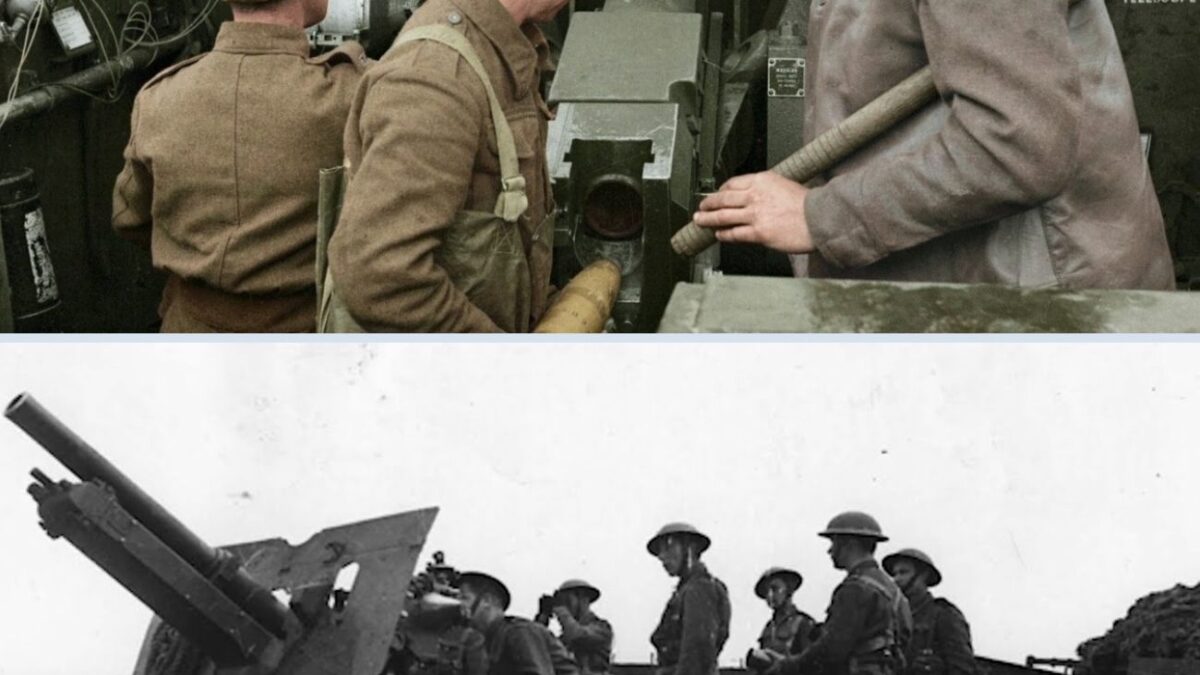
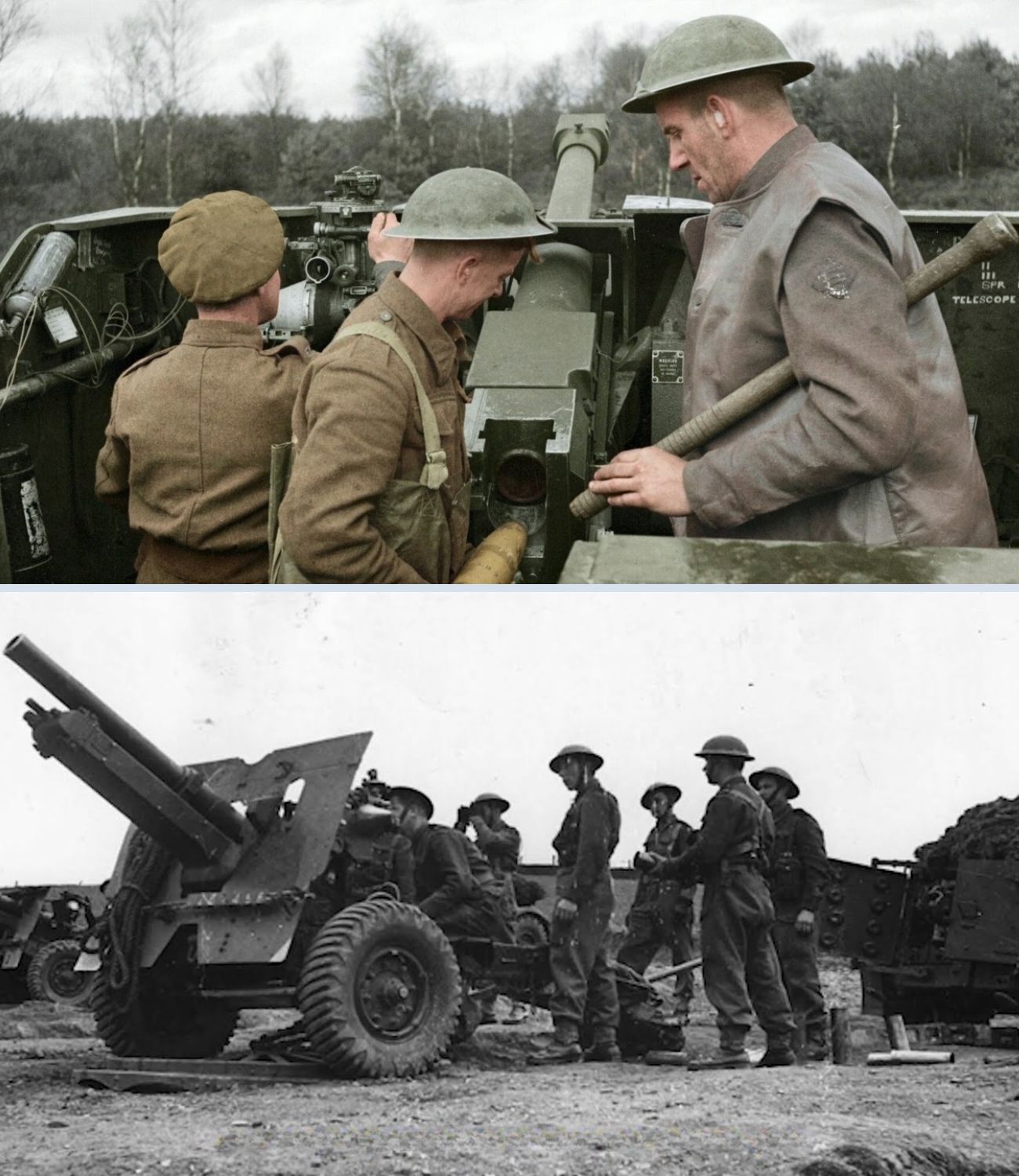
This is a British gun being loaded. A sergeant gives the order. One man opens the breech. A shell goes in and it is rammed home. Then a brass cartridge case goes in behind it. The breech is closed. Every round by hand. Six men at the fastest rate their drill allowed, six to eight rounds a minute. And in 1944 and 1945 in France, Belgium, Holland and Germany, German soldiers on the receiving end of these guns came to believe that the British had secretly deployed an automatic one.
There was no automatic gun. There was this. The easy explanation is that the British gun was fast. It was not. Across the line, the German army’s standard field howitzer also had a crew of six. It also fired six to eight rounds a minute. And it threw a heavier shell. Nearly 15 kg against the British gun’s 11 and a half.
The British gun did reach further, a little over 12 km against 10 and a half. That was its one clear advantage on paper. And the British gun had never been designed to be the best. It had been designed to be affordable. Its development between the wars was held back by a lack of money. So an ordinary field gun, no faster than the enemies, firing a lighter shell, convinced many German soldiers that they were facing a machine.
The gun cannot explain that. Something behind it can. And from where the Germans were lying, they had no way of seeing it. And before this video is over, you will see the morning in February 1945 when more than a thousand guns fell silent for 10 minutes on purpose. And what that silence was for.
After the First World War, British field artillery rested on two guns, and neither of them did the whole job. The 18-pounder threw its shell fast and flat. The 4.5-in howitzer lobbed its shell high, over hills and over cover. An army that wanted both had to haul both, supply both, and train men for both.
The answer was one gun that could do both jobs. It fired a shell of 25 lb, which gave the gun its name. And it changed its range by changing the size of the propellant charge behind the shell. Three sizes and a bigger one, called super, for its longest shots. There was no money to build it from scratch, so the first versions from 1937 were old 18-pounders converted.
The real gun, on a carriage of its own, only began arriving at the start of 1940. The first regiment to receive it was Canadian, stationed in Britain in May 1940. Remember the Canadians, they come back. In France that year, the army lost 704 of the converted guns. Not one of the new guns was lost there. What replaced them came with a feature that looks minor on a drawing.
A round steel platform carried with the gun. The crew lowered it, pulled the gun on top, and from then on, the whole gun could be swung round to face any direction quickly by hand. And it came with a drill. Six men, each with a number. Number one, the sergeant in command. Number two worked the breech and rammed the shell.
Number three aimed. Number four loaded. Numbers five and six handled the ammunition, and number six prepared it and set the fuses. Six numbers, one gun. Still on its own, no faster than the German howitzer on the other side. By 1945, more than 12,000 of them had been built. The thing the Germans could not see was usually an officer a long way in front of the guns.
A British or Canadian field regiment had 24 of these guns in three batteries of eight. Officers from the batteries went forward with the infantry with a radio. Forward observation officers. Their job was to watch the ground ahead of the infantry and to put shells on it. On his own, one of those officers could call on his battery.
But the Royal Artillery had built something much bigger on top of him. If the target was worth it, he could call for every gun in his regiment to fire on the same spot. 24 guns. That was a Mike target. He could ask for every gun in the division. 72. An Uncle target. And above that, a Victor target. The guns of a whole core, up to 250 of them on a single map reference.
The guns did not see the target. They only needed the numbers. Now picture that from the other side. A German position hears a shell land. Then the shells of 24 guns landing on the same patch of ground, then more. Each of those shells carries less than a kilogram of explosive. Each of those guns can only fire six to eight rounds a minute.
But it is not one gun. It is 24. Or 72. Every one of them loaded by hand by crews who have never seen the place they are hitting. From there, it does not sound like men working breaches. It sounds like a machine that never needs to reload. The Germans were right that something was firing without a pause. They were wrong about what it was.
And the speed was not only at the guns, it was in the call. In Italy, early in 1944, one unplanned request for support was answered by 600 guns within 35 minutes. 600 guns, and at every one of them, a crew loading by hand. One of the men doing that job was a Canadian officer named George Blackburn. He was a forward observation officer with a Canadian field artillery regiment.
He went through the Battle of Normandy in 1944, then on through Belgium, Holland, and into Germany. In 1945, he was awarded the Military Cross for his part in defending a bridgehead over the Twente Canal in the Netherlands. After the war, he became a journalist and a playwright. And he wrote down what the guns had done.
The Guns of Normandy. Then the Guns of Victory for Belgium, Holland, and Germany. Another book covers the years before, from 1939 to 1944. And its title says a great deal about how those years began. “Where the hell are the guns?” It is his account that records what German soldiers had come to believe. That the effects of the guns and the speed at which the British artillery could answer a call could only mean one thing.
The British must have secretly deployed an automatic 25-pounder. It sounds like the kind of story every army tells about itself. But look at who was drawing the conclusion. These were soldiers with field guns of their own, heavier than the British one, built to be pulled by horses or by vehicles. The same crew, the same rate of fire.
They knew exactly what one gun could do in a minute. What was landing on them was not what one gun could do. The first regiment ever to receive the finished gun in May 1940 had been Canadian. Four years later, a Canadian division in Northwest Europe typically had three regiments of them. 72 guns to a division.
The same gun. Loaded the same way by the same six numbers. What had changed was everything around it. At 5:00 in the morning on the 8th of February 1945, between the Rhine and the Maas, the British and Canadian armies opened Operation Veritable. 1,034 guns opened fire. Men there were deafened for hours. For almost 3 hours, the guns fired on German batteries and mortars, command posts and communications.
Then a line of smoke was laid across the German front as if an attack were about to come through it. At 20 to 8, every gun stopped. For 10 minutes, nothing. The smoke was a feint. It was meant to make the German gunners believe the assault had begun and open fire. Sound ranging finds a gun by timing the sound of its firing at microphones set out along the front.
It struggles when too many guns fire at once. For those 10 minutes, the only guns firing were meant to be German. And in the quiet, the sound rangers and the spotters found them. Then the fire began again on them. It kept building until half past 10 as the first units moved into position. Then the barrage lifted and five infantry divisions went forward, 50,000 men and 500 tanks.
Two Canadian divisions and beside them the Scottish, the Welsh and the Highland. It was the biggest British barrage since El Alamein. The British never built an automatic field gun. They built an ordinary one, designed on a budget, no faster than the enemies. They gave it to six men who loaded it by hand.
And they put an officer at the front who could bring 72 of them down on a single target. From the other side of the line, that sounded like a machine. It was loaded by hand.
You Might Also Enjoy

“We Thought They Would Negotiate”—What Argentine Soldiers Said When The British Attacked Goose Green

“You’ll Never Finish My Ruck March, Limey” — US Sergeant Who Challenged the SAS, Then Fell Out First






