The King’s Mother’s Jewels Are Going to Auction — Why?
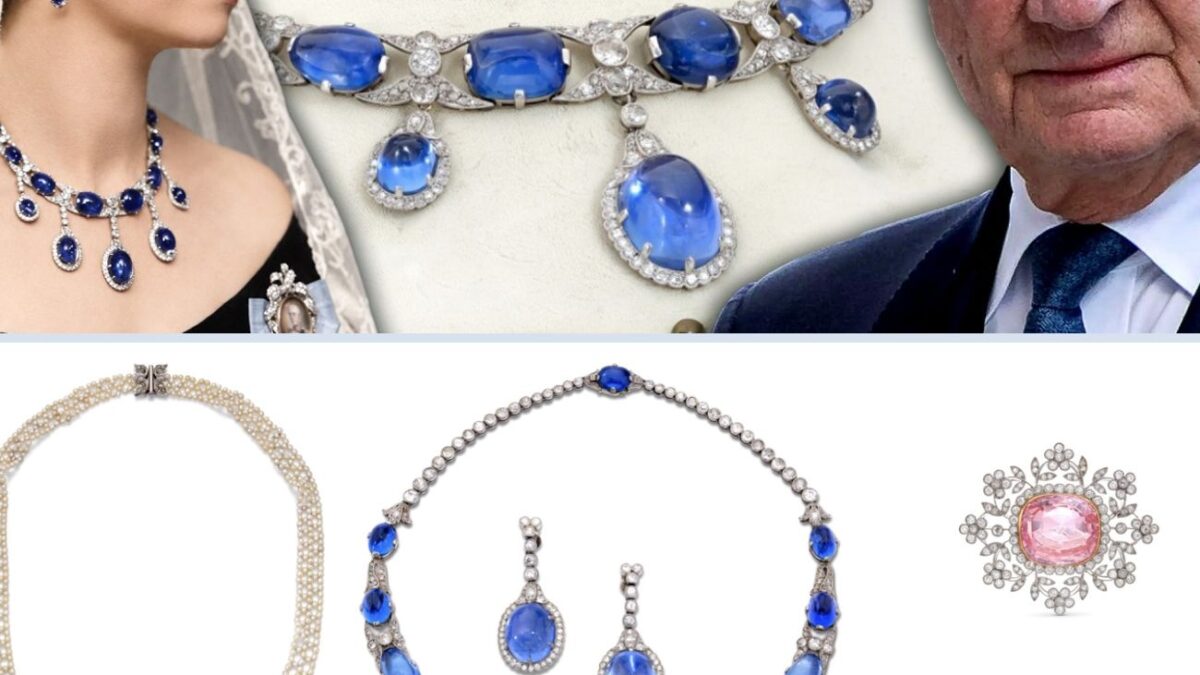
In November 2026, some of the most personal jewels of Sweden’s royal family are heading to auction. Among them is a striking sapphire necklace once worn by Princess Sibylla, the mother of King Carl XVI Gustaf, and later by her daughter, Princess Birgitta. Now, nearly two years after Birgitta’s death, her heirs are offering these family treasures for sale. Swedish commentators have questioned the decision, and reports suggest the king may not be pleased. But why would the family part with jewels that have accompanied generations of royal women? And what makes this particular collection so difficult to see leave the family? The answers begin with a royal wedding in 1932 and a remarkable set of sapphires with a possible connection to Imperial Russia.
In October 1932, Princess Sibylla of Saxe-Coburg and Gotha married Prince Gustaf Adolf of Sweden, Duke of Västerbotten. The celebrations took place in Coburg, Germany, where members of several European royal families gathered for the occasion. The civil ceremony was held on October 19th, followed by the religious wedding the next day. It was an important marriage for the Swedish royal family. Prince Gustaf Adolf stood second in line to the throne, and his young bride was expected in time to become queen of Sweden. Sibylla herself came from a family with extensive royal connections. Her father, Charles Edward, had been the last reigning Duke of Saxe-Coburg and Gotha, while her grandfather, Prince Leopold, Duke of Albany, was one of Queen Victoria’s sons. Through him, Sibylla was a great-granddaughter of the British monarch.
But by the time of her wedding, Europe’s political landscape had changed considerably. Her father had lost his German throne following the First World War, as had several of the family’s relatives. Among those former rulers was Ferdinand I, the abdicated Tsar of Bulgaria, who had returned to live in Coburg. Ferdinand was related to Sibylla through the wider Saxe-Coburg and Gotha dynasty. He was also an enthusiastic collector of jewelry and gemstones with a particular interest in unusual and valuable pieces. And his wedding gift to the Swedish princess was certainly memorable.
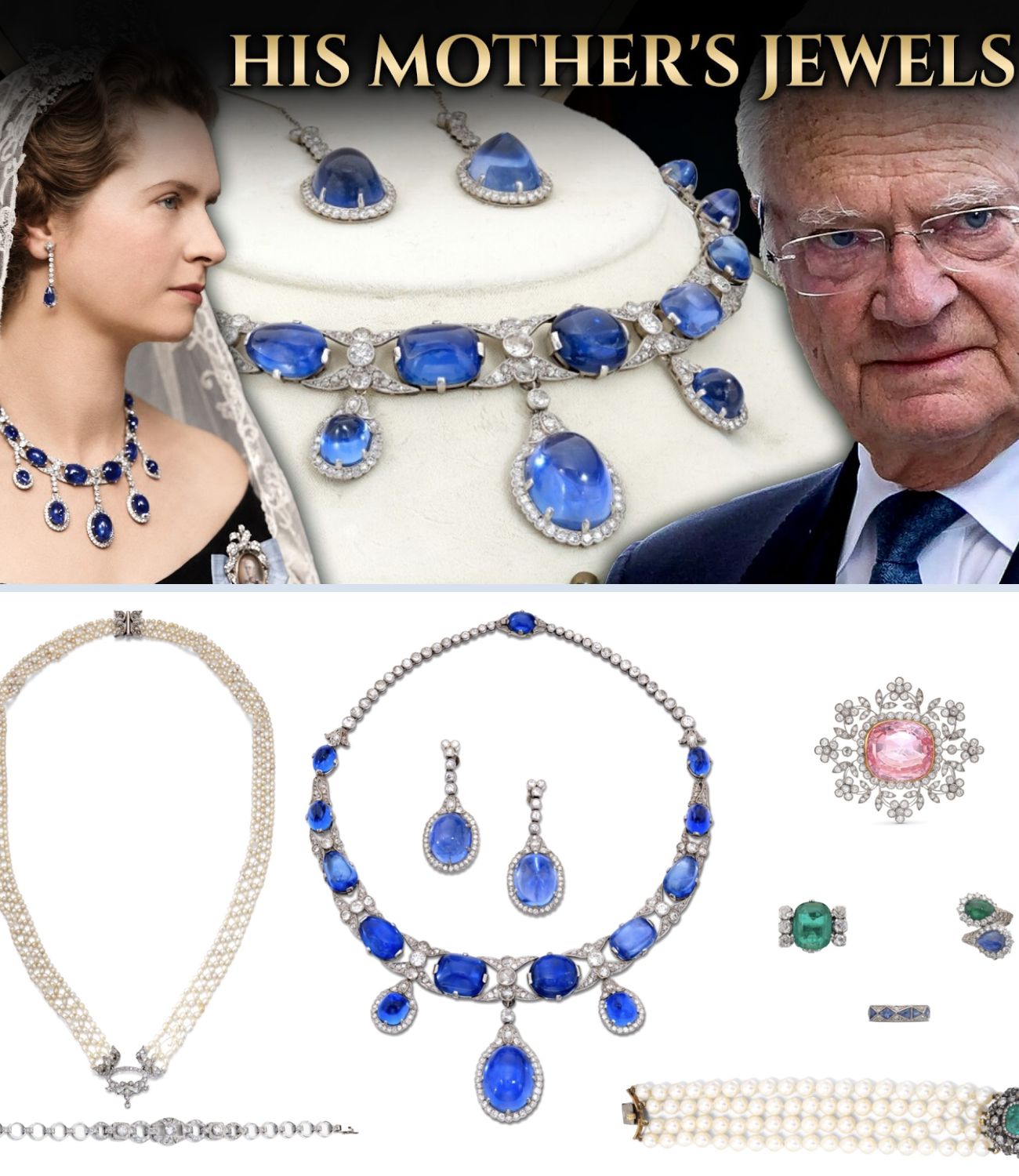
He presented Sibylla with a large sapphire and diamond necklace distinguished by a graduated series of deep blue sapphires cut as cabochons. Unlike faceted stones, which reflect light through numerous flat surfaces, cabochons have smooth rounded tops. The effect is quite different. Their polished surfaces give the sapphires a rich, almost velvety appearance. Each sapphire was surrounded by diamonds, with several substantial sapphire pendants suspended beneath the necklace. The combination made it an impressive piece. Yet the design was sufficiently adaptable for Sibylla to wear it in different ways over the years.
Ferdinand had lost his throne in 1918, but he remained an enthusiastic collector of fine jewelry. He had even acquired pieces at the famous sale of the French crown jewels in 1887. Sibylla would later recall a charming family memory: the former tsar reached into his pockets, produced a generous handful of loose gems onto the table, and invited the young bride to choose what she liked best for her wedding gift. She chose these striking cabochons, and they arrived with a remarkable story of their own.
According to sources, they may once have belonged to Empress Maria Feodorovna of Russia, the mother of the last Russian emperor, Nicholas II. If that tradition is correct, the necklace has a history reaching far beyond the Swedish and Bulgarian royal families. Maria Feodorovna had been born Princess Dagmar of Denmark. She married the future emperor Alexander III of Russia and became one of the most recognizable figures of the Russian imperial court. She was also a woman whose life changed dramatically after the Russian Revolution. Her son Nicholas II and his family were murdered in 1918. While Maria Feodorovna survived the upheaval and eventually returned to her native Denmark, where she spent her remaining years until her death in 1928, sources suggest that Ferdinand may have acquired the sapphires from her during this final period of her life.
And we have something particularly useful when studying the history of this necklace: photographs showing how it was worn, adapted, and shared. The piece being sold today is not arranged exactly as it was when Sibylla received it. Originally, two of the sapphires that now appear in the matching earrings were suspended from the front of the necklace. At some point, those elements were removed and converted into earrings. The necklace itself was also lengthened. The remaining sapphire pendants can also be detached, allowing the necklace to be worn in a simpler form. The central pendant can be worn separately as a brooch, and the royal photographs show just how useful that versatility became.
At the Nobel Prize ceremony in Stockholm in December 1957, Sibylla’s eldest daughter, Princess Margaretha, wore the sapphire necklace without its suspended pendants. Without them, the design looked noticeably more restrained, with the rounded blue stones forming a continuous line around the neckline. Ten years later, at the Nobel banquet in December 1967, another daughter, Princess Christina, found a different way to wear the family sapphires. Rather than wearing the necklace itself, Christina selected three of its sapphire elements. Two were worn as earrings, while the largest was used as a brooch to secure her sash of the Order of the Seraphim. She paired them with the four-button diamond tiara.
Sibylla herself wore the sapphires regularly during her decades at court, often pairing them with historic family diadems for gala banquets. As her daughters came of age, the modular necklace became a shared family treasure, adapted to suit different styles across two generations. On the 26th of January 1947, life changed completely for the young family living at Haga Palace. Prince Gustaf Adolf was returning home from a hunting trip in the Netherlands. During a routine stopover at Kastrup Airport in Copenhagen, the Douglas DC-3 aircraft carrying him took off, stalled, and crashed. Tragically, none of the passengers or crew survived the accident.
Princess Sibylla was left a widow at just 39 years old with four young daughters and an infant son, Prince Carl Gustaf, who was only nine months old. The family soon left the informal, peaceful surroundings of Haga to take up residence in the Royal Palace of Stockholm, where the young prince was now direct heir to his grandfather’s throne. Over the years that followed, Sibylla came to occupy a very singular position at the Swedish court. When Queen Louise, the second wife of King Gustaf VI Adolf, passed away in 1965, the court was left without a queen consort. As the mother of the crown prince, Princess Sibylla stepped forward to undertake the official duties of the realm’s first lady.
It was during this era that her public appearances became a familiar sight across the country. At formal state banquets, she frequently paired her Bulgarian wedding sapphires with one of the most distinguished diadems in the country: the Connaught diamond tiara, with its delicate loops of diamond forget-me-knots, which had originally belonged to her late mother-in-law. Together with the sapphires, it created a striking, dignified look that defined royal galas throughout the late 1960s. Sadly, Princess Sibylla did not live to see her son take the throne. She passed away in late November 1972 after an illness, just nine months before King Gustaf VI Adolf died and her 27-year-old son became King Carl XVI Gustaf.
In her will, Sibylla divided her personal jewelry among her children while the major historic heirlooms belonging to the family foundation remained in Stockholm. Among the treasures that passed to her second daughter, Princess Birgitta, was the Bulgarian sapphire demi-parure. But these sapphires were only one chapter in Birgitta’s jewelry story, one that had actually begun years earlier. To understand Birgitta’s unique place in the family, we have to look back to 1961. Under the strict Swedish royal customs of the era, three of Sibylla’s daughters—Margaretha, Désirée, and later Christina—married private citizens and relinquished their royal status.
Birgitta alone followed a different path, marrying Prince Johann Georg of Hohenzollern-Sigmaringen, known warmly as Hanzí. Because she had married a fellow royal, she retained her full title as Her Royal Highness, Princess Birgitta of Sweden and Hohenzollern. It was at that very wedding that her personal jewelry collection began to shape itself. Princess Sibylla presented her daughter with several important pieces from her own jewel box. Most notably, an antique belle époque brooch set with a rare padparadscha sapphire, which Birgitta wore pinned to her bodice for her wedding ball at the Royal Palace. A remarkable jewel we will look at closely in a moment, which is also heading to auction.
A decade later, following Sibylla’s passing in 1972, the Bulgarian sapphire demi-parure joined Birgitta’s collection as well. It was an inheritance with a lovely personal touch. As Tsar Ferdinand had been Birgitta’s godfather, and given her royal title and active public role, Birgitta was in a natural position to keep her mother’s heirlooms in the spotlight, ensuring these sapphires continued to appear at state banquets and royal celebrations for decades to come. Over the decades, Birgitta established an independent, colorful life on her own terms. She and Prince Johann Georg lived in Munich, where they raised their three children: Carl Christian, Désirée, and Hubertus.
Later, she chose to settle on the island of Mallorca, where she became an accomplished golfer known for her deep tan, casual warmth, and an unmistakably frank way of speaking. Yet, despite living abroad, she never drifted away from her Swedish family. She returned faithfully for state visits, family milestones, and royal weddings. A particularly memorable occasion took place in November 1979 during a Swedish state visit to Austria. If you look closely at the photographs from that state banquet, Birgitta wore her mother’s sapphire necklace and matching drop earrings, walking alongside her young sister-in-law, Queen Silvia.
In her later years, Princess Birgitta brought these sapphires back to Stockholm for two major royal weddings. In 2010, for the wedding of her niece, Crown Princess Victoria, she paired the demi-parure with the tall, dignified nine-prong tiara from the Swedish collection. Then, in June 2013, at the wedding of Princess Madeleine, she chose an arrangement that felt like a direct echo of her mother: she wore the sapphire necklace with the Connaught diamond tiara, recreating the exact look Princess Sibylla had worn decades earlier. The sapphire necklace belonged to Birgitta personally, unlike the historic Connaught diamond tiara that she wore with it. That difference in ownership would become especially important after her death.
While the blue sapphire demi-parure has naturally captured most of the headlines, the other lots from Princess Birgitta’s estate offer an equally fascinating glimpse into her mother’s jewelry box. Princess Sibylla clearly possessed an eye for unusual colors and versatile settings rather than simply accumulating large conventional stones. The standout among these pieces is an extraordinary belle époque brooch created around 1910. At its center sits a cushion-shaped padparadscha sapphire weighing 23.64 carats, cradled within a soft frame of diamond flowers and delicate milgrain borders.
In the gemological world, true padparadscha sapphires are among the rarest of all gemstones, prized for their delicate balance of salmon pink and sunrise orange. Sotheby’s has placed an estimate of 40,000 to 60,000 Swiss francs on the piece, but its historical footprint is far more personal. An archival discovery reveals this very brooch in a delightful family photograph taken in 1943. Princess Sibylla is seated holding her infant daughter, Princess Christina, with her three elder daughters gathered affectionately around her. Princess Sibylla later gave the brooch to Birgitta on the occasion of her 1961 wedding, where Birgitta wore it on the bodice of her gown for her wedding ball at the Royal Palace.
Decades later, Birgitta brought it out once more for the wedding of Crown Princess Victoria in 2010. There are also two interesting emerald pieces. One is a ring with a 7.58-carat Colombian emerald accompanied by old-cut diamonds and preserved in a case from the Stockholm court jewelers Holm & Hallgren. The other is a four-row pearl bracelet with a 19th-century emerald and diamond clasp that can be detached and worn as a brooch. I particularly like that adaptable design, which allowed the same jewel to be worn in two quite different ways. Two more rings are offered together: a Toi et Moi design combining a sapphire and an emerald, and a geometric sapphire ring. There is also a diamond bracelet incorporating elements dating from the 1930s.
Together, these smaller pieces give us a glimpse of the personal jewelry that remained in Sibylla’s family beyond the grand necklaces and tiaras seen at royal banquets. Now let’s look at another piece in the catalog that stands in stark contrast to the colorful gems we have just seen: a belle époque seed pearl and diamond necklace. And what makes it extraordinary is that its provenance is completely and flawlessly documented. In 1912, King Gustaf V of Sweden and his consort, Queen Victoria of Baden, presented this delicate jewel to their daughter-in-law, Crown Princess Margaret of Connaught. The occasion was the birth of her fourth child, Prince Bertil.
If you look closely at the craftsmanship, you will see that it is not made of large pearls, but rather a finely woven mesh of tiny seed pearls accented with rose-cut diamonds and preserved in a fitted case stamped with a royal coronet. Sotheby’s has placed an estimate on this piece of just 2,000 to 3,000 Swiss francs on an auction block dominated by multi-carat gems. That is a remarkably modest sum. Yet, the story behind it spans more than a century of Bernadotte history. Crown Princess Margaret passed away far too young in 1920, and the necklace eventually found its way into the hands of Prince Bertil himself.
25 years after his mother received it in honor of his birth, Prince Bertil found the perfect occasion to pass it forward. In 1937, his brother, Prince Gustaf Adolf, and Princess Sibylla welcomed their second daughter, Princess Birgitta. Bertil gave this very necklace to his infant niece as a christening present. It is such a subtle, neat detail: a jewel given to a mother to celebrate her newborn son in 1912, returning a generation later as a christening gift from that same son to his brother’s daughter. Truth be told, this modest seed pearl necklace is the piece that has surprised me the most.
When high-value sapphires or large emeralds are sent to auction, one can easily understand the practicalities of dividing a major estate among several heirs. But when an intimate christening present carrying such direct family history is offered for just a couple of thousand francs, it naturally invites curiosity. Why would the family choose to part with a personal keepsake of such modest commercial value on an open public stage? The announcement of Princess Birgitta’s jewelry auction has caused considerable discussion in Sweden. Historian Herman Lindqvist criticized the decision in Svensk Damtidning, arguing that such personal family treasures ought to remain within the family. He acknowledged the heirs’ right to sell, but felt that a private transaction would have been more appropriate than a public auction.
There has also been considerable speculation about the reaction of King Carl XVI Gustaf. Johan Lindwall, the editor-in-chief of Svensk Damtidning, has suggested that the sale goes against the king’s traditional views on family heritage. He believes the king may be deeply displeased by the prospect of his mother’s jewelry leaving the family and has even raised the possibility that His Majesty might bid for some of the pieces himself. Herman Lindqvist has expressed similar doubts about whether the king would approve, suggesting also that the monarch may not have been informed of the plans beforehand.
Princess Christina, the king’s sister, declined to comment on the auction when approached by Svensk Damtidning. However, she has previously spoken about the importance of royal jewelry in preserving family history and maintaining a connection between generations. So, what has actually prompted Princess Birgitta’s family to part with these jewels? That is the question I have been considering most carefully. And unfortunately, it is also the one for which we have no definitive answer. Princess Birgitta left three adult children: Prince Carl Christian, Princess Désirée, and Prince Hubertus of Hohenzollern.
As far as publicly available information shows, none has offered a detailed explanation of the decision to sell these particular pieces. We therefore have to distinguish what we know from what might reasonably explain the decision. Inheritance taxes often come to mind when historic family jewelry appears at auction, particularly in Britain, where high duties have often forced the sale of great collections. At first glance, taxes might seem irrelevant here, as Sweden abolished inheritance tax in 2005, and the Balearic Islands, where Princess Birgitta lived, now offer virtually complete exemptions for children.
However, all three of Birgitta’s children reside in Germany, where inheritance laws apply to worldwide assets and are far more demanding. While their private financial affairs remain confidential, the realities of the German tax system mean that fiscal considerations cannot be ruled out entirely. Perhaps the decision was simply practical. Dividing jewelry of such different values among three heirs is not straightforward, and unlike their mother, Birgitta’s children have few occasions to wear grand ceremonial pieces. With the additional costs of insurance and secure storage, selling some of the collection may have seemed the most sensible choice.
Interestingly, the heirs have not parted with everything. They clearly chose to retain other cherished heirlooms, including the delicate pearl circle tiara given to Birgitta by King Gustaf VI Adolf, as well as a historic pearl necklace from Princess Sibylla’s collection. Birgitta’s daughter, Princess Désirée, wore both pieces for King Carl Gustaf’s 80th birthday celebrations earlier this year. Personally, I would love to see at least some of these jewels remain within the Swedish royal family, especially Sibylla’s sapphire necklace. Perhaps the king himself or another member of the family might consider acquiring it.
I also hope someone will preserve the little seed pearl necklace. Its estimate is comparatively modest, but the story of Prince Bertil passing his mother’s gift to his newborn niece makes it particularly special to me. Of course, Birgitta’s descendants may have kept other pieces that mean more to them personally, and I can appreciate why they might not wish to preserve every jewel, but I do think there is something special about recognizing a jewel in photographs of a grandmother, a mother, and a daughter taken decades apart. That continuity is one of the things I enjoy most about royal jewelry, and I would be sorry to see that connection come to an end.
The auction takes place on November 11th, and I shall be very interested to see what happens, particularly whether any of Sibylla’s jewels remain with the Bernadottes. I would also love to hear your thoughts. Do you sympathize with Princess Birgitta’s heirs and their decision to sell, or would you prefer to see these jewels preserved within the royal family? And which piece would you most like to see remain in Sweden? Do share your thoughts in the comments.
You Might Also Enjoy

“We Thought They Would Negotiate”—What Argentine Soldiers Said When The British Attacked Goose Green

“You’ll Never Finish My Ruck March, Limey” — US Sergeant Who Challenged the SAS, Then Fell Out First






