The Marines Mocked the SAS Endurance March. Half of Them Were Off It Before Midday.
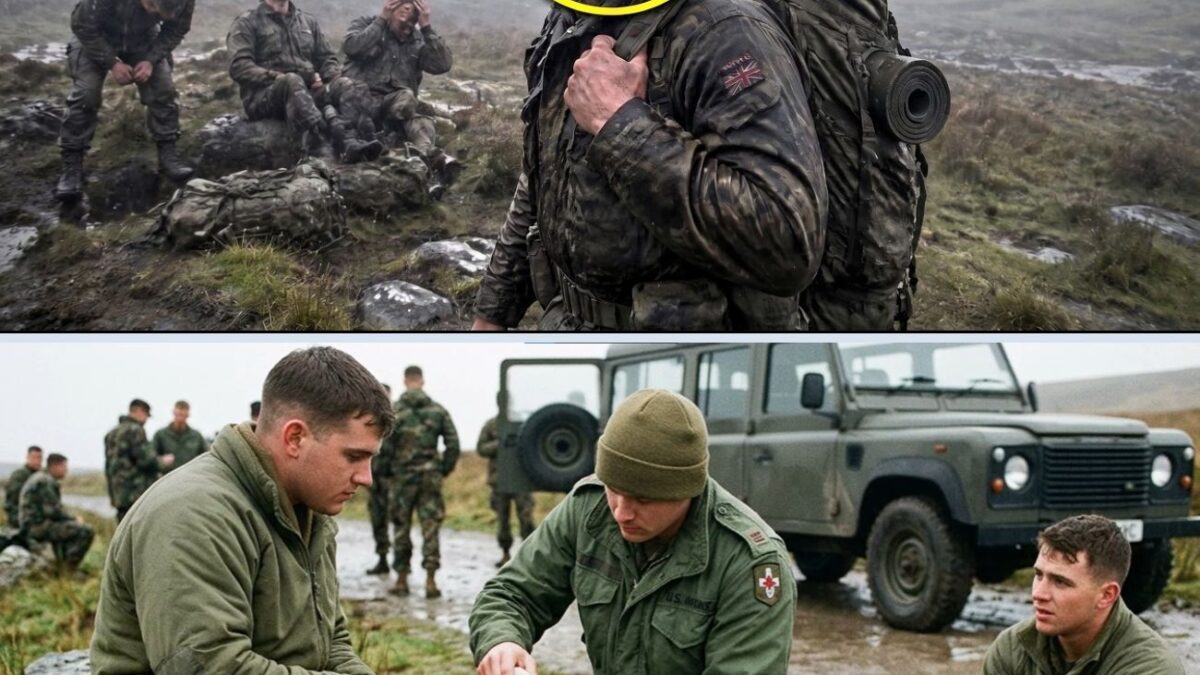
The rain came sideways across Storey Arms car park at 6:40 on a wet Tuesday in the third week of October sometime in the mid-1990s, and the Bergan on the tailgate weighed 55 lbs before anyone thought to add water for the bladder. A US Marine gunnery sergeant hefted it once, testing the straps by feel, and grinned across at the SAS colour sergeant standing with a clipboard under a poncho.
“This is it?” he said. “15 miles in a hill.”
The colour sergeant said nothing. He was watching the cloud sitting low on Pen y Fan the way it had swallowed the summit ridge hole since before dawn, and he was thinking about the four-hour clock that was about to start, and about how many of the visiting Marines standing behind their own gunnery sergeant would still be walking on their own two feet when that clock finally stopped.
The exercise had been sold to both sides on paper as a straightforward observation package. A force reconnaissance detachment in the United Kingdom that autumn for a joint cold weather exchange had been invited to sit in on a phase of SAS selection running through the Brecon Beacons, specifically the endurance march known within the regiment as the Fan Dance—a timed route over Pen y Fan and Corn Du and back down again carrying a rifle and a loaded Bergan, a fixture of selection since the 1950s and by that decade a name every special operations community in NATO had heard, if not seen.
Observing had not satisfied the visiting Marines for long. Somewhere between the mess tent on the Monday night and the map board on the Tuesday morning, observing had quietly become a wager, and a wager among proud men rarely stays quiet for long, either.
It was the gunnery sergeant who set the terms, and he set them the way experienced men set terms they expect to win loudly in front of witnesses over a second mug of tea he had not touched. Force Recon had run its own workup that spring in the Mojave on eight-mile timed humps carrying 60 lbs of kit and, by his account, had not lost a single man off the trail in six weeks of it.
Pen y Fan, in the words he used to a training wing lance corporal the night before the march, was a big green hill with a car park at both ends. He had said it standing beside a trestle table where an SAS directing staff sergeant was taping a blister on his own heel—the residue of a reconnaissance walk the DS had run that same morning simply to check the state of the peat below Corn Du before committing a serial of candidates to it, a detail the gunnery sergeant either did not register or chose to treat as beneath comment.
Exchanges of this kind were not unusual in the decade. British and American special operations units had traded observers and small training detachments through the 1980s and 1990s on a semiformal basis, each side hoping to learn something from the other’s selection and workup methods without giving away anything it considered proprietary. Most such exchanges passed without incident and without story: a week or two of shared ranges, shared rations, and polite professional respect that neither side felt any need to write up afterward.
What made this particular week memorable enough to survive in the retelling of men who were there was not the exchange itself, but the specific avoidable choice one gunnery sergeant made to turn a morning of observation into a public wager against a course he had not yet seen run in bad weather—a choice built, as such choices usually are, on an honest confidence in his own men’s fitness and a much less honest assumption that fitness alone was the variable being tested.
Neither man’s name survives in any released account, and that omission is deliberate on both sides of the exchange. They were doing a job, not making history, and the institutions they served have kept the story that way, sanded down to rank and role.
What does survive, corroborated loosely across several recollections from officers and senior NCOs who served through joint training packages of that period, is the shape of the day itself: the wager, the route, the weather closing in hour by hour, and the plain arithmetic that turned a green hill into something considerably less forgiving than advertised.
The wager itself was simple enough to fit on the back of the gunnery sergeant’s map board. Four Marines, handpicked by him from the fittest men in the detachment, would walk the Fan Dance course alongside that morning’s serial of SAS candidates, carrying the identical standard load laid down for the course: Bergan, rifle, map, and compass. No assistance offered, and none to be asked for; no resupply before the finish gate.
If any one of the four Marines finished inside the time the candidates were held to, the gunnery sergeant would stand the training wing sergeant’s mess a case of good whiskey. If none of them did, or if any dropped out before the line, the Marines would carry the DS’s kit on runs for the rest of the exchange—a small humiliation deliberately chosen for how visible it would be to the rest of the detachment.
The colour sergeant, who had said almost nothing through the whole negotiation, said one thing quietly afterward to the training wing captain supervising the serial:
“Let them wear the weight properly. The hill will do the rest of the talking.”
The morning brief delivered at 6:00 under a tarpaulin strung between two Land Rovers had already told anyone paying attention what kind of day it would be. The forecast read out by the training wing corporal called for sustained rain clearing to showers by midday, wind gusting to 40 mph on the exposed tops, and cloud base down around 2,000 ft—routine language recited in the same flat tone used for any other serial because, for the directing staff, it was routine.
Candidates were told to check their compass bearings twice before committing to any leg in cloud and to expect visibility problems on the col. The gunnery sergeant, standing at the back of the group with his own four men, is not recorded as having asked a single question during the brief, though two of the candidates near him were overheard afterward saying he had looked faintly amused by how much fuss was being made over what he still at that point considered an unremarkable walk.
Twenty-six SAS candidates started the march that morning, walking out through the gate at Storey Arms in loose single file, heads down inside hoods already soaked through, saying almost nothing to one another. Four Marines fell in among them, conspicuous in slightly different webbing and a slightly different gait, the gunnery sergeant himself staying back at the road with binoculars and a stopwatch he had bought specifically for the purpose.
By the time the front of the file reached the base of the initial climb, less than two miles in and still on made track, the difference was already visible to anyone who knew what they were looking at—not in raw speed, where the Marines, if anything, led, but in economy. The candidates moved at a pace that looked almost lazy on the flat and did not change it going uphill, wind or no wind, a metronome pace drilled into them across weeks of exactly this terrain. The Marines, fit by any conventional measure and confident of it, surged early and paid for the surge on the first real gradient, breath ragged where the candidates’ was not.
Pen y Fan stands 886 metres above sea level, the highest point in South Wales, and on a clear day the ridge walk up from Storey Arms is a demanding but entirely reasonable hill walk that thousands of civilian walkers complete every summer without incident. That particular Tuesday was not a clear day. Clouds sat on the ridge from roughly 650 metres upward, cutting visibility in places to under 10 metres, and the wind funneling through the col between Pen y Fan and Corn Du was gusting hard enough that candidates leaned into it as an unremarkable matter of habit—the way a man leans into a door he does not trust to be locked.
Rain had been falling since well before first light and had turned the peat sections of the descending track into something closer to standing water than solid ground, each bootprint filling black behind the man ahead before the next man’s boot came down in it.
The gunnery sergeant’s second marine, a corporal built like a barrel and, by his own account before the march, the strongest hiker in the whole detachment, made the summit of Pen y Fan in reasonably good order, ahead of two candidates and level with a third. He came off the descending ground on the far side moving badly, favoring his right knee on every third or fourth step, and by the base of Corn Du he had stopped adjusting his Bergan straps altogether and started simply enduring them head down, saying nothing to the candidates moving steadily past him on both sides.
Nobody on the directing staff said anything to him, either then or later. That silence, more than any words exchanged in the mess tent the night before, was the lesson beginning to arrive on the hill in real time: the ground did not care what a man had done in a training area on the other side of an ocean; it cared only what his legs and lungs could produce on this exact gradient, in this exact wind, at this exact minute against this exact clock.
Somewhere on the col itself, in the worst of the cloud, the field bunched briefly and nearly scattered the wrong way off the ridge. Visibility had dropped low enough that the leading candidates were navigating by pacing and compass bearing rather than by sight of the ground ahead, counting double paces under their breath the way they had drilled for weeks. And for perhaps 90 seconds, the whole front third of the serial drifted several degrees off the correct bearing toward a re-entrant that would have cost them the best part of a mile to correct.
It was a candidate, not a member of the directing staff, who called the error out loud first—a lance corporal on his second attempt at selection, checking his own bearing against a shoulder feature he recognized from a previous serial and refusing to trust the drift of the men in front of him.
The file corrected within a few dozen metres, quietly without any DS intervention at all, exactly as it was meant to. One of the two remaining Marines, close enough to hear the exchange, said afterward that it was the moment he stopped thinking of the candidates as simply fit young soldiers and started thinking of them as something closer to instruments calibrated for exactly this kind of hill in exactly this kind of weather.
The gunnery sergeant’s own men, navigating on a shared map board rather than individual compass bearings, had no comparable check built into their day at all, and it showed a few miles later between the col and the halfway turn.
The route dropped through a shallow stream crossing that on the map looked like nothing more than a contour line with a blue thread through it—the kind of feature nobody briefs because nobody expects it to matter. The overnight rain had lifted it a good foot above its normal bed, fast enough that the DS corporal posted there had strung a length of paracord from a fence post to the nearest rock simply so candidates had something to steady a hand against going through.
Every man in the file took the crossing the same way: cord in the off hand, rifle held high, boots filling regardless—a small delay repeated 20-odd times that cost the field collectively the better part of 10 minutes and cost nobody anything worse than colder feet because it had been walked correctly one man at a time without anyone hurrying the man ahead of him.
By the halfway mark, the turn beyond Corn Du where the field started the long descending leg back toward Storey Arms, one marine was already gone from the serial. He had stopped at a checkpoint manned by a DS corporal with a survival bag and a radio, sat down on top of his own Bergan without being told to, and had not got up again inside the margin the corporal was prepared to allow before logging him out.
The corporal noted it on a clipboard without visible reaction and walked him down to the safety vehicle idling on the forestry track below.
It was, in the flat account later given by a training wing officer who discussed that period of joint exercises on condition of anonymity, an entirely ordinary sight on a wet serial. Candidates fell out of that march in handfuls most weeks, sometimes a third of a field or more, and the directing staff treated it with the unhurried unsurprise of men watching familiar weather roll in.
What was not ordinary—and what would be remembered on both sides of the exchange for years afterward—was that the man being helped into the wagon before 10 in the morning was a United States Marine who had promised not 18 hours earlier that the hill was nothing at all.
The second marine to fall out went down almost within sight of the first on the exposed shoulder of ground below Corn Du where the wind had the least to slow it and the peat hags sat hidden under six inches of standing brown water. He caught a boot on a hidden edge, twisted hard, and went down onto his own Bergan with the weight of it driving him sideways rather than back.
He got up on his own—nobody helped him because nobody was permitted to—and tried for 400 more metres to keep the pace before a DS staff sergeant, watching him list to one side with every stride, made the call and pulled him off the course before the ankle became a stretcher case rather than a limp one.
Two of the four Marines were down before the field had covered 10 of the 15 miles.
The gunnery sergeant, watching from the road below through his borrowed binoculars, said nothing for a long time, and a training wing sergeant standing near him later said it was the first time all week the American had looked genuinely uncertain of anything. He is remembered lowering the binoculars once, wiping the lenses on a dry corner of his smock that no longer existed, and raising them again anyway, as though a clearer view might change what the stopwatch in his other hand was already telling him.
A candidate passing the twisted-ankle marine on his way down had slowed for perhaps two strides—the instinctive check of one man for another—before a DS staff sergeant’s flat “Keep moving!” sent him back onto pace without so much as a backward glance.
It was not unkindness. Candidates were forbidden from rendering aid precisely so that the directing staff, trained for exactly this, could make the call on a man’s fitness to continue without a second opinion clouding it, and every candidate on that hill understood the rule well enough not to resent being reminded of it mid-stride.
What remained on the hill after the two fallers were pulled was harder to see from a road below and mattered more than anything that had happened yet. The candidates still walking were on the whole unremarkable men to look at: a signals corporal, a Royal Engineers lance corporal, a private soldier from an infantry battalion, a handful of others in soaked smocks showing no names given because names are not used on that hill and never have been.
None of them were visibly larger or stronger than the two remaining Marines walking among them. What distinguished them was not strength in any gym sense of the word; it was the refusal to spend anything they had not already budgeted to spend, mile after mile, in conditions that offered every excuse to spend it early.
One candidate, asked afterward by the training wing officer how he had crossed the worst of the peat sections below Corn Du without turning an ankle the way the second marine had, said only that he had walked that exact stretch of ground in the rain three times already that month on other serials and knew more or less by feel through his boots where the water was hiding the deepest holes.
There was no swagger in the answer, and there rarely was on that hill. Men who had something to prove had mostly proved it one way or another in the weeks before selection ever put them on this particular slope.
The gunnery sergeant’s two remaining Marines were, by any fair account, tough men doing badly against a standard they had underestimated rather than men without toughness at all, and it is worth saying plainly that nothing about the day proved otherwise.
The third to struggle was, on paper, the fittest of the original four: a staff sergeant with a marathon personal best other Marines in the detachment quoted the way men quote a unit citation. He held pace with the leading candidates for 11 of the 15 miles, through the worst of the crosswind on the open ridge, through the descent that had already broken the barrel-chested corporal’s knee two hours earlier.
And it was the last three miles of flat, sodden fire road running back into Storey Arms that finally undid him. Not a fall, not a twisted joint, simply a body that had spent its reserve of effort on the dramatic climbing ground and had nothing left for the unglamorous miles at the end.
Those closing miles do not photograph well and rarely feature in the stories men tell afterward. But according to more than one training wing NCO who has walked that ground hundreds of times over a career, that flat final stretch is where the majority of a serial’s fallers actually happen, not on the exposed ridge where the drama plainly is.
The staff sergeant walked the last stretch in on legs that had stopped bending properly at the knee, made the gate, and finished six minutes over the time the candidates in front of him had been held to. He did not talk about it much that evening, and nobody on the DS raised it with him either.
Only one of the original four Marines finished inside the candidate’s own time. It was the youngest of the group by several years, a lance corporal with the least reputation among his own detachment to defend beforehand and, by more than one later account, the only man of the four who had spent his own free evenings before the exchange training specifically on hill gradients with a loaded pack rather than on flat time-distance at speed—a detail the gunnery sergeant had waved off two nights earlier in the mess tent as overcautious, even faintly comic.
For a man supposedly built for speed, the lance corporal crossed the finish line at Storey Arms nine candidates deep in the field—not first, not close to first—breathing hard with his hands braced on his knees, Bergan straps having cut two raw red lines into his shoulders that were still visible three days later when the detachment moved on to its next serial.
He did not claim the win loudly, and by the training wing officer’s account, he seemed alone among the four to understand exactly what he had been part of, rather than simply what he had managed to beat.
The arithmetic of the morning, once totaled quietly at the finish gate by a DS clerk with a stopwatch and a list of bib numbers, told its own story without needing anyone to narrate it. Twenty-six candidates had started at Storey Arms before 7:00 that morning; 19 finished inside the standard—a fallout rate the directing staff regarded without any particular satisfaction as ordinary for a wet October serial on that route.
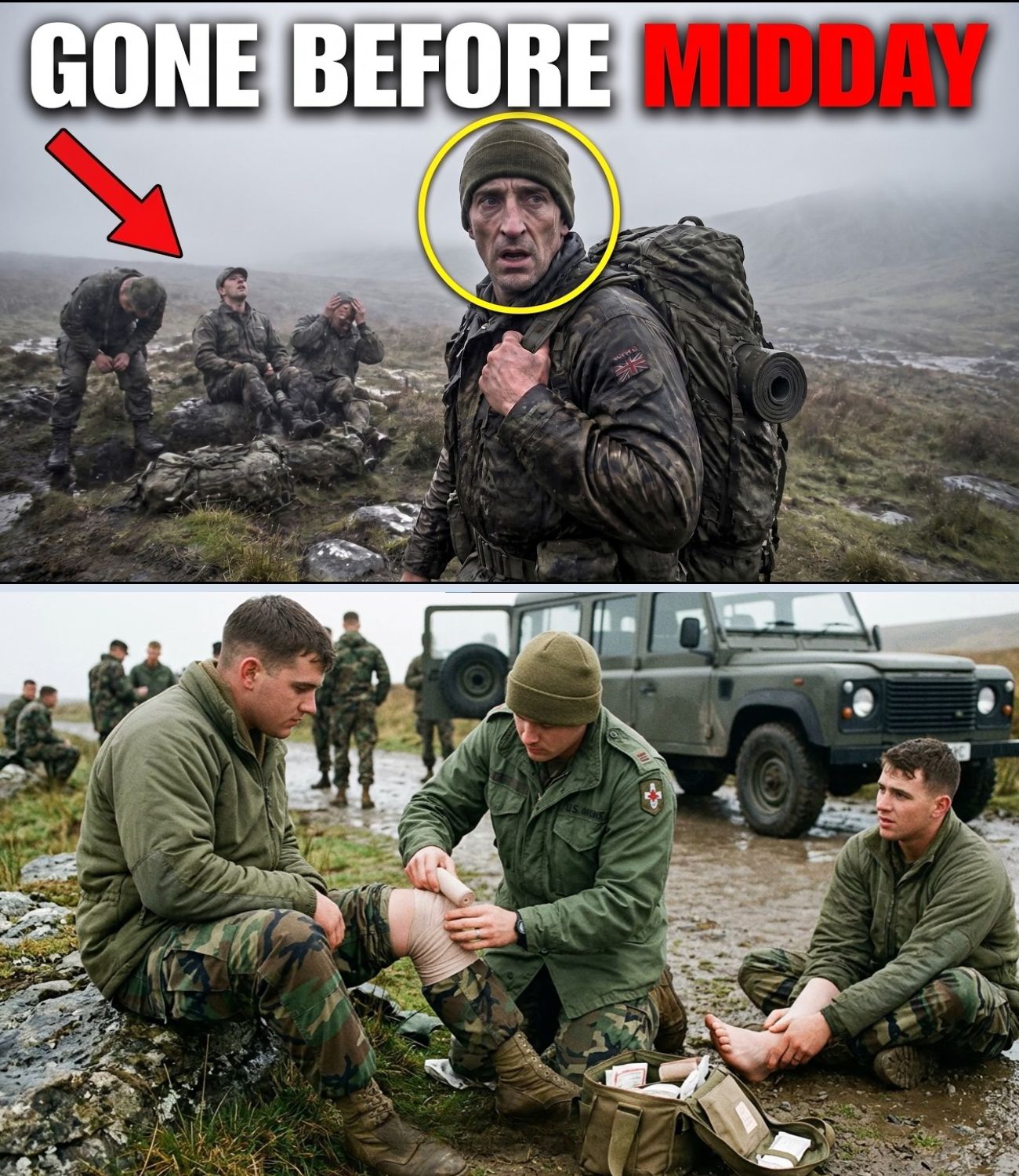
Of the four Marines who had started the day with a case of whiskey riding on the outcome, one had finished on time, one had finished well outside it, and two were already sitting in the back of a Land Rover with a medical orderly, checking a knee and an ankle respectively before midday had properly arrived on the Beacons—half the wagering party off the hill before the candidates who had beaten them had even stopped sweating at the gate.
The medical orderly who checked the corporal’s knee at the finish gate had seen the injury often enough to name it without an X-ray: a patellar strain brought on less by any single bad step than by thousands of small compensating steps taken downhill on a joint already tired from the climb—the kind of injury that accumulates rather than happens, and one the directing staff regarded as a normal cost of the route rather than an anomaly requiring explanation.
He asked the corporal, out of habit rather than any real hope of a useful answer, when the knee had first started talking to him. The corporal thought about it and said somewhere around Corn Du, which meant he had walked the last four miles of the course already knowing in some unacknowledged way exactly what it would cost him afterward.
He wrapped the knee, told the corporal plainly that he would not be walking anywhere for a few days, and moved on to the ankle case without further comment—the practiced economy of a man who had performed the same two conversations many times that year already.
It was, in its small way, another piece of the same lesson repeating itself. Nothing that had happened to either marine was unusual by the standards of the hill; it was only unusual by the standards the Marines themselves had set the night before.
News of the fallout rate reached the gunnery sergeant before his own two remaining men did, carried down the hill by radio in the flat shorthand the directing staff used for everything: two casualties, one time fail, one finish.
He is said to have asked the training wing captain, almost as an afterthought, whether the course was always run in weather like this. The captain’s answer, delivered without any particular relish, was that the course was run in whatever weather turned up on the day because selection did not reschedule for rain, and that the candidates understood this before they ever laced a boot at Storey Arms.
He added, almost as an afterthought of his own, that the forecast for the following week’s serial was worse again, with a further front already tracking in off the Irish Sea, and that nobody on the directing staff found that especially noteworthy either. It was simply what October did to that particular stretch of Wales year after year, regardless of who happened to be watching from the road.
It was, in its way, the first plain statement of the standard the gunnery sergeant had spent the previous evening dismissing as a car park with a hill attached.
The lance corporal who finished on time did not go straight to the training wing hut afterward. He sat for a while on the low wall by the Storey Arms car park, Bergan still on, working the straps loose one buckle at a time rather than shrugging the whole weight off in one movement—a small habit, he said afterward, he had picked up from watching how the candidates around him handled their own kit at every checkpoint along the route.
Nobody had told him to do it that way. He had simply noticed, mile after mile, that the men who were still walking cleanly late in the march were the ones who treated every small mechanical task—straps, laces, map case, water bottle—with the same unhurried care whether it was mile 2 or mile 13, and that the men who were struggling had, without exception, started rushing those same small tasks somewhere around the halfway mark.
It was not a lesson anyone at Storey Arms had set out to teach him that day; it was simply there to be noticed by the one man among the four who had arrived already looking for something to notice rather than something to prove.
By early afternoon, the rain had eased to something closer to standard British drizzle, and the two injured Marines were back at the training wing hut: one on crutches borrowed from the medical section and one with an ankle strapped tight inside an unlaced boot, both of them watching the last stragglers of the candidate field come through the gate in the fading gray light.
Neither man complained, and by several accounts both were more subdued than embarrassed—the particular quiet of men doing arithmetic on themselves rather than excuses on the hill.
The wind had dropped by then to something closer to a stiff breeze, and a watery patch of afternoon sun kept breaking through over the col for a few minutes at a time, lighting up the wet rock of Corn Du to gold before the cloud rolled back across it—the kind of ordinary Welsh weather turn that would have made the whole march look almost gentle to anyone arriving fresh at that hour, with no memory of what the same ground had been at 7:00 that morning.
The corporal with the ruined knee reportedly asked one of the finishing candidates—a private soldier not yet 25 who had walked the whole course near the front of the field without apparent effort—how many times he had run the route before that morning.
The candidate said four, maybe five; he had lost exact count, and each time had felt roughly as hard as the last.
It was not the answer the corporal had been hoping to hear, and he did not ask a second question. He sat back against the hut wall instead, working his strapped ankle slightly against the boot leather, and watched the private soldier walk off toward the cookhouse with the loose, unhurried gait of a man who had simply finished a piece of work rather than survived an ordeal.
By the time the last candidates came through the gate, well past 2:00 in the afternoon, the light over the Beacons had gone the flat gray of an October evening arriving early, and the training wing hut smelled of wet wool and boiled tea.
The colour sergeant, who had said almost nothing all day, did eventually say one thing more, and it was said to the gunnery sergeant directly over a mug neither man had bothered to top up. He did not gloat, because gloating had never been part of how the training wing conducted itself, and because there was, in truth, nothing to gloat about. The four Marines were fit, brave men who had simply met a standard built out of decades of exactly this weather on exactly this hill and found it a good deal heavier than advertised.
What the colour sergeant offered instead was closer to an accounting than a taunt. The course, he said, was not built to find the strongest man on his single best day; it was built to find the man who had nothing left to prove to anyone standing at the roadside with binoculars and everything left to give once the miles stopped being interesting.
The gunnery sergeant, to his credit by every account that survives, did not argue the point, and he did not try to relitigate the terms of the wager either. He paid for the whiskey that same evening without being asked twice, and by more than one recollection, it was the two injured Marines—not the lance corporal who had actually won the case for their side—who insisted on carrying it into the sergeant’s mess themselves, one on crutches and one on a taped ankle inside an unlaced boot, on the grounds that a debt paid badly by someone else was worse than a hill lost honestly by yourself.
It is a small detail, and an unverifiable one in any documentary sense, but it is the kind of detail that tends to survive in the retelling precisely because everyone who was there that week repeats it the same way: two men who had been carried off a Welsh mountain before lunchtime choosing to carry a case of whiskey across a messroom floor rather than let it be delivered for them.
The case of whiskey itself is not recorded in any official log, and it should not be treated as more than what it plainly was: a private arrangement between men on a training exchange, the kind of wager that has attached itself to hard standard courses for as long as visiting units have turned up to watch them run and found the watching insufficient.
What is far better attested in general shape, if not in exact words or exact date, is the pattern sitting underneath it. Outside observers arrive at Pen y Fan with real credentials, real fitness, and real records from other continents; measure the march by its distance and its elevation gain; and are wrong about what those numbers actually mean once weather and ground are added back in.
Fifteen miles is not on its own a large number. Fifty-five pounds is not by itself an unusual load for an infantry soldier of any nationality to carry. A four-hour standard sounds read cold off a page almost generous.
None of that survives contact with a peat bog in October rain, a crosswind funneling through a mountain col at 900 metres, and two dozen candidates who have already decided long before the first boot ever touches the trail at Storey Arms exactly how much of themselves they are prepared to spend in the first 10 miles and exactly how much they intend to have left in reserve at the gate.
It is worth setting the numbers down plainly because the numbers are the part of the story an outsider can actually check in a way that the private, unrecorded texture of any single Tuesday on the Beacons can never quite be.
The Fan Dance, as a named test within SAS selection, has run over broadly the same ground in the Brecon Beacons for decades—up from a start point near Storey Arms, over Pen y Fan and Corn Du, and back down—all of it against a clock candidates are told about in advance, and none of it adjusted for the weather on the day.
The precise time standards, the exact loads specified for a given serial, and the pass rates for any individual course are not matters the Ministry of Defence publishes, and this account does not claim knowledge of them beyond what has been said openly by veterans of the regiment in books and interviews over the years: that the loads are heavy, that the standard is unforgiving, and that the fallout rate on any given serial in any given weather is high enough that finishing at all is treated by candidates as a genuine achievement rather than a formality.
Selection as a whole is widely reported to fail the overwhelming majority of the men who started, for reasons ranging from the hills to the map-reading phases to the long, unglamorous marches deeper into Wales that follow once Pen y Fan is behind them. The four visiting Marines had walked into one morning of a process built month after month, year after year, to be exactly this hard for exactly this reason.
The load itself deserves the same plain treatment. Fifty-five pounds of Bergan is broken down—not an exotic figure: sleeping kit, spare clothing, rations, a share of section equipment, water. But it is a figure that behaves very differently on a boggier sidehill at 900 metres than it does on a level track at sea level, and it behaves differently again after six hours of continuous rain has added its own uncounted weight to boots, socks, and the outer layer of every piece of kit in the pack.
None of the four Marines had trained specifically with that combination of load, gradient, and saturation before that Tuesday. Three of the four, by their own later admission, had trained the number on the scale far more than they had trained the terrain under it.
The lance corporal who finished on time had, by contrast, spent the weeks before the exchange walking hill tracks near his own base whenever off-duty hours allowed, in whatever boots and whatever weather happened to be available that evening, on the theory that a march is only ever as easy as the ugliest conditions you have already rehearsed it in. It was, in hindsight, the only preparation among the four that actually matched the test.
There is a further detail worth setting down because it explains something the wager itself never could. The Fan Dance is not, in the regiment’s own long-standing description of it, principally a fitness test at all, whatever it looks like from a road below with a stopwatch running.
It is described by those who have designed and refined it over decades as a decision-making test wearing a fitness test’s clothing—a way of watching how a man behaves once his body has started sending him convincing, reasonable arguments for slowing down, and whether he can go on making sound judgments about pace, ground, and navigation while those arguments are arriving.
A man who has trained only to outrun the argument rather than to keep functioning underneath it tends to look identical to a man who has trained properly right up until the exact moment the argument gets loud enough to matter, which on that hill in that weather is usually somewhere on the descent rather than the climb.
Three of the four Marines discovered exactly where that moment sat in their own bodies, in front of witnesses, in under four hours.
This is, in the end, why the story belongs to selection rather than to any single named mission, and why it survives at all in the retelling of men who were never meant to be its subject. There was no target that Tuesday, no enemy, no objective beyond the hill and the clock. And yet the hill did more sorting in four hours than most training packages manage in a month of exercises.
The 19 candidates who finished inside standard that day went on afterward to further phases. Most of them would eventually fail for entirely different reasons: jungle training overseas, escape and evasion under interrogation conditions, the long, unglamorous attrition that whitters a course down over months rather than a single wet morning.
Selection, as institutions on both sides of the Atlantic understood it even then, was never really about Pen y Fan at all. Pen y Fan was simply the first filter—the one that happened, that particular October, to be watched by four men who had arrived believing filters like that belong to other, lesser services.
The four Marines went back to their own detachment’s workup within the week, wiser about one specific hill in Wales, and, if the recollections of men who served alongside them are accurate, noticeably quieter about it in their own mess for some while afterward. None of the four is known to have repeated the “car park with a hill attached” line again in front of British company, and at least one training wing NCO recalled years later, and with evident amusement, that the phrase became a private joke among the directing staff themselves—muttered under a poncho on the worst mornings as a kind of grim shorthand for exactly the sort of day that had put two grown men into the back of a Land Rover before their own lunch hour.
There is no record of the detachment changing its own workup on the strength of one wet Tuesday in Wales, and it would be tidier than the truth to claim otherwise. What did change, according to more than one officer who continued to work exchange postings between the two services into the following decade, was something quieter and less official: a habit among units that rotated through the Beacons afterward of asking a few more questions before they said anything at all about a course they had not yet walked in its worst weather.
Reputation on that particular hill had already been earned by the time any visitor arrived to test it, and it had been earned the same unglamorous way the 19 finishers earned their own place in the field that Tuesday—not in a mess tent the night before, but mile after mile, checkpoint after checkpoint, in weather nobody had asked for and nobody was permitted to reschedule.
What the gunnery sergeant is said to have kept from that Tuesday, by his own account to men in his own unit afterward, was not primarily the memory of losing a wager, and it was certainly not the memory of the whiskey, paid or otherwise. It was the memory of watching an unremarkable-looking signals corporal—a man perhaps two-thirds his own size—walk past his own corporal on the exposed ridge below Corn Du without breaking stride, without a word exchanged, without so much as a glance toward the American kneeling by the side of the track with his hands on his knees.
Not out of contempt—nobody on that hill that day showed contempt to anyone on either side, and that restraint is itself part of what the account is really about—but because the march had never been a contest with the Marines in the first place. It had only ever been a contest between each candidate and the clock strapped to his own wrist, and the clock, unlike a visiting service’s pride, does not care in the slightest who happens to be watching from the road.
The blister tape the SAS staff sergeant had applied to his own heel the night before the wager was even proposed had been for nothing more dramatic than a routine reconnaissance walk—the kind of unglamorous, unwitnessed preparation that nobody brags about in a mess tent and that nobody in the moment thought worth mentioning to a visiting gunnery sergeant confident he already understood the ground.
Retelling the story years later, by then himself a senior instructor training a new intake of directing staff, that same sergeant is said to have made only one addition to it, delivered flat without any particular smile the way men of that trade tend to deliver the lines that matter most to them:
“A hill in the Brecon Beacons,” he told the new instructors, “has never once in his entire experience of it cared how a man had talked about it the night before. It only ever asked at the second checkpoint and every checkpoint after exactly what was still left of him.”
That is where the story is usually left on both sides of the exchange that produced it, because there is not much more to add that the numbers from that one Tuesday do not already say plainly enough on their own: 26 candidates out at first light, 19 still walking at the standard, four visiting Marines who had wagered a case of whiskey on a hill they had called easy the night before, and two of them off it one way or another before midday had properly arrived on the Beacons.
Somebody on the drive down from Storey Arms that evening is said to have asked the colour sergeant whether he had known, standing at the tailgate that morning, exactly how the day would end.
He is reported to have said only that he had not known the details—not which two men would fall, not at which mile, not on which particular stretch of hidden peat—only that the hill did not make exceptions for confidence, and that it had never once needed his help to prove it.
You Might Also Enjoy

“We Thought They Would Negotiate”—What Argentine Soldiers Said When The British Attacked Goose Green

“You’ll Never Finish My Ruck March, Limey” — US Sergeant Who Challenged the SAS, Then Fell Out First






