The Necklaces No Royal Will Wear Anymore! (Including Queens)
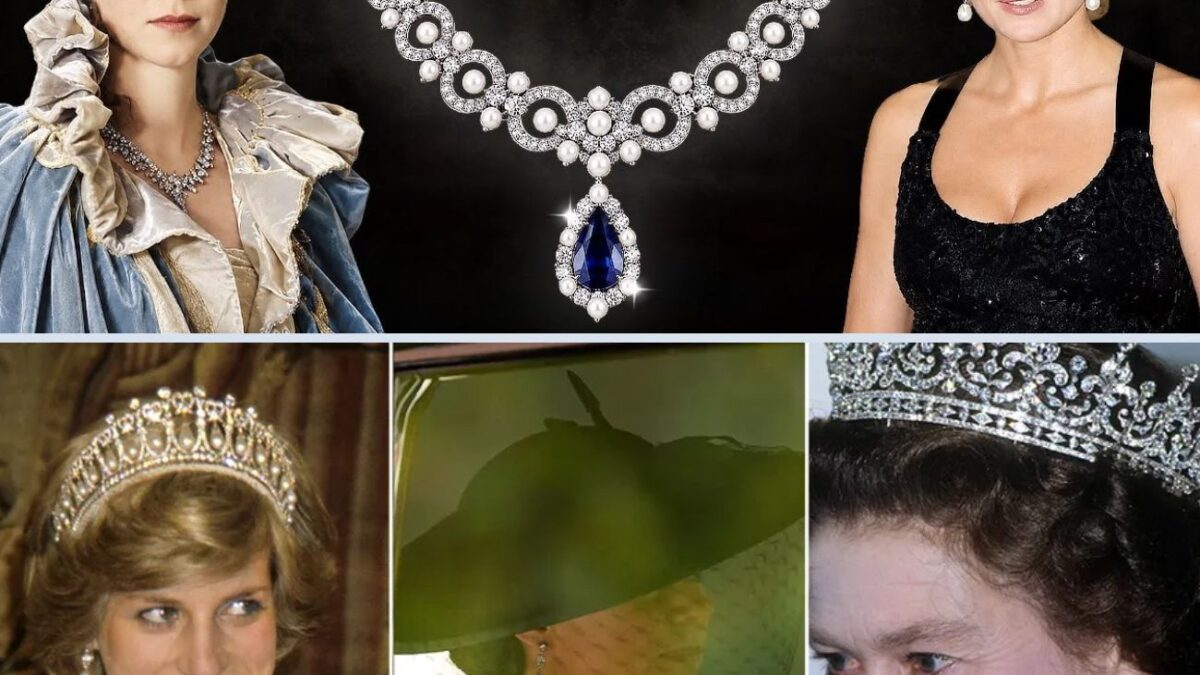
The necklaces no royal will wear anymore. On September 22nd, a necklace came out of a royal vault. Queen Alexandra gave it to the future Queen Mother as a wedding gift in 1923. Camilla wore it once in 2012. Then it went back into the vault until Princess Catherine wore it to the royal film performance 14 years later, which raises a question. If one necklace can come out after 14 years, what else is still in there? Because these aren’t legends. They’re cataloged, photographed, real. Some sit in family vaults. One went behind glass at Buckingham Palace. And every one of them has gone quiet for a different reason. One was worn to dance with a Hollywood star at the White House, and no modern royal has worn it since. One was worn by a teenage princess at a coronation and never worn again with no explanation. Seven necklaces. Let’s open the vault starting with the one you’ve almost certainly seen. Princess Diana’s sapphire choker.
It began life as a brooch, a large oval sapphire ringed with diamonds, a gift from the Queen Mother around Diana’s wedding. But Diana reportedly found brooches old-fashioned. So within a few years, she had that sapphire set into the center of a seven-strand pearl choker. Then came November 1985, a White House dinner and a dance with John Travolta. That one photograph made the choker famous. In June 1994, she wore it with the black revenge dress on the very night Prince Charles admitted on television that he’d been unfaithful. She kept wearing it after the divorce, including at a New York award dinner in 1995. And the last time cameras caught it was a New York gala in December 1996. And then, nothing. No modern royal has worn it since. It has not come back out. Most royal jewels are heirlooms, passed quietly from queen to queen. This one was remodeled by Diana herself. It isn’t an heirloom. It’s a signature. And maybe that’s why nobody has dared to pick it up.
But Diana didn’t only wear jewels that were hers. On the 1983 tour of Australia, she borrowed a necklace straight from the queen. Queen Elizabeth II’s King Faisal diamond necklace. In May 1967, King Faisal of Saudi Arabia arrived in London for a state visit carrying a gift for Queen Elizabeth II, a diamond fringe necklace made by the American jeweler Harry Winston back in 1952. It had sat in stock for 15 years until Faisal bought it that March. More than 300 diamonds, baguettes, and brilliants with 11 pear-shaped pendants hanging from the front, roughly 84 carats in all. The queen wore it for decades to state banquets, a royal film performance, even the Ghillies Ball at Balmoral. But this was never one woman’s signature jewel. It was a necklace that got passed around. In 1983, she lent it to Diana, who wore it to a charity ball in Sydney. In 2012, she lent it to Sophie, then the Countess of Wessex, who wore it with the five aquamarine tiara to a wedding gala in Luxembourg.
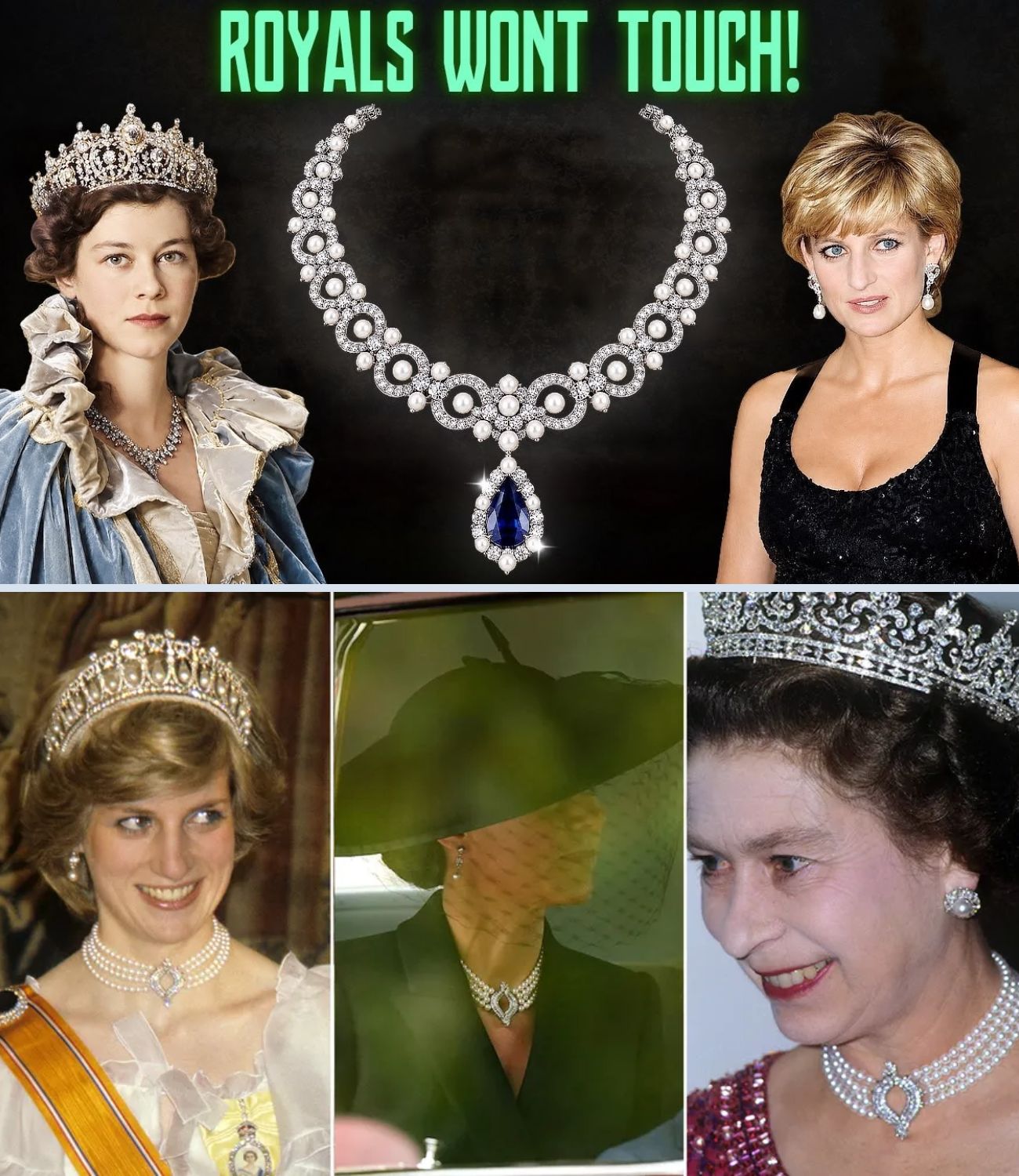
So, here’s the question. If it was lent out before, why hasn’t it been pulled out again? There’s no scandal attached to it, no curse, no single woman it belongs to. And yet, since the queen’s death in September 2022, it hasn’t turned up on anyone. A necklace that was shared for decades and has now been left alone.
From a necklace nobody has reached for to one that was built to change shape. Queen Frederica’s pearl necklace tiara. On January 22nd, 1964, Queen Frederica of Greece walked into the Waldorf Astoria in New York for Barnard College’s 75th anniversary dinner. She wore a tiara, an enormous sapphire pendant, and a diamond and pearl necklace that could also be fitted to a frame and worn as a tiara. That’s the trick of this jewel. Frederica rarely wore it bare. She hung pendants from it. The sapphire was a 478-carat Cartier stone, once owned by Queen Marie of Romania. On other nights, it carried a ruby brooch or an emerald pendant. Same necklace, a different color every time. Her youngest daughter, Princess Irene, later wore it as a tiara, including at the 1966 wedding ball of Princess Beatrix of the Netherlands. Then, in 1967, the Greek royal family went into exile. Frederica died in Madrid in 1981, and the necklace dropped out of public view for decades. Nobody has ever put a maker or a date on it. No jeweler’s name, no commission, no paper trail. Irene, the last woman known to have worn it as a tiara, died in January 2026, and to this day, no one has confirmed where it is. A necklace that crossed an ocean, outlived a monarchy, and never once told us who made it.
That Greek royal house began with a Danish prince, George I, whose sister became queen of England. Her wedding necklace is next. Queen Alexandra’s Dagmar necklace. Here’s a question for you. What if one of these necklaces isn’t locked away at all? In 2025, you could have stood 3 ft from this one at the King’s Gallery at Buckingham Palace and still never seen it worn the way it was made to be worn. In 1863, a Danish princess named Alexandra was about to marry the Prince of Wales. Her gift from Denmark was a necklace commissioned by King Frederick VII. Around 2,000 diamonds, 118 Danish pearls, and at its heart, a gold and enamel cross, a replica of the medieval Dagmar Cross. That cross reportedly holds a splinter of the true cross and a scrap of silk from King Cnut’s grave. Legend, not proof, but it has followed this necklace for more than a century and a half. Garrard made the pearls and the cross detachable, so it could be worn in pieces. Alexandra wore it complete in 1871, dressed as Mary, Queen of Scots, and again at the 1902 coronation. She left it to the crown on one condition, that it could never be altered. Queen Elizabeth II wore it stripped back, without the cross or the two largest pearls. The complete necklace has not been seen on anyone since 1902. And Alexandra’s jewels are slowly coming out. On September 22nd, Catherine, Princess of Wales, wore another Alexandra gift for the first time. The amethyst sautoir she gave the Queen Mother in 1923, last seen in 2012. A necklace built to be worn many ways and worn whole by only the woman it was made for.
If Dagmar survived by becoming a museum piece, our next necklace survived by being quietly put away. Queen Sirikit’s Van Cleef & Arpels diamond bib necklace. How does a necklace big enough to cover your entire chest just disappear? Ask Queen Sirikit of Thailand. In 1963, she commissioned a diamond bib necklace from Van Cleef and Arpels. A base of large diamonds set within an ornate diamond collar, wide enough to cover the chest and sweep across the shoulders. She debuted it in Athens at the 1964 wedding of King Constantine II of Greece and Princess Anne-Marie of Denmark. She wore it weeks later at a banquet during a state visit to Austria, and it appears again at a banquet during the British state visit to Thailand in 1972. Then, in the late 1970s or early 1980s, her daughter Princess Sirindhorn wore it, one of the largest jewels she has ever worn. And since then, nothing for several decades. Queen Sirikit, a queen consort for more than six decades, died in 2025. The jewel, built to be seen from across a ballroom, and then quietly put away.
But at least that one has a story you can follow from start to finish. Our next necklace stopped in the middle of its own. Princess Alexandra’s pearl and diamond necklace. Princess Alexandra of Kent, King Charles’s cousin, turns 90 this Christmas. She has worn spectacular jewels for seven decades. This isn’t one you’ll find in a photo from this century. It’s two rows of diamonds with three pear-shaped pearls and two diamond pendants hanging from them. Nobody knows where it came from. It may have come from Queen Mary, or been acquired for her, or even come from her Greek grandmother’s Russian collection. What we do know is that it first appeared at the 1953 coronation of Queen Elizabeth II when Alexandra was 16, and in portraits by Cecil Beaton around then. It followed her through the 1950s, a 1955 wedding gala in Portugal, a tour of Australia, a 1960 state visit from France, and Nigeria’s independence celebrations later that year. Then, around the time of her 1963 marriage, it stopped. No announcement, no explanation. And the timing is the strange part. She had just been given a pearl and diamond tiara that would have matched it perfectly, and the necklace that should have completed the set was never worn in public again. To this day, no one has publicly said what became of it. A necklace worn for 10 years, from a coronation to Nigeria, and then, with no explanation, never again.
From a necklace that stopped without a word to one that was never meant to belong to anyone but the woman who wore it. Empress Michiko’s diamond necklace. Japan’s imperial women wear only white stones, mostly diamonds and pearls. So, when a necklace is personally owned by the Empress, rather than the Imperial Household, that is unusual. In 1959, Michiko Shoda became the first commoner to marry into the Japanese Imperial Family. Her diamond necklace, with modern pave scrolls and a round diamond pendant, has no known provenance and appears to be one of her few personally owned diamond pieces. It turns up in a 1971 portrait, at a dinner with King Hussein and Queen Alia of Jordan in 1976, and at a state dinner in Bulgaria in 1979. As Empress, she wore it rarely. Once, notably, with the honeysuckle tiara at a German state banquet. And it was not among the jewels passed on to Empress Masako. Empress Michiko is still with us, so, unlike every other necklace on this list, this one may still have a next chapter.
So, there you have it, seven completely different reasons and the same result every time. The occasion passed, the owner passed, and the necklace went quiet. But, if the last few weeks proved anything, it’s that the vault can open. On September 22nd, Kate pulled a century-old Alexandra gift out of it. So, which of these should be next, and who should wear it? Tell us in the comments.
You Might Also Enjoy

“We Thought They Would Negotiate”—What Argentine Soldiers Said When The British Attacked Goose Green

“You’ll Never Finish My Ruck March, Limey” — US Sergeant Who Challenged the SAS, Then Fell Out First






