The Queen Mother’s BEHAVIOR At Princess Margaret’s Funeral Was Much COLDER Than You Think
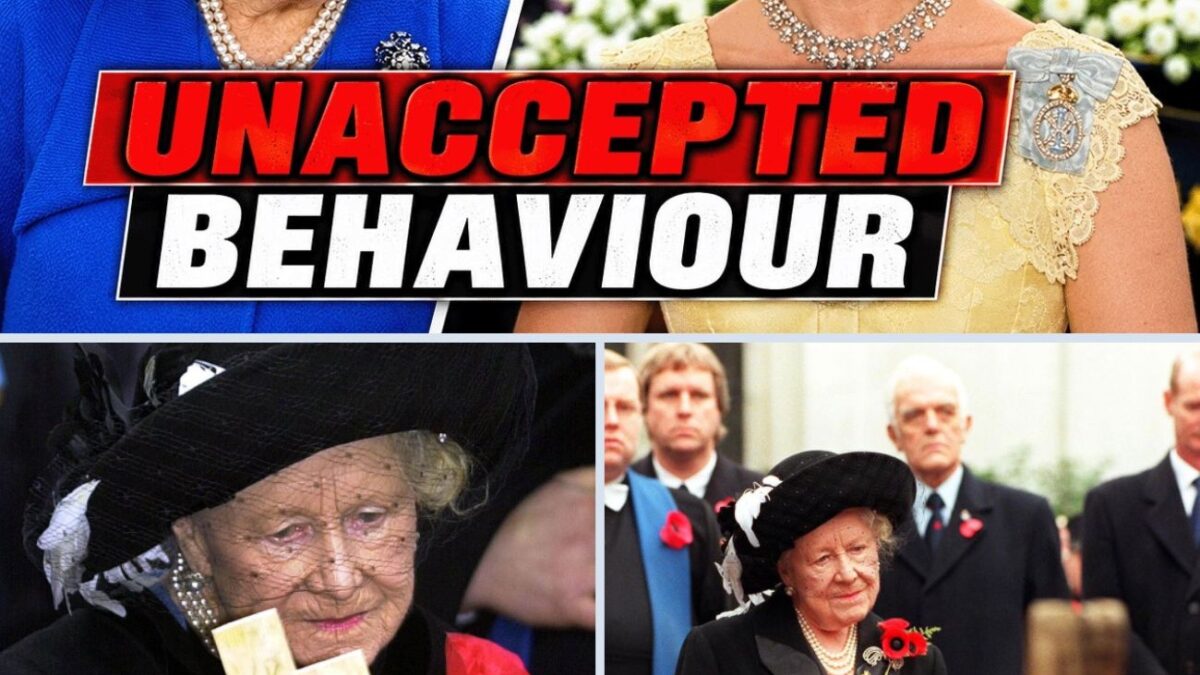
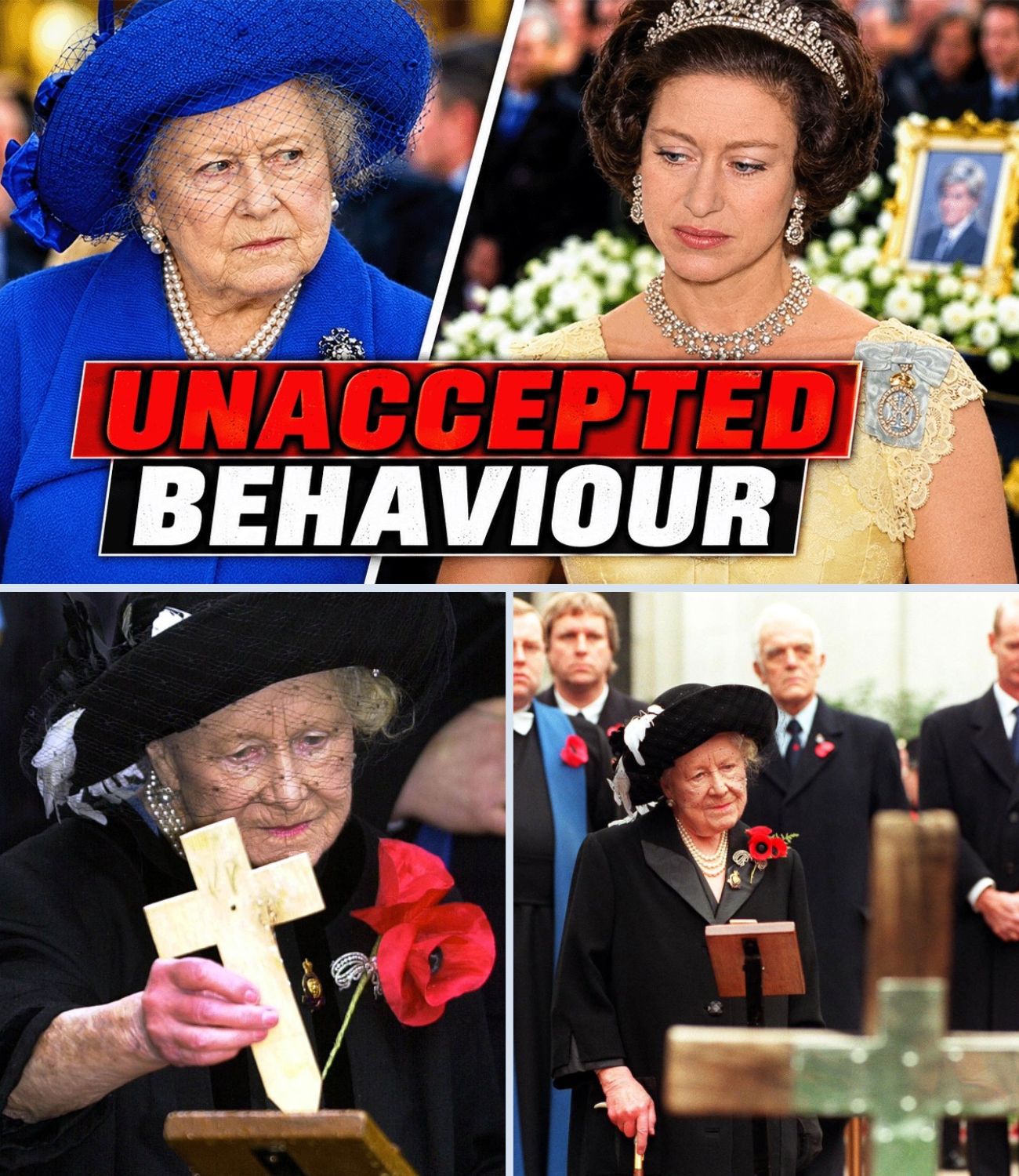
Windsor, February 2002. A 101-year-old woman in a wheelchair, one arm bandaged from a fall, overruling her doctors to reach a chapel. The public saw devotion. Look at the date. 50 years earlier, to the day, she had buried her husband in that same chapel. The coffin she now followed was small because Margaret had been cremated in Slough, alone among modern senior royals, by her own instruction. The man Margaret once loved had worked for her mother, in her mother’s house, on her mother’s payroll. Nobody stopped anything. Nobody said anything. The silence started in 1952. It never broke.
Start with what the cameras got because the cameras are the reason most people think they know this story. On the 15th of February 2002, the Queen Mother was flown from Sandringham to Windsor by helicopter. She had fallen weeks earlier and cut her arm badly enough that the dressing was still on it. She was 101. Her medical household had advised against the journey, and the palace had briefed, gently, that her attendance was uncertain. She went anyway.
She was lifted into a car, taken up to St. George’s Chapel, and positioned at the front, veiled, in black, beside the Queen. That is the image. A mother at the funeral of her second child, refusing to be told she was too old or too hurt to be there. And every word of it is true, which is exactly the problem because it’s also the only part of the story most people have ever been shown. Now, the detail the broadcast didn’t explain. Princess Margaret’s funeral was a private ceremony, not a state occasion, and the coffin that came into the chapel was noticeably small.
Margaret had left instructions that she was to be cremated. On the afternoon of the funeral, her body went to Slough Crematorium, a municipal crematorium in a Berkshire town, about 4 miles from the castle. No senior member of the modern royal family had done that. The royal vault at Windsor had been taking the family in for generations. Margaret opted out of it. The stated reason, repeated by the household and by several biographers afterward, was practical.
The vault beneath St. George’s was crowded, and she wanted to be placed next to her father in the King George the VI Memorial Chapel, a small side chapel built in 1969, and the only way to fit her there was as ashes. That explanation is plausible, and may well be the whole of it. It is also the single most controlled decision Margaret made in a life where very few of the important decisions were hers. And it is worth noticing where she chose to end up. Not with her husband, not with her own household, next to the father who died when she was 21, and whose death is the hinge of everything that follows.
Her ashes sat in storage for 7 weeks. They were not placed in that chapel until April, and the reason for the delay is the second half of this story. Hold that. We’ll come back to it. Here’s the question that the funeral photograph raises and does not answer. The Queen Mother had been, for 50 years, the most consistently adored public figure in Britain. Warmth was her entire operating system. The hats, the gin, the wave, the Blitz, the horses. A woman so skilled at being liked that she made it look like a personality rather than a profession.
If any member of that family had the standing, the affection, and the sheer unassailable popularity to intervene on her younger daughter’s behalf, to say a word, publicly or privately, when Margaret’s life was being arranged around her, it was this woman. She never did. Not once in any surviving record. Not in 1953, when the story broke. Not in 1955, when the statement was written in her own house, not in 1976 when Margaret’s marriage came apart in the newspapers.
Her biographers, who disagree about almost everything else, agree on this. Hugo Vickers describes a woman who dealt with distress by declining to acknowledge it. William Shawcross, who was given access to the royal archives for the authorized biography, is more sympathetic and argues she felt a great deal more than she showed. But even Shawcross cannot produce the letter, the memo, the recorded conversation in which she pushed. Inside the household, they had a word for it. Ostriching. So, this isn’t a story about a cruel mother. It would be much easier if it were.
It’s a story about a woman whose single most effective political instrument was silence. And about a daughter who lived inside that silence, in that woman’s house, on that woman’s staff list for the first 29 years of her life. To understand why the silence was never going to break, you have to go back 16 years before the funeral at Windsor. Not to Margaret’s childhood, but to the one event that taught Elizabeth Bowes-Lyon exactly what a royal marriage problem costs. December 1936.
Her brother-in-law, a king, gave up a throne in order to marry a woman who had been divorced twice. The consequence landed directly on her husband, a shy, unprepared second son with a stammer who did not want the job, and on her. She became queen consort of a monarchy that had just demonstrated in public that it could be broken by one man’s private attachment. She never forgave the Windsors. That part is well documented and is usually told as snobbery or spite. It’s more useful than that.
What the abdication installed in her was a working rule about the relationship between personal feeling and institutional survival. And the rule was simple, the institution does not bend, people do. And the people who bend quietly are the ones who get to stay. The second thing to know is what she believed about her husband’s death. George the VI died on the 6th of February, 1952 at Sandringham at 56. He had been ill for years, a lung removed in 1951, the strain of the war, the smoking.
His widow believed and said so within the family for the rest of her life, that the crown had killed him and that his brother had handed it to him. Whether that’s medically fair is beside the point. She held it. It shaped how she judged anyone whose private wishes threatened the arrangement. And then there was Glamis. She came out of a Scottish earl’s family where charm was not decoration but equipment. Where you handled an awkward guest, an awkward relative, an awkward subject by simply steering past it with enough warmth that nobody noticed the steering.
She was extraordinarily good at it. Her staff adored her. Her bills were legendary and unpaid for long stretches. Her overdraft at Coutts ran into the millions by the end, which tells you something about a woman who never seriously expected to be refused anything. Put those three things together, the abdication, the belief that a throne consumes people, and a lifetime’s training in never naming the difficult thing. And you have the woman who on the 9th of February, 1952 walked out of Sandringham as a widow with a 25-year-old daughter who had just become queen and a 21-year-old daughter who had just become nothing in particular.
That second daughter is the one this story is about. Margaret had been the court favorite. Everyone who wrote about the two sisters in the 1940s noted it. Elizabeth was the dutiful one, Margaret was the funny one, the mimic, the one who could play the piano and make her father laugh. Courtiers called her the family’s entertainment. Her father indulged her in a way he did not indulge the heir because the heir was a constitutional object and Margaret was a daughter.
He died and that arrangement died with him. Her sister became the queen and moved into a different category of existence. Margaret was now third in line and falling further with every child her sister had and the role of a sovereign sibling in 1952 was not defined by anything except the family’s convenience. Here is where the architecture gets built and it gets built fast. The widow and the younger daughter were moved out of Buckingham Palace together. The new queen took the palace. Her mother and sister took Clarence House, the Nash House on the Mall, after more than a year of renovation.
They went in together in 1953. One household, one staff, one front door. Look at what Margaret actually controlled at 22. Not the house. It was her mother’s official residence. Not the staff. They were her mother’s appointments. Not her money, really. The Civil List Act of 1952 gave her an annuity of 6,000 pounds a year which was comfortable and nothing more and which contained a detail that is almost too neat to be true. The annuity would rise to 15,000 pounds, two and a half times as much, on the day she married.
Her income was legislated to more than double the moment she acquired a husband. Parliament had priced her exit and she couldn’t take that exit without permission. The Royal Marriages Act of 1772, passed by George the third because he was irritated by his own brother’s marriages, made it unlawful for a descendant of George the second to marry without the sovereign’s consent unless they were over 25, in which case they could give 12 months notice to the Privy Council and marry anyway if Parliament didn’t object.
Margaret, in 1952, was 21. She needed her sister’s permission and her sister needed her government’s advice and her government cared a great deal about what the Church of England thought. So, no house of her own, no household of her own, an income that only grew if she married and a marriage that only happened if the state agreed. The grief was genuine. Everyone around them said so. The widow and the younger daughter clung to each other in those first years, traveled together, kept the same hours, went to Scotland together in the summers.
Shawcross reproduces letters in which the Queen Mother writes with real tenderness about her younger child and there is no reason to doubt them. Two things were true at once. It was a bereaved mother and daughter holding on to each other. It was also an arrangement in which one of them owned everything. And inside that household, drawing a salary from it, holding the title of comptroller, the officer who ran the Queen Mother’s domestic and financial affairs, was a decorated RAF Group Captain named Peter Townsend who had been her husband’s equerry since 1944, who was 16 years older than Margaret and who, in December 1952, was granted a divorce.
Townsend’s divorce is where most tellings of this story go wrong. So, let’s be precise about it. He was not the guilty party. In December 1952, he was granted a decree on the grounds of his wife’s adultery. Rosemary Townsend had formed a relationship with another man during the years her husband spent attached to the royal household, which is a detail worth sitting with because the job that destroyed his marriage was the job that put him in the room with Margaret. In the civil law of 1952, he was the innocent spouse.
In the eyes of the Church of England under Archbishop Geoffrey Fisher, that distinction carried almost no weight. A divorced person with a living former spouse could not be remarried in church, innocent or not. And the Queen, since 1534, had been supreme governor of that church. So, the obstacle was not morality in any ordinary sense. It was job description. Early in 1953, Townsend proposed. Margaret accepted. By his own account, and his 1978 memoir Time and Chance is the main source here, written 25 years later by a man with every reason to present himself well, so take it as evidence rather than gospel.
He then did the correct thing and told the Queen Mother, in her own house, that he wished to marry her daughter. What he describes is one of the strangest scenes in the whole affair. She listened. She did not reproach him. She did not raise her voice or refuse. She said something to the effect that she would not stand in their way, and then she did nothing at all. No meeting was arranged. No case was made to the Queen. No one was summoned. Townsend went back to running her household and seeing her daughter, and life at Clarence House carried on exactly as before.
Nothing could have been more characteristic, and nothing could have been more useful to the people who intended to stop it, because someone else was paying attention. Sir Alan Lascelles, the Queen’s private secretary, a man who had served four sovereigns and had been in the room during the abdication, was told by Townsend directly. His recorded response has been quoted ever since:"You must be either mad or bad."
Lascelles then advised the Queen that the group captain should be removed from the orbit. And Lascelles, unlike the Queen Mother, put his view into the machine where decisions actually got made. One of them had opinions. The other had process.
Then came the 2nd of June, 1953. The coronation is the most photographed day of the 20th-century British monarchy, and the relevant moment did not happen inside the Abbey. It happened in the annex, the temporary structure at the west door, where the procession gathered afterwards. Margaret, in her white gown, standing beside Townsend in RAF uniform, reached over and brushed something off his tunic. A bit of fluff, a loose thread, depending on which account you read. It was nothing, a small automatic gesture.
It took perhaps 2 seconds, and it told every journalist watching that this was a woman who was allowed to touch that man. The foreign press ran it within days. American and European papers named Townsend and named Margaret. British editors sat on it for a fortnight out of deference, which in that era was a functioning system, until the people broke the embargo on the 14th of June with a piece that purported to be an outraged denial of a vile rumor, a technique still in use today. The rumor was thereby printed. Within a week, it was everywhere.
Now, watch how fast the household moved, and watch who was in the room. Margaret had been scheduled to go on a tour of Southern Rhodesia with her mother. They left at the end of June. While they were away, Townsend’s reassignment was arranged. He was to leave the Queen Mother’s household and go to Brussels as air attaché at the British Embassy. Lascelles had wanted him posted abroad. Townsend understood there had been an undertaking that he would not be sent until Margaret was back in Britain.
He left on the 15th of July. Margaret landed in London on the 17th, 2 days. They did not see each other. I want to be careful here because this is the moment where the story usually turns into a conspiracy, and the documents don’t quite support it. Whether the dates were deliberately arranged to prevent a farewell, or whether an embassy posting simply had a start date, and the machinery ground on, historians have genuinely disagreed. Townsend himself believed he had been given an assurance, and that it was broken.
Lascelles’ defenders have pointed out that the Brussels job had a timetable of its own. What isn’t in dispute is the shape of it. A man was removed from a house while the two women who lived in that house were on another continent. And the woman who employed him, who could have asked a single question about the timing, who was with Margaret on that tour every day for 3 weeks, is absent from every surviving account of the arrangement. She was not plotting. That’s the point. She simply was not there in the way that mattered. And her not being there functioned exactly like consent.
Margaret got 16 hours notice of the engagement being publicly impossible and a boyfriend in Belgium. She was told, in effect, to wait. She would turn 25 on the 21st of August, 1955. After that, under the 1772 Act, she could give 12 months notice to the Privy Council and marry without her sister’s consent, provided Parliament raised no objection. So, she waited 2 years. Which brings us to the autumn that everybody thinks they understand.
Townsend came back to London in October, 1955. The press knew. Fleet Street camped outside Clarence House, outside Royal Lodge at Windsor, outside the Allendale’s house in Lowndes Square, where the two of them met. Crowds gathered. The Times, in a leader on the 24th of October, argued that if the princess married a divorced man, she would have to withdraw from royal life entirely. And that the country would find the whole thing a painful diminishment of the royal family as a symbol.
The Daily Mirror ran polls showing the public overwhelmingly on Margaret’s side. The country had already divided itself into the two positions it would hold for the rest of the century. The establishment saying she cannot and the readership saying why on earth not. What nobody outside government knew, and what did not become public until the National Archives released the cabinet and prime ministerial papers in 2004 is that a way through had already been drafted.
Anthony Eden, who had himself divorced and remarried, and who went to Balmoral on the 1st of October 1955, was working on a solution. The idea in the files was that Margaret could renounce her rights of succession and those of any children while keeping her royal title and significantly continuing to receive her income. Legislation could be brought. A civil marriage abroad was discussed. Eden’s officials were drafting around the problem rather than throwing it at her as a wall.
The famous version, the one in every retelling for 50 years, is that Margaret was handed an impossible ultimatum, the man or everything else. The papers show something more like a negotiation in progress with a route that senior ministers were willing to build. Nobody at Clarence House pushed on that door. There’s one more piece of mythology to take apart here, and it’s a useful one because it’s been repeated by people who should know better.
The story goes that Margaret went to Lambeth Palace to see Archbishop Fisher, that he reached for his books of canon law, and that she said:"Archbishop, you may put your books away. I am not going to marry Peter Townsend."
It’s a wonderful line. Fisher’s own papers say it didn’t happen. He recorded that he had no books out, that the meeting was not of that kind. The anecdote appears to have grown in the retelling. It survives because it gives Margaret a moment of regal command in a sequence where she had almost none.
The decision, when it came, was taken in her mother’s drawing-room. On the 31st of October 1955, a statement was issued from Clarence House:"I would like it to be known that I have decided not to marry Group Captain Peter Townsend. I have been aware that subject to my renouncing my rights of succession, it might have been possible for me to contract a civil marriage. But mindful of the church's teaching that Christian marriage is indissoluble and conscious of my duty to the Commonwealth, I have resolved to put these considerations before others."
Read that again and notice whose vocabulary it is. The church’s teaching, duty to the Commonwealth. It is the language of the institution placed in a young woman’s mouth and signed with her name. Townsend wrote that the two of them composed it together at Clarence House, which may well be true, but the argument it makes is not a private argument. It’s a defense brief for the monarchy. And the woman who owned that drawing room said nothing publicly then or ever.
In 50 years of interviews, letters, and reminiscences, there is no record of the Queen Mother giving her view of the Townsend affair. Shawcross, with the royal archives open to him, found expressions of sympathy and worry, concern about where Margaret would live, what she would do, but not one instance of her pressing a case. Ben Pimlott and Sarah Bradford both read the same absence as evasion. A woman who handled the worst crisis of her daughter’s life by hoping it would resolve itself out of sight.
She didn’t forbid the marriage. She didn’t need to. Everyone else did the forbidding and she stayed warm. Margaret was 25, lived in her mother’s house, drew an income that would have doubled on a wedding that could not happen, and had just put her name to a statement arguing that she had chosen the church over the man. She went back upstairs. She stayed in that house for another four and a half years. What the years between 1955 and 1960 look like from the outside is a princess having a good time.
Nightclubs, theater, the Cafe de Paris, a set of young aristocrats and actors the papers called the Margaret Set. She smoked through a holder. She stayed up late. She was photographed constantly. She was also, for most of that period, still sleeping in a bedroom in her mother’s official residence, going down to breakfast in a household staffed by her mother’s appointments, and living on an annuity that Parliament had explicitly structured as a marriage incentive.
Peter Townsend stayed in Brussels. He and Margaret wrote to each other for several years after the statement. Townsend said so, and said the correspondence continued regularly until the end of the decade. In 1959, he told her he was going to marry a 19-year-old Belgian woman named Marie-Luce Jamagne, who, by several accounts, bore a strong physical resemblance to Margaret. The wedding was in December 1959. Four months later, Margaret’s engagement was announced.
I’宁m not going to tell you one caused the other. Antony Armstrong-Jones had been in her life since 1958, and the relationship was real by any measure. But, the sequence has been noticed by every serious biographer, and Margaret herself was reported by friends to have been shaken by the Townsend news. Timing isn’t motive. It is, however, the kind of thing you file. Armstrong-Jones was a genuinely interesting choice, and the most important thing about him for this story is what he was not. He was not a duke, not a landowner, not a courtier, not a soldier.
He was a photographer with a studio in Pimlico, educated at Eton and Cambridge, where he had coxed the winning Cambridge boat, and failed his architecture exams. The son of a barrister, and a mother who had remarried an Irish earl. He had contracted polio at 16, and spent months in hospital in Liverpool. He worked for Vogue and the Daily Express. He had an unconventional private life that several people in the royal household knew about in outline. He was also, crucially, a man with his own income, his own flat, his own profession, and his own friends.
For a woman who had never had any of those things, that was not a small part of the attraction. The wedding was on the 6th of May, 1960 at Westminster Abbey. 20 million people in Britain watched it on television, the first royal wedding broadcast, and something like 300 million worldwide. The dress was Norman Hartnell, deliberately plain silk organza with a Poltimore tiara she had bought at auction herself. Crowds filled the route.
The couple left for their honeymoon on the royal yacht Britannia, 6 weeks in the Caribbean, which drew some grumbling in Parliament about the cost. It was, by any public measure, a triumph. It was also functionally the only exit from Clarence House that had ever been available to her, and she took it at 29. Her annuity went to 15,000 pounds as legislated. The couple were given apartment 1A at Kensington Palace, 20 rooms, a walled garden, substantially refurbished at public expense, and reported at the time to have cost around 85,000 pounds.
It was her first home. She was nearly 30 years old, and it was the first set of rooms in her life that were not her mother’s or her father’s. Armstrong-Jones was created Earl of Snowdon in 1961, shortly before the birth of their son. He didn’t particularly want a title. The reason given was that the child would otherwise have been born without one, David, Viscount Linley, arrived in November 1961. Lady Sarah Armstrong-Jones in May 1964.
For a few years this worked, and it’s worth saying so plainly, because the collapse that follows is usually told as if it were visible from the start. It wasn’t. They were the most glamorous couple in Britain. He kept working. He took a job with the Sunday Times in 1962, and went on taking photographs, which was itself a small revolution for a royal husband. They had Peter Sellers and Rudolf Nureyev and half of fashionable London through the Kensington Palace drawing room.
Friends from the period describe two funny, sharp, exhausting people who were extremely good company together. The Queen Mother, who had every reason to find a working photographer an odd addition to the family, got on with him well. That is documented and it complicates the picture usefully. She liked charm and he had it. What went wrong is not a single event. And the honest version is that both of them contributed. Snowdon took jobs that kept him away for weeks. Margaret kept hours that didn’t suit a man with deadlines.
He could be cuttingly cruel in private. Several guests described remarks at dinner that stopped conversation. And there is the much repeated account of notes left where she would find them. Those notes are a later recollection rather than a document and should be treated as such. But the pattern of coldness is corroborated by too many separate witnesses to dismiss. She drank, he drank. By the late 60s, both had relationships outside the marriage. And here the central problem of her position reasserted itself because by 1970, Margaret was a 40-year-old woman in a failing marriage who had no legal power to end it without the institutions involvement.
No independent income beyond what Parliament voted her and nowhere to go except the two houses her family already owned. Then she got one of her own. Colin Tennant, later Lord Glenconner, an old friend from the Margaret set, had bought the island of Mustique in the Grenadines in 1958 for about 45,000 pounds. As a wedding present in 1960, he offered Margaret a plot of land on it. She took it. For over a decade it sat undeveloped. In 1972, her uncle by marriage, Oliver Messel, who had become an architect in Barbados, designed her a house there and it was finished in 1973.
She called it Les Jolies Eaux, 10 acres on a peninsula, five bedrooms, a pergola, a pool, a view down to the water. She chose the fabrics and the furniture herself. There were no courtiers. Lady Glenconner, who was there constantly and wrote about it in her 2019 memoir, described Margaret doing the washing up and planning menus. It was the only property in her life that she owned outright, and the only place where nothing about her day was arranged by somebody else’s household. Keep that house in mind. It comes back.
What it also did, between 1974 and 1976, was give the press a location. Snowdon and Margaret had effectively separated in practice by the mid-70s. He was spending time with Lucy Lindsay-Hogg, whom he would marry in 1978. Margaret had met Roddy Llewellyn in 1973 at Glen, the tenant house in Scotland. He was a baronet’s son, a gardener, 17 years younger than her, and he began coming to Mustique. On the 22nd of February, 1976, the News of the World published a photograph taken on Mustique of Margaret in a swimsuit beside Llewellyn at a beach table.
One picture. It did more damage to her than 15 years of anything else. The context is what made it lethal. Britain in early 1976 was in an economic crisis so severe that by the autumn, the government would be applying to the International Monetary Fund for a loan. Inflation had run above 20% the previous year. A Labour MP, Willie Hamilton, who had made a career of attacking royal expenditure, called her a floozy and a parasite in terms that got repeated everywhere.
The question of what the civil list was paying for became for a few weeks a question about a 45-year-old woman’s holiday. The separation was announced from Kensington Palace on the 19th of March, 1976, under 4 weeks after the photograph, and this is where Margaret’s position in the family changed category, which is the thing the funeral image 50 years later cannot show you. Up to this point, she had been the sister who had given something up. The 1955 statement, whatever else it was, had bought her a certain kind of public credit, the woman who chose duty.
The Mustique photograph spent all of it. She was now a liability, a divorcing royal in a country that could not pay its bills, photographed in the Caribbean with a man young enough to be mocked for it. The divorce came through in May 1978. It was the first divorce of a sovereign’s immediate sibling since Henry the VIII’s sister Margaret in the 16th century, and the precedent it set mattered enormously. 14 years later, when three of the Queen’s four children separated in the space of a year, the ground had already been broken.
Through all of it, the Queen Mother’s recorded position was, again, nothing. Her household’s accounts of this period are consistent and slightly extraordinary. She did not criticize Margaret publicly. She also, by several independent recollections from staff and from Lady Glenconner, would not have Roddy Llewellyn’s name spoken in her presence, and simply declined to acknowledge the existence of the situation. When the subject came up, she changed it. When Margaret came to Royal Lodge, which she did constantly, they talked about horses and lunch.
There’s a line attributed to her, repeated in more than one account, about Margaret’s troubles. She was reported to have said that she thought Margaret was simply tired or needed a holiday. The specific wording varies with the teller, which is the usual sign of an anecdote smoothed by repetition. The underlying behavior, though, is not in doubt. Her method for a daughter in public collapse was to not mention it. She was not cold on the surface. She rang. She invited. She was affectionate in company, and her letters to Margaret from this period, quoted by Shorecross, are warm.
She just never once, in any record anyone has found, sat down with her 45-year-old daughter and addressed what was actually happening to her. The woman who had buried a king, outlasted a war, and charmed three generations of the British press, had one subject she would not discuss. And it was her own child’s life. Margaret came out of 1978 divorced, publicly diminished, and for the first time since 1952, genuinely alone in her own apartment. She also, for the first time, had something nobody in the family could take back. A house in the Caribbean with her name on the deeds.
The 1980s are the decade where this story quietly becomes something other than a tragedy, and most accounts skip it because nothing explodes. Margaret went back to work. She held well over 100 patronages, and she was not decorative about them. She was president of the Royal Ballet for decades, closely involved with Sadler’s Wells, and she gave serious time to the NSPCC and to the Scottish Society for the Prevention of Cruelty to Children. She toured for the Commonwealth. People who worked with her in that period, and this is consistent across sources who otherwise disagree about her, described someone who read the briefing papers, asked proper questions, and could be relied on to turn up.
She had also, in her 40s and 50s, assembled the one thing she had never possessed. A life organized around her own preferences. Kensington Palace was hers. Mustique was hers. She chose her friends from the theater and the ballet, rather than from the court. Roddy Llewellyn remained close for several years, and the relationship ended without drama. He married in 1981, and she stayed friendly with him and his wife, which is not the behavior of a woman who had been discarded.
The public version had hardened by then into something much simpler than any of this. Margaret was the difficult one, the rude one, the one who stayed up too late and summoned people to light her cigarettes and brought the evening to a halt by refusing to go to bed. Some of that was earned. She could be snobbish about precedence in a way that embarrassed her own friends, and she had an exacting sense of who should stand when she entered a room. Craig Brown’s 2017 book collects dozens of these stories, and the cumulative effect is of a woman who had been given status instead of purpose at 21 and spent 40 years enforcing the only thing she’d been left.
Her mother, meanwhile, was becoming untouchable. This is the comparison the story has been building towards, and it isn’t about who was nicer. The Queen Mother’s public standing through the ’80s and ’90s was so high that it functioned as a kind of constitutional insurance. She had the Blitz, she had the Castle of Mey, Royal Lodge, the horses, the 100th birthday. She could overspend spectacularly. Her Couts overdraft was reported after her death to have run to something in the region of 4 million pounds, settled by the Queen. And nobody minded.
She had made herself the one member of the family it was socially impossible to criticize. And the technique that built that standing was the same technique she used on her daughter. Never engage. Never confirm. Never be drawn. Stay warm and say nothing. It worked brilliantly in public. In a family, it leaves a person alone in a room. The ’90s were brutal for all of them. 1992, the separations, the winds of fire, the Queen’s own description of an annus horribilis. Then 1997 and Diana.
Margaret’s own reputation took a further battering in that period. She was openly unsympathetic to Diana in private and when some of that leaked it did her no favors at all with a public that had just decided it loved the Princess of Wales. By then Margaret’s health was going. She had had part of a lung removed in 1985. She was a heavy smoker and had been since her teens often reported at 60 cigarettes a day. She gave up smoking in 1991. In February 1998 on Mustique she had a stroke. She recovered reasonably well from that one.
A year later in February 1999 she was in the bathroom at Les Jolies Eaux and scalded her feet badly. The injuries were serious enough that she needed help walking for months and would never again move freely. Contemporary reporting and later accounts differ on the exact mechanics of the accident and the household never gave a full version. That injury happened in the only house she owned. It effectively ended her use of it and here is where the property question closes in a way that takes a moment to register.
Margaret had transferred Les Jolies Eaux to her son David in the mid-90s as part of the family’s estate planning. The point being to avoid a large inheritance tax bill on an asset held personally since the exemptions that cover transfers between sovereign and heir did not apply to her. In 1999 the year she was hurt there the house was put on the market. It sold for a reported two and a half million dollars. She did not see it again. Think about what that removes.
Mustique was not a holiday house. It was the only physical space in a 70-year life that was not provided allocated refurbished or owned by the institution she had been born into. She had got it at 43. She lost it at 69 to tax planning and an accident and after that the available addresses were Kensington Palace Sandringham Balmoral and Royal Lodge. her sisters, her sisters, her sisters, and her mothers. She was back inside the household, exactly where 1952 had put her.
More strokes followed. In 2001, she lost the sight in one eye, and much of the use of her left side. She stopped seeing most people. Several close friends recorded afterwards that she had refused to be visited. The woman who had spent her life being looked at would not be looked at anymore. Then came the 4th of August, 2001. The Queen Mother turned 101 that day. There was a small public gathering at Clarence House, as there always was. The crowd at the gate, the family at the door.
Margaret was brought out in a wheelchair, her left arm in a sling, wearing dark glasses. Her face was swollen from medication. She did not speak. She was positioned beside her mother. Her mother stood. That photograph ran on every front page in Britain, and it is genuinely difficult to look at, because it inverts everything the previous 50 years had established. The 101-year-old is upright, waving, doing the job. The 70-year-old daughter is in a chair beside her, unable to see the crowd properly, and plainly should not have been brought out at all.
It was Margaret’s last public appearance. Some of her friends were angry about it afterwards, and said so, that she had been displayed when she was past being able to consent to being displayed. Others out that she had always insisted on turning up for her mother’s birthdays, and would have insisted on this one, too. Both things can be true, and the surviving record doesn’t settle which was decisive. What it settles is the shape. The mother outlasted, outperformed, and out-photographed the daughter right to the end.
And the final image the public had of the two of them together was the one that made the whole 50-year arrangement visible in a single frame. And then Margaret did the one thing in this story that nobody arranged for her. In her last years, she went through her correspondence and destroyed a great deal of it. The accounts come from people around her, her lady in waiting, her biographers, friends who were told about it afterwards, and not from any document, so hold it at the right level of certainty.
But, the substance is widely attested and has never been denied by the household. She burned letters. Among them, by several accounts, were letters from her mother and material relating to the Townsend years and papers concerning Diana that had come into her hands. Consider what that is from a woman in her position. Every other decision in her life had been subject to somebody else’s consent. Whom she could marry, the sovereigns. Where she could live, the households. What income she had, parliaments. What statement went out in her name, drafted in her mother’s drawing room in the church’s vocabulary.
Even the account of her own romance ended up in Peter Townsend’s memoir, written from Belgium, published in 1978, telling his version to a readership of millions while she said nothing. The archive was the last thing left and she took it off the table. She made sure that the version of Margaret which survived in letters would be a version she had edited. Historians have been irritated about it ever since. They are entitled to be. The 1955 correspondence alone would have answered questions that are now permanently open, including the one this whole story turns on, which is what, if anything, her mother ever actually said to her about it.
That silence is now double. The Queen Mother never spoke. Margaret burned the paper. The second instruction she left was about her body, cremation, not the royal vault, Slough Crematorium, a municipal facility in a Berkshire commuter town, which had never handled a senior royal before. Ashes, then interment beside her father in the King George the VI Memorial Chapel at Windsor, a small annex added to St. George’s in 1969, where her father had been moved in 1969, and where there was no room for a coffin.
Her sister’s husband would later follow the same route. Prince Philip was cremated in 2021. Margaret set that precedent alone in 2002. She died at the King Edward the VII Hospital in London on the 19th of February 2002 at the age of 71. Her son and daughter were with her. She had had a further stroke the previous afternoon, the 9th of February. Her father’s funeral had been held on the 15th of February 1952, and his death notice had gone out on the 6th. Her own funeral was set for the 15th.
At Sandringham, her mother had fallen a few weeks earlier and badly cut her arm. She was 101 and 1/2. The household’s advice, reported at the time, was that the journey to Windsor would be dangerous, and that nobody would think less of her for staying. She went. That is the fact that the whole argument rests on, and I’m not going to soften it. A woman of 101 with a dressing on her arm and a medical household telling her not to got into a helicopter at Sandringham on the 15th of February 2002 and flew to Windsor so she would not be absent from her daughter’s funeral.
She was helped into the chapel. She sat through it. Afterwards, she was seen to be in difficulty getting back out. Whatever else this story is, it isn’t a story about a mother who didn’t care. The service was private, about 450 people, family and friends, no foreign heads of state, no procession through London. Margaret had specified that, too. The music included a piece by Benjamin Britten. The ballet world, which had been her real working life, was heavily represented in the pews. Her children, David and Sarah, were there with their families. Lord Snowdon came.
The Queen was beside her mother at the front. There was no public lying in state. There was no gun carriage. 4 and 1/2 hours after the service ended, Margaret’s body went to Slough. Some of the commentary afterwards tried to read insult into the small scale of it, that the family had buried the difficult one quietly. The surviving instructions don’t support that. She had asked for a private funeral and a cremation, and she got exactly what she had asked for, which by my count makes her funeral the only major event of her adult life that was arranged according to her own stated preference, rather than somebody else’s calculation.
Now, the 7 weeks. Her ashes were not interred immediately. They were held, and the reason was that the King George the VI Memorial Chapel had to be opened up to receive them, the floor lifted, the ledger stone moved. That is a piece of building work in a royal chapel, and it takes time to schedule. Before it could be completed, her mother died. The Queen Mother died at Royal Lodge, Windsor, on the afternoon of the 30th of March, 2002, aged 101.
The Queen was with her. She had been declining since the funeral, and more than one person in the household afterwards made the connection out loud, that she had got herself to Windsor in February, and then stopped. I want to resist that a little, because it’s the kind of thing people say about the very old, and it’s almost never provable. She was 101. She had fallen. She had buried both her daughter’s father, and now one of her daughters. Whether grief shortened her is unknowable, and the record doesn’t establish it.
What the record does establish is the difference in what happened next. Margaret’s funeral, 450 people, a private chapel, no public mourning, a municipal crematorium in Berkshire. Her mother’s, lying in state in Westminster Hall for 3 days. More than 200,000 people filed past the coffin, queues down the embankment through the night. Four grandsons, Charles, Andrew, Edward, and David Linley, stood vigil at the corners of the catafalque, as the Queen Mother’s own husband’s sons-in-law had once done for George V.
On the 9th of April, a ceremonial funeral at Westminster Abbey, broadcast live, with a million people estimated on the streets between the Abbey and Windsor. Big Ben struck once a minute. The service ended with a lone piper. Then the coffin went down the M4 to Windsor, into St. George’s, and into the King George VI Memorial Chapel, to be laid beside the husband she had buried 50 years and 2 months earlier. And at the same service, Margaret’s ashes were placed there, too.
She had waited 7 weeks in storage, and when she was finally interred, it was not at her own funeral. It was at her mother’s. The ledger stone in that chapel now carries three names. George VI, Elizabeth, Queen Elizabeth the Queen Mother, and below them, Princess Margaret. Look at that stone, and you have the whole arrangement in one piece of Purbeck marble. Margaret spent her life inside her parents’ household, first literally, in her mother’s house until she was 29, then institutionally through an income Parliament voted, and a marriage the Crown had to approve, and a statement written in the church’s vocabulary, and she chose, at the end, to be placed next to the father whose death put her in that position in the first place.
She got there in the same 10 minutes her mother did. She had wanted the chapel. She said so. It is entirely possible that being there, beside both of them, is precisely what she would have wished. It is also the last time the household schedule and her own ended up in the same frame, and the households came first. Then came the part that settles the question of who controlled the story. And it took another 7 years.
In 1994, the Queen Mother had agreed that her official biography should be written after her death. And the writer eventually chosen was William Shawcross. He was given something almost nobody gets. Unrestricted access to her papers in the Royal Archives at Windsor, including her correspondence with her husband, her daughters, her friends, and her household across a century. The book came out in 2009. It runs to over 900 pages. It is, by any standard, a serious piece of archival work.
And it is sympathetic. Shawcross argues that she felt Margaret’s situation deeply, and that the coldness attributed to her is a misreading of a woman trained never to display distress. He may well be right. He had the letters. But notice what the arrangement produced. The Queen Mother’s version of her own life was researched from a preserved, cataloged, state-maintained archive. Written by an author she had effectively pre-approved. Published under royal authority. And is now the standard reference work anyone writing about her must use.
Margaret has nothing of the kind. No authorized biography. No archive. The letters she had received across 70 years, including her mother’s, she burned. So, we are left with an asymmetry that is almost comically complete. On one side, 900 pages drawn from the Royal Archives. On the other, Peter Townsend’s memoir of 1978. Written by an interested party a quarter of a century after the events. A run of unofficial biographies, some careful and some not. Lady Glenconner’s affectionate recollections from 2019. Craig Brown’s collection of anecdotes. And a great deal of newspaper coverage, which proves what the public was told, rather than what happened.
Margaret’s burning of those letters is usually written up as self-destructive, or as a tantrum, or as an act of embarrassment. I think that’s wrong, and I think the pattern of her life argues against it. She had grown up watching what happened to people whose private documents entered the system. She had seen her uncle’s abdication turned into a permanent family scandal. She had watched her own romance become a Times leader and a cabinet file.
She had given her name to a statement she did not write in a house she did not own, and then spent half a century being described by other people’s versions of it. In 1978, her former fiance published his account, and she never published hers. The one asset she still held was paper, and she destroyed it rather than hand it to the archive that had already decided whose story it was keeping. That is not helplessness. It’s the only move left on the board, and she made it.
She left something else, too, and it’s a small thing that reads differently once you know the finances. Her estate was valued at around 7.6 million pounds. Inheritance tax of roughly 3 million was paid on it, which is not a sentence you often get to write about a member of that family because transfers from sovereign to heir are exempt, and hers were not. Some of her jewelry was auctioned at Christie’s in 2006 to meet the bill. 164 lots, including the Poltimore tiara she had worn at her wedding in 1960, the one she bought herself at auction before she had a house of her own.
It sold for 926,000 pounds. The tiara from the most watched wedding in British television history went under the hammer to pay a tax bill because the princess who wore it had never been inside the arrangements that protect royal property. She had been inside the household. That turns out to be a different thing. So, the funeral. Back to Windsor, February 2002, and the question in the title. Was the Queen Mother called that day? No. She was 101. She was injured. She was advised not to travel, and she traveled.
On the available evidence, that was love or duty performed so long it had become indistinguishable from love, and I don’t think it’s possible to tell the two apart in a woman who had been doing the job since 1923. The coldness is in the 50 years she sat in the front of the room and never once used what she had. She was the most popular woman in the country. She had the ear of her daughter, the Queen, who deferred to her constantly. She had the moral standing of the Blitz and the memory of a dead king.
If she had said one sentence in 1953, if she had taken Townsend’s news and turned it into a meeting rather than a silence, the story might have gone differently, or it might not. We can’t know. What we know is that she never tried, and that in 1955, when Eden’s government was actually drafting a route through, the person best placed to argue for taking it stayed upstairs, and when the statement went out, it went out from her address. She did not forbid anything. She never had to. She had a technique that got the institutional result without ever requiring her to be the one who said no, and it was the same technique that made her beloved.
Change the subject. Stay warm. Never name the difficult thing. It worked on the press for 70 years. It worked on her daughter for 50. Look at the 2001 birthday photograph one more time. The 101-year-old standing, waving, doing the public part flawlessly. The 70-year-old in the wheelchair beside her, in dark glasses, who could not see the crowd. Everyone at the time read it as a mother supported by a devoted daughter who had dragged herself out of illness to be there.
It’s the other way round. The daughter was the one being used to complete the picture, as she had been since she was 21, and the mother was doing what she had always done, showing up correctly in public, in front of a question nobody in that family ever asked out loud. Six months later, the daughter was ashes in a Berkshire crematorium. Seven weeks after that, the mother was laid under a stone at Windsor, and the ashes were slid in beside her. They got the same floor in the end. Only one of them got the
You Might Also Enjoy

“We Thought They Would Negotiate”—What Argentine Soldiers Said When The British Attacked Goose Green

“You’ll Never Finish My Ruck March, Limey” — US Sergeant Who Challenged the SAS, Then Fell Out First






