The SEALs Mocked the SAS Pack Weight. They Were Carrying More by the Second Day.
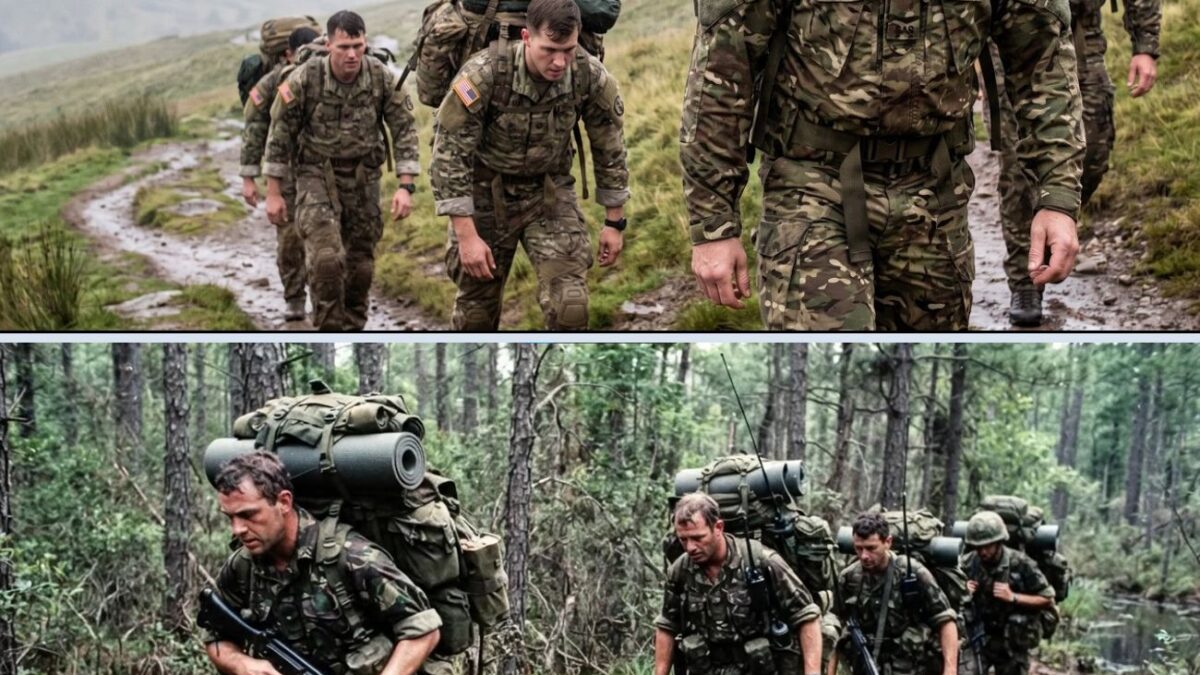
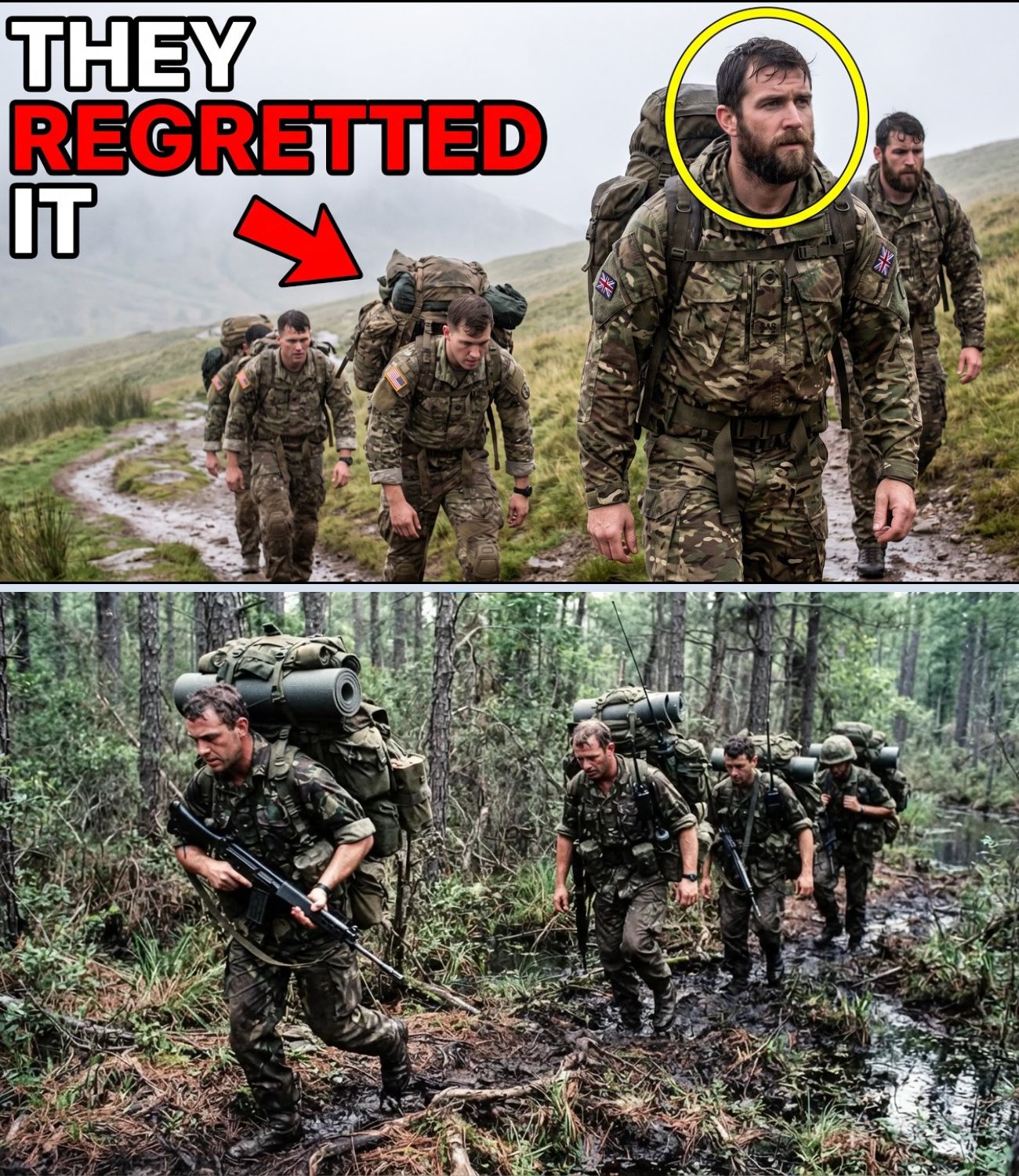
October 1986, Camp McCall, North Carolina. 6:00 in the morning and the grass is still stiff with frost. A joint exercise two years in the planning has put a four-man SAS patrol and an eight-man SEAL platoon on the same stretch of pine scrub for the first time. On the scale by the loading bay, a British Bergen goes up to 61 kg. An American Chief Petty Officer reads the number off the dial twice, laughs once, and writes it on a clipboard he does not need.
“That’s not a patrol,” he says. “That’s a house move.”
Nobody in the SAS patrol answers him. They are watching the load out for the American side, which is lighter, leaner, and on paper, smarter. By the second night, neither side is laughing about weight anymore. They are arguing about water.
The joke did not start in North Carolina. It had been circulating for months in bars near Coronado and in corridors at Bragg, wherever the two communities crossed paths during the run-up to exercise Long Reach. The premise was simple and on the surface fair. American special operations doctrine had spent the 1980s trimming load weight as a survival principle built on hard lessons out of Vietnam-era long-range reconnaissance patrols where overloaded men moved slow, made noise, and died in the triple canopy jungle before they ever reached the objective.
British doctrine shaped in the deserts of Dhofar and the mountains of the Radfan through the 1960s and 1970s had gone the other way. Carry it because there may be nowhere to get more of it. Two philosophies, two different wars, and now for three weeks, one shared training ground carved out of loblolly pine and swamp bottom.
The exercise commander, a Fort Bragg colonel named Everett Callaway, who had cut his teeth advising in El Salvador before rotating into a training command role, had approved Long Reach specifically to test doctrine against doctrine, not to referee a packweight contest. But by the first evening, that was exactly what his staff was watching happen.
He had assigned Staff Sergeant Colin Mercer, an 11-year veteran of B Squadron with two operational tours in Northern Ireland and one classified deployment nobody on the American side was cleared to ask about, to lead the SAS four-man patrol through a simulated 72-hour interdiction task in wooded terrain designed to mimic a denied border region.
Opposite him, Lieutenant Junior Grade Marcus Reyes, a SEAL platoon commander out of Team 4 with a reputation for running the leanest loadouts in his unit, had been given command of the American element for the same exercise window. Reyes’s approach reflected a hard American institutional memory, one drilled into him almost verbatim by his own instructors during BUD/S refresher training.
Studies and Observations Group patrols in Vietnam had carried 80 and 90 pounds of gear into jungle terrain and been caught flat-footed, exhausted, and slow to react precisely because the weight on their backs had traded mobility for supply. The doctrine that followed prized speed and resupply: move light, extract fast, trust the helicopter. It was sound doctrine. It had saved lives across two decades of American special operations planning.
It also assumed something Mercer’s patrol could not assume in Long Reach’s scenario, that resupply would come when it was needed on a battlefield where the enemy controlled the airspace and the weather did not cooperate.
The SAS side of the equation had its own institutional memory, older and formed in a very different climate. In the mountains of the Radfan in the mid-1960s and later across the gravel plains and wadi systems of Dhofar into the 1970s, patrols had operated for days at a stretch without any realistic prospect of resupply because the terrain, the politics, and the sheer distance from a forward base made it unworkable.
A generation of NCOs had come up through selection courses that treated a heavy burden not as a tactical liability, but as the price of independence from a supply chain that might not reach you in time. Mercer had heard the lesson secondhand from instructors who had carried water across those wastes themselves, men who told recruits, in language that had barely softened with the decades, that a patrol which ran dry was a patrol that had already made its decision to fail before the enemy did anything at all.
It was not a philosophy built for comfort. It was built for the specific recurring experience of being a small unit a long way from anyone who could help.
Mercer’s Bergen weighed 61 kg at the morning weigh-in, verified by a support company scale that Callaway’s staff had calibrated the day before, specifically because early estimates had seemed implausible to the American planning cell watching from the sidelines.
Water made up 18 of those kilograms, 9 liters at roughly 2 kg each. Ammunition, demolition charges built for the simulated interdiction task, a spare radio battery, 3 days of rations calculated at a caloric density higher than the standard American field ration allotment, and a share of the patrol’s collective medical kit accounted for the rest.
Reyes’s men, by contrast, averaged 34 kg per rucksack with water loads calculated for a 48-hour window and a pre-briefed resupply point scheduled at the halfway mark of the exercise.
The sting of that first morning was not the weight itself. It was Reyes’s own comment recorded almost word for word by an exercise observer named Captain Diane Hollesworth attached to Callaway’s staff specifically to document doctrine friction for a post-exercise report.
“They’re going to burn out by noon carrying that,” Reyes told her. “We’ll be sipping coffee at the RV point while they’re still finding a place to sit down.”
Hollesworth wrote the line into her notebook because it was quotable. She had no idea at that point how often she would need to revisit it over the following three days.
The interdiction task itself was simple in outline and brutal in terrain. Both patrols would move roughly 40 kilometers through mixed pine forest and swamp bottom to a simulated objective, avoid a roaming opposing force meant to represent local hostile militia, and hold an observation position for the final 12 hours before extraction.
Callaway had built resupply into the American plan as doctrine required. He had deliberately built none into the British plan because Mercer’s own commanding officer back in Hereford had specifically requested a scenario that tested self-sufficiency rather than logistic support, a request Callaway noted with some visible skepticism in his own planning file before the exercise ever began.
By mid-morning of the first day, the difference in pace was exactly what the SEAL side had predicted. Mercer’s patrol moved at roughly 3 km an hour across broken ground, stopping twice in the first 4 hours to redistribute load after a young trooper named Corporal Danny Ashford began favoring his left knee under the unfamiliar 61 kg burden.
Reyes’s platoon, by contrast, covered the same distance in under three hours, moving in a loose tactical file that barely disturbed the underbrush around them. Hollesworth’s notes from noon are blunt: Seal element at RV 140 minutes ahead of schedule. SAS element roughly 90 minutes behind theirs. Weight differential appears decisive.
Callaway read the note and by his own later account to a Fort Bragg debrief board allowed himself to think the exercise had already answered its own question. It had not.
The swamp bottom changed everything, and the first sign of that change arrived with the weather. A front moved in off the coast that afternoon, dropping visibility and turning the ground between the two rally points into standing water within an hour.
Reyes’s platoon hit the low ground first, a stretch of flooded cypress that the exercise planners had deliberately routed both patrols through specifically because it degraded radio performance and slowed movement regardless of load carried. What the terrain revealed was not a difference in weight tolerance. It was a difference in what each patrol had brought to survive a delay it had not planned for.
Reyes’s men, moving on a 48-hour water allotment with a scheduled resupply at the halfway point, began rationing almost immediately when the swamp crossing added 90 minutes to their timeline. Mercer’s patrol, carrying 9 liters per man against a self-imposed 3-day, no-resupply rule, did not change their consumption at all.
By the end of the first day, the numbers had started to invert in a way nobody on the American side had modeled beforehand. Reyes’s platoon had burned through nearly 60% of its water reserve, covering the same distance that had cost Mercer’s patrol only 30% of theirs because the British loadout had been built from the outset around the assumption that nothing would go as planned.
The SEAL doctrine of light and fast had bought speed. It had not bought margin, and margin was the thing the swamp had just taken from both sides equally.
That night, at a leaguer position roughly two kilometers from the swamp crossing, Mercer made the decision that would define the rest of the exercise for his patrol. He ordered a full water and ammunition redistribution, shifting nearly 4 kg from Ashford’s Bergen to his own and to that of his second-in-command, a soldier the after-action material refers to only as Trooper Wallace.
It was not a dramatic gesture. Mercer did not announce it to the patrol at large. He simply moved the weight, checked Ashford’s knee by red lens torchlight, strapped it with a field bandage, and told him to drink normally rather than conserve.
“We carry it so nobody has to ask permission to drink,” he reportedly told Hollesworth when she asked him about it the following morning, a line she flagged in her report as characteristic of the SAS approach to logistics: treat the weight as insurance, not burden.
The redistribution itself took less than four minutes, timed almost incidentally by Hollesworth, who had walked over to the SAS leaguer position specifically to record how the patrol handled the setback. She noted the mechanics with the flat precision of someone used to writing reports nobody outside a training command would ever read: two water bottles and a belt of link ammunition moved from Ashford’s Bergen to Mercer’s, a folded map case and a spare battery shifted to Wallace’s.
The whole exchange was conducted almost silently by red lens torchlight while Ashford sat with his boot off working a field dressing around a knee that had begun to swell visibly under the tape. What struck her, she wrote later, was not the redistribution itself, but the absence of discussion around it. Nobody asked whether it was necessary. Nobody offered to carry less. The patrol simply adjusted, the way a body adjusts to an old injury without ceremony and without complaint.
Ashford’s own contribution to the record is thin, filtered mostly through Hollesworth’s secondhand notes rather than his own words. But one line survives that later training instructors would quote when explaining load discipline to new recruits. Asked the next morning whether the knee still bothered him, he reportedly said only:
“It hurts less than the idea of being the reason the patrol failed.”
It is a small, unscentimental line, the kind the exercise reports tended to record almost by accident in the margins of paragraphs meant to document something else entirely. But it did more to explain the SAS approach to burden than any doctrine manual Callaway’s staff had on file.
By the second morning, the gap that had looked so decisive at noon on day one had closed entirely. Reyes’s platoon, now down to roughly a third of its original water reserve with the scheduled resupply point still 6 hours away by revised timeline, had begun moving more cautiously, conserving energy rather than speed, spacing their file wider to avoid unnecessary exertion in the heat that had followed the front through.
Mercer’s patrol, still carrying nearly half its original 9 liters per man, moved at close to their original pace, slowed only by Ashford’s knee, which Mercer had reweighted rather than treated as grounds to fall the young trooper out of the exercise entirely.
The opposing force, a composite squad of exercise aggressors drawn from a Ranger training cadre and briefed to harass both patrols without making direct contact, added its own pressure that second afternoon. A simulated contact near the second rally point forced both patrols into a hasty repositioning, burning time neither side had budgeted.
For Reyes’s platoon, the detour cost them nearly an hour of movement on a water reserve already thinning fast. For Mercer’s patrol, it cost distance but not resource because the extra weight they carried had already absorbed the cost of an unplanned delay once on day one and was built to absorb it again.
The opposing force commander, a Ranger instructor named Master Sergeant Harold Bissett, who had run similar harassment serials for three prior exercises, told Hollesworth afterward that he had never seen a heavily loaded patrol move with so little apparent hesitation after a contact drill.
“The Brits didn’t stop to think about what they’d lost,” he said. “They didn’t lose anything to think about.”
The observation phase, when it came on the afternoon of the second day, exposed the second half of the doctrine problem. Reyes’s platoon reached the objective in good order, established their position, and immediately radioed for the resupply drop their plan depended on.
The drop, simulated by exercise control, was delayed 90 minutes by a scripted complication deliberately built into the exercise by Callaway’s planning cell to test what happened when the assumption of resupply broke down—a variable Reyes’s own chain of command back at Coronado had not stress-tested in training up to that point.
For 90 minutes, eight American operators sat on an observation position with a combined water reserve that Hollesworth’s notes record as critically low, rationing in a way that visibly affected concentration on two separate radio checks logged that afternoon.
Mercer’s patrol arrived at their own observation position roughly 2 hours later than the American element, carrying by that point more water per man than Reyes’s platoon had left, even after the resupply delay finally resolved.
The institutional embarrassment was not lost on Callaway. In his post-exercise notes, later summarized for a Fort Bragg training board, he wrote that the SEAL platoon had executed sound doctrine flawlessly against an assumption the enemy is under no obligation to honor. It was, by his own admission, the sharpest line in the entire report, and it circulated informally through the special operations training community for years afterward, cited sometimes accurately, sometimes not, in briefings on logistics planning across several allied schools.
A later version of the line, stripped of its origin and softened for wider circulation, even found its way into a training slide used at a joint special operations school in the early 1990s, credited to no one in particular, which was in its own way exactly the kind of quiet second life the original exercise had earned without ever asking for it.
Word of the water gap reached the exercise’s senior observer, a one-star general named Robert Aldwin, who had flown down from a Pentagon liaison posting specifically to watch the interoperability serial and report back to a joint planning staff weighing whether to expand this kind of exchange in future budget cycles.
Aldwin’s own reaction, according to Hollesworth’s log of the observation tent that evening, was neither dismissive nor immediately convinced. He asked for the raw water consumption figures twice, had a staff officer recalculate the percentages by hand rather than trust the first tally, and then said little for the rest of the briefing.
It was Aldwin, not Callaway, who would later insist the water figures be included unedited in the report that went up the chain over the objection of a training staffer who worried the numbers would embarrass a platoon that had otherwise performed well.
“If it embarrasses them, it should,” Aldwin reportedly said. “It nearly cost them the position.”
The line did not make it into the written report. Hollesworth’s private notebook is the only place it survives.
There was a quieter friction running underneath the numbers, one that had little to do with kilograms of water and everything to do with two institutions that had spent the Cold War building very different relationships with risk.
The SEAL program, still expanding its special operations mandate through the mid-1980s, operated inside a command structure that answered to congressional oversight, budget review, and a political environment acutely sensitive to failed missions after the disappointments of Son Tay and Desert One earlier in the decade. Every training decision and every loadout standard carried the shadow of institutions that had been burned for taking on missions without adequate margin and had learned to build margin through logistics and technology rather than through what a man could physically carry on his own back.
The SAS, considerably smaller, funded on a fraction of the budget, and operating for decades under a policy of official deniability that meant many of its actual operations were never acknowledged at all, had never had the luxury of assuming a resupply chain would be politically or logistically available when it mattered. The difference in Bergen weight was in that sense a difference in what each institution had been forced to trust.
Bissett’s own harassment serial produced one more piece of evidence neither planning cell had anticipated using. When his aggressor squad broke contact and withdrew to reset for the next phase, one of his own men, a Ranger corporal running the scenario for the third consecutive exercise cycle that year, asked him afterward why the heavily loaded British patrol had reacted to the ambush drill faster than the lighter American platoon had, despite carrying nearly twice the weight.
Bissett did not have a tidy answer at the time. He gave one only months later in an informal conversation with Callaway’s staff that made its way secondhand into a training memorandum on load discipline:
“Weight slows a man down when he is uncertain what he is carrying it for. It does not slow him down nearly as much when the weight itself is the reason he does not have to think about anything except the threat in front of him.”
The final 12 hours of the observation task brought the last and quietest crisis of the exercise. Overnight temperatures dropped sharply after the front cleared, and the combination of wet clothing from the swamp crossing and a nearly empty water reserve began to tell on two members of Reyes’s platoon, both logged by exercise medical staff as showing early signs of mild exposure by the following dawn.
Neither man required evacuation, and both completed the exercise. But the medical note was enough to prompt a closed-door conversation between Callaway and the SEAL Team 4 training liaison, a commander named Alan Petrosian, who had flown in specifically to observe the exercise’s outcome for his own command’s benefit.
Petrosian’s response, recorded secondhand by Hollesworth, was characteristically blunt:
“We built a plan for the mission going right. They built one for it going wrong. Only one of those is actually planning.”
The third day brought a complication neither planning cell had scripted, which was precisely why it mattered most. Extraction for both patrols depended on a helicopter window at a forestry clearing 11 km beyond the observation position, and that window was itself contingent on weather clearing enough for safe rotary approach through the pine canopy.
By mid-morning on day three, a second low-pressure system, unforecast by the exercise’s own meteorological cell, pushed the ceiling down below the 90-meter minimum Callaway’s aviation liaison required for the approach. The extraction slipped by 4 hours.
For Reyes’s platoon, already running on a water reserve rebuilt only partially by the delayed resupply drop, the slip meant another round of rationing, calculated this time not against a two-day plan, but against an open-ended one, because nobody could promise the ceiling would lift on schedule.
For Mercer’s patrol, the slip meant sitting in place a little longer than planned, drinking normally, waiting out the weather with the particular patience of men who had never expected the schedule to hold in the first place.
Petrosian, watching the delay unfold from the exercise operations tent alongside Callaway, later described the 4 hours as the moment the entire argument resolved itself without either side needing to say another word about it.
“Nobody was making jokes about house moves by then,” he told a SEAL Team 4 training cadre the following year in a remark two of his junior officers independently recalled almost identically. “We were just watching a scale nobody had thought to weigh before the exercise started: how much patience is worth measured against how much water you’re willing to carry for it.”
When the ceiling finally lifted and the helicopters came in low over the pines, both patrols extracted without incident. But only one of them had spent the previous four hours calm.
The exercise did not end with a clean SAS victory because that was never the point, and Callaway’s own report resists that framing directly. Reyes’s platoon completed its observation task and extracted on schedule despite the water scare—a result that validated the underlying premise of light and fast doctrine when resupply worked as intended.
But the near failure at the resupply point, set against Mercer’s patrol arriving self-sufficient and unbothered 2 hours later, produced exactly the reversal nobody had scripted going in. The chief petty officer who had made the house-move joke on the first morning found himself on the third evening asking Wallace how the British patrol had managed water discipline well enough to still have reserve on day three.
Wallace’s answer, recorded by Hollesworth almost verbatim, became the line that outlived the joke:
“We didn’t manage it. We just never assumed we wouldn’t need it.”
Hollesworth herself later admitted in the same informal recollection she shared with a military historian years afterward that she had gone into Long Reach expecting to write a fairly routine observation report, one more entry in a long series of joint training documents that would be filed, read by a handful of staff officers, and forgotten.
What kept her notebook full for 3 days instead was the growing sense, sharpened with every rationed sip of water and every quiet redistribution of weight, that she was watching two institutions argue about something much larger than kilograms without either side raising its voice. Neither patrol ever framed it that way to her directly. Both were simply doing their jobs, moving through pine and swamp toward an objective, adjusting to whatever the terrain and the weather decided to hand them next. The argument was hers to notice, and she noticed it in the numbers before either commander said a word about it out loud.
Hollesworth’s final report, filed 11 days after the exercise closed and later referenced in redacted form in a 1988 joint training memorandum on allied interoperability, did not declare either doctrine wrong. It made a narrower and more useful point, one that Callaway endorsed in his covering note: weight tolerance was not the variable that mattered most; margin was.
The SEAL platoon had built a plan with almost no room for anything to go wrong, and something predictably had gone wrong. The SAS patrol had built a plan assuming everything would go wrong, and very little actually had because the weight itself had absorbed the shock before it ever reached the men carrying it.
Petrosian requested a formal sit-down with Mercer before either patrol dispersed back to their home units—a conversation Hollesworth was permitted to observe but not fully transcribe. What she did record was the shape of it rather than the content: Petrosian asking specific, almost mechanical questions about caloric density, water-to-weight ratios, and how the patrol had calculated its 3-day no-resupply margin, and Mercer answering each one plainly without embellishment, the way a man answers questions about a job he has done many times before and never found especially remarkable.
At one point, according to Hollesworth’s notes, Petrosian asked whether the SAS ever second-guessed the extra weight when a mission went smoothly and the margin turned out not to be needed. Mercer’s answer, as she recorded it, was short enough to fit in a single line of her notebook:
“We don’t count the missions where we didn’t need it. We count the ones where we did.”
Petrosian did not have a response to that beyond a nod, and the conversation ended there.
The debrief tent that closed Long Reach on the fifth day was, by every account, a more subdued affair than the opening weigh-in had promised. Callaway ran it jointly with a visiting liaison from Hereford, a major named Grant Ellison, who had flown out specifically to observe the American side of the exercise for his own command’s benefit and who spent most of the session taking notes rather than offering commentary.
When the floor opened to questions, it was Reyes, not Mercer, who spoke first, and what he said became, in its own quiet way, as durable as the house-move joke that had started the whole exercise. He acknowledged without prompting that his platoon’s plan had assumed too much about the reliability of the resupply chain and that the assumption had nearly cost them the observation position on day two.
He did not frame it as a doctrine failure. He framed it, according to two separate accounts of the debrief that later found their way into training cadre retellings, as a gap between what the doctrine promised and what the terrain had actually delivered.
Aldwin, sitting at the back of the tent, reportedly told a staff officer afterward that it was the most honest thing he had heard in a debrief in years. Ellison’s own report back to Hereford, filed roughly 3 weeks after the exercise closed, struck a notably different tone from Callaway’s, less concerned with vindicating British doctrine than with cataloging what had nearly gone wrong on the SAS side as well.
He flagged Ashford’s knee injury as a genuine risk that a heavier load had aggravated, not excused, and recommended a revised weight distribution protocol for future joint exercises that would allow faster redistribution when an individual trooper showed early signs of strain. It was not the triumphant document a viewer expecting a clean underdog story might imagine. It was a working officer’s report written to prevent the next patrol from repeating a near injury rather than to celebrate one that had narrowly been avoided.
Mercer’s own comment on the matter, relayed secondhand through Wallace years later, was characteristically unscentimental: the redistribution had worked because it happened in the first 4 hours, not because anyone had planned for Ashford’s knee specifically.
“You don’t plan for the knee,” he reportedly said. “You plan for something going wrong and then you deal with whichever thing it turns out to be.”
The mockery stopped almost entirely by the fourth day of Long Reach—not because either side conceded the argument outright. American doctrine did not change its core load weight principles because of one exercise, nor should it have, given how many lives that doctrine had already saved in other contexts. But because the terms of the joke no longer made sense to the men who had lived through the swamp crossing and the 90-minute resupply delay together.
Ashford’s strapped knee healed within the week, and he would go on, according to later training cadre recollections, to instruct newer troopers on load distribution, using almost the exact phrase Mercer had used with him that first night.
Reyes, by several later accounts filtered through training cadre recollections rather than any single confirmed source, began incorporating a contingency water reserve into his own platoon standard loadout calculations the following training cycle—a small adjustment that several SEAL instructors would later describe informally as the Long Reach tax, extra weight nobody wanted to carry carried anyway because somebody remembered a swamp in North Carolina where the joke had run out of water before the men did.
Callaway’s report went further than most colonels writing about a training exercise would risk going. He noted almost as an aside near the end of the document that the entire episode had exposed something larger than a disagreement over kilograms.
American doctrine had been built by an institution with the resources to guarantee resupply most of the time and had optimized accordingly. British doctrine had been built by a smaller, poorer institution operating in places where that guarantee had never once been reliable and had optimized for the times the guarantee failed. Long Reach had simply been the first time in a controlled setting that both doctrines had been asked the same question at once. One had answered it in theory. The other had answered it with a scale.
The report did not stay buried in a training file. Aldwin carried a summary of it back to the Pentagon liaison staff that winter, and by the following spring, elements of the Long Reach findings had been folded into a revised joint doctrine note on contingency water planning for small-unit patrols operating outside guaranteed resupply range—a document that never mentioned Camp McCall by name, never mentioned Mercer or Reyes, and reduced three days of frostbitten swamp crossing and 90-minute delays to two paragraphs of recommended reserve-to-consumption ratios.
Hollesworth, reading the finished doctrine note two years later while researching an unrelated training history, recognized her own numbers in it immediately and later joked to a colleague that it was the closest thing to a footnote she would ever get for the worst 3 days of sleep she had had in her career.
There was a coda to the exercise that never made it into either country’s official record, surviving only because Hollesworth kept her private notebook long after her own training assignment ended and shared portions of it years afterward with a military historian compiling an informal oral account of Allied joint exercises through the 1980s.
On the last night before both elements dispersed, someone in the mixed mess tent raised the subject of the scale one more time, half in jest, asking Wallace whether the SAS would consider trimming the load now that the exercise had proven the point. Wallace reportedly laughed at the question rather than answer it directly and instead recounted briefly and without much elaboration an earlier deployment in which his own patrol had gone 4 days beyond a planned extraction window because of weather and had survived it specifically because nobody had cut the water allotment to save weight beforehand.
He did not name the operation. He did not need to. The point of the story was never the specific mission. It was the arithmetic: the extra weight was cheap on the good days and priceless on the bad ones, and a patrol could never know in advance which kind of day it was about to have.
That arithmetic, more than any single line from the debrief tent, was what Callaway’s report ultimately tried to capture and what made it circulate as widely as it did within the training community over the following years. Institutions build doctrine around the failures they have already survived. The American emphasis on speed and resupply had been forged in a jungle where excess weight had gotten men killed. The British emphasis on self-sufficiency had been forged in deserts and mountains where the absence of a reliable supply chain had done the same. Neither lesson was wrong. Long Reach simply placed both lessons on the same 40 km of pine and swamp at the same time and let the terrain decide for three days which assumption held and which one broke first.
Reyes carried the experience with him for the rest of his career in ways that outlasted the exercise itself. According to two former subordinates who spoke about him decades later in the context of an informal unit history project rather than any public interview, he was by their account neither bitter about the outcome nor quick to concede that British doctrine had simply been correct.
What he took from Long Reach in their telling was narrower and more useful than either conclusion: that a plan built entirely around things going right was not a complete plan, no matter how efficient it looked on the scale at 6:00 in the morning. He reportedly kept a laminated card in his own kit for years afterward with a single figure written on it, a contingency water margin calculated the way Mercer’s patrol had calculated theirs, built for the days the resupply helicopter did not come.
The lesson resurfaced with less ambiguity four years later when elements of the same SEAL Team 4 training cadre deployed in support of an operation where resupply windows proved far less reliable than planners had assumed. A junior platoon commander who had come up under Reyes’s instruction and who had heard the Long Reach story secondhand rather than lived it reportedly ordered his own men to carry a contingency water margin well above the standard allotment before that deployment—a decision one of his senior enlisted men later attributed in an informal unit history compiled for internal training use rather than public release directly to the swamp story passed down through two training cycles. Whether that margin ever proved decisive on the ground is not something the record settles cleanly, and it would be dishonest to claim otherwise. But the platoon came home with water to spare, and its commander, by several secondhand accounts, made a point of saying so at the debrief.
Mercer, for his part, gave almost nothing away when asked years later, and by then long retired from active patrol work, what he remembered most about Long Reach. According to Ellison, who stayed in touch with him informally through the following decade, Mercer did not recall the joke about the house move at all, or claimed not to. What he remembered when pressed was the sound of Ashford’s boot coming off by torchlight on the first night and the particular quiet of a patrol adjusting its own burden without anyone needing to give an order.
It was in his telling an unremarkable moment, the kind that happens on dozens of patrols and gets noticed only when someone is watching closely enough to write it down.
The scale by the loading bay at Camp McCall stayed in use for years afterward, recalibrated annually, its dial worn smooth at the 60 kg mark from patrols who had heard the story secondhand and wanted to see the number for themselves before their own exercises began. Nobody wrote a plaque for it. Nobody needed to. Petrosian briefing his own officers back at Coronado the following spring reportedly used the number without embellishment, letting it do the work the joke never had.
Callaway’s own copy of the report, according to a Training Command archivist who cataloged his papers years later, carried a single handwritten note in the margin beside the water consumption table, added sometime after the fact in blue ink, a reminder to himself, as much as to anyone who read the file after him, that the heaviest pack in the exercise had also been the last one to run dry. The number was the point.
You Might Also Enjoy

“We Thought They Would Negotiate”—What Argentine Soldiers Said When The British Attacked Goose Green

“You’ll Never Finish My Ruck March, Limey” — US Sergeant Who Challenged the SAS, Then Fell Out First






