The Thai Queen Whose Jewels Made Europe’s Royals Look Modest
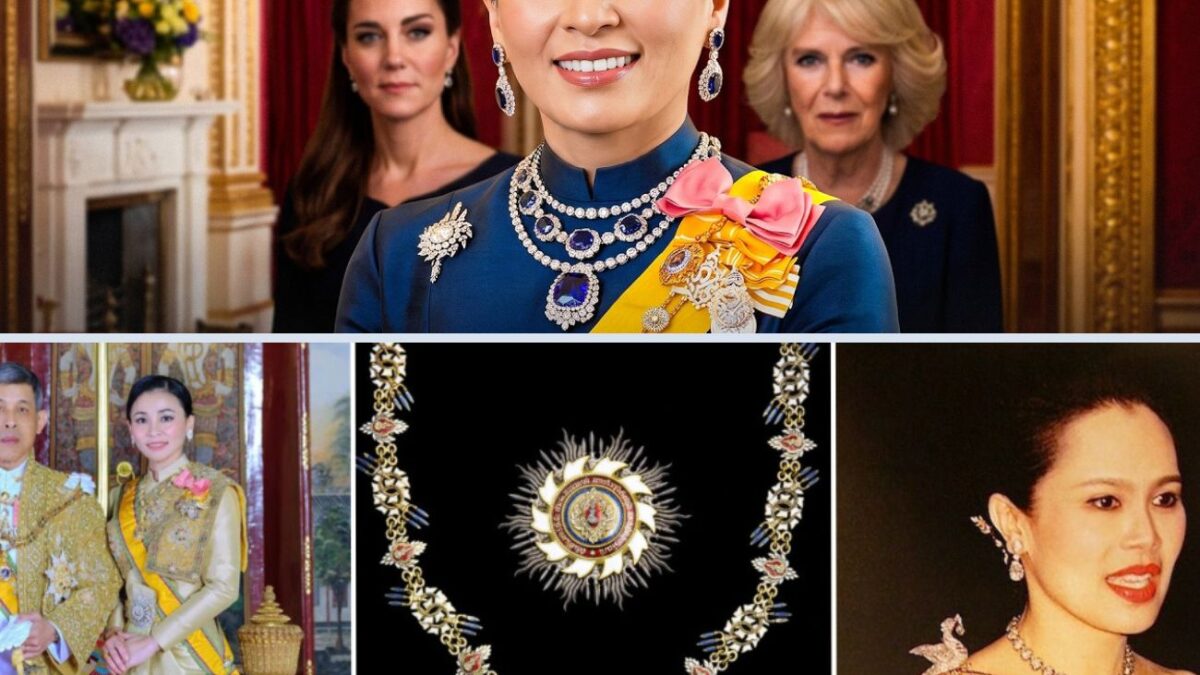
Europe has no shortage of spectacular royal jewels. But when Queen Suthida of Thailand steps into a room wearing jewels inherited from generations of Siamese queens, the story becomes much bigger than diamonds. Some of the pieces she wears are more than a century old. Some disappeared from public view for decades. And one of her most spectacular tiaras can completely change its identity depending on how it is worn.
Number 15, the Royal House of Chakri order. Before getting to the biggest diamonds, there is another kind of jewel Queen Suthida wears at the most important royal occasions. It is the insignia of the Most Illustrious Order of the Royal House of Chakri, one of Thailand’s highest royal orders. The most recognizable part is the brilliant yellow sash worn across the body together with a large star-shaped badge decorated with diamonds and centered on the emblem of the Chakri dynasty. Queen Suthida wore the order with the Thai diamond fringe tiara during the gala held at the Royal Palace in Stockholm on April 30th, 2026, celebrating King Carl XVI Gustaf’s 80th birthday.
That appearance immediately put one of Thailand’s oldest royal jewels beside some of Europe’s most famous tiaras. But there is something interesting about this combination. The sash and star tell you who Queen Suthida is within Thailand’s royal system. The tiara tells you where that royal tradition came from. And that story takes us back more than a century.
Number 14, the diamond bracelets. Queen Suthida’s wrists can sometimes reveal as much royal history as her head. Among the most striking pieces connected with Queen Sirikit’s collection are the Thai diamond bracelets made with large diamonds arranged in dense traditional Thai designs. At least eight spectacular bracelets have been identified in Queen Sirikit’s historic collection. Their exact origins are not completely documented, but some researchers believe they may be much older royal heirlooms. There are even suggestions that related bracelets may have been worn by a Thai prince during the 1870s.
Queen Sirikit wore these bracelets from the 1950s, including during the famous royal tour of Europe and North America in 1960. Then they became difficult to see in public. For decades, the bracelets largely disappeared from royal appearances. Then, Queen Suthida brought two of them back for the 2023 coronation of King Charles III and Queen Camilla. She wore them with the spectacular sapphire suite and the diamond aigrette.
So, a pair of bracelets that had once belonged to an earlier generation of the Thai royal family suddenly appeared again on the wrist of a new queen thousands of miles from Bangkok. That is one of the recurring stories behind Suthida’s jewelry. The pieces do not simply decorate her. They return with history attached to them.
Number 13, the emerald flower earrings. Not everything in Queen Suthida’s collection is about diamonds. Some of the most beautiful pieces are green. The emerald flower earrings connected with Queen Sirikit are an excellent example. Each earring combines a diamond flower with emeralds, including a pear-shaped cabochon emerald hanging below the floral section. Their exact origin is not firmly established. Royal jewelry researchers believe they may have been acquired by Queen Sirikit during the late 1960s, possibly from Van Cleef & Arpels, although that maker attribution remains uncertain.
Queen Sirikit wore them in portraits during the late 1960s and later combined them with other emerald jewelry. Decades later, Queen Suthida brought them back. She wore the earrings at a ceremony marking King Vajiralongkorn’s 70th birthday. Then again during celebrations connected with Queen Sirikit’s 90th birthday. She also wore them at a reception at the Thai embassy in London following the 2023 coronation.
The earrings are a perfect example of the way Suthida approaches old royal jewelry. She does not always need the largest necklace in the vault. Sometimes a pair of historic earrings is enough to connect one generation of the Thai monarchy with another.
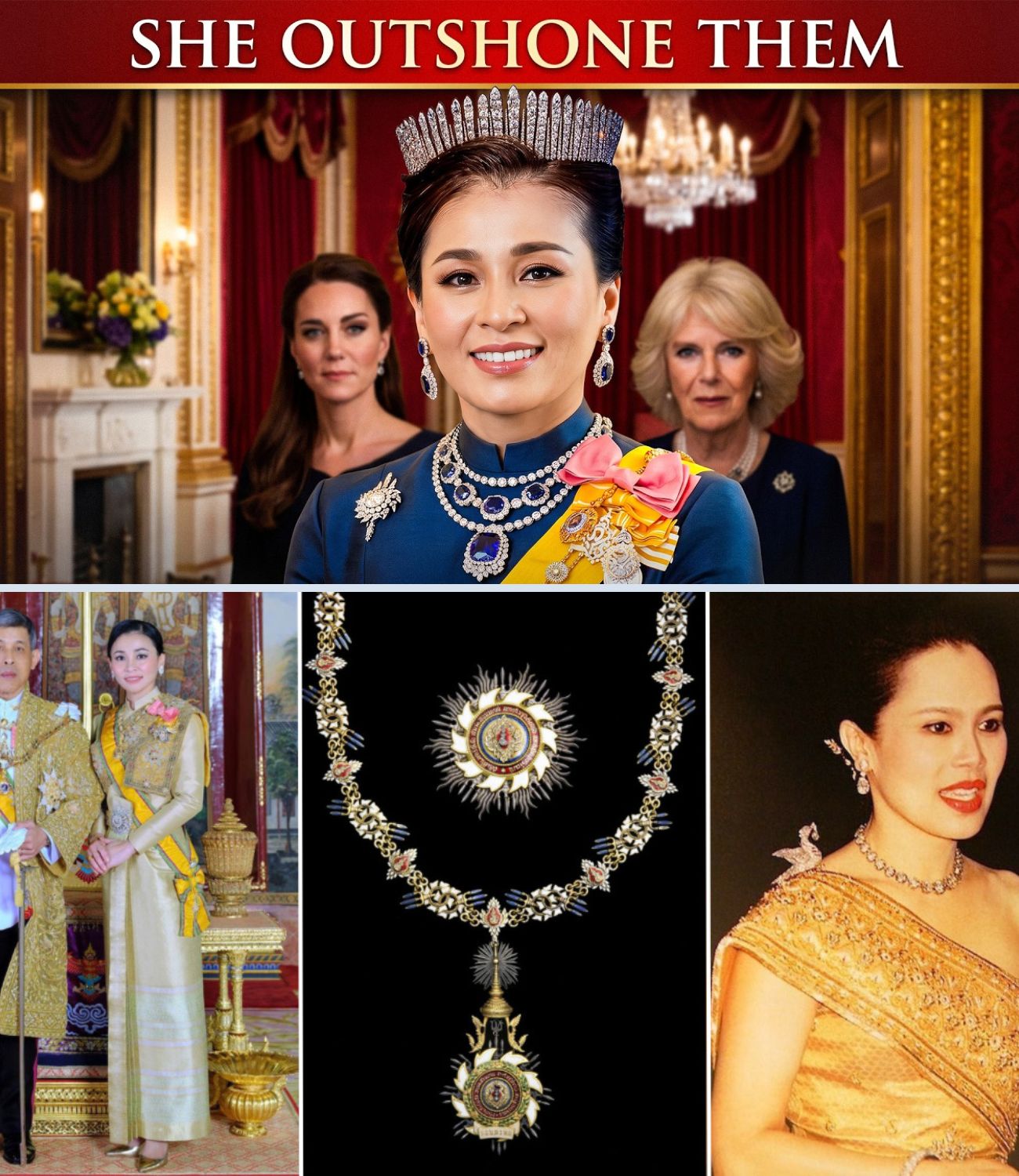
Number 12, the diamond aigrette. Now we come to one of the strangest and most distinctive jewels in the collection. An aigrette is a decorative jewel designed originally to be worn in the hair. Queen Sirikit’s diamond aigrette is centered around a large canary-colored diamond surrounded by white diamonds. But the design has another meaning. Its form represents the emblem of the Royal House of Chakri, combining the chakra or disc with the trishula or trident.
The jewel is generally associated with Queen Sirikit’s era and is believed to have been commissioned during the 1960s, possibly from Van Cleef & Arpels. However, the exact maker is not firmly established, so that attribution should not be presented as certain. Queen Suthida gave the jewel another life. At the 2023 coronation of King Charles III, she wore the aigrette not as a traditional hair ornament, but as a brooch, pairing it with Queen Sirikit’s sapphire suite and the historic diamond bracelets.
That small decision says a lot about these jewels. They were designed for royal wardrobes, not museum cases. A piece can move from the hair to the shoulder, from a necklace to a brooch, and still retain its identity. And then comes an even older pair of jewels.
Number 11, the Hongsa swan brooches. Two diamond swans. That sounds simple until you discover where their story begins. The matching Hongsa swan brooches are traditionally associated with the visit of King Chulalongkorn, or Rama V, to Russia in 1897. They have been attributed to the celebrated Russian jewelry house Fabergé. Although the attribution is generally described as reported rather than absolutely documented, each swan has a diamond hanging from its beak. The design is particularly striking when the brooches are worn on the shoulders of traditional Thai dress.
Their history is even more unusual. The brooches were reportedly connected with royal children’s tonsure ceremony, an important traditional ceremony marking the transition from childhood toward adulthood. That practice was discontinued in 1932. Queen Sirikit later adopted the swans for her own wardrobe. She often wore one at a time, but occasionally wore both together.
Queen Suthida has also brought these historic pieces into modern royal appearances. So, what looks like a beautiful pair of diamond birds is actually a small surviving link between the Thai royal court of the 19th century and the monarchy seen today. And that brings us to something much bigger.
Number 10, the Thai diamond rivière. A rivière necklace is one of the simplest forms of royal jewelry. There is no giant pendant dominating the center. There is no complicated sculpture, just diamonds one after another creating an uninterrupted line around the neck. But Queen Suthida’s historic diamond rivière has a remarkable family history. The necklace is associated with Queen Saovabha Phongsri, wife of King Chulalongkorn and mother of Kings Vajiravudh and Prajadhipok. Queen Saovabha was photographed wearing as many as three diamond rivières in royal portraits.
After her death in 1919, the necklaces disappeared from public view. Then decades later, they returned. Queen Sirikit wore the historic rivière during the royal tour of Europe and North America in 1960, including appearances in Britain, Germany, Norway, Sweden, Italy, Belgium, and the Netherlands. The necklaces could be adjusted in length and their diamonds could be arranged in different configurations that allowed Queen Sirikit to wear them alone, with a pendant, or beneath other spectacular pieces.
Queen Suthida has continued that tradition. In 2023, she wore a historic diamond rivière with a diamond pendant at the reception held at Buckingham Palace before King Charles III’s coronation. And in June 2026, she wore the necklace again at the state dinner at the Élysée Palace in Paris. The necklace had traveled from the wardrobe of a queen of the early 20th century to one of the most important diplomatic stages in modern France. That is not simply an expensive necklace. It is a royal family history written in diamonds.
Number nine, the Thai traditional tiara. The Thai royal collection also contains a jewel that proves something important. Royal jewelry does not have to look European to be internationally spectacular. The Thai tiara created by Van Cleef & Arpels around 1960 was designed specifically for Queen Sirikit and drew its inspiration from traditional Thai royal head ornaments. The result was very unusual. A French jewelry house took the visual language of a Thai royal diadem and transformed it into high jewelry.
The piece is set with white diamonds and features a prominent yellow diamond at its center. Even more interestingly, the central section can be removed and worn separately as a bandeau necklace or bracelet. Queen Sirikit first wore it during her historic 1960 European and American tour, including an appearance at the Quirinal Palace in Rome.
The jewel represented a period when the Thai monarchy was presenting its own cultural identity to international audiences. It was not simply copying European court fashion. It was taking Thai royal tradition and putting it into the hands of one of Europe’s greatest jewelry houses. That combination is one of the defining features of Queen Sirikit’s collection. And it becomes even more impressive when we reach the next piece.
Number eight, the diamond bib necklace. If the diamond rivière is restrained, Queen Sirikit’s diamond bib necklace is the complete opposite. This is jewelry designed to occupy the entire upper body. Commissioned from Van Cleef & Arpels in 1963, the bib necklace uses large diamonds in an elaborate collar-like design that spreads across the chest and shoulders. Queen Sirikit wore it for some of the grandest occasions of the 1960s, including the wedding celebrations of King Constantine II of Greece and Princess Anne-Marie of Denmark in 1964.
It belongs to the period when Queen Sirikit was becoming one of the most photographed royal women in the world. Her clothing came from Pierre Balmain. Her jewelry came from some of Europe’s most celebrated houses, but the overall appearance remained distinctly Thai. That is why the necklace is important to Suthida’s story even though she is not the person who made it famous. It represents the extraordinary royal jewelry inheritance passed down from Queen Sirikit’s generation. And that inheritance includes an even more impressive colored gem collection.
Number seven, the sapphire parure. Now the diamonds give way to blue and the color changes everything. Queen Sirikit’s sapphire parure is one of the most recognizable gemstone suites in the Thai royal collection. The centerpiece is an enormous blue sapphire surrounded by diamonds. The suite developed into a larger set containing a detachable sapphire pendant, necklace, matching earrings, bracelet, and ring. One jewelry reference identifies the central sapphire at approximately 109.57 carats.
The pendant first appeared on Queen Sirikit in the early 1960s. During the following decade, it became part of a larger parure. Queen Sirikit wore different combinations of the pieces with other royal jewels, including the diamond fringe tiara. She continued wearing the suite for decades, including during major royal visits in the 1990s.
Then came May 2023. Queen Suthida arrived at Westminster Abbey for the coronation of King Charles III wearing the sapphire necklace, pendant, and earrings. The blue stones were surrounded by diamonds while two historic diamond bracelets and the diamond aigrette completed the ensemble. Suddenly, jewelry associated with Queen Sirikit’s golden age was being worn by the next generation of Thai royal women at one of Britain’s biggest royal ceremonies. The sapphire suite was no longer simply a piece of history. It had become part of Suthida’s own public royal image.
Number six, the diamond fringe necklace. Before it became a tiara, the Thai diamond fringe had another life. It could be worn as a necklace. That is what makes this jewel so fascinating. The design consists of diamonds arranged in radiating fringe-like lines with the central sections rising higher and gradually becoming shorter toward the sides. It reflects the influence of the Russian kokoshnik style, which became fashionable in European courts and entered Siamese royal fashion during the reign of King Chulalongkorn.
The piece is believed to date to the era of Queen Saovabha Phongsri, making it one of the oldest major jewels associated with Suthida’s current collection. Queen Rambhai Barni was photographed wearing it in the 1920s, including around the time of the 1926 coronation of King Prajadhipok. Queen Sirikit later wore it as a necklace during the 1960 royal tour. Then in the late 1960s, she began wearing it as a tiara.
So the same jewel could travel through three completely different royal fashions: necklace, bandeau, tiara. And it still had another transformation waiting.
Number five, the diamond fringe tiara. This is the piece that changed the conversation around Queen Suthida’s jewelry. For years, the diamond fringe tiara had been largely associated with Queen Sirikit. Then on April 30th, 2026, Queen Suthida appeared at King Carl XVI Gustaf’s 80th birthday gala in Stockholm wearing it. The image was extraordinary. A Thai queen stood among Europe’s royal families wearing a historic Thai diamond fringe tiara, a shimmering evening gown, and the yellow sash and diamond star of the Order of the Royal House of Chakri.
The tiara is exceptionally versatile. It can be worn as an open halo, as a coronet, as a bandeau, or converted into a diamond fringe necklace. That versatility explains why it survived changing fashions. A tiara from the early 20th century can look surprisingly modern when worn as a halo. Turn it around and it becomes a necklace. Raise the center and it becomes a coronet.
Its history is just as impressive as its design. It is associated with Queen Saovabha’s generation, appeared on Queen Rambhai Barni, became a favorite of Queen Sirikit, and has now entered Queen Suthida’s public wardrobe. The Stockholm appearance was therefore more than a glamorous royal photograph. It was the revival of one of Thailand’s oldest major royal jewels on an international stage. But there is another necklace that can compete with it.
Number four, the historic diamond rivière and pendant. The Thai royal collection contains several diamond rivières, but the combination of a historic rivière with detachable pendant creates a completely different effect. Queen Sirikit used these necklaces throughout her international royal career. She could wear a simple line of diamonds for one occasion, then add the pendant for a more formal appearance. During the famous 1960 tour, these necklaces appeared repeatedly alongside Queen Sirikit’s increasingly sophisticated European wardrobe.
Queen Suthida revived the combination for the reception at Buckingham Palace in 2023, and then she brought the necklace to Paris in 2026. At the Élysée Palace, she wore the historic rivière with her purple chut Thai borphiman, creating a look where the diamonds were brilliant without overwhelming the traditional Thai costume.
This is one of the strongest examples of how Suthida’s jewelry style differs from simply wearing as many diamonds as possible. The necklace is relatively restrained, but once you know that it was associated with Queen Saovabha, disappeared after 1919, returned with Queen Sirikit in 1960, and is now being worn by Suthida, every diamond carries a little more history. And then we reach the jewel that combines the old Thai court with one of the most famous names in European jewelry.
Number three, the Fabergé swan brooches. The Hongsa swans deserve a place near the top because their story reaches beyond Thailand. They are associated with King Chulalongkorn’s 1897 visit to Russia when Siam was strengthening its diplomatic relationships with European powers. The brooches are traditionally attributed to Fabergé, the legendary Russian jewelry house. Their design is delicate. Two mythical swans sit with their wings extended while brilliant drops hang from their beaks.
But their real power comes from the way they were worn. Placed on the shoulders of traditional Thai court clothing, they became part of the silhouette rather than simply accessories. Queen Sirikit used them in this way during her long reign. Queen Suthida has continued that tradition. It is a fascinating combination: a Russian-associated jewel, a Thai royal ceremony, a traditional Thai costume, and diamonds connecting all three.
The brooches also show how the Thai royal collection was never isolated from the wider world. King Chulalongkorn traveled. Jewels entered Siam from Europe. Thai royal women adapted them to their own clothing. And generations later, those same jewels are still being worn. That leads to the most important question. What is actually behind the collection Queen Suthida is wearing today?
Number two, Queen Sirikit’s royal jewelry legacy. Queen Suthida’s most important source of spectacular jewels is not one necklace or one tiara. It is the extraordinary legacy of Queen Sirikit. For decades, Queen Sirikit built one of the most remarkable royal jewelry collections in Asia. She wore jewels from historic Thai royal families alongside major pieces commissioned from European jewelry houses. Van Cleef & Arpels became particularly important. The house created pieces such as the Thai tiara, the sapphire parure, and the enormous diamond bib necklace.
At the same time, older royal jewels remained in the collection: the diamond fringe, the diamond rivière, the swan brooches, the diamond bracelets. Queen Sirikit also understood something that made her jewelry especially memorable. The jewels needed to work with Thai clothing. During her landmark 1960 tour, she worked with French couturier Pierre Balmain, creating a wardrobe that combined Western couture with Thai silhouettes and textiles. Her jewelry then completed the picture.
The result was not simply European jewelry worn by an Asian queen. It was a new royal visual identity. Thai silk, Thai court dress, European couture, historic Siamese jewels, French high jewelry, and sometimes Russian-inspired designs all appearing together. That legacy now gives Queen Suthida access to a remarkable collection of jewels with stories stretching across generations. And that is why her most important jewel is not necessarily the biggest one. It is the one that has survived the longest.
Number one, the Thai royal diamond fringe tiara. The diamond fringe tiara earns the top position because almost everything about Queen Suthida’s royal jewelry story comes together in this one piece. It is old. It is flexible. It is historically important. It has been worn by multiple generations of Thai queens. It carries European influence while remaining part of Thailand’s royal tradition. And it can completely change its appearance.
The tiara is believed to date from the era of Queen Saovabha Phongsri and King Chulalongkorn. It was photographed on Queen Rambhai Barni in the 1920s. Queen Sirikit later wore it during some of the most important years of her international royal career. For Queen Sirikit, the jewel became part of a larger visual language that combined Thai dress with extraordinary diamonds.
Then the tiara disappeared from major public appearances for years. The last major appearance associated with Queen Sirikit was during the 2003 Swedish state visit to Thailand. Then came 2026 at the Royal Gala in Stockholm celebrating King Carl XVI Gustaf’s 80th birthday. Queen Suthida appeared wearing the historic fringe tiara.
The setting could hardly have been more appropriate. She was surrounded by European queens and princesses wearing their own inherited tiaras. But Suthida was wearing a piece that had traveled from the Thai royal court of the early 20th century into the modern European royal scene. And the tiara was not simply sitting on her head. She wore it with the yellow sash and diamond star of the Order of the Royal House of Chakri, connecting the jewel to the dynasty itself.
That is what makes the diamond fringe so powerful. It does not need the largest diamond in the world. It does not need an enormous necklace beneath it. Its value is in the story. A queen from more than a century ago wore it. Another queen carried it through the 20th century. And now Queen Suthida has brought it back onto one of Europe’s biggest royal stages.
The Thai royal collection therefore tells a story very different from a simple catalog of expensive jewelry. There are diamonds from the reign of King Chulalongkorn. There are jewels associated with Queen Saovabha. There are creations from Van Cleef & Arpels. There are pieces connected with Fabergé. There are sapphires, emeralds, diamonds, and gold. And there are royal orders that identify the wearer as part of the Chakri dynasty.
Queen Suthida’s spectacular appearances are therefore not just about what sparkles under the lights. They are about what survived long enough to be worn again. And when that historic diamond fringe tiara appeared in Stockholm in 2026, it was not simply an old tiara making a comeback. It was a century of Thai royal jewelry returning to the world stage.
You Might Also Enjoy

“We Thought They Would Negotiate”—What Argentine Soldiers Said When The British Attacked Goose Green

“You’ll Never Finish My Ruck March, Limey” — US Sergeant Who Challenged the SAS, Then Fell Out First






