THE VAULT OPENS: Princess Diana’s Five Hours of Secret Tapes Spell Total Disaster for the Royal Family as Prince Harry’s Documentary Collapses in Humiliation!
THE VAULT OPENS: Princess Diana’s Five Hours of Secret Tapes Spell Total Disaster for the Royal Family as Prince Harry’s Documentary Collapses in Humiliation!
As the calendar inexorably ticks toward the solemn thirtieth anniversary of that fateful August night in Paris, the ghost of Diana, Princess of Wales, continues to cast an impossibly long and terrifying shadow over the House of Windsor. Nearly three decades after the lights went out in the Pont de l’Alma tunnel, the global obsession with the People’s Princess has not merely simmered; it is boiling over into an institutional crisis that threatens to rupture the fragile facade of modern royalty.
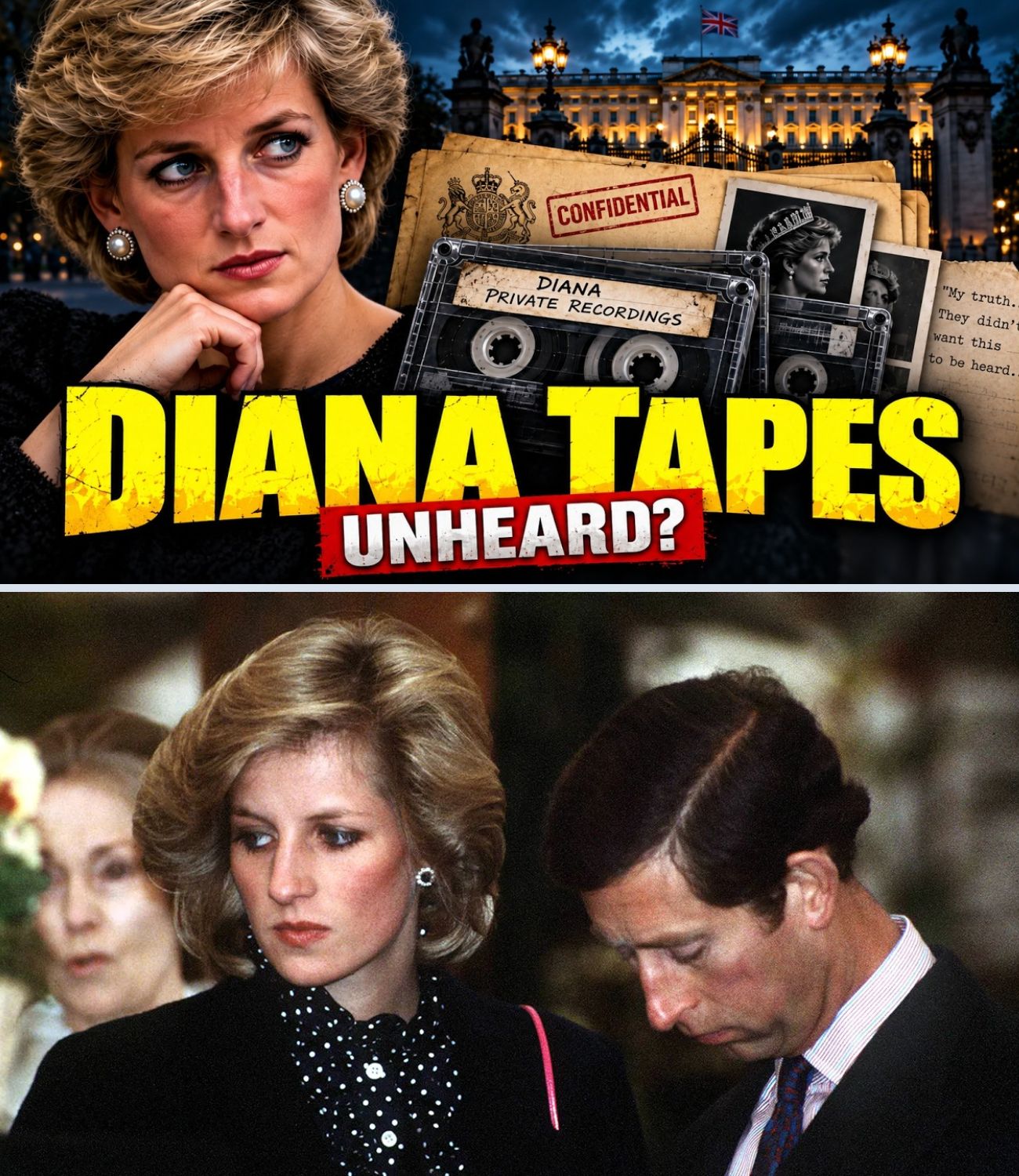
At the epicentre of this looming tempest is a staggering revelation: five hours of previously unheard, deeply intimate audio recordings are slated to detonate across the public consciousness. These are not the well-worn video tapes recorded by speech coach Peter Settelen that once shocked viewers on Channel 4 and ABC. These are raw, unvarnished cassette recordings dating back to the winter of 1991, smuggled out of Kensington Palace and channeled through loyal confidant Dr. James Colthurst to lay the groundwork for Andrew Morton’s earth-shattering biography.
Yet, while the world braces for Diana’s authentic, unedited voice to reverberate across the airwaves once more, a parallel drama is unfolding behind closed doors. Prince Harry’s frantic efforts to spearhead his own high-profile commemorative television project have collided with a devastating, immovable obstacle: an absolute, chilling freeze-out from his mother’s closest blood relatives and inner circle. Caught between an unstoppable historical reckoning and a masterclass in silent retaliation orchestrated by Prince William, the Duke of Sussex is watching his grand media ambitions collapse into total humiliation.
The Vault Unlocked: Inside the 1991 Secret Tapes
To truly grasp the magnitude of what is hurtling toward the British monarchy, one must return to the clandestine operations of 1991. While the glittering pageantry of royal life played out for the rolling cameras, Diana was living a psychological nightmare behind palace walls. In absolute secrecy, she recorded her innermost thoughts, answering a battery of structured questions posed by Dr. James Colthurst, who acted as the vital human bridge between a desperate princess and an intrepid author.
While portions of those transcripts formed the bedrock of Morton’s watershed 1992 book, the vast majority of the original audio recordings remained locked away—pristine capsules of unfiltered emotion, pain, resilience, and personal ambition. Now, a major three-part documentary series currently titled Diana: The Unheard Truth, produced by Love Monday TV and 53 Degrees Global, is scheduled to drop on August 31, 2027, exactly thirty years after her tragic demise.
According to distribution insiders, these five hours of audio present a side of Diana that corporate spin doctors and royal loyalists have spent decades trying to mould and manage. She is heard speaking fluently and fiercely about her identity, her psychological survival, her profound disillusionment with the institution, and the deliberate trajectory she desperately wanted her life to take. Crucially, the series frames her not as a passive victim swept along by historic currents, but as an architect trying to shape her own destiny.
For Buckingham Palace, the prospect of Diana’s real, unedited voice cutting through the silence of the thirtieth anniversary is nothing short of a nightmare. Senior courtiers and aides are reportedly sweating bullets, acutely aware that an entire generation of digital natives who never lived through the 1990s will be introduced to the royal family’s darkest era entirely through Diana’s own perspective. And when combined with recent explosive developments—such as Earl Spencer’s tell-all memoir Swan Song and whispered rumours of surviving audio archives detailing brutal phone calls made in the immediate aftermath of her death—the institution is bracing for a public relations tsunami.
Harry’s Desperate Gamble and the Great Cold-Shoulder
As news of the Diana: The Unheard Truth project sent shockwaves through the media landscape, Prince Harry found himself scrambling to secure his own commercial narrative. Dependent on lucrative media partnerships and desperate to cement his status as the primary guardian of his mother’s legacy, Harry reportedly initiated quiet overtures to mount a rival television documentary or commemorative tribute ahead of the 2027 milestone.
The logic from a Monteceto boardroom seemed straightforward: who better to tell Diana’s story than her own flesh and blood, the grieving son who walked behind her coffin across the stone floor of Westminster Abbey?
There was just one catastrophic flaw in the plan: nobody wanted to play ball.
According to well-placed sources within British media circles, Harry’s production team hit an impenetrable brick wall when they reached out to Diana’s inner circle. Most damagingly, Diana’s own sisters—Lady Sarah McCorquodale and Lady Jane Fellows—flatly and unequivocally declined to participate. While both women maintain an affectionate, private bond with their nephew Harry and are more than willing to trade pleasantries behind closed doors, they drew a hard, unyielding line in the sand when it came to appearing on camera for a commercial enterprise.
The rationale among Diana’s closest confidants is as clear as it is damning. Lady Sarah and Lady Jane have historically maintained a posture of dignified, steadfast privacy. They watched the media circus that enveloped their sister’s life and death, and they have zero desire to be dragged into a modern transatlantic PR war. More importantly, sources close to the family whisper that participating in Harry’s project would inevitably be interpreted as taking a hostile, partisan side in the ongoing, bitter feud dividing the House of Windsor.
For Harry, this refusal is a fatal blow. Having lost his mother at the tender age of twelve, his direct, conscious memory of Diana’s adult life is fundamentally limited. To produce a credible, authoritative documentary about a complex royal icon, he desperately required the validating voices of those who knew her before she entered the royal orbit—her siblings, her childhood friends, and her trusted associates. Without them, any project bearing his name risks being written off as a hollow, one-sided exercise in self-justification.
The Silent Smackdown: Prince William’s Masterclass in Power
While Harry faces closed doors and polite refusals, his older brother, Prince William, has exercised a masterclass in silent, constitutional dominance. For years, royal commentators have noted the stark contrast between the two brothers’ approaches to their mother’s memory. While Harry has routinely weaponized Diana’s name, image, and tragic end in television interviews, multi-million-dollar streaming deals, and bestselling memoirs, William has maintained a stoic, almost monastic silence.
William does not need to call a press conference, leak confidential memos to friendly tabloid journalists, or cut multi-million-dollar deals to assert his authority. By simply continuing his relentless schedule of public duty and refusing to engage in public mudslinging, he has established an invisible yet impenetrable boundary line across the British establishment.
Within royal circles, an unspoken rule has crystallised: you cannot align yourself with Prince Harry’s commercial endeavours without instantly exiling yourself from the inner sanctuary of the future king. To appear on a Sussex-backed television production is to declare open war on Buckingham Palace and Kensington Palace alike.
This silent royal smackdown has sent a shudder through the British entertainment and journalistic community. Friends, biographers, and former aides who might once have entertained a polite conversation with Harry’s production scouts are now running for cover. They recognize that backing Harry’s venture is professional suicide within the UK media landscape.
The irony is as thick as it is painful. Harry fled across the Atlantic seeking absolute freedom from the stifling constraints of the royal machine, convinced that he could build a glittering independent media empire fueled by the royal fairy dust of his mother’s legacy. Yet, when push came to shove, he discovered that true power does not reside in a rented mansion in Monteceto or a high-powered Hollywood talent agency. It resides within the unyielding, ancient architecture of the British state—an architecture over which his brother now stands guard.
The Paranoia of Performative Lives
As Harry struggles to piece together a coherent narrative for his flagging media slate, observers have increasingly drawn comparisons between the desperate performative nature of the Sussexes’ public branding and the quiet reality of genuine happiness. Commentators frequently point out that couples truly content in their lives do not need to stage elaborate, highly orchestrated photo opportunities, issue defensive press statements, or constantly cosplay domestic bliss for an Instagram audience.
Every public move executed by Harry and Meghan—from carefully curated red carpet appearances to heavily guarded, brief grocery runs in the Cotswolds—feels less like authentic living and more like an aggressive PR campaign designed to stay relevant in a market that has grown visibly weary of perpetual grievance. When your entire public identity is built upon an adversarial relationship with an institution that refuses to acknowledge your existence, you become trapped in a diminishing cycle of outrage.
Contrast this with the landscape at Windsor and Kensington. While California produces breathless press releases and speculative documentary pitches, the working royals are methodically locking down the future of the monarchy. The publication of the official working royal roster—surgically excising Harry’s name while cementing the core leadership of King Charles, Queen Camilla, the Prince and Princess of Wales, the Princess Royal, and the Duke and Duchess of Edinburgh—signals a total, permanent administrative divorce.
The Clock Winds Down to 2027
As the months march relentlessly toward the horizon of August 2027, the psychological pressure on the House of Windsor is palpable. The release of Diana: The Unheard Truth with its five hours of pristine, unedited audio guarantees that the ghosts of 1997 will be dragged back into the cold light of day, forcing the monarchy to relive its darkest chapter under the searing microscope of global media.
Yet, for Prince Harry, the impending anniversary represents something far more humbling. It is becoming the monument to a missed opportunity—a moment where he hoped to stand as the undisputed patriarch of his mother’s legacy, only to find himself isolated, iced out by his own family, and outmanoeuvred by a brother who understood that silence is often far louder than any Hollywood megaphone.
The vaults are opening. The tapes are coming. And as Diana’s own voice prepares to speak directly to the world once more, the modern monarchy stands firm, while the exiled prince watches the gates slam shut forever.
You Might Also Enjoy

“We Thought They Would Negotiate”—What Argentine Soldiers Said When The British Attacked Goose Green

“You’ll Never Finish My Ruck March, Limey” — US Sergeant Who Challenged the SAS, Then Fell Out First






