“They Just Disappeared” — The SAS Evasion Tactic That Shocked US Intelligence
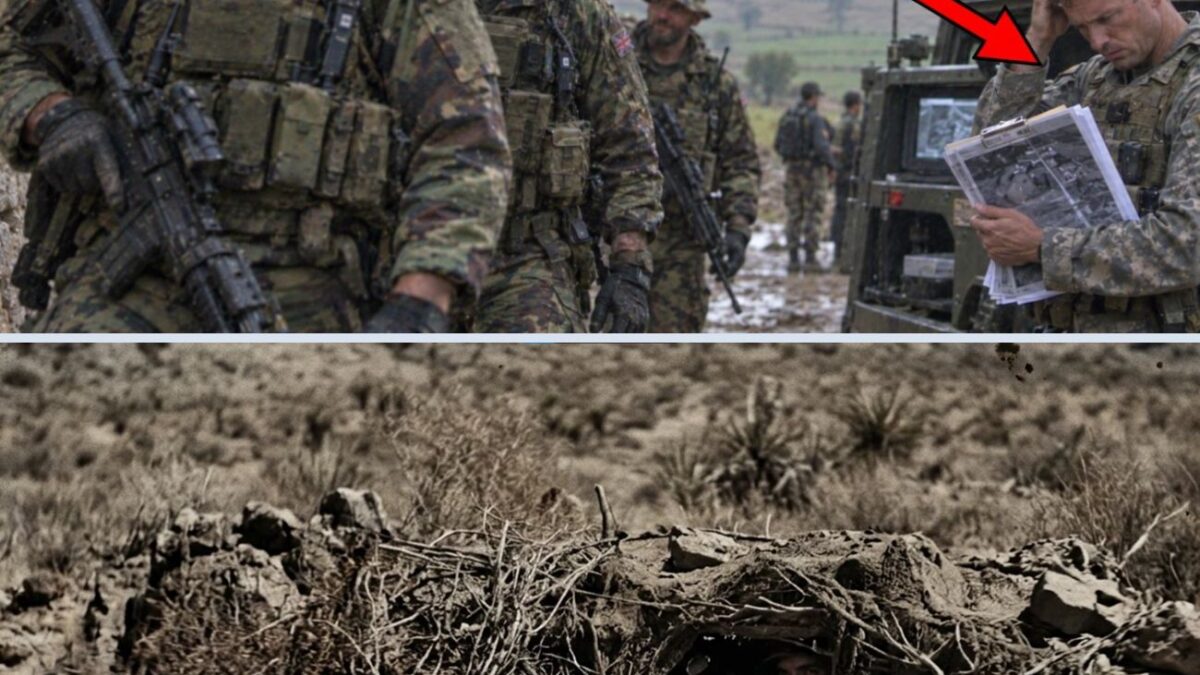
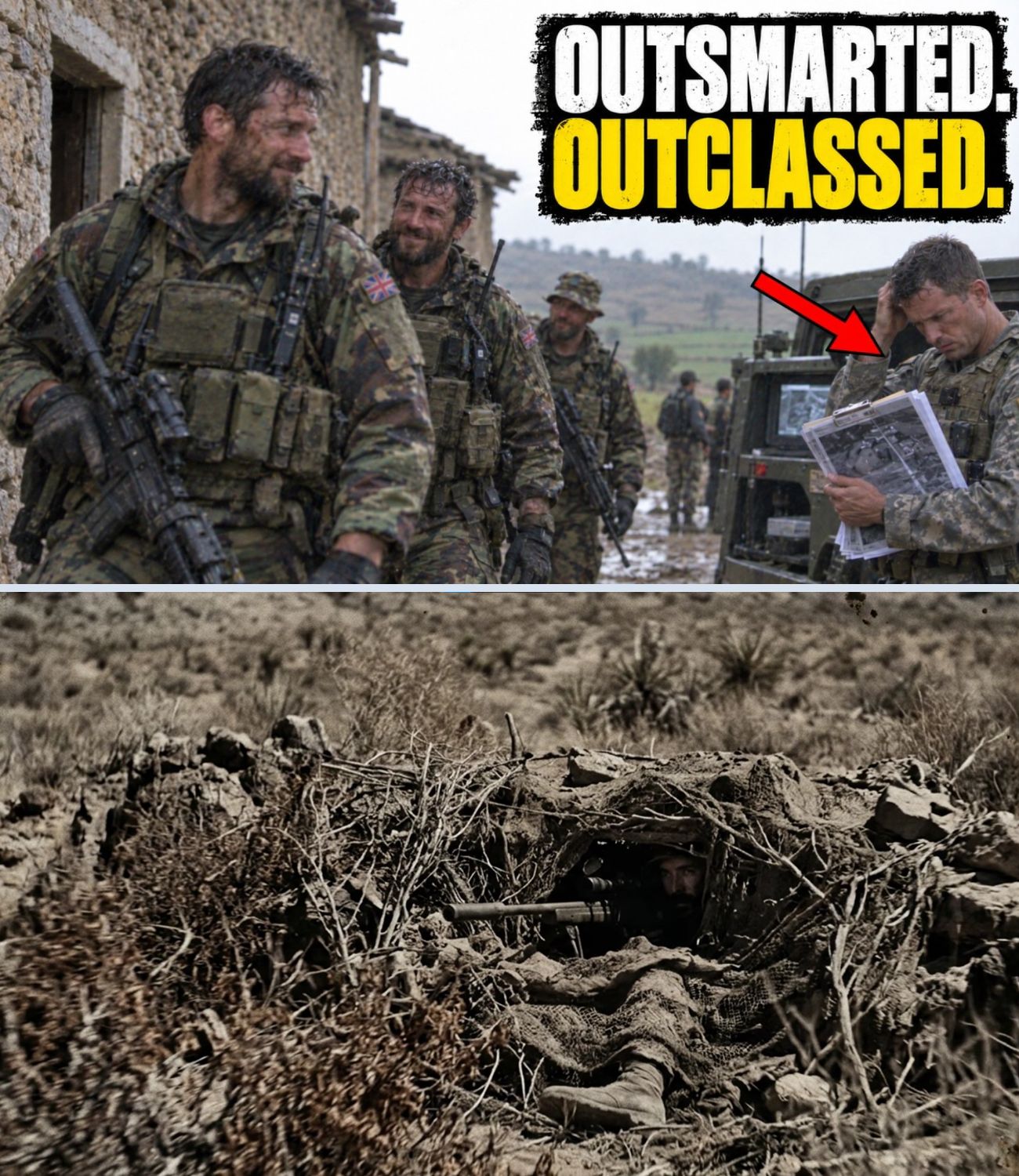
“They Just Disappeared” — The SAS Evasion Tactic That Shocked US Intelligence
Four men carrying two hundred thousand dollars worth of satellite tracking equipment lost a six-man special patrol for nineteen hours in terrain that could effectively mask movement under eight hundred meters. American analysts reviewing the night’s thermal data counted the patrol entering a valley. They never calculated it leaving.
Holbrook stared at the screen until his eyes burned, watching the footage over and over, certain he had missed something obvious. He hadn’t. Holbrook had spent fourteen years at the National Geospatial-Intelligence Agency, most of them calibrating the exact type of systems that had just malfunctioned in front of him.
He had briefed three-star generals on thermal differential analysis. He wrote the training manual junior analysts used to identify human thermal signatures against changing terrain backgrounds. He wasn’t someone accustomed to watching six human beings evaporate from a monitor that cost more than most people’s homes.
The unit in question was operating on a joint reconnaissance exercise under US supervision as part of an intelligence-sharing agreement neither side entirely trusted. Holbrook had arrived with deep skepticism about the arrangement. British Special Forces, in his professional assessment, were a romanticised relic—effective in Malaya, effective in the Falklands, but operating now in an era where sensor fusion and continuous surveillance rendered obsolete fieldcraft methods effectively obsolete. He had said as much during the planning meeting three weeks prior before eleven people, including two SAS liaison officers who merely nodded and said nothing. That silence should have told him something. The disparity in equipment alone should have told him something.
His team’s surveillance package included a Gorgon Stare derivative wide-area motion imagery system mounted on a modified MQ-9, thermal optics rated at fourteen thousand dollars per unit, and a secure communications suite running on encrypted SATCOM links costing roughly thirty-one thousand dollars per operator.
By comparison, the British patrol carried a PRC-319 radio dating back to a decades-old design, Bowman PRR short-range units costing under four hundred pounds each, and personal kit totalling less than two thousand pounds per man. Boots were stitched by a family firm in Northallerton. No biometrics. No networking. Holbrook had looked at that disparity and drawn the only conclusion his training permitted him to draw: that the patrol was underequipped, verging on reckless, for an exercise area known to host live hostile reconnaissance elements along its northern ridge.
He had flagged it in writing. The response from the SAS liaison, a soft-spoken officer who went entirely by his call sign, Badger, was four words. They didn’t need any more. But this wasn’t simply about radios and optics. It was about something that had failed before. Publicly. At great expense.
Eleven weeks earlier, a Delta Force reconnaissance unit had attempted a similar infiltration across a similarly disputed highland nearly nine thousand kilometres away in a separate operation whose outcome reflected directly on the assumptions Holbrook brought to this exercise. That team—four operators with full signal support and a continuous drone overhead, costing an estimated 4.7 million dollars over the course of the operation—had been compromised within six hours.
Not through equipment failure. Through movement discipline: a single operator shifting the weight of his pack against a rock face, reported by a goatherd two hundred metres away within the hour. The mission was aborted. No actionable intelligence was gathered. The after-action report Holbrook had personally reviewed ran to forty-three pages and offered no firm conclusion beyond suggesting further study into low-signature movement doctrine.
Holbrook had read that phrase and moved on without grasping its true meaning. He would absorb it now. The exercise scenario required the SAS patrol to traverse eleven km of mixed scrub and rock terrain, establish an observation position overlooking a simulated high-value target compound, and remain undetected for a minimum of forty-eight hours while US forces attempted to locate them using the full suite of continuous surveillance assets available to a modern joint task force.
On paper, this was an exercise designed to validate sensor technology against the hard target of a human being. Holbrook had quietly assumed the British would be found within the first six hours. He told two colleagues as much over morning coffee when the patrol stepped off.
What he didn’t know, what virtually no one outside Hereford knew, was the specific skill set being demonstrated had its origins in a phase of SAS selection that very few candidates survived intact. Roughly eighteen percent of candidates who reached the jungle phase in Brunei passed the combat survival training, according to figures later cited by journalist Mark Urban in his book Task Force Black.
The jungle phase alone weeded out candidates not through physical destruction, but through a slower, more insidious failure: the inability to move through dense terrain without generating noise, without disturbing the specific pattern of foliage that a tracker—animal or human—would recognize as an anomaly.
Candidates were taught to set each foot by feel before committing weight, to read wind direction through insect behavior, to control breathing through the nose at a rhythm matching their own heartbeat so as not to exhale further than an arm’s length. It wasn’t romantic. It was mechanical, repetitive, and broke most men who tried to do it.
Holbrook knew nothing of this as he watched the patrol’s six thermal signatures vanish from his screen at 11:04 that night. Instead, what he saw was a sequence of data points that made no operational sense. The patrol had tracked along a predictable heading for roughly two hours, conforming to the terrain’s single viable approach route—the path his own briefing told him any infiltrating force would be forced to use due to the impassability of the surrounding ground—then entered a shallow depression flanked by loose scree, and simply stopped updating.
Not faded. Not degraded by distance. Just stopped. As though six men had simply ceased radiating heat. His first assumption was a system fault.
He ran diagnostics. The Gorgon Stare feed was operating within normal parameters, resolving background terrain at the expected contrast ratio. The issue wasn’t the sensor. The issue was that at that moment he didn’t know what he was actually looking at. In the days that followed he would learn, in a debriefing he didn’t enjoy, that the depression the patrol had entered contained a feature his own mapping software had flagged as an insignificant terrain variance—a designation generated by an algorithm that had never been tested against humans who knew precisely how to exploit a three-foot change in elevation and the specific thermal-masking density of scrub oak.
The patrol hadn’t vanished. They had simply stopped showing up on a system never designed by anyone who had spent four weeks forced-marching across the Brecon Beacons with a forty-five-pound pack, learning in their joints and lungs precisely what the ground could hide a man inside.
In fact, that march was the reason the patrol lead—whose call sign Holbrook didn’t know at the time—had been able to identify the depression from six hundred metres away in low light without consulting a map. Holbrook didn’t know that yet. All he knew was his screen had gone dead.
His American superiors were asking questions he couldn’t answer. And somewhere out there in that valley, six men with equipment costing less than a single one of his surveillance drones had stepped clean across the boundary of what his entire career had taught him was possible.
Three days earlier, Holbrook had stood in the operations tent at Bagram and told Brigadier Pemberton precisely what he thought of the plan. The patrol intended to walk eighteen km of rugged terrain to a compound suspected of housing a mid-level coordinator, observe for up to five days, and exfiltrate without any support unless compromised. No drone Overwatch. No standing air package. A single emergency frequency checked twice daily for sixty seconds at a time.
Holbrook had run the numbers before the meeting. His division’s own close-target reconnaissance missions, conducted by joint special operations units with full ISR support, Predator coverage, and a quick reaction force on fifteen-minute standby, had a compromise rate of thirty-one percent over the previous eighteen months.
Thirty-one percent of the time, someone spotted the Americans watching before the mission concluded. He had the figures from an internal audit he’d helped author, one that never left the building. Six men walking into the same province carrying nothing more than what they could strap to their backs struck him not as brave.
It struck him as reckless, and he’d said so in a memo he’d filed the night before his assignment, copied to three commanders. The memo argued that the SAS patrol should accept at minimum an intelligence relay signal station and a dedicated quick reaction helicopter held on fifteen-minute readiness—the exact standard his own units operated under.
Squadron Leader Ashworth, the British liaison officer attached to the joint operations room, stood before Holbrook, read the memo, and handed it back without comment save for one sentence:
"The patrol will not take a relay."
"The patrol will not take a chopper. The patrol has already left."
That detail perhaps landed harder than Ashworth intended. Holbrook checked his watch. The insertion had been scheduled for 22:00. It was 22:11. The six men were eleven minutes into terrain Holbrook’s division was supposedly incapable of surviving without support, and no one had asked his opinion on the timing.
What Holbrook didn’t know and wouldn’t know until the after-action review four days later was the composition of what the patrol carried in lieu of a relay. Each man carried a three-litre hydration bladder capable of being replenished from two cache points marked on a master card committed to memory rather than paper.
Each carried dehydrated rations calculated against the specific caloric deficit the terrain would generate, not standard issue MREs, which weighed nearly triple for the same energy yield. Waste was managed in sealed polymer bags, carried rather than buried, because a latrine buried in that terrain, as a later declassified training document from Hereford put it, tells a story to anyone who knows how to read the ground.
The patrol’s total consumable load for five days weighed less than the battery pack of a single US AN/PRC-117 radio. The Manpack radio itself was the Clansman PRC-319, a design dating back a decade by Western standards, operating on a burst-transmission protocol that compressed hours of recorded voice into half-second pulses.
Holbrook’s unit used the newer, more versatile, vastly more expensive MBITR systems—roughly twenty-two thousand dollars a unit—and significantly more vulnerable to the type of passive signal interception gear insurgent networks in the region had begun purchasing from unmonitored markets. The PRC-319’s burst transmission was originally developed for Cold War stay-behind operations in Europe, intended for operatives who might need to report once and vanish.
No one had updated the doctrine because, as a Hereford instructor noted in a 2019 interview conducted for a regimental history and partially declassified in 2021, no one had improved upon vanishing. Holbrook only learned about the burst protocol after the operation concluded, when Ashworth walked him through the communications log line by line.
At the time, all Holbrook had was silence, and silence, in his professional experience, meant something had gone wrong. The valley the patrol traversed on the second night had not been probed by satellites in the preceding six weeks due to persistent cloud cover—a gap in coverage Holbrook’s intelligence summary had flagged as an acceptable risk.
It wasn’t acceptable. Unbeknownst to planners on either side, the valley floor was being used by a local armed group as a rotating transit route to move fighters and supplies between two assembly areas roughly nine kilometres apart. The patrol didn’t know this when they entered the valley.
Ashworth didn’t know it. Holbrook certainly didn’t know it, sitting at Bagram refreshing a screen that had nothing to refresh. At 01:40 on the second night, the patrol’s lead scout—whose call sign is recorded in no document Holbrook ever saw—halted the column with a single raised fist.
Seven metres ahead, where the route card indicated open ground, was instead a depression holding four armed men, smoking, talking in low murmurs. The patrol had walked to within seven metres of an armed group outnumbering them by a ratio Holbrook later calculated when he finally received the full report at nearly four to one if the depression connected to the wider transit route, which it did.
The patrol didn’t engage. This was the detail that, when Holbrook finally heard it from Ashworth, he initially refused to believe. Four armed men, seven metres away, undetected, and the SAS patrol’s reaction was to drop flat and wait.
British doctrine for this exact scenario, developed and refined through decades of jungle and desert patrolling from Malaya to Dhofar, held that movement attracts the eye far more reliably than a stationary shape, even an exposed one. Six men lay prone in ankle-depth scrub for what the recovery patrol logs later listed as fifty-three minutes.
Fifty-three minutes without a shot fired, without a radio call, without—so far as could be ascertained—a muscle twitch exceeding the shallow rise and fall of controlled nasal breathing, a technique drilled into every candidate during the final selection phase precisely because audible mouth breathing carries differently across the ground at night.
That breathing technique wasn’t something the patrol improvised. It originated from the escape-and-evasion selection phase conducted at the Brecon Beacons and parts of Wales deliberately left unnamed in public accounts, where candidates spent up to thirty-six hours as subjects of a simulated interrogation exercise designed less to gather information than to measure whether a man could control his own physiology under stress.
Of the roughly two hundred candidates who begin SAS selection in a given cycle, the wastage rate is recorded at eighty-five to ninety-two percent, and a significant portion of those failures occur not during the marches or hill climbs, but in those final days when exhaustion strips away conscious control and the body starts making noise the mind no longer masters.
The men lying in that brush seven metres from the armed patrol had proven months earlier that their bodies wouldn’t betray them. That proof was the only piece of equipment that mattered at odds of zero to fourteen. Holbrook wouldn’t learn the duration of those fifty-three minutes until he read the patrol summary, and when he did, he read the line twice.
The four men in the depression eventually packed their gear and moved northeast towards what subsequent imagery confirmed was a secondary staging area. The patrol resumed movement at 02:33. They were fifty-three minutes behind a schedule with almost no slack built into it.
A fact more critical than Holbrook initially appreciated, because the route card timing had been built around a full moon, and the moon sets for no one. This was the first point where the internal logic of the operation shifted. The original plan called for the compound observation to begin at dawn on the third day.
A window chosen because the target’s known movement pattern suggested he departed for a neighboring village every Tuesday morning to use a satellite phone located outside the range of any fixed collection asset. Missing that window meant missing the single most valuable thirty-minute block in the entire five-day observation plan.
The patrol was now fifty-three minutes behind a schedule already considered tight. Ashworth recounted this complication to Holbrook two days later during the debriefing, and it was this detail that finally unlocked something in how Holbrook logged the entire operation in his own mind. He had assumed, without ever admitting it to himself, that the patrol’s silence meant failure or, impossibly, miraculous success.
What he hadn’t factored in was that six men on the ground were continuously making real-time tactical decisions with no higher headquarters feeding them options, and that those decisions were costing them resources he hadn’t factored in. Resources as simple and finite as time before sunrise.
The patrol commander’s solution, relayed in the sixty-second burst transmission the patrol sent that night, utilised a route variant Ashworth had nearly mentioned during the pre-mission briefing three days earlier as a weather contingency. At the time, Holbrook hadn’t regarded that contingency as important.
It involved a dry stream bed running at an oblique angle through the valley floor, impassable in wet conditions, but, given the season, currently clear, which shaved nearly four km off the remaining distance to the observation position. The detail Ashworth had mentioned almost as an afterthought during the earlier briefing turned out to be the single thing that made the compressed timeline survivable.
The patrol reached the observation position at 04:51, nine minutes before their absolute deadline to establish concealment before first light could expose them in open terrain. What Holbrook saw next, filtered through Ashworth’s translation of the data streams seventy-two hours later, he later described, in a private conversation recorded by a historian studying joint operations in the region and partially declassified in 2020, as the most economical use of six human beings I have ever encountered in twenty-two years of service.
The patrol’s hide was established in a dead zone of natural scrub roughly six hundred metres from the disused compound, constructed using no camouflage netting, no thermal-blocking materials of the type Holbrook’s units purchased by the thousand dollars.
According to the After Action Report, it relied on cutting and withering local vegetation to match the surrounding dead pattern precisely, replaced every eighteen hours when the cut material began to differ noticeably from the living flora around it. The entire camouflage system cost nothing except labour, and labour, on that patrol, was the one resource no one lacked.
Holbrook’s screens, throughout this entire period, showed nothing. No position reports, no thermal feedback from the drone which by then had been entirely diverted to another sector because his command had assessed the mission as likely compromised and reallocated the asset. This was the detail that, when Holbrook finally confessed it to the historian years later, caused him the most embarrassment.
He had pulled the feed himself, operating on the assumption that six men who had gone fifty hours without checking in had almost certainly been compromised or withdrawn and that the asset was needed elsewhere. He logged it fourteen hours before the patrol’s most critical observation window. He wouldn’t discover what happened during that interval until the burst transmission arrived late on the fourth night.
A transmission made, according to the signal logs, in 0.4 seconds to send and containing more actionable intelligence than the previous six weeks of collection by Holbrook’s division in that province combined. Holbrook read the transmission twice before calling his signal officer back into the room. Four grid references. Two vehicle descriptions.
A recurring pattern of movement across six nights that his department’s collection plan had never detected. Because his own department’s collection plan had never kept anyone in position long enough to see it. The patrol had settled into a shallow depression eleven hundred metres from a complex his analysts had flagged as low priority three weeks earlier.
Low priority because it looked no different from forty other compounds in the valley. Mud walls, a generator, irregular foot traffic—the kind of target that falls to the bottom of the collection list when there are higher-value names to chase. What the four men in that depression had seen, across ninety-six hours of motionless observation, was a supply pattern.
Not weapons moving in. Those compounds were everywhere, and weapons moving in told you things you already knew. What they saw was weapons scheduled for movement to five separate locations on vehicles returning empty at a consistent interval that never varied by more than eleven minutes across six consecutive nights.
Holbrook’s department had spent forty-one days and an estimated 2.6 million dollars trying to map that exact distribution network using signals intelligence and airborne coverage. They had produced a fragmented picture with three confirmed nodes and no reliable timing data.
Because the network operators had learned, quite correctly, that electronic signatures get noticed and vehicle movements during active surveillance windows get noticed, and so they simply waited out the known collection window before moving. The four men in the depression were not a known collection cycle.
There was no signature to wait out. No cycle at all, in the sense his analysts understood the term. Just a British patrol that had walked there, dug into the earth, and ceased existing as anything an algorithm could flag.
That eleven-minute margin, which he had dismissed as noise in his department’s data three weeks earlier, was the exact variance the patrol had used to confirm this pattern was deliberate rather than random. Holbrook had seen that number before. He had seen it on a map in a division sub-office, buried in a footnote, marked by an analyst as of possible significance, insufficient data to confirm.
His division had a number. His division looked at it and moved on, because eleven minutes wasn’t dramatic enough to justify the resources required to confirm it meant anything. The patrol had treated it as the entire operation.
This was the asymmetry that would eventually appear without his name attached in a RAND Corporation study on special reconnaissance methodology published four years later. The observation noted that conventional ISR architecture was optimized for detecting activity, while a four-man reconnaissance patrol was optimized for detecting the absence of expected activity—a class of signal that drones, satellites, and structured signal collection poorly registered because absence generates no signature to intercept.
Holbrook didn’t have that framework yet. What he had on the evening of the fourth night was a transmission telling him his entire target picture for the valley had been built on the wrong compound, and a question he couldn’t yet answer about how four men with no electronic footprint had seen something his 2.6-million-dollar kit had missed.
He wouldn’t get the full answer for another eighteen hours, and when it came, it wouldn’t be in a report. The patrol’s selection three years prior for this type of work wasn’t a mission-specific accident. It was built deliberately through a phase of Hereford selection that candidates referred to in the handful of declassified interviews later gathered by journalist Mark Urban as the static phase, a component of continuous training that received almost zero public attention compared to the marches across the Brecon Beacons, but was regarded by instructors as the more reliable predictor of operational success.
The static phase placed candidates in fixed observation positions for a minimum of eighteen hours on terrain chosen specifically for its discomfort. Waterlogged depressions, exposed ridges, positions with no natural shelter from the weather.
Candidates were graded not on endurance in the conventional sense, but on a narrower, harder metric: the rate of decay in their written observation logs over time. A candidate whose entries at the tenth hour were as accurate as his entries at the first hour had passed. A candidate whose attention clearly eroded—shorter entries, missing detail, estimated figures instead of calculated ones—failed, regardless of his physical condition.
Of the roughly one hundred and forty candidates who reached this stage in a typical selection cycle, according to figures referenced in a Royal United Services Institute paper on special forces selection methodology, fewer than twenty-two percent passed the static observation portion on their first attempt.
The instructors running this phase had a phrase for the quality they were filtering for, repeated in at least two separate veteran accounts. They weren’t selecting men who could endure discomfort. They were selecting men whose minds didn’t wander when nothing was happening, because nothing happening was, in reconnaissance work, usually the most important moment.
This was the door Holbrook’s department had never been able to afford to open. His division rotated collection assets on a four-hour schedule driven by crew rest requirements for pilots and sensor operators running overhead platforms, and by a neat institutional assumption that four hours was enough to capture a representative sample of activity at any given location.
This assumption was reasonable for most targets. It was false here because the compound operators had evidently learned, through repeated exposure, the exact intervals at which American collection assets typically rotated, and adjusted their movement schedules to fall into the gaps.
The patrol had no gaps. The patrol had four men, each of whom had logged a combined total of over six hundred hours of continuous static observation work during selection and training prior to this deployment, and who handled the ninety-sixth hour of the watch with the exact procedural rigor as the first.
Holbrook would later request the patrol’s observation logs, heavily redacted but partially passed to his division as part of the target handover. He read through the four days of entries, logged at roughly fifteen-minute intervals. The entries did not change in quality from the first page to the last.
Vehicle type, color, heading, estimated speed, personnel count visible, weapon configuration where observable, time of arrival down to the minute. On the ninth page, roughly thirty-one hours in, there was a single line that broke the pattern. It noted that a patrol member had shifted to a secondary position seven metres east to relieve cramping in his left leg, recorded with the same clinical precision as every vehicle movement around it, and the watch continued without a gap in the log.
He found himself rereading that line more than any other in the file. There was nothing dramatic in it. It was, Holbrook finally understood, the point. The patrol didn’t need a heroic solution to thirty-one hours of immobility in a position with no shade, intermittent rain—according to the meteorological log for that day—and ground temperatures that his department’s climate data placed at roughly thirty-eight degrees Celsius during the daytime.
They needed a boring one. Rotate position, log the rotation, keep the watch. And boring solutions repeated with absolute, unyielding consistency were what separated a reconnaissance patrol that produced usable intelligence from a collection apparatus generating gigabytes of data with holes in it every four hours.
As it turned out, the compound’s supply schedule ran almost entirely inside a window that fell two to four hours before any US airborne asset typically arrived on station. Holbrook’s analysts confirmed this after the fact, cross-referencing their flight logs across eleven weeks with the patrol’s movement data.
The overlap was nearly absolute. It wasn’t evidence of anything nefarious on the part of his own collection managers. It was simply the mathematical consequence of a predictable rotation schedule meeting a patient adversary smart enough to map it.
The patrol didn’t need to map the rotation schedule. They simply never left. On the morning of the third day, according to the log, the patrol was nearly compromised. A boy, roughly eleven years old by the observer’s estimate, led a flock of eight goats directly through the depression holding the patrol, close enough that an animal stepped within what the log recorded as under one metre of the primary observer’s position before being diverted by the boy’s shouted command.
The entry recorded no movement from any patrol member for the duration of the encounter, timed at six minutes and forty seconds. No weapons were raised. No positions were adjusted. The patrol simply ceased to exist, in the only sense that mattered to the boy and his goats, for six minutes and forty seconds, and then resumed logging vehicle movements four minutes after he was out of sight.
Holbrook asked, when he interrogated one of the patrol members weeks later through comms channels, how a man kept himself from shifting weight when an animal’s hoof came close enough to brush his sleeve. The answer he received, paraphrased in his own notes because the exact phrase was never fully cleared for release, was that discomfort wasn’t the hard part.
The operator told him the hard part was fighting the urge to think about the discomfort. Because the moment your mind thinks about the leg cramp or the insect on your neck, your attention has left the target. And the target was the only thing that was supposed to exist during those six minutes.
Holbrook realised this wasn’t bravery. It was something closer to concentrated discipline that his own training system had never attempted to impart, because his own training system had never needed to. The midpoint of the patrol’s deployment brought a complication Holbrook hadn’t anticipated when he first read the daily summaries.
On the evening of the fifth day, a second compound, roughly four km north of the original target, began showing activity that the patrol’s secondary observer flagged as potentially more significant than the supply pattern they’d spent five days confirming. Two vehicles, not matching the known distribution network, arrived after dark along with a group of roughly fifteen armed personnel—larger than anything observed previously at either location—and conducted what the log described as an inventory check in the courtyard, visible through a gap in the compound’s northern wall.
The patrol commander faced a decision the mission’s original tasking had never accounted for, because the original tasking had been built around a single objective that no longer reflected the more urgent picture developing four km away. Splitting the patrol risked compromising both observation positions; abandoning the original objective risked losing five days of pattern confirmation on the supply network—data that could not be reconstructed once the clock was broken.
Requesting a new tasking through the normal chain of command risked a delay of six to eight hours based on the standard authorization cycle Holbrook’s own department operated under—a delay that would allow whatever was happening at the second compound to conclude before anyone could act on it.
The patrol commander didn’t do either. According to the logs, released years later in a heavily redacted form that journalist Ben McIntyre referenced in correspondence with a surviving member of the operation, the decision was made on the spot to maintain the primary watcher undisturbed while the secondary observer shifted his personal position without breaking position to cover both compounds using a range fan the log itself termed marginal, acceptable only because no alternative was given.
It wasn’t a solution anyone in staff college would have designed. It was a solution for four men with no ability to call in extra assets, more time, or further certainty, and who had been selected years earlier during the static phase at Hereford specifically for their capacity to absorb divided attention without their observation quality degrading on either front.
Holbrook wouldn’t learn about the second compound until the after-action review three weeks later, and when he did, his first reaction wasn’t admiration. There was something almost unbelievable about a four-man patrol simply solving a mission parameter problem his division would have required an official re-prioritization meeting to address.
That absorption came with a cost, though it took Holbrook until long after the operation to calculate it. The patrol was now carrying two sets of targets in working memory, cross-referencing vehicle movements against two separate life-pattern logs, and doing so on the three hours of collective sleep allocated across the four men over the preceding sixty-one hours.
The lead scout, identified in Holbrook’s subsequent action files only by call sign, had developed a method of recording observations without a notebook: impressions on tape wrapped around his forearm, a private shorthand of dots and dashes that meant nothing to anyone but him.
Holbrook found this detail almost quaint when he first read it. He didn’t find it quaint when he learned the tape had survived a river crossing that destroyed two radios. The frequency switch occurred on the fourth night. It was a minor thing, just a line in the signal log.
The patrol had been briefed on two backup frequencies prior to deployment. The second had been dismissed in the pre-mission briefing as redundancy no one expected to use. Holbrook remembered the briefing.
He remembered thinking the excess frequency was down to institutional over-caution, the kind of belt-and-braces planning that ate up briefing time without adding capability. He would be wrong about that within forty-eight hours, though he didn’t know it yet. He didn’t know it yet, and that not-knowing would matter more than almost anything else in the operation.
On the fifth night, at 01:51, compromise occurred. It didn’t happen the way Holbrook imagined compromise would happen, in the scenarios his department had gamed out during planning cycles. There was no firefight, no pursuit, no radio call cut short by small arms fire.
What happened was quieter and, in its way, more terrifying. A local goatherd, moving his livestock before dawn to reach a market eleven km away, passed within four metres of the patrol’s position. He didn’t see them.
What he saw was one of the goats halting, planting its feet, and refusing to move, staring directly at a patch of ground the goatherd regarded as empty. The primary operator lay motionless for twenty-three minutes while the animal inspected his face.
To understand how a human being endures this, you have to return to the selection phase that produced it: specifically, the part of the process candidates at Hereford refer to, without sentiment, as the interrogation phase. After the endurance marches through the Brecon Beacons had thinned the candidate pool by roughly forty percent, after the Belize jungle phase had thinned it further, survivors underwent thirty-six hours of resistance-to-interrogation training—stress postures, white noise, sleep deprivation compounded upon already severe sleep deprivation.
All of it designed to simulate what happens to an operator captured during the first day and a half following capture. The training doesn’t teach an operator how to resist pain, precisely. It teaches something more specific: the ability to disengage the autonomic nervous system’s panic response from conscious decision-making, to keep breathing slow and shallow, and to stay still even when every physiological signal is commanding the body to do otherwise.
Of the candidates who reached this stage, another portion failed here, not from physical collapse, but from the simple inability to keep the body quiet while the mind screamed. Across a three-year period Holbrook would later review, the overall attrition rate from initial selection to award of the beret was eighty-nine percent. Fewer than one in eight men who began the process completed it.
The goat eventually lost interest and wandered off. The goatherd never looked down. The patrol didn’t move for another eleven minutes after the animals were gone, waiting to ensure the flock wouldn’t double back. Holbrook would read this entry in the operations log three weeks later and sit with it for a long time before moving to the next paragraph.
The second near-compromise occurred nineteen hours after the first, and it involved the British Army patrol radio that Holbrook’s analysts at the division G2 shop had dismissed during a joint capability assessment eight months earlier as a legacy system overdue for replacement.
The PRC-319 wasn’t new technology. It lacked the complex frequency-hopping capabilities of the US MBITR hand-helds the patrol carried as backups, and on paper it should have been the weaker system in every measurable category. But the MBITR failed.
It failed not through enemy action, but through water ingress via a degraded seal during the river crossing three nights prior. The exact same crossing that destroyed two other units and forced the lead scout to rely on tape shorthand on his arm.
When the patrol needed to transmit a contact report at 04:17 on the fifth night, the primary radio produced nothing more than dead static. The frequency Holbrook had dismissed in the conference room for institutional over-caution was the only thing that got the contact report out.
It took the signaller four minutes to switch to the backup set, authenticate, and transmit a burst lasting under eleven seconds—a compressed coordinate package, threat assessment, and a single operational codeword letting the Joint Operations Centre know the patrol intended to continue the mission rather than request immediate exfiltration.
Holbrook was in the room when that transmission arrived. He would describe it later in an interview conducted for a staff study and declassified in 2019 as the first time I understood that redundancy isn’t bureaucracy. It’s doctrine built by people who expect their gear to fail and have planned for that failure.
He wouldn’t be the last American officer to arrive at that conclusion the hard way. The contact report concerned a vehicle—not the convoy they’d tracked at the first compound, and not anything associated with the second compound. Holbrook wouldn’t know this for three weeks either.
An engineering truck, flatbed, moving in darkness toward a position roughly four km from the patrol’s hide, escorted by two pickup trucks carrying armed personnel numbering between eleven and fourteen by the patrol’s estimate. It wasn’t on any target list. It hadn’t been mentioned in any pre-mission intelligence summary.
And it was, by the patrol commander’s own assessment transmitted in that eleven-second burst, almost certainly more important than both compounds the patrol had been watching. This was the moment the entire shape of the operation shifted.
This wasn’t a close call anymore. This was the floor shifting under everyone’s feet. Holbrook’s division had built its mission around a simple premise: observe two static locations, confirm or deny activity patterns, and support decision-making on whether follow-on direct action was warranted.
That premise now had a hole the size of an unidentified flatbed truck moving through disputed territory in the middle of the night. And the patrol? Four men, on the fifth night with minimal food and compounding sleep deprivation, had to decide in real time whether to reposition.
The patrol commander’s decision, transmitted in a second burst ninety minutes after the first, was to split the difference in a way Holbrook’s staff would later study as a textbook example of tactical judgment exceeding the parameters of the original mission order.
Two operators remained on the original compounds. Two moved to observe the new vehicle and its destination. This meant the four-man patrol was now operating effectively as two two-man elements, separated by more than three km of terrain with no secondary extraction elements assigned, in an area the patrol estimated contained at least fourteen armed personnel moving actively.
Holbrook read the transmission timestamp on the topographical map in the operations centre and muttered, not addressing anyone in particular, that the patrol commander had just violated his mission’s risk parameters. He wasn’t wrong about that. Nor was he prepared for what happened next.
The secondary element tracking the truck had followed it on foot for six km, maintaining visual contact at a distance that never closed within four hundred metres and never opened beyond eleven hundred—a discipline of distance the patrol commander would later describe in the post-mission summary Holbrook was allowed to read in redacted form as the only thing that kept us alive that night, because closing the distance would have put us inside their security perimeter, and opening it would have lost the vehicle at the first terrain fold.
The vehicle’s destination turned out to be a third site, unlinked to either compound from the initial observation, where the engineering truck was unloaded by hand over a ninety-minute period by personnel working with minimal light discipline—just enough illumination to work, not enough to be seen from a distance, which told the observing operators something about the sophistication of that site’s management.
The detail he walked away from without understanding its significance was the unloading style. The rhythm of it. The spacing between personnel. It was the way two men never stood in the same place twice. That detail would matter again before the campaign ended.
Back at the original compound, the two remaining operators continued their observation uninterrupted, logging vehicle movement at the first site and confirming, for the first time with high confidence, the presence of what the after-action report described only by the generic term order-of-battle activity on the second.
Holbrook, tracking both incoming streams of reports with a twenty-minute delay through the relay chain, found himself doing something he hadn’t expected when the mission began five days earlier. He found himself trusting tactical judgment that he’d explicitly told his staff, during the planning meeting eight days before his assignment, he considered reckless.
He didn’t say this out loud in the operations centre. Instead, he wrote it in the margin of his own printed copy of the mission order, beside the line designating the original two-compound tasking. The note, preserved in his personal papers and cited by journalist Mark Urban in a later study on joint special operations coordination, reads simply:
"They're answering a question we didn't know we were asking."
That sentence would follow Holbrook through the remainder of his career, even though it took him eleven years to say it to anyone outside his staff. The food situation by the sixth day had become its own quiet crisis, though not the kind registered in any US logistics planning document.
Each operator carried under two kg of rations per day for the planned duration of the patrol, calculated against an estimated five-day limit that had now stretched past six days with no clear end date. The patrol ate less rather than more as the mission extended—a deliberate choice, rationing across an indeterminate horizon rather than consuming at a set rate and risking being caught short.
Water was managed more carefully still, filtered through a system that added almost no weight penalty to the patrol’s load. A contrast Holbrook’s logisticians would later note with stark relief compared to US-standard filtration gear that weighed nearly four times as much and required power sources and battery packs—gear the British patrol did not need at all.
The waste discipline continued uninterrupted. Each operator carried what his body produced, sealed inside the same heavy-duty bags issued prior to insertion—a practice Holbrook had initially found finicky to the point of absurdity when he first reviewed standard operating procedures eight months prior.
He didn’t think it absurd anymore. He had arrived, by the sixth day of the operation, to understand it as a single data point in a much larger pattern. A patrol that left no physical trace of its presence anywhere it had been throughout the entirety of its deployment made the entire concept of a search-and-clear zone meaningless to anyone hunting them.
For his part, he could not dismiss that pattern as culture, luck, or coincidence. It was methodology, replicated at every level of operations, and it was about to be tested once more before extraction. At 04:17, the patrol reached the exfiltration corridor, a dry wadi running six km toward the pickup zone, and Vance watched the satellite feed show four thermal signatures moving along a route intersecting with the corridor less than nine hundred metres ahead.
The signatures weren’t the patrol. They were a technical surveillance team, three vehicles and six personnel, operating on a schedule no one had marked in the pre-mission intelligence package. Vance called it instantly.
The response from the forward operating base took ninety seconds to arrive, and when it did, it wasn’t what he expected. The patrol commander, identified only by sign, confirmed contact and requested the overhead asset hold its position and say nothing further on the open channel.
This was the moment the entire framework of US tactical doctrine demanded Vance intervene. He had watched over eleven months of joint operations, a consistent pattern in how US special operations units handled unexpected contact during extraction.
The default response was escalated surveillance. Immediate notification up the chain. Preparation of the quick reaction force. Standard operating procedure, per the Joint Special Operations Execution Order Checklist Vance had helped revise two years prior, called for a minimum of three independent confirmations before a patrol leader could be authorized to continue movement through a compromised corridor.
The SAS patrol didn’t do this. The four signatures on his screen simply stopped moving for six minutes in a formation that from overhead looked like nothing at all. Four shapes contouring the terrain at intervals consistent with every training manual Vance had never read.
What he didn’t know was that the dry wadi bed had been chosen during planning for a reason that had nothing to do with its value as a direct path to extraction. The route selection, Vance would learn in the debriefing eleven hours later, had been built on a secondary consideration the Americans in the planning room had dismissed as unnecessary caution at the time.
The wadi’s eastern wall, running for roughly four hundred metres, cast a thermal shadow for approximately forty minutes following local sunrise and prior to local sunset, a consequence of its depth and orientation relative to the sun’s angle at that time of year. Captain Pemberton, the British liaison officer on the joint planning staff, had mentioned this in a single sentence during the route-validation briefing, and Vance had noted it in his own planning logs as a minor environmental factor worth recording but possessing no value around which to build a contingency.
It was now 04:23, nineteen minutes before the thermal shadow began to dissolve, and the four signatures had positioned themselves precisely inside that four-hundred-metre stretch. The detail he had dismissed as a footnote was now the only reason the patrol remained invisible to anyone using infrared to search for them.
The technical surveillance team crossed within six hundred and ten metres of the patrol’s position, moving along a high track running parallel to the wadi, and continued on their own schedule without altering heading. Vance watched the two sets of thermal signatures converge, maintain parallel tracks for four minutes, and separate again, and at no point did the surveillance team’s equipment register anything inside the wadi bed.
He asked the operations officer beside him, a major named Reyes who’d spent two tours running surveillance components for Delta Force elements in that same province, whether this was luck. Reyes didn’t answer for several seconds. A thermal printout from the reconnaissance drone was held motionless in his hand.
"It's not luck if they knew the wall would do that."
"The question is whether they knew or got lucky, and we're about to talk ourselves into believing it's methodology."
Vance opened the mission planning file on his laptop and found Pemberton’s quote about the thermal shadow, timestamped six days before the operation began. It wasn’t a footnote. It had been built around the timing of the entire insertion schedule, which explained a detail Vance had marked as odd during the planning stage and then forgotten.
The patrol’s insertion had been delayed by eleven hours from its originally proposed time—a change the British planning staff had requested without detailed explanation, citing improved concealment parameters for the extraction phase. The documentation record for SAS planning cycles, per a 1996 Ministry of Defence internal review later referenced by military historian Michael Asher in his book Shoot to Kill, indicated an average of 4.1 independent environmental factors factored into standard patrol route planning compared to an average of 1.3 factors recorded in US Army special forces planning documents from the same period.
Vance hadn’t seen that review until nearly two years later. At 04:23 in the operations centre, he only knew that a remark he’d once treated as trivia was now the explanation for why six armed men with thermal imaging gear had walked within yards of four British soldiers without spotting them.
The patrol resumed movement at 04:29, six minutes after the surveillance team’s signatures vanished from the feed, moving now at a pace Vance felt was unreasonably slow, compressing the extraction window. He checked the mission clock. Fifty-one minutes remained before the helicopter was due at the scheduled pickup zone, and the patrol still had roughly 1.8 km to cover.
His instincts, shaped by fourteen years of operational planning, told him they needed to move faster. Reyes, watching the same feed, offered an explanation Vance initially resisted.
The patrol’s pace, he said, was dictated by the scout’s footstep pattern—a deliberate heel-to-toe placement designed to minimize sound on the surface of dry gravel that accounted for roughly sixty percent of the remaining route. Moving faster would increase the probability of a stone shift or the sound of shifting loose rock exceeding a hundred and fifty metres in the pre-dawn stillness, a risk the patrol commander had evidently decided was harder to accept than the tightened extraction timeline.
Vance recognised that this was the exact tension he’d seen described in a declassified memo from a 1982 Falklands-era SAS patrol report where an operator had stated in an interview that speed is what commanders always want and what gets patrols killed—a quote journalist Mark Urban later cited in his book Big Boys’ Rules as representative of the broader doctrinal view within the regimental chain.
The extraction window was treated as flexible, built with deliberate looseness rather than treated as a fixed deadline to be met regardless of ground conditions. Vance had spent his entire career being told the extraction window was sacred. The patrol in front of him treated theirs as a suggestion.
At 04:41, the patrol encountered the second of three near-compromises that would occur during the extraction phase. A domestic dog, presumably belonging to a herding family whose encampment lay roughly three hundred metres to the southwest, began moving toward the patrol’s position along the riverbed, its track indicating it had caught a scent trail.
The four thermal signatures on Vance’s screen did not scatter, made no attempt to retreat, and did not reach for weapons in any way visible on the feed. Instead, they held position for what the timestamp recorded as four minutes and eleven seconds while the dog closed to within eleven metres, circled twice, and trotted back toward the encampment.
Vance later learned this wasn’t improvisation. It was a trained response, and the explanation for it traced back to the earliest weeks of SAS selection. During the Brunei jungle selection phase, candidates were required to complete an exercise where they had to remain motionless in dense foliage for periods exceeding thirty minutes while instructors, sometimes accompanied by tracking dogs borrowed from Gurkha support units, passed within arm’s reach.
According to a retired training wing instructor interviewed by journalist Chris Ryan under conditions of partial anonymity—he himself a former SAS soldier—the dog exercise existed specifically to break the instinctive panic response of being close to animals, an instinct the instructor described as harder to train out of a man than fear of gunfire, because you expect gunfire and an animal sniffing your ear does not.
Candidates who flinched, shifted weight, or altered their breathing pattern noticeably during the exercise were flagged for review, and the failure rate on this specific skill historically accounted for a measurable percentage of selection failures outside the headline attrition rate most public accounts focused on.
The attrition rate for overall SAS selection hovered between eighty-five and ninety-two percent depending on entry conditions and course run—a figure corroborated in testimony before the House of Commons Defence Select Committee in 2006—but why candidates failed was rarely made public.
The dog exercise and others like it designed to test involuntary physical responses to close-range stress accounted for a fraction of the failures that never showed up in official statistics because they were recorded simply as voluntary withdrawals for other reasons. The four men in the wadi had passed that test years prior.
The dog circled them twice, found nothing to confirm the scent, and trotted out of their path. Vance exhaled slowly, Reyes noted the detail without comment, and watched the mission clock tick past the thirty-minute mark before the extraction window opened.
The patrol had closed to within four hundred metres of the pickup zone, moving now across open ground with no remaining natural cover—a stretch of terrain the mission planners had flagged in the short brief as the highest risk on the entire route. This was precisely the kind of exposure Vance’s doctrine held was never acceptable without an overwhelming security force.
US extraction protocols, as codified in Joint Publication 3-05 Special Operations, commonly referred to as the suppressed firepower positions, called for a minimum of two mutually supporting aircraft, and illumination-denial measures for any approach to the pickup zone exceeding two hundred metres.
The SAS patrol had none of this. It had four men, carrying a single general-purpose machine gun with two hundred rounds, moving across open desert with no air cover, in twenty-six minutes. Vance asked Reyes directly whether this was reckless.
Reyes, who by this point had stopped offering hedging answers, said only that recklessness and discipline look identical from the outside until the results arrive. The results arrived fourteen minutes later, and they were not what either man expected.
As the patrol crossed the open ground, moving in a staggered file with eight metres separating each man, Vance’s screen showed a fifth thermal signature entering the frame from the northeast, moving at a speed inconsistent with the surveillance team or any civilian pattern logged in the area life-pattern database compiled over the preceding six weeks.
Just a single signature, moving directly on a collision course with the patrol’s heading, and closing at a speed sufficient to bring it into visual range in roughly four minutes. This was the moment Vance had been bracing for since the mission began.
The single uncalculated variable that even the most meticulous planning couldn’t fully account for in advance. Everything the patrol had done over the preceding nine days, every discipline and every environmental calculation, was about to be tested against a human being who had no plan to walk into the wrong place at the wrong time.
The herder was perhaps sixty-one or sixty-two years old, moving with the unhurried gait of a man who had walked this exact track for most of his adult life. He carried a staff. He had no weapons the lead scout could identify, no radio, no obvious means of reporting what he was about to see.
That didn’t matter. What mattered was geometry. He was walking on a bearing that would take him within four metres of where the second man in the patrol lay beneath cut thorn branches, and he walked at a pace that probably left the patrol ninety seconds to decide what discipline actually meant when it was tested by something intangible and heavier.
Vance, watching the feed from the operations centre, realised he was holding his breath. He told colleagues later that it felt silly to realize he was sitting in an air-conditioned room four hundred km away and yet noticing it anyway.
This was the calibration point where things held or didn’t. The patrol didn’t move. This was the detail the after-action review would return to repeatedly. The detail that the Research and Development Directorate would eventually turn into a training case study distributed to three different US special operations units.
The men didn’t flinch. They didn’t reach for weapons. They didn’t shift positions to improve their firing angles, because improving firing angles would mean moving, and movement was what a herder—untrained in reconnaissance, but thoroughly trained in recognizing anything out of place on his grazing route—would catch instantly.
The breathing discipline the patrol commander had enforced since the first night. The controlled nasal breathing Vance had initially dismissed as affectation was the only thing standing between four men and a compromise that could have ended the mission and potentially worse than that.
The herder passed within four metres. He stopped once to adjust what the patrol commander’s log later described as roughly six seconds of appearing to adjust something on the lead tether of a stray goat from the small herd. Vance tracked the telemetry from the biometric sensors, fitted experimentally to this particular patrol as a sensor trial no one expected to matter tactically, and saw that the second operator’s heart rate didn’t move outside the range it had maintained for the preceding hour.
He would mention this specific data point in no fewer than four subsequent briefings because he didn’t know how else to make people understand what he had just watched. The shepherd stepped on. He didn’t look back.
The goat, Vance would muse later, had been the real variable, not the man. Animals don’t perform social camouflage; they either smell something wrong or they don’t. This one clearly didn’t.
What happened next, across the next six hours, formed the part of the operation that never made it into the public record, and Vance only reconstructed it eighteen months later, piecing it together from a heavily redacted after-action summary and a single conversation with a liaison officer who didn’t realize how much he was giving away.
The patrol, having survived the four-metre, six-second compromise threshold, made a call that Vance’s own doctrine would have opposed. They didn’t withdraw. In fact, the window Vance had been told was closing fast was the only window that mattered, and the commander on the ground determined that the convoy movement the patrol existed to confirm was now less than nine hours away.
Pulling back now meant restarting the entire targeting cycle from a position with inferior intelligence to the one they’d already achieved. They stayed. To make the final observation, two of the four men left their hiding positions entirely—a decision that, when Vance first read it in summary form, struck him as reckless to the point of being indefensible.
Splitting a four-man patrol on disputed ground, nearly compromising them, violated almost every principle of small-unit survivability that US doctrine had spent two decades refining. But the split wasn’t improvisation. It was the product of the exact selection process Vance had spent nine days learning to fully appreciate: the composite judgment phase at the end of selection.
The phase where candidates were assessed not on individual technical expertise, but on their ability to make split-second decisions on transactional risk versus intelligence value, with the directing staff marking candidates down not for mistakes, but for failing to explain why they were right. Of the one hundred and forty-one original candidates who entered that selection round, eleven passed the composite judgment phase.
The two men executing the split that night were both among them. Confirmation came at 22:41. Thirty-one vehicles rather than the estimated twenty-four moved along a secondary route rather than the primary one that three weeks of signals intelligence had confidently predicted.
The patrol transmitted the corrected intel in a four-second data burst using the backup frequency the primary communicator had grumbled about carrying dead weight on day one. The exact same frequency Vance had privately marked in his notes as unnecessary based on his assessment of the primary system’s reliability.
The primary system had failed at 22:38, three minutes before transmission. No one had yet explained fully why. The backup worked. The redundant wait, as it turned out, hadn’t been redundant at all.
Ninety-six hours after the transmission, strike aircraft operating on the adjusted coordinates engaged the convoy at an intersection the original targeting package hadn’t included. The battle damage assessment compiled by a joint targeting cell that Vance sat on confirmed effects on the convoy’s command vehicle and two logistics trucks with secondary explosions consistent with ordnance rather than fuel.
The patrol withdrew on schedule, forty-one hours later, moving along a route that existed only because the commander had insisted, contrary to the initial plan, on scouting a secondary escape corridor during the second night—a decision Vance had noted at the time as excessive caution, wasted effort, a box checked for its own sake.
It was the only viable path. The planned route had been cut by flash floods that the patrol, logging weather conditions every two hours since day one, had accurately predicted that the supporting meteorological unit’s satellite models had missed by eleven hours.
Everything the patrol carried, used, or did without comment across nine days individually defined an outcome Vance had once called impossible. None of them were expensive. None of them would have shown up on an equipment manifest in a significant way.
The comparative numbers arrived on Vance’s desk six weeks later, compiled as part of a joint evaluation he had requested, half expecting the data to soften what he’d seen. It didn’t. Over the preceding fourteen months, long-range reconnaissance patrols of this specific type, four- to six-man teams inserted for observation periods exceeding seventy-two hours in similarly restricted terrain, had been run by both British and American elements.
The US patrols, totalling eleven teams, returned actionable intelligence defined as information directly enabling a subsequent strike or capture operation four times—a jackpot rate of thirty-six percent. Compromise—contact with hostile or unidentified locals requiring immediate extraction—occurred on six of those eleven missions, a compromise rate of over fifty percent.
The British patrols, totalling nine teams over the same period, returned actionable intelligence seven times—a jackpot rate of over seventy-seven percent. Confirmed compromise occurred once.
The average cost per patrol, calculated across personnel kit, communications, and supporting assets, ran to roughly twenty-two thousand dollars on the US side and nineteen hundred pounds on the British side—a ratio Vance ran the math on three separate times because he assumed each time he had made a mistake.
He hadn’t. As recounted by Mark Urban in Task Force Black, officers who encountered this disparity directly often reacted not with institutional defensiveness, but with a specific, quiet curiosity. The sense that something in the method itself needed to be understood on its own terms rather than dismissed as cultural anecdote.
Vance’s own reaction, according to the liaison officer who debriefed him afterward, was closer to that description than to argument. He didn’t challenge the numbers. Instead, he asked to see the training pipeline that produced the two men who executed the patrol split.
A request that, routed through channels, eventually resulted in a permanent arrangement sending a small handful of US operators to observe selected training segments in Brecon—an arrangement that exists in modified form today. Years later, Vance mentioned that the detail he found hardest to shake wasn’t the compromise rate or the cost ratio.
It was the biometric telemetry. Four metres, six seconds. No change. He wrote his own evaluation of the patrol two weeks after the after-action review concluded—a document that was never widely circulated and which a colleague would, nearly a decade later, mention to a researcher compiling an oral history of joint special operations cooperation during this period.
The document ran to eleven pages. Vance’s conclusion, according to that colleague, was just a single paragraph, and the colleague could still quote its final line from memory.
"We didn't lose the patrol," Vance wrote.
"We simply never could afford to run it."
You Might Also Enjoy

“We Thought They Would Negotiate”—What Argentine Soldiers Said When The British Attacked Goose Green

“You’ll Never Finish My Ruck March, Limey” — US Sergeant Who Challenged the SAS, Then Fell Out First






