“They Went In Unarmed.” The SAS Raid That Made Delta Force Ask for a Meeting
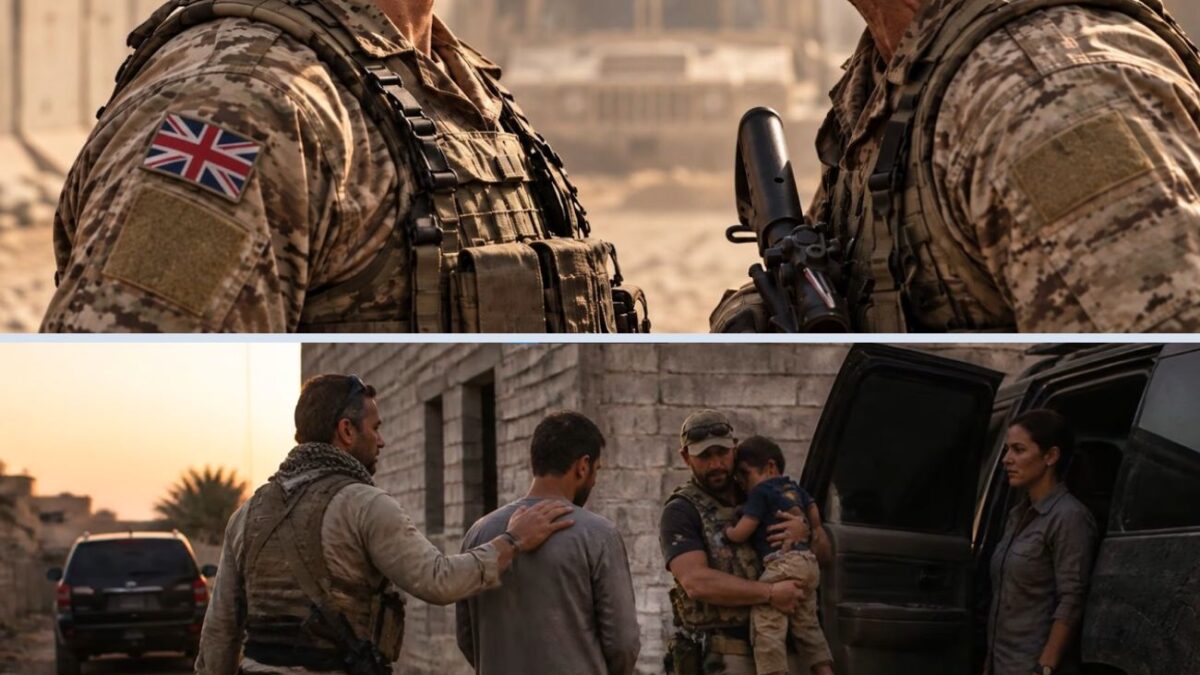
The gate opens from the inside. You are standing on the roof of a half-finished house three streets east, a spotting scope resting on a sandbag, and the man beside the scope has not moved for 2 hours and will not move until this is over. Below you, 400 m across a flat of broken concrete and goat tracks, an iron gate in a breeze block wall swings outward on a hinge that squeaks, and a British staff sergeant you have known for 11 days walks through it with his carbines slung across his back and his hands empty at his sides. Beside him walks a man in a gray dishish dash whom three different intelligence agencies have been trying to put a drone on for the better part of a year. They are walking. They are, you realize, with a kind of stalled disbelief, in no particular hurry. Behind them, two more figures come out through the gate at the same unhurried pace. One with a sleeping child in his arms, and the other with his left hand on the elbow of a heavily pregnant woman, guiding her over the lip of the threshold, the way a nephew might guide an aunt down a church step. No one is shouting. No weapon is up. The dog that has been chained to a stake inside the courtyard for three nights that you know of does not bark. Somewhere in the next street, a muezzin begins the dusk call, slow and ready and unbothered, and the whole scene below you drifts in that sound as if it were ordinary. Your hand is on your own rifle. Your finger is not on the trigger because there is no trigger press to make. There never was. You have been in this trade for 22 years, and you have walked into rooms behind flashbangs and over doors blown off their hinges, and you have never in all of that seen four men take a target out of a hostile house, as if they were leading him to a taxi. Later you will try to write about this, and you will not know where to start.
Elias Raymond Marquetti was 43 years old the summer he met the regiment, and he had earned every gray hair in his beard the slow way. He had enlisted out of a cinder block house in Scranton 2 months after his 19th birthday. Done his time in the 75th Ranger Regiment, passed the operator training course for First Special Forces Operational Detachment Delta in the autumn of 2007, and come out of it in the top third of a class that had started with men who on paper should have beaten him and did not. He had three rotations into Iraq behind him by the time he hit 30, two tours in eastern Afghanistan, a long slow year in a country he was not allowed to name, and a reputation among the squadron sergeants major as a man who did not raise his voice and did not need to. He had been shot once in the vest in Mosul and had finished the stack. He had taught at the course for 2 years and then asked politely and persistently to go back to a troop and they had let him.
The thing you need to understand about Marquetti is that he was not a man who assumed. He was a man who tested. In the breast pocket of every uniform he had ever owned, there lived a small green rite in the rain notebook. And after every exercise he had done since his ranger tab he had opened that notebook and written in cramped, slanting left-handed print what he had seen, what he had done wrong, and what the better version of the drill would look like next time. He had 78 of those notebooks in a plastic foot locker at his house outside Fayetteville. His wife, Linda, who was a pediatric nurse and understood meticulous people, had stopped teasing him about it 10 years before. The notebooks were the man.
He had worked with every tier 1 unit the Western Alliance fielded. He had cross-trained with GIGN in a disused freight terminal south of Paris and with GSG9 in a reunification era compound outside Hangla and with the poles of Grom in a wet Baltic winter that had taught him two useful words of Polish and no others. He had jumped with the Australians and shot with the Canadians and shared a dust-filled vehicle bay in Jordan with the Jordanians who had impressed him with their driving. He admired all of them. He also quietly believed that the method he and his squadron had refined over 15 years of hard contact in two theaters was the most completely developed close quarter method on earth. And he believed this because the evidence of his notebooks read end to end said so. He was not a bragging man. He was something more dangerous than a braggart. He was a confident man with receipts.
The one belief that would be taken away from him that summer, the single assumption the story is going to lift gently out of his hands and set down somewhere else, was this, that the hard problem of entering a defended house around innocent people had been solved as well as it was ever going to be solved, and that it had been solved mostly by his own tribe. He was not loud about it. He would not have put it that way out loud. But he thought it and he had thought it for a long time and he had the notebooks to defend it. So when the attachment came through, 3 weeks with 22 Special Air Service culminating in a joint operation in theater, he said yes and he did not expect to learn very much.
The attachment had come down through a liaison officer at the embassy in London, framed as the kind of professional exchange that both communities liked to pretend was normal and that both communities also knew was always a little bit of an audition. Delta was sending Marquetti and a staff sergeant named Tomas Ruiz for 3 weeks. Ruiz was 10 years younger, built like a middleweight, and chewed cinnamon gum constantly because he had quit dip two deployments ago, and still, as he put it, had the mouth of a man who was waiting for something. Ruiz respected Marquetti the way a younger operator respects a man whose notebook he has read over coffee more than once. He did not share all of Marquetti’s confidence. He had never worked with the regiment either. But he had an uncle in the Royal Marines and a quiet suspicion that the island his uncle came from grew men who did not advertise.
They flew into Brize Norton on a gray Monday and were driven west across England in the back of a Land Rover driven by a corporal who answered questions in units of three words. The country flattened out. The hedge rows thickened. By mid-afternoon they were at the gate of Stirling Lines at Credenhill in Hereford, which Marquetti noted was in England, not Wales, however many films had told him otherwise. The camp was quieter than he had expected. Low buildings, a lot of green, a guard room that was not interested in making a fuss of him, and did not. He signed his name in a book, had his photograph taken, was issued a lanyard, and was walked through a side gate into a part of the camp where no one looked up as he passed.
That evening, in the mess over an indifferent lasagna and a very good cup of tea, he met the man who would be running the groundside of his attachment, Squadron Sergeant Major David Prothero, known to the camp as Taff, a dark-haired Welshman from Merthyr Tydfil, with a voice so low that Marquetti found himself leaning in to catch the end of every sentence. Prothero asked him about his flight, about his family, about whether he preferred coffee or tea in the mornings, and did not once mention the regiment. He wished him good night. He walked out. Ruiz, who had watched all of this, waited until the door closed and said,
“He asked you three questions and told you nothing.”
“He did,” said Marquetti. “That’s the trade.”
The dismissal came the next morning and it came as these things do not as a boast but as a professional opinion delivered to a peer. There was an American colonel passing through on his own business, a man Marquetti had worked for briefly in 2014, and the colonel asked him over the breakfast counter what he thought of the Brits so far. Marquetti, who had been there 18 hours, said what he had thought for most of the preceding decade.
“Sir,” he said, pouring himself a second cup. “I’ve worked with every tier one unit the West has. The Brits are good lads. They are not magic.”
The colonel laughed. Marquetti did not laugh with him because he had not been joking. He meant it in the particular, careful, measured way he meant everything. He meant that the men here were professionals, and that he looked forward to the three weeks, and that he did not expect to come out of them with his map of the world redrawn. He said it, and he went back to his eggs, and across the counter from him a cook he had not noticed, a woman in a hairnet with a Herefordshire accent, poured him more tea without being asked, and said,
“Right you are, love.”
And he did not understand yet that the whole regiment ran on exactly the kind of attention he had just failed to pay her.
The first brief was at 9 the next morning in a room with no windows and a kettle. There were seven men already in the room when Marquetti and Ruiz came in and none of them stood up and none of them introduced themselves. And this was not rudeness, because within 5 minutes it was clear that they already knew who the two Americans were and had read their files more carefully than the two Americans had read theirs. The man running the brief was Staff Sergeant Oliver Keen of Mountain Troop, a wiry Yorkshireman with a short beard and a left hand that was missing the top joint of its ring finger. He spoke for 22 minutes about an exercise he was going to run that afternoon on a range east of camp. And in those 22 minutes, he used the word we 11 times, the word I twice, and no superlatives at all. Marquetti wrote none of this in the notebook, but he noticed all of it.
The range was not in itself remarkable. It was flat, scrubby ground with a line of steel plates at 50 m and a line of paper figures beyond those at 100. The task Keen had set was a transition drill, carbine to pistol, with a timed element. Ruiz went first because Marquetti told him to. And Ruiz, who shot a very fast transition at Bragg, shot a very fast transition on the English grass as well. And when he came off the line, he looked across at Marquetti with a small shrug of a man who had done the thing the way it was supposed to be done. Then Keen shot it. Keen shot it slower than Ruiz, Marquetti would write that night, perhaps 2/10 of a second slower on the pistol draw, and perhaps a tenth and a half slower in his transition. And in that same run, he put every round into the center circle of every target in a group you could cover with the palm of a hand, and he did it with the half finger that should, by any sensible accounting, have made his pistol grip imperfect. He shot it the way a man cuts a loaf of bread when he has cut a loaf of bread every day of his life. He did not holster the pistol with a flourish. He did not look at the targets afterwards. He turned and said to Marquetti,
“If you’d like a go, Sergeant Major, there’s a lane open.”
And he said it the way a man offers a seat on a train. Marquetti took the lane. He shot the drill clean. He shot it by his own measure half a second faster than Keen. He walked back and he knew with a particular quiet precision that was the whole point of him that he had not shot it better. Prothero, who had been standing at the back of the range the whole time with his hands in his pockets, did not say anything about any of this. He said as they walked back to the vehicles,
“There’s a brew on if you want one.”
And Marquetti wanted one, and they drank it in a porter cabin with a leaking seal and a laminated calendar from 2019, and no one offered an assessment of the day’s shooting because none was called for.
That night, in his quarters, Marquetti opened the green notebook on the small desk under the window and looked at it for a long time without writing. He did not know yet how to describe what he had seen. He eventually wrote in his cramped left-hand print four lines. He wrote, “Keen transition drill. Half a second slower than Ruiz. Groups half the size. No commentary before, during, after.” He wrote, “The man did not have to tell me he was good.” He wrote, “Query, what does it cost him to be that quiet?” He wrote in the bottom corner in letters smaller than the others, “Query, what does it cost me not to be?” He closed the notebook. He turned off the lamp. He lay on his back in the dark on a British army mattress and thought about the half finger and the group size and the woman in the hairnet with the Herefordshire accent. And he thought that he had been in this country for 46 hours and had already written one line in his notebook that he was not sure in all his 78 notebooks he had ever written before. He slept well. He always did, but he dreamed, which he rarely did, and the dream was about his wife’s hands pouring tea.
They drove west on the Thursday over the English border into Wales, and Marquetti watched the land change through the window with the attention of a man who had never seen it before. The fields went from flat to folded, the sky lowered. By the time they pulled off the A470 at the layby below Pen y Fan, the cloud was down on the top of the mountain and a thin horizontal rain had started that had no interest in stopping. The exercise, as Keen had described it that morning, was simple, a loaded Bergen, a map, four grid references across a line of hills that would take them over the top of the fan and down the far side to a pickup point beyond Talybont. A time to beat that was not the published time and that Keen had not stated out loud. Keen would be with them, moving at his own pace, and so would Sergeant Rodri Vaughan, a mobility troop sergeant Marquetti had met briefly at breakfast, a man built like a good flatcoated retriever, and who Marquetti would learn before the day was out, had been a working farrier in Carmarthenshire before he had been a soldier. Vaughan rolled cigarettes one-handed on the drive. Marquetti watched him do it and could not work out when the tongue got involved.
The Bergens were heavy. Marquetti weighed his on the camp scales before they left. 22 kg without water, more with. He had done heavier. He had done much heavier on the operator training course on selection iterations he had sat in on as an observer. He was not, he said to himself without triumph as he settled the straps on his shoulders at the layby, worried about the weight. He was not wrong about that, and he was wrong about everything else. The first hour was uphill through tusk and sheep-cropped grass, and Marquetti, who still ran 5 miles four mornings a week, moved well up it. Ruiz, younger and stronger in the legs, moved slightly ahead. Keen and Vaughan moved at a pace that was not quite the American’s pace, and that Marquetti realized about halfway up the first slope was also not slower. It was simply different. Keen walked with a very slight forward lean, and did not vary his step. Vaughan placed his boots as though the ground were ice, and the ground was not ice. Neither of them spoke. Neither of them drank water on a schedule Marquetti could identify. When Vaughan drank, it was a quick measured sip. When Keen drank, it was less often than that.
Marquetti was fit. He knew his heart rate from the feel of his chest, and he knew what his heart rate meant. He was working at perhaps 70%. Keen, as far as he could tell, was working at 50, Vaughan at 40. On the second climb, the rain thickened and the cloud came down to the ground. They walked into it. There is a particular quality to Brecon’s weather that visitors do not expect. The way the ridge disappears, the way the compass bearing stops being a theoretical thing and becomes the only thing. The way wet bracken grabs at a boot and takes a measurable amount of energy to lift out of. Marquetti, who had navigated in mountains that were taller and colder and rockier than these, found himself concentrating on the map in a way he had not concentrated for a long time. The beacons do not look difficult. They are difficult in the way a quiet man can be difficult. They give you nothing. Keen did not look at his map. Marquetti noticed this on the top of the first high ground and watched for it afterwards and did not see Keen consult the map for the rest of the day. Vaughan looked at his map once, briefly at a saddle, and said something to Keen in Welsh that Keen answered with a single syllable, and they changed direction by perhaps 5 degrees, and were, by Marquetti’s reckoning, 20 minutes later, exactly where they should have been, at the top of Pen y Fan, a flat cairn-marked summit that Marquetti, with his American habit of large mountains, had expected to feel like a smaller thing than it was. The wind came in sideways and took Ruiz’s cap off. Vaughan caught it one-handed without appearing to look. They did not stop at the top. They walked over it. Marquetti, who had been halfway through unslinging his Bergen for a water sip, slung it back on and walked over it with them. They were down the far side before his legs understood that there had not been a rest.
The pickup was below Talybont at a forestry gate that smelled of pine resin and wet rust. Marquetti came in 6 minutes behind Keen and Vaughan. Ruiz came in 2 minutes behind Marquetti. Neither Keen nor Vaughan commented. There was a flask of tea in the back of the Land Rover and a packet of custard creams and a corporal who said,
“All right, boys.”
In a tone that applied to nobody in particular. In the Land Rover going back east over the border, Marquetti sat with the green notebook open on his thigh and did not write in it for a long time. The light faded. The hills unfolded themselves backwards past the window. Vaughan, in the front passenger seat, rolled another cigarette one-handed and did not light it because he never smoked in a vehicle he had not been invited to smoke in. Finally, Marquetti wrote one line. He wrote, “Fitness is not the test.” He underlined it once and sat with the notebook open and the pen in his hand, and after a while he wrote one more line below it. He wrote, “Attention is the test.” He did not yet know what he meant by it. He knew that Keen had not needed the map because Keen had already memorized the ground. And he knew that Vaughan had looked at the saddle because the saddle was the one place the ground could lie, and he knew that neither of them had told him any of this because neither of them was in the habit of telling anyone anything about themselves. He closed the notebook. Outside the window, somewhere east of Hay-on-Wye, it stopped raining.
He rationalized because men of his seniority rationalize and he was honest enough to know he was doing it. Fitness, he told himself over breakfast on the Friday, was never going to be where the regiment surprised him. Selection was a navigation and endurance filter. Of course, the men who had passed it moved like that on their own ground. Shooting on a range, a range he did not know, at a drill he had not written, was a weak sample of the thing he actually did for a living. The thing he actually did for a living was go into a room where a man wanted him dead in the dark in two to four seconds and get everyone out alive except the man who wanted him dead. He had done that 41 times by his own count operationally, and he had done it a great many more times than that in practice, and he had done it well enough that the army had made him teach it to the people who were going to do it next. He said as much carefully to Ruiz over eggs. Ruiz chewed his cinnamon gum and listened and did not disagree out loud, which was its own kind of disagreement.
“Let’s see them shoot in a room,” said Marquetti.
That afternoon, Keen came and found him on the smoking step outside the squadron building and sat down beside him with a mug of tea. Marquetti had never seen Keen smoke, and Keen did not smoke now. He had simply chosen the step. On the bench inside the open hangar beyond them, three of the squadron’s L119 carbines lay on a strip of hessian in a row with the day’s cleaning kit beside them. One of them wore an optic Marquetti recognized. The other two wore older models that his own squadron had replaced the summer before last. He glanced at them. He did not say anything. The thought arrived and he let it go because it was not interesting and it was not the thing he was looking at. Keen held the mug in his half-finger hand. He saw Marquetti’s eye find the half finger and he smiled, the way a man smiles when he is told a story so many times he is a little bored of it but still fond of it.
“Belfast,” he said. “Not what you’d think. Car door 1992. I was reaching back for a bag of chips I’d left on the seat.”
He laughed once, a dry noise.
“There’s a lesson in there about chips.”
Marquetti laughed, too politely. It was the first time he had laughed in Keen’s company. It felt like a small, deliberate gift. He understood, drinking his tea on the step, that Keen had come out and sat down with him on purpose, and that the purpose was not to make him feel better. The purpose was to show him that none of the men here were going to carry the professional contempt he had half expected to meet because none of them were competing with him. He had come here to be assessed by them. They had absorbed that fact and were simply getting on with the day.
“House is tomorrow,” said Keen. “9:00. Bring Ruiz.”
The killing house at Credenhill was a long matte black building that looked from the outside like a warehouse and smelled when you stepped through its doors of old propellant and plywood dust and the faint specific chemical sweetness of simunition. Inside it was not one house. It was many houses at once. The walls were hinged. The layouts were rebuilt between runs with the speed of a stage crew. Catwalks ran above the ceilings, and from them the instructors watched everything that the men below could not see. On the Saturday morning, Marquetti and Ruiz stood in the ready room in the day’s loaned kit and listened to Prothero brief in the voice men still lean in for. The scenario was deliberate: one target in a two-story layout, three non-combatants, a woman, a child, a third figure of uncertain status. The entry team was four, and Marquetti and Ruiz would run as the first pair with two blades as the second, Keen and a mobility troop corporal named Allsopp, whom Marquetti had not spoken to yet, and whose face he already trusted, which was itself a thing worth examining. There would be live simunition rounds in use. There would be no instructor voice during the run. There would be a review afterwards on video which Prothero told them in the same voice he had told them where the kettle was.
They ran it. Marquetti led into the house because that was the arrangement and the arrangement was deliberate: see the Americans, Prothero had said with no emphasis at all, in their own method first. Marquetti took the front door with Ruiz on his hip, broke it in with a tool, and went in on the standard Delta flow, fast, aggressive, verbal. Each room taken with the brisk efficiency that 15 years of close quarter work in Iraqi houses had refined. He cleared the ground floor in under 30 seconds. He went up the stairs with Ruiz, cleared the first floor landing, and took the final room with a flashbang and a two-man entry. The target went down. The woman in the final room screamed and was in the beaten zone of Ruiz’s muzzle for half a second longer than Marquetti would have liked. The child, who was behind the woman on the floor, was not hurt. The third figure, who had turned out to be unarmed, had put his hands up in time. By any standard that Marquetti had operated under for 22 years, it was a clean run. The time was good. The target was down. Nobody who should have lived had died. They came out. Keen and Allsopp, who had not entered yet, nodded at them. Prothero stood by the door with his hands in his pockets.
“Right,” said Prothero. “Our turn, if that’s all right.”
They ran it with the same scenario and the same furniture. Marquetti stood on the catwalk with the headset on. He watched Keen take the front door, and he watched Keen not break it in with a tool. He watched Keen try the handle first. The handle turned. This was not a scripted gift. The house had been reset and locks had been reset at random and the handle had happened to turn and Keen had checked, which cost 2 seconds, and which the Delta team had not done because the Delta method correctly did not spend 2 seconds on something that was going to be forced open anyway. Keen opened the door. He went in slower than Marquetti had. He went in without speaking. His corporal did not speak. They flowed, Marquetti thought from the catwalk, less than they walked quickly. On the ground floor, they did not shout. They did not announce. In the kitchen, Keen paused for perhaps a full second in the doorway, which Marquetti knew from the catwalk was because the layout of the kitchen from the inside did not match what you would predict from the hall, and because Keen was waiting for his own eye to catch up with his own foot. On the first floor, the woman heard them before she saw them. Marquetti watched her lift her head on the camera feed, and he watched her not scream. Keen came into the final room and did not go for the target first. He went for the woman and the child with his carbine not pointed at them, and he spoke to the woman in a flat, calm voice without raising it. And the words were not English and were, Marquetti realized, Arabic, functional, bad, deliberate Arabic, the kind of Arabic a man had learned on purpose for exactly this purpose. The woman stopped where she was. The child did not move. Keen’s corporal took the target who had turned to the door with a pistol half raised with two rounds at a distance of 3 m and did not fire a third. The third figure put his hands up and was not shot. The run time was 11 seconds longer than Marquetti’s. The casualty count was identical: one target, zero friendlies. The texture, Marquetti would write that night and later cross out and rewrite, was not identical. It was not identical in a way that he did not, standing on the catwalk with the headset still in his hand after the run had ended, know how to describe.
Downstairs in the ready room, Prothero rewound the footage on a laptop and he did not say anything about Marquetti’s run and he did not say anything about Keen. He said,
“Any questions, lads?”
And Ruiz, blessing him, chewing cinnamon gum in the back row, said,
“Sergeant Major Pro, why Arabic?”
And Prothero looked at Keen, and Keen said in the same tone he had used about the car door,
“Because if she doesn’t scream, I don’t have to explain her son to anyone.”
Marquetti sat in the ready room on a plastic chair and understood very suddenly and very completely that the problem he thought had been solved had not been solved. It had been solved in his own tribe in one way, the fast way, the correct way under contact, the way that in a great many of his 41 entries had been exactly the right way. And it had been solved in this tribe in another way, a slower way by 11 seconds, a way that took the 2 seconds to try the handle, and the 1 second to let the eye catch up with the foot and the Arabic word before the muzzle. And that way was not better than his, and was not worse than his, and was horribly differently correct.
He did not write anything in the notebook that night. He lay on the narrow bed in the quarters they had given him, and he did not sleep. The curtain in the window was too thin, and the yard light from the car park laid a pale stripe across the ceiling, and he looked at the stripe for a long time. Somewhere beyond the wall, a tap dripped on a schedule of about 4 seconds. He counted the drips for a while because counting was a thing he could do. He got to about 300 and stopped. The notebook was on the desk under the window. He could see the edge of it in the yard light. He had not opened it. He had been writing in those notebooks for 22 years, and he had never in his memory gone to bed after an exercise without writing in one. And he was not writing in one now, and the fact that he was not writing in one now was the clearest signal his own body had sent him in a decade. His body was saying, “You do not know what to write.”
He went over the run again in his head. He went over his own run step by step, and he could not find the mistake. There was no mistake. He had done it correctly. He had done it the way the course taught it and the way he had taught the course for 2 years and the way men he had trained had done it in actual rooms where actual people had actually been trying to kill them. And those men had come home. The method worked. He knew it worked. He had the receipts. And then he went over Keen’s run, and he could not find a mistake in that one either. And the two runs sat in his head side by side like two translations of the same sentence into two different languages. Both of them true, neither of them wrong, and he understood with a cold clarity that was almost physical that he had believed without ever saying it out loud that there was only one language.
He thought about the woman in Keen’s run. He thought about the way she had lifted her head. He thought about the Arabic. Then he thought about Mosul in 2011, a specific house on a specific street whose name he still remembered and a specific woman in a back room with a specific child. And he thought about the way that woman had screamed when he had come through the door. And he thought about how long after they had cleared the house she had kept screaming, and he thought about the specific pitch of it that he had, if he was honest, carried in some back room of his own head for 13 years. He had never written about that woman in the notebook. He had written about the target. He had written about the clearance. He had written about the stack and the breach and the time and the three rounds fired by his number two that had put the target down. He had not written about the woman in the back room because the woman in the back room had not been the exercise. He understood lying on the narrow bed with the yard light on the ceiling that she might have been the exercise all along.
He did not cry. He had never been a man who cried easily, and he was not going to start in a borrowed room in Herefordshire. He simply lay there, and the tap in the next room dripped, and after a while he got up and went to the sink, and ran a glass of cold water, and drank it. The water tasted of chalk, which was Herefordshire water, which was a thing he had already learned. He went back to the bed. He did not open the notebook. He did not open it the next morning, either. He went down to breakfast and he said good morning to Ruiz and Ruiz, who was good at reading faces, did not ask him anything. Prothero came by the mess at 8. He stood by their table with a mug in his hand and did not sit down.
“Right,” said Prothero. “Two weeks of this to go. Fancy a working trip?”
The working trip was a flight to a staging base in theater and the briefings before the flight and the conversation on the night before they went up on the C17 that Marquetti did not plan and did not expect. He had gone outside late to stand on the concrete apron at the back of the admin block and breathed the Herefordshire air. He had thought he was alone. He was not. Lieutenant Colonel Henry Ashworth-Price, the commanding officer of the regiment, a tall, thin man with gray at his temples, whom Marquetti had so far seen only in passing, and had assumed to be the sort of officer senior enough to be a shape rather than a person, was standing 20 ft along the apron, with his hands in his pockets, looking at nothing in particular. He had a book in one of those pockets. The shape of it was clear through the fabric. He noticed Marquetti and did not startle and did not perform friendliness and simply nodded.
“Sergeant Major,” he said.
“Sir.”
They stood for a minute in the cold without talking. It was the second time in a week Marquetti had been in a silence with an SAS man and had not felt the need to end it. The first time had been Keen on the smoking step. He noticed that pattern as it was happening. He did not know what to do with it. Ashworth-Price took the book out of his pocket, looked at it as if he was surprised to find it, and put it back. Marquetti caught the title. It was a paperback of Edward Thomas’s collected poems. He knew Edward Thomas because his wife had taught him two, the one about the train and the station and the blackbird, and the one that ended with the man standing in the dark on the edge of a wood.
“Not what you expected to find on a regimental CO,” said Ashworth-Price. He was not asking.
“No, sir.”
“He wrote a line,” said Ashworth-Price. “The past is the only dead thing that smells sweet. I’ve been thinking about it this week. Not sure why.”
He looked at Marquetti.
“You’ve had a hard few days, I think.”
Marquetti considered denying it. He did not deny it.
“Yes, sir.”
“The thing we do,” said Ashworth-Price, “is not better than the thing you do. It is older, nothing more than that. We had a bad few decades at it before you had the trade at all. We made the mistakes. We paid for them. Some of what came out of that is slower than yours.”
He paused.
“Some of it is slower on purpose.”
He did not elaborate. He nodded at Marquetti and walked back inside. Marquetti stood on the apron for another 10 minutes. He thought about the woman in the killing house and the woman in Mosul. He thought about the half second he could not account for on the pistol transition and the 11 seconds of Keen’s run that had cost nothing and bought a scream that did not happen. He thought about his notebooks in the plastic foot locker in Fayetteville and he thought that there was room in there if he wanted there to be for a 79th. He went back inside. He slept for the first time in three nights properly.
In the morning on the flight, he opened the notebook for the first time since the killing house and he wrote at the top of a fresh page four words. He wrote, “Slower on purpose. Why?” Underneath it, he wrote, “Working trip tomorrow night.” Underneath that, in his own cramped left hand, he wrote, “Keep the notebook closed on the ground. Watch.”
The town sits in a bend of the Euphrates on a flat plain that smells in late August of dust and diesel and the inside of goat sheds. The target is Yusef al-Rashidi, a facilitator two layers below a name you would have heard of, a man who moves money and people between three cities and who has, by the account of Captain Isa Whitcom of the Special Reconnaissance Regiment, a short sand-haired woman who reads Arabic better than she speaks it and apologizes for both, been living in the back room of his own house for 11 days with his pregnant wife Hannah and his 9-year-old son Omar and a chained dog and three mobile phones that he swaps between in a rotation she has mapped. Hannah is due in days. Omar sleeps with a plastic Spider-Man figure in his fist. The dog is fed scraps at the back wall every evening by al-Rashidi himself and is fed scraps at the back wall every evening by Keen for three nights running after that. Scraps thrown over the wall from the dark on a timing that matches al-Rashidi’s. That is the heart of it, Marquetti will understand later when he tries to explain it to his own people: the dog.
The approach is on foot across the ground in the hour before dusk. Keen, Vaughan, Allsopp the mobility corporal, and Prothero behind them in overwatch. Carbines slung, hands empty, local dress over the kit. Whitcom on the radio from a flat roof three streets east with Marquetti beside her and Ruiz two streets north with the second overwatch team. The muezzin is coming up on the dusk call. The streets are in that particular lull that Iraqi provincial towns go into for 12 minutes before full dark. When the heat lifts and the shutters are not yet closed and the dogs have not yet started the night arguments, they will carry on until 2:00 in the morning. The gate is not forced. Keen walks up to it, lifts the latch. The latch is lifted every evening at this time by the man of the house who goes out to buy bread and walks in. The dog who has been fed by Keen for three nights does not bark. The dog stands up and looks at Keen and sits down again. This is the kind of detail that no training film shows because no training film has thought of it.
Al-Rashidi is in the courtyard. He is holding a cup of tea. Keen says one word to him in Arabic, which is his name. Al-Rashidi sets the tea down on the low table beside him and does not reach for anything else. There is a pistol in a cloth bag 2 m to his left on the ground. And Whitcom’s analysis has said he will not reach for it in front of his wife and his son. And he does not reach for it in front of his wife and his son. He says in English,
“You’ve been feeding my dog.”
Keen says,
“He’s a good dog.”
That is the whole conversation. Vaughan goes into the back room where Hannah is awake and sitting up. Vaughan, who has delivered two of his own children in a Carmarthenshire kitchen with his farrier’s hands, speaks to her in the Arabic that Whitcom has drilled into him for a week, which is not good Arabic, but which is the Arabic he has. Hannah does not scream. Omar wakes up with the plastic Spider-Man figure in his fist and looks at Allsopp, and Allsopp, who has a daughter the same age, smiles at him with a specific kind of smile that children recognize and adults can rarely fake, and Omar does not scream either. The farrier’s hands go under her elbow. Allsopp picks Omar up and settles him on his hip. They walk out through the courtyard behind Keen and al-Rashidi.
Marquetti watches them come through the gate. He watches Keen walk 400 m across broken concrete with al-Rashidi beside him. And he watches Vaughan walking slightly behind with Hannah on his arm and he watches Allsopp with Omar asleep on his shoulder, asleep because the boy had not been woken into fear, and he watches them not run. They do not run because running would tell the street that something is wrong and the street does not know yet that anything is wrong and will not know for another 40 minutes. When the vehicles are long gone, the muezzin finishes the call. A woman two streets over calls a child in for his dinner. A car starts somewhere and does not come down this road. They walk out past a Humvee that has rolled up quietly to the end of the alley and they put al-Rashidi into one vehicle and Hannah and Omar into another. And the one with Hannah in it has a female medic in it whom Whitcom has put there for exactly this moment. And the one with al-Rashidi in it is Prothero’s vehicle. And Prothero says as al-Rashidi gets in,
“Mind your head, mate.”
In the same voice he had told them where the kettle was in Credenhill. The whole thing from the moment Keen lifts the latch to the moment the vehicles pull away takes 9 minutes. On the rooftop, Marquetti lowers the scope. Whitcom beside him is already breaking down the radio.
“Jesus Christ,” says Marquetti very quietly, which is not a thing he says often, and which he does not mean as blasphemy and does not mean as either of them separately.
Whitcom does not look up.
“He’s a good dog,” she says apparently.
And she coils the aerial lead the way a sailor coils a rope and the dusk comes down the rest of the way. And in the courtyard four streets west, the chained dog who is now unchained lies down beside the cold tea.
By his own account, Marquetti did not say anything at all on the drive back to the base. Ruiz, who was in the vehicle with him, said later that the sergeant major sat with his hands folded in his lap and his notebook unopened on his thigh and watched the dust come up in the headlights, and that twice Ruiz tried to start a sentence, and twice closed his mouth again, because there is a kind of quiet in a man that even his juniors know not to interrupt. They came in through the gate at the staging base an hour after dark. Marquetti got out of the vehicle, took off his kit, washed his face at a basin outside the ready room, and walked straight into the plywood office where his own commanding officer, a Delta lieutenant colonel named Doug Harland, whom he had served with for 6 years, was waiting for a debrief with a coffee that had gone cold.
What Marquetti said in that office is the verdict the whole story has been pointing at, and it is given here in his own words as he spoke them that night to his own commander, and as 9 years later, in an abridged form, he recounted them in a long filmed interview for a United States military oral history project. He speaks slowly in the interview. He is older. He has retired. He is sitting in a kitchen in North Carolina with his wife’s hand in his and he looks at the camera for a moment before he answers. And when he answers he says it the way a man says a thing he has thought about every week for the better part of a decade. He said that night and he said again slower in the kitchen:
“Sir, I don’t know what to tell you except what I saw. They went in unarmed. I don’t mean they left their weapons in the vehicles. They had their carbines on them and they had their pistols on them. And if the thing had gone sideways, they’d have been in a fight like anyone else. I mean, they went in with nothing in their hands. Not a muzzle, not a torch, not a tool. One of them lifted a latch. One of them said the man’s name. The man set down his tea. His wife didn’t scream. His boy didn’t wake up. His dog didn’t bark because they’d been feeding his dog for three nights. Three nights, sir. They fed his dog and then they walked him out of his own courtyard at the pace you’d walk a man to a taxi past three of my own overwatch positions. And the only reason I knew what I was looking at was that they’d told me what they were going to do and I hadn’t believed them until I saw it. I have done this job for 22 years. I have been in 41 rooms where a man wanted me dead. I have been very good at the fast way, sir, and the fast way is correct, and I will defend it in any room you want me to defend it in. But there is a slower way, and the slower way is not a worse way, and the slower way, if the ground will let you, buys you a child who does not wake up afraid. I did not know that was buyable. I thought the scream was the price. It is not always the price. I said last week that the Brits are good lads and that they are not magic. They are not magic. They are something harder to come by than magic. I’d like to sit down with your lot. Not a debrief, a conversation.”
He said it. Harland did not interrupt him. Harland, who was a serious man, wrote one line on the pad in front of him, which was, “Set up the meeting.”
The meeting happened 6 weeks later in a conference room at a base in North Carolina between four Delta senior non-commissioned officers and three men from the regiment including Prothero and Keen. The agenda was not written down. The subject was not written down by the account of two of the men who were there. They talked for a day and a half about dogs and latches and Arabic phrases, and about the 11 seconds in Herefordshire that had bought a woman’s silence, and about the particular pitch of a scream that a man can carry in his head for 13 years, and nobody at the table claimed anybody else’s method was better than anybody else’s, and nobody at the table pretended the two methods were the same. Marquetti sat at the end of the table on both days. He had the green notebook open in front of him. He wrote in it a great deal in his cramped left-handed print. And later that year, back in Fayetteville, his wife, Linda, who was a pediatric nurse and understood meticulous people, saw him put a 79th notebook into the plastic foot locker. She asked him what was in it. He said,
“By his account, the slow one.”
She did not ask him anything else about it. She understood that there are things a man brings home from his trade that are not debriefs, they are conversations.
Marquetti stayed in another four years after that attachment. And in those four years, he changed the way he taught the course in small specific ways that he did not advertise and that the course’s own leadership did not initially understand. He added a block on pattern of life that was 11 hours longer than the one he had taught before. He added, over some resistance, a language component that was shorter and more specific than the existing one. A dozen phrases in the languages of the places his students would actually work, drilled until they could be spoken without raising the voice. He added in the room clearance phase a half day that his instructors called among themselves the slow door. The students were taught the fast door first, as they had always been taught, and the fast door remained the correct door for a very great many of the problems they would face. The slow door was taught second as a question. The question was, “Can the ground let you?”
He retired in his 50th year. He lives, as he said in the interview, in a house in North Carolina with his wife Linda and a quiet elderly dog they adopted from a shelter the year he came back from the attachment. A dog whose name they changed to Yusef because Linda thought it suited him and because Marquetti, when she suggested it, did not say no. He is a private man. He does not give the interview often. In Herefordshire at the squadron building outside Credenhill, the quarters he was given are still there. Keen retired a warrant officer class 2 and runs a small hill walking business in the Yorkshire Dales. Prothero went on to be the regimental sergeant major and is, as far as anyone will tell you, still difficult to hear from more than 6 ft away. Vaughan went back to shoeing horses part-time in Carmarthenshire and smokes less than he used to. The CO with the paperback in his pocket retired and teaches part-time at a small school in Shropshire. And if you ask him why he still carries the Edward Thomas, he will tell you, as he told Marquetti on a cold apron at the back of an admin block, that the past is the only dead thing that smells sweet.
Al-Rashidi lived. His wife lived. His son is now in secondary school and does not sleep with the Spider-Man figure in his fist anymore. The dog lived too, which is a sentence you don’t often get to write about a facilitator’s dog in a provincial town in the Euphrates Valley. And on a rooftop in that town in the hour before full dark on a late summer evening, a man who had taught the course watched four men walk a target out of his own house at a stroll, and did not understand yet what he was looking at. He understands now. He has written 79 notebooks. The last one is the slow one. Restraint in his trade is a weapon. The hands that stay empty the longest can be the hands that end a thing cleanest. And a dog fed for three nights at a back wall by a stranger is a quieter breach than any charge ever blown.
You Might Also Enjoy

“We Thought They Would Negotiate”—What Argentine Soldiers Said When The British Attacked Goose Green

“You’ll Never Finish My Ruck March, Limey” — US Sergeant Who Challenged the SAS, Then Fell Out First






