“This Is My Base, Tourist” — The Base Sergeant Major Who Tried to Run the SAS
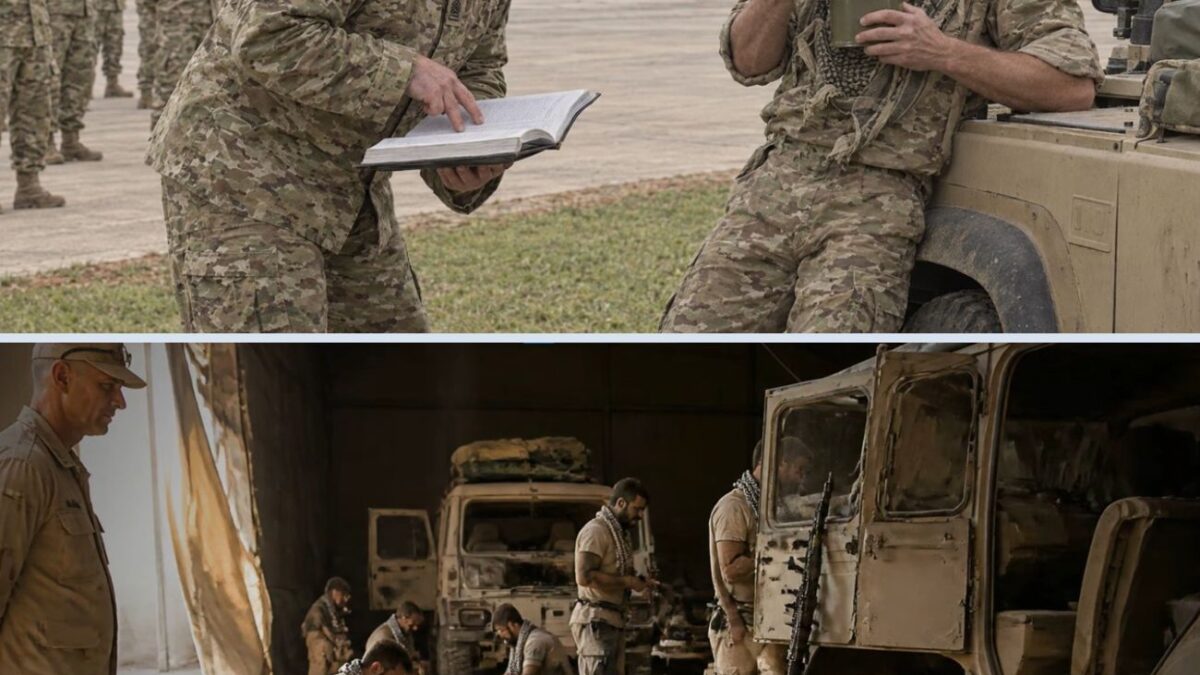
There is a sergeant major, 28 years in the United States Army, standing on a hard standing in western Iraq with a rulebook open in his hands. And the men he is about to call tourists are the men who, before the sun goes down, will walk a British hostage out of a compound 40 miles across the wire. He does not know that yet. He knows what he can see, and what he can see is a bearded man in a black and white keffiyeh leaning against the wheel arch of a dust-coloured Pinzgauer eating cold stew out of a mess tin with a spoon. He clears his throat. He adjusts the wire-framed reading glasses perched on the brim of his patrol cap. He reads from the open book as if from scripture, and then he closes it on his thumb and delivers flat and loud enough that the fuellers 30 metres away turn their heads the sentence this hour will be remembered by.
“This is my base. You are tourists in my base. You will shave, you will blouse your boots, you will stand to in the morning like soldiers, or you will get back on your airframe and go play commando somewhere else. You are not elite. You are a joke in flip-flops.”
The man with the mess tin does not stop chewing. He looks at the sergeant major the way a farmer looks at weather. Behind him, under the shade of the hangar, 11 other men in various states of unshaven, unbloused, and unstanding to continue doing what they were doing before the lecture started, which is checking magazines, taping torches to rifles, and writing short notes they will leave in their lockers in case. A United States Army captain with a green notebook is standing two paces behind the sergeant major. She is new. She writes the word tourists and underlines it twice because she can feel, without being able to name it, that she is going to want to remember the exact word later.
The sergeant major will remember saying it, too. He will be made to. Before the light goes out of this overcast afternoon, he will stand in his own operations centre with a printed log in his hand and a number on that log. And the men he has just called a joke will walk past the glass behind him one by one with a British civilian they have never met walking in the middle of them. And he will not be able to make his mouth do the shape of the word he said. That is the thing about a sentence spoken loud enough for the fuellers to hear. The fuellers hear it. So does everyone else. And a debt said out loud is a debt that gets paid out loud. He has 4 hours. He does not know he has 4 hours. He thinks he has a base and a rulebook and a problem in a cafe. He has, in fact, run out of time.
His name is Darrell Boyette, command sergeant major, United States Army, Garrison Camp Harker, which is the name we will give to a forward airbase sitting in the flat brown nothing of Al Anbar in the summer of 2006. He is 51 years old. He has been a soldier for 28 of those years. He went into the 75th Ranger Regiment as a private in the late ’70s and he came out of it eventually as one of its senior non-commissioned officers. And in between, he was in the 2nd Ranger Battalion’s blocking position on a street in Mogadishu in October of 1993. And he came home from that street with a Bronze Star with V device and a limp that lasted 8 months and a very specific understanding of what happens to soldiers who are casual on operations.
He is not a fool. That is the first thing to understand about him. He is a hard, competent, decorated non-commissioned officer who has buried more men than most officers will ever meet. And he has arrived at the back half of his career with a thesis. And the thesis is this, the standards are the standards because the standards are what keep young men alive. You shave because a gas mask does not seal on a beard. You blouse your boots because a loose trouser cuff catches on a ladder. You stand to in the morning because the morning is when they hit you. He has watched across three deployments to this country special operations transients arrive on his bases out of uniform, out of the mess hall queue, out of the morning routine, and he has watched the regulars who live on those bases year-round look at them and begin, slowly, to let their own standards slip.
He runs a tight camp. He is proud of his camp. Harker has a parade every Thursday and a sergeant major’s inspection every Friday. And no beards except on the Green Beret team that lives in the back compound and has a signed waiver from a two-star in Baghdad.
What he has this Tuesday afternoon is an unannounced British party. A C-130 came in at 11:00. 12 men got off. One of them, a major with calm blue eyes and a battered paperback poking out of the top pocket of his smock, walked to the operations centre, signed for a hangar, a hard standing, a fuel account, and a secure comms line, and declined to say what he was there to do. His squadron sergeant major, a soft-voiced Welshman called Price, walked straight past the cookhouse queue, drew a cold ration from his own Bergen, and ate it standing up next to a Pinzgauer because the queue, he said, bored him. A staff sergeant with a full beard and a keffiyeh over his smock was already asleep in the shade of the hangar by 13:00.
By 14:00, Boyette had been told by three different soldiers from three different units that there were beards on his flight line. He walked out to look. He took Sergeant First Class Pike with him, who is his military policeman, and Captain Haig with her green notebook, because Boyette does nothing in private that he could do in front of a witness. In the hangar’s open mouth, he saw a British trooper, 24 years old, cleaning the lens of a scope with the hem of his own shirt. He saw a corporal with a biscuit tin on his lap labelled in black marker Hobbs. He saw Hallam, the keffiyeh man, eating. And something in him, something that was Mogadishu and Thursday parades and 28 years, decided that this would not stand on his base.
He opened his copy of Army Regulation 670-1 at the page he had tabbed years ago. He read the paragraph on facial hair. He read the paragraph on headgear. He closed the book on his thumb, and he delivered in front of his captain, his military policeman, two of his own fuellers, and the entire detachment, the sentence we have already heard. He said the word joke. He said the words flip-flops. He said them loud.
What he did not see, because he was looking at Hallam, was the man in the operations centre doorway 30 metres behind him, Master Sergeant Luther Vanek, operations non-commissioned officer. He was a Delta man on a staff tour, and Vanek had, the moment the C-130 taxied in at 11:00, read the tail number, read the manifest, read the British major’s face, and known exactly what unit was on his flight line, and roughly what sort of afternoon the base was about to have.
Vanek watched Boyette deliver his sentence. He did not say anything. He looked for a long second at Captain Haig’s notebook. And then he turned around and went back inside and started quietly moving the shift roster so that the men he wanted on the desks at 18:00 hours would be the men on the desks at 18:00 hours. He was the only person on Harker at that moment who understood that the sergeant major had just started a clock.
The hangar at Harker is a tin shed the size of a village hall with a concrete floor that keeps the day’s heat in its surface the way a stone keeps a fire. By 15:00 in the afternoon, the detachment has turned it without anyone appearing to work hard into a self-contained operations space. There is a map on the long wall held up by four strips of black tape. There are three laptops on a trestle table, their screens angled away from the door. There is a plywood model of a compound on the floor built that morning out of ration box cardboard and dust and a tube of glue with little paper flags labelled window, generator, dog, stair. There is a kettle. The kettle has already been on four times. None of this is visible from where Boyette stood when he delivered his sentence. The hangar’s inner space is screened from the apron by a hanging tarpaulin pegged to the floor with four tent irons. The tarpaulin is a decision, not an accident. Everything on the regiment side of that tarpaulin is a decision.
Major Edwin Thornycroft is the man who signed for the hangar. He is 36, slim, prematurely grey at the temples with the sort of calm that reads as mild until you watch him make a decision. He commands the detachment and he keeps in the top pocket of his smock a battered Penguin paperback of the Meditations of Marcus Aurelius which he reads for 20 minutes before he sleeps because he has told exactly one person in his life it slows his pulse. He has been in the regiment for 7 years. Before that he was an infantry officer in a county regiment nobody on this base has heard of. He does not announce himself. He has, since arriving at 11:00, said 40 words to the base cadre and 3,000 to his own men.
The man he most often addresses is Squadron Sergeant Major Gareth Price, Warrant Officer Class 2, a Welshman voiced like a school teacher who has stopped shouting because shouting stopped working years ago. Price is 41, has done every tour the regiment has done since the first Gulf, and runs the troop the way a good foreman runs a yard, by walking around and looking at things. It is Price who built the plywood compound this morning. It is Price who taped the map to the wall. It is Price who, when the fuellers wandered past the hangar mouth, pulled the tarpaulin down an extra foot. He is also the man eating the cold stew. The cold stew is a habit. The queue in a base cookhouse, he will tell you if you push him, is where you find out which units have been standing still too long.
Staff Sergeant Ivor Hallam, known to the troop as Spud, is the keffiyeh man. He is the patrol commander. He is 32, has the beard because he has been working low profile out of a safe house in Baghdad for 5 months, and wears the keffiyeh because it keeps the dust out of his throat, and because by now it is simply what his face looks like. He cuts his own hair with a pair of trauma shears. He is the one Boyette shouted at. He is also, as of 14:00 hours this afternoon, the man who will lead the ground element onto the target.
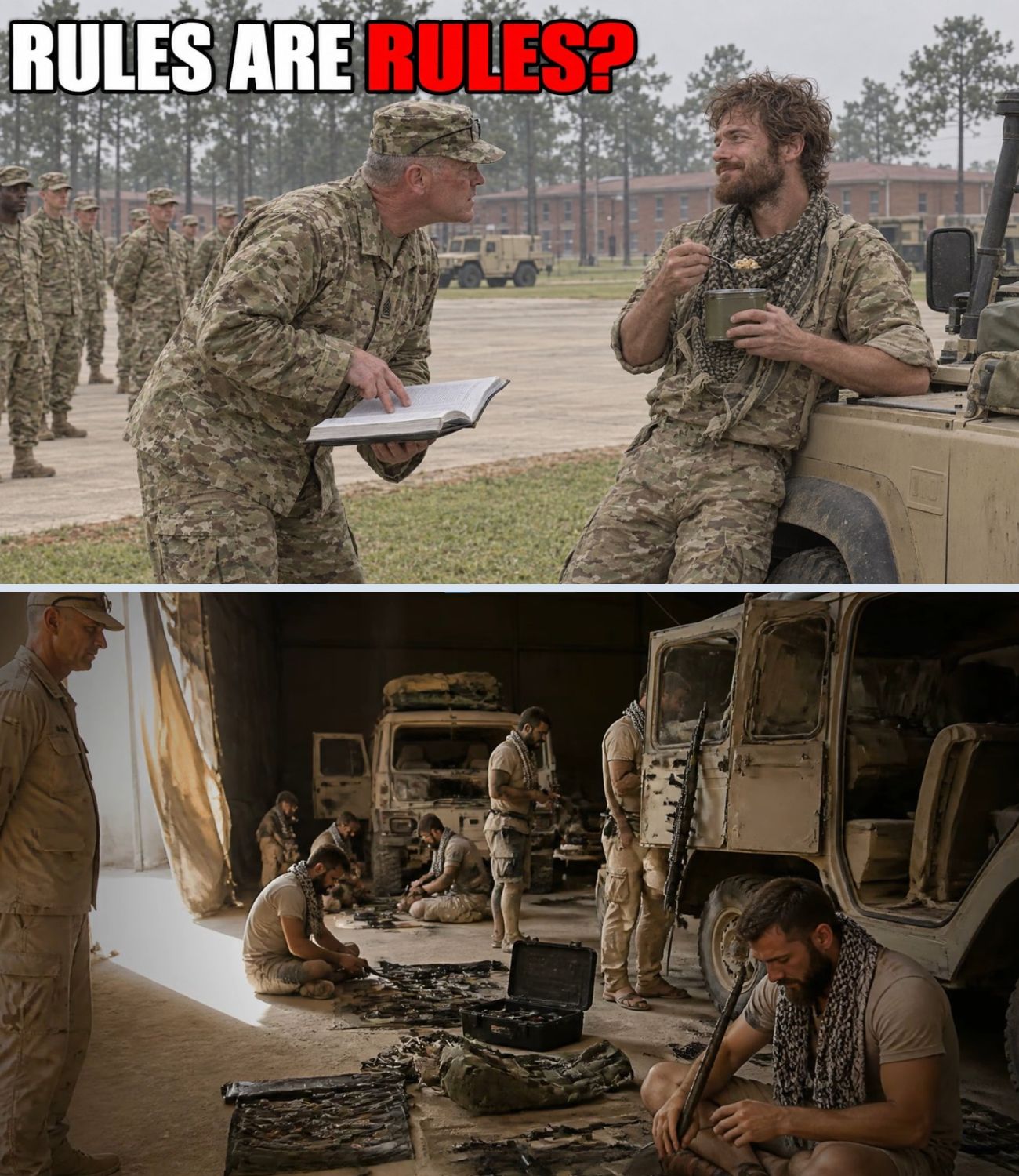
Trooper Michael Lindsay is the baby of the troop at 24. He left a philosophy degree at Durham half finished to try selection, passed on his first attempt in the Brecon Beacons, and has been in Air Troop for 18 months. He is one half of the sniper pair. He is the one cleaning the scope with his shirt. The other half, Corporal Henry Ogilvy, known as Bear because he is one, is sitting cross-legged with a biscuit tin on his lap and his tongue poking slightly out of the corner of his mouth as he weighs a shaped charge on a set of jeweller’s scales. The biscuit tin is labelled Hobnobs because the biscuit tin 4 months ago contained Hobnobs and Ogilvy is sentimental.
The task that has brought them to Harker was given to the squadron at 22:00 hours the previous evening in a plywood briefing room in Baghdad and it is this. A British water engineer called Alan Creswell, 57 from Teesside, employed by a contractor rebuilding the pumping stations west of Ramadi, was taken on the main road 11 days ago by six armed men in two pickups. He has been held since the 8th day in a walled compound at the edge of a village 42 kilometres west of Harker. The compound has been under drone cover for 3 days. The cell is seven men. The cell is expected to move him again before dawn tomorrow because they always do and once he moves, he will go to a basement in Fallujah and the drones will lose him and he will not come home. The window, in other words, is tonight.
The decision to go tonight was taken at 10:00 this morning by a man two ranks above Thornycroft in a room 600 miles away. The reason Thornycroft, Price, Hallam, Ogilvy, Lindsay and seven other men are on Harker and not somewhere else is that Harker is the forward airbase closest to the compound and that is the only reason. They are not here to join Boyette’s camp. They are not here to stand to. They are here to use his runway and his fuel and his comms and then they are here to go and get the water engineer. And if everything goes the way it should, they will be back on his hard standing before midnight with a sleeping man in a blanket.
Nobody on the base cadre has been told any of this. Not Colonel Jefferson Merrick, the base commander, who signed the hangar chit this morning and asked no questions because the chit told him not to. Not Captain Haig with her green notebook. And emphatically not Command Sergeant Major Boyette. The compartment is deliberate. The regiment moves in silence, not because it is secretive for its own sake, but because every man on the base cadre who knows what is going to happen is another man who between now and the time they move might mention it on an unencrypted line to a friend. The silence is a weapon. It is also, although Boyette does not know this yet, the specific weapon he has misread as laziness. He thinks they are not working because they are not where he can see them working. They have been working flat out since the aircraft taxied in. He simply does not have the eyes to see it.
Yusuf, the Iraqi interpreter who flew in with them, sits on an empty ammunition tin at the back of the hangar mouthing the Arabic for the words the cell will shout when the wall opens. Inside his helmet, taped to the lining, is a photograph of his two daughters. He touches it twice without looking. The way other men touch a cross.
At 15:34, Price lifts the tarpaulin a few inches and looks out across the apron to where Boyette and Pike and Captain Haig are now talking to a group of regular soldiers under the fuel bowser. He lets the tarpaulin fall. He goes back to the plywood model and moves the little paper flag labelled dog. The kettle goes on for a fifth time. Thornycroft, without looking up from his notebook, says quietly,
“3 hours and 40.”
Price says,
“Aye, sir.”
Nobody raises their voice. Nobody has all day.
The first blow is small and it is about shooting, which is the thing Boyette has been quietly deciding in the hours since he closed his rule book that these men probably cannot do very well. He has decided this because he has not seen them clean a weapon. He has not seen them on the base range. He has not seen them do, in short, any of the things he would do if he were preparing for an operation. What he has seen is Hallam asleep and Price eating.
Harker has a small arms range at the north perimeter dug into a berm which the garrison uses every Tuesday for the base cadre’s quarterly qualification shoot. It is Tuesday. At 16:00 hours exactly, a line of 20 regular soldiers from the base defence company is standing on the firing point under a staff sergeant waiting their turn to put 10 rounds into a figure 11 at 100 metres with their rifles.
Boyette is there. He is always there on qualification days. He stands at the back of the firing point with his hands behind his back and his eyes on the targets and when a soldier shoots badly, he says nothing and the soldier knows. Captain Haig is there, too, because Boyette told her to be. Pike is there with his camera and his clipboard. And, standing a little apart because the range master gave them a lane out of courtesy when they walked up 10 minutes ago in boots and plate carriers and nothing else, are three men from the detachment, Hallam, Lindsay, and a trooper called Doherty, whose name does not need to detain us. They are there because Price told them to zero the suppressors they fitted to their Diemaco rifles this morning and the base range is here and so they are here. They have asked for 10 minutes. The range master has given them 10.
Lindsay goes first. He fires five rounds slow from the prone at 100 metres with a suppressor on an L119 through a cold barrel with a sight he adjusted twice last week in Baghdad. The range staff sergeant walks down to look at the target because the base cadre’s targets are being walked and scored. And he might as well. He looks at Lindsay’s. He looks again. He pulls it off the frame and he brings it back up the range in his hand instead of calling the score down the field telephone, which is not how it is done. And he hands it without a word to the range master.
The range master is a United States Army sergeant first class with 15 years in. He looks at the target. He looks at Lindsay who is already repacking his magazines. And then he looks at Boyette because Boyette is his sergeant major. And this is Boyette’s base. He walks the target over to Boyette and holds it up. Five rounds, all five inside the inner ring at 100 metres from a cold barrel with a suppressor. The group measures side to side a little under 4 centimetres.
The range master does not say anything. He does not have to. The soldiers on the firing point who have been watching the whole business out of the corners of their eyes for the last 3 minutes say nothing either. But a few of them look at their own targets and the targets of the men around them and begin quietly to adjust what they thought they knew about the afternoon.
Hallam shoots next. Hallam shoots standing unsupported 10 rounds in 11 seconds at a figure 11 at 50 metres, which is a stupid distance for the sort of shooting Hallam actually does. And he puts all 10 rounds in a group in the centre of the chest that you could cover with the palm of your hand. He clears his weapon, slings it, and walks away. He does not look at Boyette. He has not, since the hangar, looked at Boyette once.
Doherty shoots a failure drill at 25 metres on a reactive steel plate twice at a cadence that sounds to Captain Haig, who is new, like one long rattling noise instead of six separate shots. The plates make the small sharp tick that steel makes when it is hit cleanly in the right place. The three of them turn in their lane card, thank the range master, and walk back towards their hangar in the dust, still in boots and plate carriers and nothing else.
Captain Haig writes in her green notebook,
“Suppressors on the long range from cold, 5 in 4 cm.”
She underlines cold. She looks up and finds that Vanek has appeared at her elbow, which he has a habit of doing. Vanek says quietly, so that Boyette cannot hear him,
“Ma’am, that’s a group most of our marksmanship instructors couldn’t do with a bench and a hot barrel.”
Haig writes that down, too. She does not underline it. She does not need to.
Boyette says nothing on the range. He has his hands behind his back and his eyes on the targets and he says nothing. He has, however, done a small thing that the people watching him notice, which is that he has taken his wire-framed reading glasses off the brim of his patrol cap and folded them and put them in his breast pocket. Pike, who has worked for Boyette for 2 years, knows what that means. It means Boyette is thinking.
What Boyette is thinking is that the shooting does not change anything. The shooting is a thing a man can do. A man can shoot well and still be a tourist on his base. A man can put five rounds in 4 centimetres and still have a beard and a keffiyeh and eat his dinner out of a mess tin standing up. He is going to walk back to the hangar in a few minutes and he is going to find the major, the calm one with the paperback, and he is going to tell the major that his men will be at the Thursday parade or they will not be on his base on Friday. And that will be that.
He does not know, as he thinks this, that the Thursday parade is not something he is going to be in charge of this week. He does not know that the thing that is coming will happen tonight, inside the 10 minutes a C-130’s load ramp takes to lower and raise, and that he will spend the parade, when it comes, standing at the back of his own operations centre looking at a piece of paper. He thinks the shooting was the test. He is a professional and he has let himself believe, because it comforts him, that he has just seen the test and that the test was not that impressive. And that was only the first time that afternoon he would be wrong.
The second blow is about speed and it happens on the fuel pad at 17:10 in front of enough of Boyette’s base cadre that he cannot later pretend it did not. The schoolgirls, he had called them. Not in those words exactly, but a joke in flip-flops is close enough. And a joke in flip-flops is what you say about men you have decided are not serious. The thing about serious men, as any sergeant major will tell you if you give him a minute, is that you can tell by watching them refuel. A unit that is slack on operations is slack on the pad. A unit that is tight is tight on the pad. The pad is where you look.
The detachment comes out onto the fuel pad at 17:10 in four vehicles. Two dust-coloured Pinzgauers, cut down and up-armed in the regiment’s own way, with mounts on the roll bars and jerrycans on the sides and comms antennas that are not the comms antennas the base has. A third vehicle is a stripped Land Rover with a general purpose machine gun on the back and a man called Paulie behind it. The fourth is a Hilux which is the Hilux it is because tonight it is going to be a Hilux and no other reason.
The base’s own fuellers, two young specialists called Reyes and Tompkin come out to meet them because that is their job and so does Pike with his clipboard and his camera because Boyette has sent him. Boyette is 30 metres away under the awning of the operations centre with Captain Haig and a coffee.
The 12 men of the detachment refuel four vehicles, check 12 rifles, cross-load four radios, redistribute ammunition between two of the Pinzgauers, hand a sealed envelope to the loadmaster of the C-100 that has rolled out onto the apron behind them with its engines turning. Run comms checks on three different nets including one that pings a satellite the base’s own operations centre does not have the keys for and get all four vehicles up the ramp of the aircraft and lash down in 11 minutes.
11 minutes is the figure Pike writes on his clipboard because Pike is a man who writes figures on clipboards and he writes it because he started the clock when the first vehicle rolled onto the pad and he stopped it when the last chain binder clicked on the aircraft’s deck. He writes it down. He underlines it. He then stands there holding his clipboard and does not know what to do with the number because the number is not the number he was expecting.
Reyes the fueller who is 22 years old and has refuelled a lot of vehicles says to Tompkin loud enough for Pike to hear it,
“I have never seen anyone do that in 11 minutes.”
Tompkin who has refuelled fewer vehicles but has eyes, says,
“I have never seen anyone do that in 20.”
Pike writes this down, too. He writes down who said it. He is a thorough man.
While the pad is clearing, Hallam walks over to Pike. He is still wearing the keffiyeh. His beard has not been touched. His sleeves are rolled. His boots are not bloused. And he eats as he walks a bar of Kendal Mint Cake with the wrapper still half on. He stops in front of Pike and he does something small and precise. He hands Pike a piece of paper.
The piece of paper is a signed-for list of the fuel they have drawn, the ammunition they have cross-loaded from the base armoury against a chit the base commander countersigned at 11:00 this morning, and the airframe hours they will be using on the aircraft the base has provided. It is correct to the gallon and to the round and to the minute. Hallam says,
“For the sergeant major’s records.”
He does not smile. He walks away.
Pike takes the piece of paper to Boyette. Boyette reads it. He reads it twice. He looks at the pad, which is now empty. He looks at his watch. He looks, finally, at Pike. He says,
“Where are they going?”
Pike says,
“Sergeant major, I don’t know.”
Boyette says,
“Who signed for the aircraft?”
Pike says,
“Colonel Merrick this morning.”
Boyette does not say anything to that. He folds the piece of paper in half and he puts it in his breast pocket next to his glasses. He walks back inside the operations centre with Captain Haig behind him. She writes in her green notebook,
“Fuel pad, 11 minutes, four vehicles, all comms up.”
She underlines 11. She has started underlining a lot of things in the last 2 hours.
Boyette, inside the operations centre, does the thing a man like Boyette does when his first explanation stops working. He builds a second one. The second explanation goes like this. They can shoot. Shooting is a trick. They can run a pad fast. Running a pad fast is a trick. Men who can do tricks are not necessarily men who can do the thing. The thing, the actual thing, the thing he has spent 28 years in uniform doing, is the serious part, the holding of a line, the standing to, the long grind of a professional army doing its job in a country that does not want it there. He has decided, standing at the duty desk at 17:22, that he has watched a circus act, and that circus acts are not what wars are won by.
He walks over to the duty desk, where Vanek is standing with his arms folded. He says to Vanek, without preamble,
“What are they doing, Luther?”
Vanek looks at him for a long second. Vanek is a man who has not told Boyette what unit the detachment is, because Vanek is a man who does not break compartments for a sergeant major who has not asked. Vanek says carefully,
“Sergeant major, they’re doing their job.”
Boyette says,
“On my base.”
Vanek says,
“Through your base.”
The verb is deliberate. Boyette hears it. He does not like it. He goes back to his desk, and he sits down in his chair, and he looks at the piece of paper from Hallam, and then he looks, for the first time in a long time, at the large flat screen monitor on the wall above the duty desk, which is at this moment showing in black and white and slightly juddery, a live feed from a drone orbiting over a walled compound 42 kilometres west of his gate. He has, until this moment, not asked what the feed is for.
The third blow is quieter than the other two, and it cuts deeper, and it happens because Boyette, having walked back into his operations centre at 17:22, convinced that he has watched a circus act, decides at 17:31 to go back out of it and find Thornycroft, the major, the calm one with the paperback, and tell him, man to man and sergeant major to officer, how his base is run.
He finds Thornycroft on the apron, standing next to the lowered ramp of the C-130, with Price beside him, both of them watching their men complete the last of the loading. The light has gone from yellow to grey. The engines of the aircraft are turning at the slow idle that aircrew use when they are 5 minutes from taxi. Boyette walks up to Thornycroft, and Captain Haig walks up behind Boyette, and Pike with his clipboard walks up behind Haig, and the three of them make a small deputation under the port wing of the Hercules. Boyette says,
“Major, a word.”
Thornycroft says, pleasantly,
“Of course, sergeant major.”
Boyette says, and he is at his best here. He is not shouting, he is being, in his own view, correct.
“On Thursday, this base holds a parade. On Friday, I inspect. My expectation is that your men, while they are on my base, will meet the standards of my base. Shaved, bloused, headgear correct, mess discipline. If they will not, they are not welcome on my base. I will take it up with the colonel in the morning.”
Thornycroft listens. He has his hands behind his back. He is holding in his left hand the paperback, folded open at the page he was on this morning, with his thumb between the pages. He waits until Boyette has finished, and then, and this is the thing that cuts, he does not disagree with Boyette. He agrees with Boyette. He says,
“Sergeant Major, you are right about your base. A base needs standards. You keep them. That is your job.”
Boyette, who was ready for an argument, is not ready for this. Thornycroft says,
“But my men, Sergeant Major, are not going to be at your parade on Thursday. They are not going to be here on Friday for your inspection. In about 4 minutes, they are going to be on that aircraft. And in about 90 minutes after that, they are going to be on a piece of ground that is not your ground. The standards on that piece of ground are not your standards. They are mine. On that piece of ground, Staff Sergeant Hallam’s beard is a reason the people we are going to meet will not fire at him in the first second. Sergeant Major Price’s mess tin is the reason he has eaten tonight because the queue in your cookhouse is 40 minutes long, and we do not have 40 minutes. The keffiyeh is the dust. The biscuit tin is Corporal Ogilvy’s affection for Corporal Ogilvy’s grandmother. None of it is directed at you. I am sorry if it looked like it was.”
He says all of this quietly with the engines of the aircraft turning 12 feet away, and the men around him loading the last of the kit, and Price standing beside him with his cold stew finished, and the empty mess tin hanging from one finger. He says it with no edge in his voice. He says it the way a man explains a thing he has explained before. He says, finally,
“And at some point tonight, Sergeant Major, a man called Alan Creswell, who is a water engineer from Teesside, is going to walk out of a room he has been in for 11 days. He is going to walk out of that room because my men have gone and got him. When he does, I would be grateful if your base’s medical section is ready for him because he will come back through here on the way home. That is the help I need from your base. The parade, I am afraid, is yours.”
Boyette does not say anything. He stands there under the port wing with his hands behind his back and he looks at Thornycroft. He looks at Price. He looks past them at his own men on the pad who have stopped working and who are watching. He looks at Captain Haig who has her green notebook open and is not writing in it because she has understood that this is not a moment for the notebook. He looks at Pike who is looking at the ground. He opens his mouth. He closes it.
It is not that he has lost the argument. It is that he has discovered, standing on his own apron in the grey light of an overcast afternoon, that there was not an argument. The man he has been shouting at all afternoon has been politely and patiently and without raising his voice letting him be wrong. The men he has been calling tourists have been, for the whole six and a half hours since the aircraft rolled in at 11:00, preparing to go and do a thing he was not told about and would not have been told about even if he had asked because he did not need to be told about it because his base is a runway and a fuel account and a hangar and nothing more.
He understands, in that half second under the wing, something that 28 years in the army has not previously required him to understand. It is that his base, the thing he is proud of, the thing he keeps shaved and bloused and parading, is in this moment a service station. He is a man who runs a service station. The men on the forecourt are not tourists in his service station. They are the drivers and they are about to leave.
Thornycroft, who is a decent man, closes the paperback and puts it in his pocket. He nods once, politely. He says,
“Sergeant Major, excuse me.”
He walks up the ramp. Price follows him. Hallam follows Price. One by one, the men Boyette called a joke walk up the ramp of the Hercules, past the Sergeant Major who called them a joke, and not one of them so much as glances at him. The ramp comes up, the engines spool, the aircraft taxis. At 17:51, it is airborne.
Boyette is still standing under where the wing was. Captain Haig, after a long moment, says,
“Sergeant Major, we should go inside.”
Boyette says nothing. He goes inside.
The operations centre at Harker is a plywood and breeze block room with four desks, three radios, two flat screen monitors on the wall, and a coffee urn that has been on since 05:00 in the morning. At 19:02 local, the room is quieter than usual. Boyette is at the back wall. He is standing. He has not sat down since he walked in from the apron. Captain Haig is at a desk with her notebook open and her pen uncapped. Pike is by the door. Colonel Merrick, the base commander, who was told at 18:00 hours what his base has been used for, and who said, when told, “Only right. Let’s keep the lane clear,” is at the duty desk with Vanek. Vanek is wearing a headset. Vanek is on the net.
On the left-hand monitor, which has been running black and white judder all afternoon, is a top-down thermal picture of a walled compound. The compound is a rectangle, perhaps 40 metres by 30, with an inner courtyard, a flat-roofed main building, two outbuildings, and a vehicle gate at the north end. There are seven heat sources inside the walls. Six of them are moving. One of them, in a windowless inner room on the ground floor of the main building, is not. The one that is not moving is Alan Cresswell.
At 19:04, Vanek lifts one finger. He says into the headset,
“Copy, stand by.”
He looks at Merrick. He says,
“Sir, call sign zero is 5 minutes out.”
Merrick says,
“Understood.”
Boyette, at the back wall, does not say anything. He has been reading the monitor for 20 minutes. He understands now because nobody has needed to tell him that the aircraft that left his apron at 17:51 dropped the four vehicles and 12 men somewhere beyond the ridgeline on the drone’s horizon. That the vehicles have been moving west for the last 40 minutes on a route Vanek has watched on a second screen. That at some point in the last 10 minutes the vehicles have stopped. And that whatever is about to happen on the picture on the wall is the thing he was not told about this morning. He has worked all of this out by watching Vanek’s shoulders.
At 19:07, there is a small movement at the south wall of the compound on the thermal picture. It is one man. He is at the base of the wall. On the right-hand monitor, which has come up in the last 2 minutes, there is a different view, grainier, narrower, looking across flat ground at a wall from about 200 metres out. On that view, there is a figure prone in a shallow fold of ground with a long object beside him. The figure is Lindsay. The long object is a rifle. He is the overwatch.
At 19:07 and 30 seconds, three things happen in the thermal picture in a sequence so fast the eye wants to call it one thing. The south wall opens. Not the gate, the wall. A section of it, perhaps a metre across, bursts outward in a bloom of white heat, which is Ogilvy’s charge from the biscuit tin doing what it was weighed on jeweller’s scales this morning to do. Four figures go through the gap. They do not stop.
Two of the six moving heat sources inside the compound turn towards the gap and begin to raise what are presumably weapons and both of them, in a space of time Vanek will later call less than a breath, cease to move. On the right-hand monitor, two faint flashes bloom and fade from Lindsay’s position, which is the sniper pair taking the roof sentry and the courtyard sentry at a shade over 200 metres with suppressors on cold barrels in the grey last light of a long afternoon.
Captain Haig at her desk has stopped writing. She has her pen in her hand. She is not moving it.
The four figures that went through the gap are now inside the compound. They flow. There is no other word and Captain Haig will try several in her notebook later and settle on this one. They flow around the base of the main building. Two go in through the south door. Two hold on the courtyard. There are small white blooms on the thermal picture now. Two, three, four and each bloom is a cell member and each bloom goes still.
The non-moving heat source in the inner room has not moved. It is Cresswell. He has been in that room in the dark listening to something he does not understand for perhaps 70 seconds. At 19:09 and 40 seconds, the door of the inner room opens on the thermal picture. One of the figures goes in. Nine seconds later, the figure comes out. There are now two heat sources in the doorway where there was one. The second one is slower than the first. It is being supported. It is walking.
At 19:11 and 41 seconds, Vanek lifts his hand off the desk and he says into the headset and also, because he cannot help himself, out loud.
“Jackpot. Jackpot. Jackpot.”
Merrick says quietly,
“Time.”
Vanek looks at the clock. He has been timing it. He has been timing it since the south wall bloomed. He says,
“From breach to jackpot, 4 minutes 11 seconds, sir. Hostage ambulatory. No friendly casualties reported. 4 minutes 11 seconds.”
The seven heat sources inside the compound are now one heat source, Cresswell, in a blanket in the courtyard, plus four heat sources around him, which are the men who have come to collect him. With the other six gone cold on the thermal picture at points that Pike, who is now looking at the monitor from the door, is counting under his breath.
“1… 2… 3… 4… 5… 6.”
He stops counting. Captain Haig writes in her green notebook with a hand that is steady because she has decided to make it steady.
“4:11. Hostage walking. Six enemy combatants neutralised. Zero friendly.”
Boyette at the back wall has not moved. He is looking at the monitor. His hands are not behind his back anymore. They are at his sides. His wire-framed reading glasses are still in his breast pocket next to the piece of paper Hallam gave him on the pad with the fuel and the rounds and the airframe hours on it. He understands at this moment several things in a row, and he understands them in the order a professional understands them.
He understands that the men he called tourists have, in 4 minutes and 11 seconds, done a thing that his own career has nothing in it to compare with. He understands that they did it from his runway, with his fuel, through his base. He understands that they will come back through his base in about 90 minutes with a British civilian who, when he was told at 11:00 this morning that 12 men had got off a Hercules on his apron, Boyette did not know existed, and he understands, last and worst, that at the moment the south wall of that compound bloomed outward on the thermal picture, he was standing in his own operations centre, and he was still, in some corner of his head, thinking about the Thursday parade.
Vanek, without looking at him, says,
“Sergeant Major.”
Boyette says,
“Yes.”
Vanek says,
“The medical section, the hostage will be on the ground at 20:45.”
Boyette says,
“On it.”
He goes out of the operations centre.
The C-130 is on the ground at 20:42, 3 minutes ahead of Vanek’s figure. The ramp comes down at 20:44. The fuel pad, which 5 hours ago took 11 minutes to turn around, is lit now by the sodium lamps of the apron, and by the headlights of the base ambulance, which has been reversed up to the mouth of the hangar on Boyette’s instruction. The base’s chief medical officer, a United States Army major called Lenz, is standing at the ramp with a stretcher team of four and a bag of warmed saline. Boyette is standing 6 feet behind Lenz. He is in his patrol cap. His hands are behind his back again. He has put the reading glasses back on the brim. Pike is standing with his camera. Boyette, without turning his head, says,
“Pike, put that away.”
Pike puts it away.
Captain Haig is beside Boyette on his left. She has her green notebook closed under her arm. Merrick is on his right. Vanek is a pace behind. The base commander has not said a word to Boyette since the operations centre. He is not angry. He is, in fact, going to say in the morning that Boyette ran the medical reception well, which Boyette will, but he is standing on Boyette’s right now because he is the base commander, and this is how it is done, and Boyette feels the weight of him there, the way a man feels the weight of a hand that has not yet been placed on his shoulder.
The first figure down the ramp is Thornycroft, who nods to Merrick and shakes his hand and says,
“Sir.”
He does not look at Boyette.
The second figure is Price, who nods to Merrick and does not shake anyone’s hand because his hands are full. In his left hand, he has his rifle. In his right hand, he has the empty mess tin, which he is carrying because his webbing is on the vehicle, and he has not had time to put it back. He does not look at Boyette, either. He walks past.
The third and fourth figures down the ramp are Hallam and Ogilvy, together with Cresswell between them in a shock blanket. Cresswell is walking. He is thin, and he is grey in the face, and he has a cut above his left eye that has been dressed on the aircraft with a field dressing, and his left arm is around Hallam’s shoulders, and his right around Ogilvy’s. He is 57 years old. He has been held for 11 days. He is crying quietly in the way men of his generation cry, which is without noise, and he keeps saying to Hallam, who is still wearing the keffiyeh,
“Thank you. Thank you. Thank you.”
Hallam, who is a professional, says,
“You’re all right, sir. Few more steps, sir. The doctor’s just here.”
They walk past Boyette. They walk past him close enough that the fabric of Hallam’s smock brushes the sleeve of Boyette’s uniform. Hallam does not look at Boyette. He is looking at Cresswell. He is looking at where Cresswell is going to put his foot next because Cresswell is not steady. He walks Cresswell to Lenz. He hands Cresswell to Lenz the way you hand something fragile to a man you have decided can be trusted with it. He says to Lenz,
“Water engineer, Teesside, 11 days, dehydrated, old concussion, nothing bleeding.”
Lenz says,
“Thank you, Staff.”
Hallam nods. He steps back. He walks past Boyette a second time to get back to the ramp. He does not look at Boyette on the second pass, either. He is not making a point. He is simply busy.
The rest of the troop comes down the ramp in ones and twos. Lindsay has his rifle slung muzzle down, and he is drinking from a water bottle. Ogilvy is carrying his biscuit tin, which is empty now except for the lid. Doherty is helping Paulie with a long box of unused linked ammunition. 12 men. Count them. Nobody is hurt. Captain Haig does count them under her breath, because she has started counting things since 4 minutes and 11 seconds happened on her monitor.
Merrick walks up to Thornycroft at the hangar mouth. He says,
“Major, well done.”
Thornycroft says,
“Thank you, sir. The base was very helpful.”
It is a polite sentence, and it is also, in its way, the only sentence that will be said this evening about the base. Merrick says,
“Anything you need before we turn you around?”
Thornycroft says,
“Fuel and sleep, sir.”
“In that order?”
Merrick says,
“Done.”
He turns away. He turns deliberately to Boyette. He says,
“Sergeant Major, see to it.”
Boyette says,
“Yes, sir.”
That is the sentence. That is the moment. The base sergeant major, who at 09:00 this morning closed a rule book on his thumb and told 12 men they were tourists on his base, is given, at 21:10 in the evening, an order by his colonel to see to the fuel and the sleep of those 12 men in that order, and he says, “Yes, sir.”
Captain Haig, later in her notebook, under the 4:11, writes one more line. She writes,
“The sergeant major did not say the word tourist again.”
She does not underline it. There is no need.
Vanek, walking back towards the operations centre with Boyette a few minutes later, says quietly, so that only Boyette hears him,
“I told you who they were, Darrell.”
Boyette says,
“You did.”
Vanek says,
“I don’t think I did, actually.”
Boyette says,
“No, you didn’t, but you tried.”
They walk the rest of the way in silence. The rulebook is on Boyette’s desk. He does not open it. He will not open it again this tour.
There is a thing the sergeant major learns if he is any good in the course of 28 years, and Darrell Boyette, whatever else happened to him on the afternoon of this particular Tuesday, was any good. The thing is that a base runs on standards, and the standards keep young men alive, and he was not wrong about that. He was right about the shaving. He was right about the Thursday parade. He was right about his base. He was catastrophically wrong about the men on his base. He had said at 09:00 in the morning in front of his captain and his military policeman and 12 men he did not know that they were tourists in his base, that they were a joke in flip-flops, that they were not elite.
He was right about the surface of it. The beard was there. The keffiyeh was there. The mess tin of cold stew was there. Hallam had not shaved. Price had not queued. Ogilvy’s charges were in a biscuit tin. All of it was true. All of it was visible from 30 metres away on an overcast afternoon on a hard standing in Al Anbar. He was right about the tea. He was wrong about the men who drank it.
That is the sentence this story leaves behind. He was right about the tea. He was wrong about the men who drank it because the men who drank the tea and ate the cold stew and wore the beards and kept their charges in biscuit tins had come on to his base at 11:00 in the morning and had left it at 17:51 and had put a British civilian who was going to lose his life before dawn into a doctor’s hands at 20:44. In 4 minutes and 11 seconds of actual work on the target with no friendly casualties and had walked past the sergeant major who called them a joke without so much as a glance because they were busy.
Thornycroft, who had read Marcus Aurelius for 7 years before he slept, had a line in the paperback in his pocket that he liked more than the others.
“Waste no more time arguing what a good man should be,” it said. “Be one.”
He had never quoted it on operations. He never would. But Price, who had known him for 4 years, had seen him with his thumb between those pages often enough to know what the line said.
It is as good a line as any to leave this story on because it is the line that explains why when a sergeant major with a rule book called a troop of professionals tourists on his own apron in front of their faces, not one of them answered him. They did not need to. The answer was going to be delivered in 4 minutes and 11 seconds at 19:07 that evening by the thing itself.
Alan Creswell went home on a transport 3 days later. He wrote to the regiment. The regiment wrote back politely as it does. The letter did not mention Harker. It did not need to.
There are more stories like this, real in their texture, invented in their names, waiting in the quiet files of a long war. The ones about the men who did not raise their voices, the ones about the sergeants major on both sides of the ocean who learned, late in the afternoon of a long career, what their own base was actually for, they are worth telling. They will keep.
You Might Also Enjoy

“We Thought They Would Negotiate”—What Argentine Soldiers Said When The British Attacked Goose Green

“You’ll Never Finish My Ruck March, Limey” — US Sergeant Who Challenged the SAS, Then Fell Out First






