“Touch It and Die” — The SAS Warning US Marines Ignored in Fallujah.
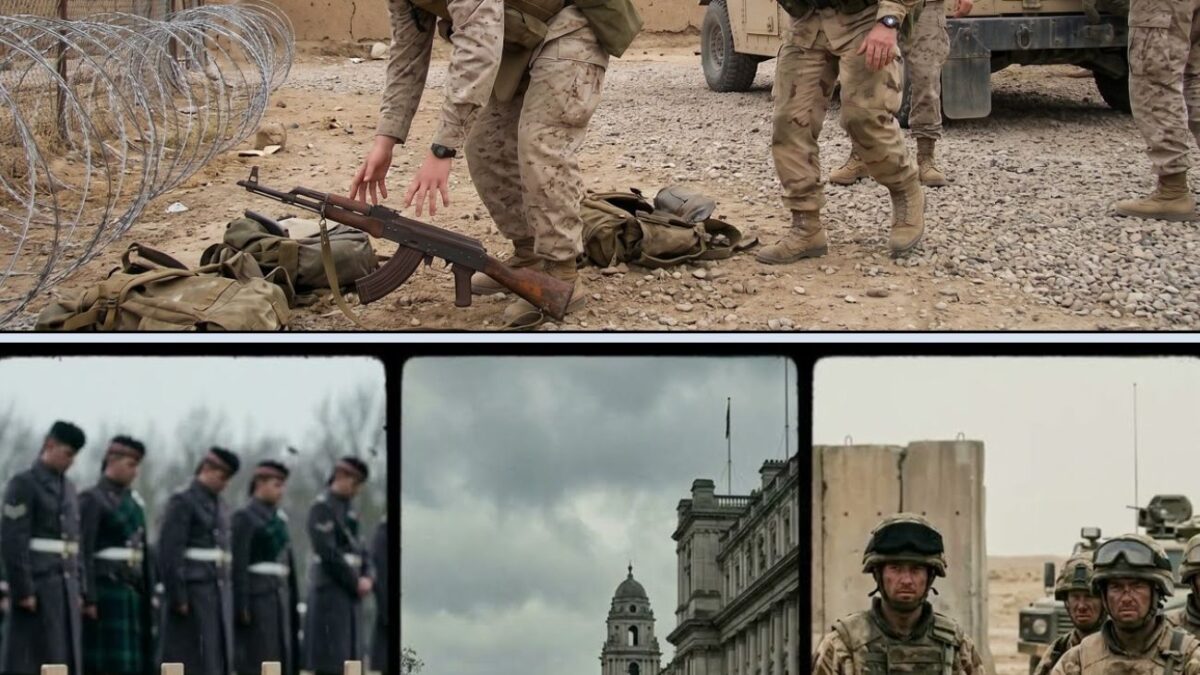
7 November 2004, east of Fallujah, on the raised shoulder of Highway 10, a British armoured vehicle sat dark with its engine off 40 metres back from a Black Watch checkpoint. Inside it, two men who wore no cap badges and carried no identification beyond a radio call sign were going through a single sheet of paper by red light. It was a hand-drawn floor plan, a house interior, nothing more, copied days earlier from a sketch made during a reconnaissance patrol along the city’s eastern edge. Doorframes were marked with small X’s. A stairwell had been shaded in solid black. Underneath, in block capitals, someone had written four words that would outlive the sketch itself: “Touch it and die.”
Less than two kilometres away across the cordon, three battalions of United States Marines were running final equipment checks before the push into the city began. The sheet of paper and the warning written on it had already been typed, copied, and sent forward through the liaison channel to the Americans 11 hours earlier. Whether it reached the men who actually needed it before they put a boot through the first door of the assault was a question nobody could answer cleanly that night and nobody has answered cleanly since.
Fallujah had become a problem no one in the coalition wanted to own twice. In March 2004, four American contractors working for Blackwater USA were ambushed and killed in the city. Their bodies were mutilated and two were hung from a bridge over the Euphrates while a crowd filmed it. The images ran on every network within hours. Washington’s political response was immediate and in military terms premature. The Marines were ordered into Fallujah that April under Operation Vigilant Resolve, then ordered to halt three weeks later short of finishing the job as diplomatic and political pressure built over civilian casualties and international criticism.
The city was handed instead to a hastily assembled local force called the Fallujah Brigade, built from former Iraqi army officers and intended to police the city on the coalition’s behalf. It collapsed within months, its weapons and vehicles absorbed by the very insurgent networks it was meant to contain. Major General James Mattis, commanding the First Marine Division at the time of that first halted assault, had argued against stopping an operation. His Marines were, by his own later account, close to finishing. The decision to withdraw before the city was cleared was taken well above his level, and it left a bitter taste inside the division that persisted long after Mattis himself moved on from the command that August.
Richard Natansky, who inherited the division from him, inherited the grievance along with it. By October, Fallujah functioned as something close to an open insurgent capital. Intelligence estimates put the number of fighters inside the city, foreign and Iraqi, somewhere around 3,000. Car bomb factories operated inside residential compounds. A house used for interrogating and killing hostages was later found with Muhammad’s army painted across one wall. Much of the city’s command structure answered directly or loosely to the network run by the Jordanian militant Abu Musab al-Zarqawi.
Lieutenant General John Sattler, commanding I Marine Expeditionary Force, and Major General Richard Natansky, who had taken command of the First Marine Division that August, both understood, without needing to say it aloud in any briefing room, that a second assault on Fallujah could not be allowed to end the way the first one had. What almost nobody outside a narrow circle knew that autumn was that British special forces had already spent months working the edges of that same problem and that one of their most specific contributions to the coming battle—a technical warning about how the city’s defenders had rigged entire houses to kill the men who walked into them—would arrive in American hands and then appear to dissolve somewhere between a liaison officer’s desk and the fire teams who paid in blood to relearn it.
The British had been quietly inside Iraq’s secret war since the early months of 2004 when a Sabre squadron of 22 Special Air Service Regiment was folded into a new, deliberately unglamorous formation that American and British planners referred to internally as Task Force Black. Its existence was never publicly confirmed by either government. Its operators worked out of a secured compound near Baghdad International Airport, moved in civilian vehicles rather than military convoys, and hunted high-value targets alongside the American Task Force 121, later absorbed into Task Force 145.
A disproportionate number of the men selected for that first rotation had spent years of their earlier careers on tours in South Armagh, Belfast, and Fermanagh, where command-wired culverts, booby-trapped farmgates, and houses rigged to kill the first soldier through a door had been routine, exhausting vocabulary since the 1970s. That knowledge—slow, repetitive, bought over three decades at the cost of other soldiers’ lives in a conflict most of the British public had stopped thinking about—was about to become briefly and almost invisibly the single most relevant skill set in the entire Iraq campaign.
One of the men attached to the small liaison element working that autumn had, for the purposes of this account, the name Davies. He had served two tours in Northern Ireland as a young infantryman before passing selection in the late 1980s and had spent much of the following decade instructing close-quarters battle technique to new SAS intakes at the regiment’s purpose-built killing house in Herefordshire, a building constructed specifically so instructors could stand inside a room while students fired live rounds around them.
By his own account, given years later and anonymously to a journalist researching Britain’s secret Iraq campaign, he found Fallujah in October 2004 depressingly familiar, just bigger, and with considerably more high explosive on hand than South Armagh ever had. He was not supposed to be anywhere near the city in anything resembling a combat capacity that month. That restriction was the first problem the story turns on, and it was not one Davies or his two colleagues had created.
The killing house at Pontrilas was built for exactly the kind of error that gets a man killed in a place like Fallujah. It allowed an instructor to stand inside a room inches from a student while that student engaged a target with a loaded weapon, because the only way to train a soldier out of hesitating in a doorway is to put him in a doorway over and over until the hesitation is gone. Davies had run hundreds of those iterations by the time he deployed in 2004. And the two operators working with him had similar records.
One was a demolition specialist who had spent a tour attached to an ammunition technical officer’s team diffusing devices in County Tyrone; the other was a signaler who had rebuilt radio links under fire outside Crossmaglen. None of them had expected County Tyrone’s lessons to resurface almost unchanged on the western edge of Baghdad province.
During one reconnaissance patrol in mid-October, working a route north of Camp Dogwood with a Black Watch rifle company, the demolition specialist stopped a soldier from kicking in the door of an abandoned house on the strength of a detail nobody else in the patrol had registered: fresh tool marks on a hinge that should have been rusted solid. The house, checked afterward by a disposal team, held a device wired into the frame. Nobody wrote an incident report crediting the warning to a man whose unit officially was not there. The patrol simply moved on, and the detail went straight into the notebook that would within weeks become the floor plan sketch and the four words underneath it.
In October, as planning for the second assault accelerated on both sides of the Atlantic, Downing Street and the Ministry of Defence confronted a decision about exactly how far British special forces would be permitted to go. D Squadron, 22 SAS, had spent weeks preparing to take part directly in the coming ground battle, training and rehearsing alongside American elements with every expectation of fighting inside the city itself. The political authorization for that never came.
The reasoning laid out afterward by journalists who covered the campaign in detail was blunt and entirely political rather than tactical. A rising British body count inside an American-led urban battle at a moment when domestic support for the Iraq war was already fracturing and a general election loomed the following year was judged too costly a risk for the government to accept. D Squadron was ordered to stand down from the assault it had spent a month preparing for. The decision was made in an office in London by officials who would never see the inside of a Fallujah stairwell.
And its effect was simple. The one unit in the entire coalition with the deepest, hardest-earned institutional memory of urban booby trapping would not be walking through the doors it understood better than anyone else present. The man who had to defend that decision in public was Geoff Hoon, the Secretary of State for Defence, answering questions in the House of Commons about why British troops were being pushed further into Iraq’s most dangerous province at the exact moment public patience with the war was thinnest.
General Sir Mike Jackson, Chief of the General Staff and the army’s most senior officer, had his own narrower argument to make, not about Fallujah specifically, but about an army already stretched across Iraq, the Balkans, and Northern Ireland, and about what it cost in readiness elsewhere every time a government asked for one more battalion on one more road. Between Hoon’s political caution and Jackson’s resource arithmetic, the one option that never seriously survived discussion in Whitehall that October was sending more special forces into a city neither government was prepared to bury soldiers for on television.
Inside D Squadron itself, the stand-down landed the way most political decisions land on men who have already rehearsed the alternative: quietly and with very little patience for the reasoning behind it. One former operator discussing the episode long after leaving the regiment summarized the mood without much diplomacy:
“The squadron had trained for weeks to go into Fallujah and then watched American and Iraqi units go in without them while London explained in careful language why the risk had not been worth taking.”
It was not an argument any of them were in a position to win and most did not try. They simply found other ways through channels nobody in Whitehall had anticipated or approved to make the knowledge they had still count for something. The compromise that emerged—”Infantry for the roads, not the rooms”—read on paper as a measured contribution to a difficult coalition problem.
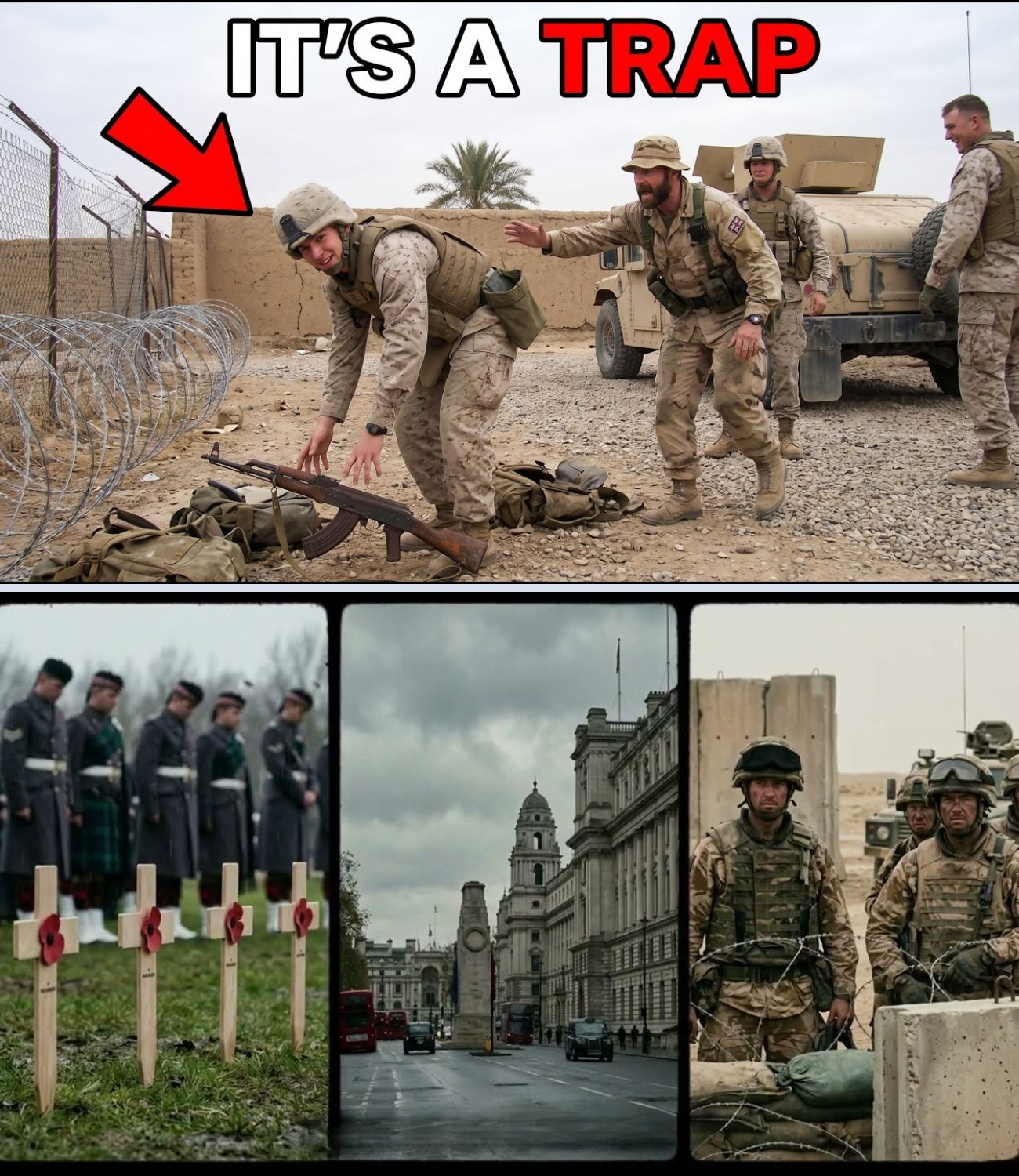
It read very differently to the Black Watch families who gathered outside Downing Street that November with a wreath and a letter after four of their soldiers had already been killed holding ground the deployment’s own planners had called secondary. What London would authorize instead was support, not combat—troops to free up Americans elsewhere, not troops to fight alongside them in the city. The British government committed the first battalion, the Black Watch, roughly 850 soldiers under Lieutenant Colonel James Cowan, to move north from Basra and take over ground south of Baghdad, a deployment named Operation Bracken.
It was a politically convenient trade. It let the Americans pull a brigade’s worth of combat power north toward Fallujah without thinning their own lines while keeping the British commitment framed for a domestic audience as logistics and area security rather than participation in the assault itself. The Black Watch moved into Camp Dogwood south of Fallujah in late October and took over checkpoints and patrols along the roads east and south of the city, work meant to cut off routes insurgents might use to reinforce the garrison or escape it once the attack began.
It was unglamorous and exposed in exactly the way politicians prefer not to think about when they draw lines on a map, and it put British soldiers on the ground around Fallujah during the same weeks that three men whose deployment could not officially be acknowledged were still finding reasons to be useful nearby. The cost of that exposure arrived before the main battle even began. On the morning of 4 November 2004, a suicide car bomb struck a Black Watch vehicle checkpoint east of the Euphrates while the position was already under sustained mortar fire.
Sergeant Stuart Gray, 31 years old, was killed instantly along with soldiers from his own company. The regiment lost further men to another device 17 days later. By the time Operation Bracken ended, four Black Watch soldiers were dead and 10 wounded, a toll that struck London harder than almost anyone had expected precisely because the government had gone to such lengths to keep British troops officially outside the fighting that was actually killing them.
Camp Dogwood itself was little more than a cleared patch of desert when the Black Watch arrived, and the battalion spent its first fortnight there improving its own defenses while running the patrols London had asked of it in temperatures that dropped sharply once the sun went down and under near constant harassment from mortar and small arms fire aimed at the perimeter. Convoys moving the short distance north from Basra had to run roads already seeded with devices, which meant every resupply of water, ammunition, and fuel carried its own risk before it ever reached the men holding the line east of the city.
It was against that backdrop—a battalion already absorbing casualties to secure ground most of the public back home did not know it was holding—that Davies’s small liaison element was trying to build a usable picture of a city it was not allowed to enter and could not yet see past its outer buildings. The pressure on London to reinforce rather than reduce that commitment only grew as the battle approached.
Press reports in the weeks before the assault described around a hundred soldiers from the Scots Guards being ready to join the Black Watch in the stretch of territory south of Baghdad that British troops themselves had taken to calling the triangle of death, a reinforcement that read to critics in Parliament less like a measured contribution to an American-led operation and more like a government sliding step by step into a deeper role than it had ever asked the public to approve. Every additional soldier sent to hold that ground was by definition a soldier London had decided not to send into Fallujah itself, the same calculation made at a slightly larger scale that had kept D Squadron out of the city a few weeks earlier.
Davies and the two operators with him were attached informally to the Black Watch’s own reconnaissance effort through October under a title vague enough to survive scrutiny if anyone asked: technical liaison for explosive hazards. Their declared job was protecting the battalion’s checkpoints and supply routes from roadside devices, the same work that had just cost Gray his life. Their undeclared work, built through contact with American reconnaissance patrols probing the city’s perimeter and with Iraqi sources passing fragments of information to both armies, was closer to compiling a threat picture of Fallujah itself—specifically how the city’s defenders were preparing the houses that Marines would eventually have to clear room by room.
The pattern they assembled was not subtle once a man knew what to look for, and it was lethal precisely because to anyone who didn’t, it looked almost domestic. Fighters inside the city were wiring propane cylinders and artillery shells into door frames, closets, and stairwells, running detonation cord to a position where a defender could trigger the device by hand or by a hidden pressure plate once an assault team had fully committed to a room.
Jersey barriers and heavy furniture were stacked inside otherwise ordinary houses as firing points, converting the structure itself into a killbox rather than the shelter it appeared to be from the street. In several buildings identified during the reconnaissance, stairwells leading to the roof had been bricked over entirely, leaving a single pre-registered approach as the only way up and the only way the defenders needed to cover.
None of this intelligence was invented by the SAS liaison team working out of Camp Dogwood. American and Iraqi sources were independently gathering fragments of the same picture through October. But Davies’s group, applying three decades of counter-booby trap doctrine inherited from Ulster almost by reflex, recognized the internal logic of it faster than most analysts reading isolated reports and condensed it into something closer to a field warning than an intelligence summary: do not force a door that has been left conspicuously unlocked; do not clear a stairwell at a run; treat every improvised strong point, every barricade, every piece of furniture placed somewhere it had no reason to be as wired until it is proven otherwise. The document closed with the four words that would travel further in the end than the paper itself: “Touch it and die.”
Compiling it took longer than any of the three men expected, partly because the raw material kept arriving faster than it could be checked. An Iraqi source working with the Black Watch’s intelligence section described secondhand a house in the Jolan district rigged so that its own front gate—chained and padlocked in a way meant to look like an owner had fled in a hurry—was in fact the trigger for a device laid in the entryway behind it.
A separate fragment passed through an American reconnaissance element probing the city’s southern edge described insurgents deliberately leaving weapons caches visible in open rooms on the theory that a soldier who stopped to search a find would miss the wire running under the carpet beneath his boots. Davies’s group cross-checked what they could against what the Black Watch’s own engineers were already seeing on the roads; the same hands in several cases appeared to be building both the roadside devices and the house traps, which told them more about the insurgency’s internal organization than any single report could have.
Sorting confirmed pattern from plausible rumor in a city neither the British nor the Americans could yet enter to verify a claim directly was slow, unglamorous work done at night by the light of a vehicle’s interior lamp, and it produced in the end a single page rather than the longer document any of them would have preferred to write. The sheet traveled its final stretch in the pocket of a British liaison officer who had no more official standing to be carrying it than Davies had to have written it—a captain whose posting that autumn was nominally administrative, attached to the headquarters coordinating the two armies’ planning staffs.
He carried it by hand rather than trusting it to a message system that would have left a trail neither government particularly wanted. And he has since described handing it across a folding table to an American staff officer with the kind of understated instruction that passes in both armies for emphasis: “This one matters more than it looks.”
What happened to the page after that handover is where the story stops being verifiable and starts being argued over by the men who were there. That warning moved up the only channel available to it—through the British liaison cell attached to the headquarters coordinating the assault and across to American planning staff in the weeks before an operation whose opening phase was already fixed for the night of 7 November. That threat material of this kind passed between British and American elements ahead of Phantom Fury is not in dispute; coordination between the two forces in that period is documented in the broader record of the campaign.
What is far harder to establish, and what the men who produced the document still disagree about decades later—some insisting it reached battalion-level planners in time to shape rehearsals, others saying flatly that it never survived the layers between a liaison officer’s inbox and a lance corporal’s fire team—is exactly how far down the American chain that specific technical warning actually traveled before H-hour.
What is not in dispute is what happened once the Marines went through those doors. Iraqi government forces moved first on the night of 7 November, with the 36th Commando Battalion, advised by US Army special forces, securing Fallujah General Hospital and two key bridges west of the city, cutting off routes the insurgency might otherwise have used to repeat the propaganda disaster that followed the first battle when images of fighting near the hospital had dominated Arab media coverage.
The main ground assault began in the early hours of 8 November. Natansky’s two regimental combat teams drove south through the city from the north. RCT-1—built around 3rd Battalion, 1st Marines and 3rd Battalion, 5th Marines, with the Army’s 2nd Battalion, 7th Cavalry attached—took the western half of the city. RCT-7—with 1st Battalion, 8th Marines and 1st Battalion, 3rd Marines, alongside the Army’s 2nd Battalion, 2nd Infantry and 2nd Battalion, 12th Cavalry—took the east.
By the evening of 9 November, lead elements had cut straight across Fallujah to Highway 10, what the axes planners called Phase Line Fran, splitting the city in half far faster than most insurgent commanders had planned for. The speed was deliberate, and it was expensive to buy. Marine commanders had learned from April’s half-finished operation that the insurgency’s single greatest advantage was time; every day a fight dragged on gave defenders more opportunity to reinforce, to film, and to turn the battle into the kind of images that had forced Vigilant Resolve to stop short.
Natansky’s plan traded caution for tempo wherever the two could be weighed against each other: tanks and armored vehicles leading where possible, AC-130 gunships and fixed-wing strikes called in against identified strong points, and infantry pushed forward on a schedule tight enough that a battalion which slowed to clear every structure with full deliberation risked falling behind the units on its flanks. It was the correct operational choice, and nearly every officer who later wrote about the battle defended it. It was also the choice that guaranteed houses would be entered faster than they could be searched with the caution Davies’s warning had specified, because a city cannot be seized quickly and swept carefully by the same men in the same hour.
Nowhere did that trade-off cost more than in the Jolan district in the city’s northwest, which Marines from 3rd Battalion, 5th Marines fought through against some of the most determined resistance of the entire operation. Jolan’s narrow, ancient streets and densely packed houses had been prepared by defenders who understood the terrain far better than anyone attacking it, and company after company found itself clearing buildings that had been deliberately turned into fortified positions, their occupants moved out or already fled before anyone arrived to search the rooms left behind for exactly the kind of rigged doorway and wired strong point.
The battalion’s own information operations officer, Captain Paul Batty, would later describe to reporters covering the fight how Battalion Sergeant Major Rudy Resto moved between companies through the worst of it—the kind of senior presence that mattered more to exhausted Marines, several later said, than any single piece of intelligence paperwork could have. It was in streets like these, not in a briefing slide, not in a liaison officer’s folder, that the difference between knowing a pattern existed and having it drilled into every fire team before contact turned out to matter most. Speed bought the Marines the city’s geography in days; it did not buy them its houses.
Within the first 72 hours, squads clearing block after block began hitting almost exactly the pattern Davies’s team had described weeks earlier: doors left deliberately unlocked, interiors converted into prepared firing points, propane cylinders and artillery rounds wired into walls and door frames and triggered the instant a fire team pushed through. After-action reporting from the battle describes homes rigged from floor to ceiling, grenades wired to door handles, entire rooms built as single-use traps engineered to kill the first man through rather than the fifth.
Among the Marines fighting block by block in those early days was Company A, 1st Battalion, 3rd Marines, part of RCT-7. On 15 November, clearing a house during a house-to-house sweep, Sergeant Raphael Peralta was leading a scout team into a room when insurgents inside opened fire with automatic weapons, hitting him multiple times. As the fighters fled the room, one of them threw a grenade back into the space where Peralta and the Marines behind him were working to clear the house.
Peralta, mortally wounded, was credited by seven fellow Marines with pulling the grenade beneath his own body, absorbing the blast and sparing the men near him. He died at 25. Natansky later recommended him for the Medal of Honor; a Pentagon review ultimately awarded the Navy Cross instead after officials said the precise circumstances of his final seconds could not be established without any possibility of doubt—a dispute that outlived the battle itself by more than a decade and that was still being argued in Congress years after Fallujah had faded from the news.
Peralta’s house was not, by the accounts that survive, rigged with the kind of wired device Davies’s warning had described. The grenade that killed him was thrown by a fleeing man, not triggered by a hidden switch. But the episode belonged to the same broken assumption that ran through the entire battle: that a room, once a Marine was inside it, could be judged safe by what was visible rather than by what might still be reaching back into it.
Multiple accounts from RCT-1’s sector, fighting through the Jolan and Shuada neighborhoods in the same week, describe the harder, more literal version of the same mistake: fire teams hit by secondary explosions in houses already searched once after insurgents concealed inside wall cavities, beneath floorboards, or in spider holes dug beneath the structure waited for a room to be declared clear before opening fire or triggering a charge by hand.
The exact tally of American casualties caused specifically by booby-trapped structures, as opposed to direct fire or roadside devices encountered on the approach to a building, was never broken out as a separate category in the Marine Corps’s public accounting of the battle. Veterans who fought through Fallujah that November have since estimated in oral histories and unit reunions that house-born traps accounted for a disproportionate share of the fighting’s ugliest surprises—not because they were the most common threat, but because they were the one that struck men who believed for a few seconds that the danger was already behind them.
A rifleman clearing his 10th house of the day does not fear the 10th house the way he feared the first. Fatigue erodes exactly the caution a warning like Davies’s was meant to preserve, and no liaison note written weeks earlier could have reached into that particular accumulating exhaustion to hold it in place. Marine units adapted inside the fighting itself, not because any single memo instructed them to, but because men were already being hurt. Relearning the pattern room by room, squads began breaching exterior walls instead of forcing doors, tank and demolition teams collapsed suspect structures rather than clearing them floor by floor, and stairwells were treated by the second week as the ambush points the city’s defenders had built them to be rather than as simple routes to the roof.
Whether any individual squad leader’s caution that week had been shaped, even secondhand, by a British liaison warning passed down an unglamorous chain from Camp Dogwood, or whether it was simply the brutal, repetitive cost of losing men to the same trick more than once, is not something the surviving record settles cleanly. What the record does show is that the doctrine Marine units converged on by the middle of November—treat the convenient room as the dangerous one, treat the open door as the trap—was in its essentials the warning Davies’s team had written down in October before a single Marine had crossed the line of departure.
Organized resistance inside the city broke down through the middle of November, though fighting continued in pockets and sporadic combat dragged on until 23 December. By then, the American dead from the operation stood at 95, with roughly 560 wounded, against 54 killed and more than 400 wounded in the opening phase alone. Iraqi government troops lost 8 killed and 43 wounded.
British forces holding the cordon and the highways rather than the city’s interior finished Operation Bracken having lost four soldiers killed and 10 wounded—a toll London had tried through its own political caution to keep smaller than it turned out to be. Across the whole campaign, coalition losses totaled 107 dead and well over 600 wounded. Insurgent dead were estimated at somewhere between 1,200 and roughly 2,000, with coalition forces claiming approximately 1,500 captured.
Abu Musab al-Zarqawi, the man whose network had made Fallujah worth taking in the first place, was not among them. American officials acknowledged within days of the assault that he and a number of other senior insurgent leaders had almost certainly slipped out of the city before or during the opening phase of the attack, filtering into surrounding towns ahead of the cordon the coalition had spent weeks building to seal them in. The city had been won; the man it was fought to reach had simply walked out a different door first.
By almost any measure available to historians afterward, it was among the heaviest sustained urban combat American forces had fought since Huế City in 1968. The formal reckoning began almost immediately. Marine Corps Combat Development Command, the organization responsible for turning battlefield experience into doctrine, began collecting after-action interviews from Fallujah veterans within weeks of the fighting’s end, feeding them into a lessons-learned process that would eventually reshape urban combat training across the Corps.
Those interviews are thorough on the subjects the Marine Corps could own outright: breaching technique, tank-infantry coordination, the use of combat engineers to collapse rather than clear suspect structures, the volume of ammunition a company actually burns through in a single contested block, and the logistics of keeping water, ammunition, and medical supplies moving forward to companies that had stopped functioning on anything resembling a normal resupply schedule within the first day of contact.
They are considerably thinner on where precisely the pattern recognition behind some of those adaptations first took shape, because the honest answer involved a page of paper that had entered the American system sideways through a channel few people writing the official history had reason to go looking for. None of the official after-action material produced in the following months credited a British warning for the lessons American units absorbed about clearing booby-trapped structures.
That omission was less an oversight than a direct consequence of how the information had traveled informally through a liaison relationship nobody above colonel particularly wanted documented, from a unit whose own government had, days before the battle, publicly refused to let it fight in it at all. An American officer involved in later reviews of the campaign, speaking to a journalist years afterward on condition of anonymity, summarized the institutional discomfort without much softening: “Nobody wanted to write in a formal Marine Corps report that some of the costliest lessons of the battle had already existed in writing, produced by a liaison element from an ally that politics had just barred from the fight.”
It was simpler and considerably less awkward for everyone with a signature on the final report to let the lesson be rediscovered as combat experience rather than acknowledged as a warning that had arrived too early for anyone’s comfort and too late in practice for the men who needed it. There was, underneath the paperwork, a narrower and more human irritation at work as well.
American commanders, who had spent the better part of two years building the largest, best-resourced urban warfare apparatus the Marine Corps had ever fielded, were not, by several later accounts, especially receptive to a handwritten page arriving through a junior liaison channel from a British squadron that had just been politically forbidden from fighting in the battle it was now offering advice about. One Marine officer who reviewed intelligence products in the run-up to the assault recalled years afterward a colleague’s dry response to the floor-plan warning when it crossed his desk: “Useful, probably, but hardly something nobody had already worked out for themselves.”
It was the kind of comment a much larger, much better-funded command makes about a much smaller one without quite noticing it has made it. The record of the battle itself suggests the floor-plan sketch had worked out a few real things rather earlier than most of the apparatus around it had. Davies and the two operators with him were withdrawn to Baghdad before the fighting in Fallujah had fully burned out. Their informal attachment to the Black Watch reconnaissance effort closed quietly alongside Operation Bracken itself.
There was no commendation and no public acknowledgement of any kind—nothing that would have been possible for men whose unit’s presence in the country remained officially unconfirmed. The single piece of the episode that did travel forward intact was the phrase itself. By Davies’s later account, “Touch it and die” became something closer to a teaching line than a warning in the years that followed, repeated half in dark humor and half entirely in earnest in close-quarter battle instruction back at the Pontrilas killing house used to drill into successive intakes of operators the single idea that a room which looks too convenient, too undisturbed, too easy, is very often the room built to kill you.
Versions of the same lesson surfaced, unattributed and stripped of any British origin, in American urban warfare training circles as well, passing the way most hard lessons in that world travel—soldier to soldier and instructor to student—with the original source sanded off somewhere along the way. The Marine Corps absorbed its own version of the lesson through its own much larger institutional machinery, which did not need to credit anyone to put the result to use.
Urban combat instruction at facilities like the Military Operations on Urban Terrain complex at Twentynine Palms expanded in the years after Fallujah to put far greater emphasis on structural breaching, on treating an undisturbed room with suspicion rather than relief, and on the specific signatures—wired utility fittings, furniture moved to cover a floor seam, a door left open where every other door on the street was shut—that Marine units had paid for in November 2004, one house at a time.
None of the training literature produced afterward cites a British liaison warning as its source, and there is no reason to expect that it would. Institutions build doctrine from their own casualties, not from a page someone else wrote first. The men who wrote that page were never positioned to ask for credit, and by the account of at least one of them, never much wanted it. What they wanted, Davies said later, was for the lesson to stick somewhere useful.
It did. It simply stuck without his name on it, which is the only way most of his career’s lessons ever stuck anywhere. Task Force Black itself outlived the battle by years, renamed Task Force Knight in September 2005 as its mission shifted further toward the hunt for Zarqawi’s network and other high-value targets across Baghdad and beyond. Its public footprint stayed close to zero throughout that period. Britain did not formally end its special forces commitment in Iraq until May 2009, nearly 5 years after D Squadron had been told in October 2004 that it would not be permitted to fight in the one battle its training had most directly prepared it for.
The detail of a four-word warning written on a hand-drawn floor plan and carried forward by three men whose names the official record still declines to confirm survives today only in fragmentary, partially anonymous accounts given long after the fact, cross-checked where they can be against a public record that was never built to acknowledge they existed. What survives independently of whose warning reached whom is the shape of the houses themselves: the doors left open on purpose, the stairwells bricked over to funnel men into a single kill zone, the ordinary clutter of a living room wired to detonate the instant someone decided it was safe to walk through it.
Fallujah’s defenders had built an entire district of rooms designed to punish the one assumption every soldier is trained under normal circumstances to make—that a space once entered and found empty is finished. The men who had written that danger down before the battle began had learned it slowly years earlier in streets with different names and a different flag overhead. The men who relearned it that November, block by block, learned it the only other way the lesson has ever been taught.
Davies left the regiment some years later, by his own account without ever discussing Fallujah publicly until a researcher working on the broader history of Britain’s secret war in Iraq tracked down enough fragments of his service to ask. He did not claim when he finally spoke that the warning had saved anyone specifically or that ignoring it had cost any specific life. He was careful in the one interview he gave to say only what he could actually support: that the pattern existed, that it was written down accurately before the battle, and that the city’s houses behaved in the weeks that followed exactly the way the page said they would.
The hand-drawn sketch itself did not survive. Like most working paper carried by men whose unit could not be acknowledged, it was destroyed rather than filed, and no copy of it has ever surfaced in any archive on either side of the Atlantic. What survived was the sentence underneath it. Instructors at the killing house in Herefordshire kept using it for years afterward, chalked sometimes on the frame of the mocked-up door itself before a new intake’s first run through the building—four words meant to do in half a second what a page of intelligence analysis could not: “Touch it and die.”
Marines who fought through Fallujah that November never saw the sketch it came from and never needed to. By the second week of the battle, they were writing a version of the same warning themselves in grease pencil on the doors of houses they had already cleared and did not trust—a mark meant for the next man through in the only language that city had left anyone room to use.
You Might Also Enjoy

“We Thought They Would Negotiate”—What Argentine Soldiers Said When The British Attacked Goose Green

“You’ll Never Finish My Ruck March, Limey” — US Sergeant Who Challenged the SAS, Then Fell Out First






