Victoria Eugenie of Battenberg: The Queen Whose Wedding Day Turned to Bl00d
Imagine the most important day of your life. You are 18 years old. You have spent your entire childhood in the shadow of your grandmother, the most powerful woman in the world, moving between her palaces and her drawing rooms, listening to her opinions and attending to her needs. You have grown up knowing that your purpose, like every princess of your generation, is to marry well and carry the weight of a dynasty forward. And today is the day. You are Victoria Eugenie of Battenberg, known as Ena in the family, a granddaughter of Queen Victoria, and you are marrying a king, Alfonso XIII of Spain, young and handsome and charming, who noticed you across a crowded banquet room and could not stop asking about you. Today, you walk into the church of St. Jerome the Royal in Madrid as a princess. You will walk out as queen of Spain.
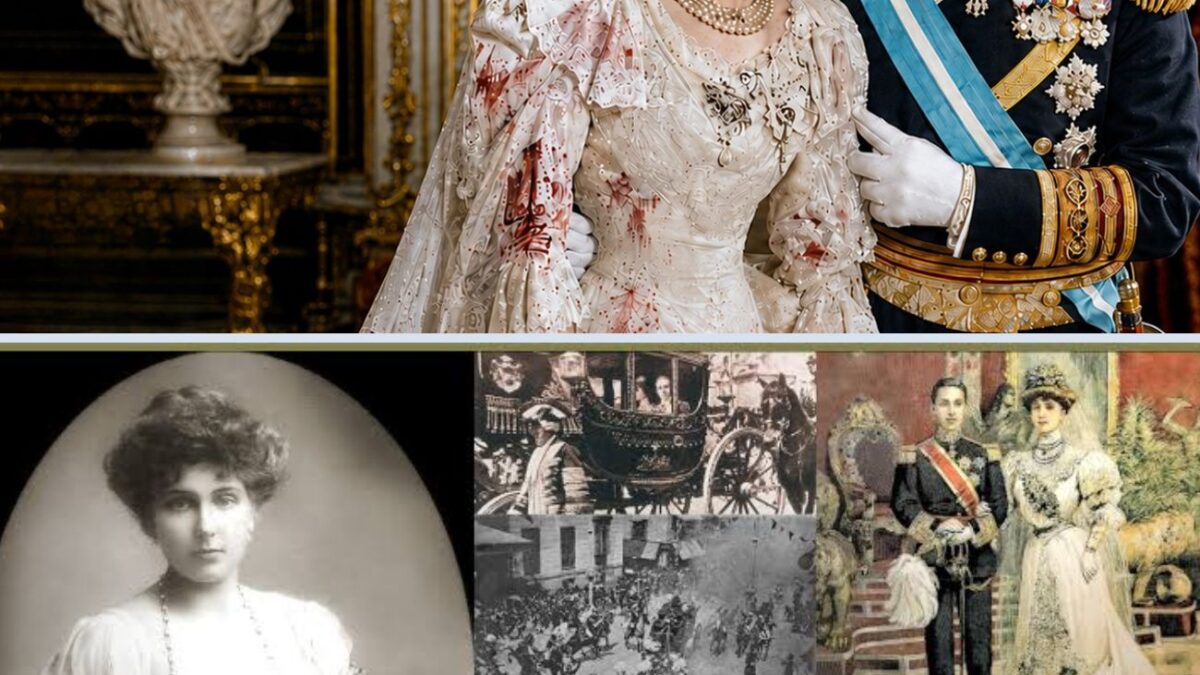
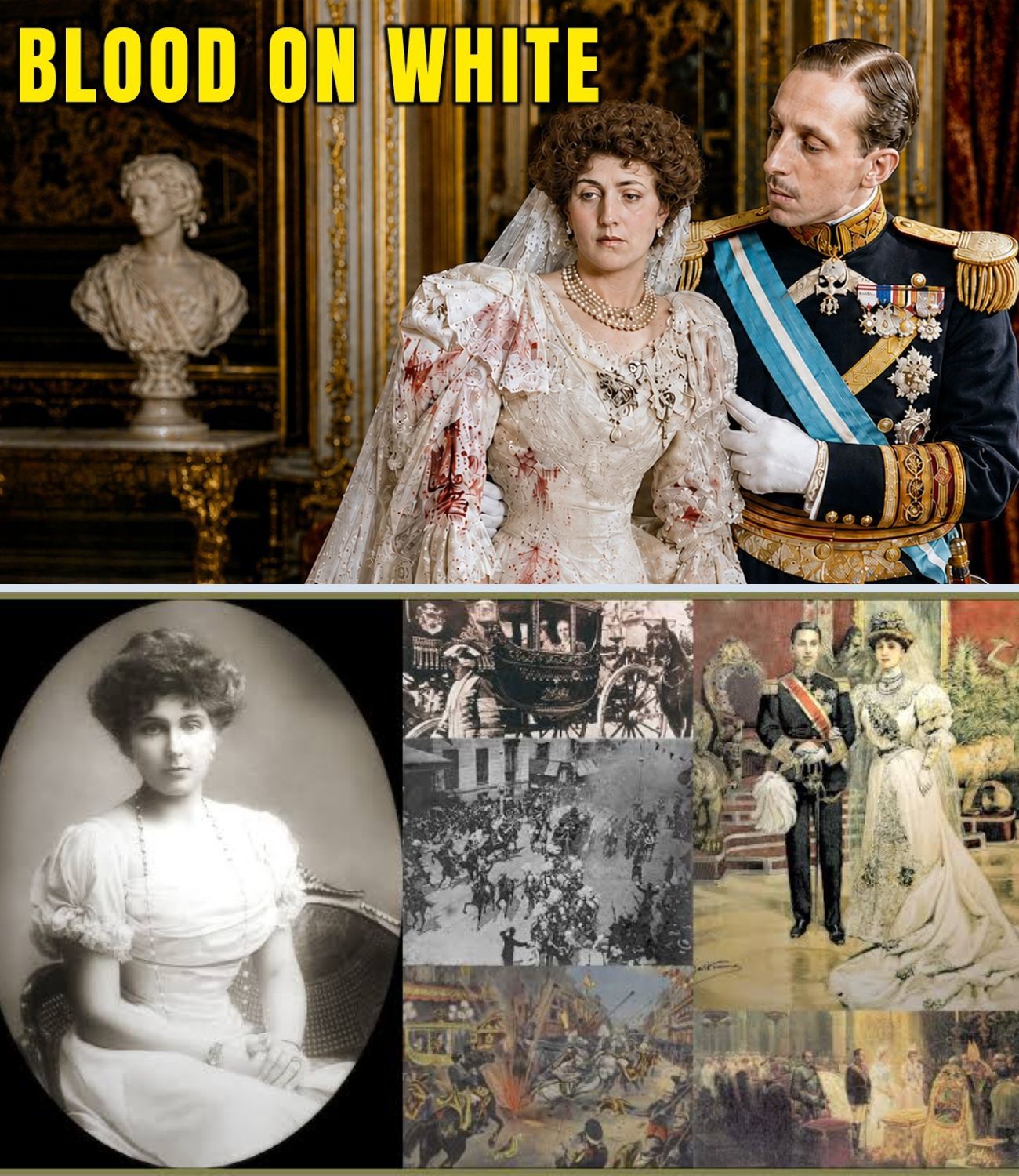
The ceremony is magnificent. The dress is extraordinary: white satin and silver thread, a train carried by pages, a veil of Spanish lace that catches the light as you move through the church. The crowds outside are enormous. Madrid has turned out in its thousands to see their new queen. And then you climb into the royal carriage for the procession back to the palace. And somewhere above you in the window of a hotel on the Calle Mayor, a man named Mateo Morral is holding a bouquet of flowers. Inside the bouquet is a bomb. He throws it. The explosion kills 24 people and wounds more than 100. Horses fall, carriages shatter, blood runs across the cobblestones of the street where moments before there had been flowers and cheering. You and your new husband escape without serious injury. You have shrapnel wounds, small ones, the kind that bleed freely before they are dressed. But the wedding dress that you walked out of the church in is no longer white. You attend your own wedding reception in a blood-spattered dress. You are 18 years old, and it will get worse.
Victoria Eugenie Julia Ena of Battenberg was born on the 24th of October 1887 at Balmoral Castle in Aberdeenshire. She was the only daughter of Prince Henry of Battenberg and Princess Beatrice of the United Kingdom, and through her mother, the youngest granddaughter of Queen Victoria herself. That connection to Victoria shaped her entire childhood in ways that were both privileged and confining. When Beatrice married Henry in 1885, Victoria had imposed a condition. Her youngest daughter, her companion and secretary and most devoted attendant, could not simply leave. Beatrice and Henry were to live with the queen, to accompany her wherever she went, to remain within the orbit of the court. It was in many respects a condition of captivity dressed in the language of family devotion.
The result was that Victoria Eugenie grew up not in a home of her own but in a series of royal palaces: Balmoral, Osborne House, Windsor Castle. Her world was shaped by her grandmother’s routines, her grandmother’s preferences, her grandmother’s formidable sense of how things ought to be done. She was, by all accounts, a thoughtful and observant child, fair-haired—almost white-blonde in her coloring—with a quietness about her that those who met her found striking. Her godmother was the exiled Empress Eugenie of France, a woman who had been driven from her throne, who had lost her husband and her son, and who lived in English exile as a relic of a world that no longer existed. It is one of those details that history offers up with a particular kind of irony: Victoria Eugenie began her life in the arms of a woman who had already endured the fate that was waiting for her.
Her father, Henry, died in 1896 when Victoria Eugenie was 8 years old. He had gone to West Africa with a British military expedition against the Ashanti and contracted malaria on the journey. He was brought back to Gibraltar but never recovered. He was 33. Victoria Eugenie lost her father before she was old enough to fully understand what losing him meant.
Queen Victoria died in January 1901. The vast presence that had shaped every corner of Victoria Eugenie’s world was simply gone. The palaces were quieter, the routines altered, the dynasty moving into a new reign under a new king. Victoria Eugenie was 13. The grandmother she had grown up beside, in whose shadow she had spent her entire conscious life, was buried. She was now, in the language of her world, available—a princess of marriageable age, granddaughter of the most famous monarch in history, connected by blood to half the royal families of Europe. The question of who she would marry was simply a matter of time.
In the spring of 1905, King Alfonso XIII of Spain made a state visit to London. He was 19 years old, handsome, energetic, and very much in the market for a queen. The Spanish throne required an heir, and Alfonso was aware that the choice of his future wife would be one of the most consequential decisions of his reign. King Edward VII, Victoria Eugenie’s uncle, hosted a state banquet at Buckingham Palace in Alfonso’s honor. The Spanish king was seated between Queen Alexandra and Princess Helena at the table, surrounded by the full splendor of the British court. And somewhere in that room, across the candlelight and the conversation, he noticed a young woman with almost white hair and asked who she was. She was Victoria Eugenie. She was 17.
The courtship that followed was not without obstacles. There were several serious ones. The first was religion: Victoria Eugenie was Anglican, and Alfonso was devoutly Catholic. Marriage would require her to convert, an act that carried both personal and political weight. The second was her family’s place in the royal hierarchy. The Battenbergs were a morganatic branch considered by some European courts to be insufficiently royal. Alfonso’s mother, Queen Maria Cristina, was opposed to the match for precisely this reason, preferring a Habsburg connection. And then there was the third obstacle, the one that everyone in the room understood and nobody said out loud with quite sufficient clarity: Victoria Eugenie’s uncle, Prince Leopold, had been a hemophiliac. Her brother, Leopold, was also a hemophiliac. The hereditary bleeding disorder that Queen Victoria had passed to several of her descendants was a known quantity in the family. Victoria Eugenie might carry the gene; any sons she bore might be afflicted. Alfonso knew this. His advisers knew this. It was discussed, assessed, and ultimately set aside in favor of the match. The risk, they concluded, was worth taking. It was not a conclusion that would age well.
The engagement was announced. Victoria Eugenie converted to Catholicism. Her old faith, the faith she had been raised in, was set aside for a country she had never visited and a man she barely knew. She left England in the spring of 1906, sailing toward a new life in a new country with a new religion. Carrying with her the name and the blood of the grandmother whose shadow she had grown up in, she arrived in Spain to a rapturous reception. The Spanish people adored her at first sight. She was young and beautiful, and she smiled at them with a warmth that seemed entirely genuine—because it was. Whatever anxieties she carried privately, she presented to her new country a face of composed and radiant confidence.
On the 31st of May 1906, she married Alfonso XIII at the Church of St. Jerome the Royal in Madrid. And then the carriage left the church. The procession back to the royal palace took the royal carriage along the Calle Mayor, one of Madrid’s main thoroughfares. The route was lined with crowds and decorated for celebration. Soldiers lined the street. The atmosphere was one of public joy. Mateo Morral was an anarchist, a young man employed in the library of a radical educational institution in Barcelona, motivated by a hatred of the monarchy and a desire to spark revolution. He had taken a room in a hotel on the Calle Mayor with a view of the processional route. He had concealed a bomb inside a large bouquet of flowers. As the royal carriage passed below him, he threw it.
The explosion was devastating. 24 people were killed, and more than 100 were wounded. Horses fell, the street was filled with smoke and screaming. In the immediate aftermath, those near the carriage scrambled to understand what had happened, whether the king and queen were alive, and whether another attack was coming. Alfonso and Victoria Eugenie were alive. The carriage had been close enough to the blast that she sustained minor shrapnel wounds—small cuts from the debris of the explosion. They were not life-threatening, but they were bleeding. Her wedding dress, the white satin and silver thread she had walked into the church in, the dress that had been chosen for this day above all days, was stained. She attended her wedding reception in that dress. The historical record does not tell us what Victoria Eugenie said in those hours or what she felt as she sat through the formalities of a celebration while her husband’s city still smelled of smoke and the wounded were being carried away from the street outside. What the record tells us is that she was there: composed, present, performing the role that had been given to her, a queen on her wedding day in a dress that was no longer white.
Morral escaped the immediate aftermath of the attack and fled Madrid. Two days later in the town of Torrejón de Ardoz, he was confronted by a local militia. He shot a man dead and then turned the gun on himself. Alfonso and Victoria Eugenie’s marriage had begun with the deaths of 24 strangers on the street below a hotel window. It would continue in a spirit consistent with that beginning.
Alfonso and Victoria Eugenie’s first son was born in May 1907 and named Alfonso, Prince of Asturias, after his father. His birth was greeted with enormous celebration across Spain; the dynasty had its heir, and the future seemed secure. The celebration did not last long. During the infant prince’s circumcision, the physicians noticed something wrong: the bleeding would not stop. The wound that should have closed quickly and cleanly was still open, still seeping in a way that made no medical sense for a healthy child. The diagnosis was hemophilia. The hereditary bleeding disorder that Victoria Eugenie’s family had carried for generations—that her uncle and her brother had both suffered from—had been passed to the heir of the Spanish throne.
Alfonso XIII’s response to this news set the tone for everything that followed in the marriage. He knew the risk when he married her; his advisers had assessed it and advised him to proceed. The possibility had been discussed and accepted. None of that mattered apparently in the face of reality. He blamed Victoria Eugenie. He blamed her completely. And he never stopped. The warmth that had characterized their early relationship cooled, then chilled, then essentially disappeared. Alfonso began to distance himself from his wife publicly and privately, in ways that those around them could see and understand. The marriage that had begun in blood on a Madrid street continued in a different kind of bloodletting.
They had seven children in total, five sons and two daughters. The children were Alfonso, Prince of Asturias; Infante Jaime, Duke of Segovia; Infanta Beatriz; Infanta María Cristina; Infante Juan, Count of Barcelona; and Infante Gonzalo. A seventh child, born in 1910, died in infancy. Jaime, their second son, was deaf and mute from early childhood, the result of a mastoid operation gone wrong, and he would renounce his succession rights in 1933. Gonzalo, their youngest surviving son, also had hemophilia. From 1914 onwards, Alfonso began to take mistresses openly. Over the years that followed, he fathered five illegitimate children, making little effort to conceal any of it. Victoria Eugenie endured this with the same public composure she had brought to the wedding reception in her blood-spattered dress: present, dignified, performing the role whatever it cost her privately.
In 1923, General Miguel Primo de Rivera seized power in Spain and established a military dictatorship. Alfonso gave the coup his support, a decision that aligned the monarchy with authoritarian politics in ways that would prove catastrophic. When Primo de Rivera’s regime collapsed in 1930, the damage to the crown’s reputation was irreparable. Alfonso had bound the monarchy to a dictator and then watched the dictator fall. Municipal elections in April 1931 delivered a decisive verdict: Republican parties swept the major cities, and the Second Spanish Republic was proclaimed. On the 14th of April 1931, Alfonso XIII went into exile. Victoria Eugenie went with him.
She had lived in Spain for 25 years, raised seven children there, served as its queen through two decades of political turbulence, attended her wedding reception in a blood-spattered wedding dress, endured her husband’s public infidelities and his private contempt, and watched the country she had given everything to simply vote her out. She was 43 years old. The family went first to France, then to Italy, and then—as was perhaps inevitable given everything that had preceded it—Alfonso and Victoria Eugenie separated. The marriage that had survived a bomb, hemophiliac sons, serial infidelities, and the loss of a throne could not survive the loss of the throne’s purpose. There was no longer a Spain to be king and queen of; there were only two people who had never really known each other, living in exile in borrowed spaces.
Victoria Eugenie eventually settled in Switzerland, purchasing a chalet called Vieille Fontaine outside Lausanne. Alfonso lived separately in Rome. They met on occasions, most significantly in 1938 when the whole family gathered in Rome for the baptism of their grandson, Juan Carlos, the son of their son Juan. It was one of the last times the family was together. In January 1941, Alfonso XIII felt that death was approaching and transferred his rights to the Spanish crown to their son Juan, Count of Barcelona. On the 12th of February 1941, he suffered a heart attack, dying 16 days later on the 28th of February in Rome at the age of 54. Victoria Eugenie had not been his wife in any meaningful sense for a decade. She had been his queen, his partner in the loss of a throne, the mother of his children, and for years the recipient of a blame she did not deserve. Whatever she felt at his death, she kept it to herself.
The losses that followed were of a different order entirely. In 1934, their youngest son, Gonzalo, had died at the age of 19 from internal bleeding following what appeared to be a minor car accident; his hemophilia had made the difference between a survivable injury and a fatal one. In September 1938, their eldest son, Alfonso, Prince of Asturias, died in Miami at the age of 31. He had been a passenger in a car driven at night by an acquaintance when the vehicle swerved to avoid a truck and crashed into a telephone booth. His injuries appeared minor, but his hemophilia made them fatal, and he died of internal bleeding. Two sons, two car accidents, two deaths from the condition she had been blamed for passing to them—the condition that Alfonso had known about before they married and chosen to accept the risk of, only to spend the rest of his life holding it against her.
Victoria Eugenie outlived them all. She outlived her husband, her two hemophiliac sons, the regime that had exiled her, and the dictator who had replaced her. She lived in her Swiss chalet through the Second World War, quietly sympathetic to the Allied cause in ways that got her expelled from Italy in 1942 for being, in Mussolini’s government’s phrase, persona non grata. She settled permanently in Lausanne and built a life there, attending football matches, receiving visitors, corresponding with her surviving children, and watching her grandchildren grow.
In February 1968, 80 years old and in the final year of her life, Victoria Eugenie returned to Spain for the first and only time since the exile of 1931. She had been away for 37 years. She came for the baptism of her great-grandson, a boy named Felipe, the son of her grandson Juan Carlos and his wife, Princess Sophia of Greece and Denmark. The crowds that turned out to see her surprised everyone, including perhaps herself. Madrid came into the streets; people who had not been born when she was queen, or who had been children when she left, pressed forward to see this old woman who had once been their queen, who had sat in a blood-spattered wedding dress on the day she arrived among them, who had given them children and duty and decades of composed public service before being voted out without ceremony. She was deeply moved by the reception, trying to see as much of the city as she could during her short visit. She held her great-grandson in her arms for his baptism and then returned to Switzerland.
She died on the 15th of April 1969 at her home in Lausanne. She was 81 years old. It was with a precision that history occasionally produces: exactly 38 years to the day since she had left Spain in exile. She was buried initially in Lausanne, but in 1985 her remains were returned to Spain and reinterred at El Escorial, the great royal monastery outside Madrid where the monarchs of Spain lie. She had come home at last in the only way that was left to her. The boy she held at his baptism in 1968 became King Felipe VI of Spain in June 2014 upon the abdication of his father, Juan Carlos. The monarchy that her grandmother had lived to see exiled had been restored, and her bloodline sat on the throne of the country that had driven her out. She did not live to see it, but she had seen enough.
Victoria Eugenie of Battenberg lived one of the most remarkable lives of the 20th century, yet it remains almost entirely unknown. She was born in a Scottish castle to a princess who gave up her freedom to care for a queen. She grew up in the shadow of the most famous grandmother in the world. She converted her faith, crossed a continent, and married a king she barely knew—and on the day she married him, survived a bomb that killed 24 people on the street below her carriage window. She was then blamed for the rest of her marriage for a genetic condition she had not chosen, and that her husband had accepted the risk of before they wed. She endured it. She endured the affairs, the contempt, and the very public demonstration that the man to whom she had given her youth, her faith, and her country had no particular interest in her once the question of the dynasty was settled. She performed her role with a composure that those around her found remarkable, because the alternative—a public breakdown, scandal, or retreat—would have cost her the only thing she still had.
She raised seven children in a court that was never entirely hers, in a country that was never entirely comfortable with her, and in a language she had had to learn as an adult. She watched two of her sons die from a condition she had been blamed for. She lost her throne, her marriage, her country, and eventually her husband, all within a decade. And then she lived for another 28 years in a Swiss chalet, attending football matches, receiving visitors, and corresponding with her grandchildren. And she did it with the same composure she had brought to everything else.
When she held Felipe at his baptism in 1968, she was holding the future of the dynasty she had nearly destroyed and ultimately, through her bloodline and her endurance, helped to preserve. The monarchy of Spain today runs through her; King Felipe VI is her great-grandson. The throne she sat on in 1906, the throne she was driven from in 1931, is now occupied by her family. She arrived in Spain on her wedding day in a dress that turned to blood before the day was out. She left Spain 37 years later, quietly and without drama, in the way she had learned to do everything. She went back once, she held a baby, and she died exactly 38 years after the day she left. That is the life of Victoria Eugenie of Battenberg: one of the most extraordinary women you have probably never heard of until now.
You Might Also Enjoy

“We Thought They Would Negotiate”—What Argentine Soldiers Said When The British Attacked Goose Green

“You’ll Never Finish My Ruck March, Limey” — US Sergeant Who Challenged the SAS, Then Fell Out First






