Wallis Simpson: Die Liebesgeschichte, die keine war
A living room in Paris, May 18, 1972. Cars are stopped outside. Inside stands a 75-year-old woman. Very small, very upright, in a dress that she had probably been planning since the day before. The Queen of Great Britain stands before her, and then this woman curtsies. Her husband is one floor above. He has terminal cancer. He will be dead in ten days and he reportedly insisted that he be dressed, put in an armchair and the tubes hidden behind the armchair so that his niece would not see him as sick, but as what he once was. This is the end of the most famous love story of the 20th century. Not a palace, but a rented house on the edge of a park, a man who gets up from his deathbed for a 15-minute visit, and a woman who bows in her own living room to the very family who have not received her for 36 years. When a king abdicates his crown for a woman, one imagines the ending differently.
Almost everything the world thinks it knows about this marriage comes from two books. He wrote one, she wrote one, both were co-authored by professional writers, both were reviewed by lawyers, and both were published at a time when the couple desperately needed money and, even more urgently, public attention. This is not a conspiracy, this is simply the available information. The most romantic version of this story comes from the two people who made a living from the fact that it sounds romantic. However, there is also a second pile of material: private letters, notes from girlfriends, records from diplomats, secretaries, servants, guests – things that were never intended for publication. And this second pile tells a decidedly colder story.
I don’t want to tell this story as a chronology, because chronology is merciful here. She spreads everything out over 50 years, making it seem harmless. Let’s tell the story in numbers instead. This marriage can be counted with astonishing precision. 16 guests, not a single relative, three letters, 35 years old. Thirty years for a few minutes, four years in full public view, and finally about ten years of silence in a darkened room. Each of these numbers is a chapter. Let’s start with the first one. 16.
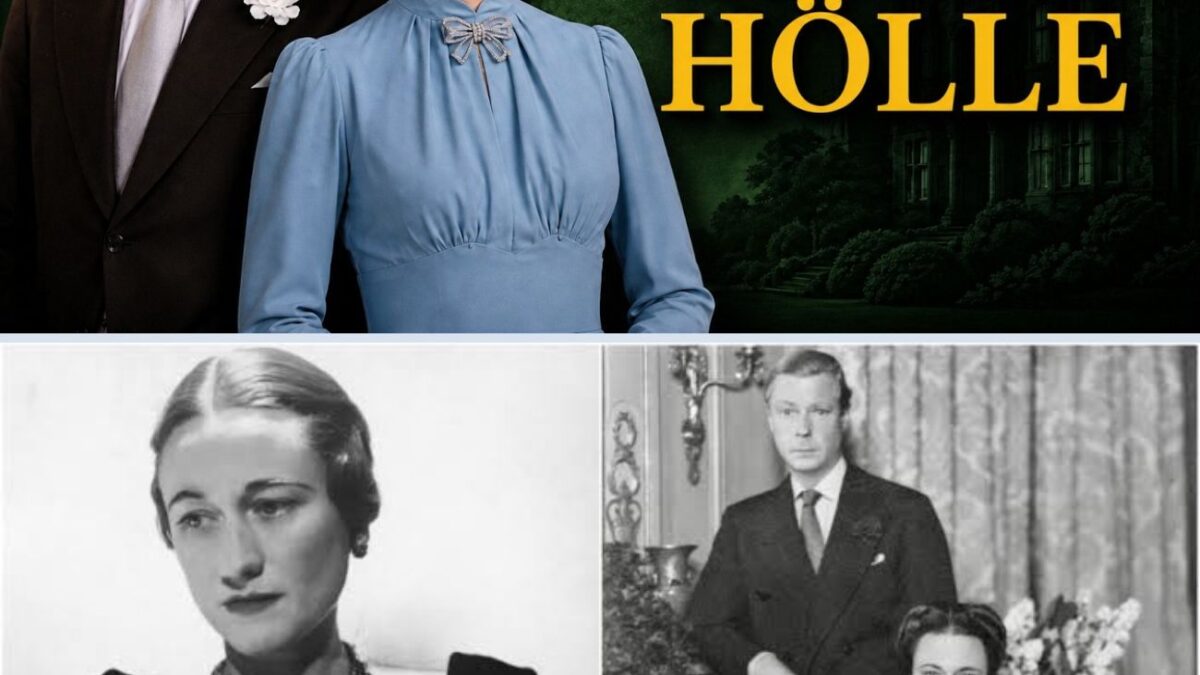
This is approximately how many people were present when a wedding took place in France on June 3, 1937. No grand reception, no cathedral, no state ceremony. A castle in Touremen, provided by a millionaire friend, because the couple themselves had nowhere to go where the wedding could take place. And now the second number from the same day, the more important one. Not a single relative of the groom was there. The man who, until six months ago, had been King of Great Britain, Emperor of India, and head of a church, married without his mother, without his three brothers, without a cousin, without a representative, without a single face from the family into which he had been born. He had been told that nobody would be coming. He had hoped until the very end that this would change. It changed. The Church of England also refused to perform the wedding ceremony. A simple driver from northern England travelled on his own, performed the ceremony, and subsequently got into considerable trouble for it. The bride wore a light blue dress, the shade of which later got its name. In the photographs from that day, two people are smiling very correctly at the camera.
Stay with this image for a moment, because everything that follows is already laid out here. This marriage did not begin as a triumph. It began as an event that half the world watched and nobody came. And it didn’t stop there. The decision that this woman would not be received was not a spontaneous act of displeasure, but a line that no one in London had touched for decades. She was not invited, she was not visited. She didn’t appear in any program. And when mediation attempts were made years later, they regularly failed at the same wall. It is a strange form of punishment because it works completely silently. Nobody has to say anything bad. You simply leave the space empty, again and again for decades, and eventually the lesson itself becomes the statement.
Second number: three letters. Six days before the wedding, on May 27, 1937, a document was drawn up in London which on paper looks like routine administration but in reality determined the form of this marriage for the coming decades. The former king was entitled to use the title Royal Highness as Duke of Windsor. His wife did not. She became a duchess. She received the title, the coat of arms, the rank on paper, but not the form of address that every wife in this family automatically receives. She was thus the only person in the history of this house to be denied the status of her own marriage.
In practice, it looked like this. When a relative came to visit, he bowed to him and not to her. If they both entered a room together, they had different ranks; if a seating arrangement was made somewhere, she sat lower than him. And this became an obsession for her husband, one that never left him until his death. He therefore wrote letters to the Prime Minister. He brought up the topic in conversations where it was completely irrelevant. He commissioned legal opinions. He insisted that guests in his Paris house curtsy to his wife in the same way they had in Windsor, and many did so because arguing about it would have cost the evening.
That brings us to the third number, and that’s the one that explains the tone of the whole thing. 35 years. That’s how long this fight lasted. From 1937 until his death in 1972. 35 years in which a married couple had a central joint project. And this project did not consist of children, not of work, not of a house built together, but of an insult that was never healed. Consider for a moment what that does to two people. A couple who wake up every morning to find the same old injustice in their room will not develop warmth. It develops a shared bitterness. And bitterness sometimes feels like closeness from the outside, because it keeps two people in the same room.
To understand why she ended up in this particular situation, one has to look at her life before any prince appeared. She was born on June 19, 1996, in a summer hotel in Pennsylvania to a family with a respected name from Baltimore and virtually no wealth. Her father died when she was a few months old. She grew up on gifts from uncles in houses owned by other people, in a social class whose rules she knew perfectly and whose standard of living she could not afford. This creates a certain character. Someone who learns very early on that charm works like money, that a good table, a good set of words and good timing open doors that would otherwise remain closed, and that security is not something you are entitled to, but something you organize.
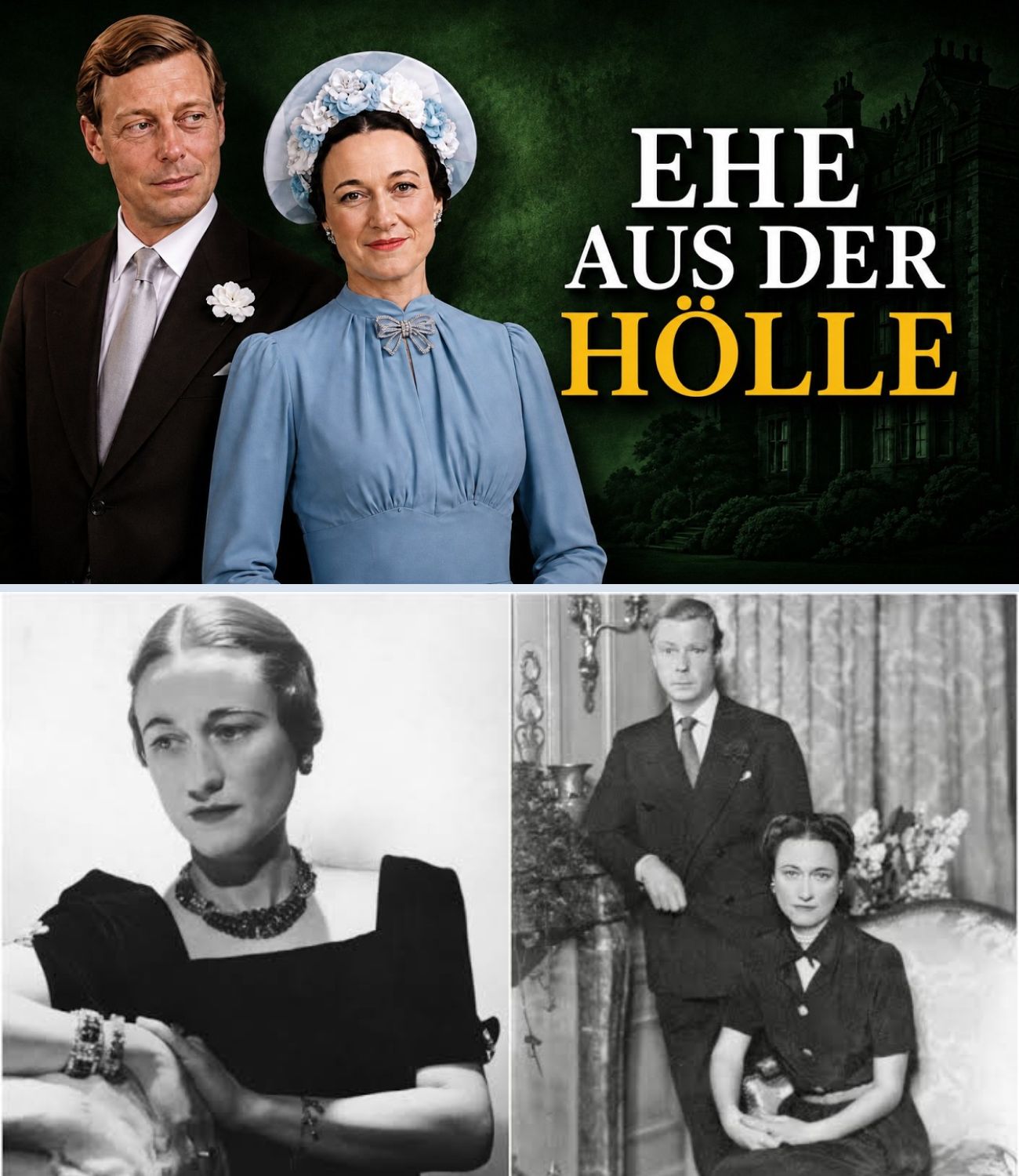
Her first marriage, in 1916 to a naval aviator, ended in disaster. He drank, he was jealous. There are credible accounts of humiliations and of years of leaving and returning until the divorce was finally finalized in 1927. The second marriage was the correction. Ernest Simpson. Half-American, half-English, calm, educated, friendly, absolutely reliable. They married in 1928 and moved to London. And here’s the point that the romantic version of this story always omits. She had made it in London. She ran a house that was considered one of the best addresses in the city. Their dinners were famous. She knew everyone. She was invited everywhere. She had a husband who left her alone and proudly showed her off. And for the first time in her life, she had financial security. She was not a woman looking for a king. She was a woman who had just arrived.
The meeting took place around 1931 at an English country estate, arranged through an acquaintance who was then the mistress of the heir to the throne. It wasn’t a lightning strike, but a slow process that unfolded over several years. The crucial mechanism is described identically by almost all contemporary witnesses. The future Edward VIII was a man who had been kept down by a harsh, cold father and who, as an adult, systematically sought out women to command him. Wallis did not treat him with respect. She contradicted him, she interrupted him, she made lighthearted fun of him in front of other people. For him, this was apparently a completely new experience, and he became dependent on it to such an extent that his closest circle of acquaintances worried him years before the actual crisis.
It is important to name this as precisely as the sources do, because this is the crux of the whole matter. What arose between these two was not symmetrical from the beginning. On his side, it was obsession. On her side, it was initially something much more ordinary. A very great social gain, which she accepted with amusement and which, like everyone else, she assumed would eventually end on its own. His father died on January 20, 1936. That’s when it ceases to be a social game. The new king is doing a bad job. He leaves official documents lying around. He disappears. In the summer of 1936, he chartered a yacht and sailed with Wallis through the eastern Mediterranean. Photographed by reporters from all over the world, while not a single newspaper in Great Britain itself reported on it.
Keep this situation in mind from your perspective. The entire world outside of Great Britain knows. The British know nothing, and she sits right in the middle of this structure, without any lever with which she could control it. Her second divorce will take place in October. In November, the king informs his prime minister that he wants to get married. At the beginning of December, the silence of the British press breaks and within a few days Wallis Simpson becomes the most discussed topic in the country. And what actually happened during those December days is the best-documented and worst-told part of the whole story.
She was no longer in England at that time. There were people standing in front of her London house. Windows were smashed and she fled to the south of France, to the villa of American friends near Cannes. From there she made a phone call to the king. The connection was poor, the conversations dragged on for hours, and several people living in the same house independently reported the same thing. She tried to stop him. She issued a public statement offering to withdraw from the situation. She urged him on the phone not to resign. She proposed compromises. She wrote to confidants that a retreat was the only sensible solution. He wasn’t listening. He didn’t listen to anyone on this matter. Not the government, not the church, not his mother, not his brothers. And that’s the crucial point, not even her.
He signed the abdication document in December 1936. On the evening of December 11th, he spoke on the radio and said the sentence that would define the next 50 years of their lives, that he could not bear the responsibility without the woman he loved. It is one of the most effective sentences ever spoken into a microphone. Millions of people listened to him live. To this day, he remains the foundation of the entire legend, and for her, he was the moment when a door slammed shut. From that second on, Wallis Simpson had no way to be unhappy. She must not doubt, complain, fail, be bored, and under no circumstances leave. Half the world had just heard that a man had given up an empire for them. From now on, there was only one acceptable role for her: to be the woman who was worth this sacrifice, every single day until the end.
And there is a second thing that came about during those December days and that she could never get rid of: a name. For decades, members of the royal family did not refer to her by her name, but rather by a circumlocution. This woman, two words that encapsulate everything she was accused of: the American woman, the divorcee, the foreigner, the intruder. The image worked immediately for the British public because it was simple. A young, popular, unhappy king, enchanted by a calculating foreigner. There were cartoons, there were angry letters to the editor, there were threats. What is nowhere to be found in this narrative is the possibility that the calculating foreigner herself tried to stop it and failed. This possibility would have complicated the story, and complicated stories rarely prevail.
This is where the material comes into play that finally flips the picture. For decades, the inner workings of this marriage were pure speculation. Then letters became available that Wallis had written to her second husband, the quiet Ernest, whom she had left for the king. The British historian Anne Sebba analyzed them in her 2011 biography. The content does not fit into any version of the legend. She continued to write to him, not even out of politeness, but for years. She wrote to him after the abdication. She wrote to him after her own wedding. She called him the most decent person she had ever met. She remembered evenings they had spent together. She hinted that she had gotten herself into something that she could no longer stop. Please read this time reference again slowly, not before the abdication. Then, after the wedding, in the very years when the world had decided that the greatest love story of modern times had taken place.
One could interpret this as nostalgia, and that would be fair. People write warm letters to their former partners without their existing marriage necessarily being cold as a result. It just so happens to fit perfectly with everything else that has been handed down from those years: to her remarks to female friends about exhaustion, to her description of a life that felt like a very well-furnished cage, to a man she couldn’t disappoint because otherwise he would have collapsed in on himself. This is not hate and it is not betrayal. It is the description of a woman trapped in a situation from which there is no socially viable exit.
And that brings us to the question that this couple couldn’t shake for the rest of their lives. What does one actually do all day when one has given up everything and has nothing left to do? In October 1937, four months after the wedding, the two travelled to Germany. They were led through factories and settlements by officials of the regime. There were receptions, cameras, crowds of people, and in the end they were received by Adolf Hitler at the Obersalzberg. Much has been written about the Duke’s political stance, and much of it remains controversial. The more interesting question here is simply why two people would do something like that in the first place.
The answer that emerges most clearly from the sources is disturbingly banal. They had nothing to do. He was without office, without a profession, without a task, and without any prospect of one. She was 41 and in the same situation. An invitation that looked like a state visit, complete with honor guards, photographers, and hosts who showed his wife the very respect that London denied her, was exactly what he needed. Keep this observation in mind, because it explains the next 30 years better than any psychological theory. This marriage wasn’t cold because two people hated each other. It was cold because it was empty.
The war briefly interrupted the emptiness. In the summer of 1940, the Duke was appointed Governor of the Bahamas. A post that London awarded primarily because it was very far away. They were there for 5 years. She worked for the Red Cross, managed aid projects, redesigned the office building, and complained bitterly in private letters about the heat, insects, boredom, and the provincialism of her surroundings. She is said to have compared the islands to Napoleon’s place of exile in private. That too came to an end in 1945. After that, there was never another assignment. Not a single one for the rest of both their lives.
Incidentally, there is one number that is completely missing in this marriage, and its absence explains more than any existing one: zero children. She was 41 at the wedding. Whether there were medical reasons, whether it was a decision, or whether it was never discussed, nobody knows for sure, and neither of them ever commented on it publicly. The point is not the cause, the point is the effect. Two people who had no country, no job, no profession and no children sat in a very nicely furnished house from 1945 onwards and had exactly each other. 24 hours a day, for 27 years. There are marriages that can withstand that. She coped with it in her own way.
But the price for this is visible on every page of the tradition. What followed were almost thirty years of a life that was organized with remarkable precision, yet in which nothing happened. They settled in France. First a converted mill southwest of Paris, then from the early 1950s the house in the Bois de Boulogne, which the city of Paris gave them for a symbolic price. She furnished both houses with a perfectionism that regularly left visitors speechless. And this is where you best understand what the word “cold” actually means. It’s not about arguing, it’s about the temperature of everyday life. Their dinners were famous and feared. The table was photographed beforehand and corrected after the photo was taken. The flowers were rearranged several times. The entire process was planned down to the minute.
The staff worked according to guidelines that reminded guests of a drill. She herself ate almost nothing because she was convinced that a woman in her position should never gain weight. And she said so openly. In addition, there was a calendar that repeated itself identically every year. Spring in Paris, summer on the coast, autumn back in France, winter in New York and Florida. Always the same hotels, the same hosts, the same conversations. They traveled with an amount of luggage that was remarkable even within their social class, with over 100 suitcases and boxes, with the dogs, with the staff, and with their own bedding. This isn’t travel, it’s moving, repeated every few months because there’s nowhere to truly arrive.
And above all else, there was the issue of money. The duke was not poor. On the contrary, he was plagued by the fear of not having enough his entire life. He negotiated sums that were irrelevant to him and argued with London for years over payments from the family fortune. His wife, who grew up without financial security, had the same reflex. It is one of the few commonalities that appears in virtually all reports. They both talked a lot about money, and neither of them ever felt safe doing so.
Now, one more detail from those decades that most accounts omit, even though it says it all. This couple hardly ever spent an evening alone. Not rarely, but almost never. For decades, people either entertained or went out almost every evening. This can be interpreted as sociability. It can also be read as several of her closest friends openly thought, namely as a very carefully constructed avoidance structure. As long as there were always guests in the house, nobody had to find out what these two people were talking about when nobody was watching.
However, the witnesses are surprisingly unanimous about the asymmetry between them, regardless of whether they liked Wallis or not. The duke followed his wife through the house. In the letters that have survived, he uses a private, childlike language, invented nicknames, and a veritable baby vocabulary over decades. He signed with a collective “we,” as if it were a single person. Her letters sound completely different. Practical, organizational, ironic, often impatient. Appointments, staff, invoices, clothing, obligations. She almost never writes in the same register as him.
Guests report that she reprimanded him in front of others, cut short his anecdotes, and occasionally treated him like a somewhat clumsy secretary. Some found it strange, others found it unpleasant. Almost all of them describe the same basic situation. He needed her completely, and she endured him with a mixture of loyalty, irritation, and a certain amount of pity. This is not a war. It’s something that’s much harder to endure in everyday life. An imbalance that can no longer be corrected, because any correction would destroy the livelihood of both parties, which brings us to the next number: 4 years.
In the early 1950s, Wallis was seen almost continuously for about four years in the company of a significantly younger American heir to a department store fortune. He was funny, disrespectful, very rich, and openly homosexual. Whether it was an affair in the classic sense will probably never be clarified. What cannot be denied is the visibility. The three traveled together. They appeared together in restaurants, clubs, and at parties. The Duke sat beside her while his wife amused herself with another man, for months, for years, in full view of all European society. Only when the younger man crossed a line at a dinner did the Duke finally throw him out of the house.
And here’s the question that reveals more about this marriage than any declaration of love. What kind of husband wears something like that for years? The answer is uncomfortably simple. Someone who knows perfectly well that he wouldn’t survive the alternative. Two books also belong in this list, because they are the reason why the world still knows the friendly version today. In 1951, the Duke’s memoirs were published, a highly successful book in which the abdication was portrayed as a great romantic decision. Years later, in 1956, her own memoirs followed, in which she describes herself as a woman who was overwhelmed by events.
Both books were professionally co-written, both legally reviewed, both very well paid, and both were written during years in which the couple had exactly two problems: ongoing costs and the fear of being forgotten. That doesn’t mean it contains lies. It is said that the most frequently cited source of warmth in this marriage is precisely the product that the two parties jointly launched on the market. If you are wondering why the private tradition sounds so different from the public one, then a large part of the answer lies here.
Next number: 30 years for a few minutes. Do the math and see how many times the British royal family officially left the couple beside them over all these decades. After their wedding in June 1937, it took three years before the Duke and his wife were allowed to appear together at an official event in England. It happened in June 1967 at the unveiling of a memorial plaque for his mother. They stood outside in a row with their family for a few minutes in front of the cameras. Waiting 30 years for a few minutes on a grey London morning. Then they went back to Paris.
In the 1960s, the trace of her own words becomes noticeably darker. She was now in her 60s. He was ill, he had problems with his eyes. Later came the cancer diagnosis. The number of invitations decreased because the generation that had found them interesting was slowly dying out. They both drank. The evenings became emptier, the conversations repetitive, the journeys shorter. The remark most frequently quoted by her dates from these years. And it is significant that it is not a sentence about love. She is said to have told a friend that nobody realizes how difficult it is to actually live a great love story.
This is not an admission of misfortune. It’s something more precise. It is the statement of a woman who has realized that she is not living in a marriage, but in a narrative, and that this narrative must be served every day. And so we return to the scene from the beginning, May 18, 1972. The curtsey in one’s own living room, the man in the armchair, which one has put on for 15 minutes. Ten days later, on May 28, 1972, the Duke of Windsor died in this house at the age of 77. For the first time since his abdication, Wallis was officially invited to England. She lived in Buckingham Palace. At the funeral service in Windsor, she stood in the front row, dressed in black, next to the family who had kept her at a distance for 35 years. The footage from that day shows a very small, very upright, obviously completely lost person. She was 75 and with the death of her husband she lost not only him, but the only function her life had had since 1936.
Last number: Approximately 10 years of silence. She returned to Paris, to the same house. Initially she received guests, but then there were fewer. Then came the falls, the hospital stays, the diagnoses, which back then were not named as precisely as they would be today. And into this vacuum stepped a lawyer. Suzanne Blum was a respected Parisian lawyer who took over the Duchess’s financial affairs and, from this position, gradually gained complete control over her life. Friends who called were turned away. Visitors could not get through the gate. Journalists who asked questions received legal threats. Jewelry and furniture were sold, and disputes arose over how the money should be used, which later ended up in court.
A British writer tried to see the Duchess in the early 1980s and made a book out of it, the real question of which is: is this woman up there even still alive? And if so, in what condition? Because that was the situation. In her final years, Wallis, Duchess of Windsor, lay in a darkened room on the first floor. She could no longer speak. She was fed artificially. She saw no one except nursing staff and a lawyer, and not for weeks, but according to consistent reports, for several years. The woman whose name once graced every front page of the Western world spent the last decade of her life completely invisible, just a few kilometers away from the restaurants where she had been considered the most elegant woman in Europe. She died on April 24, 1986, at the age of 89.
And now comes the detail that, in retrospect, says the most about these 50 years. What happened next was not improvisation. It was a process that had been established decades earlier. The coffin was flown to England. He was taken to the St. George Chapel in Windsor to the very building whose family had refused to receive her during her lifetime. The church service on April 29th was short. There was no eulogy, no tribute, no account of her life. And according to reports, her name was hardly mentioned at all during the entire process. She was then taken to Frogmore and buried next to her husband on the piece of land that the family had granted him. Her title as Duchess of Windsor is inscribed on the stone. The three letters that her husband had fought for for 35 years are not there. She didn’t get them in life, and she didn’t get them in death.
A year later, her jewelry was auctioned in Geneva. The collection fetched many times the estimated value, and according to her wishes, the proceeds went to medical research in Paris. It was the last headline of her life, and like almost all the headlines of her life, it was about objects. At this point, it is important to be honest about what can and cannot be deduced from everything. No one can claim from the outside that there was no affection in this marriage. There are witnesses who report moments of genuine tenderness. There are years that no one can survive when there is absolutely nothing. And there is a woman who did not leave an increasingly helpless man until his death, even though she could have.
But what can no longer be explained away is the structure of this life. A wedding without a single relative. Three refused letters that became the main focus of a marriage. 35 years of waiting for a rehabilitation that never came. Letters to the former husband, written after the wedding. A calendar in which almost no evenings for two were scheduled. Four years of public humiliation, which the husband endured, and finally a decade of silence in a darkened room. You don’t have to like this woman to see what actually happened here. She got the man, she got the title, she got the houses, the jewelry, the clothes, the attention of two continents, and a place in every history book about the 20th century. And everything that has been passed down from her own voice suggests that at some point during those 50 years she understood what she had paid for. Not with wealth, not with prestige, not even with her reputation, because she had already lost that anyway, but with the only possession she had truly owned before: the ability to get up and leave on any given day.
What remains of her is nevertheless greater than the legend allows. An abdication that forced the British monarchy to reinvent itself and placed the reclusive younger brother on a throne he never wanted, just in time for the greatest war in history. A style that has shaped fashion for half a century and a question that still works today because everyone understands it. What do you give up when you finally get everything that everyone claims you wanted? Rest in peace.
You Might Also Enjoy

“We Thought They Would Negotiate”—What Argentine Soldiers Said When The British Attacked Goose Green

“You’ll Never Finish My Ruck March, Limey” — US Sergeant Who Challenged the SAS, Then Fell Out First






