“We Don’t Answer to You”: The British SAS Who Turned a Green Beret Assessor Into a Student
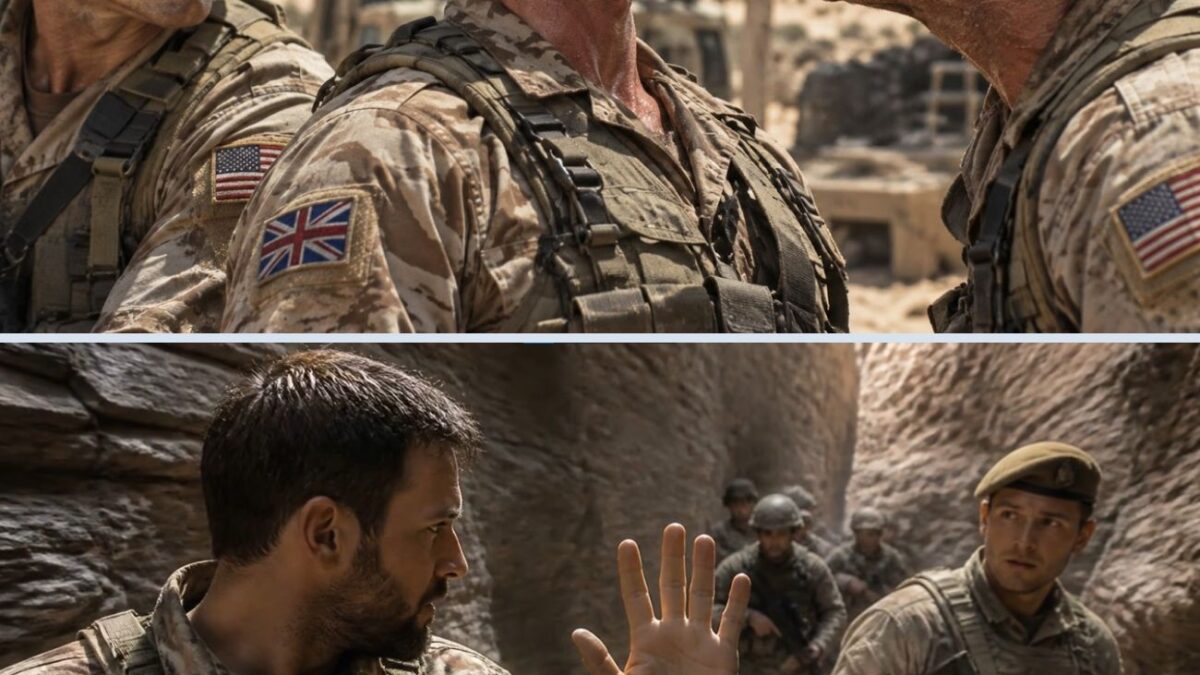
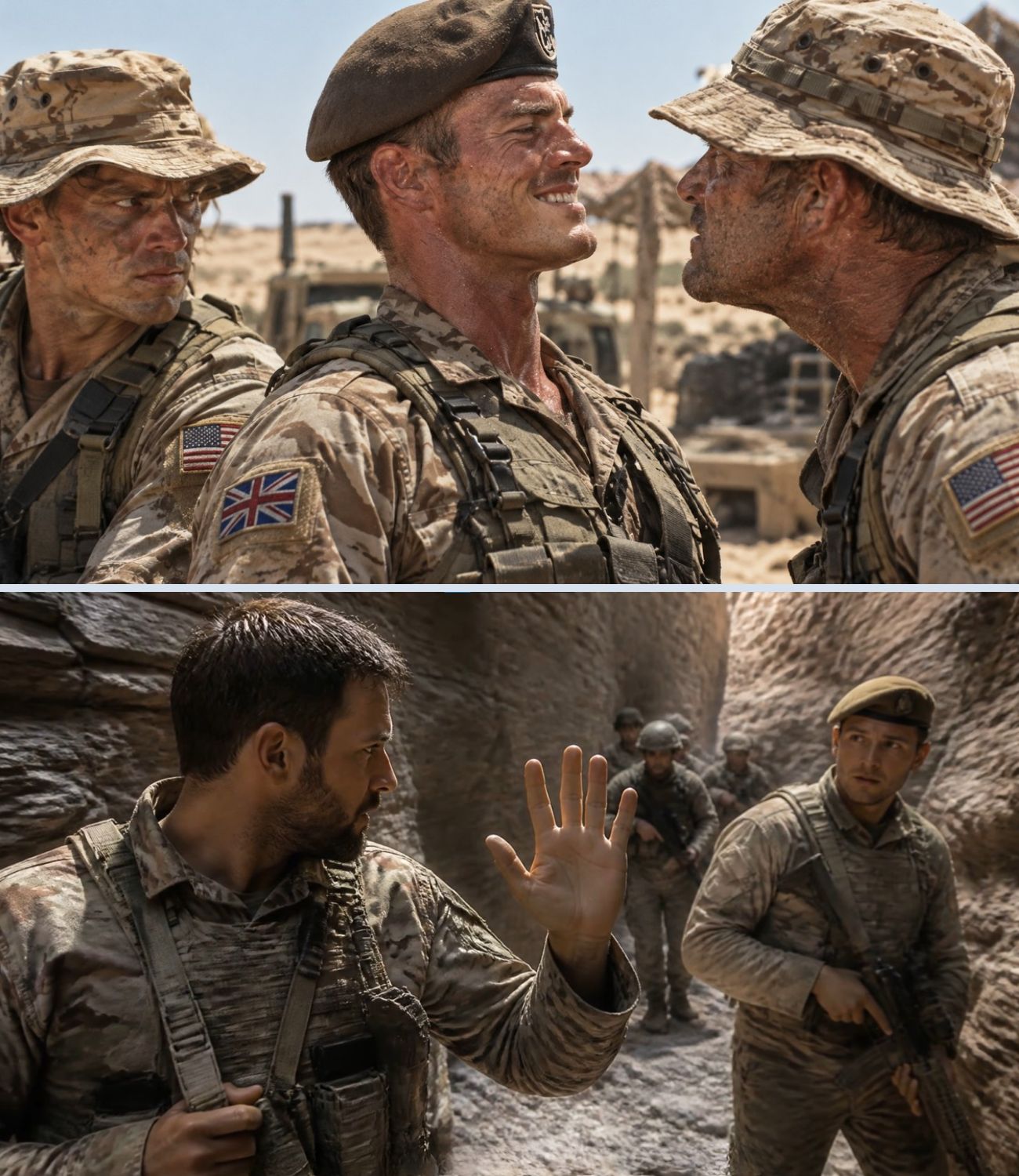
You are standing in a wadi in the south of Jordan at 10:02 in the afternoon and the heat has stopped feeling like weather and started feeling like a surface, like something you are pressed against. Your name for the purposes of this moment is Elliot Vance, and until 3 weeks ago, you were the man they sent to grade other people.
You have your notebook in your left hand. It is small, green, the elastic band around it darkened by sweat, and the pencil is between your teeth because your right hand is busy shading your eyes. Twenty meters up the wadi, three men in British multi-terrain pattern are moving along the shale in a way that is doing something to the math you thought you understood. They are not fast.
That is the part your notebook cannot cope with. They are not fast, and they are not loud, and they are not, by any measure you were taught, doing anything unusual. And yet, in 11 minutes, they have covered ground that your own team on Tuesday took 26 minutes to clear, and they have done it while carrying more.
You take the pencil from between your teeth. You open the notebook to the page you have been keeping on the middleman, the one with the lopsided grin and the roll-up that never seems to burn out, and you look at the column where you were going to write your assessment score, and you write nothing in it. You close the book. You put it back in your left breast pocket.
You watch the three of them stop at the lip of a spur, drop into cover so smoothly that the movement seems to be the same shape as the ground they drop into. And you understand with a cleanness that hurts a little that the man they sent you here to assess is not, in any sense that matters, a man you are qualified to assess.
Behind you, a voice with a Belfast softness in it says your surname the way a schoolteacher says the name of a boy who has stopped paying attention. You turn. Warrant Officer Duckett is looking at you with something that is not quite kindness and is not quite anything else. And he says:
“We should have a word, Master Sergeant.”
How does a man who has spent 19 years being the one who grades other men end up standing in a wadi in Jordan with a blank page and a Belfast warrant officer waiting to have a word with him? To answer that, you have to go back 3 months to a phone call in a corridor at Fort Bragg. Elliot Vance was 41 years old and, by any honest reckoning, one of the more capable senior non-commissioned officers in the United States Army Special Forces.
He had come into the regiment the long way. Ranger Battalion first, then the Q course at Camp Mackall, and then 12 years on operational detachment alphas inside 7th Special Forces Group, whose area of responsibility is Latin America, and whose men, out of professional pride, tend to speak Spanish before they speak much else.
He had three rotations in Afghanistan behind him, one long tour in the Sahel training Nigerian light infantry, and a chest full of the kind of modest ribbons that mean he did the job and did not talk about it afterwards. His men on his last team called him Top, and they meant it warmly. He was not one of the loud ones.
He did not shave his head, did not wear his sleeves rolled tight, did not sit in the mess with a pistol conspicuous on his thigh. What he did, and what had made him useful to the schoolhouse, was take notes. He took them constantly. He had in his left breast pocket at all times a small green Right in the Rain notebook with an elastic band around it, and he had kept one continuously since 2008.
On his desk at Bragg, there was a shelf of them, 63 at last count, dated on the spine. He was proud of a specific number. On his most recent Cooper test, the two-mile timed run they still administer as a benchmark inside the group, he had run a 4:54, 4 minutes and 54 seconds per mile sustained, which is what people meant when they called him the Bragg man who ran a 4:54.
There were men in the group who beat him on that. There were not many, and he knew all of their names, and he knew he could still take one of them on a good day. This number mattered to him, not because he mistook running for soldiering, but because it was the one metric he had kept ascending since he was 23, and because a man who is still improving his benchmark at 41 has, in his private view, earned the right to grade other people.
That was the job Special Operations Command had moved him into. For the last 18 months, he had been on the assessment side of the schoolhouse, the man who watched other operational detachments on their culmination exercises and wrote the reports that decided which team sergeants got their next stripe. He was good at it. He was good at it because he did not enjoy it.
He went in wanting to give credit and came out having given credit only where the work supported it, which was, he had found, less often than the men being assessed would like. The belief this story will overturn is not that he was the best. He did not think that. The belief this story will overturn is that assessment is a portable skill, that a man qualified to grade Green Berets is by extension qualified to grade any special operations force on earth because the underlying competencies are, in his phrase, load-bearing across the community.
He had said this in briefings. He had written it into a paper. He believed it the way a carpenter believes a spirit level works on any wall. He was about to spend 12 weeks with the British Special Air Service, and he was about to discover that his level did not, in fact, work on their wall.
He would not discover this because they were better than his own people. He would discover it because they were measuring for something his instrument was not built to find, but he did not know that yet. On the afternoon the phone call came, he was in a corridor at Fort Bragg holding a paper cup of coffee that had gone cold, and he was being told to pack for England.
The phone call was from Colonel Bram Hayley, who ran the liaison desk at Special Operations Command and who had known Vance since Vance was a staff sergeant with two years in the group. Hayley talked the way he always talked, which was like a man reading his own emails aloud, and he got to the point inside 40 seconds. There was a joint program.
There had been a joint program in one form or another since the Iranian Embassy siege in 1980, and the current iteration involved a rolling exchange of senior assessors between US Army Special Forces and 22 SAS. The British had sent theirs. The Americans were due to send one. The name that had come up was Vance.
“You’ll be at Credenhill,” Hayley said. “That’s their base outside Hereford in England. Selection, they run out in Wales in the Beacons. You’ll see both most likely. Twelve weeks, full access to their squadron rotation. And I mean full.”
“And the deliverable?” Vance asked.
“A report,” Hayley said. “Assessment framework. How they select, how they train, how their staff sergeants—sorry, their troop sergeants—hold their squadrons together. We want to know what’s transferable.”
Vance thought about this for a second longer than Hayley expected. Then he said the sentence that would follow him around for the next 3 months, the sentence he would remember every time he thought about the shape of his own confidence:
“How different,” he said, “can a bunch of blokes on a Welsh hillside really be?”
Hayley laughed because Hayley had been to Credenhill once and knew more than he was going to say on an open line.
“You’ll enjoy it,” was what he said. “Take a warm jacket.”
Vance flew into Birmingham on a Tuesday in October and picked up a hire car and drove west through country that did not look to his eye like anywhere he had trained. The hedges were close on both sides of the road. The fields were small. The rain, when it started, did not stop for the whole drive.
By the time he reached Credenhill, a village on the Roman road out of Hereford in flat green country with the Welsh border 20 miles further west, he had revised no assumptions. He had simply added cold as a variable. He was met at the gate by Warrant Officer Class 2 Colum Duckett, the squadron sergeant major of B Squadron, who had a Belfast accent softened by 20 years of living in Herefordshire and who drank his tea black.
Duckett did not shake his hand. He looked at Vance’s boots, looked at Vance’s face, and said:
“Right, we’ll get you a brew and a bed, and the OC will see you in the morning.”
The officer commanding was Major Ian Lane, Ulster Scots by name and by manner, and he spoke the way a man speaks who has learned that most sentences do not need to be said. He told Vance, in three separate single sentences with pauses between them, that Vance would be attached to B Squadron for the duration, that he would observe, not lead, and that if he had questions, he should ask them of the man he was watching, not of the man he was watching for.
Then Lane stopped speaking. Vance waited for the rest. The rest did not come. Somewhere in that silence, the thesis of the whole exchange got laid down, though Vance would not recognize it as a thesis until much later. It was this: inside this regiment, authority is not conferred by rank, and it is not conferred by nation, and it is certainly not conferred by having flown in from Fort Bragg with a notebook.
Authority is conferred by demonstrated competence in front of the specific men whose lives depend on it. It cannot be assessed from outside because it is not made available to outsiders in a form that can be graded. Vance would not be graded on his own terms here. He would be watched. Whether he understood what he was being shown was his problem.
Duckett led him back out into the rain. The first men from B Squadron that Vance met were not introduced. He was walked through the door of a Portakabin that smelled of instant coffee and boot polish, and there were four blokes sitting around a low table with mugs on it. Duckett said, “This is the American,” and then closed the door behind Vance and left.
Nobody stood up. Nobody offered a hand. One of them, dark-haired, mid-30s, with a build that came from carrying weight over ground rather than lifting it in a gym, nodded at the kettle and said:
“Brew.”
His name, Vance would learn later, was Harun Iqbal, and he was a staff sergeant in Mountain Troop. Everyone called him Haz. He had a roll-up between his fingers that was not lit inside the cabin, but that seemed to be his hand’s natural resting posture. Vance would notice in the days that followed that Haz rolled his cigarettes one-handed while walking, and did it without looking because he had broken his left wrist in Helmand in 2011, and 2011 taught his right hand the whole business.
Vance said he would have a brew. Haz made it. He made it correctly, which was to say he made it in a mug the size of a small bucket with the bag left in, and he handed it over without comment. Vance sat down. The conversation in the Portakabin did not stop for him, and did not particularly acknowledge him.
Two of the men were arguing in a low, bored, professional way about the merits of a specific brand of insole. A third, a lean, pale man with sun damage down the side of his neck, was reading a paperback that had been cracked twice down the spine, and that appeared to be a John le Carré novel from a charity shop. That was Sergeant Duncan Fraser from Mobility Troop, and he was reading because they were waiting for a helicopter that was late, and he did not appear to consider Vance’s arrival a reason to put the book down.
Vance sat with his brew. He had been in a lot of team rooms in a lot of countries. He had been in team rooms at Fort Bragg, Eglin, Stuttgart, and once in a compound outside Agadez that had no walls left on the south side. He had never been in one that ignored him this efficiently. It was not rude.
That was the part that unsettled him. If it had been rude, he would have known how to respond. It was simply that his presence had been noted, accommodated with a cup of tea, and set aside as not currently relevant to what these men were doing, which was waiting for a helicopter and arguing about insoles. He took out the notebook.
He wrote: “Team room B squadron. No introductions offered, no hostility, complete indifference to observer.”
He looked at the sentence. He crossed out “indifference” and wrote “economy.” He did not know yet why that word was more accurate. He simply felt that it was. The helicopter came eventually. The four of them stood up together without a signal that Vance could identify, put their brews down at the same moment, and walked out. Vance followed.
Outside, the rain had thinned to something that was not quite rain. Haz, walking beside him, glanced sideways and said mildly:
“You’ll want a jacket, Yank. It’s warm in there. It’s not warm out here.”
He said it the way you say “mind the step,” and he did not wait for an answer. Vance already had his jacket. That was not what Haz was checking. At the aircraft, the crewman knew all four of the SAS men by name and did not know Vance. Vance was loaded last. He noticed, sitting on the webbing bench with his knees against Fraser’s, that Fraser had taken the paperback out again and was reading it on the aircraft.
This was not a bit. This was a man who read on aircraft because a lot of his life had been spent on aircraft. Fraser looked up once halfway through the flight and caught Vance watching him. He smiled, a small, uninterested smile, and went back to the book. Just before the pilot brought them down onto a wet Welsh hillside for the start of a serial that had not been explained to him, Fraser closed the paperback, tucked it inside his smock, and said to nobody in particular, but perhaps a little to Vance:
“We don’t perform for visitors, mate. Fair warning.”
Vance wrote that down. The hillside they landed on was on the eastern edge of the Brecon Beacons, in ground that had swallowed a generation of selection candidates, and that the regiment continued to use for its own conditioning because nothing else in the British Isles was quite as unpleasant in October.
Pen y Fan was somewhere off to the west in the cloud. Vance could not see it. What he could see was a long, wet tussock slope that went up until it disappeared into weather. Duckett was on the ground already, having come in on an earlier lift. He gave Vance a set of coordinates, a map, a compass, and a Bergen that had been made up to 70 pounds.
He told him, in his soft Belfast accent, that this was not a competition, and that Vance was not being timed against them. Vance understood, because he had not been born yesterday, that he was being timed against them. The plan, Duckett said, was a straightforward one: four checkpoints, roughly 23 kilometers in a rough figure of eight.
The men would move as pairs, self-navigating. Vance was welcome to move with any pair he chose. Vance chose Haz Iqbal. Vance was, as noted, a man who had run a 4:54 on his last Cooper test. He had done the Bataan Memorial Death March under load. He had done ruck runs in Fort Bragg summers that had put men in the medical tent. He was expecting, at some level he would not admit to, that his fitness would speak for him here, that even if these men knew their ground, he would at least be able to keep up on the flat and probably close a gap on the descents. He had this expectation because on every previous occasion in his professional life it had been correct.
The first 3 kilometers were uphill over ground that had no path and that soaked him from the knees down inside 4 minutes. Haz set a pace that was, by Vance’s watch, unspectacular. It was a walking pace. It was the pace of a postman who had been doing his round for 20 years. Haz was not sweating.
He was appallingly humming, something tuneless in free time that Vance would later identify as a Welsh hymn Haz had picked up from an old troop sergeant. Vance kept up on the first climb. His breathing was heavier than Haz’s. His pack was riding wrong on his right hip. At the top of the first climb, Haz stopped. He did not stop to rest.
He stopped because he had arrived somewhere and Vance had not seen him arrive, and Haz looked at the map for 4 seconds and then folded it and put it away. Vance took his own map out. He oriented it. He confirmed the checkpoint. Haz had moved on. By the sixth kilometer, Vance understood that the pace had not changed and that this was the problem.
Haz had been moving at the same speed since they had stepped off the helicopter. He was moving at that speed uphill, downhill, across contour, and through the boggy sections where Vance’s boots kept sucking free of the ground with a sound like a jar being opened. Vance had been adjusting his pace to Haz’s, pushing on climbs, easing on descents, and the net cost of those adjustments over 6 kilometers had produced a small, unbudgeted debt in his legs that he did not remember accumulating.
By the tenth kilometer, the debt was not small. His right hip flexor had started to argue with him. He had not eaten; Haz had not eaten either and did not appear to require eating. Vance ate a gel because he did not want to reach checkpoint two on his last set of matches. Haz waited for him politely, without comment, and while he waited, he rolled a cigarette one-handed and did not light it.
At checkpoint two, Fraser came in behind them with his pair. Fraser, Vance saw with something that was not quite dismay, was not out of breath. He nodded at Haz, looked at Vance, and said:
“All right, Yank.”
And he did not wait for the answer because he had already registered the answer. The second half of the tab was worse. The ground dropped into a re-entrant that had running water in it, and the water was above Vance’s boots inside the first 30 meters.
Haz picked a line that Vance would not have picked. It looked like the harder line. It was, Vance realized after the fact, the shorter line. It was the shorter line because Haz had walked this re-entrant enough times to know which of the two obvious routes actually saved ground when the water was up, and the answer was not the one that looked easier.
Vance had no way of knowing this without having walked it himself, and Vance had not walked it. And so Vance followed. He got to the final checkpoint 11 minutes after Haz did. Eleven minutes over 23 kilometers. It was not a disgrace on any American benchmark he could think of. It was a good time under 70 pounds in that weather. It was not, however, close to Haz’s time, and it was not—and this was the part that was beginning to work on him—a gap that Vance could attribute to fitness.
Haz was not fitter than him. Haz was, at a guess, marginally less well-conditioned on a pure metric. Haz was simply not spending anything he did not need to spend. He was moving through ground he had read before at a pace calibrated to the load he was carrying, humming a hymn. At the checkpoint, Duckett gave Vance a mug of something hot and did not comment on the time.
Haz, sitting on his Bergen, finally lit the cigarette. He looked at Vance without any particular expression and said:
“It’s not the hill, mate. It’s what you’re doing on the hill.”
Vance took out the notebook. He wrote: “Fitness was not the test.” Then he underlined it. Then he sat and he stopped writing because a question had opened up under the underlining that he did not yet have a way of asking.
If fitness was not the test, then what he had come here confident he could grade was not in fact the thing being measured. He had been measuring the wrong thing. He did not yet know what the right thing was. He suspected he was about to be shown.
In four days’ time, Master Sergeant Vance would walk into a two-story building on the Credenhill training area with a suppressed carbine on a sling and a stopwatch in his head, and he would discover in a corridor that smelled of rubber and burnt propellant that the men he had come here to assess had been assessing him back the entire time, and that they had a name for what they thought he did not yet understand.
Right now it was Tuesday evening, and Vance was in the corner of a low-ceilinged mess room drinking a pint of something warm and dark, and he was deciding in the private way men decide these things that today did not count. Fitness was not everything. He had said this his whole career.
He had written it into his ODA culmination reports. The fact that Haz Iqbal had walked him into the ground on 23 kilometers of Welsh bog did not, in Vance’s current framing, mean anything he had not already known. What it meant was that these men were, as he had expected, hard on their ground, and hard on their ground was one thing.
Room work was another; shooting was another. Decision-making under contact was another. If he wanted a fair read on this squadron, he needed to see them do the technical work, the close-quarter battle, the assault, the surgical shooting in low light, and he needed to see them do it against a stopwatch he had brought with him from Bragg.
He knew on some private level he was not proud of that this was what men did when they were losing an argument. They picked the ground they were strongest on, and insisted that the argument be held there. He knew it and he did it anyway, because 41 years is not so old that a man’s ego has stopped defending itself.
Fraser sat down opposite him at the small round table without being invited. He had the same paperback, further into it now, one corner turned down. He did not open it. He looked at Vance, and Vance looked back, and Fraser said mildly:
“You all right, mate?”
Vance said he was fine. Fraser nodded. He waited. Fraser was very good at waiting. Eventually, Vance said:
“Your kit is different.”
And here once, only once for the whole conversation, he let himself think the thing he had been warned in his briefing not to say out loud, which was that the British regiment did an enormous amount with equipment that would be an entire budget line smaller than what his own group ran on. He did not say it. He noted it privately and he put it away, because Fraser was watching him note it and Fraser was smiling in a way that was not smug, but was not far off.
“It’s not the argument, mate,” Fraser said. He tapped the spine of his paperback twice absently, the way he tapped everything twice. “The argument is whether you can read the ground before it reads you. Nobody wins that one on kit.”
Then he opened the book and started reading again. Vance sat there holding the warm pint and he thought, “Friday, the killing house on Friday. Let’s see them shoot.”
The killing house at Credenhill was not one building. It was a complex, and Vance saw only the part of it he was allowed to see, which was the two-story shoot house used for the squadron’s standard rotation drills. It was a rubber-lined, low-lit, ventilated structure with a mezzanine gantry above so that instructors could watch a run from overhead. It smelled faintly and permanently of burned propellant and neoprene.
The rounds fired in it were live. That was not something Vance needed to be told, but he was told anyway by Duckett in exactly one sentence before Duckett walked him up the metal staircase to the gantry. The plan on Friday was simple, or was described as simple: two four-man teams from B Squadron would run a hostage scenario through the building.
Ground floor entry—which Duckett noted in passing the Americans would call the first floor—clear left hallway, kitchen, up the stairs to the first floor (the second floor in Vance’s language), landing, master bedroom with the hostage extract. Standard rotation. Nothing special about it. The teams had run it hundreds of times.
Vance watched from the gantry with the stopwatch Hayley had given him for Christmas two years earlier. The men would carry the L119A2 carbine, the British service variant from the Diemaco family, with a Glock 17 as a sidearm. The first team went. Fraser was on point. They entered at 9:14 and 22 seconds by Vance’s watch.
The door went in with a controlled charge that was smaller than Vance was expecting. There was no shout. There was no roar of “Go.” There was a hiss of the frame parting, and then four men were inside the ground floor of the building, and Vance could no longer see three of them. Only the fourth, who was moving up the hallway on a line that seemed to be closer to the wall than Vance would have chosen.
The suppressed carbine made a sound that was not quiet, but was, by Vance’s ear, 30% of what a comparable rifle would make without a can on it. Two rounds, a pause, two more. Vance’s watch showed 9:14 and 31. They were up the stairs. Vance lost them entirely for 4 seconds; the gantry did not have a good angle on the landing.
He heard three shots. He heard a shout, which was the only shout of the whole run, and the shout was a single word: “Clear!” from a voice he thought was Fraser’s but was not sure. At 9:14 and 47 seconds, they came out with the hostage. Vance looked at his watch. Twenty-five seconds from breach to hostage out of the building. Twenty-five seconds.
He knew what the published best times were for similar drills in similar buildings in his own community, and this was not quite impossible; it was at the far end of what he had personally seen. What was doing the work on him was not the time. What was doing the work on him was that he had not at any point during those 25 seconds heard an instruction. Nobody had been told anything. Nobody had been called to a corner. Nobody had adjusted a stack. There had been four men in a building with live rounds and one hostage, and they had moved through the building as if the building had been arranged in advance into the shape of their movement.
Duckett, beside him on the gantry, said nothing. Duckett was watching Vance. The second team ran at 9:31. This time Haz was on point, and this time—because there is always a “this time”—the scenario had been changed without warning: a door on the first-floor landing had been rigged to jam. Vance did not know this, and neither did the men going in.
Down below, Vance watched Haz’s team hit the jam. You are watching this in the present tense now because Vance is, and because his stopwatch has become useless. The door does not open. Haz does not stop. Haz is already moving laterally along the wall before the second man has registered the jam. The second man breaks left into the master bedroom’s outer door, which is a decision that has not been rehearsed and has not been called and is happening in silence. Haz clears the alternate room.
The third and fourth men route, not by instruction, but because they can see from where they are standing that the rooms are being cleared in a different order than expected, and they adjust. There is one shot. There is one more shot. There is a pause of 4 seconds in which Vance can hear his own heart in his throat, and then Haz’s voice—low, unhurried, almost bored—says:
“Coming out.”
At 9:31 and 52 seconds—29 seconds with an unrehearsed obstacle mid-serial without a word spoken beyond the closing call—Vance sits down on the metal step of the gantry. He does not sit because he is tired. He sits because his framework has run out of chairs.
He has in the notebook a page prepared for the shoot house serial. It has columns: time to breach, time to first shot, time to last shot, hostage extract, weapon transitions, comms count. The comms count column is what he keeps looking at. It is a small square on the right-hand side of the page. He was going to put a number in it, the number of verbal instructions given during the serial. In his own community on a well-run team, that number is six or seven, and lower is considered better; below four is considered exceptional.
The number he needs to write in the box for this serial is one. He writes it as one—the extract call—and looks at it, and does not for a full minute understand how a team of four could clear a two-story building with a mid-serial obstacle on a single word.
Then he understands, and understanding it is worse than not understanding it. They are not communicating less; they are communicating in a way his instrument does not detect. They are reading each other’s positions, weapons up, angles, foot placement, the whole vocabulary of where a man’s body is and what he is about to do—the way Fraser reads the paperback on the aircraft, fluently, without effort, without needing to be told.
He closes the notebook. Duckett, beside him, says:
“We don’t answer to your stopwatch, Master Sergeant. It’s not that we won’t. It’s that the thing it measures isn’t the thing we’re doing.”
Vance does not write that down. He knows he will not need to. That night, Vance did not go to the mess. He walked the perimeter road inside Credenhill at 10:00 in a fine cold rain that was not deciding whether to be mist, and he walked it three full times, which was somewhere between 6 and 7 kilometers, and he did not remember doing the second or the third.
He was wearing a fleece under his jacket and he was not warm. He was not cold either. He was in the state that men who have run out of arguments walk in. The notebook was in his left breast pocket. He could feel it against his chest. He did not take it out. He was thinking in a loop that had stopped being productive about the moment in the shoot house where Haz had gone laterally along the wall before the second man had registered the jam.
He was thinking about the fact that Haz had not known the door was going to jam. He was thinking about what it took for a man’s body to be reading a building at a frame rate faster than that man’s teammate—not because that teammate was slow, because that teammate was Fraser and Fraser was not slow, but because Haz had spent something on that room that Vance did not know how to spend: time in it, repetitions in it, a particular kind of repetition done for a particular kind of reason over years.
He thought about his own team at Bragg. He thought about the boys on his last detachment, whom he loved, and who were, by every measure he had ever applied, exceptional operators. He thought about how many times on a run in the shoot house he had called an instruction across the stack, and how proud he had been of the concision of those instructions, and he thought about the fact that inside the standard he had been measuring against, he was not the standard. He was a level above the standard. What he had just seen was a level above that, and it was not achieved by talking better. It was achieved by not needing to talk at all.
It was a different economy. The “economy” word again. It had been circling him since the Portakabin. He understood now, walking the perimeter road in the cold Herefordshire rain with the lights of the base making yellow smears in the water on his glasses, that economy was the whole thing. It was why Haz had not sweated on the tab. It was why nobody had stood up in the Portakabin. It was why Lane spoke one sentence at a time.
These men were not saving effort out of laziness. They were saving effort because effort was a currency, and they had learned over careers of a particular length in a particular kind of unit to spend it only on the specific problem in front of them and never a penny more. He had been his whole career a competent, honest, hard-working overspender.
He stopped walking. He was by the wire on the north side of the perimeter road. There was nothing to see on the other side of the wire except more field and eventually the lights of a farm. He put his hand on the fence and he leaned against it for a second and he closed his eyes. He did not cry. He was not that kind of man, and this was not that kind of moment.
What happened was quieter than that. What happened was that the 63 notebooks on the shelf in his office at Bragg, dated on the spine, shifted a little in his mind, and what they represented shifted with them. They were not, he understood, records of a man learning; they were records of a man watching and taking notes and being sure the whole time that the taking of notes was itself the learning. It was not. It was the shape of a man defending himself against the possibility of being watched back.
He took the notebook out of his pocket. He looked at it in the rain. He did not open it. He put it back. He walked the rest of the way to his quarters and he slept badly. And in the morning, Duckett was at his door with a mug of black tea and the news that they were flying to Jordan on Sunday.
The thing that turned him was not the tab, and it was not the shoot house. The thing that turned him happened on the Saturday, the day before the flight to Jordan, in a hangar on the north side of the airfield, and it happened without ceremony. He was loading a pallet.
He should not have been loading a pallet. He was a master sergeant on secondment, and there were troopers three ranks below him whose job the pallet was. But he had walked into the hangar looking for Duckett and found instead a stack of aluminum cases that needed to be strapped to a wooden base and moved onto a forklift, and he had, out of an instinct he had not lost, started helping.
He was doing it wrong. He was doing it in the American way, which was a good way, but which used a cam strap in a configuration that these particular cases were not built for. Pethick from Air Troop was on the other side of the pallet. He was a corporal, and he was younger than Vance by 12 years, and he had been working for 4 minutes in the same space without saying anything.
Vance had assumed, in the way you assume these things, that Pethick would let him do it wrong because Pethick did not care whether the American did it wrong. Pethick did not do that. Pethick, without breaking his own rhythm, said:
“Mate, that strap wants to go under the lip, not over. Case’ll walk on you in the hold.”
He did not look up. He did not smile. He did not in any way make Vance feel like a man being corrected. He simply said the thing, the way you tell a bloke his shoelace is undone, and he kept working. His accent had the softened vowels of the far west of Cornwall in it, a fishing family’s cadence.
Vance reran the strap under the lip. It sat right. He could feel immediately the difference.
“Thanks,” he said.
“I,” Pethick said.
He looked up briefly, and Vance saw a face that had spent a lot of its life in weather. Pethick nodded at the roof of the hangar as if he was checking something out there and said:
“Winds up from the southwest tonight. Trevithick wind, my old man calls it. Rain by two.”
Then he went back to the pallet. Vance did not know what “Trevithick” was. He did not ask. He understood, standing there with his hand on the strap and his palms flat against the aluminum case, that Pethick had just done him three separate favors in 90 seconds: corrected him without shaming him, given him a piece of weather law for free, and, most importantly, treated him as a man who was on the pallet, not as a man who was being watched loading the pallet.
The distinction was not one Vance had thought about before. It was the distinction he had been on the wrong side of for 3 weeks. He finished the pallet with Pethick. They did not speak again. When they were done, Pthic clapped him once on the shoulder—exactly once—and walked off.
Vance stood in the hangar for a moment. He took the notebook out. He looked at it. He opened it for the first time since the killing house, and on a fresh page he wrote one line and one line only: “Stop grading, start learning.”
Then he closed the book and he went to find Duckett, and he asked him straight what he could carry on the flight to Jordan. Duckett smiled in the way a Belfast schoolteacher smiles when a slow boy finally gets the sum.
“Come on then,” Duckett said.
By Vance’s later account—which is the only account we have, and which he gave with the hedging of a man who understood that specifics of the actual operation were not his to share—the exercise in Jordan was a joint serial with the Jordanian 71st Counter Terrorism Battalion staged in the broken country southeast of Wadi Rum. It was described in the paperwork as a training event. The paperwork was on this occasion telling the truth.
The role of B Squadron was to act as the assaulting force on a mock objective, a compound of low buildings on a dry riverbed, with the Jordanians providing outer cordon and blocking positions. Vance was attached to Fraser’s patrol. He was, for the first time on the whole deployment, carrying his own weapon.
The infiltration was at first light on a Wednesday. It was done on foot from a drop-off 6 kilometers out along a wadi that shifted direction three times before it opened onto the flat ground where the compound sat. The wadi was in October dry. It was not silent. It was full of the small sounds shale makes when men move over it, and Vance was aware, with the sharpness of a man who had finally understood what to listen for, that his own footfall was louder than any of the four men ahead of him.
He was watching Haz on point. Haz was moving at the same pace he had moved in Wales—postman pace. The wadi was not Wales. It was loose shale over hard rock with lips of ground that could hide two men each side, and Haz was reading it at a speed Vance’s eyes were still calibrating to.
Two kilometers out, Pethick, moving second in the patrol closest to Haz, raised a hand. Not a signal Vance recognized from any manual: a hand at chest height, palm flat, fingers loose. Everyone stopped. Pethick tilted his head. He was listening for something.
“Winds shifted,” he said. “Quiet from the west now. We’re upwind of them.”
“Them” was the notional enemy on the objective. Being upwind was a problem. It was a problem because dogs, if the compound had dogs, would smell the patrol from the wrong side of the ridge, and because the small human noises of five men on shale would carry further than they should.
Fraser made a decision Vance could see him make. He gestured—one flat motion of the hand, a curve to the left—and the patrol adjusted its line, taking a longer route that ran south of the ridge and came on the compound from a different angle. It cost them 4 minutes. It saved them in a way Vance could not quantify but understood the whole exercise.
Present tense from here. They are 200 meters out. The compound is three low mud-brick buildings arranged around a courtyard. There is a vehicle, a white pickup, parked on the courtyard’s south side. Fraser signals a halt. He looks at Vance. Vance is not expecting to be looked at; he is expecting at most to be told where to stand.
Fraser says:
“Look, Yank, you’ve got eyes on the vehicle. Anyone comes out that door left of the pickup, you call it.”
That is Vance’s job. That is the whole of his job for the next 90 seconds. He is not being tested; he is being trusted, which is a different thing. And he understands the difference for the first time in 3 weeks.
He lies flat behind a shelf of rock. He puts the carbine on the shelf, safety off, muzzle across the door. He does not blink for what feels like a minute and is probably 8 seconds. Haz and Pethick move. He does not watch them move; he watches the door.
At 42 seconds by the count in his head, the door opens. A figure in dark clothing steps out. Vance’s voice is low and flat into the throat mic:
“Door left, one up, weapon long right hand.”
The response is instant. There are two suppressed cracks from a position 20 meters to Vance’s right that he had not registered as a position, and the figure—a target dummy, this being an exercise, though Vance has to remind himself of that afterwards—drops.
Fraser’s voice in his ear:
“Good call, Yank.”
The rest of the compound falls in 11 seconds. Vance holds his angle on the door and does not move. Two more figures come out. He calls them. They are dealt with. The all-clear comes over the net from Haz in the compound’s central room in his same bored voice:
“Clear, package secure.”
Vance lies on his stomach behind the shelf of rock. He can feel the heat of the ground through his plates. He can feel the strap of his helmet where it is cut into the side of his jaw. He looks down at his hands on the carbine, and they are steady in a way he did not know they were still capable of being steady at 41 on foreign ground doing a job that was not on any organizational chart in Washington. His job.
He rolls onto his back. Above him, the sky is that hard, thin blue that desert skies have at 10:00 in the morning. He hears faintly the sound of Haz’s voice in the compound giving directions to a Jordanian sergeant in what Vance thinks is passable Arabic, and he hears closer the small, dry sound of Haz’s other hand rolling a fresh cigarette while he talks.
Behind him, unheard, Haz has come up the wadi. Duckett is standing there with his hands in his pockets, looking at Vance. He does not say anything for a long moment, then he says quietly:
“We should have a word, Master Sergeant.”
That is the sentence you already heard at the start, out of all this, in the wadi in the afternoon. The morning becomes the afternoon in the way desert mornings do, and this is where you came in years later by Vance’s account—and it is worth saying that Vance is the source for almost everything in this story that is not obvious from the outside.
He was asked in a schoolhouse setting at Bragg to speak to a class of prospective detachment team sergeants about assessment. He was by then retired for 18 months. He had put on a small amount of weight around the middle and had grown a mustache. The Cooper number was gone, and he had made his peace with the loss of it. He came in in civilian clothes and stood at the front of a classroom with a whiteboard behind him and about 30 men in front of him, and he did not use the whiteboard.
The question, when it came, was the one he had known was coming since the flight home from Jordan. A staff sergeant in the second row—young, hard-eyed, respectful—put up his hand and said:
“Top, they told us you spent 3 months with the Brits. What was that like?”
Vance took a moment. He looked at the ceiling. He looked at the floor. Then he looked at the staff sergeant, and he said the thing he had rehearsed on airplanes for years and never quite got right until that afternoon:
“I went over there,” he said, “to grade them. That was the job. I had a framework. I had a stopwatch. I had a notebook. I had, if we’re being honest, 19 years of the pretty firm opinion that anywhere a good American operator went, he could tell you within a week whether the local product was up to standard.”
The class laughed a little. He let them.
“They didn’t stop me from doing my job,” he said. “That’s the part I want you to understand. Nobody in that regiment ever told me to put the notebook away. Nobody refused to answer a question. They fed me. They carried me on a helicopter. They let me lie behind a rock in a wadi and call a door for them. They were to a man professionally courteous. But there was a moment. There was a moment in a two-story building in Herefordshire on a Friday when the squadron sergeant major, a Belfast man, very quiet, drinks his tea black, leaned over on the gantry and he said to me, and I have never forgotten the exact words, he said: We don’t answer to your stopwatch, Master Sergeant. It’s not that we won’t. It’s that the thing it measures isn’t the thing we’re doing.”
He paused. He looked at the young staff sergeant.
“That’s the sentence I came home with. That’s the sentence I want you to write down because what I’d been doing my whole career on the assessment side—and it took me 3 months on a Welsh hillside and one shoot house and a wadi in Jordan to figure this out—what I’d been doing was walking into other people’s houses and grading the furniture by weight. Because weight was what my scale measured. And the scale worked. The scale was accurate. It just wasn’t measuring the thing that made the room a room. Those men, the Special Air Service I was with, they knew what my scale was and they knew what it wasn’t. They didn’t argue with me about it. They didn’t debate me. They just quietly over 12 weeks showed me what my scale couldn’t see. And when I finally figured out what they’d been showing me, the answer was simple. The answer was they don’t answer to you, to me, to the framework I flew in with, to the paper I was going to write. They answered to each other and to the specific job in front of them, and to a standard that was set inside that regiment by men whose names most of you will never hear, and it isn’t for me to grade. That’s what a Green Beret goes to England thinking he understands, and comes home from England understanding a little differently. I went over there an assessor. I came back—and I mean this the way I’m saying it—I came back a student.”
He looked at the young staff sergeant who had at some point during the speech stopped taking notes.
“How different,” Vance said quietly, “can a bunch of blokes on a Welsh hillside really be? Turns out, gentlemen, the answer to that is different in a way you cannot see from the outside. Different in the way that matters. And you don’t find that out with a stopwatch. You find it out by being wrong for 3 months and being lucky enough to have somebody bother to correct you.”
He nodded. He stepped away from the whiteboard. The class did not clap—that was not the kind of class it was—but nobody on the way out forgot the sentence.
The report Vance wrote for Colonel Hayley on his return was not the report Hayley had commissioned. The framework Vance had flown out with was not in it. The stopwatch column was not in it. What was in it was a 14-page recommendation that the assessor exchange with 22 SAS be rescoped, that in future the Americans sent to Credenhill should go not to grade but to learn, and that they should be selected not on their seniority in the assessment cell, but on their willingness to spend 3 months being wrong.
Hayley read the report. Hayley, who remember had been to Credenhill once and had known more than he had said on an open line, did not argue with it. He signed off on it. The scoping change took 18 months to move through the joint program, and by the time it did, Vance had put in his papers.
He did not retire angry. That is the part that would be easy to get wrong. He retired, by his own description, satisfied. He had one more year of running teams left in him, and he knew it, and he chose to spend it back on a detachment in 7th Group doing the work he was best at, and then he took his pension and he walked.
He teaches now at Bragg in the capacity described above. He is well-liked. He is apparently very good. Fraser is still in; he is a staff sergeant now in the same squadron, and by the last word Vance had of him, he is still reading paperbacks with cracked spines on aircraft. Iqbal took an injury on a serial in 2019 and moved onto the training side of the regiment, where he is, by all accounts, exactly the sort of instructor the men below him complain about while they are on the ground and speak well of afterwards.
Pethick made sergeant. Duckett made regimental sergeant major, which surprised nobody. Major Lane is a lieutenant colonel somewhere Vance is not at liberty to say, and he still, by all accounts, stops speaking when he has finished the sentence.
You remember the wadi in Jordan, Vance behind a rock, notebook empty. That is the image he came home with, and it is the image he keeps on his desk now—not as a photograph, because there are no photographs of that morning, but as a private thing, a shape in his memory that he takes out sometimes and looks at.
He was 41 years old. He was carrying 70 pounds of the wrong assumptions. He walked over 3 months across a Welsh hillside, through a two-story building in Herefordshire, and down a dry wadi in Jordan, and he came out the other side lighter—not because anybody had made him drop what he was carrying, but because he had at last been shown what he did not need.
If there is a thesis to any of this, it is a small one, and it belongs to a Belfast warrant officer with a soft accent, and it is that some things are not measured from outside, some rooms are not graded by their furniture, and some men in some regiments in some countries do not answer to you.
You Might Also Enjoy

“We Thought They Would Negotiate”—What Argentine Soldiers Said When The British Attacked Goose Green

“You’ll Never Finish My Ruck March, Limey” — US Sergeant Who Challenged the SAS, Then Fell Out First






