What American Soldiers Couldn’t Understand About Britain
Cambridge, England. March 1943. A man in civilian clothes is walking the streets of a university town looking for American soldiers. He is an American himself. When a soldier asks why he wants to talk, he says he is in England on a writing assignment for a New York magazine. That puts the soldiers at ease. They talk the way men talk to a countryman far from home. He listens, and later he writes it all down. In Cambridge and in the market town of Huntingdon, he speaks at length with 23 soldiers. About 30 more join the conversations. About 40 others he simply overhears. 93 men in all. What they give him is a list. The shopkeepers are agonizingly leisurely. The hotels are uncomfortable. The lavatory equipment is outmoded. The trains are funny. The cut of the women’s clothes is wrong, and so is the style of the men’s haircuts. The traffic keeps to the left. The business offices are slovenly. He types it up. It goes into the files of the Ministry of Information’s Home Intelligence Division, as special report number 40, dated the 11th of March 1943.
Nearly every soldier who complained to him finished on some version of the same sentence. “They’re okay, and I’m for them, and we’ll win this war.”
Here is the part that does not fit. These men shared a language with their hosts. They shared an alliance and an enemy. Before they sailed, the War Department had printed a guide to explain the country to them page by page. And still, the list. Look at it again, slowly. Most of the items on it can be given a date. Not a date from the Middle Ages, a date in 1941 or 1942 with a government order attached to it. The soldiers did not name those dates. So, three questions. What exactly were these men looking at when they looked at Britain? Why did a shared language make the misreading worse instead of better? And why did the most violent clash of the whole stay have nothing to do with tea, trains, or haircuts? The title asks what American soldiers could not understand about Britain. I will answer it literally, in plain words, in part five, the verdict. First, something you can check tonight. On the 10th of September, 1942, in a House of Commons debate on service pay, the Labour member for Bassetlaw, Frederick Bellenger, put one sentence on the record. “The United States soldier, of whom there are many serving in this country, gets 10 shillings a day.” The basic rate for a British private, stated in the same debate, was two shillings and sixpence. Hold on to that number. It is the first entry in a ledger, and by the end we will have to balance it.
Part one, the record. The first American troops sent to the European war came down the gangways at Dufferin Dock, Belfast, on the 26th of January, 1942. They belonged to the 34th Infantry Division, a National Guard formation drawn from Iowa, Minnesota, and the Dakotas. The convoy carried 4,058 combat soldiers on two troop ships. A soldier from Hutchinson, Minnesota, named Milburn Henke, was picked from his unit to step ashore first, so the press could photograph him. He waved to the crowd. The picture went around the world. That was the first entry. By the Normandy landings in June, 1944, counts run from about 1 and 1/2 million Americans staged in the United Kingdom to more than 1.6 million present on the day itself. The sources differ on what they count and when. Either way, the scale changed what the visit meant. This was not a delegation. It was a second population, young, mostly male, and paid in dollars. The War Department understood that it was sending these men somewhere they would misread.
By the summer of 1942, the Army’s Special Service Division had produced a short guide to Great Britain. Time magazine quoted from it in its issue of the 27th of July, 1942. One of the men who contributed to it was Eric Knight. He was in Menston, in Yorkshire, on the 10th of April, 1897. He moved to the United States in 1912. In the First World War, he served as a signaler with the Princess Patricia’s Canadian Light Infantry. He wrote the novel Lassie Come Home. By 1943, he was a major in the Army’s Special Services, writing films for Frank Capra’s Why We Fight series. A Yorkshireman helping to explain England to young men from Iowa. He did not see most of them arrive. On the 15th of January, 1943, Major Knight was killed when his C-54 transport crashed in Dutch Guiana in South America. The great build-up of American troops in Britain was still more than a year from its peak.
Open the guide, and the first thing you notice is how much of it is about manners. “The British are often more reserved in conduct than we. That doesn’t mean they are being haughty and unfriendly. Do not say bloody in mixed company. Do not mock the accent because you sound just as funny to them, but they will be too polite to show it. Never criticize the king or queen.” And the line every reprint quotes: “The British don’t know how to make a good cup of coffee. You don’t know how to make a good cup of tea. It’s an even swap.” That is how the guide is remembered, and how the whole encounter is remembered with it. Warm beer, weak coffee, stiff manners.
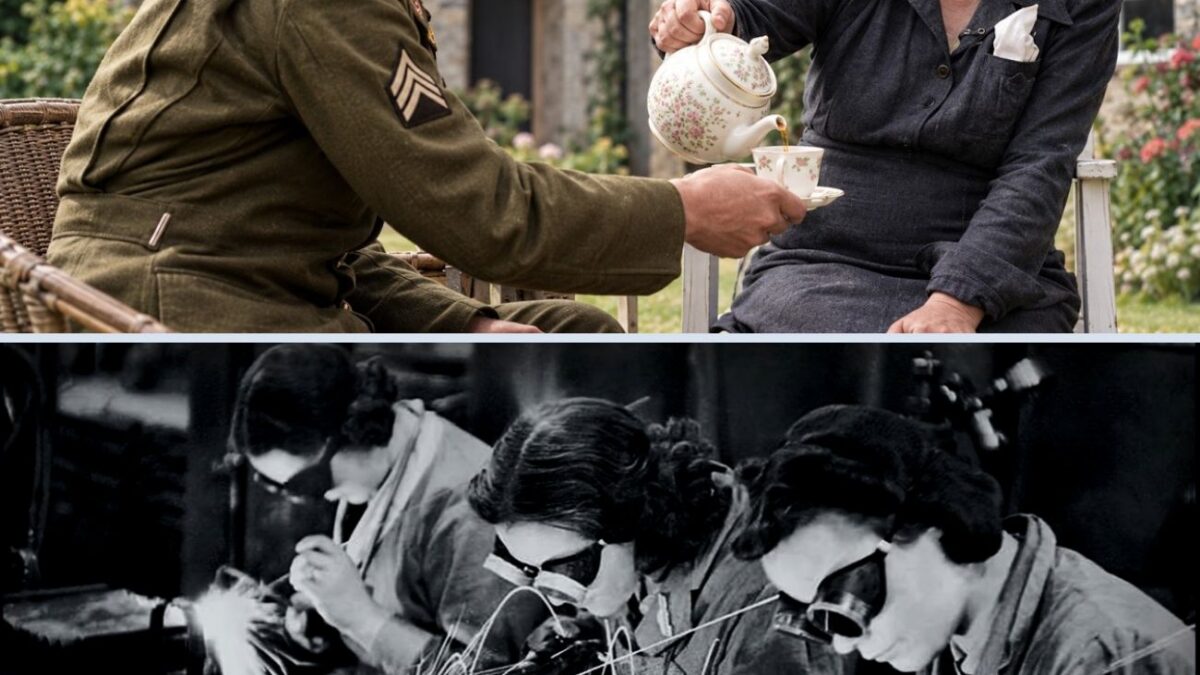
Keep reading though, and a second guide appears underneath the first. “Britain may look a little shopworn and grimy to you. There’s been a war on since 1939. The houses haven’t been painted because the factories have not been making paint. They’re making planes.” The beer, it notes, is now below peacetime strength. And then the instruction about dinner: “If a British host urges you to eat up, there’s plenty on the table, go easy. It may be the family’s rations for a whole week spread out to show their hospitality.” Picture that table. A family has laid out 7 days of food to look like one evening’s plenty for a guest they have never met.
The guide carried a number as well. 60,000 British civilians, men, women, and children, have died under bombs. That figure is the guide’s own. Historians usually give a lower one for the Blitz. More than 43,500 civilians killed between September 1940 and May 1941. I cannot reconcile the two from the record I have read. I give you the guide’s number because it is the one the soldiers were handed. The guide also gave an order that reads like a staff officer’s arithmetic. It is always impolite to criticize your hosts. It is militarily stupid to insult your allies.
Now, set that guide beside the 93 soldiers in Cambridge and Huntingdon, and the comfortable explanation arrives by itself. Two peoples divided by a common language, two national temperaments, one loud and open, the other quiet and closed. The British were reserved, class-bound, and old-fashioned. The Americans were brash, rich, and modern. They grated on each other. That explanation deserves its strongest form because the record supports part of it. Report number 40 says, “The soldiers found English good manners sissy.” It says they heard precise English speech as the speech of the upper classes. The American investigator calls that association mistaken, held erroneously but firmly. Then he adds a sentence that is hard to argue with: “It does make him feel inferior.” That is real friction about speech and class, and no ration book caused it.
So, let us test the temperament explanation against the soldiers’ own list, item by item. Open the ledger. The cut of the women’s clothes. Clothes rationing began on the 1st of June 1941. Every person received 66 coupons a year. An adult raincoat cost 16 of them. A dress cost seven. A pair of stockings cost two. By 1942 and 1943, the yearly allowance had fallen to 60. Women were not out of fashion by choice. They were spending coupons.
The agonizingly leisurely shopkeepers, by August 1942, almost every food except bread and vegetables was rationed. Each purchase meant a ration book, a coupon, a register, and a calculation. I infer, and I mark it as my inference, that a counter where every sale is checked against a government allowance moves more slowly than a counter in Des Moines.
The funny trains. On the 1st of July 1942, the basic petrol ration for private motoring was abolished. For most families, the private car left the road and the railways carried the difference.
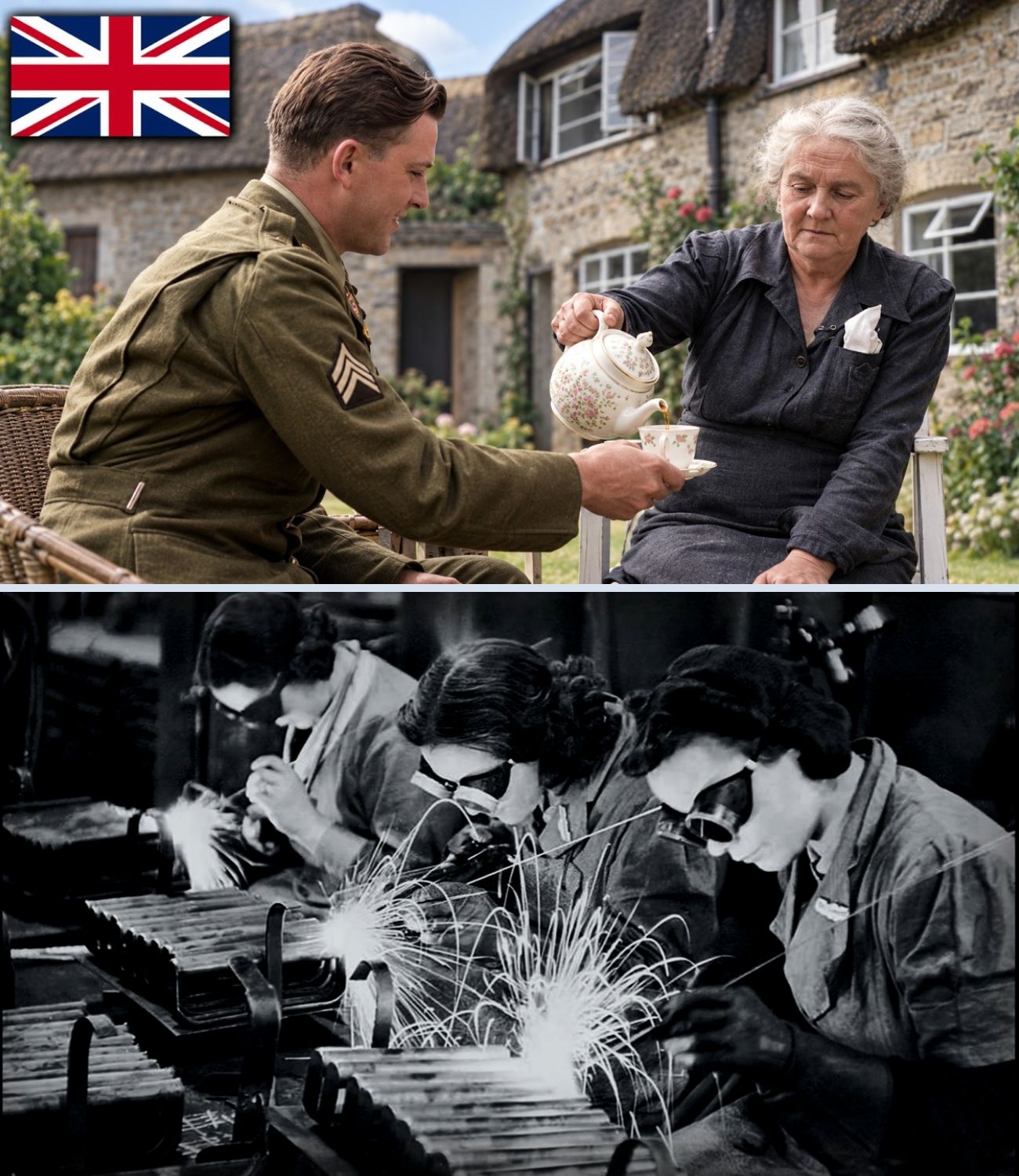
The slovenly business offices. On the 18th of December 1941, Parliament passed a second National Service Act. It made unmarried women and childless widows, age 20 to 30, liable to call up. Many of the clerks who had kept those offices in order were going to factories, auxiliary services, and civil defense. The link to any particular office is my inference. The law is not.
The paint and the grime the guide had already explained. Planes. That leaves three items. The lavatories and the left-hand traffic were British before the war and stayed British after it. Concede both. The hotels I cannot assign. The record I have read does not say why they were uncomfortable, and I will not invent a reason. So, count it up. Eight complaints. At least five carry a wartime date. Two are genuine national habits. One is unknown. National character explains two lines of that list, at most. The rest is a set of government orders, read by strangers as a personality.
That clears the ground, but it does not finish the job. These men had been warned in print about paint and planes and a week of food on one table. Why could they still not see it? For that, we need the second document in the ledger, a soldier’s pay, and the figure from the Commons. 10 shillings a day.
Part two. Two ledgers. Put the two soldiers side by side. Same age, roughly. Same war. Same island. Now, go through them component by component. Pay first. On the 16th of June 1942, President Roosevelt signed the Pay Readjustment Act. It set an army private’s base pay at $50 a month. Service overseas added 20%. A private in England drew $60 a month. Through the war, the pound was held at $4.03. Do the arithmetic and $60 comes to just under £15 a month. Spread across 30 days, that is close to 10 shillings a day. Bellinger’s figure in the Commons was not a flourish. It was a sum. In that same debate, a Major Taylor put the British side weekly. A private on 2 shillings and 6 pence a day drew 17 shillings and 6 pence a week. After 6 months, if he earned his proficiency pay, that rose to 21 shillings. 10 shillings a day against 2 and 6. 4 to 1 before proficiency pay. A little over 3 to 1 after it.
30 seconds on the money itself and then straight back. The pound was divided into 20 shillings and each shilling into 12 pence. 240 pennies made a pound. A single price could need three columns. Report number 40 records what the soldiers made of it. The GI, the investigator wrote, “thinks the monetary system is an example of carrying a national joke a bit too far.” Some suspected it was arranged to confuse them. It was older than their country.
Back to the pay. Food second. The American soldier ate in an army mess supplied by his own army. The British civilian ate from a ration book. A typical adult allowance in 1942 looked like this. 4 oz of bacon and ham a week, 2 oz of butter, 2 oz of cheese, 4 oz of margarine, 4 oz of cooking fat, 8 oz of sugar, 2 oz of tea, and meat rationed not by weight but by price to the value of 1 shilling and 2 pence a week. 1 shilling and 2 pence of meat. A private on 10 shillings a day could have bought that week’s meat ration more than eight times over with a single day’s pay.
Now put yourself inside the Sunday table from the guide. Seven days of bacon, butter, cheese, and sugar set out at once. The guest has never held a ration book. He sees plenty because plenty is what he has been shown. He is told to eat up. He eats.
Clothes third. The soldier wore an issued uniform, replaced by his quartermaster when it wore out. The civilian counted coupons, 66 a year, then 60.
Women fourth. After December 1941, many of the young British women the soldiers met at dances were liable to call up or already in uniform. The guide tried to explain what that meant. “When you see a girl in khaki,” it said, “remember she didn’t get it for knitting more socks than anyone else in Ipswich.” It went further. There is not a single record in this war of any British women in uniformed service quitting her post or failing in her duty under fire. Report number 40 records how much of that landed. The investigator found many soldiers convinced that English girls were inferior to American girls in beauty, in intelligence, and treating them as fair game. The guide had also tried to head off the other easy contempt. The English language didn’t spread across the oceans and over the mountains and jungles and swamps of the world because these people were panty waists.
Leisure fifth. The soldiers admitted to the investigator that they were drinking far more than they drank at home. Asked why, the answer he recorded was short: “What else is there to do?” The pubs were open. The beer was weaker than before the war. Much else was rationed, blacked out at night, or closed.
Now the intuitive answer, and it is a good one. It was money. The report says so outright. The GI, it records, feels that the English soldier is jealous of him because he earns more money and resents him because it looks as though he has come over here to win a war. The comedian Tommy Trinder spread the line everyone still remembers: “The Americans were overpaid, oversexed, and over here.” The GIs had a reply ready: “The British were underpaid, undersexed, and under Eisenhower.”
And the money did its work. A teenage girl in Bournemouth remembered the Americans this way: “They swaggered, they boasted, they threw their money about. How we loved it.” The guide had seen it coming. One of its headings was blunt: “Don’t be a show-off.” American wages and American soldiers pay are the highest in the world, it said. And then, the British Tommy is apt to be specially touchy about the difference between his wages and yours. Four to one. It feels like the whole answer. It is only part of it, and the rest sits in the ration list.
Money only matters for what it can buy. In a country where meat, butter, sugar, tea, clothes, and petrol were all controlled by coupon, extra shillings could not buy more of the essentials. They bought whatever sat outside the coupon system. Drink, dances, cinema seats, gifts, and attention. So, the pay gap did not land on an ordinary market. It landed on the narrow strip of life that rationing had left open. And it landed there four times over. That is why it looked like swagger. A soldier with 10 shillings a day in Chicago is unremarkable. The same soldier in a town where the butcher counts out 1 shilling and tuppence of meat per person per week is a spectacle.
So, here is the real difference between the two men at the bar. Manners played a part, and so did pay. But one of them lived inside a ration book, and the other lived outside it. Each kept a ledger, and the two ledgers were written in different kinds of scarcity. The Americans read the British ledger as a temperament. Thrift looked like meanness. Coupons looked like dowdiness. Shortage looked like backwardness.
Which raises an objection any careful viewer has been holding since the list in Cambridge. If the problem was scarcity, why did the British not simply explain it? Or fix the parts that could be fixed? A government that could run a world war could surely find some paint. To answer that, we need the document every item on the list depended on, a ship’s manifest, and a figure, 70%.
Part three, the ships. The British knew exactly how they looked. That is the first thing the record shows, and it is easy to miss. Report number 40 is itself the evidence. It sits in the Ministry of Information’s own files. Someone in Home Intelligence wanted to know how the guests saw the house and kept the answer.
In 1943, the Ministry went further. It put out a film for American troops called A Welcome to Britain, made by the Strand Film Company. Anthony Asquith directed it with the American actor Burgess Meredith, who also narrated. The Hollywood writer Sam Spewack worked on the script. The American generals Jacob Devers, John C.H. Lee, and Ira Eaker appeared in it, and so did Bob Hope and the actress Beatrice Lillie. It walked soldiers through pubs, dinner invitations, children, strangers, and officers. The Daily Mail wrote that it should do more than any other stroke to create a genuine Anglo-American understanding.
The explaining ran in the other direction, too. Time reported in July 1942 that a British counterpart to the American guide was being written by the journalist Sir Wilmott Lewis for Royal Air Force cadets training in the United States. And in the summer of 1943, the American Office of War Information sent the anthropologist Margaret Mead to England. Her task was to explain American manners to the British. Her account came out as a pamphlet, The American Troops and the British Community. So, the explaining was done by two governments in print and on film.
Explanation could not repaint a house. So, why not repaint it? Look at the arithmetic of an island. Before the war, Britain imported about 70% of its food. By one count, it was bringing in more than a million tons of food, fuel, and other supplies every week when the war began in September 1939. German submarines then spent years attacking that traffic. One museum account gives Britain’s food imports falling from 22.5 million tons to 12 million during the war years.
The American investigator in Cambridge saw the point and wrote it into report 40. “The soldier,” he said, “is talking about and living in an island nation dependent almost entirely on ocean commerce for its produce, a nation that has been totally at war in many theaters all over the world for 3 and 1/2 years.”
Sit with that sentence. It was written by an American in March 1943 about the country his countrymen were complaining about. Now read it as a constraint rather than an excuse. Every ton of cargo space is a choice, wheat or aluminum, fuel for bombers or fuel for family cars, paint for houses or paint for aircraft, cloth for dresses or cloth for uniforms. The government made those choices in writing. The clothes order of June 1941, the call up of women in December 1941, the end of the basic petrol ration in July 1942. Each order made Britain better at fighting and shabbier to look at. So, the grime was not neglect, it was an allocation. The country spent its paint, its cloth, its petrol, and a generation of young women on the war. What the visitors saw was the change left over.
To be fair to the soldiers, report 40 says they allowed that wartime shortages explained part of what they disliked. They knew it in the abstract. What they could not do was read it on the street. Knowing a country is rationed is one act, recognizing a slow queue at a shop counter as rationing is another.
Now I want to shift from the institutional view to the individual one. Behind every line in that ledger stand people the soldiers never met, the crews of the merchant ships who carried that cargo across the Atlantic, the women called up after December 1941 who built aircraft instead of painting houses, the shopkeepers who counted coupons for every customer all day, the families who set out a week’s rations on a Sunday table and told a stranger there was plenty. Their names are not in any report I have read. The list made in Cambridge is, among other things, a record of their work, written down by men who did not know what they were reading.
Pay was the other thing Britain could not fix, and it knew that, too. Go back to the Commons on the 10th of September, 1942. Members already knew the comparison to the shilling. Bellinger read the American rate into the record. Members complained that the press had been given the government’s proposals before the house. Aneurin Bevan called it a most humiliating position for the house. The government’s answer that autumn was a pay rise, and members in the chamber argued it was not generous.
Could Britain have matched the Americans? It had been paying for a war since September 1939. From March 1941, it was receiving American supplies under Lend-Lease, because it could no longer pay cash for everything it needed. A country in that position sets its soldiers pay inside a budget its ally did not share. I do not think the record supports the idea that London kept its soldiers poor out of indifference. I read it as a priority decision, made by a government spending its reserves.
The strongest objection to all this deserves a hearing. It goes like this. I am being too kind to the British. Class snobbery was real. English reserve was real. The soldiers were not imagining the way some Englishmen spoke to them. That is a fair point, and Report 40 supports it. The soldiers felt talked down to, but the same report says their reading of that speech was mistaken, and the class friction accounts for one complaint among many. It does not explain the clothes, the trains, the shops, the offices, or the paint. If you have read Report 40 or letters home from that winter, and you see temperament where I see the ration book, tell me which line in any record makes your case. I would rather be corrected with a document than agreed with on instinct.
There is one misunderstanding though that cuts straight across my argument. In it, the British are the ones who cannot understand and the subject is not scarcity at all. To see it, we have to go to a pub in Lancashire on a June night in 1943 and to one piece of clothing, a field jacket.
Part four, the exception. Start with the case that seems to break everything I have said so far. The United States Army arrived in Britain segregated. President Roosevelt’s policy was that about 10% of the army and of each theater should be black soldiers serving in separate units under mostly white officers. On the 31st of August, 1942, the Foreign Secretary, Anthony Eden, told the War Cabinet that the Americans were still sending the full authorized proportion of colored troops, about 10% of each contingent. By the end of 1942, there were 7,315 black American soldiers in Britain. By the end of 1943, 65,000. By D-Day, 130,000.
Here the misunderstanding seems to flip. In much of the record, it is British civilians who cannot understand American practice and the subject is not rationing. It is race. If my thesis is that scarcity was misread as character, this looks like the reverse, a real difference in values with the British on the decent side of it. That is how the story is usually told. Examine it honestly and the British state does not come out as clean as the story.
In early August, 1942, Major General Arthur Dowler issued notes to British troops on relations with black American soldiers. On the 13th of October, 1942, the War Cabinet met to decide whether Britain should support a discrete color bar. The record of that meeting says this: “It was generally agreed that the people of this country should avoid becoming too friendly with colored American troops.” That was the British government in writing. What it refused to do was enforce it. In September 1942, the Home Office told chief constables: “It is not the policy of His Majesty’s government that any discrimination as regards the treatment of colored troops should be made by the British authorities.”
British police would not enforce American segregation. British facilities would not be segregated by British order. General Eisenhower accepted that an open color bar was unacceptable in Britain and that discrimination should be sedulously avoided. So, the difference was not that one people was tolerant by nature and the other was not. The difference was an institution. The American army brought its own rule book. Britain had no matching rule and declined to write one while its cabinet privately hoped for distance. Even the welcome film was calculated. In A Welcome to Britain, an elderly British woman invites a black American soldier to tea. The filmmakers chose an older woman on purpose so the scene would not provoke white servicemen.
Where the law stayed silent, field practice moved in. On the 7th of September 1942, The Daily Herald reported black soldiers barred from dances and a reading room at Eye in Suffolk. By late 1943, eight of the 1,550 pubs in Ipswich had been designated for black troops only. Between November 1943 and February 1944, one count records 44 clashes between white and black American servicemen in Britain. On the 26th of September 1943, at Launceston in Cornwall, white and black servicemen exchanged gunfire.
Now, from the totals to one night in one town, Bamber Bridge, Lancashire. Thursday, the 24th of June 1943, the 1511th Quartermaster Truck Regiment, a black unit, is stationed nearby at Air Force Station 569, known locally as Adam Hall. Several of its men are drinking at a pub called Ye Olde Hob Inn. Two white military policemen of the 234th Military Police Company walk in. Corporal Roy A. Windsor and Private First Class Ralph F. Ridgeway. They try to arrest Private Eugene Nunn. The offense is his clothing. Nunn is wearing a field jacket instead of the required Class A uniform. A field jacket was the short working jacket a soldier wore on duty. Class A was the formal service dress expected when he went out on pass.
Local people and women of the Auxiliary Territorial Service, the British women’s army, take the soldiers’ side. One account quotes a British soldier asking the police: “Why do you want to arrest them? They’re not doing anything or bothering anybody.”
The argument moves into the street. It turns violent. A military policeman shoots Private William Crossland in the back. Crossland dies. Later that night, men of the 1511th take weapons from their camp. Soldiers and military police fire at each other in the dark. The shooting stops at about 4:00 in the morning. Here is the cost. One soldier dead, between four and seven wounded, depending on the account. The courts-martial convicted between 27 and 32 men of the 1511th, depending on which record you follow. The National Archives summary gives 32 convicted of mutiny and related crimes. Sentences ran from 3 months to 15 years. On review, they were reduced and one man was released. The last of them was freed after 13 months. No white military policeman was charged.
Under wartime censorship, British newspapers reported only that violence had broken out in a town somewhere in northwest England. The charge that started it concerned a jacket. A story grew up later that all three pubs in Bamber Bridge put up black troops only signs when American commanders demanded a color bar. The novelist Anthony Burgess told it. The historian Harold Pollins looked for evidence and found none. Treated as a memory, not a document.
The strongest testimony came from the man with the most reason to keep quiet. General Ira Eaker commanded the Eighth Air Force, the American air arm the station at Bamber Bridge belonged to. His military police and his officers were the ones in question. He placed most of the blame on the white officers and military police, citing poor leadership and racial slurs. Another record has him saying that 90% of the trouble with Negro troops was the fault of the whites. That is an American commander indicting his own side in a matter that reflected on his own command. It is strong evidence for exactly that reason. It cost him something to say.
So, does this exception break the thesis? I read it the other way around. What did the people in that pub fail to understand about America? Not American character. They failed to understand a regulation, an army rule set in Washington that decided which soldiers drank where and who could arrest whom. What did the soldiers in Cambridge fail to understand about Britain? Also a set of regulations, a petrol order, a clothes order, a call-up, a ration book written in London. In both directions, strangers met an institution and took it for a people. The exception has the same shape as the rule. The difference is that this time the bill was paid in a life, which leaves one task. Add the columns, all of them, from the convoy at Belfast to the jacket in Lancashire and see what the totals say about the question in the title. That is the verdict and it begins with a figure, 60,000.
Part five, the verdict. Open the ledger one last time and read only the totals. The 26th of January 1942, 4,058 soldiers come ashore at Belfast. June 1944, between 1 and 1/2 million and more than 1.6 million Americans in the United Kingdom, depending on the count. Black American soldiers among them, 7,315 at the end of 1942, 65,000 at the end of 1943, 130,000 by D-Day. One printed guide. Tea and the king. Grim and plain. A week of food on one table. One report number 40. 93 soldiers, eight complaints. At least five with a wartime order behind them. A private’s pay, 10 shillings a day against two shillings and sixpence. A meat ration, one shilling and two pence a week. Clothing, 66 coupons a year, then 60. Basic petrol for private cars from July 1942, none. One soldier dead in Lancashire after a dispute over a jacket. And after the war, more than 60,000 British women and about 1,800 Irish women married American servicemen. 60,000 marriages. Whatever the soldiers failed to understand, it did not keep them from staying.
Now, the witnesses with every reason to say the opposite. The investigator of report 40 was an American writing about Americans for a British ministry. He could have flattered his countrymen. Instead, he recorded their contempt for good manners, called their reading of English speech mistaken, and reminded his readers that the soldier was living in an island nation dependent almost entirely on ocean commerce. Frederick Bellenger was a British Member of Parliament. He stood up in the Commons and put his own soldiers’ poverty on the record beside the wealth of an ally. Ira Eaker blamed his own police. And the soldiers themselves, after listing everything they disliked, kept ending on the same sentence. One of them gave the investigator advice that sounds like a man who had learned it the hard way: “If you want to get along with them, don’t knock their country because they can’t take it.”
So, let me pay off the title in plain words. What American soldiers could not understand about Britain was that they were not looking at Britain. They were looking at a country in its fourth year of total war, and they took the war for the country. They saw ration books and read stinginess. They saw coupons and read dowdiness. They saw empty roads and crowded trains and read backwardness. They saw offices thinned by the call-up and read slovenliness. They saw soldiers on two and six a day and read jealousy.
Each of those was a government order, a shipping figure, or a budget line. Each was read as a trait of character. And the misreading ran both ways. At Bamber Bridge, British civilians met an American Army regulation and read it as America. The shared language made it worse, and the reason is simple. In a foreign language, every difference announces itself as foreign. And the visitor keeps translating. In the same language, the visitor assumes he already understands. He stops translating at the dock.
That is the principle, and it outlives the subject. A visitor who arrives in the middle of a scarcity will see the scarcity as a temperament. He reads the ledger as a personality.
Go back to Cambridge. March 1943. The man in civilian clothes is still walking the streets. Still telling soldiers he writes for a New York magazine. Still taking down the list. Leisurely shopkeepers. Uncomfortable hotels. Funny trains. The cut of the women’s clothes. Slovenly offices.
Read it now. And it is no longer a list of what was wrong with Britain. It is an inventory of what the war had already spent. The petrol. The cloth. The paint. The clerks. The patience of a shopkeeper checking coupons for every customer every day for years.
This story belongs to the people on the other side of that list. The hosts. The shopkeepers and the clerks. The women in khaki and the women in the aircraft factories. The merchant crews. The families who laid out a week of food for a stranger and told him there was plenty. Most of them left no name in any file I have read. They deserve to be remembered.
Picture him one last time in a street in Cambridge writing down the line the soldiers kept coming back to: “They’re okay and I’m for them and we’ll win this war.” Around him in every shop on the street someone is counting coupons.
You Might Also Enjoy

“We Thought They Would Negotiate”—What Argentine Soldiers Said When The British Attacked Goose Green

“You’ll Never Finish My Ruck March, Limey” — US Sergeant Who Challenged the SAS, Then Fell Out First






