What German Special Forces Said When They Were Sent to Fight the SAS
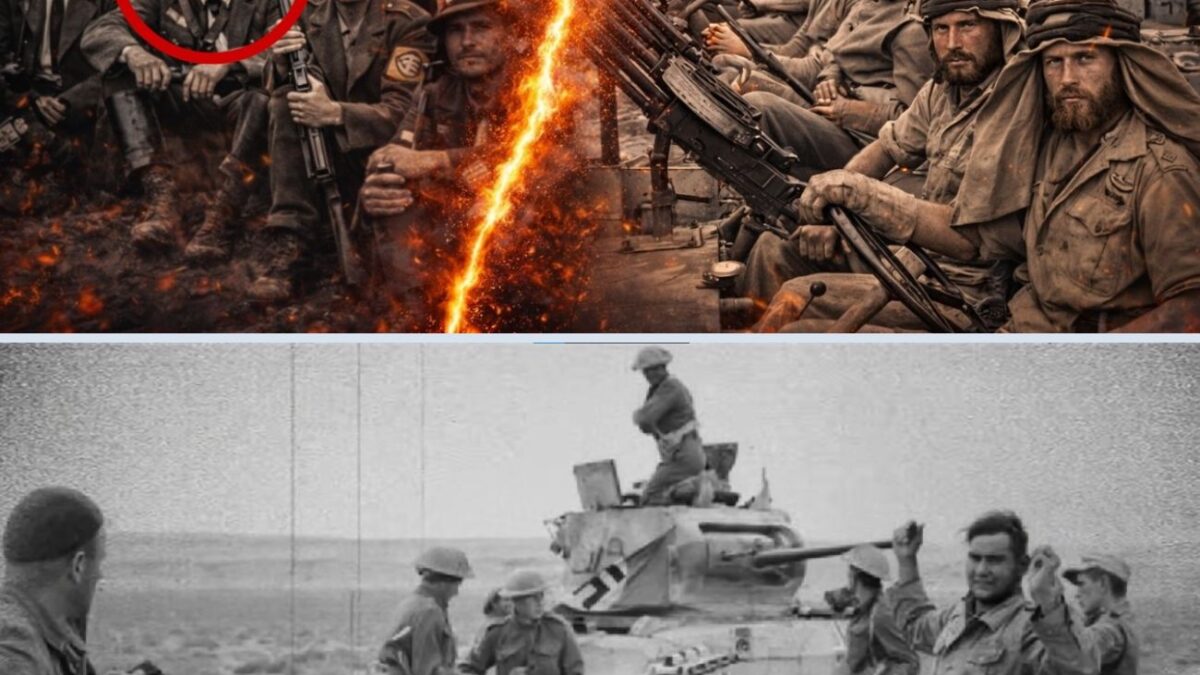
October 1941. A handful of German soldiers landed in Tripoli who spoke perfect English, carried British weapons, and had orders to become the enemy in every way imaginable. They were called Brandenburgers, Germany’s secret special forces. And they had been fighting behind enemy lines two full years before the British SAS even existed. So, what happened when Hitler’s forgotten commandos were sent into the same desert as the most famous special forces unit in history?
A small group of German soldiers climbed off a transport plane into air so hot it burned the inside of their lungs. They did not look like regular Wehrmacht troops. They were not dressed in standard grey. Some had skin tanned dark from years under the African sun. While some had been born on farms in a place that used to be called German Southwest Africa before the British took it after the First World War. Others came from families scattered across old German colonies in East Africa, Togo, and Cameroon. Territories lost a generation ago and never forgotten.
These men spoke English as easily as they spoke German. Many of them spoke Arabic. Some spoke Swahili and half a dozen African dialects on top of that. They carried forged identity papers. They knew how British soldiers walked, talked, and acted. And they had been sent to the desert with one job. Get behind British lines. Become the enemy. And do whatever it took to help Erwin Rommel win the war in North Africa.
These men were Brandenburgers, members of Germany’s most secret special forces unit. And at the time they landed in Tripoli, almost nobody in the Allied world knew they existed. The unit was the creation of a man named Theodor von Hippel.
During the First World War, von Hippel had served under General Paul von Lettow-Vorbeck in German East Africa, where a tiny force of German colonial soldiers had fought a brilliant guerrilla war against a British army 10 times its size. Lettow-Vorbeck was never defeated. He fought for 4 years using speed, deception, and knowledge of the land to humiliate one of the largest empires on Earth. He only laid down his arms after the armistice ended the war, unbeaten in the field from the first day to the last.
The experience changed von Hippel forever. He came home from that war convinced that small groups of well-trained men, fluent in foreign languages, and schooled in the enemies’ own customs could do more damage deep in hostile territory than entire battalions could do at the front.
When he pitched the idea to the German army, they threw it out. Traditional Prussian officers called it dishonourable. They said men who fought in disguise and used deception did not deserve to be called soldiers.
Von Hippel did not give up. He took his idea to Admiral Wilhelm Canaris, the head of the Abwehr, Germany’s military intelligence service. Canaris said yes. And on October 15th, 1939, the Brandenburgers were officially born.
That date matters. It was 2 full years before a tall, restless Scotsman named David Stirling would talk his way into a hospital bed meeting with a British general and pitch an idea for a unit that sounded almost identical.
The SAS would not exist until the summer of 1941. By then, the Brandenburgers had already seized bridges in Poland, infiltrated the Netherlands disguised as Dutch police, and crossed the Soviet border dressed as Red Army soldiers before Operation Barbarossa even began.
The recruitment rules for the Brandenburgers were the exact opposite of the SS. While Heinrich Himmler wanted blond-haired, blue-eyed Aryans, von Hippel wanted the opposite. He scoured Germany’s borders looking for Slavs, ethnic minorities, and men who had grown up in foreign countries. Every recruit had to speak at least one foreign language fluently. Many spoke three or four.
They trained at a country estate outside the city of Brandenburg, learning sabotage, hand-to-hand combat, demolitions, and how to move through enemy territory without being noticed. They learned to handle Allied weapons. They drove captured Allied tanks. Then they studied the habits, slang, and body language of enemy soldiers until they could pass as one of them in broad daylight.
Now, in October 1941, a hand-picked group of these men arrived in North Africa under the command of Oberleutnant Fritz von Koenen. Born in Danzig, but raised in what is now Namibia, von Koenen was a man who knew Africa the way other men knew their own backyards. He divided his company into two half companies and set up operations in Tripoli.
More than 60 men had volunteered. Most of them had colonial roots. All of them spoke English. All of them could disappear into the desert landscape like they had been born in the sand. But there was a problem. Field Marshal Rommel did not want them. The Desert Fox believed in tanks, not tricks. He saw no use for spies and saboteurs. And von Koenen’s men had been sent to fight a war their own commanding general thought was a waste of time.
And somewhere out in that same desert, 500 miles to the east, David Stirling was about to jump out of a plane with 55 men and a bag of homemade bombs. The SAS was about to be born. And the biggest shadow war of the entire conflict was about to begin right under Rommel’s nose.
To understand what von Koenen’s men were walking into, you have to understand what was already happening on the other side of the desert. The first SAS operation was a disaster. On the night of November 16th, 1941, David Stirling and 55 men parachuted into the desert behind German lines to attack five forward airfields near Gazala. They jumped into one of the worst storms North Africa had seen in 30 years. High winds scattered the men across miles of empty sand. Equipment containers vanished into the darkness. When the sun came up, 34 of the original 55 were dead, wounded, or captured.
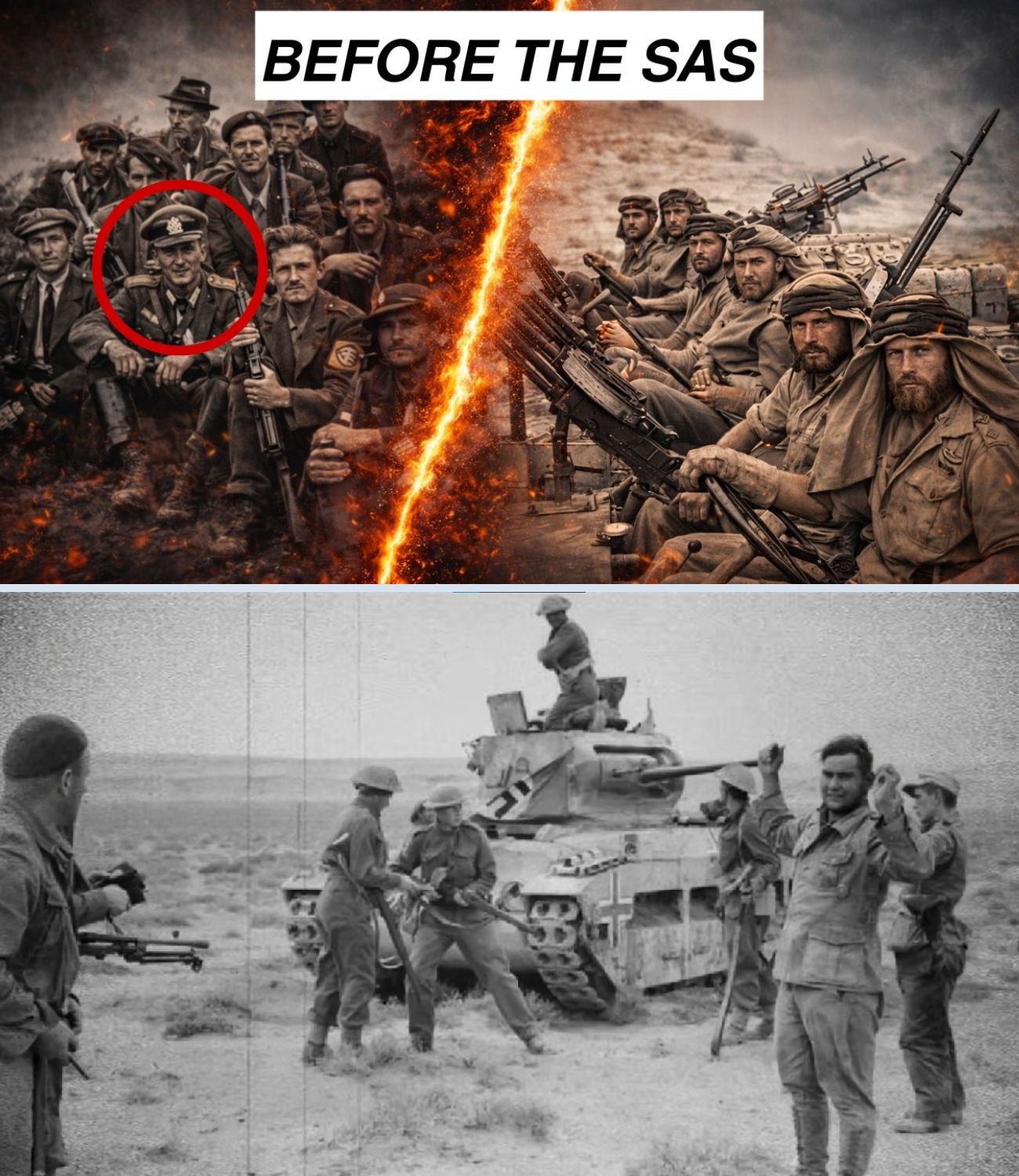
Stirling and the survivors were rescued by the Long Range Desert Group, the LRDG, a British reconnaissance unit that drove modified trucks hundreds of miles into Axis-held territory to spy on enemy movements. The LRDG became the SAS’s lifeline, and from that point on, Stirling abandoned parachutes. The LRDG would drive the SAS to their targets instead.
It worked. On December 14th, 1941, Stirling’s men hit the airfields at Sirte and Tamit. A wild Irishman named Paddy Mayne walked onto the tarmac at Tamit and destroyed 24 aircraft in a single night, ripping instrument panels out with his bare hands when his bombs ran out. The pattern was set. Sneak onto airfields at night, plant bombs, vanish before dawn.
Rommel placed a bounty of 100,000 reichsmarks on Stirling’s head. The Germans called him the Phantom Major. By mid-1942, the SAS had destroyed over 250 Axis aircraft on the ground, blown up fuel dumps, wrecked railways, and raided ports.
On the night of July 26th, 1942, Stirling pulled off his masterpiece. 18 Jeeps armed with Vickers K machine guns drove in V formation straight onto the Sidi Haneish airfield. Stirling fired a green flare and the Jeeps surged forward. Within minutes, dozens of Axis aircraft were burning. The raiders disappeared into the night. It was one of the most audacious raids of the entire war.
But what nobody in the SAS knew, what almost nobody in the entire Allied command structure knew, was that the Germans had men doing the exact same thing. And those men had been doing it longer.
Von Koenen’s Tropen Company began active operations in early 1942. Their original mission was simple, short reconnaissance patrols behind British lines to gather intelligence for Rommel’s Panzer Army. But by June 1942, Rommel’s advance towards Egypt changed everything. The Brandenburger’s role expanded from gathering intelligence to active raiding.
They started operating exactly like the LRDG, deep in the Allied rear. Long-range missions across hundreds of miles of open desert using captured British vehicles, driving British Jeeps armed with machine guns, riding in British trucks. They even acquired a captured Spitfire fighter aircraft and flew it on reconnaissance missions over Allied positions. They wore khaki. They spoke English at checkpoints. They carried British weapons. When they drove through Allied-held territory, nobody looked twice because everything about them, the vehicles, the uniforms, the language, the body language, was British.
The most ambitious Brandenburger mission in Africa was Operation Dora. In June 1942, a special task force of roughly 100 men under Oberleutnant Konrad von Leipzig departed Tripoli with 24 captured British vehicles, 12 trucks fitted with 40 mm guns, four armed jeeps, a command vehicle, and a signals truck. Their destination was French Chad in Central Africa.
The total distance was 2,485 miles across the Sahara Desert. They built an airstrip in the deep desert. They set up a listening post to intercept Allied radio communications. They were operating a thousand miles behind the front lines, as deep into enemy territory as anything the LRDG had ever attempted. Several Brandenburgers were killed at Bir Hakeim in June 1942 and at the first battle of El Alamein the following month. And neither side knew the full truth of what was happening.
Two units born from the same idea, shaped by the same First World War guerrilla legends, rejected by the same kind of generals who thought war should only be fought in straight lines, now hunting each other across the same stretch of sand. The only difference was the flag on the vehicle.
December 1942, Tunisia. The war had turned. Montgomery had smashed through at El Alamein and Rommel was retreating west. The Americans and British had landed in French North Africa in Operation Torch. The Axis forces were being squeezed from both sides and the end of the desert campaign was coming fast.
Von Koenen’s Brandenburgers were flown to Hammamet, Tunisia with new orders. Stop the Allied advance by any means necessary. Their targets were no longer British airfields. They were American and Free French supply lines. And the Americans had never faced anything like them.
Von Koenen had an idea that nobody else in Tunisia was trying. He would use gliders, silent, engineless aircraft that could float over enemy lines in total darkness and land his men directly on top of their targets. On the night of December 26th, 1942, two gliders packed beyond their maximum capacity lifted off and headed for southern Tunisia.
Von Koenen was in the lead glider. The target was the railroad bridge at Sidi Bou Bekar, which crossed the Wadi el Kebir, one of the only crossings the Americans and Free French could use to reach the town of El Guettar. A second team, under Lieutenant Hagenauer, took a single glider toward a bridge north of Kasserine that carried the main Allied supply route. Both teams landed in darkness. Both teams reached their targets. Both bridges were destroyed. And the Brandenburgers fought their way out under fire from Free French guards and disappeared into the mountains.
In a single night, von Koenen had cut two of the most important supply routes in southern Tunisia using nothing but gliders, explosives, and men who moved through the dark like they owned it. In January 1943, a Brandenburg team under Lieutenant Fuchs destroyed another bridge over the Wadi el Mellel, deepening the chaos in the American rear.
But the operation that earned von Koenen his place in military history came in February 1943 at a small village called Sidi Bou Zid. The Americans were new to the desert war. Their troops had not yet faced seasoned German special forces. Von Koenen hit them before they understood what was happening. His Brandenburgers raided the American position and captured 27 tanks and armoured troop carriers along with massive supplies of guns and ammunition. It was one of the largest single hauls a commando unit had taken in the entire war.
Weeks later, the wider battle of Kasserine Pass would become famous as the moment American forces learned the brutal cost of inexperience. But before Kasserine, there was Sidi Bou Zid. And before Kasserine, there was von Koenen. He earned the Knight’s Cross for that raid. He was 26 years old.
Meanwhile, the SAS had lost its own leader. In January 1943, David Stirling was captured by the Germans. The Phantom Major was gone. He would spend the rest of the war in prisoner of war camps. The SAS continued under Paddy Mayne. But the desert chapter was closing.
In 15 months of operations, Stirling’s raiders had destroyed over 250 aircraft confirmed, with estimates running closer to 400 when damaged planes and secondary explosions were counted. They had hit dozens of supply dumps, wrecked railways, and struck nearly 50 key positions. Their record was extraordinary.
But nobody would remember the Brandenburgers’ war. Not the tanks they captured. Not the bridges they dropped from the sky to destroy. Not the 2,500 miles they drove across the Sahara in stolen vehicles. Not the radio intercepts from a thousand miles behind the front. None of it. One side would be remembered forever. The other would be erased.
In May 1943, as the Axis surrender in North Africa became inevitable, the surviving Brandenburgers escaped by sea to Italy. They left behind nothing but sand, links of spent ammunition, and a story the world would choose to forget.
Fritz von Koenen never came home. After North Africa, he was transferred to Yugoslavia to fight Tito’s partisans in the mountains of the Balkans. The men who had outsmarted the Americans in Tunisia now faced guerrilla fighters who could not be bluffed, bribed, or outmanoeuvred.
On August 21st, 1944, near the town of Višegrad in what is now Bosnia, von Koenen was killed in a partisan ambush. He was 28 years old. The boy from Namibia who had spoken five languages and led glider raids in the dark died on a dirt road in a country he had no connection to, fighting a war that was already lost.
One month before von Koenen was killed, the Brandenburgers’ entire world collapsed. On July 20th, 1944, a group of German officers tried to assassinate Adolf Hitler with a bomb hidden in a briefcase. The plot failed, and among the men implicated in the conspiracy was Admiral Wilhelm Canaris, the head of the Abwehr, the man who had said yes to von Hippel’s idea in 1939, the man who had built the Brandenburgers from nothing.
Canaris was arrested, tortured, and eventually hanged. The Abwehr was destroyed, and because the Brandenburgers had always been Canaris’s personal unit, his own special forces, they were punished by association.
In September 1944, the Brandenburg Division was stripped of its special forces role. The unit that had operated on every front of the war, seized bridges before invasions, infiltrated hostile nations in disguise, mapped and fought a shadow war across two continents, was reclassified as a regular motorised infantry division and shipped to the Eastern Front.
There, they were ground up like every other German unit caught between the advancing Soviet Army and the collapse of the Third Reich. About 1,800 Brandenburgers managed to transfer to Otto Skorzeny’s SS commando units and continue as special operators until the end. The rest fought and died as ordinary infantry. No one asked them about the desert. No one asked them about Tunisia. No one asked them about anything at all.
Theodor von Hippel, the man who started it all, survived the war. He lived quietly in Germany until January 1st, 1977. He was 86 years old when he died. Almost nobody noticed.
After the war, some surviving Brandenburgers found new homes in unlikely places. Several joined the American CIA. Others were recruited into the British SAS, the very unit they had fought against in the desert. Others became mercenaries in Africa, returning to the continent where many of them had been born. They scattered across the world like seeds from a dead tree, carrying skills that every intelligence agency on Earth wanted, but nobody would publicly acknowledge.
The SAS went on to become the most famous special forces unit in history. Books were written about them. Movies were made. Their motto, “Who dares wins”, became one of the most recognised phrases in military culture. David Stirling was knighted. Paddy Mayne became a legend. The LRDG was celebrated as one of the great reconnaissance units of the war.
Every modern special forces unit in the Western world traces its roots back to what happened in the North African desert between 1941 and 1943. The Brandenburgers became a footnote. They were erased for three reasons. First, the Abwehr’s connection to the plot against Hitler tainted everything Canaris had ever touched. Second, Germany’s post-war reckoning with its own history made celebrating any Wehrmacht unit politically impossible. And third, the oldest reason in the world, the winners write the story.
The SAS had better storytellers. The Brandenburgers had none. Two men had the same idea, inspired by the same wars, rejected by the same kind of rigid military thinkers. Both built units from nothing. Both sent their men into the same desert at the same time using the same methods.
One of them became a legend. The other was forgotten. Not because he failed, but because he fought on the wrong side. The desert does not care which flag you carry. It buries everyone the same way. But history does not work like the desert. History remembers who it chooses to remember. And somewhere beneath the sand of North Africa, two shadows still cross paths in the dark. But only one of them ever walked into the light.
You Might Also Enjoy

“We Thought They Would Negotiate”—What Argentine Soldiers Said When The British Attacked Goose Green

“You’ll Never Finish My Ruck March, Limey” — US Sergeant Who Challenged the SAS, Then Fell Out First






