What Happened To Prince Philip’s 4 Sisters After He Died
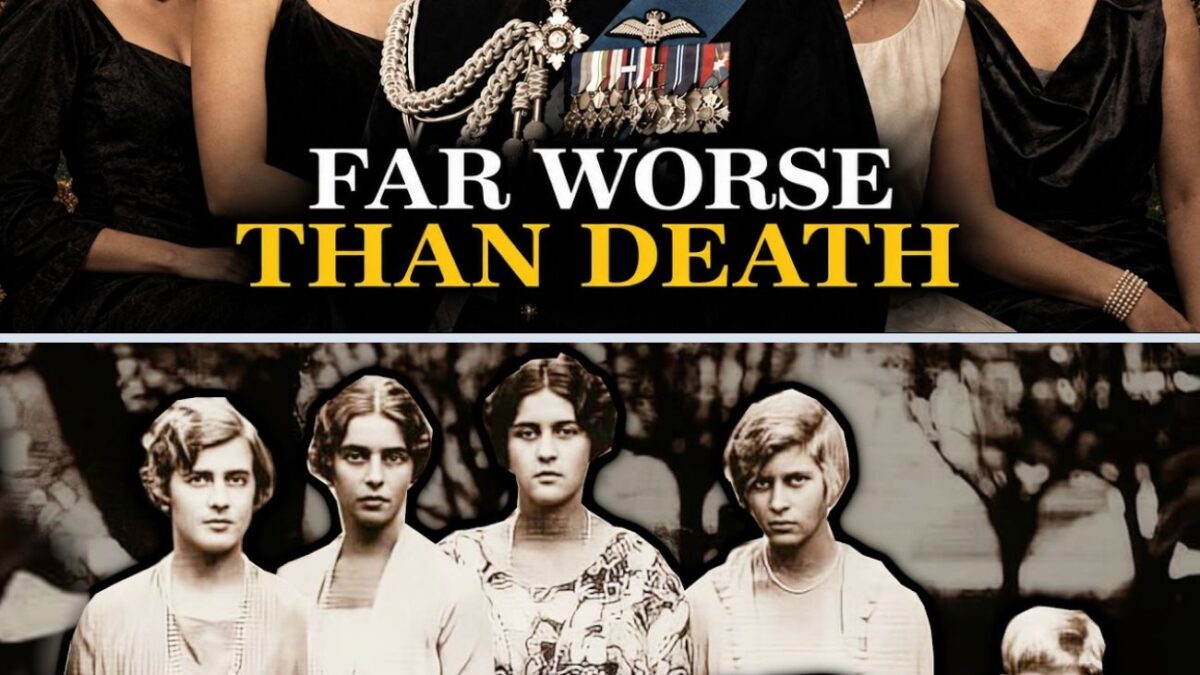
That photograph is real. You can find it in archives today. Darmstadt, the 23rd of November, 1937. A long line of mourners moving slowly through a German city. And near the front, a tall teenage boy in a dark overcoat, hands at his sides, face completely blank. On one side of him, men in the uniform of the SS. On the other, men wearing the swastika armband of the Nazi party. Behind them, the coffins. The boy is Prince Philip of Greece and Denmark. He is 16 years old, and he is burying most of his sister’s family.
A 16-year-old boy walks behind a coffin through the streets of Darmstadt. The men beside him wear swastika armbands and SS uniforms. 10 years later, that boy married the future queen of England. Inside the coffin was his sister. She was 8 months pregnant. Rescuers found a newborn in the wreckage. Another sister’s husband ran Hermann Göring’s secret surveillance service. A third sister’s husband was arrested after the plot to kill Hitler. Their mother, meanwhile, was hiding a Jewish family in Athens. And in 1947, when Philip married Elizabeth, not one of his four sisters was there. Nobody explained why. Her name was Cecilia. She was 30. And 7 days earlier, she had boarded a plane in Frankfurt with almost everyone she loved. The occasion was a wedding. Cecilia’s brother-in-law, Prince Louis of Hesse, was marrying a young English woman named Margaret Geddes in London, and the Hesse family was traveling over for it. Cecilia was 8 months pregnant. Doctors today would not have let her near an aircraft. In 1937, nobody stopped her. She went with her husband, Georg Donatus, the heir to the House of Hesse and by Rhine, their two small sons, Ludwig, who was six, and Alexander, who was four, and Georg Donatus’ mother, the Dowager Grand Duchess Eleanor. One child stayed behind in Darmstadt, Johanna. She was two, considered too young for the journey. Remember her.
The aircraft was a Belgian Sabena airliner, a three-engine Junkers, flying from Frankfurt to Croydon with a stop planned at Ostend on the Belgian coast. The weather that morning was awful. Thick fog rolled off the North Sea and sat on the ground. The pilot circled trying to find the airfield, dropping lower and lower to see something, anything beneath him. At around half past 11:00, close to the village of Steene, a wing clipped the top of a brick factory chimney. The plane came down in a field and burned. Everyone on board died. Then, the rescuers found the baby. Among the wreckage was the body of a newborn infant. The evidence suggested Cecilia had gone into labor during those long minutes of circling, or in the moments of the crash itself. It is one of those details that sounds invented. It is not. It appeared in the contemporary reporting, and it has been in every serious account of the family since.
Philip was at school in Scotland, Gordonstoun. He was called out and told that his sister, her husband, her two small boys, and their grandmother were all dead, and that he was expected in Germany for the funeral. He traveled there alone. And here is the part that tells you what kind of childhood this actually was. The funeral in Darmstadt was the first time in six years that Philip’s mother and father had stood in the same place. Princess Alice came from Greece. Prince Andrew came from Monte Carlo. They had not seen each other since 1931. It took the deaths of five members of the family to put the parents of Prince Philip in the same room.
The other thing about that funeral is who else came. Cecilia’s family was now part of the German aristocracy, and the German aristocracy in 1937 belonged to the Reich. Hermann Göring attended. The streets were lined. The coffins were draped. And walking in that procession, in the photographs that survive, are Philip’s own brothers-in-law in Nazi uniform.
Which brings up the question everybody asks about Cecilia. So, let’s deal with it directly rather than hinting at it. Yes, Cecilia and her husband had joined the Nazi Party. They signed up on the 1st of May, 1937, 6 months before the crash. Their membership numbers are in the records. Georg Donatus appears to have been enthusiastic about it. What Cecilia herself believed is harder to establish because she left very little behind that speaks for her. You will see headlines calling all four of Philip’s sisters Nazis. That is lazy. Four women, four marriages, four completely different positions inside Germany. And by the end of the war, one of their husbands would be under Gestapo suspicion for his links to the men who tried to blow Hitler up. We’ll get there. But the crude version, four princesses, one ideology, collapses the moment you look at them one at a time.
Now back to Johanna, the 2-year-old who stayed home. Overnight, she became the only surviving child of the senior branch of the House of Hesse. Prince Louis, whose wedding they had all been flying to, married Margaret Geddes anyway, quietly, the day after the crash in London, because the arrangements could not be undone. Then the newlyweds came back to Darmstadt and adopted the little girl. 20 months later in June 1939, Johanna died of meningitis. She was three. Cecilia’s entire line was gone inside two years. Her husband, three children, and one unnamed newborn.
So how does a Greek prince end up with four sisters married into German princely houses, a mother he barely saw, and no home to go back to? That part of the story starts seven years earlier and it happened fast. The family had already lost one country. In 1922, after a military disaster in Asia Minor, Philip’s father was arrested by a revolutionary court in Athens, tried, and banished for life. Six of his fellow defendants were shot. A British warship, HMS Calypso, took the family off. Philip was 18 months old and reportedly slept in a cot improvised from a fruit box. The four girls were 17, 16, and eight.
They landed in Paris in a borrowed house at Saint-Cloud lent by a wealthy relative and lived there on other people’s money for most of the 1920s. Prince Andrew had no income and no occupation. Alice threw herself into charity work for Greek refugees, then into religion with an intensity that alarmed people around her. In 1930, it broke. Alice was diagnosed with schizophrenia. She was removed from the house, accounts agree she was taken against her will, and placed in a sanatorium at Kreuzlingen in Switzerland run by the psychiatrist Ludwig Binswanger. Sigmund Freud was consulted on her case. His recommended treatment, by the standards of any later century, was brutal.
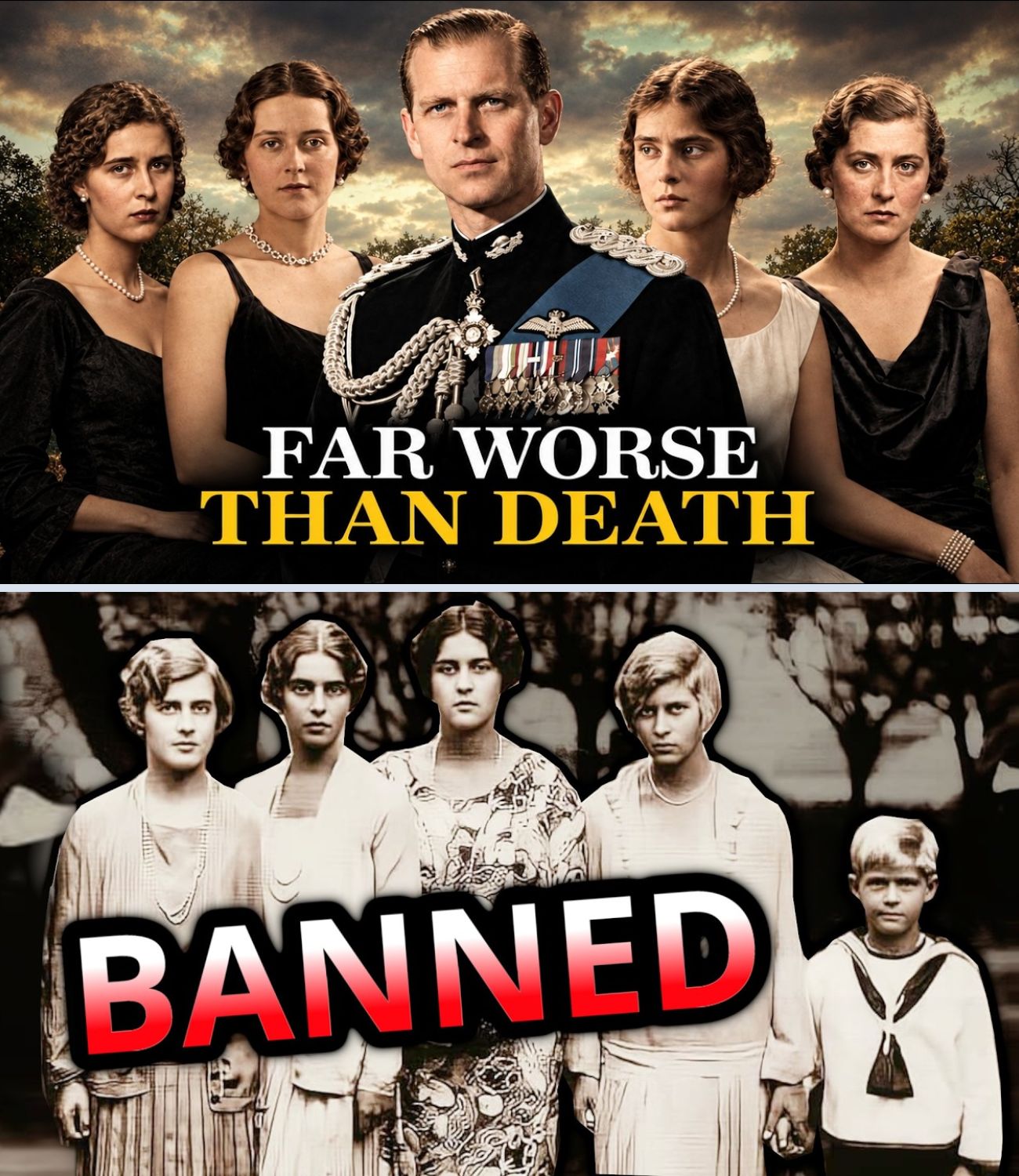
Philip was nine. He would not see his mother again for five years. Prince Andrew closed the house at Saint-Cloud, sold what there was to sell, and moved to the south of France, where he lived in hotels and on a yacht, largely supported by a companion, and effectively stopped being a father. He and Philip would meet occasionally. They were not estranged in any dramatic sense. They just no longer shared a life.
And then something happened that laid out on a calendar is genuinely startling. Between December 1930 and August 1931, 16 months, all four sisters married. All four married German princes. And Philip, aged nine and then 10, watched his family reassemble itself in a country he did not live in as a series of weddings he attended as the small boy in the front row.
Sophie went first. She was 16 years old, 16, when she married Prince Christoph of Hesse in December 1930. Christoph was 29. He was also, within a few years, an officer of the SS and the head of a secret government agency that read other people’s mail and tapped their telephones. Sophie’s story is coming, and it is the darkest of the four. Cecilia married Georg Donatus of Hesse two months after that in February 1931. Margarita, the eldest, married Prince Gottfried of Hohenlohe-Langenburg in April. Theodora, the second sister, married Berthold, Margrave of Baden, in August. Four weddings, two of them into the same Hesse family, and by the end of that summer, Philip had no parents at home and no sisters in the same country.
So, he was passed around. School in Paris, then a prep school in Surrey, then Germany, then Scotland. Holidays with his uncle George, the Marquess of Milford Haven, and his grandmother at Kensington Palace. Somebody once asked him which language was spoken at home. He is reported to have answered with a question. What did they mean by home?
The German stretched matters because it came from a sister. In 1933, Philip was sent to Schule Schloss Salem, a boarding school on Lake Constance owned by Berthold’s family, Theodora’s husband. So Philip’s schooling was, briefly, a family favor. It lasted two terms. It ended because of politics that had nothing to do with him and everything to do with him. Salem’s headmaster, Kurt Hahn, was Jewish. He had publicly attacked the Nazis before they took power, and in 1933, he was arrested. Influential friends in Britain got him out. He left for Scotland and founded a new school on the Moray Coast, Gordonstoun. Philip followed him there.
There is a detail from those two terms at Salem that people repeat, and it is worth repeating carefully. The Nazi salute had become compulsory in German schools. Philip, by several accounts, found it funny because the raised arm looked to him like the gesture boys used at his English prep school when they wanted to be excused to the lavatory. He laughed. That is the story as it has been told by biographers, and it may have been tidied up over the years. What is certain is that he did not stay.
Which is how a Scottish schoolboy came to be standing in Darmstadt in November 1937 between a brother-in-law in an SS uniform and a mother he had barely seen since he was nine. Alice had come out of the sanatorium in 1932, and for several years afterwards, she moved around Europe more or less untraceably, sometimes without telling her own children where she was. By 1937, she was back in Greece and beginning the work that would define her. She had started wearing the gray habit of a nursing nun, and during the German occupation of Athens, in a small flat with soldiers on the street below, she did something that would take 60 years to become public.
Hold that thought because it produces the single strangest fact about this family. While the mother was in Athens doing what she did, her four daughters were inside Germany, married to men in German uniform, and her only son was in the Royal Navy, at sea, fighting them. One family, both sides of the war, no contact for years.
But the war is still 2 years away from that funeral, and something else happens first in the house of the sister nobody expected to end up closest to the top of the Nazi state. Sophie was the baby of the family. She was the one who could not remember Greece because she was eight when they were evacuated and her memory started in a borrowed French house. She was the one who married at 16, and in the middle of the 1930s, she was living in Berlin with a husband whose office had a name so bland it was designed to tell you nothing, the research office, Forschungsamt. It was Hermann Göring’s wiretapping service. It read the diplomatic cables of foreign governments. It listened to Germans. It reported to the top of the regime. Christoph of Hesse ran it, and what happened to him in October 1943, over a mountain in Italy, is argued about inside the family today.
Start with the wedding because the arithmetic is uncomfortable. Sophie was 15 when she got engaged and 16 when she married. Christoph of Hesse was 29. Charming, athletic, a grandson of a German emperor’s sister, and broke in the way a lot of German princes were broke after 1918. Enormous name, no state, no job. They married in December 1930 at Kronberg in the castle his family kept in the wooded hills above Frankfurt. Within 18 months, Sophie had her first child. She would have five children before she turned 30. She would bury her husband before the fifth one was born.
Christoph found his job quickly and he found it in the one organization that was hiring ambitious unemployed aristocrats. He joined the Nazi Party in 1931 before Hitler had power. He joined the SS the following year. For men like him, this was not a slow drift. It was a career decision made early when the party was still a gamble and it paid off faster than almost anything else could have.
By 1935, he was running an agency called the Forschungsamt, the research office. The name was deliberately boring. What it actually did was intercept communications, foreign diplomatic cables, international telephone calls, the mail and phone lines of Germans the regime wanted to know about. Think of it as the Third Reich’s listening service, reporting directly to Hermann Göring. Its intercepts landed on the desks of the men making decisions about invasions, purges, and arrests.
So when people say Philip’s brother-in-law was a Nazi, that flattens it. He wasn’t a party member who kept his head down and wore the badge. He was a department head. He signed off on surveillance product. His office material fed into the state’s machinery of suspicion. And during the night of the long knives in 1934, its intercepts were part of the picture. He was 34 years old, and he had gone from a titled man with no income to one of the better informed people in Germany.
What about Sophie herself? Here, the evidence is thinner and needs handling with care. There is no record of her holding office or membership comparable to her husband’s, but she did not stand apart from any of it, either. In 1937, she and Christoph named their third child, Karl Adolf. Biographers who worked through the family’s private papers have described Hitler sending a gift at the birth, and Sophie writing warmly in later private recollections about meeting him and being impressed. She was in her early 20s, married to the regime’s own surveillance chief, and she went with it. Not an ideologue, not a bystander, either.
She also wasn’t alone in the family. Christoph’s elder brother, Philip, had gone considerably further. Philip of Hesse was married to Princess Mafalda of Savoy, daughter of the King of Italy, and that marriage made him uniquely useful. He became Hitler’s private channel to Mussolini, flying between Berlin and Rome, carrying messages that never went through a foreign ministry. It was Philip who telephoned Hitler in March 1938 after the annexation of Austria to say that Mussolini had accepted it. He also became the regional governor of Hesse-Nassau and bought art in Italy for Hitler’s planned museum at Linz. And inside his province, in 1940, a building at Hadamar was handed over to the program that murdered disabled patients under the label of euthanasia. Historians have documented Philip’s administrative involvement in that transfer.
This is where the polite phrase connections to the regime stops being adequate. Two brothers, one running interception, one wired into the leadership and its crimes, and Philip’s youngest sister living inside that family.
Then the regime turned on them. It happened fast, and it happened because of Italy. In the summer of 1943, Mussolini was arrested by his own government. Overnight, every German with an Italian royal marriage looked like a possible conduit for betrayal. Hitler had already signaled his distrust of the aristocracy. The so-called princes decree had pushed royals out of frontline service. Philip, the man who had carried Hitler’s messages for a decade, was detained in September 1943 and sent to Flossenbürg concentration camp, registered under a false name to hide who he was.
Three weeks later, Sophie’s husband was killed. The official account is straightforward. On the 7th of October, 1943, Christoph was flying in a light aircraft over the Apennines in northern Italy near Forlì. The plane went into a mountain side in bad weather. He was 42. He had been serving as a Luftwaffe officer, and by most accounts had grown disillusioned with the regime he had helped run. Though how far that went is disputed and rests largely on family testimony given after the war.
What is not disputed is that people inside the family later wondered whether it had really been an accident. The suspicion was that Christoph knew too much, that his brother’s arrest had made the whole Hesse family unsafe, and that an aircraft is a convenient thing to lose. No evidence has ever surfaced to support it. Accounts differ, and the most sober historians treat it as an ordinary wartime crash, but the doubt itself tells you something about what that autumn felt like from inside the house at Kronberg, a family that had served the regime now afraid of it.
Sophie was 29. She had four children. She was pregnant with a fifth she and Christoph had not yet named. Clarissa was born the following July and never met her father. And in that same month, the worst thing that happened to the Hesse family happened to somebody else. Mafalda, Philip’s wife, the Italian princess, the reason the family had been useful and then the reason it was suspect, had been lured to the German embassy in Rome, arrested, and deported to Buchenwald. She was held in a hut near a munitions plant. On the 24th of August, 1944, the Allies bombed the plant. She was badly injured and died three days later. Her husband, still in captivity, was not told for months.
Sit with the shape of that. A family that helped build the regime’s apparatus lost a wife to Buchenwald, a brother to a camp cell, and a husband to a mountainside, all inside 11 months. Whatever Sophie had believed at 23, by 30, she was a widow living in a country collapsing around her with five children and a surname the occupying armies were about to take a very close interest in.
They did in a way nobody predicted. After the war, Kronberg Castle was requisitioned by the Americans as an officers club. Hidden in the cellar was the Hesse family jewelry, the collection that had belonged to Christoph’s mother, Princess Margaret of Prussia. In 1945, three American officers, one of them a WAC captain named Kathleen Nash, found it, prized the stones out of their settings, and posted them home. The gold was melted. It became one of the largest jewel thefts of the 20th century, and the resulting court-martial made headlines. Some of it was recovered. Much of it never was.
So, one sister of Prince Philip lost her husband, her brother-in-law’s wife, her home’s contents, and most of the family’s portable wealth in the space of 3 years.
Now, turn the volume down because the second sister’s war looks nothing like that. Theodora was the quiet one, sensible, private, the sister Philip seems to have been closest to in an uncomplicated way. In 1931, she married Berthold, Margrave of Baden, and moved to Salem on Lake Constance. Berthold was not a party man. He served in the German army, was severely wounded in France in 1940, a head injury, and was invalided out of the war. He spent the rest of it out of uniform, at home, largely useless to the regime, which in those years was close to the safest thing a German aristocrat could be.
But, the Baden connection produced something that changed Philip’s entire life, and it is easy to miss. Berthold’s father was Prince Max von Baden, the last Imperial Chancellor of Germany, the man who announced the Kaiser’s abdication in 1918. After the war, Max founded a boarding school in the family’s old monastery buildings at Salem, and he hired as its headmaster a brilliant, difficult German Jewish educator named Kurt Hahn. Berthold had been Hahn’s pupil. Hahn had essentially raised him.
In March 1933, Hahn was arrested. He had publicly told Salem’s old boys that they had to choose between the school and Hitler. Pressure from Britain, including from the Prime Minister Ramsay MacDonald, got him released and out of the country. He went to Scotland, rented a house on the Moray Firth, and opened a school with a handful of pupils, Gordonstoun.
Which means the chain runs like this. Theodora married into Baden. Baden owned Salem. Salem had Hahn. The Nazis drove Hahn out. Philip, who had been sent to Salem because his sister’s husband owned it, followed his Jewish headmaster to Scotland. That school and Hahn’s ideas about cold water, seamanship, and self-reliance shaped the rest of Philip’s public character. And later, he sent his own son Charles there, who hated it.
One sister’s marriage put Philip inside Nazi Germany. The same marriage got him out.
Theodora’s own war was, by the standards of this family, uneventful. And that is exactly why she matters. Salem was taken over by the state and Nazified. Berthold, wounded and sidelined, waited it out. They had three children. When it ended, the family got the school back, and Berthold spent the rest of his life running it. No arrests, no camps, no crashes. She is the control case, the sister who shows that marrying a German prince in 1931 did not automatically mean what the headlines now claim it meant.
Two sisters down, and the pattern refuses to settle. One died in fog with her party membership 6 months old. One buried a husband who had run Göring’s wiretaps. One sat out the war beside a wounded man in a school by a lake. The eldest sister has not appeared yet.
In July 1944, a group of German officers put a bomb under a table at Hitler’s field headquarters. It went off. He survived. In the weeks that followed, the Gestapo arrested thousands of people, and the arrests reached far beyond the men who planted it, to relatives, to friends, to anyone in the conspirators address books. Margarita’s husband was a serving Wehrmacht officer on the Eastern Front. He had known some of those men for years. Within weeks, he was relieved of his command.
Margarita was 25 when she married Prince Gottfried of Hohenlohe-Langenburg in April 1931, in the same rush of weddings that emptied Philip’s family out of France and scattered it across Germany. Their home was Langenburg, a castle on a wooded ridge in the southwest that the family had held for centuries. On paper, it looks like the softest landing of the four. Gottfried had spent part of his childhood in England. His mother was a princess of Saxe-Coburg, and his English was better than his brothers-in-law’s. He was a career soldier rather than a party official, and after the war, his household would generally be described as the least compromised of the lot.
That is not the whole truth, and the awkward version is better than the tidy one. In 1937, the same year Cecilia and Georg Donatus signed the forms, Margarita and Gottfried joined the Nazi Party as well. Two sisters, one year, the same decision. And the sister who never joined at all was Sophie, the youngest, the widow of the SS colonel, the one who had sat down to lunch with Hitler, and later admitted in her private memoir that she had found him charming and modest. That is how badly the headline version fails. The sister closest to the machinery of the regime never carried a card. The sister with the gentlest reputation did.
Before any of that, Margarita had already lost something quietly. In 1933, she gave birth to a son who did not live. She was 28 and it was her first child. Four more followed across the next 11 years, the last of them arriving in 1944, which was, by any measure, the worst possible year to be born into that family, because by then her husband was in serious trouble.
Gottfried had served through the war as a Wehrmacht officer, including on the Eastern Front, where whatever illusions he had brought with him in 1941 did not survive contact with what was happening there. He knew people. That was the problem. The German officer corps was a small, interconnected world of families who had known each other for generations. And when the bomb went off under Hitler’s map table on the 20th of July, 1944, the Gestapo did not limit itself to the men who planted it. They went through address books, guest lists, regimental histories, marriages. Gottfried was removed from his command in the weeks that followed. Accounts of the family attributed to his acquaintance with officers inside the conspiracy and to his own known coolness toward the regime by that stage. He was not arrested and no evidence has emerged that he took any part in the plot. But he was pushed out, watched, and left at Langenburg with a wife, small children, and a newborn, while the Wehrmacht of them spent its last months executing people for less.
Hold all four of them in your head at that moment, in the autumn of 1944. Cecilia has been dead for 7 years, along with her husband, her sons, and a baby who lived for minutes. Sophie is a widow at 30 with five children of her own and the orphan children of Mafalda, who has just died at Buchenwald in her care. Theodora is at Salem beside a husband with a head wound that ended his war in 1940. Margarita is married to a man the Gestapo has just taken an interest in. Four sisters, four different Germanys, all of it collapsing.
And now the part of this story that almost nobody in Britain knew until the 1990s. Their mother was in Athens. Princess Alice had come back to Greece in 1938, and when the Germans occupied the country, she refused to leave. Athens in the winter of 1941 and 1942 was starving. Tens of thousands died of hunger in the city. Alice worked with the Red Cross, organized soup kitchens, ran shelters for orphans, and flew to Sweden at one point to bring back medical supplies. She was the mother-in-law of nobody important to the occupiers. She was deaf. She wore a gray nun’s habit she had designed herself. She was, in the most useful sense, easy to overlook.
In 1943, when the Germans began deporting Greece’s Jews, she took in Rachel Cohen and two of her children and hid them in her flat. The Cohens were the family of Haimaki Cohen, a Jewish former member of the Greek Parliament who had sheltered Alice’s father-in-law, King George I, decades earlier. She was repaying a debt from another century. She kept them there for over a year through the rest of the occupation. German security officials came to her door and asked questions. She used her deafness and her vagueness and gave them nothing. If she had been caught, the penalty was not a reprimand.
In 1994, 25 years after her death, Yad Vashem named her Righteous Among the Nations, and Philip traveled to Jerusalem for the ceremony. Asked about it, he said his mother had never mentioned it and that he believed she would have considered it a perfectly human thing to do for another person in trouble. Which is a sentence worth putting beside the family photograph.
While her four daughters were living inside the Reich, married to men in German uniform, their mother was hiding Jews in a flat in an occupied city and she told no one. Their son, meanwhile, was at sea. Philip joined the Royal Navy in 1939 and was on the battleship Valiant at the Battle of Cape Matapan in March 1941, working the searchlight control, picking out Italian cruisers in the dark for the British guns to destroy. He was mentioned in dispatches. He was 19. He later served in the Mediterranean during the Sicily landings and was in Tokyo Bay when the Japanese surrendered.
For roughly 6 years, he had no contact with his sisters at all. Whether that was policy, wartime censorship, his uncle Mountbatten’s advice, or simple impossibility has never been settled and Philip did not discuss it.
So, the war ends and now the bill arrives. Germany is occupied and the allies begin denazification, tribunals that sorted Germans into categories from major offender down to exonerated. Philip of Hesse, freed from Flossenbürg by the Americans, was immediately re-interned by them and spent years in custody and hearings before being classified as a lesser offender. Gottfried went through the process at Langenburg. Berthold, wounded and unaffiliated, came through cleanly and got his school back. The family that had produced Imperial Chancellors and Grand Dukes now had to queue up and explain itself to a captain from Ohio.
And in London, Philip was becoming British. He gave up his Greek and Danish royal titles, was naturalized in 1947, and took his mother’s Anglicized family name. He became Lieutenant Philip Mountbatten. Every part of that was practical, and every part of it was also about the same problem. He was about to marry the heir to the British throne, two years after a war with Germany, and his four living sisters were German princesses. Three of them widowed or married to men who had worn the enemy’s uniform.
None of the four was invited to the wedding at Westminster Abbey on the 20th of November, 1947. That much is documented, and has never been disputed. The reasoning was never officially published, and everything said about it since is inference. But, the inference is not exactly difficult. Britain in 1947 was still rationing bread. Inviting the Hereditary Prince of Hohenlohe-Langenburg’s wife, a party member until 1945, was not something the palace was going to do.
His mother came. Alice traveled from Athens, and sat in the Abbey in the gray habit, among the tiaras and the plumes, and she was the only member of Philip’s immediate family in the building. She had already given him something else. She broke up a tiara of her own, and had the stones made into the ring he gave Elizabeth. The engagement ring of the future queen of England came out of the jewelry of a woman who had spent the war hiding a family in her flat.
It took six years to undo. At the coronation in June 1953, the sisters were there, invited, seated, photographed. From then on, Philip went back to them regularly and privately. He visited Salem. He stayed at Langenburg. He was, by every account from the German cousins, an attentive brother for the rest of their lives, and the visits were kept quiet enough that most of the British public never learned the sisters existed at all.
Sophie, the 16-year-old bride, the one who never joined the party and had the most to answer for anyway, remarried in April 1946, 5 months before the first denazification proceedings began touching her in-laws. Her second husband was Prince George William of Hanover, whose sister was the Queen of Greece. They moved to Salem, where he became headmaster of the school that Kurt Hahn had built and left. Sophie had three more children. She had married at 16, buried a husband at 29, raised eight children in total, and lived long enough to see her brother become the longest-serving consort in British history.
Theodora died first in 1969, aged 63, in the same year their mother died at Buckingham Palace. Berthold had died 6 years earlier. Margarita died in 1981 at 76 at Bad Wiessee in Bavaria. Sophie outlasted all of them. She died in Munich on the 24th of November, 2001, aged 87, the last surviving sister, having written down in old age exactly what she had thought of Hitler in 1932, and exactly how completely she had changed her mind afterwards. She did not sand it down. Her son read those passages aloud for a television documentary years later.
Put the four of them side by side, and the thing you notice is that they all made the same decision in 1931, and it took them to four different places. One was killed by fog with her party card 6 months old. One married the man who read Germany’s mail and lost everything the regime touched, including the regime’s protection. One married into the family that produced the school that saved her brother from all of it. One married a soldier who ended up on the wrong side of the Gestapo’s list in the last winter of the war.
Alice was buried in Jerusalem in 1988 on the Mount of Olives as she had asked. Philip visited the grave in 1994 and planted a tree in her name.
Which leaves the photograph. Darmstadt, November 1937. Now you can name the uniforms. The 16-year-old between them had lost his sister, her husband, both nephews, a niece he would lose 2 years later, and a newborn nobody named. Within 4 years he would be firing on his brothers-in-law’s allies in the dark off Cape Matapan.
In April 2021 at Windsor under COVID restrictions that capped the mourners at 30, Philip’s funeral plans included three German relatives flown in at his own request, the heirs of Theodora, Margarita, and the House of Hesse. He had put them on a list of 30 names. 84 years after that procession in Darmstadt, the boy in the overcoat made sure his sister’s grandsons were in the room.
You Might Also Enjoy

“We Thought They Would Negotiate”—What Argentine Soldiers Said When The British Attacked Goose Green

“You’ll Never Finish My Ruck March, Limey” — US Sergeant Who Challenged the SAS, Then Fell Out First






