What Iraqi Soldiers Said When They First Fought British Troops In The Gulf War
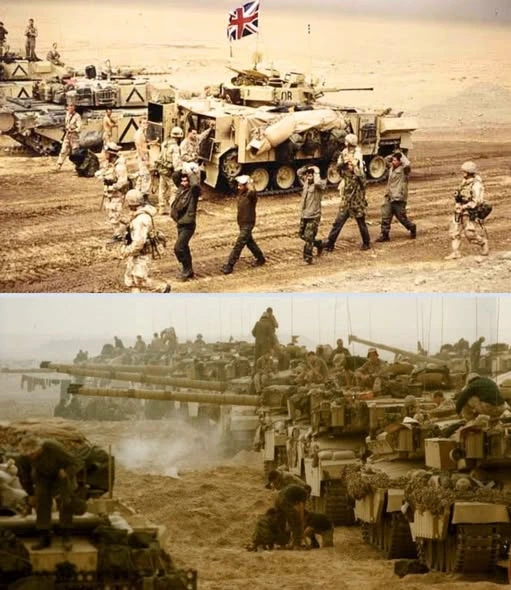
February 1991. Iraqi Republican Guard soldiers, veterans who’d survived eight brutal years fighting Iran, sat in their desert trenches convinced the British would be the easiest part of the coalition to face. Their commanders had even told them the Brits would avoid direct combat and stick to logistics. Then, in the dead of night, they heard the rumble of Challenger tanks advancing, watched their own tank rounds bounce harmlessly off British armor, and began frantically radioing words their officers in Baghdad never expected to hear. What did these battle-hardened Iraqi soldiers actually say when they realized the enemy they’d underestimated could see them perfectly in the darkness while they were completely blind?
The Kuwait-Iraq border. Night falls across the desert, and in the darkness, over 100,000 Iraqi soldiers wait in their trenches. This is the story of what Iraqi soldiers actually said when they first encountered British forces in the Gulf War. Their words, their shock, the brutal reality that followed.
The sand is cold now. During the day, the desert floor burns hot enough to cook an egg, but when the sun disappears, temperatures drop fast. Iraqi soldiers huddle in trenches that stretch for miles across the Kuwaiti border. Some wear thick coats over their uniforms. Others wrap blankets around their shoulders. They’ve been here for months, digging, waiting, preparing for a war they believe they can win.
Britain has sent over 45,000 troops to the region. It’s the largest British military operation since World War II. But the Iraqi commanders aren’t worried. In their bunkers, looking at maps spread across wooden tables, they point to American positions and talk strategy.
“The Americans are the real threat,” they say. “The British? The British are different.”
Iraqi military intelligence has made calculations. They’ve studied reports. They’ve listened to radio broadcasts. Their conclusion is clear and confident. British forces are soft compared to the Americans. This is what the reports say. This is what the commanders believe. This is what they tell their soldiers.
The men in the trenches hear these words and nod. Many of them are veterans of the Iran-Iraq War, a conflict that lasted eight long years and killed hundreds of thousands. They’ve seen combat. They’ve survived artillery barrages and human wave attacks. They’ve watched friends die and kept fighting. These are not inexperienced soldiers. These are men who know war.
Their commanders give them more information to boost their confidence. “British troops lack desert warfare experience,” the officers explain. “The British haven’t fought a major war in decades. They’ll avoid direct confrontation. They’ll stay back and let the Americans do the hard fighting.”
Some Iraqi soldiers even joke about it in their trenches, sharing cigarettes and laughing nervously in the cold night air.
The Iraqi defensive strategy is impressive by any measure. Engineers have spent months building elaborate trench networks that zigzag across the sand. They’ve laid thousands of mines in careful patterns. Artillery positions dot the landscape. Big guns pointed south toward where they expect the enemy to come from. This is a fortress designed for a long war, a war of attrition where the enemy bleeds slowly and eventually gives up.
Iraqi radio broadcasts repeat the same message every day. The British will negotiate, not fight. It’s a phrase that spreads through the ranks like a rumor. Soldiers repeat it to each other. Officers include it in their briefings. Even the Republican Guard, Iraq’s elite fighting force, believes it. Why would the British risk their soldiers when they can talk instead?
But there are other voices, quieter voices that the commanders choose to ignore. Some intelligence reports mention British armored capabilities. They describe Challenger tanks and Warrior fighting vehicles. They talk about training exercises in the German plains and British experience in Northern Ireland. These reports sit on desks in Baghdad, largely unread or dismissed as exaggerations.
Senior Iraqi commanders wave away concerns. One general actually laughs when a junior officer suggests the British might be more dangerous than expected.
“We fought Iran for 8 years,” the general says. “We know how to fight a war. The British are a small force in a big coalition. They’ll follow American orders and stay out of our way.”
The soldiers in the trenches don’t have access to these debates. They only know what their officers tell them. And what their officers tell them is simple. Prepare for the Americans. Watch for the Americans. The British are a secondary concern.
Then, things start to change. It’s subtle at first. Iraqi soldiers on observation duty report strange aircraft in the sky. Tornado jets flying low and fast. The sound is different from American planes. The profile is different. British reconnaissance is increasing, but the Iraqi command structure moves slowly. Reports travel up the chain of command, get filed, get lost in the bureaucracy of war.
Some soldiers see something else that troubles them. Through binoculars and spotting scopes, they catch glimpses of tanks on the horizon. The thermal imaging scopes that a few Iraqi units possess pick up heat signatures in the distance. These aren’t the tanks they expected. The shape is wrong. The size is wrong.
One Iraqi officer radios back to his command post with a question that gets no clear answer. “What kind of tanks are those?”
Night vision equipment shows movement where there should be stillness. British forces are probing, testing, watching. But Iraqi intelligence still insists this is minor activity. The British are gathering information for the Americans, nothing more. Don’t worry about them. Focus on the main threat.
In one particular trench system near the border, an Iraqi lieutenant sits with his men and tries to keep their spirits up. He’s 26 years old, a veteran of brutal fighting against Iran. He tells his soldiers they’re ready for whatever comes. Their trenches are deep. Their weapons are loaded. Their artillery support is strong. But privately, late at night, when he can’t sleep, he wonders about those strange tanks on the horizon.
The final piece of miscalculation comes from the very top of Iraqi command. Saddam Hussein’s military advisers assure him that NATO coordination is weak, that the British will follow their own agenda separate from American plans, that coalition unity will crack under pressure. This becomes official doctrine. This becomes what everyone believes.
But on the sand, with the cold wind blowing and the stars bright overhead, some Iraqi soldiers are starting to feel something they won’t admit out loud. Doubt. They see the increasing activity. They hear the aircraft. They watch the horizon and wonder.
“These aren’t the British we expected,” one sergeant whispers to his friend in the darkness.
His friend doesn’t answer. There’s nothing to say. The war is coming. And very soon they’ll discover just how wrong their commanders were.
The British have a plan, and it’s not the plan Iraqi commanders expect. They call it the left hook strategy. A massive sweeping movement designed to cut off Iraqi forces and destroy them quickly. The 1st Armoured Division moves into position with 176 Challenger 1 tanks leading the way. These aren’t ordinary tanks. Each one weighs over 60 tons and carries armor so advanced it has a special name, Chobham. The Iraqis have never faced anything like it.
The Desert Rats, officially known as the 7th Armoured Brigade, take their positions in the cold desert night. This unit has history stretching back to World War II fighting Rommel in North Africa. Now they’re back in the sand, but this time they have technology their grandfathers could never have imagined. Thermal imaging, GPS navigation, laser rangefinders, night vision so clear they can see Iraqi positions from miles away, while the Iraqis see nothing but darkness.
British artillery sets up behind the advancing armor. M109 self-propelled guns and towed FH70 howitzers, 155 mm wide, point toward Iraqi positions. Each gun has GPS targeting, meaning they can hit exact coordinates with precision the Iraqi artillery cannot match. The Iraqi guns are powerful, yes, but they rely on maps and eyesight and guesswork. The British guns know exactly where to aim.
G day arrives, February 24th, 1991. 4:00 in the morning. The ground offensive begins. While American forces attack from the south, British forces swing west and then north, racing across the desert at speeds that shock Iraqi observers. Challenger tanks can move at 35 mph across flat ground. They eat up the distance, their thermal cameras scanning constantly for targets.
February 25th, near the Iraqi-Kuwait border. The first direct combat between Iraqi and British ground forces is about to begin. An Iraqi observation post sees movement on the horizon. The soldiers grab their radios and report British tank movements, but what they’re seeing doesn’t make sense. The British tanks are too far away. Surely they can’t shoot from that distance. Surely they’ll come closer first.
The Iraqi soldiers in the observation post are wrong. They’re about to learn how wrong. The first shots come from 3,000 m away. That’s almost 2 miles. Iraqi tankers sitting in their T-55 tanks don’t even know they’re being targeted. Then the shells arrive. Challenger tanks carry a 120 mm gun that fires armor-piercing rounds at incredible speed. The first Iraqi tank explodes, then the second, then the third.
The Iraqi crews inside the remaining tanks panic. They can’t see the enemy. Their night vision equipment is old, weak, nearly useless. They fire back blindly into the darkness, hoping to hit something, hitting nothing.
A captured Iraqi officer will later tell British intelligence exactly what it felt like. “They could see us in the dark,” he says. “We were blind.”
His voice shakes when he says it, remembering the helplessness of that moment. Imagine sitting in a metal box, knowing someone out there can see you perfectly, knowing you can’t see them at all. Knowing that any second a shell might come through the armor and kill everyone inside.
The Royal Scots Dragoon Guards engage an Iraqi tank formation and destroy 14 tanks in their first contact. British losses? Zero. Not a single Challenger tank is hit. Not a single British soldier is wounded in this engagement. The math is brutal and one-sided. 14 to zero. This pattern will repeat itself again and again over the next 100 hours.
Iraqi Republican Guard units near objective bronze try to hold their positions. These are supposed to be Iraq’s best soldiers, the elite units that get the best equipment and training. They’ve prepared defensive positions carefully. 8 km of trenches snake across the sand. Over 2,000 mines have been laid in patterns designed to funnel enemy vehicles into kill zones. Iraqi commanders are confident these defenses will slow the British advance and cause heavy casualties. They’re wrong.
British combat engineers bring forward a weapon the Iraqis have never seen. It’s called the Giant Viper, and it’s essentially a rocket that pulls a long hose full of explosives across a minefield. When the hose detonates, it clears a path through the mines instantly. The massive explosion throws sand and shrapnel high into the air. Iraqi soldiers in nearby trenches feel the ground shake. They watch in horror as their carefully laid minefields disappear in seconds. Combat engineer tractors follow behind the Giant Vipers, bulldozing through the trenches and creating gaps for the tanks to pour through. The Iraqi defensive plan, months in the making, falls apart in minutes.
Radio traffic from Iraqi positions becomes frantic. British intercept operators listen to the confusion and fear in the voices.
“They are everywhere at once,” one Iraqi radio operator screams into his handset. “How can they be everywhere at once?”
200 Iraqi soldiers surrender to a single British armored squadron. They walk out of their trenches with their hands up, many of them looking relieved. Some are crying. Others look shell-shocked and dazed. They expected a long battle where they could fight with some chance of survival. Instead, they faced an enemy that could kill them from distances they didn’t know were possible, in darkness where they were helpless.
The Battle of Wadi al-Batin area becomes a demonstration of just how outmatched the Iraqis really are. Iraqi commanders order counterattacks using their T-72 tanks, the best tanks in the Iraqi arsenal. These are modern Soviet designs sold to Iraq in the 1980s. They should be competitive. They should at least be able to fight back effectively. They can’t.
British Challenger tanks sit still and let the Iraqi T-72s fire at them. It sounds insane, but it works. The Chobham armor is so advanced that Iraqi shells simply bounce off or shatter on impact. One Challenger tank is hit 14 times during the battle. 14 direct hits. The crew inside feels each impact like a hammer blow, but not a single shell penetrates the armor. After the battle, they climb out of their tank, inspect the damage, and find deep scratches and dents, but no holes.
Iraqi tankers watch their shells bounce off British armor and simply give up. They abandon their tanks and run. There’s no point in staying. Their weapons are useless. Some tanks are found later with engines still running, hatches thrown open, crew gone.
British tank commanders report watching Iraqi crews bail out and sprint away across the sand before the British even fire a shot.
One British tank commander will remember it clearly years later. “They just stopped shooting and ran,” he says. “You could see them climbing out of their tanks and running away. We didn’t even have to fire. They knew they couldn’t hurt us, and they knew we could destroy them whenever we wanted. So, they ran.”
The battlefield becomes littered with abandoned Iraqi equipment. Tanks, armored vehicles, artillery pieces, supply trucks, all left behind as Iraqi units disintegrate. British forces keep advancing, meeting less resistance with each passing hour. The war is barely 2 days old, and already the outcome is clear.
As the sun rises on February 27th, the scale of the catastrophe becomes impossible to hide. The numbers tell a story that Iraqi commanders in Baghdad don’t want to believe. When the ground war started, over 100,000 Iraqi troops held positions in the Kuwait theater. By February 27th, just 72 hours later, fewer than 40,000 remain combat effective. The rest are dead, wounded, captured, or scattered across the desert trying to survive. British forces have destroyed more than 300 Iraqi armored vehicles. British Challenger tanks suffered no losses from Iraqi fire, though one was damaged by friendly fire.
At a place the British call Objective Platinum, a single British battalion engages an entire Iraqi armored brigade. The battle lasts 4 hours. When it ends, the Iraqi brigade no longer exists as a fighting force. Burning vehicles dot the landscape for miles. The night sky glows orange from the fires. Thick black smoke rises into the air, visible from miles away. British casualties in this engagement? Single digits. Most of those are minor wounds, soldiers who will return to duty within days.
British forces process over 7,000 Iraqi prisoners of war in just 72 hours. The POWs keep coming in groups of 50, 100, sometimes 200 at a time. They’re hungry, thirsty, exhausted, and many of them look grateful to be captured. British soldiers set up processing centers in the desert, giving prisoners water and food, checking them for wounds, cataloging their units and ranks. British intelligence officers interview the captured Iraqis, and this is where the real story emerges. This is where we hear what Iraqi soldiers actually said about fighting the British.
One soldier, still shaking from his experience, tells his interviewer a simple truth. “We thought we were fighting in the day, but they owned the night.”
He describes how British forces seemed to appear out of nowhere after sunset, how Iraqi night vision equipment was useless, how they fired at shadows and hit nothing, while British shells found their targets with terrible accuracy.
Another Iraqi soldier, a veteran of the Iran-Iraq War, struggles to explain what made this different. “Our officers told us the British would avoid us,” he says. “Instead, they hunted us.”
He talks about the psychological impact of being hunted, of knowing the enemy can see you, but you can’t see them. Of waiting in a trench, wondering if the next second will be your last.
“During the war with Iran,” he explains, “both sides were equally blind at night. Both sides suffered equally. This was different. This was one-sided slaughter.”
A young Iraqi tank crewman, barely 20 years old, describes his last moments in his T-55 tank. “I fired seven shells at a British tank,” he tells the interviewer. “All bounced off. Then they fired once.”
His tank was destroyed by that single British shell. He survived only because he was blown clear of the wreckage by the explosion. His three crewmates died instantly. He wandered in the desert for 6 hours before British soldiers found him and gave him medical treatment.
The stories paint a picture of complete technological dominance. Iraqi bunkers, built deep into the sand with overhead cover, are obliterated by British artillery before the soldiers inside even see British forces. The precision is terrifying. Iraqi soldiers describe shells landing directly on target again and again. Coordinates fed by GPS satellites the Iraqis can’t see or counter. There’s no hiding. There’s no safe place.
The sensory details from these interviews are vivid and disturbing. The thunderous sound of Challenger tanks advancing, a deep rumble that gets into your chest and makes your heart beat faster. The night sky lit up by tracer fire, red streaks cutting through the darkness. The acrid smell of burning vehicles, oil and rubber and plastic all melting together into a stench that sticks in your throat. Iraqi soldiers describe these details years later and still react physically. Their bodies remembering what their minds try to forget.
Physical conditions in the trenches become unbearable as the British advance. Some trenches flood when British engineers breach Iraqi defensive positions, water from broken pipes mixing with sand to create thick mud. The desert nights are freezing, temperatures dropping to near zero, and Iraqi soldiers in wet uniforms suffer from exposure. Coalition air superiority means any movement during daylight is suicide. Iraqi soldiers learn to stay completely still during the day, pressed into whatever cover they can find, barely breathing when they hear aircraft overhead.
In Baghdad, Iraqi high command initially denies the scale of British success. Radio broadcasts claim tactical withdrawals and reports of inflicting heavy casualties on coalition forces. The Iraqi propaganda machine works overtime describing British tanks burning and British soldiers retreating. None of it is true. Iraqi officers in the field know it’s not true, but Baghdad keeps broadcasting the lies anyway, perhaps believing them, perhaps just refusing to admit reality.
The reality is the Republican Guard units are disintegrating. These elite formations, the pride of the Iraqi military, break apart under British pressure. Officers flee ahead of their troops, abandoning their men and racing north toward Basra and Baghdad. Discipline collapses. Units that held together through eight years of war with Iran fall apart in hours against the British.
Iraqi commanders try different tactics to counter the British advance. They redeploy elite units from other sectors, creating new defensive lines that the British smash through within hours. There are whispered discussions about using chemical weapons, threats that are never carried out, perhaps because Iraqi commanders know it would be suicide, perhaps because the command structure is too chaotic to coordinate such an attack. Some Iraqi strategists propose falling back to Baghdad and fighting an urban war using the city’s buildings and streets to negate British technological advantages. This plan is abandoned as the coalition advance proves unstoppable, and the international pressure to end the war becomes overwhelming. Baghdad itself is never directly threatened because the war ends before coalition forces reach it.
Something unexpected happens among the Iraqi prisoners. They begin to show respect for British professionalism. The treatment they receive contradicts everything Iraqi propaganda told them about Crusader cruelty. British medics treat Iraqi wounded the same as British wounded. Food and water are provided. Prisoners are kept in groups so they’re not isolated and alone. This humane treatment shocks many Iraqi soldiers who expected to be tortured or executed.
British psychological operations have been dropping leaflets over Iraqi positions for weeks. The leaflets, printed in Arabic, promise safe surrender and proper treatment under international law. Iraqi soldiers have been picking up these leaflets and hiding them, not sure whether to believe the promises. Now, seeing British forces in action, watching how prisoners are treated, entire Iraqi units surrender after witnessing British capabilities first hand.
One documented incident becomes legendary among both sides. An entire Iraqi battalion surrenders to a British Lynx helicopter crew. The helicopter lands near the Iraqi position, and the crew chief steps out expecting to take a few prisoners. Instead, hundreds of Iraqi soldiers emerge from their trenches with white flags ready to give up. The helicopter crew radios for support, and soon British ground forces arrive to process the surrendering Iraqis.
The Highway of Death becomes the war’s most infamous image. Iraqi forces retreating from Kuwait City jam onto Highway 80, creating a massive traffic jam of military and civilian vehicles. Coalition aircraft, primarily American, attack the convoy, and the highway becomes a graveyard of burned vehicles stretching for miles. The carnage is so extensive that even some coalition pilots expressed discomfort. This isn’t combat anymore. This is massacre.
The final scale of the ground war defies expectations. 100 hours. That’s all it takes. Kuwait is liberated. The Iraqi military is shattered. British forces have proven themselves not as the weak link in the coalition, but as one of its most effective components. The Iraqi soldiers who survived will carry memories of those 100 hours for the rest of their lives. Memories of technological superiority so complete, it felt like fighting an enemy from the future.
The war ends, but the lessons continue. British military analysts spend months reviewing everything that happened during those 100 hours of ground combat. They watch video footage from tank-mounted cameras. They read reports from every unit that saw action. They interview soldiers and officers, gathering details about what worked and what didn’t.
One conclusion becomes crystal clear. Heavy armor still matters in modern warfare. For years, military theorists had been arguing that tanks were becoming obsolete. That light infantry with high-tech weapons would dominate future battlefields. The Gulf War proves them wrong. The Challenger tank cements its reputation as one of the best battle tanks in the world. During the conflict, a British Challenger crew achieves what was reported as one of the longest tank-on-tank kills recorded at the time, destroying an Iraqi tank from approximately 4,700 m away. That’s nearly 3 miles. The shot is so far that the Iraqi crew never knew what hit them. This record will stand for years, a testament to British engineering and crew training.
For the Iraqi military, the aftermath is devastating and humiliating. The force that fought Iran to a standstill for 8 years, that was supposed to be the fourth largest army in the world, has been crushed in less than a week of ground fighting. Rebuilding takes over a decade. Every aspect of Iraqi military doctrine has to be revised. The Soviet-style tactics they relied on, the mass formations and artillery-heavy approach, all of it failed catastrophically against modern Western technology and training.
The Desert Rats return home to Britain as heroes. In London, a massive victory parade winds through the city streets. Thousands of people line the route, waving flags and cheering. Children sit on their parents’ shoulders to get a better view. Veterans of World War II watch with tears in their eyes, proud that the unit’s legacy continues. The soldiers march in formation, crisp and professional, but many of them are already struggling with what they experienced in the desert.
Gulf War Syndrome emerges as a dark shadow over the victory. Thousands of British veterans begin reporting strange health problems in the months and years after the war. Chronic fatigue, joint pain, memory problems, respiratory issues, the causes remain disputed and controversial even decades later. Some blame exposure to depleted uranium in tank ammunition. Others point to smoke from burning oil wells or experimental vaccines given to troops. The British government initially denies there’s a problem, then slowly acknowledges it, then spends years arguing about compensation and treatment.
NATO military planners study the British performance in the Gulf War and adopt many of the tactics that proved so effective. Combined arms warfare, the coordination of tanks, infantry, artillery, and air support becomes standard doctrine. Night fighting capabilities receive massive investment. Every NATO country wants thermal imaging equipment as good as what the British used. Training exercises emphasize the lessons learned in the Kuwaiti desert.
British military academies, particularly Sandhurst, add the Gulf War as a major case study in their curriculum. Officer cadets study the British left hook maneuver, examining how it was planned and executed. They analyze the decision-making process, the logistics, the coordination between different units. The Gulf War becomes a textbook example of how to fight a modern conventional war.
The Iraqi military takes different lessons from the same experience. Unable to match Western technological superiority, Iraqi strategists begin focusing on asymmetric warfare. When American and British forces return to Iraq in 2003, they find a completely different kind of enemy. No more mass tank formations, no more fixed defensive positions. Instead, they face improvised explosive devices, ambushes, and insurgent tactics designed to negate Western advantages.
Many of the Republican Guard veterans who survived the Gulf War put their experience to use as insurgent commanders, teaching younger fighters how to avoid Western surveillance and strike from unexpected angles.
Military academies worldwide study the Gulf War as a turning point in modern warfare. At West Point in America, at Sandhurst in Britain, at military colleges in France and Germany and China, instructors use footage and data from the conflict to teach new generations of officers. The war demonstrates the importance of technological superiority, superior training, and proper logistics. It shows how a smaller, better-equipped force can dominate a larger but less advanced enemy.
British commanders who led forces in the Gulf War go on to distinguished careers. Some rise to senior NATO positions, bringing their desert experience to alliance planning. Others retire and write memoirs, sharing detailed accounts of the decision-making process during those intense 100 hours. A few become military consultants, advising governments and defense contractors on armored warfare tactics.
Iraqi soldiers scatter to very different fates. Some return home and try to rebuild normal lives, never speaking publicly about their experiences in Kuwait. The shame of defeat runs deep in Iraqi military culture, and many veterans prefer silence to reliving the humiliation. Others end up in mass graves after Saddam Hussein’s regime purges units that performed poorly. Still others survive to fight again in 2003, when coalition forces returned to finish what the Gulf War started.
The Republican Guard units that were dissolved after the 2003 invasion contained many Gulf War veterans. These experienced soldiers, unemployed and angry, form the core of the Iraqi insurgency. They know Western tactics now. They understand Western technology. They’ve learned that you can’t beat Challenger tanks in open desert combat, so don’t try. Fight in cities instead. Use guerrilla tactics. Make every street a potential ambush. The lessons of defeat become the foundation of resistance.
British veterans hold reunions every year, gathering to remember fallen comrades and share stories from the desert. 47 British personnel died during the Gulf War, and their names are read aloud at memorial services. Some died in combat. Others died in accidents, including the friendly fire incident involving a Challenger tank. Each name represents a family changed forever. Children who grew up without a parent. Spouses who became widows or widowers.
The broader lessons about innovation and adaptability extend beyond military circles. Business schools study the Gulf War as an example of how superior preparation and technology can overcome numerical disadvantage. The British didn’t win because they had more soldiers. They won because they had better training, better equipment, and better planning. These same principles apply in competitive markets and corporate strategy.
Human nature reveals itself on the battlefield in ways that peacetime never shows. The Iraqi soldiers who faced British troops displayed courage even in hopeless circumstances. They stayed in their positions when running would have been safer. They fired back even when their weapons were clearly ineffective. They followed orders even when those orders came from commanders who had badly miscalculated the enemy’s capabilities. That kind of courage under impossible conditions deserves recognition, even from the victors.
The Gulf War teaches us that wars are often won before the first shot through superior preparation, intelligence, and adaptability. The British victory wasn’t an accident or luck. It was the result of decades of investment in training and technology. It was the product of realistic exercises that prepared soldiers for exactly the kind of warfare they encountered. It was the outcome of good intelligence that accurately assessed Iraqi capabilities and weaknesses.
Modern warfare continues to evolve, but the fundamental lesson remains constant. The side that can see farther, shoot more accurately, move faster, and coordinate better will usually win. Technology matters, but technology without training is useless. The British had both, and that combination proved unstoppable.
What those Iraqi soldiers said, captured in intelligence reports and prisoner testimonies, reveals a universal truth about warfare in any era. The words of men who faced an enemy they couldn’t see, who fired weapons that couldn’t penetrate enemy armor, who watched their formations fall apart under technological superiority they couldn’t match. These words remind us that even in defeat, there are lessons. Lessons about courage and miscalculation and the brutal efficiency of modern war.
The Iraqi soldiers learned those lessons in the harshest classroom imaginable. The desert battlefield where British Challenger tanks ruled the night and thermal imaging turned darkness into deadly clarity. Their words echo across the decades, a warning about underestimating your enemy and a testament to how completely modern technology can transform the ancient art of war.
You Might Also Enjoy

“We Thought They Would Negotiate”—What Argentine Soldiers Said When The British Attacked Goose Green

“You’ll Never Finish My Ruck March, Limey” — US Sergeant Who Challenged the SAS, Then Fell Out First






