What the Americans Said the First Night They Watched an SAS Patrol Work in Helmand.
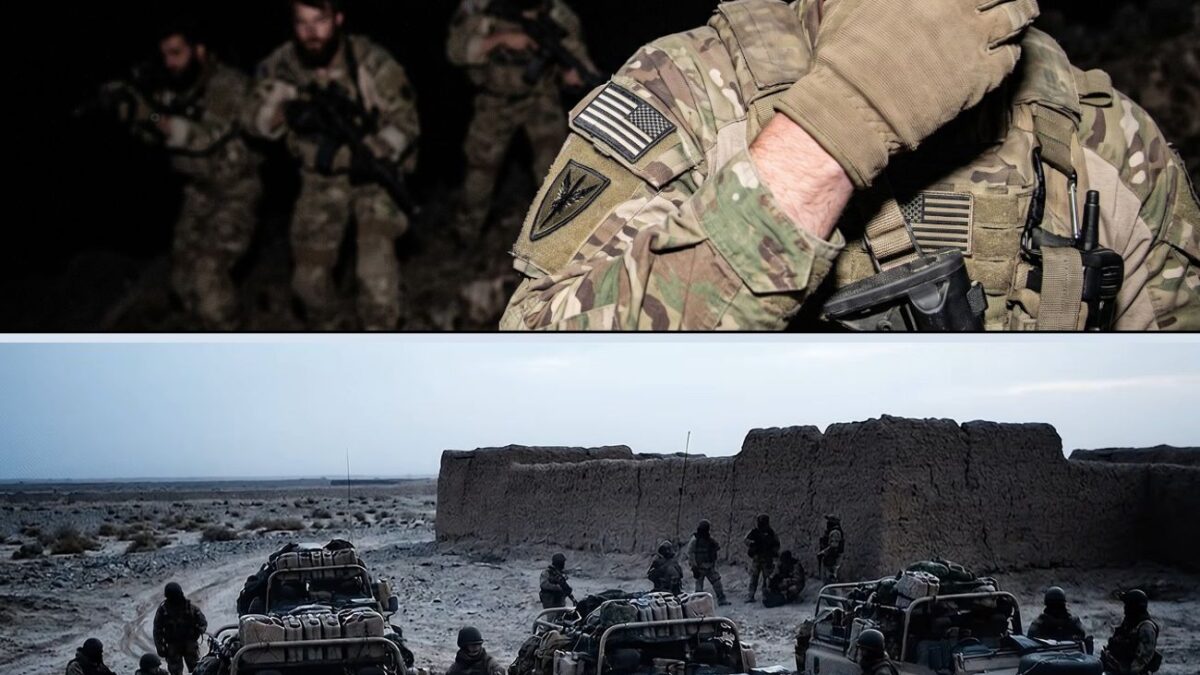
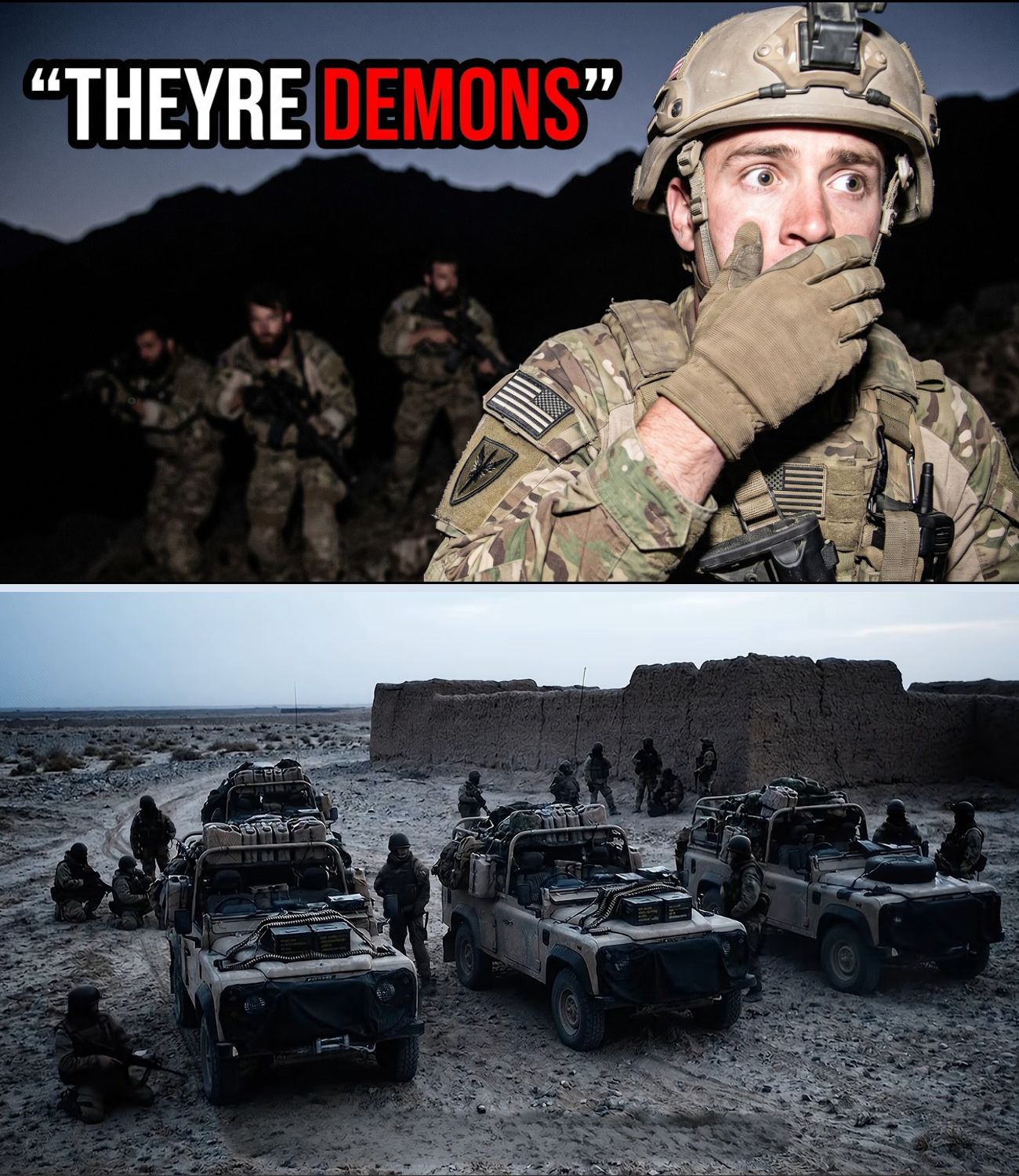
Helmand province, February 2007. A four-vehicle SAS patrol sat off a compound wall 11 km north of Gereshk. Engines cut, headlights taped over with black cloth. Four Land Rovers stripped of doors, weighed down with jerrycans and belt-fed ammunition, tires half deflated for grip on the wadi sand. A young American forward air controller, attached that week to observe, crouched behind the lead vehicle with a night vision monocular and said nothing for 11 minutes.
He had been told this patrol was going to reduce a Taliban command node before dawn. He had not been told there were only 12 men doing it, no armor, no quick reaction force within 40 minutes, and a single interpreter who had been recruited from a bazaar in Lashkar Gah nine days earlier. The compound’s generator kept cutting the lights inside on and off.
The patrol commander, watching through his own scope, waited for the third cut before he moved.
“That’s just one story like it. I wrote down 20 operations the record never mentioned at SAS Declassified in the description. If you want it, it’s there. I will not mention it again.”
The Americans’ name, for the purposes of this account, was Captain Dale Ferris, a junior air liaison officer seconded from a Marine Air Naval Gunfire Liaison Company operating out of Camp Bastion.
He had spent 18 months training against a doctrine built on saturation, overwhelming firepower, layered communications, redundancy stacked on redundancy. He had never watched 12 men and four vehicles walk into a compound holding what aerial imagery estimated at 30 to 40 fighters. He said later, in a debrief that made its way informally around Bastion’s operations tent, that his first reaction was simple disbelief, not fear for himself.
Disbelief that a plan this thin was the plan. The SAS patrol had been building toward that compound for 6 days. It began as so many of these operations did that winter with a single piece of information nobody wanted to act on. A signals intercept suggesting a Taliban logistics cell was using the compound to stage pressure plate components moving up from the border.
Conventional battle space owners wanted more confirmation. The regiment squadron commander, a major running the detachment from a hardened room at Bastion, did not have 6 more days to wait for it. He had one squadron split across three simultaneous taskings, a maintenance backlog on two of his six serviceable pinkies, and a British brigadier upstairs asking why a strike hadn’t already been called in from the air.
The major’s answer, recorded almost verbatim by a signaler present that day, was that air strikes on a compound with unconfirmed civilian presence were not going to happen on his authority, and that if the target was real, men on the ground could confirm it in an hour what a predator feed could not confirm in a week. That was the first narrowing.
No air option, no brigade patience. A patrol had to go in on wheels at night and work it out at close range. This was not the regiment’s first winter in Helmand, and it was not the first time an American officer had questioned whether a dozen men in unarmored vehicles were the right tool for a province that size.
A US Army lieutenant colonel attached to Task Force Helmand as a planning liaison, a man colleagues remember as thorough to the point of caution, had argued in a planning meeting the previous month that special forces elements operating without a fixed quick reaction force were an unacceptable risk to accept for the intelligence value returned.
He was not wrong about the risk. He was, over the following weeks, proven wrong about the value as one thinly resourced patrol after another delivered confirmed intelligence that battalion-level assets moving in daylight with vehicle columns visible for miles had never been positioned to collect. He did not change his view all at once.
He changed it operation by operation, each time asking a slightly smaller question about why the patrol needed less than everyone assumed. The intercept itself had come from a signals detachment working out of a container at Bastion, cross-referenced against a pattern of vehicle movement noticed independently by an analyst on the American side, a warrant officer named Colby Rennick attached to a joint fusion cell.
Rennick had flagged the compound twice already that month in reports that went nowhere because the standing procedure for his chain required two independent human sources before a strike package could even be drafted. And Helmand in February 2007 did not have two independent human sources for most of anything.
Rennick’s frustration, recorded in his own notes and later shared informally with a British counterpart, was that the fusion cell had good data and no mechanism built to act on it quickly. When the SAS squadron picked the target up through their own channel and asked only for what Rennick already had, he handed it over inside the hour.
It was the first of several moments in this story where an American with real information found the regiment easier to work with than his own command structure. The second narrowing came from the vehicles themselves. Two of the four Land Rovers had been cannibalized twice already that month for parts, gearbox components stripped from a written-off third vehicle after a mine strike near Sangin in January.
The squadron’s REME fitter, a warrant officer named Grant Aldis, had flagged both vehicles as marginal for anything beyond short-range work. He was overruled not out of recklessness, but arithmetic. Four vehicles were the minimum needed to carry the dismounted assault group, the fire support pairing, and enough water and ammunition for a 48-hour contingency if extraction was delayed.
Aldis spent the night before departure with his sleeves rolled to the elbow replacing a leaking radiator hose with a section cut from a fuel line because the correct part was still on a supply manifest sitting in Kandahar. The ammunition picture was little better. The squadron had drawn down its link-belted machine gun ammunition faster than resupply flights could replace it that month.
A consequence of two earlier contacts near Musa Qala that had burned through reserves nobody had expected to need before the next scheduled rotation. The quartermaster sergeant responsible for squadron stores, a man known to the troops simply as Q, told the patrol commander 2 days before Gereshk that he could fully outfit only three of the four vehicles to the standard combat load, and that the fourth would go out roughly 60 rounds per gun short of what doctrine called for.
The patrol commander accepted the shortfall rather than delay for a resupply flight that Kandahar’s tasking board showed arriving no sooner than 4 days out, reasoning that 4 days matched almost exactly the window Yusuf’s contact had already flagged as closing. Q spent the evening before departure redistributing belts by hand between vehicles so that the shortfall when it came would be spread evenly rather than concentrated on any single gun.
A decision nobody higher up the chain ever formally authorized or needed to because by the time anyone above squadron level would have heard about it, the vehicles were already 11 km from Gereshk. The third narrowing was water. Helmand in February is not the furnace it becomes by June, but a 12-man patrol carrying ammunition loads approaching 40 kg per man, burns through water fast on foot, and the plan called for a 2-km dismounted approach to avoid engine noise near the compound.
Each man carried 9 L. The patrol medic, a corporal remembered by colleagues only by his call sign Bishop, did the sums twice and told the patrol commander that 9 L left no margin if the exfiltration was delayed past first light. The commander’s answer was that they would not be there past first light. That sentence would be tested.
The fourth narrowing was the interpreter. Terrain like this ran on local knowledge, and the patrol’s interpreter, a man the operators called Yusuf for security, had grown up two valleys away and knew which family compounds still spoke to elders sympathetic to the government side. Two nights before the operation, Yusuf reported that a cousin of his had warned him the compound’s occupants had rotated in extra fighters from Kajaki, and that word of foreign vehicles moving at night had already reached a neighboring village. Compromise was no longer a possibility. It was, by Yusuf’s account, already in motion.
Yusuf’s warning did not arrive in isolation. It came after 2 days of quiet contact with a village elder on the northern edge of the valley, a man the patrol’s intelligence file referred to only by a number rather than a name, who had agreed months earlier to pass word of unusual movement in exchange for nothing more than a standing assurance that his own compound would not be searched without notice.
That arrangement had been built slowly across the preceding autumn by a different patrol entirely, one that had spent weeks establishing exactly the kind of low-visibility local relationships a larger conventional formation rotating through the district every 6 months rarely had time to build. The elder’s warning through Yusuf was the second time that winter, his information had proven accurate, and the squadron’s intelligence officer at Bastion, a captain who tracked such sources on a hand-updated card index, rather than any centralized database, treated the tip with more weight than the brigade’s own analysts initially gave it.
It was the kind of asset that could not be surged, requisitioned, or replaced on short notice if it were lost, which was precisely why losing it to a botched or overlarge operation was treated by the squadron as its own category of risk, separate from and in some ways heavier than the physical danger to the patrol itself.
That was the moment the operation stopped being a plan and became a race. There was a fifth narrowing that never made it into the written report, though two men present later described it the same way independently. The brigade headquarters, alerted that a special forces tasking was moving inside its area of operations, requested a 12-hour hold so a conventional infantry company could be briefed and positioned as a backstop.
The squadron major refused the hold on the grounds that a 12-hour delay handed the compromise problem to the enemy on a plate, and that a conventional company moving into unfamiliar ground at short notice created more risk of a blue-on-blue than it solved. The brigade’s operations officer, a lieutenant colonel who is not named here because the exchange was never formally minuted, pushed back twice by radio before deferring on the understanding that the SAS squadron would take full responsibility for the outcome. It was the kind of decision that, if it had gone wrong, would have ended a career.
The major signed for it anyway, because the alternative was doing nothing while the compound kept manufacturing the parts that killed men on the roads outside it. The patrol commander, a captain who went by his given name only among his own troop, and appears in later regimental accounts simply as the boss, made the call that night to move the timeline forward by 24 hours once Yusuf’s warning came in. Rest was cut.
Final checks on the two marginal vehicles were compressed into four hours instead of the planned 10. Aldis, the fitter, later told a colleague he had not slept before the vehicles rolled, and that he had followed the patrol out to the perimeter wire on foot, listening to the engines, waiting to hear if the repaired radiator hose would hold under load.
It held for the first 11 km. It began weeping coolant at km 12. The patrol commander made the decision to abandon the dismounted approach plan and instead close the last stretch on wheels at low speed, accepting the noise risk to avoid losing a vehicle to overheating in open desert with an unknown number of fighters ahead.
This was risk against risk, not risk against safety. There was no safe option left on the table. Every choice by that point simply changed the shape of the danger. They reached the wall at 0140 hours. Ferris, the American FAC, watched the 12 men split without a spoken order into three groups, one holding the vehicles and radios, one moving to a breach point on the compound’s eastern wall, one covering a track running north that Yusuf had identified as the likeliest escape route.
There was no rehearsal on this ground, no satellite overwatch feed running on a screen anyone could check. There was a hand-drawn sketch made from Yusuf’s description and a decision made in the dark about which wall was weakest. The generator cut out for the third time at 0151. The assault element moved on the dark. What followed lasted four minutes by the account later given in the operations after-action report filed three days afterward at Bastion.
Four minutes of close engagement inside a walled compound against a force that outnumbered the assault group by more than two to one on paper. Two Taliban fighters were killed at the breach point. A third was detained, wounded, and later provided the confirmation the brigade had wanted from an air feed.
The compound had indeed been used to stage pressure plate components, several of which were recovered intact from a storeroom behind the main building. No civilians were present. The intercept had been right, and Rennick’s original flag sitting unused for weeks in the fusion cells queue was vindicated inside a single night by 12 men who had never seen his report.
One patrol member was hit in the forearm by fragmentation from a grenade thrown blind over the wall. Bishop, the medic, treated the wound inside the compound under a torch shielded by a poncho, working from a water bottle that was, by his own later account, down to less than a liter. The 9-liter allocation had held, but only just.
He remembered asking for someone to check how much was left in the vehicles before he used any more on cleaning the wound, a detail that made it unglamorously into the after-action report almost word for word. Ferris watched all 4 minutes from beside the vehicles on the radio to Bastion, relaying a fight he had no framework for. He had trained to call in fires that arrived in tonnage.
What he watched instead was 12 men solve the problem with speed, information, and a level of physical risk that no American conventional unit he had served with would have been authorized to accept on that little confirmation. He said in the debrief that later reached other American liaison officers rotating through Bastion that the thing that stayed with him was not the 4 minutes of gunfire.
It was the 20 minutes afterward when the patrol methodically searched the compound, bagged the material evidence, questioned the wounded detainee through Yusuf, and loaded back onto vehicles that were leaking coolant all without raising their voices above a working murmur. The extraction was its own narrowing. The radiator hose Aldous had repaired the night before failed completely 4 km from the compound at 0240.
The patrol commander made the decision to abandon that vehicle rather than risk further delay, transferring its crew and cargo to the remaining three, now overloaded, moving at reduced speed through terrain that offered no cover before dawn. First light in Helmand in February comes close to 0630. They needed to be inside the wire well before that because a slow-moving three-vehicle patrol on open ground in daylight without air cover confirmed was an invitation for exactly the kind of engagement the entire operation had been designed to avoid.
The brigadier at Bastion, informed of the abandoned vehicle and the delay, asked the squadron major by radio whether the patrol required an armored recovery team sent forward to protect the position, an offer that would have taken at minimum 90 minutes to organize and deploy. The major declined on the patrol commander’s recommendation, judging that a recovery team moving at night into unfamiliar terrain carried more risk than three overloaded Land Rovers moving fast on a route they already knew.
It was the same arithmetic that had shaped the whole operation from the first day. More support arriving late was often a worse trade than less support moving now. They crossed back through the perimeter wire at 0504, 36 minutes before the sun would have made them visible for kilometers. Ferris was waiting there, having been driven back separately earlier with the wounded detainees’ initial statement.
He watched the three vehicles come in low and fast, coolant fumes trailing from the overloaded lead vehicle, men climbing down stiff-legged after nearly 5 hours on hard benches, and he reportedly said to a British liaison officer standing beside him that he had never seen 12 men do the work of what his own doctrine would have assigned to a company.
The liaison officer’s reply, recorded in an informal note rather than any official document, was simply that the regiment did not have a company to spare, so it did the job with what it had. The after-action report filed that week credited the operation with removing a functioning IED component cell from a stretch of road that had accounted for six coalition casualties in the preceding 2 months.
It also flagged, in dry administrative language, three equipment deficiencies: the radiator hose failure, water margins on dismounted approaches exceeding 2 km, and a request for a second interpreter to reduce reliance on a single local source for compromise warnings. All three were addressed slowly in subsequent taskings.
None of them had been addressed in time for that night, and the patrol had gone anyway because the alternative was 6 more days of a compound manufacturing the components that killed and maimed men on roads the SAS themselves would use. The wounded detainee taken at Gereshk turned out to matter well beyond the confirmation he gave that night.
Handed over to a joint interrogation facility at Bastion 2 days later, he provided, over the course of a week, a partial map of a wider logistics network moving components south from the border, information that fed directly into two further operations that spring. One of them run not by the squadron, but by a conventional infantry company acting on a target package the squadron’s intelligence cell had built and handed across.
That handover, ordinary as it sounds, represented its own small reversal. 6 months earlier, few conventional units in that brigade would have trusted a target package built entirely on special forces sourcing without independent verification they had no time to obtain. By spring, the brigade’s own operations staff were asking the squadron’s intelligence officer directly for anything else his hand-updated card index held on the same network, an informal arrangement that outlasted the rotation of at least two brigade staffs.
News of the raid reached the director special forces office in the UK inside the fortnight. Folded into a routine theater summary rather than flagged as anything exceptional, which was itself telling. By 2007, an operation of this shape and risk profile was closer to routine than remarkable for the regiment, even if it remained extraordinary to every American who watched one happen for the first time.
A brigadier who reviewed the summary that month is reported to have written a single line in the margin of his own copy passed later to a staff officer who kept it, that the squadron had again done with 12 men and four vehicles what the wider campaign’s planning assumptions still budgeted a company and an air package to attempt.
It was not praise so much as an observation, and it was one that shaped how the regiment’s tasking priority was set for the remainder of that deployment with squadron commanders given wider latitude to accept exactly this kind of thin margin operation rather than wait for the fuller support conventional doctrine preferred.
The abandoned vehicle became a problem of its own. Left 4 km from the compound with a seized engine, it was recovered 2 days later under separate escort towed back to Bastion on a low loader borrowed from an American logistics unit whose sergeant, filling out the loan paperwork, asked what had actually happened to it. He was told only that it had broken down on a routine patrol.
The full account did not circulate through American channels for months and even then only informally, officer to officer, never through a written channel that would have required anyone to explain why a special forces patrol had been operating on such thin margins in the first place. The sergeant who signed the low-loader across on loan kept a copy of the paperwork long after it should have been filed and forgotten.
A habit colleagues put down to nothing more than curiosity about a vehicle that had come back towed rather than driven, its rear axle seized solid, its bodywork scarred along one flank from the wadi crossing near the compound wall. He asked once, informally, whether the vehicle had been part of something bigger and was told just as informally that it had.
Nothing more was said and nothing more needed to be because by that point in the deployment, the exchange itself had become a small recognizable ritual between the two forces. An American asking a careful question and a British operator giving back exactly as much of an answer as operational security allowed, no more and no less.
The patrol commander himself, the boss, gave a short internal talk to newly badged operators the following year, a talk that was never recorded but was described consistently by three men who attended it separately. He reportedly spent almost none of the time on the four minutes of fighting inside the compound and almost all of it on the six days before, walking the new operators through each narrowing decision in order.
The intercept nobody would act on, the vehicles that should have been withdrawn from service, the water margin that assumed a clean exfiltration, the interpreter’s warning that closed the window overnight, the ammunition shortfall spread by hand between guns. His point, according to the men who heard it, was that the raid itself had been the easy part.
12 trained men in a compound at night, outnumbered but prepared, was a problem the regiment solved routinely. The six days of narrowing choices beforehand, each one closing off a safer option, were the actual test. And the test was passed or failed long before anyone crossed the wall. Word of the Gereshk raid reached the regiment’s training wing at Hereford within weeks, carried back by a returning instructor who had served on the operations planning staff.
It was written up, stripped of identifying detail, as a case study for the selection and continuation courses that ran through the following two years, used specifically to teach the sequencing of a compromised timeline. What changes when an operations window collapses from six days to one night? And what has to be decided in order when it does? Candidates on the course were given the water numbers, the vehicle numbers, and the interpreter’s warning, and asked to produce their own sequence of decisions before being shown what the actual patrol had chosen.
Few candidates, according to two instructors who taught the package in successive years, arrived at the same order of priorities on their first attempt. Most protected the vehicles too long or the timeline too little or assumed water margins that the compressed schedule no longer allowed.
Ferris himself carried the story home when his attachment ended two months later, retelling it, according to colleagues who served with him afterward, at a stateside training establishment more than once. He always ended it the same way, not on the firefight or the casualties avoided, but on the sight of a corporal medic asking, in the middle of treating a wound by torchlight, exactly how much water was left in the vehicle before he used another swallow of it on a bandage.
It was, Ferris reportedly said, the smallest possible measure of an operation run on almost nothing, and it had worked. He was posted the following year to an evaluation cell reviewing special operations liaison procedures, and colleagues noted that his recommendations leaned consistently toward shorter approval chains for small, fast-moving teams working on partial information, a preference several attributed directly to that one night outside Garishk.
That evaluation cells work fed, in turn, into a wider conversation across the American special operations community about how liaison officers were selected and briefed before rotating through British-led taskings in Helmand. A colonel who chaired one such review board, briefed on both the Garishk and Sangin operations without being given operational detail he was not cleared to hold is said to have remarked that the recurring theme across both accounts was not courage, which every unit in the theater claimed in equal measure, but tolerance for an unfinished picture.
American planning culture, he argued, preferred to wait until a picture was as complete as time allowed before committing men to it. The squadron in Helmand had shown twice in 6 weeks that a picture completed at the cost of the target disappearing was not actually a safer picture at all, only a later one.
The colonel’s paper on the subject, circulated internally rather than published, used the word amateur only once and used it to describe the assumption that more information always meant more safety, an assumption he wrote the two Helmand operations had quietly disproved. None of this filtered down to the 12 men who had walked the compound wall at Garishk, most of whom rotated out of Afghanistan within the year and back into the regiment’s ordinary cycle of squadron postings, courses, and the next task nobody else wanted.
Bishop, the medic, was posted 18 months later to a training role teaching combat first aid to new entrants, where instructors recalled he taught water discipline with unusual intensity, always circling back to the same instruction:
“Know exactly how much you have left before you spend any of it because the moment you need to know is never the moment you expect.”
Yusuf continued working with the squadron successor rotation for a further year before returning by his own choice to ordinary life in Lashkar Gah, a decision the squadron respected without comment, aware that men who did that work on 9 days notice rarely lasted longer than he already had. The compound near Gereshk exists now only as a flattened rectangle of disturbed earth visible on commercial satellite imagery, indistinguishable from a dozen other demolished structures along the same road unless a viewer already knows exactly where to look and exactly what to look for.
The Gereshk raid was not the last time that winter an American officer watched the same squadron work and the pattern that formed across those weeks did more to change minds at Task Force Helmand than any single night could have. Three weeks later in early March, the squadron was tasked against a Taliban commander’s compound closer to Sangin, a target that had been under loose observation since a British patrol had taken casualties from a command wire device on the same stretch of road in January.
This time the American present was not a junior liaison officer but the same lieutenant colonel who had argued a month earlier that unarmored patrols were an unacceptable risk. He had asked after Gereshk to observe the next operation directly rather than read about it afterward, a request the squadron major granted on the understanding that the lieutenant colonel would stay with the vehicle group and not interfere with the assault plan.
That operation carried its own funnel of problems distinct from Gereshk’s but no gentler. A dust haze moved into the valley 2 days before the planned insertion, thick enough to ground the single Apache pair that had been promised as top cover, an asset the squadron had specifically requested given the target’s known access to a heavier weapon than anything encountered at Gereshk.
The squadron major was told the Apaches could not fly until visibility improved with no reliable estimate of when that would be. He weighed a delay against the near certainty that the commander, already known to move location every four to six days, would be gone by the time the weather cleared and chose to go in without air cover, accepting a level of exposure the lieutenant colonel later admitted he would not himself have authorized.
A second problem followed almost immediately, political restriction. The compound sat 400 m from what British and American commanders had informally agreed was the operational boundary with a neighboring district still governed by a separate rules of engagement authority. And any pursuit of fighters fleeing across that line would require a fresh clearance that could take upward of an hour to obtain by radio at that hour of the night.
The patrol commander accepted the restriction rather than risk the delay of contesting it, briefing his own assault group before insertion that no pursuit would cross the line regardless of what happened inside the compound, a constraint that meant several fighters were allowed to escape north during the raid rather than be chased into contested territory.
A third problem was overload. The vehicle group, still running the same four Land Rover structure used at Gereshk, was carrying an additional 200 kg of demolition stores that week, intended for a controlled destruction of a weapons cache the intelligence picture suggested was stored on site. The extra weight cut cross-country speed by nearly a third on the approach, a fact the patrol commander only fully understood once the lead vehicle bogged briefly in a wadi crossing that had been dry on the map imagery but held standing water from an unseasonal rain 3 days earlier.
Four men dismounted in darkness to manhandle the vehicle free, adding 22 minutes to a timeline that had almost none to spare while the lieutenant colonel, watching from the second vehicle, later said the thing that struck him was not the mud or the delay but the lack of raised voices while it was happening.
The raid itself, when it came, ran to under 6 minutes from breach to withdrawal signal, faster than Gereshk despite the heavier problem set because the assault group had trained the compound’s layout from an earlier reconnaissance photograph and knew exactly which room to clear first. The commander was captured alive, a outcome the intelligence staff at Bastion had rated as unlikely given his known habit of fighting rather than surrendering, and two weapons caches were located and destroyed in place rather than carried out, cutting the extraction load back down for the return journey.
No patrol member was wounded. The dust haze that had grounded the Apaches lifted 2 hours after the patrol returned, a piece of timing the squadron major later described dryly as the kind of thing that either worked in your favor or it did not, and that night it had.
The lieutenant colonel’s report on the operation, filed through his own American chain rather than the British one, reversed his earlier position without qualification. He wrote that the squadron’s willingness to accept exposure that conventional force structure would never have authorized had produced a result no larger, better supported formation had managed in the same area over the preceding 4 months, and he recommended that future American liaison officers rotating through Task Force Helmand be given direct exposure to special forces planning cycles rather than reading them at second hand.
Colleagues who worked with him afterward said he raised the Sangin operation in professional discussions for years, always making the same point, that the size of the force had mattered less than the speed of its decisions, and that watching men choose correctly under pressure in real time had taught him more about risk than any staff college exercise.
He also raised more quietly, and only with officers he trusted, the detail that had unsettled him most, that the patrol commander had briefed his own men before insertion to accept fighters escaping across the boundary line rather than contest a clearance request that might arrive too late, and had done so without complaint, without appeal up his own chain, and without revisiting the decision once it was made.
In the lieutenant colonel’s own service, a restriction of that kind, accepted so completely and so fast, would more often have triggered a formal objection logged for the record. What he took from watching it accepted in silence instead was that the squadron treated political restrictions the same way it treated a failed radiator hose or a dust haze grounding an aircraft, as one more fact of the terrain to be worked around rather than argued with because arguing cost minutes the operation did not have.
Grant Aldis, the fitter, replaced the radiator hose again 3 days later with a correct factory part that had finally arrived from Kandahar. He kept the old length of fuel line that had done the job instead coiled in a toolbox for what colleagues described as no particular reason beyond wanting to know it was there.
Rennick, the American analyst whose original flag had gone unused for weeks, later requested and received a direct liaison line to the squadron’s operations room, cutting out two layers of the fusion cell’s own reporting chain, an arrangement his own command tolerated rather than endorsed. He served two further rotations in Helmand before returning to a stateside analysis posting, and colleagues there remembered him telling the Gereshk story not as a war story, but as a lesson in organizational friction.
The kind he tried afterward to design out of every reporting chain he touched. He kept, taped inside a notebook he carried for years afterward, the original date-time group of his unused report. A reminder, he said, of exactly how long good information could sit unused inside a system built to be careful, rather than fast.
The village elder whose warning had reached the patrol through Yusuf continued passing information through the same channel for another 11 months until a change of squadron rotation and separately a deterioration in the security of his own valley made further contact too dangerous to sustain. The intelligence officer who had tracked him on a hand-updated card index retired that source formally in a one-line entry that read only the contact had lapsed by mutual and unspoken agreement. The kind of quiet ending that this sort of relationship was always understood to have from the start.
The compound near Gereshk was demolished by engineers the following month. The road it had overlooked stayed open through the rest of that fighting season, its verges cleared of the components that compound had been built to supply. 12 men and a length of borrowed fuel line the only reason six days of institutional caution had not become six months.
Aldis’s coiled length of fuel line eventually went missing from the toolbox some years later during a squadron move between postings and nobody made much of losing it. What stayed longer than any single piece of salvaged rubber hose was the habit it represented. Fix what you have with what is in in of you because the correct part arriving on schedule was never something the plan could depend on in Helmand or anywhere the regiment was sent afterward, in any winter, on any hard road, against any patient enemy still waiting quietly behind the next mud wall.
You Might Also Enjoy

“We Thought They Would Negotiate”—What Argentine Soldiers Said When The British Attacked Goose Green

“You’ll Never Finish My Ruck March, Limey” — US Sergeant Who Challenged the SAS, Then Fell Out First






