When the SEALs Borrowed an SAS Sniper in Helmand — And Never Wanted to Return Him.
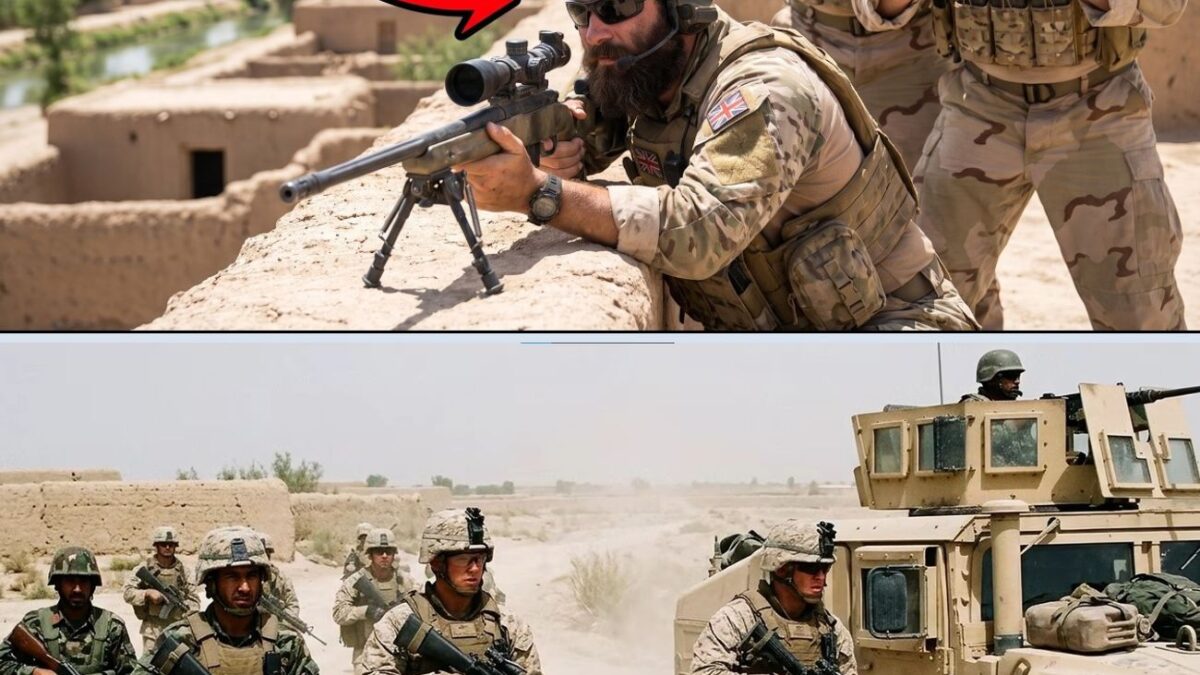
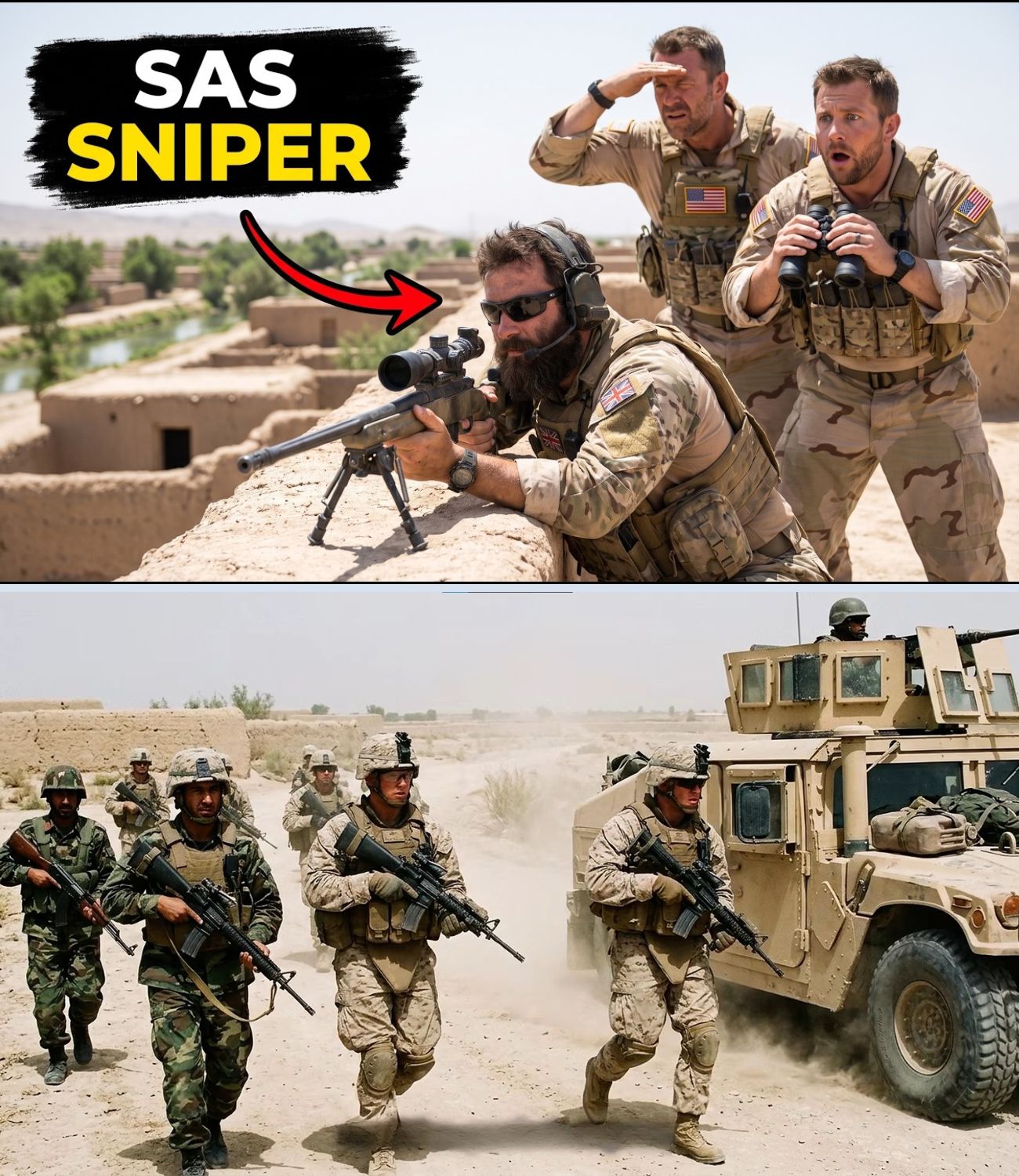
Garcier district, Helman Province. The dry season of 2008. A mudwalled compound on the east bank of the Helmond River, 400 meters from the nearest American position, had been firing and ducking for 6 hours. Inside, a crumbling grape hut converted into an observation post. Three naval special warfare operators lay on their stomachs behind a pair of SR25 rifles, watching heat shimmer rise off a tree line they could not clear. Their interpreter kept repeating the same sentence into a handheld radio. The enemy spotter was moving, not shooting, just moving, and nobody could get eyes on him long enough to put a round anywhere near him.
400 m away in a British observation position built from Hesco barriers and sandbags, a two-man SAS reconnaissance team was already glassing the same tree line with better optics than anyone on the American side owned that week. One of them picked up a radio handset that was never supposed to be on this net and said something that would be repeated in debriefs on two continents. “We can see him. Do you want him dead or do you want to keep asking?”
The man who answered that radio call, whose name for the purposes of this account was Daniel, had been in Afghanistan for 11 weeks. He was not supposed to be talking to Americans at all that morning. His troop had been tasked to a reconnaissance line north of the river, watching a Taliban logistics route that fed fighters and ammunition into Garmser from the desert. A role that had nothing to do with a Navy SEAL platoon pinned down in a half-collapsed compound. But the SEAL’s own designated marksman, a young petty officer with a bolt-action M24 chambered in 7.62mm, had a rifle rated to roughly 800 meters of effective range against a man who was holding position at closer to 900 in heat that was bending every shot low.
Daniel’s rifle, an Accuracy International L115A3 in .338 Lapua Magnum, had been built for exactly that kind of distance. The British Army had only started issuing it in quantity the year before, specifically because the old 7.62mm L96 could not reliably reach targets that Helmand’s long, flat, irrigated terrain kept putting a kilometer away. The Americans did not have anything in theater that matched it for 6 hours. That single fact was the entire war.
To understand why that fact mattered so much, you have to understand what Helmand had become. By the start of 2008, British forces had taken responsibility for the province in 2006 under Operation Herrick, inheriting a few thousand troops and a map covered in towns nobody in London had planned to fight for: Sangin, Now Zad, Musa Kala, Garmser. The British Army’s special forces element in Afghanistan, generally referred to in open reporting simply as the task force, ran small, high-value reconnaissance and strike operations across the province, often far ahead of where conventional troops could support them.
The Americans arrived in growing numbers the same year, and by 2008, a naval special warfare task unit was operating in southern Afghanistan alongside Marine and British units, partnering with Afghan commandos, running presence patrols and targeted raids meant to choke off the Taliban’s freedom of movement along the river valleys. On paper, these were Allied forces working the same ground toward the same goal. In practice, they were separate chains of command, separate supply systems, separate rules of engagement, and separate equipment tables stitched together by liaison officers and goodwill. The goodwill usually worked. The equipment tables did not.
The L115A3 that Daniel was carrying had entered British service in 2007, specifically because commanders in Helmand had been complaining for two fighting seasons that the standard 7.62mm sniper rifle could not reach targets that the terrain made routine. Helmand’s canal-fed farmland created exactly the geometry that favors a long gun: flat fields, straight irrigation ditches, tree lines a kilometer apart, compounds that gave fighters cover to shoot and then walk away before anyone within effective range could react.
The Americans operating in the same province that year were still built around the M24 and in some units early model semi-automatic designated marksman rifles chambered in 7.62mm NATO—weapons optimized for a different war in a different kind of country. Nobody had done this on purpose. It was simply how two Allied militaries buying equipment on two separate procurement timelines for two separate wars that happened to be the same war had ended up unevenly matched on the same 400 meters of riverbank.
The SEAL element pinned in that compound belonged to a naval special warfare task unit rotating through Helmand as part of the broader coalition push that year, working closely with Marine units around Garmser and with Afghan National Army soldiers. They were training and fighting beside their troop chief known on the radio that week by the call sign Hammer, who had run a platoon in Iraq’s Anbar province and had a low tolerance for waiting on anyone. But there was nothing in his platoon’s organic equipment that could solve the problem in front of him. His request up his own chain, relayed through a staff officer at the task unit’s forward operation center, was simple: “Anything with longer legs than what we’re carrying, and fast.”
The answer that came back after almost 90 minutes was that nothing organic to the American task force was within range that morning. Air support was tasked elsewhere; whether it was holding a rotary-wing asset on the ground 60 kilometers east and a precision strike authorization for a single unconfirmed spotter in a tree line was not going to clear in the time it would take to matter. It was a British liaison sergeant monitoring the joint radio net, not any formal request chain, who suggested what nobody had authorized: “Ask the SAS observation post 400 meters to the east if they have eyes on.”
Daniel’s troop staff sergeant, a methodical man who had spent the whole deployment refusing to let his two-man teams get pulled into missions outside their tasking, took the call personally. His name does not appear in this account because unlike Daniel’s position as the operator who fired the rifle, his role was entirely administrative. What he said, according to a debrief account later circulated informally among sniper instructors at Brecon, was close to this: “We’re not tasked to support them. We’re tasked to watch that track. If he can see the spotter from where we already are without moving, that’s not a new mission. That’s the same mission with a different customer.”
It was a distinction that mattered enormously to anyone worried about authorization and meant nothing at all to the three Americans still lying in the dirt 400 m away waiting. What happened next is the part of the story that later got repeated half-jokingly in two different special operations communities as evidence of how differently the British and American systems handled the same 90 seconds. Daniel did not ask his troop staff sergeant for permission to fire. He asked for permission to continue observing a target that was already inside his assigned arc, which had already been granted implicitly the moment he was told to watch that tree line. Firing under his unit’s standing rules of engagement for that operation required only that he could positively identify a hostile act or hostile intent and that the shot would not endanger the Allied troops he could see moving in the compound below him.
The spotter in the tree line was holding a radio and a pair of binoculars calling grid references toward a group of fighters maneuvering on the SEALs’ northern flank. That was enough. Daniel’s spotter lying beside him called the range at 912 meters, corrected for a 10 mph crosswind coming off the river, and gave him the data. Daniel held just under a full second of lead and fired once.
The engagement itself lasted under 2 minutes from the moment the SAS observation post picked up the net to the moment Hammer’s radio operator called a change in the enemy’s posture. It is the kind of detail that sounds almost anticlimactic set against the six hours that preceded it. And that anticlimax was in its own way the entire point. The problem the Americans had spent a morning failing to solve by radio, by air tasking, and by waiting had been solved by two men 400 meters away who had simply been looking in the right direction with the right rifle.
Hammer’s exact words over the net, recorded by at least one radio operator and repeated afterward almost verbatim by several of the men present, were: “Whoever that was, we want him.”
It was meant as praise. Within 11 days, it became something closer to an informal request for a permanent loan. And that request was the part nobody in either headquarters had a process for. Naval Special Warfare’s chain of command in Afghanistan ran broadly through a task force headquarters responsible for coordinating American special operations activity across the south, which answered up through the wider coalition special operations structure for Afghanistan. British special forces answered through an entirely separate British chain, which itself answered to a British commander who had his own obligations to the overall coalition effort, but no obligation whatsoever to hand an SAS asset to an American unit on request.
Lending a soldier across that boundary was not like lending a radio or a case of ammunition. It meant a British serviceman carrying British weapons and operating under British rules of engagement would be moving and fighting inside an American unit’s tactical control outside the reconnaissance tasking his own troop commander had sent him there to do, in a district that was that spring seeing some of the heaviest fighting of the entire campaign around Garmser as British and American forces pushed to clear Taliban fighting positions from the town’s southern approaches.
The request went up both chains at almost the same time, which is itself unusual because normally these things moved slowly and through channels designed to avoid exactly this kind of entanglement. On the American side, it went from Hammer to his task unit commander, who recognized immediately that this was not a decision he could make alone and forwarded it with his own strong endorsement attached to the Special Operations Task Force headquarters. On the British side, it went from Daniel’s troop commander to the squadron headquarters running the reconnaissance tasking with a note that read, according to someone present at the handover briefing weeks later, something close to: “An American unit has asked informally whether our sniper team can continue supporting their position for the duration of the Garmser operation. Request guidance.”
Neither message used the word loan. Both of them meant it. The first answer that came back from the British side was no. Not a flat no, but a bureaucratic one. The kind that institutions produce when they are afraid of a precedent rather than afraid of a decision. The squadron headquarters’ concern was straightforward and not unreasonable on its face: If an SAS sniper team started operating under American tactical control, even informally, even for a few days, it created a question about who was responsible if something went wrong, who approved the rules of engagement he was operating under, and what happened to his own tasking—the logistics route surveillance that had been the reason his troop was in that observation post in the first place.
A reconnaissance officer back at headquarters, whose job was precisely to weigh those trade-offs, flagged the request as something that needed to go further up than squadron level before anyone committed to it. That meant days, not hours. And Garmser’s fighting season did not wait for staff officers. What actually happened on the ground in the gap between that flagged request and any formal answer is the part of this story that embarrassed the people responsible for the formal answer.
Daniel’s troop did not stop watching the logistics track, but their observation post happened to sit on a piece of high ground that also commanded a clear view into the compound where the SEAL platoon was still operating, still taking intermittent small arms and RPG fire from positions across the river, still without a weapon system that could reliably reach that range. Nobody ordered Daniel to keep supporting them. His troop staff sergeant’s interpretation—the same one he had used the first time—held: “If the target was visible from the position he was already tasked to occupy, firing on it was not a new mission.”
Over the following four days, while two headquarters argued about whether to authorize something, Daniel fired on hostile positions in support of the SEAL platoon on six further occasions. All of them by his own account inside the same observation arc he had been assigned before any American had ever called his position on the radio. The arrangement held together on precisely that kind of technicality, and technicalities are fragile things in a combat zone.
The first real crack came from something much more mundane than doctrine: ammunition. The L115A3 fired a .338 Lapua Magnum round that nobody else in that stretch of Helmand was carrying. Daniel’s troop had deployed with a fixed allotment calculated for a reconnaissance tasking that assumed limited engagements, not six days of near-continuous support fire for an American platoon in sustained contact. By the fourth day, his spotter’s log book—the existence of which was confirmed years later by a former colleague who taught at the Royal School of Infantry Sniper Wing—recorded that they were down to a reserve that would not survive another full day’s fighting at the rate they had been shooting.
There was no resupply line built for this. British logistics did not stock .338 Lapua at the American patrol base 40 minutes away. And the nearest British resupply point was a helicopter flight away that nobody had tasked because officially on paper this mission did not exist. It was Hammer, not any staff officer, who solved it in a way that became its own small piece of the legend. He radioed his own task unit’s logistics element and asked bluntly whether anyone had a source for British sniper ammunition and was told there was none closer than Kandahar. He then asked what the Americans did have that could reach the same range and was reminded that his own unit’s .300 Winchester Magnum stock carried for a separate designated marksman role was not the same cartridge and would not chamber in Daniel’s rifle.
The fix that emerged, worked out between Daniel’s spotter and an American logistics chief warrant officer over two radio calls, was almost absurdly simple. A resupply helicopter already scheduled to bring ammunition and water to the SEAL position was quietly asked to carry an extra crate requisitioned through the British liaison cell at the main operating base, addressed to no one in particular, and offloaded at the American position instead of the British one 40 minutes away. On paper, it looked like a shipping error. In practice, it was the first time anyone had built, even informally, a supply chain for a soldier who technically was not supposed to be there.
The second crack was weather, and it arrived at the worst possible moment. On the fifth day, a dust haze rolled up the river valley thick enough to cut visibility to a few hundred meters—exactly the kind of conditions that make a long sniper rifle useless and make close combat far more likely. Garmser’s fighting that week had already pushed British and American units into close urban terrain with Taliban fighters using irrigation ditches and compound walls to close distance rather than stand off at range, which meant Daniel’s rifle for the first time all week was not the right tool.
He and his spotter had carried it, its ammunition, their own rifles, water, and observation equipment on a body that had not slept properly in 5 days. And on the fifth day, they had to physically relocate twice under reduced visibility to keep any usable line of sight at all, carrying a sniper system that weighed close to 8 kg unloaded over broken ground, while a platoon they were not officially supporting kept calling for eyes they could no longer reliably give.
By that point, time itself had become its own kind of pressure. Daniel’s spotter kept a rough personal tally separate from the official log book of hours slept against hours on the optic. And by the end of the fourth day, the two men had managed barely 6 hours of broken rest between them, split into stretches no longer than 40 minutes at a time, while still being expected to call wind and range accurately enough to put a single round into a man-sized target at distances that left almost no margin for a shaking hand or a slow eye.
Fatigue at that level does not announce itself as exhaustion so much as a narrowing of attention. And both men later agreed that by day five they had stopped tracking anything beyond the tree line, the wind flags they had rigged from strips of cloth, and the ammunition count because there was nothing left over to spend on anything else. It was, by Daniel’s own later description, the first time in his career that keeping a simple tally of bullets remaining had felt more urgent than the shooting itself.
It was also the fifth day that the formal answer finally arrived from British headquarters, and it was not what anyone expected. Rather than ordering Daniel’s team back to its original tasking, the response authorized a short-term attachment retroactively covering the days he had already spent supporting the American platoon on the condition that the arrangement end as soon as the immediate operation around Garmser concluded. It was in effect official permission to keep doing what had already been happening for 4 days without it.
One reconnaissance officer who had been skeptical of the whole thing reportedly told a colleague afterward that approving it after the fact rather than before was not how it’s supposed to work and exactly how it always works. The sentence survived in enough retellings among SAS instructors in the years after that it became something close to the unofficial epitaph for the whole episode.
By the sixth day, the Taliban fighters operating across the river had worked out that whoever was hitting their spotters and machine gun teams at distances their own weapons could not answer was shooting from a fixed position on the high ground east of the American compound, and they began treating that position as a target in its own right. Two mortar rounds landed within 60 meters of the observation post over a span of 20 minutes that afternoon—close enough that Daniel’s spotter later described the second impact as having thrown enough dirt over their position to require them to physically reclear their optics before they could keep working.
This was the moment the arrangement stopped being merely irregular and became genuinely dangerous in a way that had nothing to do with paperwork. A single sniper team carrying no armored vehicle, no organic indirect fire support of its own, and no quick reaction force assigned specifically to its protection had become the most valuable and most exposed asset on that stretch of riverbank, and the people responsible for protecting it were an American platoon that was itself still fighting for its own position.
Hammer’s response to that threat is one of the more quietly revealing moments in the whole episode because it showed in a single decision exactly how far the informal partnership had already gone. Rather than treating the British sniper team as a guest to be protected at arm’s length, he folded them directly into his platoon’s own defensive plan, assigning two of his own operators to cover the approach to the observation post and routing a portion of his platoon’s indirect fire support when it became available toward suppressing the far bank whenever Daniel’s position took fire.
It was the kind of decision that made sense tactically and would have made almost no sense administratively to anyone reviewing it afterward from a headquarters tent. An American platoon commander had without any order to do so committed part of his own combat power to protecting a foreign soldier who was not on his unit’s manning roster and did not appear on any American personnel accounting that week.
The operation around Garmser that spring was in the broader history of the campaign a genuinely large undertaking. British and American forces, including elements of a Marine Expeditionary Unit pushed into the area that year specifically to relieve pressure on British troops holding the town’s southern edge, spent weeks clearing entrenched Taliban fighting positions along the Helmand River’s eastern approaches in some of the heaviest and most sustained combat Helmand had seen to that point in the campaign. Set against that scale, a two-man sniper team quietly attached to a single American platoon for a handful of days was a footnote invisible in any press release and absent from the official order of battle either headquarters later produced.
But footnotes are often where the real friction in a war actually lives. And this one revealed something neither headquarters particularly wanted: that the formal, approved, properly resourced version of coalition cooperation had taken 4 days and two staff officers to produce an answer that two platoon-level leaders on the ground had already produced correctly in about 90 seconds.
When the immediate fighting around the American platoon’s position finally eased and the wider Garmser operation moved into its next phase, the terms of the attachment required Daniel’s team to return to its original tasking. Hammer did not accept that quietly. According to someone who worked in the task unit’s operations center that month, he made what was described without obvious exaggeration as a direct and repeated request to extend the arrangement for the remainder of his platoon’s rotation on the grounds that no organic American asset in theater that spring matched what the L115A3 had just demonstrated at range.
The request went nowhere, not because anyone disputed the rifle’s performance, but because by then the original flagged concern about precedent, about chain of command, about what happened the next time an American unit wanted to borrow a British soldier and did not have six days of combat already behind them to justify it after the fact, had hardened into an actual policy conversation at a level well above either platoon.
That policy conversation produced exactly what institutions tend to produce when a good improvisation threatens to become a bad precedent: a review rather than a rule. The British Squadron headquarters that had approved the attachment after the fact commissioned an informal after-action review of the episode less concerned with whether Daniel’s shooting had been effective, which nobody disputed, than with whether the chain of authorization that had allowed it to happen without proper signoff could be tightened without losing the thing that had made it work in the first place—speed.
The review’s conclusions, as later summarized by people who had seen it, were almost apologetic in tone. It noted that the troop staff sergeant’s original interpretation that an already tasked observation position did not require a new mission authorization simply because the people requesting its output wore a different uniform had technically been correct under the rules as written even if it had clearly not been what those rules were designed to permit. Rather than closing that gap, the review recommended it be formalized—that British reconnaissance assets operating in proximity to American units be explicitly empowered within defined limits to support them without waiting for a cross-chain authorization that could take days to produce.
That recommendation, modest as it sounds, was quietly embarrassing to people well above Daniel’s pay grade because it amounted to an official admission that the existing coordination architecture between British and American special operations elements in Helmand had been too slow to be useful in a six-day firefight and that what two platoon leaders on the ground had worked out for themselves was in the judgment of the people paid to design that architecture better than what they had built.
Nobody wrote that conclusion in quite those words in any document that circulated outside the headquarters that produced it. But the practical result, confirmed by more than one person who served in Helmand in subsequent rotations, was that informal cross-attachment of specialist assets like snipers, forward observers, and interpreters between British and American small units became noticeably more common and noticeably less burdened by paperwork in the fighting seasons that followed Garmser.
None of that institutional maneuvering was visible to the men actually lying in the dirt that week, and the human details that survived from the episode are smaller and stranger than any policy conclusion. On the fourth day, with water running low across the whole position, one of the SEALs crawled the 400 m to the observation post, not to check on the shooting, but to drop off 2 L of water he had carried the whole way himself, on the theory, as he reportedly put it: “That the guy keeping us alive shouldn’t be the one who runs out first.”
Daniel’s spotter, asked years later by a colleague what he remembered most clearly from those six days, did not mention the shots or the mortar fire. He mentioned the water bottle and the fact that it had arrived already slightly warm from being carried against the American’s body armor in 40° heat and that it was, in his words: “The best water I’ve ever had and also the worst.”
There is one more detail from those days that outlasted almost everything else about the episode because it traveled deliberately into training. Daniel’s method for managing the ammunition shortage on the fourth and fifth days was not glamorous. He and his spotter began logging every shot not just by range and wind call as standard practice required, but by target type and outcome, specifically so that if the ammunition ran out entirely, they would have a clean record of exactly how many engagements a single sniper team could sustain under real combat conditions before needing resupply and at what rate. That log book, or at least the method behind it, reportedly found its way into sniper instruction at Brecon in the years after Helmand, used not to teach marksmanship, which needed no help, but to teach the much less glamorous discipline of ammunition planning for sustained operations rather than single engagements—a lesson the British sniper community had not needed to learn with that much urgency in earlier, shorter wars.
When the attachment formally ended and Daniel’s troop returned to its original reconnaissance line, the reaction from the Americans was not gratitude so much as something closer to irritation, which is its own kind of compliment. Hammer’s own account, relayed secondhand by a former teammate, described the end of the arrangement less as a farewell and more as a complaint lodged with anyone who would listen: that his platoon had spent a week discovering exactly what it had been missing, had been handed it by accident, and was now having it taken away by two headquarters arguing about ownership rather than outcome.
One American officer who reviewed the episode afterward as part of a broader look at coalition sniper capability gaps reportedly noted with some understatement that the task force’s own longer-range options were still at that point in procurement and would not reach platoons in Helmand for some time yet. The gap Daniel had filled for 6 days did not close because the Americans fixed it. It closed because the mission that had exposed it ended and the next unit to find itself in the same position would have to solve the same problem the same informal way or do without.
The official record of the Garmser operation that spring in both British and American retellings makes no mention of a borrowed sniper because there was no clean administrative category for what had happened and institutions tend not to record what they cannot categorize. What survived instead was oral, a story passed between sniper instructors, naval special warfare training cadre, and the handful of liaison officers who had actually watched the paperwork try and largely fail to keep pace with what two platoon leaders had already decided to do.
It became in the years after something closer to a teaching example than a historical footnote, cited according to more than one person who heard versions of it at Hereford and at Naval Special Warfare training commands as the case you brought up when a staff officer insisted that cross-attachment between Allied special operations units needed more process, not less.
What made the episode land the way it did inside both special operations communities was not really about one rifle outperforming another, although that was the detail that traveled best in the retelling. It was that the entire machinery built to make two Allied militaries function as one coherent force in Helmand—the liaison officers, the joint operation centers, the shared radio nets, the staff processes designed precisely to prevent the kind of confusion that gets people killed—had in this one instance moved slower than two sergeants deciding on their own initiative that the mission in front of them mattered more than the mission on their tasking sheet.
That is an uncomfortable thing for any headquarters to sit with, British or American, because the entire argument for having a headquarters is that it produces better, faster, more accountable decisions than individuals improvising in the field. For six days in Garmser, the opposite had been demonstrably true, and everyone involved—from the troop staff sergeant who stretched a technicality to the task unit commander who endorsed an unofficial request—knew it.
It is worth saying plainly what the larger institutions actually had and chose not to use. The coalition in Helmand by 2008 had helicopters, fixed-wing strike aircraft, a functioning if imperfect intelligence apparatus, and formal liaison structures built specifically to prevent exactly the kind of equipment and authority gap that nearly cost a SEAL platoon control of its own position for most of a day. What it did not have in that specific moment was the organizational speed to connect an available solution to an urgent problem without passing through two headquarters that were understandably more worried about precedent than about the 6 hours a platoon had already spent pinned down.
The fix came from men with no authority to approve it, using a reading of their own orders generous enough to survive scrutiny only because the outcome made the scrutiny feel beside the point. The feared backlash when it finally arrived in the form of that informal after-action review turned out to be smaller than anyone expecting a reprimand might have guessed. Nobody was disciplined. The troop staff sergeant, who had stretched the standing orders, kept his post, and according to someone who served under him afterward, used almost the identical justification on at least two further occasions before his tour ended, with the same result each time: a request for forgiveness filed only after the shooting had already stopped.
Daniel himself returned to an ordinary reconnaissance rotation for the remainder of his deployment. And if the episode changed anything about how he was regarded within his own squadron, the only visible evidence of it was a standing joke repeated for years afterward by people who were not even in Helmand that spring: that if the Americans ever again found themselves outranged in a firefight, the fastest official channel for help was still slower than just shouting across 400 meters of open ground.
That joke, worn smooth by repetition, is probably as close as this story gets to an official verdict because no tribunal, no formal inquiry, and no public report was ever built around 6 days in a grape-dry hut on the edge of the Helmand River. What exists instead is a log book entry, a secondhand quote about water that arrived warm, a staff officer’s dry observation that: “Approval after the fact is not how it is supposed to work and exactly how it always works.”
And a rifle that the Americans did not have and for that one week did not need to have because someone else already did and was willing to keep firing it long after anyone back at headquarters had decided whether he was allowed to.
The single closest call of the whole six days came not from the mortar fire that bracketed the observation post on the sixth afternoon, but from a much quieter moment on the third night when a four-man Taliban patrol worked along the river’s edge toward the SAS position, apparently probing for exactly the kind of isolated outpost Daniel and his spotter were occupying without a dedicated security element of their own. They were spotted at roughly 150 m by Daniel’s spotter using a thermal monocular that had been issued to the troop only that rotation—close enough that a rifle built for shooting at 900 m was for a few minutes the wrong tool entirely—and both men transitioned to their personal weapons and waited rather than engaged on the judgment that opening fire at that range and in that light would have given away the position for good with no clean way to break contact afterward.
The patrol passed within what the spotter later estimated at under a 100 meters without ever looking directly at the slight rise where the two men lay motionless and moved on toward the river. Nothing about that moment made it into any official account of the operation because nothing happened that required one. It survived only because Daniel mentioned it in passing years afterward as the 3 minutes of the whole deployment he remembered most clearly, more clearly even than the shot that started the entire episode.
By the time the wider Garmser operation concluded after weeks of fighting that pushed Taliban positions back from the town’s southern approaches with the help of the Marine Expeditionary Unit brought in to support British and Afghan forces, the six days in the grape hut had already become the kind of story that gets told at a bar rather than written in a report. But its practical afterlife inside both militaries was real. British liaison officers assigned to American units in the fighting seasons that followed reportedly carried informally a kind of shorthand understanding that a reconnaissance asset already observing a target area could support a partnered unit without a new tasking order, provided the engagement stayed within the original observation arc—which was precisely the interpretation that had let Daniel keep shooting for 4 days before anyone above squadron level had said yes.
It was never written into a formal standing order as far as anyone outside the relevant headquarters has confirmed. It simply became how people who had heard the story or served with someone who had chose to behave the next time the same gap opened up in front of them.
There is a reason this particular story kept circulating in sniper and special operations circles long after Garmser faded from the news cycle. And it has less to do with the shooting than with what the shooting exposed about two allied militaries that genuinely liked and trusted each other and still could not move information and authority between themselves as fast as the men on the ground could move a rifle and a radio call.
The British Army had spent real money and real procurement years solving the range problem that the L115A3 represented, specifically because Helmand’s geography had taught painful lessons about what happens when a sniper can see a target he cannot reach. The Americans fighting the same war in the same province were still a step behind on that particular piece of equipment, not through negligence but through the simple mismatch of two procurement systems running on two different clocks for two different armies that happened that year to be standing in the same 400 m of riverbank. Daniel’s rifle did not make the Americans less capable. It simply arrived briefly exactly where a gap already existed, carried by a man who had no formal reason to be there and every practical reason to stay.
What the episode never produced, and what people who tell the story still sometimes seem faintly disappointed by, was a clean ending. There was no medal ceremony, no joint press statement, no formal acknowledgement from either government that an SAS soldier had spent most of a week fighting alongside an American SEAL platoon outside his own chain of command. The closest thing to an official record is the kind of secondhand paper trail this account has already described: an informal squadron review, a log book kept for ammunition planning rather than glory, a liaison officer’s dry comment about approval granted after the fact, and a joke about 400 meters that outlived the policy conversation it was supposed to settle.
Daniel finished his tour, rotated home, and by most accounts never discussed the episode publicly in any form that could be independently verified beyond what colleagues and instructors later repeated informally among themselves. That absence of a tidy official record is not a flaw in the story. For a mission that was never supposed to exist on paper in the first place, it is closer to the point.
There is one postscript to the episode that several people who have told this story over the years consider the most telling part precisely because it happened so long after Garmser that nobody involved had any reason left to exaggerate it. Two years later, a naval special warfare sniper instructor training at a joint exercise in the United States reportedly recognized in a visiting British sniper cadre a name he had only ever heard as a nickname passed down from a platoon chief who was by then out of the service. He asked, half joking, whether anyone there had ever heard of the SAS sniper who got borrowed by a SEAL platoon in Garmser and never fully given back. Daniel, present at that exchange by coincidence rather than design, is said to have answered only that he had heard something like that once and let the subject drop.
Whether that exchange happened exactly as later told, or whether it gathered a little polish in the retelling the way these stories always do, is impossible to confirm from outside the room. What is not in dispute is that by then the story had already outgrown the six days it described, circulating as shorthand for a much larger argument about how Allied special operations forces should and mostly still do not share capability across a boundary that exists on an organizational chart and nowhere else.
What remains in the end is smaller than a battle and larger than an anecdote: a water bottle carried 400 meters and handed over still warm; a shot called at 912 meters into a crosswind nobody had time to argue about; and a line from a staff officer repeated so often afterward that nobody can say for certain who said it first—that approving something after it has already worked is not how any of this is supposed to work, and is exactly how it always works.
You Might Also Enjoy

“We Thought They Would Negotiate”—What Argentine Soldiers Said When The British Attacked Goose Green

“You’ll Never Finish My Ruck March, Limey” — US Sergeant Who Challenged the SAS, Then Fell Out First






