Why German Engineers Couldn’t Explain How Britain Built A Bomb That Bounced On Water
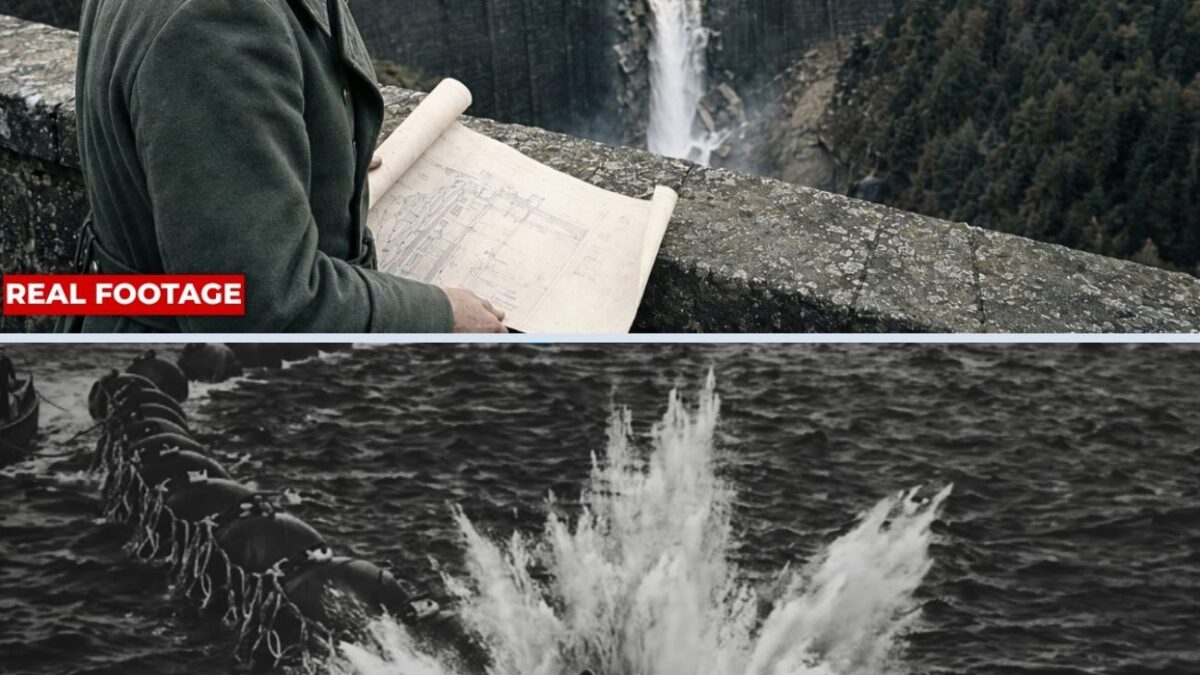
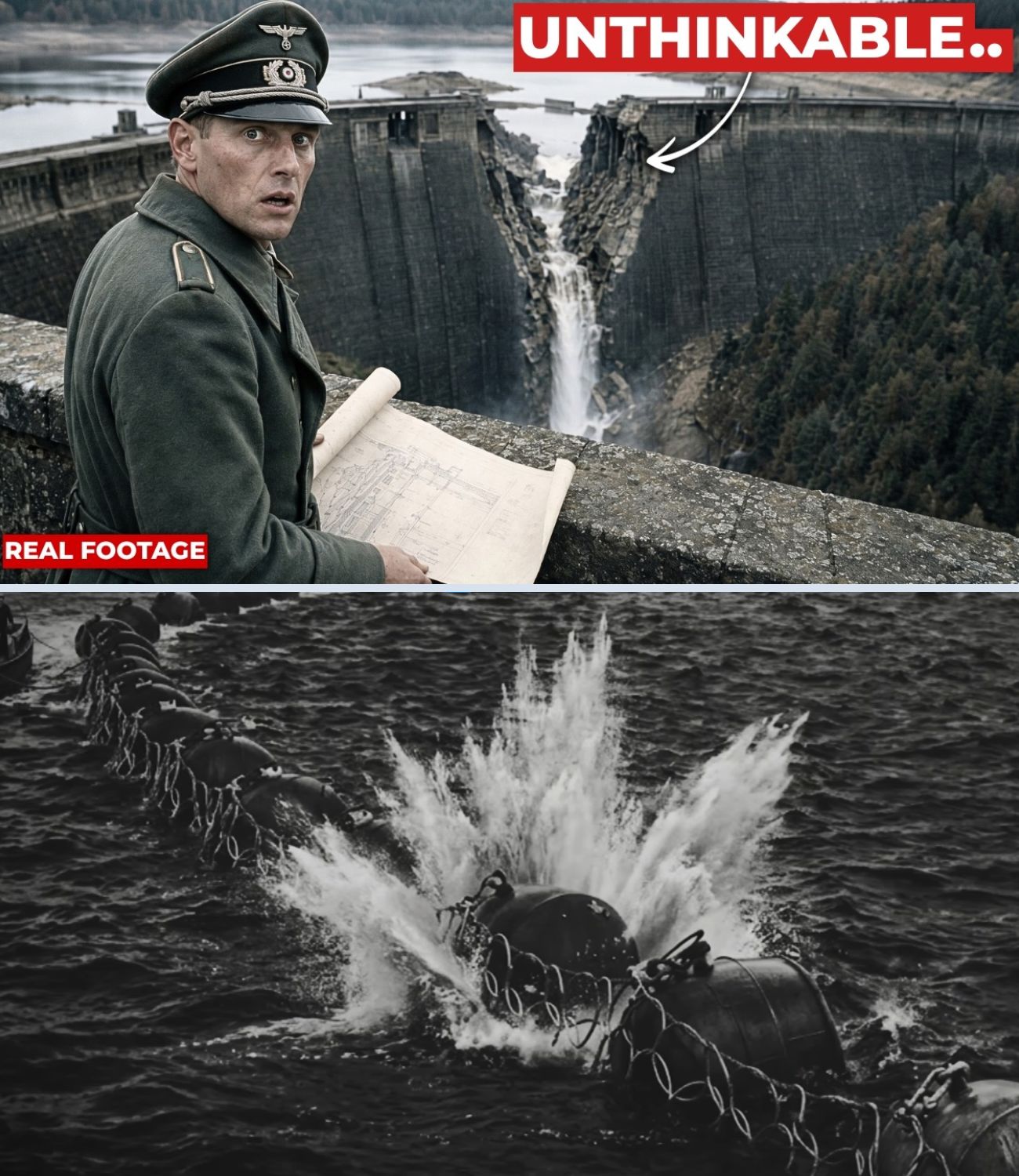
May 17th, 1943, 3:12 in the morning. A black Mercedes saloon climbs the narrow road above the Möhne Reservoir in the Sauerland hills of Western Germany. Inside, a man in a grey civilian overcoat stares out at a landscape that has rearranged itself overnight. His name is Albert Speer, Reich’s Minister for Armaments and War Production, 47 years old, the most powerful technocrat in the Third Reich, answerable only to Hitler. A man who has spent the war building things, organizing things, mobilizing the industrial muscle of a continent. He has been pulled from bed at the Berghof a few hours earlier. He has flown across Germany at first light in a Junkers transport. He has driven the last miles up through the valley, and now he is standing on the hillside above what used to be the Möhne Dam, looking down at something his engineers told him was impossible, a hole 250 ft wide, punched clean through 650 ft of cut Sauerland masonry. 12 million tons of stone laid up before the First World War, designed to last a thousand years. He turns to one of the Wehrmacht engineers beside him, a man holding blueprints he no longer needs. The man cannot explain it. Speer himself will write later in his memoirs that the British that night came close to a success greater than anything they had achieved with a commitment of thousands of bombers. He will write that the power station at the foot of the dam looked as if it had been erased along with its heavy turbines. But standing on the hillside that morning, what Albert Speer wants to know is simpler. He wants to know how. He wants to know what kind of bomb does this. He wants to know what kind of mind designs it.
Pause on that question for a moment. Because this is not a story about a dam. This is a story about how a country at war tells itself who it is. This is the story of Operation Chastise.
Part one, the wall the Germans believed in. To understand why a German engineer could not explain the hole in the Möhne, you have to understand what German engineers believed about dams. And to understand that, you have to go back, not to the start of the war, but to the start of the century. The Möhne Dam was finished in 1913, sister to the Eder, finished a year later in 1914. Both were what engineers called Intze type gravity dams, named for Professor Otto Intze von Raken, who had spent a career working out the precise geometry by which a wall of stone could hold back a lake. The Möhne held 134 million cubic meters of water. The Eder held 202 million. Together, they fed the rivers, the canals, the steel mills, the coke plants, the synthetic oil works. They held the drinking water for over 5 million people. They were not pretty engineering. They were strategic engineering. They were Germany’s industrial heart in liquid form, and the Germans had thought about defending them.
By the spring of 1943, the Möhne carried two torpedo nets, strung across the reservoir in front of the dam wall. Heavy steel mesh suspended on floats, designed to catch any underwater weapon long before it reached the masonry. On the dam itself, light flak guns, 20 mm and 37 mm cannon, some on the towers, some on the banks, a small garrison. The Eder had less. The Eder had effectively nothing. Two patrolling guards with rifles, no torpedo nets, no flak guns. The Germans had decided the Eder did not need them. They had decided this for a reason that, inside the frame they were thinking in, was completely correct. His assessment was not insane. It was based on available data. The problem was that it was about to be 3 weeks out of date.
Here is what the German engineers believed. They believed a dam could be attacked in three ways. A torpedo fired at the wall from the water. The torpedo nets stopped that. A high explosive bomb dropped from altitude. Royal Air Force Bomber Command’s own statistics, captured early in the war, had shown that a bomber dropping from 20,000 ft placed its load within 5 miles of target only one time in three. To hit a wall 50 ft thick from 4 mi up was a statistical impossibility or sabotage from the ground, which the Sika Heights Deans could handle. Three threats, three answers. Doctrine closed, case closed.
And inside that frame, German engineering had been brilliant. The dam designs were published in international journals in the 1930s. The Germans were proud of them. They wanted other engineers to study them. The Möhne was a monument to a culture that believed engineering excellence and engineering openness went together. Helmuth Euler, the German historian who wrote the definitive account of what happened to those dams, makes the point exactly. The plans were public. They were published. They were a source of national pride. Their model worked until it didn’t. Their model worked because it had imagined every threat that fitted the doctrine. It did not work because it had not imagined the man.
Part two, the man in the back garden. 47 mi south of London, in the village of Effingham, Surrey, in a red brick house called White Hill House, a 54-year-old engineer is leaning over a metal trough of water in his back garden. He has a homemade catapult. He has a tin of his daughter Mary’s marbles. He has a notebook. And he has, by his own later admission, a problem he cannot stop thinking about. His name is Barnes Neville Wallis. He is not a soldier. He has no rank. He’s a civilian engineer employed by Vickers-Armstrongs as assistant chief designer in the aviation section. He came up through airships. He designed the R100, sister ship to the doomed R101 in the 1920s.
When the airship era ended, he reinvented himself in aircraft. He invented the geodetic airframe, the lattice work skeleton that gave the Vickers Wellington bomber its strange basket weave fuselage, and its astonishing ability to come home with half its skin shot off. He is not flamboyant. He is, to use a word the Royal Air Force coined for men like him during the war, a boffin, a civilian scientist or engineer attached unofficially to the war effort, working partly from his desk and partly from his garden. Robert Watson-Watt, the radar pioneer, said a boffin was essentially a middleman, a bridge between two worlds, the world of pure science and the world of operational use.
Wallace fits that exactly. He also fits something older, the British amateur tradition, the country curate who classifies beetles, the retired colonel who breeds orchids, the Vickers engineer who in 1942 decides at his kitchen table that he is going to find a way to break a German dam. Pause on that because it matters. Wallis had been writing about strategic bombing since 1940. He had submitted a paper that year, eventually titled A Note on a Method of Attacking the Axis Powers, 120 pages of dense engineering argument, now held at the Churchill Archives in Cambridge under reference WLIS1. In it he wrote, in a sentence that is the engineering equivalent of a manifesto, that if the destruction or paralysis of certain key targets could be accomplished, they offered a means of rendering the enemy utterly incapable of continuing to prosecute the war.
The Air Ministry read it. The Air Ministry rejected it. In April 1942, he wrote a second paper. This one was titled Spherical Bomb Surface Torpedo. It identified the specific targets, hydroelectric dams and floating vessels moored in calm waters. He sent it up the chain. It was, again, mostly rejected. A few people read it carefully. Most did not.
So, Wallace did what eccentric British inventors have always done. He went home. He went into his garden. He filled the trough with water. He took his daughter’s marbles and a homemade catapult, and he started flicking them across the surface to see how they bounced. He was not the only person working on the problem. He was helped by his colleague George Edwards at Vickers, who knew cricket and who suggested that backspin, not topspin, would make a sphere skip cleanly. He was helped by the Road Research Laboratory at Garston, who built a model dam and blew it up in winter ’40 to ’41. He was helped by A.R. Collins, who in July 1942 destroyed a disused dam in Wales called Nant y Gro with a small charge held in contact with the wall underwater.
That last test gave Wallis the number he needed. 6,000 to 6,500 lb of high explosive detonated against the dam face below the waterline would do to the Möhne what nothing dropped from the sky had ever done. He moved his testing from the garden to the National Physical Laboratory at Teddington. Tank trials with steel spheres, he proved a back spun sphere dropped at the right speed at the right altitude would skip across the water like a stone. He proved that when it hit the dam wall, the backspin would cause it to crawl down the masonry rather than bounce off. He proved it would settle against the wall at depth where the hydrostatic fuse would fire it and where the surrounding water would amplify the explosion many times over. It was beautiful. It was looked at with fresh eyes, almost obvious.
The Air Ministry hated it. Sir Arthur Harris, Commander-in-Chief of Bomber Command, hated it most of all. On the 14th of February 1943, 3 months before the raid, Harris wrote a memo on a Vickers proposal that is still held at the National Archives in Kew under file AIR 14840. It is, even by Harris’s standards, a document of extraordinary contempt. Harris wrote that the whole thing was tripe of the wildest description. He wrote that there were so many ifs and ands there was not the smallest chance of it working. He wrote that vibration at 500 revolutions per minute would wreck the aircraft or tear the bomb loose. He wrote:
“At all costs, stop them putting aside Lancasters and reducing our bombing effort on this wild goose chase. The war will be over before it works, and it never will.”
Read that line again. The war will be over before it works and it never will. This was the man Wallace had to convince. He never did convince Harris. What he did instead was something more characteristically British. He went around him. He showed his test films secretly to an intelligence officer named Group Captain Frederick Winterbotham. Winterbotham showed them to Air Chief Marshal Sir Charles Portal. And on the 26th of February 1943, Portal, Chief of the Air Staff, overruled Harris. He allocated 30 Lancasters. He gave Wallace seven weeks. Three weeks before the raid, Wallace had a number that made the youngest pilots stare. The bomb would have to be dropped from precisely 60 ft above water at night at 232 mph over the ground spinning at 500 revolutions per minute backwards, 425 yd from the dam wall. That is the money number. 500 revolutions per minute, 60 ft. He had derived it in his garden with marbles.
Part three, the squadron and the deeper system. To execute the impossible thing that Barnes Wallis had designed, the Royal Air Force needed pilots who could fly a Lancaster heavy bomber, 29 tons of aircraft, 60 ft above water at night in formation at a tight speed and release a 4-ton spinning weapon within a 12-ft height window and a 50-yd distance window. There were not many men in the world who could do that. There were perhaps no men in the world who could do that. So, they made some.
On the 21st of March 1943 at Royal Air Force Scampton in Lincolnshire, a new squadron was formed. It was numbered Squadron X for the first few days. It was renumbered 617. Its commanding officer was a 24-year-old wing commander named Guy Penrose Gibson.
Pause on Gibson for a moment because this is a man who matters. He was born in Simla in British India in 1918. He had been flying combat operations since the start of the war by the time he took command of 617. He had completed more than 170 sorties on Hamptons, Manchesters, Lancasters, and as a night fighter pilot on Beauforts with 29 and 106 squadrons. He held the Distinguished Service Order and Bar. He held the Distinguished Flying Cross and Bar, four major decorations. He was 24 years old. He was not a likable man. Several of the pilots who served under him said as much. He was abrupt. He was demanding. He was at times what later generations would call a snob. He was also in the air in command almost without parallel. The men called him Gibbo behind his back. They followed him because he was the best of them.
He had a black Labrador whose name has rightly become unspeakable in the 80 years since. The dog lived at the squadron, ran across the airfield, was loved by the men, and was killed by a passing car outside the main gate of Scampton on the morning of the 16th of May 1943. Hours before the raid, he was buried at midnight behind Gibson’s office. His name that night would become the code word for one of the most dramatic moments in the history of air warfare.
Gibson and his 19 crews trained for 8 weeks. They flew over Eyebrook Reservoir in Rutland, over the Derwent in Derbyshire, over Abberton in Essex. They flew at 60 ft at night by the light of two converging Aldis lamps mounted under the aircraft, designed by a scientist named Benjamin Lockspeiser at the Royal Aircraft Establishment, calibrated so that when the two beams met on the surface of the water, the aircraft was at exactly the altitude Wallis had specified. They flew until they could do it without thinking.
This is where you have to widen the lens. Because the question is not just how the British built this weapon. The question is why the British could build it at all, why it was a country house engineer in Effingham who solved this and not say an engineering institute in Berlin? Here is the deeper system. Britain in 1940 had a culture embedded in the way it taught engineering, ran its civil service, organized its armed forces that left a small but real space for the unattached individual. The country curate who classified beetles, the retired colonel who bred orchids, the Vickers engineer who drew bomb diagrams in his back garden. There was a word for it in wartime Royal Air Force slang, boffin, a civilian, often eccentric, working at the seam between pure science and operational use.
Frank Whittle, who invented the jet engine in his Cranwell thesis in 1928, was a boffin. His patent lapsed in 1935 because he could not afford the five-pound renewal fee and the Air Ministry would not pay it. R. J. Mitchell, who designed the Spitfire while terminally ill with cancer at Supermarine, was a boffin. Alan Turing, who broke the German Enigma cipher at Bletchley Park, was a boffin. Wallace was a boffin.
Now compare. German wartime research and development was hierarchical. It was specification-driven. It ran through massive corporate or state structures. Krupp, Rheinmetall, Daimler-Benz, Junkers, Speer’s Armaments Ministry, Organization Todt. It was brilliant in its own paradigm and it produced extraordinary things. The V-2 rocket, the Tiger tank, the Type 21 submarine, but it did not easily produce Barnes Wallis.
There were German equivalents. Hans von Ohain built a working jet engine and got it into a Heinkel 178 before Whittle flew. Konrad Zuse built the Z3 computer in his parents’ Berlin apartment in 1941. They existed. They did not flourish. The patronage system, the way decisions ran through Hitler and Speer and Göring, meant that an outside-the-system amateur could not get a hearing the way Wallis got a hearing. Wallis got past Harris by getting Winterbotham show his films to Portal. There was no equivalent path in Berlin. The German engineer in the back garden, if there was one, did not get the meeting. This was the structural difference. This is the deeper system that built the bomb that bounced on water. Not racial, not moral, cultural and institutional. A country with enough confidence in its amateurs to let them sometimes into the room. The Germans had Ingenieurstolz, engineering pride. The British had something more dangerous. They had the back garden.
Part four, the night and the realization. At 9:39 in the evening on the 16th of May, 1943, the first Vic of three Lancasters of 617 Squadron lifted off from Scampton, Gibson, Hopgood, Martin. 11 minutes earlier, the second formation had already gone, taking the long northern route over the Frisian Islands toward the Sorpe Dam. The third formation, the mobile reserve, would follow at 9 minutes past midnight. 19 aircraft, 133 men. The youngest gunner was 20.
The route for Gibson’s main force ran low across the North Sea and over the Dutch coast at Walcheren, south around the Ruhr defenses, and east to the Möhne. Low meant 50 to 100 ft. They flew under the radar. They flew so low that one aircraft, Flight Lieutenant Jeff Rice, struck the surface of the Waddenzee and tore his bomb clean off the underside of his Lancaster. He turned and flew home with the rear gunner soaked and screaming about the cold.
Two aircraft did not even reach the dams. Pilot Officer Vernon Byers was shot down by flak as he crossed the Dutch island of Texel. All seven of his crew were killed. Flight Lieutenant Bill Astell flew into high tension power lines near the village of Marbeck in Germany. All seven of his crew were killed. Flight Lieutenant Norman Barlow on the northern route struck power lines near Rees. His Lancaster fell in flames. His bomb was thrown clear and rolled intact into a German field where a Luftwaffe officer named Hauptmann Heinz Schweizer recovered it and shipped it east for analysis.
Gibson reached the Möhne at 28 minutes past midnight. He banked over the lake and led the attack himself. Two engines flat out, 60 ft, 232 mph. Bomb spinning at 500 revolutions per minute. The two Aldis lamps converging on the water beneath the aircraft. The bomb aimer, Pilot Officer Spafford, sighting through a wooden bomb sight made of plywood with two pins. The bomb fell. It bounced. It bounced again. It hit the dam. It exploded against the netting and the masonry. The water rose into a column 300 ft high. When it cleared, the dam was still there.
Flight Lieutenant John Hopgood ran in second. His Lancaster was hit by flak on the approach. The front gunner was killed. The engines were damaged. He held the aircraft level long enough for his bomb to release, but it released too late. It bounced over the dam and struck the power station behind it. His Lancaster was already burning. The wing came off. He held the aircraft long enough to give two of his crew a chance to bail out and then he died.
Squadron Leader Henry Maudslay watched it from circling height. Maudslay was 21 years old, acting commander of B Flight, holder of the Distinguished Flying Cross. A new name in this story introduced here because his story is the second story of the night and the story of the Eder.
Mick Martin attacked third. His mine veered. Henry Young attacked fourth. His mine bounced cleanly, hit the dam and detonated. Something in the wall shifted. The Möhne was dying. It did not yet know it was dying.
David Maltby attacked fifth. His mine bounced four times, struck the dam, and at 49 minutes past midnight on the 17th of May, 1943, the masonry of the Möhne dam cut from Sauerland stone before the First World War gave way. Gibson’s wireless operator, Flight Lieutenant Bob Hutchison, sent the code word to group headquarters at Grantham. The code word was the name of Gibson’s dog. It was sent in Morse three times. At Grantham, in a converted country house called St. Vincent’s Hall, where Air Vice-Marshal Ralph Cochrane was waiting with Barnes Wallis at his side, the signal came through. Wallis put his hands to his face.
Gibson took the survivors east to the Eder. The Eder was harder. The Eder was harder because, although it had no flak and no torpedo nets, it was hidden in steep wooded valleys that demanded an approach the Lancaster was not designed to fly. Hairpin descent, fast pull-up over Waldeck Castle on the ridge above the dam. Drop. Climb away before the hill on the far side of the lake.
David Shannon of the Royal Australian Air Force made six attempts and could not get the geometry right. On the seventh, he dropped. The bomb bounced cleanly, but the dam held.
Henry Maudslay ran in second. He came in too fast, too high, slightly off line. He released his bomb late. It bounced once, and on the second bounce, it struck the parapet of the dam itself, exploding almost beneath his Lancaster as he climbed away. The aircraft was visible against the flash. Gibson’s voice came over the radio:
“Henry, are you okay?”
Maudslay’s voice came back faintly:
“I think so. Stand by.”
Maudslay flew west. He flew on a damaged aircraft, leaking, slowing. He reached the German-Dutch border. At 36 minutes past 2:00 in the morning, he was shot down by light flak near the town of Emmerich. All seven of his crew were killed.
Pilot Officer Les Knight of the Royal Australian Air Force, 22 years old, ran in third. His mine bounced three times. It hit the dam. At 54 minutes past 1:00 in the morning on the 17th of May, 1943, the Eder Dam broke. The code word for the Eder was dinghy, named after Henry Young, who had ditched in the sea twice earlier in the war and been rescued from his rubber dinghy each time. Young himself, on the way home from the Möhne, was shot down by flak crossing the Dutch coast at Castricum aan Zee. All seven of his crew were killed. The code word was sent in his name by other men 6 minutes before he was killed, although nobody knew it yet.
Eight Lancasters of the 19 never came home. 53 aircrew were killed. Three were captured. Two of the three were the men Hopgood had held the aircraft level for. Flight Lieutenant David Maltby was the first to land at Scampton. He set down at 11 minutes past 3:00 in the morning. The last to land was Flight Sergeant Bill Townsend on three engines at 15 minutes past 6:00.
Wallis, at Grantham, was told the casualty list. He turned to Cochrane and said, in words that have come down through several memoirs in slightly different forms, but which all carry the same meaning, that if he had known it was going to be like this, he would never have started it. He had been right about the engineering. He had been right about every number. He had been right about the spin rate and the altitude and the explosive charge and the depth of detonation. He had not been wrong about anything except the cost.
Albert Speer, the man with whom the story began, recorded in his memoirs what happened next. He had been woken at the Berghof. He had flown to the Ruhr at first light. He had stood on the hillside above the broken Möhne. And when he wrote, 25 years later, what the British had nearly done that night, he chose his words carefully. The British, he wrote, came close to a success greater than anything they had achieved with thousands of bombers. But they made a mistake which puzzles me to this day. They divided their forces, and the same night they destroyed the Eder, which had nothing whatsoever to do with the supply of water to the Ruhr.
Read that line again. They had nothing whatsoever to do with the supply of water to the Ruhr. Speer was right. He was right about the Eder. He was right that the British had not understood the Ruhr industrial water system completely. He was right that the Möhne was the prize, and the Sorpe undamaged that night was the second prize, and the Eder was, in cold strategic terms, a side dish. He was right about everything except the thing he could not bring himself to say, which was that the British had broken the dams at all.
Within a week, Speer had pulled 7,000 workers off the Atlantic Wall and sent them to the Ruhr. Within 6 weeks, the worst of the flooding was repaired. By the 23rd of September, 1943, the breach in the Möhne was closed just before the autumn rains. Speer wrote in the same chapter that while we were engaged in rebuilding, the British Air Force missed its second chance. He was right about that, too.
Part five, the verdict. So, why could German engineers not explain how the British built a bomb that bounced on water? The Germans had blueprints. The British had a back garden. The Germans had Ingenieurstolz. The British had a man with a tin of marbles. The Germans had a defensive doctrine that was complete and consistent and correct against every threat that fitted inside it. The British had a 54-year-old civilian with no military rank who refused to fit inside it.
This is the verdict the morning at the Möhne demanded, not that the Germans were inferior engineers. They were not. The dams they built held until somebody invented a weapon nobody had imagined. The men they trained to defend those dams were professionals. The flak gunners on the Möhne towers shot down Hopgood’s Lancaster, and with it killed his front gunner and his bomb aimer and his wireless operator and Hopgood himself. They were not amateurs. They were not cowards. They did their job.
The verdict is structural. The verdict is cultural. The verdict is that a country which left space between its institutions for the unattached eccentric, the country curate, the back garden engineer, had access to a kind of mind a more rationally organized country did not. This is not a moral judgment. It is an observation about how systems fail, and which kinds of system fail in which ways.
The British, this story tells us, were lucky in a particular way. They were lucky that their engineering culture had this strange amateur tradition. They were lucky that their service ministries, although obstructive, were not totalitarian. They were lucky that a man could write a paper, get it rejected, and still go home to Effingham and put the marbles back in the bath. And still find, eventually, a group captain who would smuggle his test films to a chief of the air staff who would overrule a commander-in-chief. They were lucky in their system’s failure.
They were unlucky in the cost of the 133 men who took off on the night of the 16th of May, 1943, 53 did not come back. 40% Bomber Command would not see another loss rate like it in a single operation. And on the German side, in the valley below the Möhne, at least 1,650 people drowned in the floodwaters. The majority of them foreign forced laborers in a women’s barracks at Neheim. Soviet civilians who had been brought to Germany against their will, and who died in their bunks when the water came through the valley before dawn. This part of the story is not romantic, or is it should not be. The morality of strategic bombing is not the subject of this video, but the cost of it deserves to be named. The cost of breaking the dams was paid most heavily by people who had no part in the war’s making.
What can be said, in the name of remembrance, is the names of the men who flew. Wing Commander Guy Gibson, 24 years old, who would be killed 16 months later over the Netherlands. Squadron Leader Henry Maudslay, 21 years old, who flew a damaged Lancaster as far as Emmerich before the flak found him. Flight Lieutenant John Hopgood, who held his burning aircraft long enough for two of his crew to live. Flight Lieutenant David Maltby, who broke the Möhne, and who would die in a training accident later that year. Pilot Officer Les Knight, who broke the Eder, and who would be killed flying back from another raid 4 months later.
And behind them, the engineer. Barnes Neville Wallis, civilian, no rank, who lived to be 92, and who said, near the end of his life that for him the success of that night was almost completely blotted out by the sense of loss of those wonderfully young lives. These men should not be allowed to disappear.
I should tell you before this ends that the German engineer at the start of this video, the man Speer turned to on the hillside above the broken Möhne, is composite. The historical record shows that Speer flew to the Ruhr at first light and stood above the dam for 2 days, and that he was accompanied by Wehrmacht and ministry engineers. The named engineer in the cold open is a stand-in for several real men whose reports I drew from. The morning happened. The hole was real. The blueprints were real. The man unable to explain it was real, and there were several of him.
The dam broke at 49 minutes past midnight on the 17th of May, 1943.
You Might Also Enjoy

“We Thought They Would Negotiate”—What Argentine Soldiers Said When The British Attacked Goose Green

“You’ll Never Finish My Ruck March, Limey” — US Sergeant Who Challenged the SAS, Then Fell Out First






