Why King Charles’ Parents Hated Him So Much
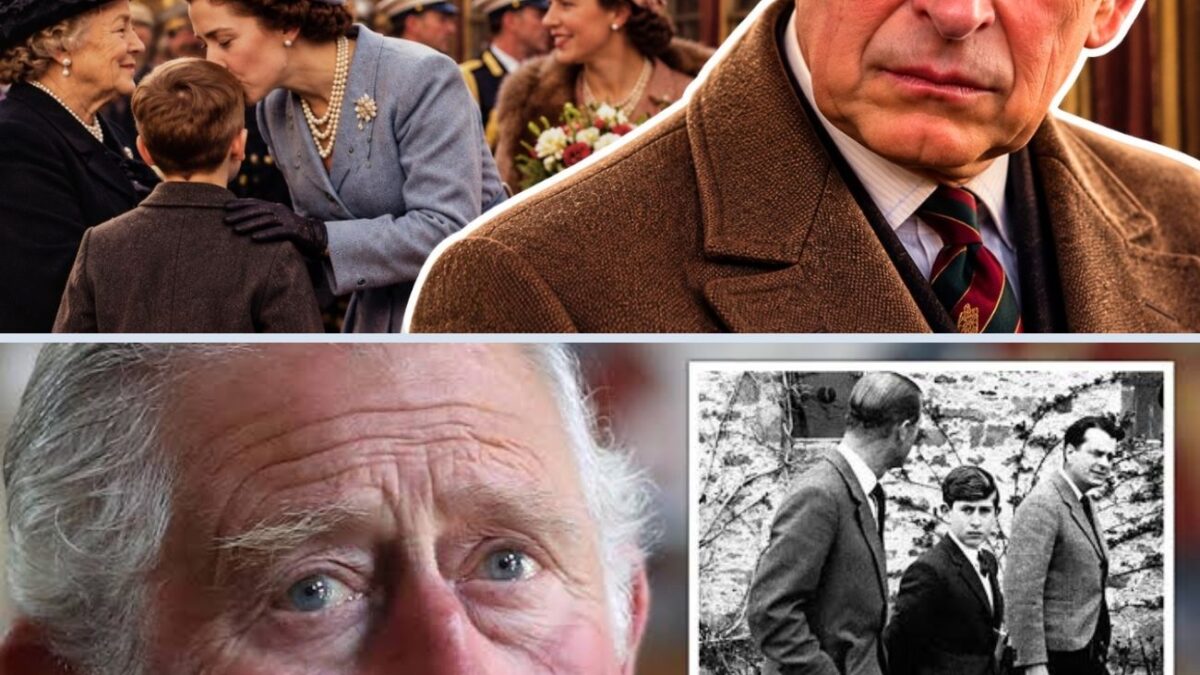
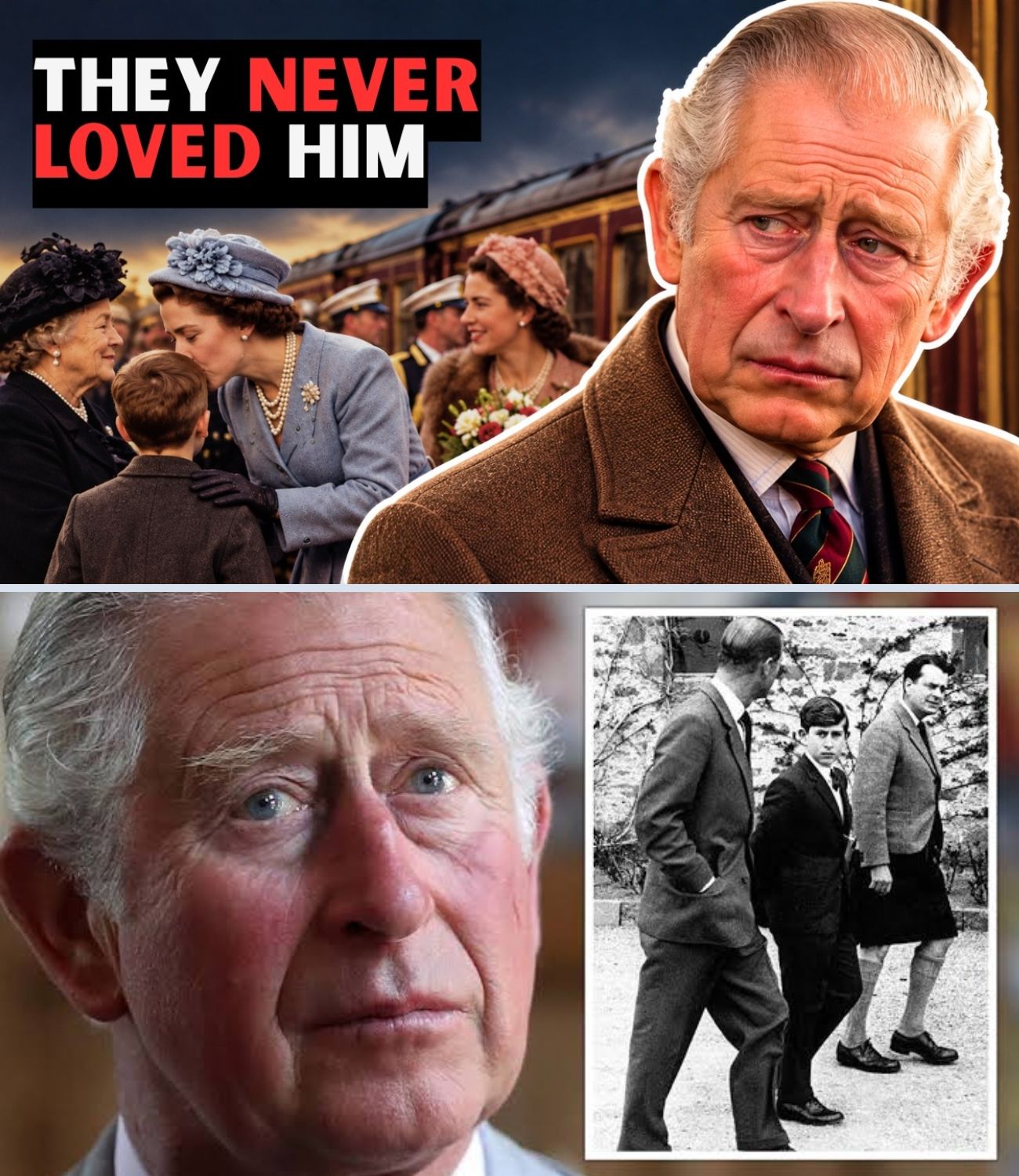
There is newsreel footage from 1951 that should not feel as sharp as it does. Princess Elizabeth steps off a royal train at Euston Station in London after 5 weeks in Canada. Her 3-year-old son waits on the platform clutching his grandmother’s hand. Elizabeth kisses her own mother first. Then she bends down and gives Charles the briefest peck on the top of his head. Then she embraces her sister, Princess Margaret, for noticeably longer. The boy barely reacts.
He has been standing in a receiving line behind dignitaries waiting for a greeting that lasts less than a second. He would keep waiting for the rest of his life. The footage survived because cameras followed the royal family everywhere in those years. What the cameras could not follow was the boy back inside Buckingham Palace up to the third floor past 775 rooms he would never use into a nursery suite where the fire burned year-round and two women, not his parents, ran his entire life on a schedule timed to the half hour.
Curtains opened at 7:00 in the morning. A nanny washed him, dressed him, and fed him breakfast in her own quarters. At 9:00, he was brought downstairs to see his mother for a 30-minute session. By 9:30, he was back in the nursery.
He went for a walk at 10:30. He had lunch. He napped. He appeared again at tea time with his parents. Then bath, then bed. The nursery had its own footman, its own nursery maid, and its own cook. It operated as a self-contained household within the vast palace, a warm firelit compartment inside a building so large that the boy at its center could go days without crossing paths with either parent in a corridor.
That was the shape of Charles’s childhood. And the people who filled it were not Queen Elizabeth and Prince Philip. They were Helen Lightbody and Mabel Anderson. Lightbody was the senior nanny, recruited from the household of the Queen’s aunt and uncle, the Duke and Duchess of Gloucester. She was experienced, traditional, and by several accounts, gentle with the sensitive boy in her care. Anderson was the junior nanny, younger, warmer, and from a background that had nothing to do with palaces.
She was the daughter of a Liverpool policeman who had been killed during the Blitz. She arrived at Buckingham Palace when Charles was only a few months old, and she would remain the most constant human presence in his life for the next three decades. Anderson was firm, but deeply maternal. She was tall, dark-haired, and looked strikingly like the Queen, the same neat, pinned-back ’40s hairstyle, a resemblance that palace staff noticed. She was 22 when she started the job. Elizabeth was 22 when she had Charles. But the resemblance stopped at appearance. Anderson was present six nights a week.
Elizabeth, according to one account, spent time in the nursery primarily on Mabel’s night off. Sally Bedell Smith, one of Charles’s biographers, wrote bluntly that the Queen and Prince Philip saw their children only after breakfast and at tea time. So, basically, not much at all. Jonathan Dimbleby, the journalist who wrote the authorized biography with Charles’s direct cooperation in 1994, quoted the prince on the matter.
“The people who raised him,” Charles said, “were inevitably the nursery staff.”
Another biographer, drawing on the psychological literature of royal families, went further, writing that it was improbable that Prince Charles experienced anything other than minimal parental involvement during his infancy. And when Elizabeth did visit the nursery, she reportedly sat on a gilt chair brought in by a footman. She was uncertain how to engage with her own baby. The chair was formal. The visit was scheduled. The mother was, in the most physical sense, a guest in her child’s daily life, seated on borrowed furniture in a room run by employees.
This was the arrangement before the crown even intervened. Elizabeth was still a princess when Charles was born on the 14th of November, 1948. She was only 22. She and Philip had recently moved into their first home together, and even then, long before the weight of queenship fell on her, she would spend extended stretches visiting Philip in Malta, where he was stationed with the Royal Navy. Charles stayed behind with the nannies. Philip, for his part, was away on overseas naval duty for much of Charles’s first 2 years. The boy did not know much of his father at all during infancy.
And then, Charles’s grandfather died, and everything got worse. King George VI passed away on the 6th of February, 1952. Elizabeth was 25 years old. Charles was 3. Overnight, his mother became queen of the United Kingdom and head of the Commonwealth. Charles became heir apparent, first in line to the throne at an age when he could not understand what a throne meant. The crown consumed whatever private hours Elizabeth had previously carved out. The family moved from the relative intimacy of Clarence House to the sprawling official machinery of Buckingham Palace.
The nursery routine did not change. Mabel Anderson still opened the curtains at 7:00, still fed him breakfast, still delivered him downstairs at 9:00. But the distance between the third floor and the monarch’s schedule widened into something permanent.
“The queen was absorbed in her own hectic itinerary,” Dimbleby wrote, “and would withdraw from friction or disputes inside the family, leaving the more abrasive Philip to police the household and discipline the children.”
Within 18 months of her coronation, Elizabeth and Philip embarked on a Commonwealth tour that lasted approximately 6 months. Charles was five, Anne was three. They were left behind with the nannies and the Queen Mother, Elizabeth’s own mother, who had recently been widowed. The tour carried the Queen and Philip to New Zealand, Australia, and several other countries by sea. In Australia alone, they visited 57 towns across 58 days. The schedule was relentless. Morning events, afternoon programs, evening receptions. Elizabeth addressed 107,000 school children at three outdoor venues in New South Wales during a single stretch. She opened Parliament. She attended surf life-saving demonstrations. She shook hands with thousands of people who were not her children.
Charles and Anne eventually traveled to the island of Malta to reunite with their parents at the end of the tour, meeting them aboard the Royal Yacht Britannia. One account from the period describes what happened when the family finally came together again. Charles had to wait for his personal greeting while the Queen shook hands with a line of dignitaries. There were no running embraces, no long hugs, no tears of reunion on camera. The public greeting was formal, polite, and brief. Royal historian Carolyn Harris suggested that Elizabeth and Philip were likely more relaxed with their children in private, but they used formal etiquette in public. The trouble is that biographers have struggled to find sustained evidence of what that private warmth actually looked like, at least with Charles and Anne. The institution did not just take the Queen’s public hours. It shaped her private instincts.
But the emotional distance from his mother was only half the architecture of Charles’ unhappiness. The other half was his father. And to understand why Prince Philip treated his eldest son the way he did, you have to start on a dining room table on the Greek island of Corfu. Philip was born there on the 10th of June, 1921. A prince of both Greece and Denmark. Titles that sounded magnificent, but carried almost no money and no stability. His father, Prince Andrew of Greece and Denmark, was a professional soldier in the Greek army. His mother, Princess Alice of Battenberg, was a great-granddaughter of Queen Victoria. She had been born deaf.
When Philip was just 18 months old, the revolutionary government of Greece forced the royal family into exile. Prince Andrew was nearly executed by a Greek court before being banished for life. The family fled the country. The story that has survived, possibly embellished, possibly literal, holds that the infant Philip was carried off the island in an improvised crib made from an orange crate, placed aboard a Royal Navy warship sent by King George V of Britain. They settled in Paris. The family was royal by title, but dependent on the charity of relatives for housing, clothing, food, and school fees. There was no palace, there was no court, there was no money.
And then, when Philip was 9 years old, the remaining structure of his family collapsed entirely. His mother, Princess Alice, suffered a severe nervous breakdown. The causes were debated for decades. The trauma of exile, repeated separations from her children, a difficult menopause, manic depression, possibly a religious crisis. Whatever the combination, Alice was committed to the Bellevue Sanatorium in Switzerland. She was diagnosed with schizophrenia. She was reportedly institutionalized against her will and subjected to experimental treatment. Philip was nine. By some accounts, no one clearly explained to him where his mother had gone.
Meanwhile, his father, Prince Andrew, abandoned the remnants of family life. He moved to Monte Carlo with a mistress. He rarely contacted Philip afterward. Philip’s four older sisters, Margarita, Theodora, Cecilia, and Sophie, had all married German noblemen by the early 1930s, several with documented connections to the Nazi party. The sisters scattered across Europe. Philip was left effectively alone in Paris at the age of nine, then shuffled between relatives in England and a series of boarding schools in England, Germany, and Scotland.
When he was later asked what language he spoke at home, his answer was devastating in its brevity.
“What do you mean, at home?”
Michael Parker, an Australian wartime naval friend who became Philip’s first private secretary, described the void simply. When he needed a father, there just wasn’t anybody there. Philip’s own words, quoted in a biography by Philip Eade, were characteristically flat. About the disappearance of his parents, he said, “It’s simply what happened.”
Philip survived by becoming hard. He attended Gordonstoun, the boarding school on the Moray Firth in Scotland, founded by the German Jewish educator Kurt Hahn in 1934. The school’s philosophy was Spartan. Cold showers, early morning runs, manual labor, seamanship, and the development of what Hahn called an undefeatable spirit. Philip thrived. He became decisive, physical, competitive, blunt.
When he married Princess Elizabeth in 1947, he gained, for the first time in his 26 years, a stable family, a home that did not move, a wife who would not be institutionalized, a household that would not scatter. And when his own children arrived, Philip had exactly one model for how to prepare a boy for the world: endurance. Softness, in Philip’s experience, was not something the world rewarded. Softness was what you had before your mother was taken and your father vanished, and your sisters married men who supported a regime your adopted country was fighting. If you were soft, you were exposed. Philip would not allow his son to be exposed.
So, Philip looked at Charles, sensitive, shy, artistic, a boy whose Scottish governess, Catherine Peebles, described as hypersensitive, lonely, excessively shy, and given to quiet pursuits like reading and painting, and saw a problem that needed correcting. Philip wanted his son to be, in his own words, a man’s man. Charles was emphatically not that. And instead of adjusting his approach to fit the child in front of him, Philip doubled down on the only method he trusted.
Dimbleby’s authorized biography paints a sustained portrait of pressure. Philip was able to cow Charles easily with his forceful personality. He belittled the boy. He relied on sarcasm. Friends of the young prince considered Philip’s parenting tactics much too severe. Philip Eade, the Duke’s own biographer, noted that Philip was often heard insisting on toughness, and was never afraid of cutting remarks when dealing with not only Charles, but Anne as well. The difference was that Anne, extroverted, headstrong, and temperamentally similar to Philip himself, could brush off the sarcasm without visible damage. Charles could not. He withdrew. He became more vulnerable. And the more vulnerable he became, the more Philip pushed.
The most telling early act was the dismissal of Nanny Lightbody. According to Dimbleby, Philip had Helen Lightbody removed from the household because she favored Charles over Anne and indulged in the boy’s softness. Whether the dismissal was technically a firing or a managed departure is debated. Dimbleby’s account implies Philip’s displeasure was the decisive factor. But the effect was not ambiguous. The one adult inside Buckingham Palace who had shown Charles unconditional tenderness was gone. The lesson, even if a child could not articulate it at the time, was clear. Warmth was a vulnerability, and vulnerabilities would be corrected.
The correction reached its most damaging expression when Charles reached school age. In November of 1956, at the age of eight, Charles was sent to Hill House School in West London. He was the first heir apparent in British history to be educated at a school rather than by private tutors. The headmaster, Stuart Townend, encouraged the Queen to have Charles train in football, noting that boys on the pitch were never deferential to anyone. But Charles lasted only 6 months at Hill House. He apparently had difficulty mixing with other pupils.
In September of 1957, he was moved to Cheam School in Berkshire, another of Philip’s alma maters. Charles boarded there from age eight to 13. He suffered acute homesickness from the start. A plainclothes detective accompanied him at all times, which made him conspicuous among the other boys and deepened his social isolation.
It was during his time at Cheam that his mother made a decision that captured the strange emotional architecture of his childhood. During a recorded broadcast to the people of Wales on the 26th of July, 1958, the Queen announced that she intended to create her son Prince of Wales. Charles was 9 years old. He learned about his own title sitting in the headmaster’s study with a group of schoolboys who had been invited to listen to the broadcast. His mother told the nation before she told him.
As Charles’ years at Cheam ended, the most consequential educational decision of his life arose. The Queen Mother, who understood Charles’ temperament better than either of his parents, wrote a letter to Elizabeth in May of 1961. She described Eton College as ideal for one of his character and temperament.
“If he went to Gordonstoun,” the Queen Mother warned, “he might as well be at school abroad.”
She pointed out that the children of the Queen’s friends were at Eton, that Charles could see his parents regularly at nearby Windsor, and that the boy would stay connected to family affairs. The letter was documented. The advice was specific. The reasoning was sound. She was overruled.
Buckingham Palace announced that Prince Charles would attend Gordonstoun. Philip’s school. The institution that had forged Philip’s survival instincts on the Scottish coast. The logic was brutally simple. What had hardened the father would harden the son.
In May of 1962, Philip, a licensed pilot, flew Charles to Royal Air Force Lossiemouth in northeastern Scotland, and then drove him the rest of the way to the school grounds. A former classmate, Johnny Stonborough, remembered the arrival decades later in Newsweek. Charles stepped out of a car surrounded by his mother, the headmaster, and various officials. He was a small 13-year-old boy in a gray suit with rather big ears, and he looked terrified. Stoneborough recalled that Charles had been silent during an earlier tea at the palace, arranged so he could meet some future schoolmates. He was a silent little boy, and he kept very much to himself.
The terror was justified. Each day at Gordonstoun began with an early morning run before breakfast, followed by an ice-cold shower. The curriculum emphasized physical endurance, outdoor labor, and a rugged independence that suited athletic, extroverted boys. Charles was neither. He was a target from virtually his first day. Boys bullied him, partly from class envy, partly because his royal status made him impossible to ignore, and partly because his quiet, sensitive temperament made him easy to torment. They threw slippers at him in the dormitory. They mocked his ears. The bullying was persistent, and by Charles’s own account, relentless.
In a letter to his mother, Charles laid it out.
“I hardly get any sleep in the house because I snore, and I get hit on the head all the time. It’s absolute hell.”
Philip’s responses to these letters reportedly advised the boy to endure, to toughen up, to stop complaining. The prince privately described Gordonstoun with a phrase that became famous: “Colditz in Kilts.” Another former student, the novelist William Boyd, called the school “a penal servitude,” and confirmed that Charles had told him he detested the place.
Charles never complained publicly while he was there. Stoneborough said the prince never cried, or at least not where anyone could see. He never reacted, and he never punched back. He endured. He performed in school plays, which were reportedly his happiest moments at the school, but even those failed to impress Philip. He earned two A-levels, a B in history and a C in French, which were respectable but unremarkable.
Decades later, the Scottish child abuse inquiry would examine Gordonstoun’s historical record and uncover 82 documented cases of peer-on-peer bullying and 11 alleged incidents of abuse involving staff, largely concentrated in the 1970s and ’80s. The school’s principal, Lisa Kerr, acknowledged before the inquiry that in earlier decades there had been a completely unacceptable view that these were just things that happened. The trust and autonomy given to housemasters, she admitted, was astonishing and unacceptable by modern standards. The institution Philip loved was for many of its students far darker than nostalgia allowed.
And then, buried inside the misery of Gordonstoun, Charles found the one school experience that would prove what his parents could not see. In January of 1966, at 17, Charles was sent to the Timbertop campus of Geelong Grammar School in the Victorian Alps of Australia. It was a bush campus, remote, physically demanding, but in a completely different way from Gordonstoun. Students split logs with bush saws. They hiked through mountain terrain. They lived without servants, without palace protocol, without a detective shadowing their every step in quite the same suffocating way.
Charles spent two terms there, roughly 6 months, 10,000 miles from his parents, from Gordonstoun, and from the emotional machinery that had shaped his entire childhood. He flourished. He made friends. He spoke later about Australia with an affection he never extended to any other period of his education.
“The most enjoyable part of my whole education,” he called Timbertop.
He once said, more quietly,
“I didn’t enjoy school as much as I might have, but that was only because I’m happier at home than anywhere else.”
Except, of course, the home he meant was not Buckingham Palace. The home he meant was the nursery, the nanny, the teddy bear, the fire burning year-round. The proof was devastating in its simplicity. The boy flourished precisely when the parental system released him. The child who wilted under Philip’s severity and suffocated inside the palace’s emotional vacuum became confident and happy at the greatest possible distance from both.
And when the two terms ended, he had to go back. Back to Gordonstoun. Back to Britain. Back to the machine. Both parents would later acknowledge, privately, that Gordonstoun had been a mistake. They described the decision as trying to fit a square peg in a round hole. The admission was quietly damning. The Queen Mother’s letter had existed. The advice had been specific. The warning had been clear. They had ignored it, and their son had suffered for years because of a choice rooted not in Charles’s needs, but in Philip’s mythology about his own survival.
On the 1st of July, 1969, the monarchy deployed its square peg for the first time on the international stage. Charles was formally invested as Prince of Wales at Caernarfon Castle in North Wales, a medieval fortress originally built by Edward I in the 13th century as a symbol of English conquest over the Welsh. In preparation, Charles spent 9 weeks at Aberystwyth University studying the Welsh language, tutored by a Welsh nationalist academic named Teddy Millward.
Inside the castle walls, 4,000 invited guests watched as the Queen placed a gold coronet designed by the goldsmith Louis Osman on her son’s head. Charles knelt before his mother. She placed her hands on his. The ceremony was broadcast live. 500 million people watched worldwide.
Outside, the tension was real. Welsh nationalist groups opposed the investiture as a symbol of oppression. Protests had been building for months. The Free Wales Army wore paramilitary uniforms. Mudiad Amddiffyn Cymru conducted a bombing campaign. On the eve of the ceremony, two members of that group, Alwyn Jones, 22, and George Taylor, 37, were killed when a bomb they were planting outside government offices in the nearby town of Abergele detonated prematurely.
The Queen later recalled being relieved to reach the comforting security of the castle’s walls. Walls that had been built for exactly that purpose eight centuries earlier. The contradiction was extraordinary. The mother who could not hold her son privately now crowned him before the world. The boy who had been emotionally invisible inside the palace was now politically visible inside a fortress performing a role designed not for his benefit, but for the monarchy’s public mythology.
Charles gave his speech. He spoke in Welsh. He did his job. The crowd applauded. The monarchy had used its heir. Performance is not love. And for the institution, performance was the only currency that mattered.
Then came the part of the story that made everything before it not just painful, but probably unnecessary. Prince Andrew was born on the 19th of February, 1960, nearly 12 years after Charles. Prince Edward arrived on the 10th of March, 1964, 16 years after Charles. By the time the younger boys came along, Elizabeth had been queen for more than a decade. The machinery of the role no longer overwhelmed her the way it had in the early ’50s. She had older children. Charles and Anne were now teenagers who could share some of the representational burden.
And something shifted. Robert Lacey, in his biography of the Queen, quotes Elizabeth’s reaction to Andrew’s birth.
“What fun it is to have a baby in the house again.”
She was seen crawling on the floor with baby Andrew. She bathed the younger boys herself. She spent more time in their nursery. Royal biographer Sarah Bradford confirmed that the Queen seemed to find a better balance between the demands of her work and her children in the 1960s when Andrew and Edward were small.
Philip, too, was reportedly softer with the younger boys, less relentlessly demanding. Princess Anne was his favorite child, headstrong, physical, unbothered. And Anne’s son, Peter Phillips, burly and rugby-playing, would become Philip’s favorite grandson, everything Charles had failed to be.
Clive Irving, author of The Last Queen, put it bluntly in a Channel 4 documentary: “To this day, she’s more openly affectionate to Andrew and more forgiving toward Andrew than she is towards Charles.”
Irving believed Charles would never live up to the Queen’s sense of duty. The eldest son was, in Irving’s assessment, a puzzle Elizabeth never solved.
This is the cruelest evidence in the entire story. Elizabeth and Philip were capable of warmer, more present, more physically affectionate parenting. They proved it with their younger children. They had the capacity. They had the willingness. And they gave that version of themselves to Andrew and Edward, not to Charles. The argument that the Queen was simply not maternal by nature collapses entirely under the weight of her documented behavior with the younger boys. She was maternal. She just was not maternal with her firstborn.
Princess Anne complicates the narrative, but not in a way that exonerates the parents. Anne, born in 1950, was raised under identical conditions. Same palace, same nannies, same absent mother, same severe father. She has consistently defended their upbringing and dismissed the idea that their childhood was unhappy. She was extroverted, tough-minded, and temperamentally suited to Philip’s approach. She brushed off his sarcasm in a way Charles never could.
Anne’s resilience does not disprove Charles’s suffering. It proves something more specific. Philip’s parenting was not universally destructive. It was specifically destructive to a particular kind of child, a child who happened to be the heir.
Charles told Dimbleby that he recalled much happiness in his childhood and believed his parents had tried their best. The generosity of that sentence is almost unbearable. The fired nanny, the overruled grandmother, the letter about snoring, the cold showers, the slippers, the 6-month absences, the platform where a mother kissed everyone else first. The younger brothers who received a different version of the same parents. And the man who endured all of it offered them, “Tried their best.”
Charles was 73 years old when he finally became king, the oldest person ever to accede to the British throne after more than seven decades as heir apparent. He did not simply wait for the throne. He waited for relevance. He waited for approval. He waited for a mother his mother seemed uncertain he deserved.
But through all of it, through the schools, the bullying, the coldness, the decades of apprenticeship, the public marriage to Diana, the public divorce, the public hatred, and the long road back, one person remained constant. Mabel Anderson stayed at Buckingham Palace until 1977, when she left to help Princess Anne care for Peter Phillips at Gatcombe Park. Until that year, every single morning Charles was home at the palace, he ate breakfast with Mabel in her third floor quarters. He kissed her goodnight. He called her Mipsy.
When his childhood teddy bear, a toy he reportedly traveled with well into his 40s, began to fray, Mabel was the only person in the world allowed to mend it. A former assistant valet confirmed the rule.
“She was the only human being allowed to take needle and thread to Prince Charles’s teddy bear.”
The future king of England, in middle age, still needed his nanny to repair the last surviving object of childhood comfort.
Charles hosted a dinner for Mabel’s 90th birthday at Clarence House. When she turned 100, he traveled to her Grace and Favor residence near Frogmore on the Windsor estate. They shared tea. He had described her publicly as warm, loving, sympathetic, and caring. The exact words a son might use about a mother, given to the woman who actually did the job.
Philip died on the 9th of April, 2021, at the age of 99. Charles was reportedly the last family member to visit him. Their relationship had softened over the decades, though the fundamental mismatch never fully resolved. Philip remained Philip, blunt, unapologetic, convinced that the toughness he had imposed was the price Charles had to pay for the good of the monarchy.
Charles became a father who corrected the pattern. He hugged William and Harry in public. He walked Harry to the altar at his wedding. He wept openly at his mother’s coffin. The cycle did not repeat unchanged. But the damage did not disappear, either. Prince Harry, on a podcast recorded while the family was still mourning Philip, said he wanted to break the cycle of what he called genetic pain and suffering.
The phrase described a chain that ran from a dining room table on Corfu to a Swiss sanatorium to Monte Carlo to a cold shower in Scotland to a nursery on the third floor of a palace with 775 rooms where a young mother sat on a gilt chair brought by a footman because she did not know how to hold her own child.
Elizabeth died on the 8th of September, 2022, at 96. Charles became king immediately. He was 73 years old. On the 6th of May, 2023, he walked into Westminster Abbey to be crowned. The same building, the same ancient ceremony.
70 years earlier, almost to the season, he had sat in this Abbey between the Queen Mother and Princess Margaret, a 4-year-old boy photographed looking bored while his mother was given to the nation. He had used a pair of binoculars from the Buckingham Palace balcony afterward, peering down at the crowds who had come to see the Queen.
Now, at 74, he stood where she had stood. The Queen Mother was dead. Princess Margaret was dead. Philip was dead. Elizabeth was dead. The grandmother who had written the letter was gone. The father who had fired the nanny was gone. The mother who had kissed everyone else first was gone. And the boy who had waited on every platform, in every receiving line, behind every handshake, through every cold morning run at a school he compared to a prison, had finally arrived at the one place the system had always promised him, but only because every person who had kept him waiting was no longer alive to see it.
Somewhere inside Buckingham Palace, on the third floor, there is a suite of rooms where a nanny once opened the curtains at 7:00 in the morning, washed a boy, dressed him, fed him breakfast, and delivered him to a mother for 30 minutes before carrying him back upstairs. That nursery is still there. Mabel Anderson is still alive. The boy is king. The parents are buried at Windsor.
And the footage from Euston Station, a young mother stepping off a train, kissing her own mother first, pecking her son on the top of his head, embracing her sister longer, and moving on, still plays exactly the way it happened 75 years ago to a child who did not yet understand that the greeting order would never change.
You Might Also Enjoy

“We Thought They Would Negotiate”—What Argentine Soldiers Said When The British Attacked Goose Green

“You’ll Never Finish My Ruck March, Limey” — US Sergeant Who Challenged the SAS, Then Fell Out First






