Why King Edward VII’s Siblings Hated Him So Much
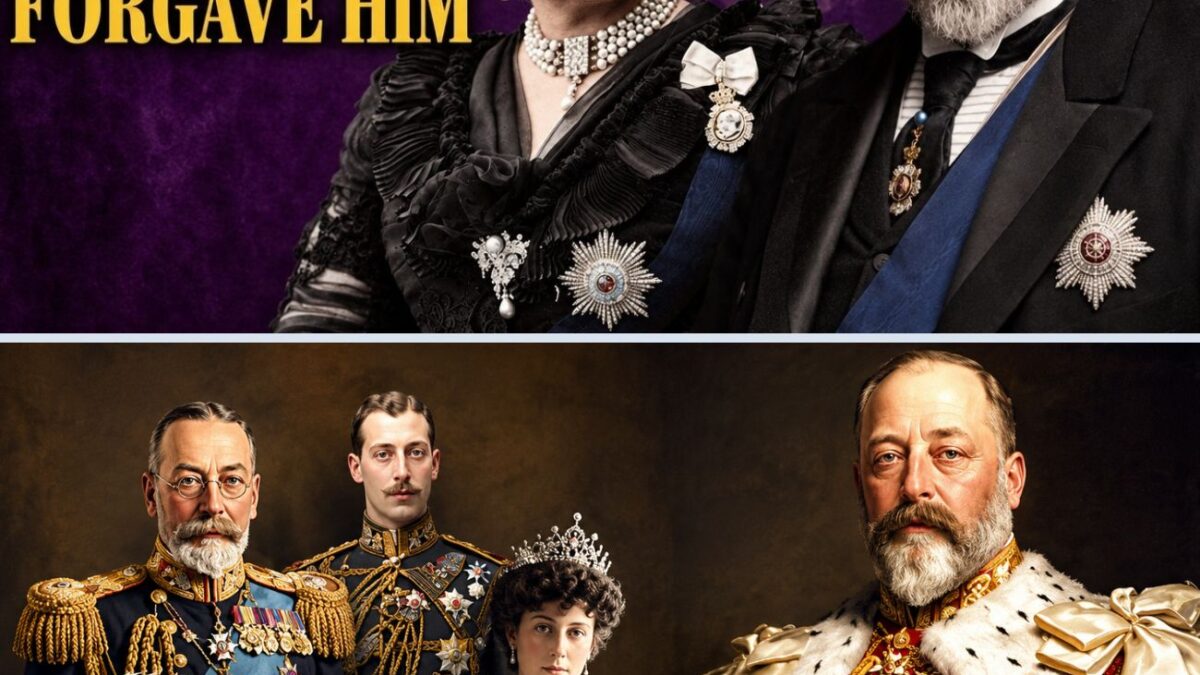
On the 22nd of January, 1901, Queen Victoria lay dying at Osborne House on the Isle of Wight. She was 81 years old and the room around her was crowded with the people she had made, her children, her grandchildren, the heirs to half the thrones of Europe. But there was one face she kept asking for, one name she whispered again and again and it was not the name of her eldest son, it was the name of her dead husband, Albert. She wanted Albert and standing at the foot of her bed, watching his mother reach for a ghost instead of him, was the man who had waited 60 years to become king.
Edward, Prince of Wales, soon to be Edward the VII, would inherit the largest empire the world had ever seen. He would also inherit something else, something no crown could fix and no coronation could heal, the hatred of his own brothers and sisters. In the months and years that followed that deathbed, the private letters of the royal family would reveal a war that had been burning quietly for six decades, a war of blame, of jealousy, of wounds so old no one could remember who had struck first.
Edward’s siblings believed he had killed their father. They believed he had humiliated their mother. They believed he was unfit to rule. And here is the strangest part, some of them may have been right. Over the next half hour, you are going to watch a family tear itself apart in ways that make the modern Windsor dramas look like a garden party. You will meet the sister who called him a moral degenerate in writing, the brother who refused to attend his coronation, and the mother who told her own son, to his face, that she could never look at him without a shudder.
Was Edward truly the villain his family believed him to be or was he something more complicated, a man destroyed by expectations he never asked for, punished for sins he did not fully commit. Join me to find out.
To understand why Edward’s siblings hated him, you have to understand what it meant to be born first in the House of Saxe-Coburg. On the 9th of November, 1841, at Buckingham Palace, Queen Victoria gave birth to her second child and first son. He was named Albert Edward after his father. And from the moment he drew breath, he was not a baby. He was a project.
Prince Albert, the Prince Consort, had very specific ideas about what a future king should be. He believed that monarchy could only survive in the modern age if the sovereign was morally perfect, intellectually rigorous, and utterly self-controlled. He looked at his infant son and saw not a child, but the raw material for an experiment. The curriculum began before the boy could walk.
By the age of six, young Bertie, as the family called him, was studying six hours a day under a series of private tutors. He was learning French, German, Latin, arithmetic, history, geography, and scripture. His father personally designed the timetable and personally reviewed the results. And the results, from the very beginning, were disappointing. Bertie was not stupid. Modern biographers, like Jane Ridley and Philip Magnus, have examined his letters and his later statecraft and concluded that he possessed considerable intelligence, but it was a social intelligence, an emotional intelligence, a gift for reading people rather than books.
What he could not do was sit still. He could not concentrate. He could not meet the impossible standards his father had set for him. The tutors sent reports back to Prince Albert describing the boy’s restlessness, his tears, his tantrums. One governess noted that he would sometimes fly into rages so violent that he would beat his own head against the wall.
Prince Albert’s response was not compassion. It was more discipline, longer hours, stricter isolation. The boy was kept apart from other children his own age because his father feared they would corrupt him. He was told, repeatedly, that he was failing not just himself, but his future subjects, his family, and his God.
Now, here is the thing you need to understand about the other children. While Bertie was being broken on the wheel of his father’s expectations, his siblings were growing up in a completely different household. Victoria, the Princess Royal, called Vicky, was born a year before Bertie in 1840, and she was everything he was not. She was brilliant. She was disciplined. She could read by the age of four and was corresponding with her father in French by six.
Prince Albert adored her. He called her his intellectual companion and he meant it. The letters between them read like letters between colleagues, not parent and child. When Vicky was 14, Prince Albert began arranging her marriage to the Crown Prince of Prussia, a union he hoped would eventually liberalize the German states and spread constitutional monarchy across Europe. It was the great political project of his life and he trusted her to carry it out.
Bertie, meanwhile, was still failing his Latin exams. The younger children watched all of this and drew their own conclusions. Prince Alfred, born in 1844, saw that his father’s approval was a prize to be won and that Bertie had already lost. Princess Alice, born in 1843, learned that love in this family was conditional, measured out according to achievement. Princess Helena, Prince Arthur, Prince Leopold, Princess Beatrice, each of them, in their own way, absorbed the central lesson of their childhood.
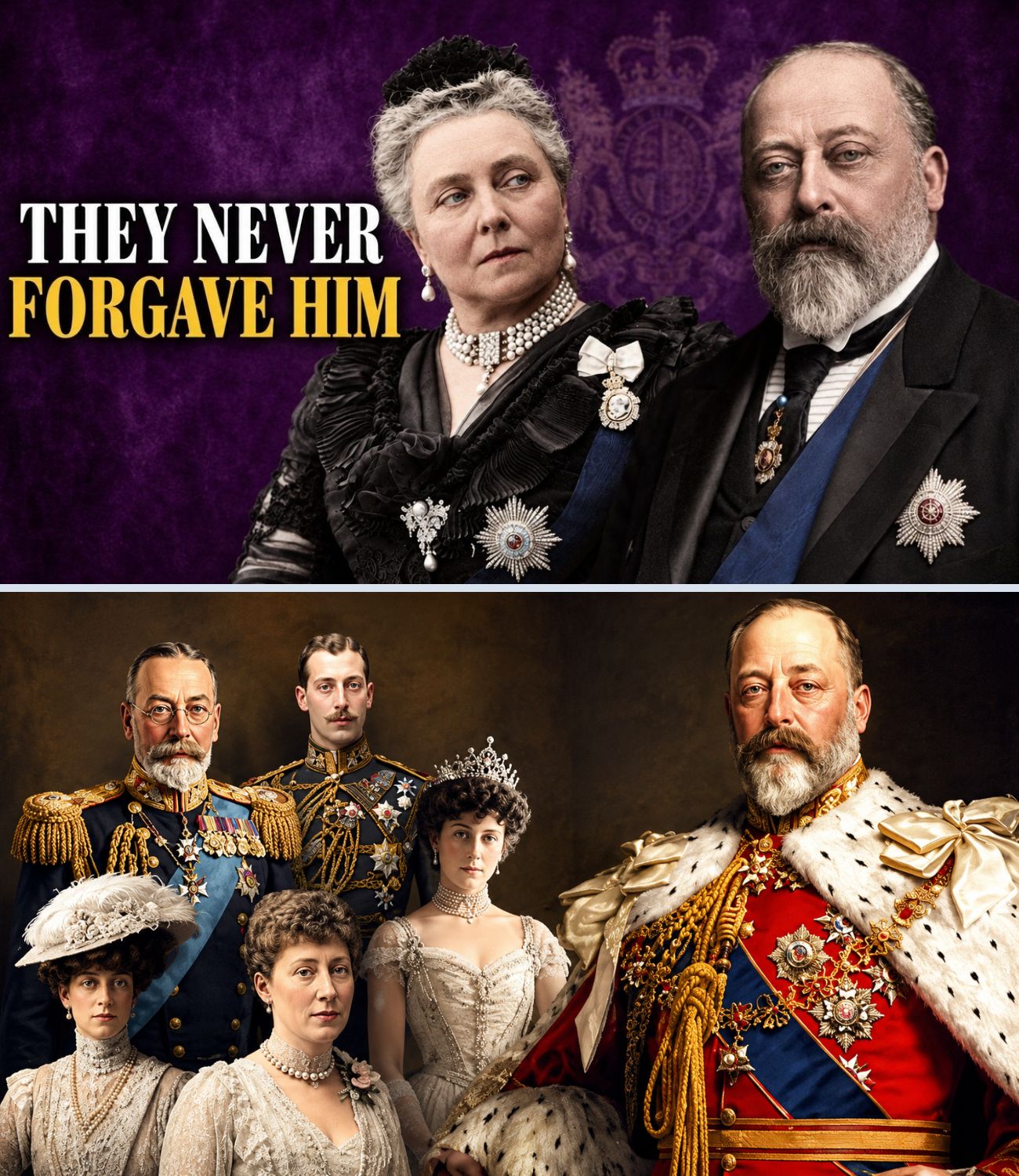
Bertie was the disappointment. Bertie was the problem. And whatever they did, however they failed, at least they were not Bertie.
On the evening of the 14th of December, 1861, Prince Albert died at Windsor Castle. He was 42 years old. The official cause of death was typhoid fever and the doctors who attended him left detailed records of his final weeks, the delirium, the wasting, the slow surrender of a body that had never been robust. But Queen Victoria did not believe it was typhoid that killed her husband. She believed it was her son.
In the weeks before Albert fell ill, the family had learned a secret, a secret so scandalous that Victoria would refer to it in letters only as the disgusting business and the awful thing. While serving in the army at the Curragh camp in Ireland, the 19-year-old Prince of Wales had been seduced by an actress named Nelly Clifton. His fellow officers, as a joke, had smuggled her into his bed. The affair was brief, but the rumors were already spreading.
Albert learned of it in early November. He was devastated. He wrote to Bertie calling the incident the worst disaster that could befall the monarchy. He traveled to Cambridge where Bertie was supposedly studying and walked with his son for hours in the cold rain, lecturing him, pleading with him, trying to make him understand the magnitude of what he had done. Two weeks later, Albert was dead.
Victoria’s grief was oceanic and it needed somewhere to land. It landed on Bertie. In the weeks after the funeral, she could barely stand to be in the same room with him. She wrote to Vicky, now living in Prussia, that she could never look at the boy without a shudder. She wrote that he had broken his father’s heart. She wrote that she did not know if she could ever forgive him. These were not private thoughts. Victoria shared them with her other children. She made them witnesses to her grief and conscripts in her blame. And the siblings, already primed by a childhood of comparison, accepted the verdict. Bertie had killed their father.
Modern biographers treat this narrative with considerable skepticism. Prince Albert had been unwell for years before the Curragh incident. His letters from the early 1860s describe chronic stomach pain, exhaustion, and episodes of depression so severe he sometimes could not work. The typhoid that killed him was almost certainly contracted from the notoriously poor drainage at Windsor Castle, the same drainage that would sicken Bertie himself a decade later. But facts are weak medicine against a grieving mother’s need for a villain. And Victoria needed a villain for the next 40 years.
She excluded Bertie from any meaningful role in government. She refused to show him state papers. She sent him on foreign tours not because she trusted him, but because she wanted him out of her sight. When he asked to represent her at official functions, she often refused, preferring to send one of his younger brothers instead.
Prince Alfred, the second son, became her particular favorite for a time. He was naval, he was dutiful, and above all he was not Bertie. Victoria showered him with affection and with responsibilities that should have gone to the heir.
Vicky from Prussia kept up a correspondence with their mother that amounted to a running prosecution of Bertie’s character. The letters between them, preserved in the royal archives, are remarkable for their venom. They discuss his weight, his gambling, his rumored affairs. They fret about what kind of king he will make. They comfort each other with the hope that perhaps he will not survive to reign at all.
But here is what the official story leaves out. While his mother and sisters were writing him off as a moral wastrel, Bertie was doing something none of them could do. He was making friends, not friends in the aristocratic sense, useful alliances, diplomatic contacts, but genuine friends from every corner of society. He befriended Jewish bankers at a time when anti-Semitism was the default position of the English upper classes. He befriended artists, actors, American millionaires. He charmed the French who had every reason to distrust the English crown. He built a network of personal relationships across Europe that would later prove invaluable to British diplomacy.
His siblings saw only the gambling and the actresses. They did not see the work. Biographer Jane Ridley, in her 2012 book Bertie, a life of Edward VII, argues that the Prince of Wales essentially invented the modern concept of soft power. He understood, in a way that his rigidly principled father never had, that monarchy in the age of democracy depended on being liked. He could not change the laws. He could not command the armies. But he could make people want to be on Britain’s side, and he did. The Entente Cordiale, the alliance with France that would prove decisive in the coming World War, was in many ways his personal achievement. The French called him our king, and they meant it as a compliment.
Princess Vicky, for all her brilliance, achieved nothing comparable in Prussia. Her marriage to Crown Prince Frederick was a love match, and by all accounts a happy one. But the political project her father had designed for her was a total failure. The liberalization of Germany did not happen. Instead, power passed to Otto von Bismarck, who despised her, and to her own son, the future Kaiser Wilhelm II, who despised her even more.
Wilhelm’s relationship with his mother is one of the saddest stories of the 19th century. A son so damaged by a birth that left him with a withered arm, so warped by the Prussian court’s obsession with military strength that he came to see his English mother as the enemy. When Frederick finally became Kaiser in 1888, he was already dying of throat cancer. He reigned for 99 days and when he died, Wilhelm immediately ordered soldiers to surround his mother’s palace searching for documents he believed she was trying to smuggle to England. Vicky spent her final years in humiliated exile watching everything she had worked for turn to ash. She died of spinal cancer in 1901 just months after her mother and in her final letters she was still criticizing Bertie.
Prince Alfred’s story is even darker. The naval career that had once made him Victoria’s favorite took him far from England first to the Mediterranean and then to the position of Duke of Saxe-Coburg and Gotha. A German duchy he inherited in 1893 when their childless uncle died. He did not want it. He hated Germany. He missed the sea and the duchy brought him nothing but grief.
His only son, Prince Alfred of Saxe-Coburg, was a troubled young man, depressive, possibly suffering from syphilis contracted in his youth, certainly suffering from a disastrous love affair with a woman his parents deemed unsuitable. In January 1899 at a family gathering to celebrate his parents wedding anniversary, young Alfred shot himself. He died 2 weeks later. The official cause of death was listed as a tumor but everyone knew the truth.
The Duke of Saxe-Coburg never recovered. He began drinking heavily. He withdrew from public life. He stopped answering letters even from his siblings. He died of throat cancer in July 1900 just 6 months before his mother. He was 55 years old. According to his wife, he had not smiled in 18 months.
And through all of this, through Vicky’s humiliation and Alfred’s disintegration, Bertie waited. He waited while his mother blamed him. He waited while his siblings wrote him off. He waited while the years turned into decades and the decades piled up like unpaid debts. He was 59 years old when Victoria finally died, the oldest heir apparent in British history. And when he finally took the throne as Edward VII, the siblings who remained looked on with something beyond disapproval. It was closer to disbelief. How had he survived? How had the family failure outlasted them all?
Princess Alice, the third child and second daughter, had died all the way back in 1878. She had married the Grand Duke of Hesse and had devoted herself to nursing and charitable work. When diphtheria swept through her household, she nursed her children personally and contracted the disease herself after kissing her grieving son. She died on the 14th of December, the 17th anniversary of their father’s death. Victoria called it almost incredible and most mysterious. But Alice’s death, though tragic, came before the worst of the family fractures. She never had to choose sides. She never had to watch her brothers destroy each other with silence and scorn.
Princess Helena survived into Edward’s reign but remained a marginal figure, devoted to their mother, occupied with charitable committees, too overshadowed by her older siblings to play a major role in the family drama.
Prince Leopold, the youngest surviving son, had died in 1884 at the age of 30 from a brain hemorrhage caused by his hemophilia after a minor fall. He had been Victoria’s favorite in his final years. She loved his intellect and pitied his illness, but he had also been one of the few siblings who genuinely liked Bertie. The two had been close. Leopold’s death removed one of the few bridges between the heir and the rest of the family.
That left Arthur and Beatrice. Prince Arthur, Duke of Connaught, was the soldier of the family, disciplined, dutiful, and deeply conventional. He had done everything right. He had served in the army with distinction. He had married appropriately. He had produced heirs. And he had never, not once, caused a scandal. In family photographs, he stands ramrod straight, his expression carved from the same stone as the statues in Windsor Castle.
He disapproved of Bertie. He disapproved of the gambling, the racing, the women, the Marlborough House set with their loose continental manners. He disapproved quietly because Arthur disapproved of everything quietly, but the disapproval was total. According to biographer Theo Aronson, Arthur once told a cousin that he could not understand how Bertie had any friends at all given his character. When Edward VII was crowned in August 1902, Arthur attended. He had no choice, but those who watched him that day noted that his face betrayed nothing, no pride, no joy, no fraternal warmth. He looked like a man attending a funeral.
Princess Beatrice, the baby of the family, born in 1857, had spent her entire adult life as their mother’s companion and secretary. Victoria had been so possessive of her youngest daughter that she had only permitted Beatrice to marry on the condition that the husband move into the royal household and that Beatrice continue her duties.
When Victoria died, Beatrice inherited a sacred and terrible task, editing the Queen’s private journals. Victoria had kept diaries for nearly 70 years and they contained everything. Every grievance, every judgment, every cruel thing she had ever said about her children was in those pages. Beatrice spent the next 30 years copying selected passages in her own hand and then burning the originals. We will never know exactly what she destroyed, but we know that she destroyed a great deal and historians have long speculated that she removed the most damaging material about Bertie, not to protect him, but to protect their mother’s reputation. The Victoria of the edited journals is imperious, but not monstrous. The Victoria of the destroyed originals may have been something else entirely.
Edward VII reigned for only nine years, from 1901 to 1910. In that short time, he transformed the monarchy. He brought color and pageantry back to a crown that had grown dusty under his mother’s endless mourning. He opened Parliament in full state for the first time in decades. He entertained lavishly, not because he was frivolous, but because he understood that being seen was part of the job. He worked behind the scenes to improve relations with France and to contain the rising threat of Germany. The Germany that his own sister had failed to liberalize and that his own nephew, the Kaiser, was rapidly turning into a war machine.
When he died on the 6th of May, 1910, of a series of heart attacks brought on by chronic bronchitis, the nation genuinely mourned. The wasteful prince had become a beloved king, but his surviving siblings did not mourn or if they did, they did not say so.
Arthur lived until 1942, dying at the age of 91, the last surviving child of Victoria and Albert. By then, the world his parents had known was gone, swept away by two world wars, both of which could be traced, in part, to the family failures of the Victorian age. The Kaiser, who had started the First World War, was his nephew. The rigid system of alliances that had turned a regional assassination into a global catastrophe had been built, in part, by the marriages his father had arranged.
Beatrice lived until 1944, still editing, still protecting, still guarding the secrets of a family that had eaten itself alive.
What are we to make of all this? The easy answer is that Victoria and Albert created a monster, not in Bertie, but in the family itself. They built a household where love was conditional, where approval was earned through performance, and where failure was never forgotten. They taught their children to compete, and the children learned the lesson too well. They were still competing at the end, still keeping score, still nursing grudges that had outlived everyone who could explain them.
But there is a harder answer, and I think it is closer to the truth. The siblings did not hate Bertie because he was bad, they hated him because he was free. He had failed so completely, so early, that he had nothing left to lose. He could not disappoint his father any further. He could not fall any lower in his mother’s estimation, and so he did the one thing none of them could do. He stopped trying. He stopped chasing the approval that would never come. He built a life outside the family’s judgment, a life of pleasure, yes, but also a life of genuine friendship and genuine influence. He became the person his parents had never wanted him to be and in the end that person turned out to be exactly what the country needed.
His siblings never forgave him for that. They had spent their whole lives being good, being dutiful, being everything their parents demanded and what had it gotten them? Vicky had been destroyed by the country she was supposed to save. Alfred had drunk himself to death after his only son. Alice had died nursing her children. Leopold had bled out at 30. Arthur had turned into a statue. Beatrice had spent decades erasing the evidence of their mother’s cruelty and Bertie, fat, scandalous, irresponsible Bertie had outlasted them all and died with a nation’s love.
The hatred of his siblings was not really about the Curragh scandal or the gambling debts or the actresses. It was about something much simpler and much more painful. He had escaped and they had not.
You Might Also Enjoy

“We Thought They Would Negotiate”—What Argentine Soldiers Said When The British Attacked Goose Green

“You’ll Never Finish My Ruck March, Limey” — US Sergeant Who Challenged the SAS, Then Fell Out First






