Why Prince Andrew HATED His Own Daughter Beatrice Her Entire Life
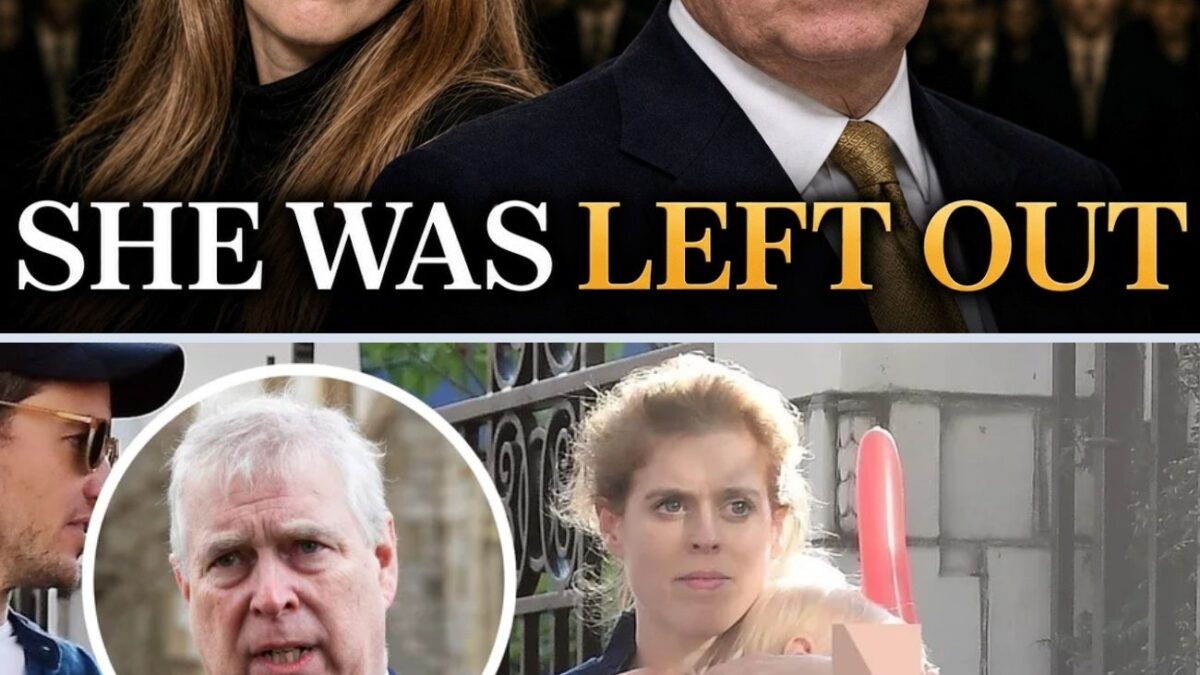
On 17th July 2020, a father walked his daughter down the aisle of a chapel in his garden. Then he disappeared. Prince Andrew appears in none of the official photographs from Princess Beatrice’s wedding. 21 months earlier, at Eugenie’s wedding, he rode in the carriage, wore the uniform, stood in every frame. Beatrice wore her grandmother’s 1962 dress, her grandmother’s tiara, married in her grandmother’s chapel. Nothing of her father’s but the walk. He had spent 30 years securing her rank. That rank is now the one thing she cannot give back.
The fight started the week she was born. Start with the photographs because the photographs are the evidence. Four images went out to the world the day after that wedding, taken by Benjamin Wheeler. Beatrice and Edoardo Mapelli Mozzi outside the Royal Chapel of All Saints. Beatrice and Edoardo with the Queen and Prince Philip. The Queen in bright florals. Philip at 99, out of the house for one of the last times anyone would photograph him. A portrait of the couple alone. Sunlight, ivy, a small stone chapel in Windsor Great Park. The Duke of York is in none of them. He was there. He had walked his daughter the length of that aisle minutes earlier. Buckingham Palace offered no explanation and none was requested in any formal way because everyone covering it already understood the arithmetic. Eight months before, Andrew had sat for an interview with Emily Maitlis that is now taught as a case study in how not to answer a question. And four days after that interview, he had released a statement withdrawing from public duties. By July 2020, his face in a wedding photograph would not have been a family detail. It would have been the story. So they cropped him out of his own daughter’s wedding album in his own back garden.
Here’s what makes that more interesting than it first looks. The original plan was nothing like this. Beatrice and Edoardo were engaged in September 2019 and the date was set for 29 May 2020 at the Chapel Royal at St. James’s Palace with a reception hosted by the Queen in the gardens of Buckingham Palace. That is not a modest arrangement. That is the sovereign putting her own house, her own lawn, and her own name behind a granddaughter who had never worked a day as a royal. The Buckingham Palace reception was quietly pulled from the plan before Britain had locked down for anything. The pandemic took the rest later and the pandemic is the reason everyone politely files that wedding under bad luck. It wasn’t bad luck. It was containment. And the person being contained was not the bride.
Now compare the other daughter. 12 October 2018, St. George’s Chapel, Windsor. Eugenie married Jack Brooksbank in front of 850 guests with ITV broadcasting live from 7:00 in the morning, a carriage procession through the town, and crowds on the hill. Andrew is everywhere in that record. Morning dress, hand on his daughter’s arm, visibly delighted. Contemporary reporting described him as the driving force behind the scale of it. He had pushed for the television coverage, pushed for the carriage, pushed for the Windsor crowd. He wanted his daughter’s wedding to look like a state occasion because his daughter’s looking royal was by then close to the last public argument he had. 21 months later, he could not be in a photograph. That is the shape of this whole story compressed into two afternoons.
The version you’ve been sold is simple. Andrew is the doting dad. He said it himself in interviews for decades and the people around him repeat it. Whatever else he is, he was present for his girls. Friendly biographers call it the one unimpeachable part of his record. And I want to be straight with you early, because the title of this thing is a hammer, and the evidence is a scalpel. There is no credible documentation that Prince Andrew hated Princess Beatrice. None. No letter, no witness, no recorded line. The record shows something stranger, and in the long run, more damaging. It shows a father who fought for his daughter’s status for 30 years, with a persistence nobody else in that family could match, and who needed that status himself, because his own was built on sand. He gave Beatrice something she never asked for, and cannot now return. He won her a rank with no salary, no job, no protection, and by October 2025, a family name that had been publicly stripped from him, and not from her. The cruelty here isn’t coldness. It’s the inheritance.
To understand why he fought so hard, you have to understand what he was before he was anybody’s father, because he had never once in his life had to ask for rank. He was born a prince, second son of a reigning queen, and for about 11 years, he was second in line to the throne. Then Charles married and had children, and Andrew began a slow slide down the list that has never stopped. He is a man whose entire identity was measured in proximity, not office, not achievement, proximity. The Falklands is the part even his critics concede. In 1982, he flew Sea Kings off HMS Invincible, including decoy duty, hovering a helicopter near the fleet to draw Exocet missiles away from ships. The Queen reportedly resisted suggestions he be kept home. He came back a national figure, 22 years old, photographed with a rose in his teeth. And for a few years, he was the glamorous one. The press called him Randy Andy, and he enjoyed it.
He married Sarah Ferguson at Westminster Abbey on 23 of July, 1986, and the Queen made him Duke of York on the morning of the wedding, the title traditionally given to a monarch’s second son. He had the title, the wife the public liked more than it liked him, and a naval career that mostly meant he was somewhere else. Beatrice was born on 8 of August, 1988, at the Portland Hospital in London. Her father was a serving officer. The commonly repeated figure, which comes from the period’s reporting and has been used by biographers since, is that in the first 5 years of the marriage, the couple spent only a few months in each other’s company. Sarah later described, in her own books and interviews, the isolation of being a young naval wife inside a palace system with a husband at sea. Those are her accounts, written after the marriage ended, and they have an obvious interest attached. But the deployment records don’t contradict her. So, here’s the first thing to hold on to. Beatrice’s father was physically absent through her infancy, and fiercely present in one specific way. He made sure of what she was called.
Under the letters patent issued by George V in 1917, the children of the sons of a sovereign are automatically royal highnesses, princes and princesses. Beatrice and Eugenie qualified at birth. Nobody granted it. It simply applied, the way a surname applies. What Andrew did was defend it for three decades against a palace that increasingly didn’t want it. That defense is the through line of his fatherhood. It starts almost immediately, and it hardens after the marriage collapses, because when the marriage collapses, he watches exactly how cheap a royal title can be made. The separation was announced on 19th March 1992. Beatrice was three, Eugenie was two. And then, August 1992 happened. The photographs of Sarah in the South of France with the American financier John Bryan, published in the Daily Mirror, taken at a villa where both little girls were staying. Sarah was at Balmoral with the royal family when the pictures ran. The humiliation was total, and it was transmitted into every news agent in Britain.
That is the moment the family’s attitude towards Sarah Ferguson calcified. And it is also the moment Andrew learned the lesson that shaped everything he did for his daughters afterward. Royal status is not a possession. It is permission, and permission can be withdrawn. It was withdrawn from her. The divorce became absolute on 30th of May 1996, and later that year, letters patent removed the style of royal highness from divorced wives of princes. Sarah went from HRH the Duchess of York to Sarah, Duchess of York. Diana lost hers in the same stroke. Two women who had generated the previous decades entire royal press economy were formally downgraded by a single technical instrument. Andrew’s daughters were not downgraded. They couldn’t be. Not under the 1917 rule. Not as the children of a sovereign’s son. Whatever else the family did to their mother, Beatrice and Eugenie stayed royal highnesses.
Look at what each person walked away with. Sarah lost the style and kept the access. She kept living with her ex-husband, which is a sentence that should stop you for a second. Andrew kept the dukedom, the house, and the public claim to be the family man the tabloids had decided he wasn’t. And the girls, aged seven and six, got the one asset that could not be revoked by any adult in the room. He didn’t invent that asset. He guarded it. There’s a difference, and the difference is where the story goes. Because a title you cannot lose is also a title you cannot leave. Beatrice has never been a working royal. She has never received money from the sovereign grant in her own right. She has held jobs in publishing, in software, in business development, and she has done them under a name that makes every colleague, every client, and every journalist aware of exactly what she is. She has the rank and none of the machinery. No office, no private secretary funded by the state, no role. Andrew spent years trying to fix the second half of that equation, and every attempt put her further into a fight that was never really about her.
The first time that fight became visible in public, Beatrice was 22 years old, sitting in Westminster Abbey, wearing a hat the entire planet decided to laugh at. The hat was by Philip Treacy, a beige and cream knot of silk that curved up off her forehead into a shape nobody could describe without reaching for a comparison. It was 29 April 2011, the wedding of William and Catherine, and within hours Beatrice was a meme in a world that had only recently invented the word toilet seat, pretzel, antlers. Facebook groups with hundreds of thousands of members, late night hosts in America who could not have named a single other granddaughter of the Queen. She had been photographed walking into the Abbey beside her sister in front of two billion people, and the thing they took from it was headwear. What she did next is the first real evidence of who she actually is, and almost nobody noticed at the time. She put the hat on eBay. The auction ran that May. The bidding went past £81,000 and the money went to UNICEF and children in crisis. A Treacy hat retails in the hundreds. She turned a global joke into £81,000 for charity in under a month. Keep that in mind because it’s a skill her father never developed. She understood at 22 that when the story is going to be told without you, the only move left is to decide what it’s about.
10 weeks later, the family had a bigger problem than a hat. On 21 July 2011, Prince Andrew stepped down as the United Kingdom’s special representative for international trade and investment. He had held the role for a decade. The immediate trigger was reporting on his friendship with Jeffrey Epstein, including the photograph taken in Central Park in December 2010. The two men walking together in New York months after Epstein’s release from a Florida jail. And a separate line of reporting about Andrew’s contacts with the family of the Libyan arms dealer, Tarek Kaituni. The government framed the departure as mutual. Nobody in Westminster treated it as mutual. Set those two events side by side because the summer of 2011 is where this relationship’s whole logic gets exposed. In April, the daughter is the punchline. In July, the father is the liability. And for the next decade, those two facts are going to trade places in a way that drains everything he built for her.
That same year, a decision came down that Andrew fought harder than almost anything else in his public life. Both princesses lost their armed Metropolitan Police protection. The reported figure for their security was around half a million pounds a year between them. And in a period of government austerity, the question of why two young women with no official duties required taxpayer-funded bodyguards had become politically unanswerable. The change was approved by the Royal and VIP Executive Committee, the Home Office body that makes those calls. Contemporary reporting, and this is contemporary reporting rather than any documented statement from him, described Andrew as having lobbied hard against it and lost. The Sunday Times and others reported sustained pressure from him over several years both on the security question and on the broader question of whether his daughters should be funded, employed, and given public roles. The palace never confirmed the detail. He has never publicly disputed the substance. That’s the fight in one line. He wanted his daughters inside the institution and the institution was already drawing up plans to shrink. Charles had been talking about a slimmed-down monarchy since the ’90s. The logic is brutal and simple. A smaller core of working royals supported by the public purse with everyone else expected to earn a living. Under that model, Beatrice and Eugenie were never going to be working royals. They were born into the wrong branch at the wrong moment. If Beatrice had been born in 1968 instead of 1988, she’d have had a lifetime of ribbon-cutting and a grace-and-favor apartment. So, she got the rank and none of the structure. She kept the HRH which under the 1917 rule nobody could take from her, and she got no job, no funding, no protection, and a permanent requirement to explain herself in every professional room she ever walked into.
Andrew’s answer to that was to use the only thing he had left, which was his contacts book. There was an internship at Sony Pictures. There were positions in finance and in software. The most consequential one came later. A job in the New York office of Affinity, an artificial intelligence company, where she worked in business development and eventually held the title of vice chair of partnerships and strategy. Affinity’s chief executive was Zia Chishti. Andrew had known him. The company’s advisory board over the years included a parade of former heads of state and government. It was exactly the kind of company his trade envoy years were built to produce. Hold that one. It comes back.
Now, look at where all of them were living while this played out. Because in this family, the property register tells you more than the court circular. Andrew and Sarah divorced in 1996 and did not separate households. They stayed at Sunninghill Park, the house in Berkshire the Queen had given them as a wedding present. A sprawling modern pile the press had nicknamed South York after the ranch in Dallas. The explanation given, then and since, was the children. Both parents have said versions of this in interviews for 30 years. They stayed together because it was better for Beatrice and Eugenie. I’m not going to pretend that’s cynical. By every account from people who knew the household, the two girls grew up with both parents present, which is more than their cousins William and Harry got. Whatever else you think of either of them, Andrew and Sarah ran a functioning joint household for two decades after the marriage legally ended. That’s rare. It’s also, and this matters, the arrangement that made Beatrice’s entire adult life financially and physically dependent on her father’s housing.
In 2003, they moved to Royal Lodge. Royal Lodge is a 30-room house in Windsor Great Park, the Queen Mother’s home until her death in 2002. Andrew took a lease from the Crown Estate reported at 75 years with a premium of around 1 million pounds and a commitment to spend roughly 7 and 1/2 million on refurbishment. The National Audit Office later looked at the deal. The arrangement meant that once the premium was paid and the refurbishment done, the rent was effectively peppercorn. That lease is the single most important document in this story. Not the letters patent, the lease because here is the hierarchy it created. Andrew held the house. Sarah had no property of her own and lived there under his roof as she had for years. Beatrice and Eugenie had their suites there into adulthood. The one asset in the family that was genuinely owned, legally defensible, and unreachable by the palace was a 75-year interest in a house in Windsor Great Park and it was in his name. For 20 years, that house meant luxury and shelter. Later, it would mean something else entirely. Watch what happens to it.
By the mid-2010s, the shape of the arrangement is clear. Andrew is a man who has lost his public role and holds three things: a house, a dukedom, and two daughters whose rank proves he is still a son of the sovereign. He defends the third item with an intensity that makes the rest of the family uncomfortable and by every contemporary account, he was genuinely, uncomplicatedly devoted to the girls themselves. There’s a detail from this period I think is the strongest single piece of evidence against the cold father version of this story. Beatrice was diagnosed with dyslexia at 7. Both parents have talked about it publicly, repeatedly, for years about the reading support, the tutoring, the decision to be open about it. Beatrice has spoken about it herself about how long it took to tell anyone outside the family about the shame attached to it at school. She has worked with dyslexia charities as an adult. Andrew spoke about it at public events more than once in a period when he spoke publicly about almost nothing personal. That’s not performance. A man managing an image does not volunteer that his daughter struggles to read. He did it because he wanted the diagnosis normalized for her and it cost him nothing he cared about.
So, we are not dealing with indifference. We are dealing with something harder to look at, which is a father whose love ran through the only currency he understood. He could not give her a career because he had never built one. He could not give her money, not in the quantities that matter, because princes of the blood in that generation were not wealthy independently. He could give her rank. He could give her a room in a house he leased from the crown. He could give her introductions. Every one of those three gifts turned out to have a string running back to him. And then there’s the fourth thing he gave her, which neither of them chose and only one of them caused, a social world. I want to be careful here and I’m going to be precise because this is where internet storytelling usually goes feral. Jeffrey Epstein and Ghislaine Maxwell were not abstractions in Beatrice’s upbringing. Maxwell was a guest at Royal Lodge and at Windsor. She attended Beatrice’s 18th birthday party in 2006, a costume event at Windsor Castle. Epstein himself was at Windsor for Beatrice’s 18th birthday celebration, a fact later confirmed in reporting and never seriously disputed. And he was photographed entering Royal Lodge in later years.
Beatrice’s name appears in Epstein-related court material in a handful of places, in flight logs, in witness references, in documents unsealed from the Giuffre v. Maxwell litigation in January 2024. In every instance, the references are peripheral and they are not accusatory. There has never been an allegation of wrongdoing against her. She was a teenager and then a young woman in rooms her father populated. The 2024 unsealing produced a flood of headlines containing her name and nothing containing a claim against her. That distinction is important and it’s also the point. She acquired, through no act of her own, a permanent association with the worst scandal in the modern history of the British monarchy because the man who arranged her parties also arranged her introductions. One incident from this period has been reported since and gives the texture of it. Virginia Giuffre’s accounts described being at a London nightclub in 2001 with Andrew in the period covered by the notorious photograph taken at Maxwell’s Belgravia house.
Andrew’s defense, delivered in November 2019, was that he had spent that evening at a Pizza Express in Woking at a children’s party because he was being a present father that day. Sit with the architecture of that alibi. The man’s public answer to the most serious allegation ever made against a member of the royal family was,
“I was doing a school run birthday party.”
He reached instinctively for the identity he had built, devoted dad. It was the only character he had ever successfully played and he deployed it in a BBC studio as a shield. The interview aired on 16th November 2019. Beatrice had been engaged for 8 weeks. The engagement had been announced on 26th September 2019 with photographs taken in Italy by Misan Harriman. Beatrice was 31. Edoardo Mapelli Mozzi was a property developer with an Italian aristocratic background and a 3-year-old son, Christopher, known in the family as Wolfie, from a previous relationship. The reporting was warm. The wedding was set for 29th May at the Chapel Royal, St. James’s Palace, with the Queen hosting the reception at Buckingham Palace.
Seven weeks later, her father sat down in the blue room at Buckingham Palace with Emily Maitlis. You know what happened, the sweating condition. The Pizza Express, the man who said he had no recollection of meeting the woman he was photographed with his arm around. What matters here isn’t the catalog of it. What matters is the speed of the collapse and the specific thing it detonated. The interview aired on a Saturday night. By Tuesday, major sponsors were pulling out of his Pitch Palace entrepreneurship program. By Wednesday, the 20th of November, he had released a statement saying he had asked the Queen for permission to step back from public duties for the foreseeable future and that he had been given it. The language of that statement is worth noting. He said he was stepping back and that he unequivocally regretted his association with Epstein. He did not apologize to Virginia Giuffre. He offered to help law enforcement with any investigation. US prosecutors would later say, publicly and more than once, that his cooperation did not materialize as described. His legal team disputed that characterization. Six days after the engagement photographs had been in every paper as the good royal story of the autumn, the bride’s father was out of public life.
Now, watch what happened to the wedding. The Buckingham Palace reception was dropped first. Reporting in the spring of 2020 indicated the palace garden element was off the table and that reporting predates Britain’s lockdown, which began on 23rd March. The pandemic then took the rest as it took everything else, and that is the version that stuck. A COVID wedding, a shame about the timing. But the sequence doesn’t support the simple version. The sovereign’s reception was pulled before the country closed. The guest list of 850 that Eugenie had enjoyed in 2018 was never a live possibility for Beatrice from the moment the blue room interview went to air. You can argue about how much of the shrinkage was virus and how much was containment. You cannot argue that the containment started first.
Here’s the part people miss. The wedding they eventually had was not a downgrade in every respect. It was a downgrade in scale and an extraordinary upgrade in sentiment. And that upgrade came from one specific person. They married on 17 July 2020, 17 days after the Queen gave her formal consent under the Succession to the Crown Act. Consent that was recorded in the Privy Council on the 30th of June. 20 guests. The Royal Chapel of All Saints, the small chapel in the grounds of Royal Lodge, her father’s chapel, on her father’s lease. She wore a dress by Norman Hartnell that the Queen had worn in 1962 to a film premiere and to the state opening of Parliament. Remade by the Queen’s dresser, Angela Kelly, and designer Stewart Parvin. She wore Queen Mary’s diamond fringe tiara, the tiara the Queen had worn at her own wedding in 1947, the one that famously snapped that morning and had to be repaired in a rush.
Think about what those two loans actually say. The monarch did not attend a granddaughter’s grand wedding because there wasn’t one. What she did instead was dress her in her own clothes. That was not a consolation prize. That was the head of the family making a public statement in the only language that institution speaks about who the York’s problem was and who it wasn’t. She was drawing a line with fabric. And the man who had spent three decades insisting on his daughter’s royal standing finally watched his mother confer it personally on a day he had to be edited out of. I said at the start that the photographs are the evidence. Four images, no Andrew. Both parents attended. Sarah posted her own message afterwards. Andrew’s name appeared in the palace statement as a parent. His image did not appear anywhere. There’s no document saying who made that call. It is possible, even likely, that he agreed to it himself, that the most useful thing a father in his position could do for his daughter’s wedding photographs was not be in them. If that’s what happened, it’s the single most unselfish act in his public record. It’s also the moment the exchange rate flipped. For 30 years, his name made her royal. On 17 July 2020, his name was the thing that had to be kept out of the frame so she could be.
Now, for a while, things genuinely got better. I want to be honest about this stretch because the lazy version of this story treats every good thing that follows as a setup for a fall. That’s not what the record shows. The two or three years after that wedding were, by any reasonable reading, the best of Beatrice’s adult life. She became a stepmother. She and Edoardo have been consistent in the few public statements they’ve made about Wolfie’s place in the household. She has used the phrase “bonus son”. Their daughter, Sienna Elizabeth, was born on 18 September 2021 at the Chelsea and Westminster Hospital, weighing 6 lb and 2 oz, Sienna is 11th in line to the throne. She is also notably not a princess. Under the 1917 Letters Patent, great-grandchildren of a sovereign in that line don’t qualify, and nobody requested an exception. Think about that for a second in the context of this story. The rank Andrew defended so fiercely stops at his daughters. It does not pass to his grandchildren. Everything he fought for has a hard expiry date written into a document from 1917.
She also had a professional life that was finally running on something other than her surname. She’d worked in finance, then in software at Affinity, then in a role at the same company that put her on stages at business conferences. She became involved with dyslexia charities, with Outward Bound, with the Big Change charity she’d co-founded years earlier with Holly Branson and others. She began speaking publicly about the diagnosis her father had helped her through at 7, and she did it well. Specific, unsentimental, useful. And in 2022, something happened that seemed, at the time, like the institution finally finding a use for her. In the autumn of 2022, Parliament passed the Counsellors of State Act. The problem was mechanical. Counsellors of State are the people who can carry out a monarch’s constitutional functions when the monarch is abroad or unwell, signing documents, holding Privy Councils. The pool was defined by law as the sovereign’s spouse and the four adults next in line. After the Queen’s death in September 2022, that pool included Prince Harry, who lived in California, and Prince Andrew, who had been removed from public duties. The fix was to add the Earl of Wessex and the Princess Royal to the list. It did not remove anybody. Andrew remains technically on the list and would not be asked. Harry, the same. Beatrice, as the daughter of a son of the late sovereign and ninth in the line of succession, was already there. She has been a counselor of state her entire adult life. In 2023 and since, she has actually acted as one, attending Privy Council meetings. A woman with no public role, no funding, and no job in the family, formally authorized to act for the king. That is the strangest fact in this entire story. The non-working royal with the trapped title is constitutionally more significant than most of the ones you see on the balcony. And it exists for exactly one reason. Her father is a son of a sovereign. The same clause that gave her the HRH gave her this.
So, briefly, the inheritance looked like an asset again. A house in the Cotswolds with her husband, a daughter, a stepson, a job in New York, a constitutional function, the grandmother’s dress and the grandmother’s tiara on the wall of every magazine that covered the wedding. The first thing to crack was the job. In November 2021, The Wall Street Journal reported allegations of sexual misconduct against Zia Chishti, Affinitas chief executive, made in testimony to a US congressional committee by a former employee. Chishti denied the allegations categorically and in detail. He resigned from Affinitas within days. Beatrice resigned from the company shortly afterwards. The company confirmed her departure. She has never publicly explained it beyond that. Look at the chain. The job came out of the trade envoy world her father had spent a decade building. The company’s executive chairman at various points, its advisory board, its introductions. That was Andrew’s ecosystem, the one he dissembled while representing British business abroad. When the chief executive went, the role went with him, and the only professional identity she had that wasn’t a charity trusteeship evaporated. Nobody alleged anything against her. That’s not the point. The point is the structure. She had built a career inside a network that she did not control, and that had been built by a man whose judgment about who to be in business with was by that stage the subject of global commentary.
Nine weeks later, the bigger one landed. On 12 January 2022, a judge in the Southern District of New York denied Andrew’s motion to dismiss Virginia Giuffre’s civil suit. The case would proceed. He was going to be deposed. The following day, Buckingham Palace issued a statement of two sentences. His military affiliations and royal patronages had been returned to the Queen. He would not undertake public duties and was defending the case as a private citizen. He was stripped of the use of His Royal Highness in any official capacity. That statement was reportedly agreed by the Queen with Charles and William. The man who had spent his life defending the rank of others lost the public use of his own in a single working day by decision of his mother and his brother. Keep hold of the specific wording. He could no longer use HRH in an official capacity. He did not lose the style itself. It was simply made unusable. His daughter’s styles were untouched. They always had been. They always would be.
And then, in February, came the settlement. And the question of who actually paid for it. The stipulation of settlement was filed on 15 February 2022. No admission of liability. A statement in which Andrew accepted that Virginia Giuffre had suffered as an established victim of abuse, said he regretted his association with Epstein, and pledged a donation to her charity for victims rights. The amount was not disclosed in the filing. Reporting across British and American outlets put the total figure in the region of 12 million pounds, and that figure has never been confirmed by anyone with direct knowledge. Treat it as reported, not established. What’s harder to dispute is the timing of the money moving. Andrew’s Swiss chalet at Verbier, Chalet Helora, bought with Sarah in 2014 for a reported 18 million pounds, had been the subject of a legal dispute with the previous owner over an unpaid sum of around 5 million pounds. That dispute was settled in late 2021. The chalet was sold in the spring of 2022. Reporting at the time connected the sale to the settlement, and the Queen was widely reported to have contributed, possibly from the Duchy of Lancaster. The palace never confirmed any of it. Andrew has never explained where the money came from. I’m not going to pretend to know. What I can tell you is what the sale removed. That chalet was the only significant property asset the York family held outright. The one place Beatrice and Eugenie had skied every year of their lives. The house their parents had bought jointly after the divorce, as if the divorce were a technicality. It was also, in practical terms, the only inheritance there was. He did not lose it gambling. He lost it defending himself against an allegation that Beatrice had spent her 20s reading about in the same newspapers as everyone else.
So, by the spring of 2022, here is the ledger. Her job is gone, because her father’s network collapsed. The family’s one liquid asset is gone because of her father’s case. Her father has no patronages, no military rank, no public use of his own title, and she still has hers. That’s the inheritance working exactly as designed and exactly backwards. The rank survives everything. Everything else burns, and it keeps costing. She can’t resign it. That’s not a figure of speech. There is no mechanism. A peer can disclaim a peerage under the 1963 Act. A princess of the blood has no equivalent process. The style flows from the 1917 letters patent, and only the sovereign can alter it by issuing a new instrument. Harry and Meghan agreed in January 2020 not to use their HRHs. They still have them. Nobody can hand back what they never applied for, which means every time her father’s name moves through the news, hers moves with it, and she has no procedural way to put distance between them. She can’t resign from the family the way you resign from a company. She can only decide what she does next.
What she did next is the part of this story that nobody packaged. Start with where she lives. She and Edoardo bought a house in the Cotswolds, reported in 2023, a property in the Oxfordshire countryside, about as far from the Windsor estate as you can get while still being an hour and a half from London. They had previously been in Chelsea and in a Cotswolds rental. For a woman who had spent her entire life in houses leased or granted by the Crown, buying was not a lifestyle choice. It was an address that nobody could take back. Compare it with her father’s position in the same period because the contrast is the whole argument. He was living at Royal Lodge on that 75-year lease, surrounded by 30 rooms he could not afford to maintain. Under sustained public pressure about how the upkeep was being funded, with reporting through 2024 and 2025 that the king had cut his private financial support, and that the Crown Estate was reviewing whether the lease terms were being met. She bought a house. He defended a lease. That’s the generational difference in one sentence.
Then look at how she started speaking. For most of her life, Beatrice’s public voice was mediated. Palace statements, brief red carpet quotes, business conference panels. In January 2025, her daughter Athena Elizabeth Rose Mapelli Mozzi was born prematurely, several weeks early. The family announced the birth, and then that spring, Beatrice wrote about it herself in a first-person piece for British Vogue, describing the experience of a premature birth and the work of the neonatal charity Born. That piece matters out of all proportion to its length. It is the first time in 36 years that the story of a major event in her life reached the public in her own words, under her own byline, without a palace press office in the middle of it. She has given interviews. She has never before controlled the frame. And notice what she did with it. She attached it to a cause, exactly what she did with the hat. That instinct, if they’re going to look at me anyway, I decide what they’re looking at, is the only real power she’s ever had, and she developed it at 22, with 81,000 pounds of other people’s mockery in a charity account. Her father never learned it. He sat down with the BBC thinking he could decide what the story was about. He was the only person in the building who believed that.
Here’s the other operational choice, and it’s the one that gets misread constantly. Beatrice has never publicly defended her father, not once. Not in an interview, not in a statement, not in a sympathetic briefing to a friendly columnist. She has also never criticized him. There is no quote. In a decade of the most intense scrutiny any British family has faced since Diana, neither daughter has produced a single sentence about Andrew’s situation that can be quoted back at them. That is not passivity. Eugenie and Beatrice have been photographed with their father repeatedly through the worst of it, walking to church at Sandringham, at Crathie Kirk in Scotland, at family events. They have maintained the private relationship in full public view and said nothing about it. It’s the only available position and it’s a sophisticated one. Defend him and you own his record forever. Denounce him and you detonate your own mother’s household, your sister’s position, your children’s grandfather, and the one family relationship nobody has ever credibly questioned. Say nothing and keep showing up and you preserve both the relationship and your own future. They worked that out. Nobody appears to have advised them to. They have no staff for that.
The contrast with their mother is instructive. Sarah has published memoirs, given interviews for four decades, appeared on daytime television, made documentaries, released books, and generated a secondary archive of apologies for the previous archive. In 2021 she said in an interview that she and Andrew were the happiest divorced couple in the world. In 2022 she was reported to have continued living at Royal Lodge throughout the settlement crisis. She told her story constantly and controlled very little of it. Her daughter told almost nothing and controlled nearly all of it. Then October 2025 arrived and took the rest of the structure down. On 17th of October 2025, Andrew issued a statement saying that in discussion with the King, he had agreed to stop using his titles and honors, including the Duke of York. The trigger was the imminent publication of Virginia Giuffre’s posthumous memoir. She had died in April 2025 and newly surfaced correspondence between Andrew and Epstein, including an email from 2011 that appeared to contradict his claim to have ended contact that year. He kept the prince style in that statement. That lasted 13 days.
On 30th of October 2025, Buckingham Palace announced that the King had initiated a formal process to remove the style, titles, and honors of Prince Andrew. He would be known as Andrew Mountbatten-Windsor. The Royal Lodge lease would be surrendered and he would move to private accommodation on the Sandringham estate with the King providing for him privately. The statement said these censures were necessary, notwithstanding that Andrew continues to deny the allegations against him and ended with a line about the King and Queen’s thoughts being with the victims and survivors of abuse. Letters patent followed. The same instrument that had made his daughters princesses in 1988 was used to unmake him in 2025. And the palace statement included one more sentence, which almost every outlet buried. The princesses would keep their titles. Read that back. In the document that stripped Andrew Mountbatten-Windsor of everything, the dukedom, the prince style, the house, the garter, the name, the crown specifically confirmed that Beatrice and Eugenie remain royal highnesses and princesses of the United Kingdom. He spent 30 years making sure nobody could take that from them. The last official act of his royal life was a document confirming that nobody had.
There’s a detail in the eviction that I keep returning to. Royal Lodge is the house he moved into in 2003. The house he refurbished for a reported 7 and 1/2 million. The house where both his daughters had their own rooms into their 30s. The chapel in its grounds, the Royal Chapel of All Saints, is where Beatrice got married. It is also where the family worshipped on ordinary Sundays. A small working chapel the public never sees. So the chapel where he walked his daughter down the aisle in the one wedding photograph nobody took of him sits on land he no longer holds. He gave her an aisle and lost the ground under it.
What happened to Sarah in all this is its own answer to a question people have been asking for 30 years. She had been living at Royal Lodge throughout. In September 2025 emails surfaced showing that in 2011 after Epstein’s conviction and after she had publicly denounced him she had written to him calling him a supreme friend and apologizing for having criticized him. She said at the time that the email had been sent under legal pressure. Her charities dropped her within days. When the lease went, she went too. Beatrice had bought a house in Oxfordshire two years earlier. The woman whose title was removed in 1996 and the man whose title was removed in 2025 ended up in the same position. Dependent on the king’s private generosity for a roof. Their daughters who were never given anything they could lose kept everything. That’s the inheritance in its final form. It protected her from the institution and it welded her to the man.
So what was this relationship actually? Not hatred. I said that at the start and the record has only hardened it. He was at the school gates. He got her the dyslexia support and then talked about it publicly so she wouldn’t have to be ashamed of it. He stayed in the same house as her mother for 20 years so the girls would have both parents under one roof, which is more than his brother managed and more than his own parents managed with him. When he was accused of the worst thing a man can be accused of, the alibi he reached for, reflexively, disastrously, was that he’d been at a children’s party in Woking. He wanted to be known as a father. By every available account, he genuinely was one and he was never able to separate what he gave her from what he needed. The HRH was real love and real self-interest fused into a single object. Every time he fought the palace over her status, over the security, over the funding, over whether she should have a role, he was fighting for her and he was fighting to prove that the second son of a queen still counted for something.
He had no career, no office, no fortune and after 2011, no role. What he had was two daughters whose titles demonstrated his place in the line. They were the proof of concept. That’s why he pushed for the carriage and the cameras at Eugenie’s wedding in 2018. It wasn’t vanity in the ordinary sense. It was a man insisting on the scale of his own branch of the family while he still could. 15 months later, he was giving an interview that would end his public life and the next wedding had 20 guests and four photographs he wasn’t in. He gave his daughters a rank with no income attached, no job attached, no protection attached and after October 2025, a father’s surname that the crown had formally retired. He also made it impossible for her to decline any part of it. That’s the thing the title gets wrong in the letter and right in the effect. A father who hated his daughter could not have done more lasting damage to her public life than this one did while loving her. He didn’t withhold. He conferred. And what he conferred could not be refused, resigned, sold, or escaped.
Which leaves the last question, the one that decides who wins these stories in the end. Who controls the version that survives? Charles does, on paper. And he has been ruthless about it. He controls the letters patent, which is to say he controls who is a prince. He controls the housing, which is why one brother is at Sandringham and the other is at Windsor. He controls the invitation list to every state occasion, the funeral seating, the balcony. In October 2025, he demonstrated that he could unmake a prince of the blood with a document and a two-paragraph statement, something no British monarch had done in that way since 1917.
Sarah controls a library of her own making, the memoirs, the interviews, the children’s books, the four decades of explaining herself, and almost none of its meaning. Every time she told her side, the archive she built got used against her. The 2025 emails were simply the last time. Andrew controls silence. He has published nothing. He has given no second interview. He lives on a private estate provided for by a brother who removed his name. There have been reports of a manuscript and no manuscript. Whatever his version is, he has not been in a position to tell it since 20 November 2019. And the one time he tried, it took him four days to lose his public life.
Beatrice controls the only thing none of them could touch. She is still a royal highness. She is still a princess of the United Kingdom, confirmed in the same document that stripped her father. She is ninth in line to the throne, eighth as the line shifts. She is a counselor of state, which means that when the king is abroad or unwell, she is one of a small number of people legally able to sign on behalf of the sovereign. A woman with no palace office, no funding, no public role, and a surname the family just retired is constitutionally authorized to act for the crown. And she has spent the last 5 years building the one thing her father never had, a public identity she actually controls. The house she owns outright, the charity work she chose rather than inherited. The dyslexia advocacy that started as his gift and became her platform. The Vogue essay about Athena’s birth. Her own words, her own byline, attached to a cause, which is exactly what she did with that hat in 2011.
Go back to the hat for a second, because it’s the first and best evidence of who she is. 2 billion people laughed at her. She was 22. She had no press office, no advisers, no strategy, and the only decision available to her was what to do with a ruined afternoon. She put it on eBay and turned it into 81,000 pounds for children’s charities inside a month. Her father, at 59, with a private secretary, a palace communications team, and the full weight of the institution behind him, sat down in the blue room and tried to do the same thing. Take the story back by walking straight at it, and destroyed himself in 59 minutes. She understood something at 22 that he never learned at any age. That when you cannot control whether you’re looked at, the only move is to control what they’re looking at.
Now, look at the photographs again. Four images, 18 July 2020. The bride outside a small stone chapel in a dress her grandmother wore in 1962, in a tiara her grandmother wore in 1947, in the grounds of a house her father had leased for 75 years and would surrender in five. Her grandfather at 99, out of doors for nearly the last time. Her grandmother in florals. Her husband. Her joy, which by every account was real. And no father anywhere in the frame. For years, that absence read as punishment. The disgraced man cut out. The family closing ranks. The daughter paying for the father’s conduct on the one day that was supposed to be hers. It reads differently now. He was in the chapel. He walked the full length of that aisle with her. He was simply kept out of the only part of the day that would still exist in five years. The record. Whoever made that call, and it may well have been him, understood the trade exactly. His presence in the photographs would have made the wedding about him. And the one thing he could still give his daughter was his own disappearance. He’d spent 30 years making sure she could never be erased from the family. On 17 July 2020, the most useful thing he could do for her was erase himself.
And the Queen’s answer that day was the opposite gesture. She did not attend a grand wedding because there wasn’t one. She dressed her granddaughter in her own clothes instead. Her dress, her tiara, altered to fit, which in that family is not sentiment. It’s a ruling. It said, in the only language the institution has ever spoken fluently,
“This one is ours, and the problem is not her.”
Five years later, in the document that took away his dukedom, his princely title, his garter, his house, and his name, the Crown confirmed the same thing in plain English. The princesses keep their titles. That’s the whole story in one sentence of a press release. He spent his life proving that his daughters were royal highnesses because it proved what he was. The proof outlived him. She is a princess in a family that just formally declared her father is not. Living in a house he can’t be evicted from, carrying a rank she can’t give back and can’t be stripped of, with a name attached to the worst royal scandal in a century, and no procedural way to put it down. He never hated her. He did something she’ll be living with longer. He left her everything he had, and all he had was his name.
You Might Also Enjoy

“We Thought They Would Negotiate”—What Argentine Soldiers Said When The British Attacked Goose Green

“You’ll Never Finish My Ruck March, Limey” — US Sergeant Who Challenged the SAS, Then Fell Out First






