Why Princess Diana’s Mother Hated Her So Much
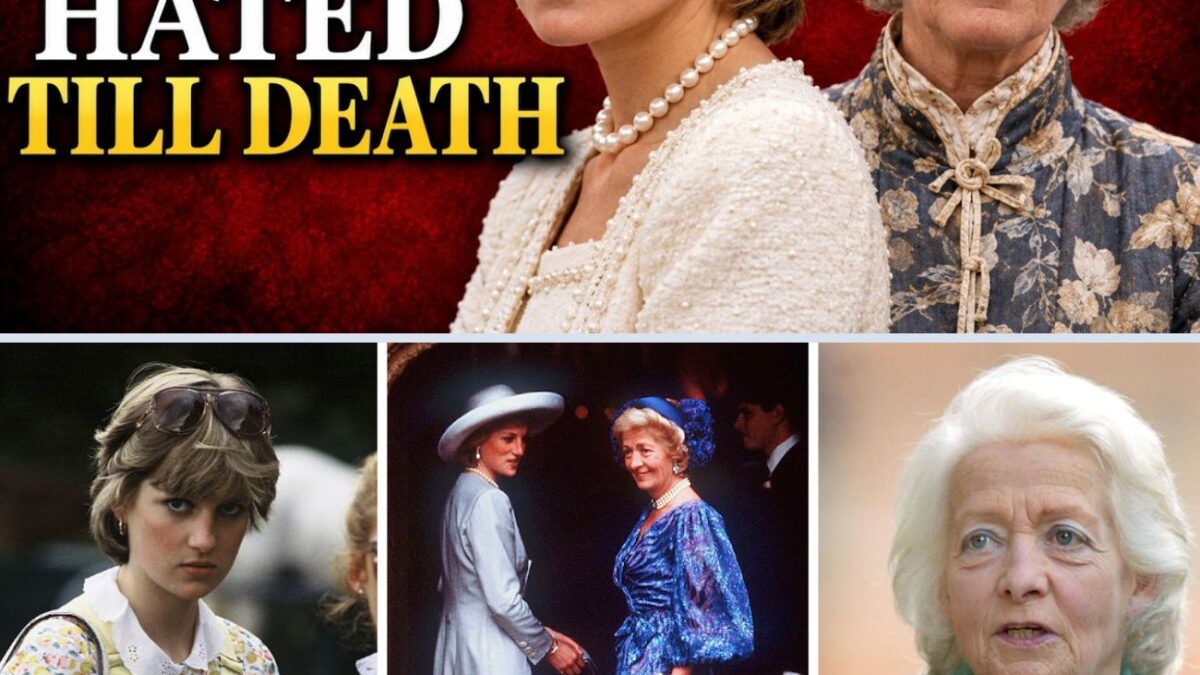
In 1954, Westminster Abbey hosted the wedding of the year. The bride was 18. 13 years later, she walked out of her marriage and lost her daughters in court because her own mother gave evidence against her.
Diana was six. She remembered the sound of car tires on gravel leaving. The press called Frances the runaway mother and never stopped. Decades on, Diana reportedly made peace with the stepmother she had loathed while refusing her own mother’s phone calls in her final summer. And weeks before Paris, Frances gave a magazine interview. What she said in it is still disputed.
Start with the child who isn’t in any of the famous photographs. In January 1960, at Park House on the Sandringham estate, Frances Althorp gave birth to a son. His name was John. He lived for about 10 hours. There was no public mourning, no long family account of what that week was like. He was buried and the household carried on.
Diana was not yet born. Her brother Charles was not yet born. And the two children who already existed, Sarah and Jane, were small girls who were simply told that the baby had died.
Frances was 23. She had been married for 6 years and in the world she had married into, the death of that particular baby was not only a private grief, it was a dynastic problem.
Here’s the part that sounds medieval because it is. Her husband, Johnny Spencer, then Viscount Althorp, was heir to the Spencer Earldom and to Althorp, the family’s enormous house in Northamptonshire. Under the rules attached to that title, only a son could inherit it. Daughters could not. So, a couple could produce daughter after daughter and still be treated inside the family and by everyone around them as having failed. That was the arithmetic Frances was living inside when John died.
What happened next is one of the ugliest details in the whole story and it comes from Diana herself. In the tapes she recorded for Andrew Morton in 1991, she described her mother being sent to Harley Street clinics to be examined to find out what was wrong with her because she had not produced a male heir.
Diana’s account is Diana’s account. She was not born yet and she was repeating what she had been told, but nobody in the family has ever publicly denied it.
Think about what that means in ordinary terms. A woman in her early 20s loses a newborn son and the response is to send her for medical tests, not grief counseling, tests, as though her body were a piece of failing estate machinery.
18 months later, on the 1st of July, 1961, in a bedroom at Park House, the next baby arrived, another girl, 7 and 1/2 lb and by most accounts a very easy birth. She was not what anybody had been hoping for and the family did not hide it well. Her parents had not chosen a girl’s name. They registered her a week after she was born, Diana Frances Spencer. The second name taken from her mother.
She grew up knowing that story. She told Morton she had always felt she was a disappointment, a girl when a boy was needed. That is the sentence people quote. What they usually skip is who else was being judged in that room. Diana was the unwanted girl. Frances was the woman who had produced her.
In May, 1964, the son finally came, Charles Edward Maurice Spencer. The Queen was one of his godparents. The problem that had hung over the marriage for a decade was solved.
And here is the thing nobody predicted. The marriage fell apart anyway. Within 3 years, Frances was gone.
The reason has a name. In 1966, at a dinner party in London, Frances met Peter Shand Kydd. He was the heir to a wallpaper fortune, married with three children, and by every account the opposite of the world she had been handed at 18. He was funny. He had been a farmer in Australia. He was not an earl’s son.
What the Spencer marriage had actually been like by then is contested, and you should know that before anyone tells you a clean version of it. Some biographies, drawing on people close to Frances, describe a marriage that had become cold and at times frightening. Johnny Spencer’s defenders describe a decent, slow, loyal man abandoned by a restless young wife. Both camps were talking about the same house. The children were in it.
In the autumn of 1967, Frances left for a flat in London and took Diana and Charles with her. That is a detail most retellings lose. She did not walk out of the door and abandon her small children. The two youngest went with her. Diana was enrolled at a school in Knightsbridge.
Then Christmas came. The children went back to Norfolk to see their father, and Johnny refused to send them to London again. He had the house, the name, the money, and the estate. She had a rented flat and a lover who was still married to somebody else. From that moment, the fight was never really about who loved the children more. It was about who could afford to win.
And now look at the four children, because their ages decide almost everything that follows. Sarah was 12, Jane was 10, Diana was six, Charles was three. Four people in one family living through the same event and each of them got a different mother out of it. Sarah remembered a household before the trouble. Charles remembered nothing at all. Diana sat exactly in the middle, old enough to understand that her mother had gone, too young to be told why.
The detail that survived in Diana was a sound. She described hearing her brother crying for their mother in the night and the noise of footsteps on gravel, of a car leaving. Children do not store arguments or court dates, they store sounds. That one stayed with her for 30 years and she was still talking about it when she was a princess with two sons of her own.
Which brings us to the question stamped on this story ever since. Why did Diana’s mother hate her?
Here’s the honest answer and it is stranger than the rumor. There is no credible evidence that Frances Shand Kydd hated her daughter. None. No letter, no interview, no reliable witness. What there is instead is a custody case she lost, a reputation decided for her by other people and a silence at the very end of Diana’s life that has never been fully explained.
So the real question is not why she hated her. It’s who decided that she was a monster, how that story got fixed in place before Diana was even eight years old and why it never came off.
The first blow landed in April 1968. Peter Shand Kydd’s wife, Janet, filed for divorce and named Frances in the papers. In 1968 Britain, that single legal line did something to a woman that is hard to explain now. Before fault-free divorce, adultery had to be proved and published. Frances’ name went into the newspapers as the woman who had broken up another family. She was 32 with four children she was trying to get back.
She went to court anyway. She sued for custody of all four children and on paper in the late 1960s, she had a real chance. English courts of that period usually gave young children to their mother. Judges talked about the tender years. A six-year-old girl and a three-year-old boy were exactly the kind of children who stayed with their mother even when she was the guilty party in a divorce. Her lawyers knew that. So did Johnny’s.
To understand what happened in that courtroom, you need one more person and she is the most important character in this entire story apart from Frances herself. Her name was Ruth, Lady Fermoy. She was Frances’ mother, Diana’s grandmother, and she was not a bystander at the English court. She was part of it.
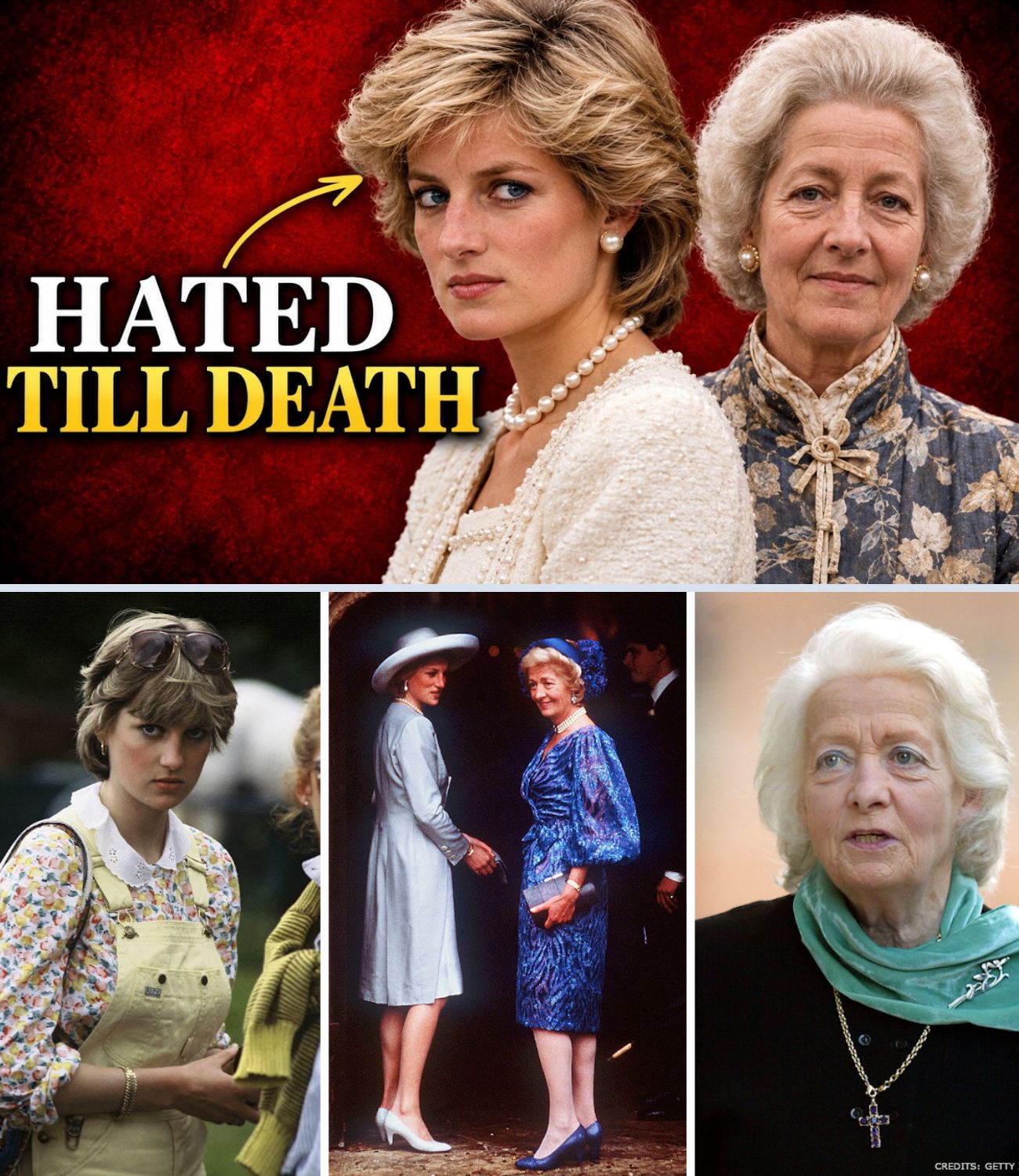
Ruth had been a concert pianist, a commoner from Aberdeenshire who married Maurice Roche, the fourth Baron Fermoy, and found herself living at Park House as a neighbor and close friend of the royal family at Sandringham. After her husband died, she became a woman of the bedchamber to Queen Elizabeth the Queen Mother. In plain terms, a trusted personal attendant and companion to the Queen’s mother inside the household for decades.
Everything Ruth Fermoy had, she had gained by behaving impeccably. Her position, her friendships, the house at Park House itself leased from the Queen. Her daughter had just blown all of that up by running off with a wallpaper heir.
The custody hearing was not a long dramatic trial. It was a short, brutal, almost entirely private affair. The kind of case that produced a few paragraphs in a newspaper and destroyed a life. Johnny Spencer’s side produced witnesses who would speak to Frances’s character as a mother. Frances expected that. What she did not expect was the name near the top of the list.
But before we go through that door, stay in the house she left behind because 1968 at Park House is where the damage actually happened.
Johnny Spencer kept his children and then had no idea what to do with them. He was a man of his class and generation, affectionate, undemonstrative, and completely unequipped to raise a three-year-old and a six-year-old on his own. So, he hired. A string of nannies came through the house. Charles Spencer has said publicly that some of them were cruel. The children fought back in the way children do. Diana and Charles threw one nanny’s clothes out of a window. They pushed pins into a chair. These are small, almost funny stories until you notice what they are actually about. Two children trying to get rid of every woman who arrived to replace their mother.
Sarah and Jane were away at boarding school for most of it, which is its own kind of exile. The two eldest girls processed the separation at a distance among other girls with letters. The two youngest processed it at the breakfast table every single morning in a very quiet house.
Frances was allowed to see them. She would come or they would be sent to her and then it would end and she would have to hand them back. Anyone who has done a custody handover in a car park understands the particular awfulness of that routine. Do it for 10 years and it stops being an event and becomes the shape of the relationship.
That is the inheritance Diana carried into St. Paul’s Cathedral 13 years later and into her own marriage and into every interview she ever gave about not wanting her sons to grow up the way she did.
People talk about Diana’s childhood as though the villain is obvious. It isn’t. There are at least four candidates, and one of them is a woman in a hat sitting a few seats away at the royal wedding.
Because in 1968, in a London courtroom, Frances lost her children in a matter of days. The press got the version it wanted, the countess who ran off, the mother who chose a man over her family. That version stuck for the next 37 years. It is still the version most people repeat today, and almost nobody knows why it was so easy to prove.
The answer is in the witness box. Somebody Frances trusted walked in, took the oath, and spoke against her. She was not a servant, not a rival, not a friend of Johnny’s. She had known Frances for 32 years, since the day she gave birth to her. And when the court asked her what kind of mother her own daughter was, she answered the question.
Her name was on the witness list because she had agreed to be there. Ruth, Lady Fermoy, gave evidence supporting Johnny Spencer’s bid for custody against her own daughter for her son-in-law.
There is no transcript to quote. Private family hearings of that period were not published, and anyone who tells you the exact words is guessing. What nobody disputes is the fact of it. It appears in biography after biography, and the family has never denied it. Diana’s grandmother backed the father.
Why? You can argue about her motives forever, and people have. But look at what Ruth Fermoy actually was, and the decision stops being mysterious. She was a woman of the bedchamber to the Queen Mother, a trusted personal attendant inside the royal household. Everything she had, she had earned by being reliable. Her daughter had just left an earl’s heir, been named in somebody else’s divorce, and asked a court to hand over four aristocratic children so she could raise them with a wallpaper millionaire.
Frances lost. All four children stayed at Park House with their father. The divorce came through in 1969. She married Peter Shand Kydd within weeks, and the press had its headline, “The Runaway Mother.” She was 33 years old, and she would carry that phrase for the next 37 years.
She denied it for the rest of her life. In the few interviews she gave, she rejected the idea that she had abandoned her children, and pointed out the thing the newspapers never bothered with. She had taken the two youngest with her, and it was their father who refused to send them back. She did not leave, she was locked out. That was her account, and the court record of a mother suing for custody supports it.
So, where do you go after that? Frances went as far from Northamptonshire society as the map allowed. She and Shand Kydd farmed on the Isle of Seil, a small island off the west coast of Scotland reached by a single humpbacked bridge a few miles south of Oban. Later, she ran a shop in Oban selling gifts and China. A countess’s daughter stacking shelves, 400 miles from the world that had thrown her out.
The children came in the holidays. Diana spent summers in Scotland, and by several accounts, loved it. The beach, the boats, a house with no footmen in it. Then term started, and she went back south, and the gap opened again. A mother you see in August is not the same as a mother.
Meanwhile, the house the children had been kept in, got bigger and colder. In 1975, Johnny’s father died. He became the eighth Earl Spencer, and the family moved to Althorp, a house of more than 100 rooms with state apartments and a public tour.
Diana was 14. A year later, her father married again. Raine, Countess of Dartmouth, was the daughter of the romantic novelist Barbara Cartland. She was forceful, glamorous, and extremely good at getting her own way. Johnny married her in July 1976 at a register office and told his children afterwards. None of them were there.
The Spencer children’s response was close to open warfare. They called her Acid Raine. Charles Spencer has described shouting at her. Sarah, the eldest, led most of it. And here is the piece that connects back to Frances. The children now had a stepmother installed in their house with total authority, and the mother who might have balanced her was 400 miles away with no legal standing at all.
Frances’s absence did not just hurt in 1968. It kept hurting every time something changed at Althorp without her. The grievance had substance. Raine redecorated Althorp and sold off paintings, furniture, and other heirlooms to pay for it. A real loss of family property that Charles Spencer later tried to reverse where he could.
Then, in September 1978, Johnny collapsed with a massive cerebral hemorrhage. He was not expected to live. Raine kept his children from his bedside at times, and when doctors offered little hope, she obtained a drug not then licensed in Britain. He survived another 14 years. Both things are true. She was the woman who sold their furniture, and she was the reason they still had a father.
Watch what that household did to the eldest daughter first, because Sarah’s story is the one that nearly rewrote history. Lady Sarah Spencer was clever, funny, red-haired, and furious. She was expelled from West Heath, the Kent boarding school all three sisters attended, for drinking. In her late teens, she developed anorexia nervosa, serious enough that she later spoke about it publicly at a time when almost nobody did. She has said she was starving herself while almost nobody around her understood what they were looking at.
And in 1977, she was the Spencer sister dating the Prince of Wales, not Diana, Sarah. She brought him to Althorp for a shoot that November, and that is where he met her 16-year-old sister in a plowed field. Then, Sarah gave an interview to a magazine and said she would not marry a man she did not love, whether he was the dustman or the king of England. The romance ended, the introduction did not.
Sarah married Neil McCorquodale in 1980, moved to a farm in Lincolnshire, had three children, and spent the next decades almost entirely out of the newspapers. Almost. We will come back to her, because when Diana died, it was Sarah, the sister who had the romance first, who ended up running the memorial fund that handled millions.
The second sister went the opposite way entirely. In April 1978, Lady Jane Spencer married Robert Fellowes. He was then assistant private secretary to the Queen. He later became her private secretary, the most important official in the monarch’s household, the man who runs the palace’s relationship with the government, the press, and the family itself.
Think about the geometry of that. One Spencer sister married into the machine. Another sister would marry its heir. And their mother was the woman that same establishment had quietly destroyed in a courtroom 10 years earlier.
Jane and Diana stayed close. When Diana’s marriage began collapsing, Jane was in an impossible position. Sister to the princess, wife to the man whose job was protecting the crown. When Andrew Morton’s book appeared in 1992, and the palace realized Diana had cooperated, Robert Fellowes was the official who had to handle it. Accounts of the strain inside that marriage vary, and the Fellowes family has never discussed it. Jane stayed at Diana’s side. She was on the aircraft that flew to Paris to bring her sister’s body home.
That leaves the boy who remembered nothing. Charles Spencer was three when his mother left, and he has said he has no memory of her living in the house at all.
At 8, he was sent to Maidwell Hall, a boarding prep school in Northamptonshire. In 2024, at the age of 59, he published a book about what happened there. A very private school describes beatings and sexual abuse by a member of staff, and a system in which small boys were handed over and left. He has said he was abused at 11. He has also said the hardest part of writing it was recognizing how much of his adult life it shaped. He did not tell anyone at the time. His mother was in Scotland. His father was at Althorp with Raine. Whatever the court believed it was protecting in 1968, this is what the arrangement actually produced. A small boy with nobody to tell.
Now come back to the grandmother, because in 1980, Ruth Fermoy did something that makes the custody case look almost small. The Prince of Wales was 31 and under pressure to marry. Ruth was the Queen Mother’s closest companion. Several biographies describe the two older women as quietly encouraging a match between Charles and the 19-year-old Diana. The right background, the right family, a girl with no history. Diana was invited to Balmoral. The machinery started moving.
So, the woman who had helped take Frances’s children away now helped deliver one of those children to the heir to the throne. Whether she believed it was a gift or a duty, nobody can say.
There is a reported coda. According to Jonathan Dimbleby’s authorized biography of the Prince of Wales, Lady Fermoy warned Diana before the engagement that royal life was not what it looked like and that the family’s way of living and joking might be very different from anything she was used to. Diana, by that account, said it did not matter. Later, after the marriage failed, Ruth was reported to have expressed regret to the prince. The family has never confirmed the wording of any of it.
On the 29th of July, 1981, Frances Shand Kydd watched her daughter marry the future king. She was in St. Paul’s and the newspapers noted her presence the way you note an awkward relative. Twice divorced, named in another woman’s divorce. In 1981, at a royal wedding, that still mattered.
Her ex-husband gave the bride away. Her mother sat in the congregation as a member of the Queen Mother’s household. Frances sat with the family that had spent 13 years proving she was not fit to raise the woman walking up the aisle.
And then, something odd happened. Frances became a defender. When the press began hunting Diana in the early ’80s, it was her mother who wrote to the Times complaining about the treatment of her daughter. She gave the occasional interview, always carefully, usually to correct something. The woman the newspapers had destroyed spent the next decade arguing with newspapers on her daughter’s behalf.
Then her own life started taking hits again, and almost nobody noticed because by now every camera in Britain was pointed at her daughter.
In August 1984, her younger brother Edmund, the fifth Baron Fermoy, died by suicide at his home in Dorset. He was 54. He had been suffering from depression. The inquest was reported in a few column inches. Diana was then pregnant with Prince Harry. The family buried him quietly, and the story went away.
Six years later, the marriage she had lost her children for ended. In 1990, Peter Shand Kydd left her. He had met someone else, and he went to live in Australia. They divorced.
Frances was 54, alone on an island, twice divorced, in a house with a view of the sea, and very few visitors. Read that sentence next to the one that made her famous. She was called the runaway mother because she left a marriage for Peter Shand Kydd. She lost four children over him, and after 21 years, he walked out on her for somebody else. Nobody wrote a headline about that.
Then, March 1992, Johnny Spencer died suddenly in London, age 68. Diana flew home from a skiing holiday in Austria. The photographs taken of her face at the airport are among the worst ever taken of her.
14 months later, in July 1993, Ruth, Lady Fermoy, died at 84. Frances buried her mother, the woman who had helped take her children, without ever publicly saying a word about what happened in 1968.
By the middle of the ’90s, Frances was 60, living quietly on Seil, driving herself to a church in Oban, and her daughter was the most photographed woman on the planet and coming apart in public. Mother and daughter spoke constantly in those years. People who knew them both described the two as unusually close.
And then, at some point between 1996 and the summer of 1997, something broke so badly that Diana reportedly stopped taking her mother’s calls altogether. What caused it is still argued over. Frances denied the worst versions of it until the day she died. The answer involves a magazine, a telephone call, and a religion nobody saw coming.
The thing that changed her was not therapy and not a book deal. It was a church. In 1994, at 58, Frances Shand Kydd was received into the Roman Catholic Church. She had been introduced to it in Scotland, and she took it seriously in a way that surprised people who only knew the newspaper version of her.
She began traveling to Lourdes, the pilgrimage town in southern France, where the sick are brought by the trainload. And she went not as a visitor, but as a helper, pushing wheelchairs, washing people, doing the unglamorous work that volunteers there actually do. She gave money away, quietly and a great deal of it, to Catholic charities and to causes around Oban. She sold things. Friends described a woman stripping her life down rather than building it up.
You can read that any way you like. She never offered a tidy explanation, and she would have refused one. But it is worth holding next to the headline that followed her for decades. The runaway mother spent the last 10 years of her life carrying strangers’ luggage at a shrine.
There was something else she was dealing with, and she said it herself, which is why it can be said here. She drank. In 1996, she was convicted of drink driving in Scotland and banned from the road. She did not hide behind a lawyer’s statement. She later spoke publicly about being an alcoholic and about stopping and about how much better life became afterwards.
For a woman of her class and generation, raised to say nothing about anything, that was close to astonishing. And it reframes the two periods of her life people argue about most. Nobody can say when the drinking started. Nobody honest can tell you how much of the distance between her and her children came from a courtroom and how much came from a bottle. Both things were in the house. Only one of them made the papers.
Now the part everyone wants, and the part where certainty runs out. In the last 18 months of Diana’s life, something went wrong between them. That much is agreed by almost everyone who has written about it. What caused it is not.
The version repeated most often involves an interview. In the spring of 1997, Frances spoke to Hello magazine. She talked about her daughter’s divorce, which had been finalized the previous August, and about Diana losing the style of Her Royal Highness. According to several accounts, Diana was furious. Not at the content so much as at the act. Her mother had spoken to a magazine about her.
There is a second, uglier version, and it has to be labeled for what it is. People who worked around Diana, including her healer Simone Simmons, later claimed there had been a phone call in which Frances said hostile things about Diana’s relationships with Muslim men, meaning the heart surgeon, Hasnat Khan. Simmons has described it. Others close to Diana have repeated it. Frances denied it flatly and publicly, and there is no recording, no letter, no independent witness. It is second-hand testimony about a private conversation between two people, one of whom died weeks later. Treat it as a claim, not a fact.
What is reasonably well established is that for a period in 1997, Diana did not take her mother’s calls, and that Frances kept ringing. Some accounts say contact resumed briefly before August. Others say it never did. Frances herself later insisted that the picture of total estrangement was wrong, and that she had spoken to her daughter. The exact state of things on the 30th of August, 1997, is simply not knowable.
And here is the reversal that makes the whole story turn over. While Diana was reportedly refusing her own mother’s calls, she was having lunch with Raine, the stepmother the Spencer children had declared war on, the woman who sold the Althorp heirlooms. By the mid-90s, the two of them were meeting in London, talking regularly, and by every account, genuinely fond of each other.
Raine had been widowed, had married and divorced a French count, and had come out the other side of her own public humiliation. Diana reportedly said she had been wrong about her.
Think about what that looked like from an island in Scotland. Your daughter has forgiven the woman who took over her father’s house. She is not speaking to you.
Then, Paris. Frances was at mass in Scotland when she learned her daughter was dead. She flew south. In the days afterwards, she went to St. James’s Palace, and she later spoke about the time she spent with Diana there before the coffin was closed. She said she was grateful for it and that it mattered to her enormously. She did not elaborate and nobody should elaborate for her.
On September 6th, she walked into Westminster Abbey, the same building where she had been married at 18 43 years earlier as a girl everyone photographed. She sat through the service. She heard her son stand up and attack the crown from the pulpit promising that Diana’s blood family would make sure her sons’ souls were not immersed by duty and tradition. The applause came in from the crowds outside and rolled up the nave.
Then, she went home to Seil.
There is a detail from that period that says more than the eulogy did. Diana’s grave is on an island in the middle of a lake at Althorp, the family house, the one the children were kept in when Frances lost them. Her daughter was buried in the one place Frances had been legally shut out of.
She went back to her life. She kept going to Lourdes. She kept giving money away. She gave a handful of interviews over the following years, usually defending something. And in 1998, she spoke about grief in terms that nobody in that family had ever used in public, saying that she would not pretend she was over it and that she did not expect to be.
The press came back one more time. In 2001, the trial of Diana’s former butler Paul Burrell and the chaos around the princess’s possessions dragged the family through the courts again. Sarah, as an executor of her sister’s estate, was in the middle of it. Frances was not spared the coverage. Her health was failing by then. Reports at the time described a degenerative brain condition and she suffered the effects of Parkinson’s disease. She lost mobility. She kept the house.
Frances Ruth Shand Kydd died at home on June 3rd, 2004. She was 68, the same age her first husband had been when he died, which is the kind of coincidence that means nothing and sticks anyway.
Her funeral was at St. Columba’s Cathedral in Oban, a plain granite church on the seafront in a small Scottish port town. Prince William and Prince Harry came. So did Sarah, Jane, and Charles. The congregation was full of people from the island and the parish who had known her as the woman from the shop, the one who turned up at Lourdes every year. She was buried on the Isle of Seil.
The three surviving Spencer children went on in three directions, which is the whole point of this story.
Sarah McCorquodale, who dated the Prince of Wales first and then watched her younger sister marry him, became the keeper of the paperwork, executor of Diana’s estate, chair of the memorial fund, that money the public sent, a witness at the Burrell trial, and at the inquest. She still lives in Lincolnshire, still rarely speaks publicly, and has spent nearly 30 years handling the administrative wreckage of her sister’s fame.
Jane Fellowes, now Baroness Fellowes, stayed exactly where she had always been, inside the system. Her husband was made a life peer after retiring as the Queen’s private secretary. Jane flew to Paris to bring her sister home, and in 2018, she stood up in St. George’s Chapel at Prince Harry’s wedding and read the lesson, the only one of Diana’s siblings chosen to speak. Harry picked his aunt.
Charles Spencer kept Althorp, bought back family pieces where he could, built the memorial around the lake, and became the loudest Spencer of all. Three marriages, a public separation, a best-selling book in 2024 about being abused at his prep school at 11 years old and a very direct public sentence about his own life that he had not told anyone at the time because there was nobody to tell.
Raine died in 2016. At her funeral, it was Charles Spencer, the boy who had called her acid rain, who gave the address.
Put the four Spencer children beside one another and the pattern is not a pattern at all. One married the establishment. One married the heir to the throne and then tore the establishment apart. One withdrew to a farm. One wrote the book nobody in that world was supposed to write. Same house, same mother leaving, same father. Four completely different answers.
And their mother is the figure the story never quite found a place for.
The title asks why Diana’s mother hated her. Strip the evidence down and you cannot make that sentence stand up. There is no letter, no reliable witness, no documented contempt, only a custody case she lost in days, a verdict the newspapers wrote for her in 1968 and never revised, a reputation that belonged more to the press than to her family, and an argument at the end that neither of them had time to finish.
What Frances actually did is in the court record. She sued for all four of her children and was beaten by a husband with a house, a title, and her own mother on his witness list. Everything after that happened to a woman who had already been convicted.
Go back to the gravel. The sound Diana remembered from the winter she was six was a car leaving Park House in the dark and her little brother crying for his mother. That sound outlived almost everyone in it. It followed Diana into her marriage, into letting her sons be raised at a distance, into the interviews, into the tapes.
But listen to it from the other side of the windscreen. 36 years later, on the 1st of July, Diana’s birthday, Frances would make the same sort of journey in reverse, driving herself down a single-track road on a Scottish island. A twice-divorced woman in her 60s, driving off to mass in a small granite church to pray for a daughter she could no longer ring.
That is where it ends. Not at St. Paul’s, not at the Abbey, not on the island in the lake at Althorp, where the family that won in court eventually buried her child. A low white house above the sea on Seil, 400 miles from Northamptonshire, with a bridge over a tidal channel and almost no visitors.
Inside it, on the wall, the photographs she kept of all four of them.
You Might Also Enjoy

“We Thought They Would Negotiate”—What Argentine Soldiers Said When The British Attacked Goose Green

“You’ll Never Finish My Ruck March, Limey” — US Sergeant Who Challenged the SAS, Then Fell Out First






