Why Princess Diana’s Siblings Hated Her So Much
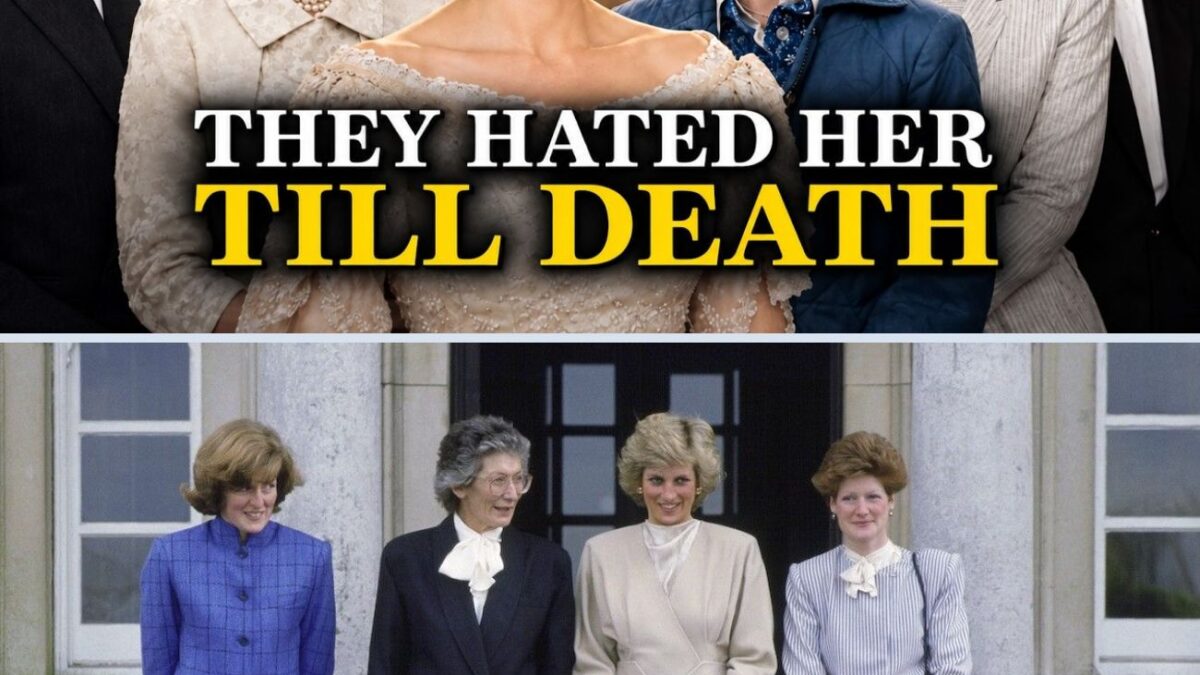
She said she wouldn’t marry him if he were the dustman or the King of England. That was Diana’s older sister Sarah talking about Prince Charles, the man she was dating first. Months later, he was courting her 19-year-old sister instead. The middle sister, Jane, was already married to the Queen’s own private secretary, the man at the center of the machine Diana came to believe was working against her. And the brother who stood in Westminster Abbey and scolded the royal family to their faces? He had already told Diana no when she asked to come home to Althorp.
So, let’s deal with the obvious thing first. Hated her? No. That word gets thrown around because it sells, and because what actually happened inside that family is harder to say in four words. There is no reliable evidence that Sarah, Jane, or Charles Spencer hated their sister. What there is in the documented record is something stranger and far more uncomfortable. A sister who had the prince first. A sister who married the man whose job was to protect the throne from people like Diana. A brother who praised her in front of the world after refusing her a place to live. And one person in that family Diana genuinely stopped speaking to who was none of them.
Start with Sarah. Lady Sarah Spencer, born in 1955, the eldest of the four surviving Spencer children, 6 years older than Diana. In the early ’70s, she was the one people watched. Red-haired, fast, funny, a decent shot, a better rider, named one of the debutantes of her season. If you had stood in a London ballroom in 1973 and been told that one of the Spencer girls would end up on the cover of every magazine on Earth, you would not have picked the shy one hiding behind her fringe. He would have picked Sarah.
Four surviving children. That word is doing work and I’ll come back to it because there was a fifth Spencer child, a boy. And what happened to him in January 1960 shaped the house all four of them grew up in. But first, 1977 and the part of Sarah’s life nobody expected her to talk about. She had been sent to West Heath, the girls’ boarding school in Kent and she was removed from it, expelled by most accounts, after being caught drinking. The same school later took her little sister. Then came the illness. Sarah developed anorexia nervosa in her late teens and early 20s, badly enough to need treatment. And she did something almost no young woman of her background did in 1977. She talked about it, publicly, by name, to the press.
Read that again. Years before the word became familiar to British households, before anyone was discussing it on television, the eldest Spencer daughter put her own eating disorder in the newspapers. Hold that detail. It comes back. Because at the exact moment she was recovering, Sarah Spencer was also dating the Prince of Wales. They met properly at Ascot in 1977. She was invited to Balmoral. She went skiing with him at Klosters. The newspapers did the arithmetic the way newspapers do and by that winter, the eldest Spencer girl was being discussed in print as the next Queen of England. Her father’s estate, Althorp, was a stately home with a Van Dyck collection. Her grandmother, Ruth, Lady Fermoy, was a close friend and lady-in-waiting to the Queen Mother. On paper, it was almost too neat.
And in November of that year, Sarah brought the Prince to Althorp for a shoot and introduced him in a plowed field to her 16-year-old sister who was home from school. Diana remembered that field for the rest of her life. So did everyone else afterwards. At the time, it was nothing. A teenager in Wellington’s meeting her big sister’s boyfriend. Then, Sarah blew the whole thing up herself.
Early in 1978, she sat down with two reporters and talked about the prince with a frankness that would be startling today and was close to suicidal then. She said the relationship was platonic. She said she was not in love with him. And then, she delivered the sentence that followed her for 40 years. She would not marry anyone she did not love, whether he was the dustman or the king of England.
It appeared in print. The romance ended. Reporting at the time and later biographies described the prince as furious. One often repeated account has him telling her she had done something extremely stupid. The exact words are not firmly documented. The outcome is, he stopped calling. Three years later, Sarah stood in St. Paul’s Cathedral and watched her younger sister marry him in front of 750 million people.
Think about the position. Not grief exactly. Not jealousy that anyone could prove. Just the permanent public knowledge that you introduced them. That you were there first. And that the entire planet now treats you as a footnote in someone else’s photograph. Diana later joked about it in private, that Sarah used to boss her about. That she had been the one running the show. Sarah, for her part, never attacked her sister in print. Not in 1981. Not in the terrible years afterwards. Not once in nearly 50 years of being asked.
A year before the wedding of the century, in May 1980, Sarah married Neil McCorquodale, a Lincolnshire landowner, at the little church at Great Brington, near Althorp. Prince Charles came. And here is the first small piece of Spencer strangeness, the kind that sounds invented and isn’t. The McCorquodale name already existed inside that family, and not happily. Raine, the woman who had married their father in 1976, and whom the Spencer children famously could not stand, had been born Raine McCorquodale, daughter of the romance novelist Barbara Cartland. Neil was a relative of hers. So, the eldest Spencer daughter, in a household at war with its stepmother, married into the stepmother’s family and took her surname. The children reportedly called Raine something unrepeatable behind her back. Sarah signed the register as Mrs. McCorquodale anyway.
To understand why that family was at war with a stepmother at all, you need 90 seconds in 1967. That year, their mother, Frances, left. She fell in love with Peter Shand Kydd, a married wallpaper heir, and she went. Sarah was 12, Jane was 10, Diana was six, Charles was three. What followed was not a quiet separation. It was a custody case their father won. In a period when English courts usually handed small children to their mothers. And the single most damaging witness against Frances was her own mother, Ruth, Lady Fermoy, the Queen Mother’s lady-in-waiting, who gave evidence against her daughter. Frances lost her children. She would describe that courtroom for the rest of her life as the worst thing that ever happened to her.
So, the Spencer children grew up in a house where the mother had gone, the father kept the children, and the grandmother had helped make it happen. Four small people learned very early that in this family, loyalty was something you chose a side on.
Now, put Sarah back in the picture. By the late ’80s, she was living in Lincolnshire, married, raising three children, Emily, George, and Celia, on a farm, about as far from Kensington Palace as an English county can take you. And then, she went back. Sarah became her sister’s lady in waiting. If the term sounds decorative, it isn’t. A lady in waiting handled correspondence, traveled on official tours, stood a few feet away during walkabouts, carried the flowers, managed the schedule, and absorbed whatever happened next.
So, the woman who had dated the Prince of Wales spent years of her life as unpaid staff to the woman who married him. She did it through the separation. She did it while the marriage was coming apart in the newspapers. Whatever the two of them had said to each other about 1978, it had been settled in private and never once leaked.
And now, the detail I asked you to hold. In 1977, Sarah Spencer was being treated for anorexia. Roughly a decade later, her younger sister was living with bulimia inside Kensington Palace, describing it eventually on national television. Two sisters, one childhood, the same house, the same lost mother, the same boarding school, the same illness family. Nobody can tell you what caused either case, and I’m not going to pretend otherwise. Eating disorders don’t work like a simple sum, but it is difficult not to notice that when Diana finally spoke about hers, there was already somebody in her family who had been through it, publicly, first.
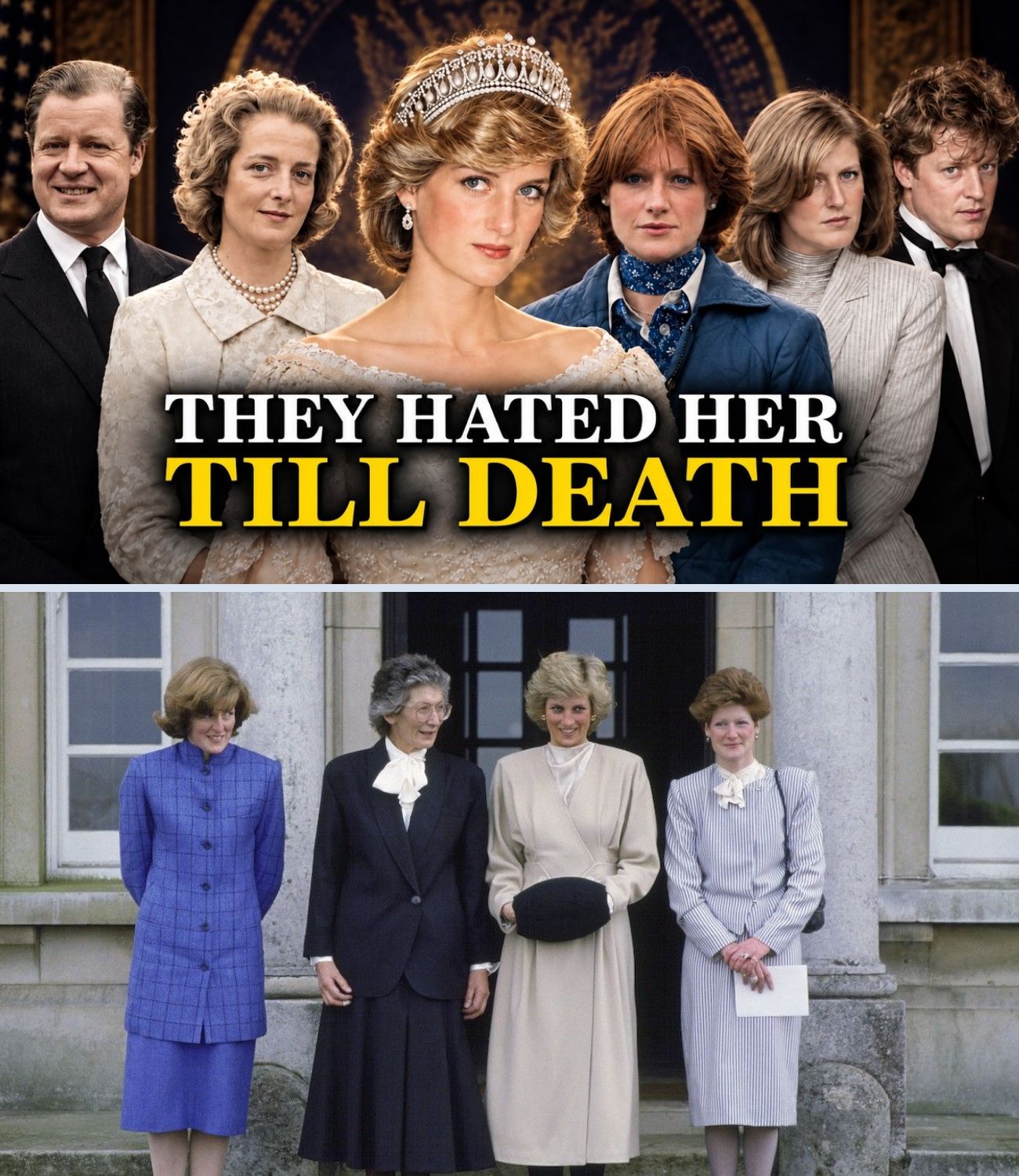
Sarah’s reward for all of it arrived in the summer of 1997. She was one of the two sisters who flew to Paris to bring Diana home, and I’ll come back to the other one. Then, in the weeks afterwards, she became an administrator of the memorial fund set up in her sister’s name, sorting through money, lawsuits, and the strange business of what a dead woman’s image is worth.
She has given almost no interviews since. Not one score-settling book, not one television confession. In 2018, her daughter Celia married wearing the Spencer tiara her aunt had worn on the way to St. Paul’s, and that was as close as Sarah came to a public statement. The eldest Spencer, the one everyone expected to be famous, spent the rest of her life declining to be. There is one exception, and it matters. Sarah became president of the Diana Award, the youth charity created in her sister’s memory, and she turns up for it. A handful of ceremonies, a few short speeches, always about the young people in the room, and almost never about herself.
That is the whole public life. A farm in Lincolnshire, three grown children, grandchildren. A woman in her 70s who once had the future king of England on the telephone, and who now, by every available account, would rather talk about anything else. Sarah chose distance, and she has held it for four decades.
And there was one more thing happening in that house while Sarah’s romance was collapsing. In September 1978, their father suffered a massive cerebral hemorrhage. He was 54. For months he lay in hospital, and the person keeping him alive was arguably not a doctor at all. It was Raine, the stepmother the children loathed, who sat at his bedside, chased down an unlicensed German drug, and by most accounts refused to let him die. She also controlled who got in. The Spencer children have described being kept at a distance from their own father’s hospital room.
He survived. He lived another 13 years, and the children now owed something to the one person in the world they had decided to hate. That is the family we are dealing with. Nothing in it arrives clean.
So, that is one answer to the question people keep asking. Sarah didn’t hate Diana. Sarah got out of the way, and then spent years quietly carrying her sister’s handbag through foreign airports, and then shut the door.
But, she is the easy one. Because while Sarah was being written about as the future queen, the middle sister, the quiet one, the clever one, the one nobody photographed, had already done something that would put her at the exact center of the fight that destroyed Diana’s marriage. In 1978, 3 years before Diana married into the royal family, Jane Spencer married a man who worked at Buckingham Palace. He would rise over the next 12 years to become the Queen’s private secretary, the most powerful courtier in Britain, Diana’s brother-in-law. And when the war of the Waleses began, Jane Fellows woke up every morning in a house that contained both sides. She has never once explained how she managed it. And her sister’s account, when it came, was not the whole truth, either.
Here is the thing almost everyone gets wrong about Jane. She did not marry into the royal world. She was born next door to it. The Spencer children spent their early years at Park House, a 10-bedroom house on the Sandringham estate in Norfolk, rented from the Queen. Diana was born in that house in July 1961. The royal family were, quite literally, the landlords and the neighbors. The children of the two households played together. And the man who ran Sandringham for the Queen, her land agent, was Sir William Fellowes. His son Robert was 16 years older than Jane Spencer and had known her since she was small.
Jane was the one nobody wrote about. Quiet, dry, the best student of the four. She went to West Heath like her sisters, came out with O levels, and took a job at Vogue, the same magazine that later gave her little sister a brief, unglamorous spell as a sort of junior dogsbody.
In April 1978, she married Robert Fellowes at the Guards Chapel in London. He was 36, already working as an assistant private secretary to the Queen. The Queen came to the wedding. So did the Prince of Wales, who at that point was still being linked in print to the bride’s older sister.
You need to understand what the job Robert Fellowes was climbing towards actually is, because the whole story turns on it. The private secretary to the sovereign is not a diary manager. He is the monarch’s chief of staff, her link to the Prime Minister, the person who decides what the Queen sees, what she signs, what she says, and crucially, how the institution defends itself when something goes wrong.
In 1986, Fellowes became deputy private secretary. In 1990, he got the top job. By then, his wife’s younger sister was the most photographed woman alive, and her marriage was rotting in public. So, one man was now responsible for protecting the crown from the consequences of his own sister-in-law’s private life. And they lived on top of each other. The Fellowes family were given a grace and favor house called the Old Barracks inside Kensington Palace. Diana’s apartment was a short walk across the same grounds. Picture that. The princess at war with the palace and the palace’s most senior official married to her sister putting his bins out a few hundred yards away.
Their eldest daughter, Laura, born in 1980, had Diana as a godmother. For a while, it looked like the warmest arrangement in the family.
Then, in 1983, Jane had a son. They called him Alexander. He was born prematurely with a severe kidney malformation and he did not survive. He lived for a matter of hours. A Spencer daughter had lost a baby boy almost immediately after birth and if that sentence gives you a strange feeling, it should because it had happened before in the same family to Jane’s own mother. Jane and Robert later had a second daughter, Eleanor. They did not discuss Alexander publicly. Almost nothing about that loss exists in the record beyond the bare facts, which is itself revealing about how this family handles pain.
They don’t because there was a fifth Spencer child and he is the key to the whole house. On the 12th of January, 1960, Frances gave birth to a boy. They named him John. He was severely malformed and he lived about 10 hours. He was buried quietly. Sarah was four, Jane was two and Diana and Charles did not exist yet.
Now the part that explains everything afterwards. The Spencers needed a boy, not wanted, needed. The earldom and Althorp itself could only pass down the male line. So, a family with three daughters and no son was a family facing the loss of everything it had held since the 16th century. After John died, Frances was sent to Harley Street for tests to find out what was wrong with her. She was 23. By her own later account, it was humiliating. No one, as far as the record shows, tested her husband.
18 months later, Diana arrived, a girl, the wrong answer again. The family had not prepared a girl’s name, and she went nearly a week without one before they settled on Diana Frances. Three years after that, Charles was born, the boy, the heir, the one who would get the house. The Queen was among his godparents, and he was christened at Westminster Abbey. Diana later said, more than once, that she had always known she was a disappointment at birth. Whether a small child could really absorb that, or whether it was something she worked out much later, is impossible to prove, but she believed it, and she said it out loud.
So, the four of them grew up inside a simple, brutal piece of arithmetic. The girls were the ones who happened while the family waited for a boy. One brother had died. The next one inherited a stately home. And the marriage that produced all of them never recovered from the 10 hours in January 1960. Not the only cause of what came in 1967, but a wound the Spencers never talked about.
Which brings us back to Jane, standing in the middle of the worst royal crisis in 60 years, with her husband on one side of it, and her sister on the other.
In June 1992, Andrew Morton published Diana, Her True Story. Diana publicly denied cooperating. She had, in fact, secretly recorded tapes and sent them to Morton through an intermediary, something only confirmed beyond argument after her death. The book accused the royal family, in effect, of destroying her.
Buckingham Palace had to respond, and responding was Robert Fellowes’ job. According to several biographies, Diana came to see her brother-in-law as the enemy, and by extension, to regard Jane as living in the enemy camp. Friends of Diana have described her complaining that she could not speak freely in her own sister’s kitchen. The Fellowes side has never answered that in public, not once in 30 years.
What is documented is that the sisters kept seeing each other, that Jane kept turning up, and that nobody in the family went to the newspapers. Whatever was said inside the old barracks stayed there.
Then came November 1995, and the hour of television that detonated what was left. Diana sat down with Martin Bashir for Panorama, and told 23 million people in Britain that there had been three of them in her marriage. She had arranged it in secret. She did not tell the palace. She did not tell her sister. And she did not tell the one relative whose career it was about to damage.
Here is what reportedly happened before transmission. Rumors reached the palace that an interview existed. Robert Fellowes asked and was told it did not. He passed that reassurance up to the Queen. Then the BBC announced the program. According to accounts published since, Fellowes offered the Queen his resignation over it, and she refused to accept it.
Take a second with that. The most senior courtier in the country was made to look like a fool in front of his employer, and the person who put him there was his wife’s little sister.
For 25 years, that was the story. Diana deceived her own family to get on air. Then in 2021, Lord Dyson’s inquiry for the BBC found that Bashir had used faked bank statements and deceit to gain access to her and that the BBC had covered its tracks. Diana’s brother had handed over the evidence. Suddenly, the picture flips. The secrecy that isolated her from Jane and Sarah was not simply paranoia. She had been worked on by a journalist feeding her stories about people spying on her, including in the reporting on what Bashir showed her, suggestions about those closest to her.
Two days before Christmas 1995, the Queen wrote to both the Prince and Princess telling them to divorce. The letters went out through the private secretary’s office. The settlement, finalized in August 1996, stripped Diana of the style Her Royal Highness. She was no longer, in protocol terms, a member of the family she had married into.
Jane said nothing in public then. Jane has said nothing in public since.
And then you get the morning that answers the question better than any statement could. The 31st of August, 1997. A telephone call before dawn. Later that day, a BAE 146 of the Queen’s Flight took off for Paris carrying three people, the Prince of Wales and Diana’s two sisters, Sarah and Jane.
Not a lady-in-waiting, not a press secretary. The two women who had every documented reason to be bitter, the one whose boyfriend she married, the one whose husband she had humiliated, went to collect her body. They were photographed coming down the steps at RAF Northolt that evening behind the coffin. Sarah in dark glasses, Jane holding herself completely still.
If you want to know what the Spencer sisters felt about their sister, that aircraft is the evidence and it is worth more than any anonymous quote in a newspaper.
On the 6th of September in Westminster Abbey, both sisters read. Sarah read lines by Mary Lee Hall, asking the living to turn again to life. Jane read Henry Van Dyke, “Time is too slow for those who wait, too swift for those who fear, but for those who love, time is eternity.” Two short readings, no commentary, and then they sat down.
What happened behind the scenes that week was not calm. The funeral had to be invented from nothing, and the negotiations ran between Balmoral, Downing Street, and the Spencer family. Robert Fellowes was in the middle of them. Accounts published afterwards describe real friction between the palace and Diana’s brother over the arrangements, including who would walk behind the coffin and what the Spencers would be allowed to say.
One widely repeated account has a senior royal snapping at Fellowes in fury during those days. The quotation has never been confirmed by anyone involved, so treat it as what it is, reported, not proven. The friction itself is not in doubt.
Robert Fellowes retired in 1999 and was made a life peer. Jane became Baroness Fellowes of Shotesham and promptly carried on doing what she had done for 40 years, which is nothing public at all. No book, no documentary, no interview.
The one time she stepped forward was in May 2018 in St. George’s Chapel at Windsor when her nephew Harry married Meghan Markle and asked his mother’s sister to give the reading. She stood up in front of a global audience, read from the Song of Solomon, and sat down again. That is the complete public record of Diana’s middle sister in the 21st century.
So, two sisters, two opposite strategies. One married into the institution and absorbed every blow without a word. The other left London altogether and absorbed hers in Lincolnshire. Neither has ever defended herself, which is why the hatred story survives. Silence lets anybody write anything.
The third sibling did the opposite of both. Charles Spencer has spoken constantly for nearly 30 years. He stood up in that Abbey six days after she died and told the royal family in front of the Queen that Diana’s blood family would not allow her sons to be swallowed by duty. The crowd outside applauded through the doors and the sound rolled in. It is still the most extraordinary thing anyone has said at a British state occasion in living memory.
And it was said by the one member of the family who had already turned her away. Four years earlier, Diana asked her brother if she could come home to Althorp. He said no. That is the piece that still needs explaining. And it still leaves the real estrangement, the one person Diana genuinely stopped speaking to, who was not Sarah, not Jane, and not her brother.
In the autumn of 1993, Diana stood up at a charity lunch and announced she was withdrawing from public life. She asked for space. What almost nobody knew was that she had already asked her brother for somewhere to put it. She wanted the Garden House at Althorp, a four-bedroom property on the estate where she had grown up, inside the gates, behind the walls, with the family name on the deeds. It was the closest thing to a safe house available to her in England.
Charles turned her down. His stated reasons were practical and, depending on who you ask, either entirely reasonable or a convenient wall. He wrote back saying the police had told him her protection officers would bring a security presence he could not accommodate, and that the press would follow her into a village of a few hundred people and never leave. Althorp was a working estate with tenants. He has also said, plainly, that he was in his 20s, newly responsible for the house, and that he handled it badly.
The exchange became public years later, and it is not comfortable reading in either direction. Diana was told, in writing, that there was no room for her at the only house in the world she thought of as hers. She was 32, coming out of a collapsing marriage, hunted by photographers, and the answer from her own brother was no.
Both things can be true at once. He was protecting an estate and its people. She was being refused shelter by the last Spencer standing. Neither reading cancels the other.
And he was not steady himself. Charles Spencer had inherited the earldom in 1992 at 27, when their father died of a heart attack, the same father who had survived that hemorrhage 13 years earlier. He inherited a house with a crippling tax bill attached. He had married Victoria Lockwood, a model, in 1989 at Great Brington, with Diana and Prince Harry among the guests.
By 1995, he had moved the family to South Africa, partly to escape the British press. The marriage was already in trouble, and the way it ended put the Spencer name into the newspapers in the worst possible week. The divorce was heard in Cape Town in December 1997, 3 months after his sister’s funeral. It was ugly, and it was open. Court testimony and contemporary reporting described his wife’s treatment for anorexia and alcohol and drug problems and listed his relationships with other women during the marriage. One of them gave interviews.
The man who had stood in Westminster Abbey and lectured the royal family about how to treat a vulnerable woman was within 12 weeks being described in open court as a serial adulterer whose wife had been in a clinic. He did not contest much of it.
Go back to 6 September then, knowing all that. He wrote the address on the flight home and on the night before. He said Diana needed no royal title to generate her particular brand of magic. He said she was the most hunted person of the modern age. And he made a promise out loud to his nephew’s mother that her blood family would do everything they could to continue steering the boys the way she had wanted, so their souls were not simply immersed by duty and tradition.
The queen was sitting a few feet away. Outside, the applause started in Hyde Park and moved down the street until it came through the Abbey doors and the congregation joined in.
Whether that promise could ever be kept is still argued about. The boys were brought up by their father and the institution, as was always going to happen, and the Spencers were never going to outvote Buckingham Palace on the upbringing of a future king.
Charles has defended the speech ever since and described writing it in a state of anger. He has also admitted he was taking a swing at an entire family while most of that family sat in the pews in front of him. It was the single bravest and most reckless thing any Spencer ever did in public.
Then he did the other thing. Diana was not buried at Great Brington in the church where generations of Spencers lie, and where her brother and sister had been married. She was buried on an island in the middle of the oval lake at Althorp, surrounded by water, reachable only by boat.
Charles said the reason was simple. A grave in a public churchyard would be swamped, and nobody would ever be able to protect it.
Critics said something else. They said the woman who had asked for a house on that estate and been refused had finally been given a piece of it on terms she could not argue with, behind a gate the public pays to approach but never crosses.
The following summer, Althorp opened to the public for a few weeks each year with a museum devoted to his sister. Her school reports, her wedding dress, home movie footage. Visitors could walk an avenue of 36 oak trees, one for each year of her life, to a viewpoint across the water. Some of the money went to her memorial fund.
The criticism came anyway, that a brother who had refused her a cottage was now selling tickets to her grave. He has answered it the same way every time. The house costs millions to keep standing. The exhibition raised money for her charities, and the alternative was photographers in a village graveyard forever.
So, that is the brother, not hatred. Something more awkward. A young man who said no when it mattered, and then spent the rest of his life saying yes to her memory loudly, on his own terms.
But, he was not the family rupture. The person Diana actually stopped speaking to, the one the hatred story should have been about all along, was her mother.
Frances Shand Kydd had moved to Scotland after losing her children, settling eventually on the island of Seil near Oban, running a gift shop, working as a volunteer. Her second marriage ended in 1990. She had been there for Diana during the engagement in 1981. The two of them hid together in a flat in Belgravia while photographers worked the street outside.
For years, mother and daughter were close enough that Frances helped answer Diana’s early correspondence by hand. Then, it came apart, and the reasons remained disputed.
In 1996, as the divorce was being finalized, Frances gave an interview to Hello magazine. She was quoted talking about her daughter’s loss of the royal style and suggesting it might be a relief to be rid of a title. By several accounts, Diana was furious.
There was also her mother’s conversion to Catholicism and a drink-driving conviction that same year, which put Frances in the papers in a way the family found humiliating. Biographers have offered different explanations for the silence that followed.
What is agreed is that in the last months of Diana’s life, they were barely speaking. Some accounts say they had not spoken in 4 months. Frances rejected the bleakest version. She disputed the claim that she had been cut off entirely and said the relationship had been misrepresented after her daughter’s death.
She walked into the Abbey with her children in September 1997 and then went back to Seil. Her last years were hard. Parkinson’s disease, a brain tumor, failing sight. She died in June 2004, aged 68.
Her funeral was held at the Catholic Cathedral in Oban, and she was then brought hundreds of miles south to be buried near Althorp, near, at the end, the daughter she had barely spoken to in the final months.
And then, 24 years after the funeral, the family story changed shape again, and it was the brother who did it. Charles Spencer had kept notes of his first meeting with Martin Bashir in September 1995 at Althorp, where Bashir showed him documents making claims about people around Diana. He had those notes for a quarter of a century.
In 2020, he handed them over and demanded an investigation. Lord Dyson’s report in 2021 found Bashir had commissioned fake bank statements and lied, and that the BBC’s own inquiry at the time had failed. The Queen’s grandsons both issued statements. The brother who had been accused of monetizing his sister’s grave spent 2 years dismantling the story of her most famous interview.
3 years after that, he published a book that reframed the whole childhood. A Very Private School, released in 2024, is his account of being sent away at eight to Maidwell Hall, a boarding prep school in Northamptonshire, and of the violence and sexual abuse he says he experienced there, including, he has said, abuse by a woman on the staff when he was 11. He described it as something he had carried silently for half a century.
The Spencer children were not raised in a warm house. They were raised in an institution, then sent to other institutions, and taught not to discuss any of it. That is the mechanism behind 40 years of family silence, and it was always hiding in plain sight.
He is now on his fourth chapter of private life, divorced from Victoria in 1997, divorced again in 2007, and separated in 2024 from his third wife, Karen. He has seven children. He runs Althorp, writes popular history, and hosts a podcast. He is the most visible Spencer and the most criticized one, and he has never pretended otherwise.
Line the four of them up and the pattern is obvious. One household, one lost mother, one courtroom, one dead baby brother nobody mentioned, four children sent away to be educated by strangers.
Sarah ran as far as Lincolnshire and said nothing for 40 years. Jane married the institution itself and said nothing for 40 years. Charles said everything to everyone forever. And Diana did all three in turn. Fled it, married into it, then went on television and detonated it.
The hatred theory survives because two of the three left a vacuum and vacuums get filled by whoever is willing to talk. But look at what they did rather than what they said.
Two sisters on a plane to Paris on the worst day of their lives. Two readings in the Abbey. Sarah spending years as her sister’s unpaid assistant and then more years administering her memorial fund before becoming president of the Diana Award and turning up for schoolchildren she will never meet again.
Jane standing in St. George’s Chapel in 2018 to read for Diana’s younger son. A brother who refused her a house and then refused for 25 years to let anyone forget how she had been treated.
These are not the actions of people who hated her. They’re the actions of a family that had no idea how to say so.
Which brings us back to a young woman in 1978 telling two reporters she would not marry a man she did not love, dustman or king of England. At the time it all looked like sabotage or stupidity or both. From here it looks like the only free choice anyone in that family ever made out loud.
Sarah walked away from the throne and got a farm, three children, and silence. Her sister walked towards it and got everything, including the end of it.
Go to Althorp in July, and you can walk the Avenue of Oaks to the edge of the water. The island sits there, 40 yards out across still brown water, with a plain stone urn and four black swans that the family put on the lake. You cannot cross. Nobody crosses. Her brother keeps the gate.
Her mother lies a few miles away, and somewhere in Lincolnshire, a woman in her 70s who once nearly married a king is doing something else entirely, and still declining to explain.
You Might Also Enjoy

“We Thought They Would Negotiate”—What Argentine Soldiers Said When The British Attacked Goose Green

“You’ll Never Finish My Ruck March, Limey” — US Sergeant Who Challenged the SAS, Then Fell Out First






