WILLIAM Declares Bluntly to KING: If HARRY Steps Foot in Windsor, Catherine and the Children’re GONE
The Highland Lockout: A Masterclass in Institutional Sovereignty
There is an unmistakable finality to the way ancient stones are locked when a family feud passes the point of diplomatic repair. In the early weeks of autumn, a quiet, irreversible private legal transfer took place across the rugged borders of Scotland. Prince William, acting in concert with Lord Ivar Mountbatten, executed an administrative maneuver that permanently bypassed the standard civil service channels of Whitehall and Westminster. With the stroke of a fountain pen in an Edinburgh solicitor’s office, the secluded keys to Ren’s Nest—the deeply private stone dwelling tucked deep within the ancient pinewoods of the Balmoral estate—were handed directly to 22-year-old Lady Louise Mountbatten-Windsor.
The exact second those private estate deeds were officially registered in the Scottish capital, every single back-channel inquiry originating from Montecito hoping to secure a Highland sanctuary was dead on arrival. For months, intermediaries acting on behalf of the Duke and Duchess of Sussex had worked the corridors of influence, seeking a foothold on British royal soil. They wanted a retreat; they wanted proximity; they wanted legitimacy. Instead, they received a masterclass in calculated institutional silence. This was never merely about an old granite cottage among the heather. This was the future monarch drawing a hard, impenetrable line around the inner sanctum of the British crown, ensuring that those who walked away five years prior would never breach the perimeter again.
To understand how this seventy-day campaign fell apart so completely, one must look past the polished veneer of tabloid headlines and examine the cold, unyielding mechanics of royal survival in 2026.
The Sanctuary of Great Quiet
To the millions of tourists who peer through the wrought-iron gates every summer, Balmoral is defined by its massive gray granite castle, the turrets piercing the Scottish mist, and bagpipers marching across manicured lawns. But anyone acquainted with the private operational reality of the sovereign’s private Scottish domain knows that the true heart of Balmoral lies far away from the public gaze.
Deep inside the ancient Caledonian pinewoods, right at the jagged edge of the Cairngorms and entirely hidden from tourist walking trails, sits Ren’s Nest. For seven consecutive decades, this modest, rugged stone cottage was cherished within the royal household as Queen Elizabeth II’s ultimate private refuge. It was the exact spot where the late monarch retreated whenever the crushing institutional weight of heading fifteen nations became too suffocating to bear. She called it her place of “the great quiet.”
Within those rough-hewn stone walls, she was not the sovereign head of state; she was simply Elizabeth. No aide, no prime minister, and no foreign dignitary was ever permitted near that door without a personal, handwritten invitation from the queen herself.
Yet, during the months preceding the Balmoral lockout, Harry’s legal and PR advisers in California were quietly attempting to subvert that very legacy. Framing their request through emotional appeals about letting Prince Archie and Princess Lilibet connect with their late great-grandmother’s Scottish roots, the Sussex team pushed for a secure private retreat on crown land where press cameras could never reach them. They calculated that King Charles, undergoing grueling cancer treatments and longing for familial peace, would capitulate out of sheer paternal vulnerability. They miscalculated entirely. Prince William was watching, and he had entirely different plans.
The Highgrove Showdown: Camilla in the Chair
To trace the collapse of the Sussex strategy, one must rewind to late August and examine the dramatic pivot that occurred inside Clarence House. King Charles, at 77 years old, was pacing his public duties against demanding cancer therapies. Staring down his own mortality, the king’s most vulnerable human desire was remarkably simple: he wanted to see his son, and he desperately wanted to hold his grandchildren before time ran out.
Signals emanating from the king’s private office were initially warm. Charles told close friends that life was too short for permanent grudges, preparing to clear an afternoon at Highgrove for a quiet family tea with no cameras and no official fanfare. Then, the spreadsheet arrived.
Just days before the proposed reunion, Harry’s legal team transmitted a formal, multi-page document through institutional channels that courtiers quickly dubbed the “Sussex precondition spreadsheet.” The itemized terms demanded before Archie and Lilibet could step onto British soil left the king breathless:
The Security Demand: Harry demanded that the king intervene to override the British Home Office and restore full, round-the-clock armed state security funded by British taxpayers—bypassing a battle he had already lost in the High Court via royal decree.
The Estate Demand: He insisted on a guaranteed, non-revocable crown leasehold, requesting an expansive country estate in Oxfordshire or a private mansion inside Windsor Great Park.
The Half-In, Half-Out Mandate: He demanded the official revival of the forbidden hybrid model, allowing him to represent the Commonwealth on his own terms while freely executing multi-million-dollar commercial deals in California.
This was not a family seeking reconciliation; this was a corporate entity issuing an ultimatum. Driven by spiralling domestic overheads in Montecito—crushing property taxes, elite legal retainers, and private security teams—Harry and Megan were confronting a lethal financial paradox. Their commercial value entirely depended upon their proximity to the institution they had spent five years denouncing. Cut off from palace balconies and state banquets, they were rapidly mutating into standard-issue West Coast reality celebrities. They needed a fresh infusion of British royal prestige to survive commercially.
When Charles read those terms, paternal warmth vanished, replaced by the chilling realization that his affection was being weaponized as customer acquisition collateral for a California lifestyle brand.
Thus, when Harry walked up the gravel path of Highgrove House on that overcast September afternoon expecting an intimate one-on-one chat, he walked straight into a constitutional trap. The heavy double doors swung open to reveal Queen Camilla sitting calmly in the central velvet armchair, sipping Earl Grey with zero intention of leaving.
Camilla was not there to play petty palace politics; she was acting as a human emotional shield for an exhausted cancer patient. She had watched Charles’s blood pressure spike and sleep collapse after tense transatlantic phone calls. She stepped into that room to ensure an ailing king was not bullied into constitutional surrender. Furthermore, she served as an incorruptible sovereign witness. With Camilla seated steadfastly beside him, Charles found the constitutional resolve to inform his son that family relations were now formally separated from the business of the crown. Henceforth, all requests must be submitted in writing through Sir Clive Alderton, the principal private secretary. Harry was officially treated as an unaccredited foreign lobbyist.
The Oxfordshire Campaign and the Architectural Audit
Rebuffed at Highgrove, the Sussex team pivoted toward acquiring an unassailable royal estate to anchor their brand. Discretionary exploratory feelers were floated regarding Fort Belvedere—the historic Gothic retreat in Windsor Great Park where King Edward VIII signed his abdication in 1936 before fleeing the realm.
The audacity of attempting to claim the fortress of Britain’s most infamous royal defector stunned senior courtiers. For Megan, whose lifestyle enterprise American Riviera Orchard was struggling with supply chain setbacks and regulatory hurdles, having a British country manor as a filming backdrop was the ultimate golden ticket.
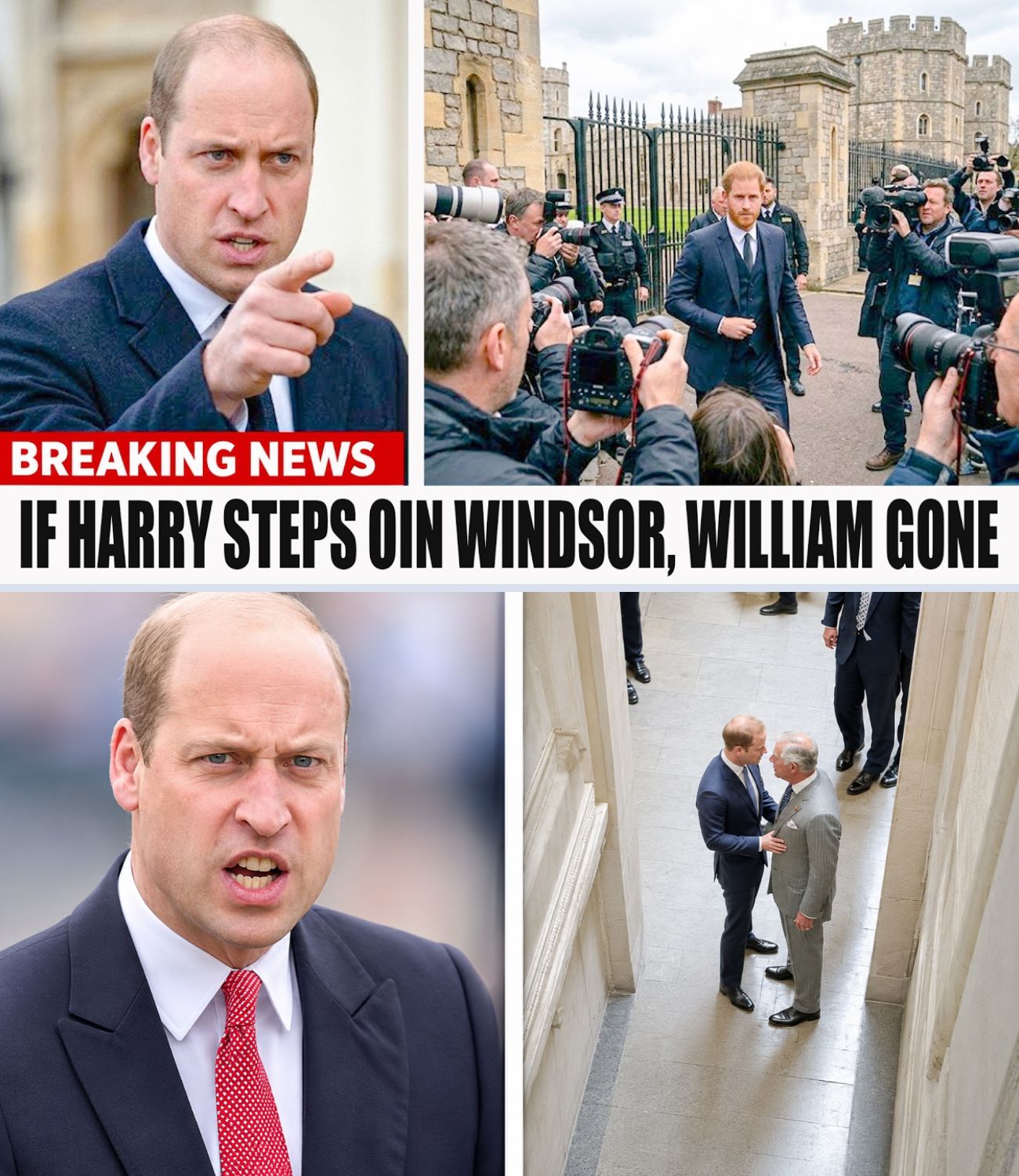
That was the exact moment Prince William went nuclear. Informed that Harry’s team was floating exploratory memos regarding Windsor-adjacent properties, the Prince of Wales walked into an emergency council and delivered a non-negotiable ultimatum: If Harry is granted a single key in Windsor, my family leaves Adelaide Cottage by nightfall.
William was protecting Princess Catherine, who was fragile and recovering from chemotherapy, ensuring no California media machine could set up an operational base ten minutes down the road. Backed by Princess Anne—who reminded the household that crown residences are not aristocratic timeshares—the Windsor gates were slammed shut.
Yet, an even more devastating blow landed on the king’s desk: a forensic architectural compliance audit of Frogmore Cottage following the Sussexes’ eviction. Under the Planning (Listed Buildings and Conservation Areas) Act of 1990, Frogmore Cottage is a Grade II* listed national monument of exceptional importance. Every floorboard and grain of 17th-century lime plaster is legally protected by Parliament.
The audit revealed that the Sussexes’ contractors had treated the historic manor like a speculative Hollywood flip house:
They knocked through original load-bearing partition walls to create massive open-plan living quarters.
Installed industrial-grade acoustic soundproofing membranes to block Heathrow flight noise, inadvertently sealing off natural ventilation and trapping moisture against 18th-century timbers, causing catastrophic dry rot.
Ripped out period fireplaces to install luxury boutique wellness amenities without formal planning approvals from historic preservation officers.
To King Charles—a lifelong champion of historic preservation who spent millions restoring Dumfries House—and Prince William, this was architectural vandalism. Giving them another estate was a legal and constitutional impossibility.
The Masterstroke: Lady Louise and the Scottish Trust Deeds
Realizing standard avenues were blocked, William executed his masterstroke regarding Balmoral. Balmoral is private personal property purchased by Prince Albert in the 19th century, meaning its private leases and trust structures can be restructured quietly through Scottish private law without public disclosure.
Working with Lord Ivar Mountbatten and elite solicitors on Charlotte Square in Edinburgh, William bypassed standard civil service channels. They drafted an unalterable private deed of conveyance for Ren’s Nest, transferring exclusive life tenancy and physical keys directly to Lady Louise Mountbatten-Windsor.
Choosing Lady Louise was pure genius. As the late Queen’s favorite grandchild—a quiet university student studying English literature at St Andrews who never leaked to tabloids—she was the living embodiment of uncomplaining devotion. By handing the sanctuary to Louise, William achieved two unassailable objectives:
Impenetrable Optics: Harry could never publicly complain on American television that an ancient Highland cottage was given to his blameless 22-year-old cousin.
Irreversible Legality: Under Scottish property statutes, once those deeds were registered in Edinburgh, even the king could not unilaterally revoke the covenant.
Local locksmiths replaced the locks on Ren’s Nest, handing the brass keys directly to Louise. When Montecito’s intermediaries inquired 48 years later, the response was a single polite sentence: Ren’s Nest was no longer available.
Prime Time Discipline and the Manila Takedown
While Harry’s campaign collapsed on every front, Prince William appeared on BBC One’s The Graham Norton Show, radiating effortless charm alongside Hollywood star Cate Blanchett. Asked by Norton what ordinary career he might have chosen, William paused, smiled, and delivered twelve lethal words: “I’m just quickly trying to think what I can say on television.”
While the studio audience laughed at a self-deprecating quip, the subtext was heard loud and clear across the globe: true power lies in the discipline of knowing what must remain private, completely demolishing five years of confessional television.
Desperation in California reached a fever pitch in late October when an unexpected catalyst detonated from the Philippines. Thomas Markle Jr. surrendered electronic storage drives belonging to their ailing father, Thomas Markle Senior. Seizing an opportunity to rewrite history, Megan’s press office released an aggressive international statement claiming she had warned Scotland Yard about her father back in 2018.
It took the Metropolitan Police exactly 2 hours and 47 minutes to demolish the claim. Scotland Yard issued an unsparing public statement confirming they had never investigated Thomas Markle Senior nor offered any operational reassurances to the Duchess. The British press swiftly revived the brutal moniker: The forgetful duchess.
Simultaneously, commercial disaster struck: American Riviera Orchard preserves were impounded by British customs for agricultural import non-compliance, federal courts in Washington weighed unsealing Harry’s immigration records regarding past drug use, and ballooning legal bills crushed their financial reserves.
The Birthday Snub and the Final Exit
The desperate endgame arrived on Friday, November 14, 2026—King Charles’s 78th birthday. The Sussex camp leaked briefings suggesting Harry was flying Archie and Lilibet to London as an unexpected birthday surprise, expecting Buckingham Palace to panic and negotiate a televised family summit.
Instead, the king’s private office announced that His Majesty would spend his entire birthday dedicated completely to the nation. While Harry waited by the phone in Oxfordshire, the 77-year-old monarch braved freezing November rain to tour community food hubs and open distribution centers for the Coronation Food Project, spending the afternoon shaking hands with veterans. The message was absolute: The sovereign belongs to the British people.
In the damp pre-dawn darkness of a freezing November morning, a small convoy of tinted black SUVs pulled out of the Oxfordshire estate and headed east toward Heathrow Airport. Inside the lead vehicle, Harry stared through tinted glass at the soden English hedgerows, returning to California in unmitigated defeat. No formal farewells were exchanged—just the cold administrative thud of an aircraft door clicking shut against the gray Atlantic drizzle.
Three hundred miles to the north across the wild pine forests of Balmoral, 22-year-old Lady Louise Mountbatten-Windsor rode her fell pony along the slopes of the Cairngorms. Deep inside her leather saddle bag rested the antique brass key to Ren’s Nest—untouched, unmonetized, and safe in the hands of someone who loved the queen for who she was.
The seventy-day siege of the British monarchy was over. The institution did not raise its voice; it simply outlasted the storm. As Harry reflects in Montecito on the 2021 Oprah interview where he claimed his family was “trapped,” the iron gates of Windsor Castle remain closed, heavy, immovable, and cold against the autumn rain, teaching the most unforgiving lesson of royal blood: you can burn down your family’s house to sell the ashes, but you do not get to complain when they quietly change the locks.
You Might Also Enjoy

“We Thought They Would Negotiate”—What Argentine Soldiers Said When The British Attacked Goose Green

“You’ll Never Finish My Ruck March, Limey” — US Sergeant Who Challenged the SAS, Then Fell Out First






