“You Salute When I Enter.” — What a US Colonel Told the SAS in Ramadi. They Never Did.
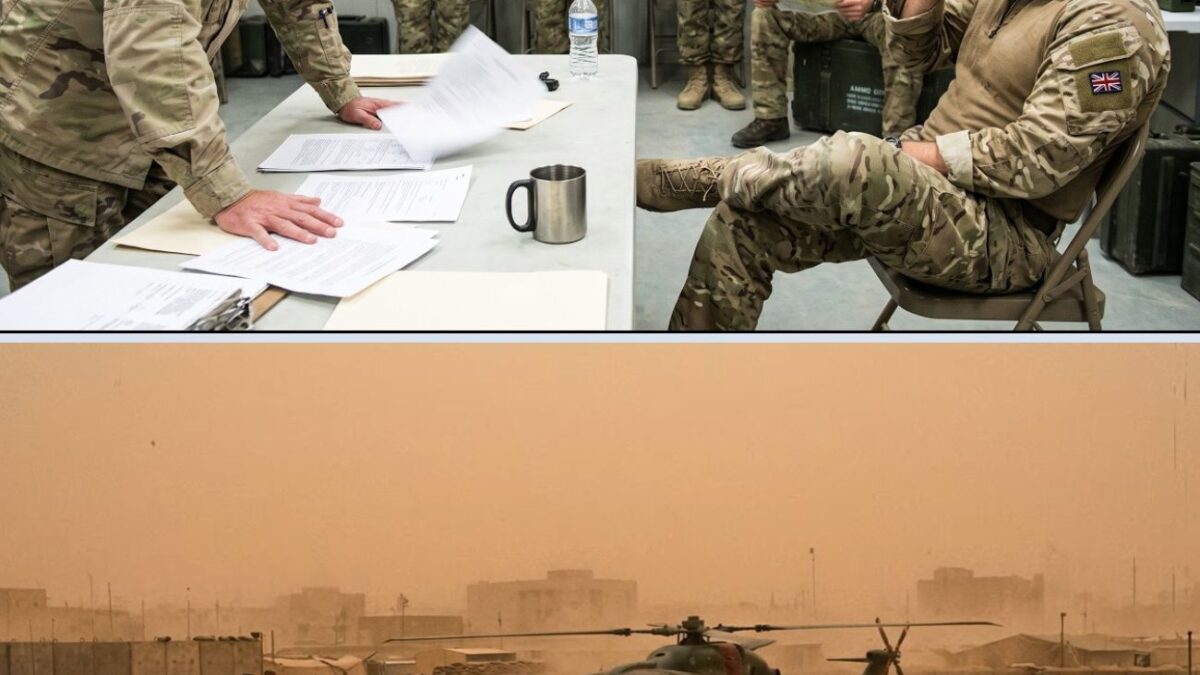
Ramadi, Anbar Province. The 8th of March, 2006. Four men in unmarked civilian pickups sit outside a US forward operating base on the eastern edge of the city. Engines off, dust still settling from the drive-in. One of them, call sign Bravo 2, has a folded 1:50,000 map on his knee with three routes crossed out in red grease pencil. An Iridium satellite phone sits on the dash, cable taped down against the vibration. They have been awake for 31 hours. Inside the base, a US Army colonel is waiting for them, and he has already decided what he expects to see when the door opens.
The colonel’s name, for the purposes of this account, was Colonel Everett Doss, and he ran the forward operating base’s command element with the fixed conviction that discipline was visible or it was nothing. He had spent two decades in conventional formations where rank was worn like a uniform inside the uniform. And when he heard that a four-man British patrol would be working out of his perimeter, coordinating on a joint targeting cell, he issued one instruction before they had even arrived: whoever entered his operations room, regardless of cap badge, regardless of task, would salute the room and identify themselves by rank.
It was not an unusual demand in a conventional headquarters. It was, however, a demand aimed at men who did not wear rank on their sleeves in the field, did not carry ID discs with anything a stranger could read, and had spent years being told correctly that visible military courtesy in front of local staff, interpreters, and third-country contractors could get a man killed by narrowing down exactly who mattered in a room.
The four operators had been in Anbar Province for 6 weeks by then, attached loosely to a coalition special operations task force built around American and British troops working the insurgency in Ramadi, a city that in early 2006 was already sliding toward the worst urban fighting of the war. Task Force Black, the joint British special forces element operating in Iraq at the time, had a standing arrangement. British patrols supported American conventional and special operations formations with reconnaissance, targeting packages, and direct action where the picture called for it. And in exchange, they kept their own chain of command, their own selection of dress, and their own operating rhythm.
That arrangement worked well with most American commanders on the ground, several of whom had trained alongside British special forces and understood exactly why a four-man patrol did not want a colonel’s aide memorising which one wore three stripes. Colonel Doss was not one of those commanders. He had inherited the base three months earlier from a predecessor killed by an improvised device on Route Michigan, and he ran it, by his own account to staff, the way it should have been run from day one: salutes indoors, name and rank on entry to the ops room, a visitors’ log at the door that recorded in full who came and went and under what authority.
For most of the base’s population—cooks, engineers, signal staff, military police—this was simply garrison life transplanted into a war zone, uncomfortable but survivable. For the British patrol, it was a direct collision with the only rule that had kept men like them alive for the better part of 20 years: nobody outside the patrol needs to know who is in charge.
The patrol’s lead operator, a staff sergeant the men called Renie—a name earned, according to one account, for talking his way past an Iraqi police checkpoint at 3:00 in the morning using nothing but a torch and a bad Arabic accent—had briefed his three men before their first meeting with Doss’s staff: keep it simple, no rank spoken aloud, no saluting indoors, not out of arrogance, but because the room was never just the room. Local police liaison moved through it, interpreters moved through it, and a salute told anyone watching exactly who to follow home. It was a rule they had carried from Northern Ireland through the Balkans and into Afghanistan, refined by a decade of men learning what happened when it was ignored.
The first meeting went badly within about 90 seconds. Doss’s adjutant, a young captain named Reyes, told the four men flatly that the colonel required visible military courtesy from anyone entering the command element, coalition or not. Renie told him without raising his voice that his patrol did not identify rank in the field for reasons that were not up for negotiation. Reyes reported this upward within the hour. Doss’s response, relayed by radio, was reportedly a single line that made its way around the base by evening:
“Then he can wait outside my room until he learns some manners.”
The line has been repeated by several who served on that rotation in slightly different phrasing over the years, and it should be read as a paraphrase of a moment, not a verbatim transcript. But its substance was never disputed by anyone who was there. What followed was not a shouting match. It was worse in the way that only bureaucratic friction can be worse. It became a supply problem.
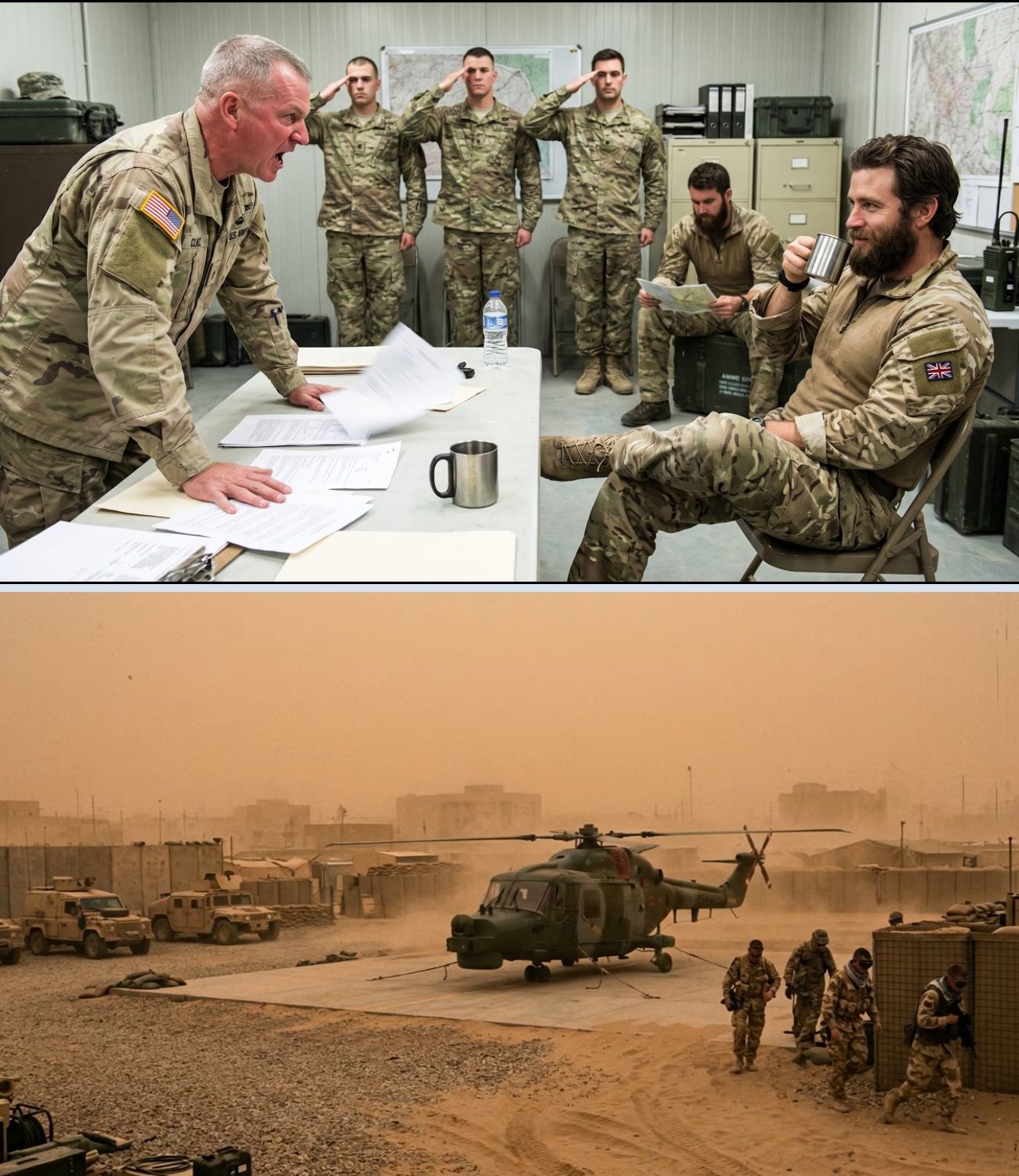
Access to the colonel’s targeting cell, where signals, intercepts, and aerial imagery were fused into actionable packages, ran through a room Doss controlled directly. For 5 days, the patrol’s request for updated imagery of a stretch of road just north of the Tamim district—a route their intelligence suggested was being used to move a bomb-making cell between safe houses—sat in Reyes’s inbox unanswered, while Doss decided whether men who would not salute him deserved his cooperation.
The road itself, a two-lane strip locally referred to by coalition units simply as the Tamim cutoff, was the first hard problem the patrol had to solve without help. Renie’s men had identified through their own low-level source network a pattern: a white flatbed truck moving at irregular hours, always at night, always taking a slightly different route to avoid the same checkpoint twice. Without updated overhead imagery, they had one option left: put eyes on the ground themselves in a city where four foreign men in an unmarked vehicle were already a target simply by existing.
They took two of the pickups out on the 11th of March at last light, loaded with water, a single medic’s kit, and just enough fuel to reach a hide position roughly 600 metres from the suspected route and return without refuelling inside the city. It was here that the first mechanical problem hit. The lead vehicle’s alternator belt, already worn from 6 weeks of unpaved roads and dust intrusion, began slipping audibly within 20 minutes of leaving the base—a high, thin whine that in a quiet residential street sounded to men trained to notice such things unmistakably like trouble.
Renie made the call to press on rather than turn back into range of the base’s own checkpoint, where a return so soon after departure would have drawn attention from exactly the people they most needed not to notice them. The hide position they’d chosen, a collapsed masonry yard on the edge of a date grove, gave them line of sight onto the cutoff, but almost no cover from the open ground behind them. Patrol discipline in a hide like that comes down to water, silence, and stillness. And by the second hour, the water was already the limiting factor.
Four men in body armour in an Anbar spring do not sweat lightly. One of the younger operators, a lance corporal known on the patrol as Whitlock, made the request that shows up in nearly every honest account of this kind of operation. He asked quietly over the short-range radio how much water was left and was told by Renie:
“One bottle each until first light.”
It was not dramatic. It was the entire war compressed into one sentence. The truck did not appear that night, nor the next. What did appear on the second night was a civilian on a moped who stopped roughly 200 metres from their position, looked toward the date grove for what one man on the patrol later estimated at 10 to 15 seconds, and then rode on. It was impossible to know whether he had seen anything at all. It was equally impossible to assume he hadn’t.
Surveillance pressure of this kind, the low-grade uncertainty of whether a position has been compromised by an uninvolved civilian rather than an insurgent scout, is one of the quietest and most corrosive parts of this kind of work because there is no action to take against it except to wait and to move if the wait goes on too long. Renie gave it one more hour, then pulled the patrol back to the vehicles under cover of a residential generator noise that masked their movement, and returned to the base at just past 4 in the morning on the 13th of March, still without the imagery Colonel Doss’s cell had been sitting on.
It was at this point that the friction inside the base stopped being merely personal and became in the plainest sense dangerous, because the patrol was now operating blind on a route where a bomb cell was actively moving, using a vehicle with a failing alternator belt, on 4 hours of sleep in 5 days, because a colonel had decided that access to a shared intelligence picture was a reward for saluting rather than a basic function of a coalition headquarters.
It was a US major, not the colonel, who quietly broke the logjam. Major Grant Holloway, who ran the targeting cell’s day-to-day operations and had worked alongside British special forces in Helmand a year earlier, pulled the requested imagery himself and physically walked it to the patrol’s tent rather than route it back through Reyes in the colonel’s office. He did this, by his own account given later in an after-action discussion, because four men were about to go back out on bad information, and that seemed like a worse problem than a colonel’s temper.
Holloway’s intervention did not fix the underlying standoff. It solved exactly one night’s problem, which was, in this line of work, usually the most that could be hoped for. The imagery provided showed something the patrol’s own eyes hadn’t caught: a second building set back from the cutoff road behind a low wall with vehicle tracks leading to a side gate that did not appear on any existing coalition map of the area. It was, in the language later used in the joint debrief, a previously unflagged compound—not the safe house itself, but very possibly a staging point for material moving between safe houses. Exactly the kind of node that made a bomb network resilient against having any single location raided.
With one good night of intelligence and a set of tired vehicles, Renie’s patrol had to decide within about 18 hours whether to mount a second observation with less rest than the first, or wait a further 2 days for their scheduled resupply and risk losing the pattern entirely if the cell shifted its routine, which insurgent networks in Ramadi were doing with increasing frequency that spring specifically because so many of their previous routines had eventually been detected. Waiting was on paper the safer option. It was also, in the patrol’s judgment, the option most likely to lose the target permanently, because a security-conscious network that had already produced one unexplained near encounter with a moped rider two nights earlier was a network already showing early signs of nerves.
They went again on the 14th with the second vehicle now also showing early belt wear, which meant abandoning any plan that depended on both vehicles being reliably mobile at once. It was decided that one vehicle would sit close to the base as a standby recovery asset while the other carried the observation team out—a decision that halved their extraction options if anything went wrong at the hide itself. And that is precisely the kind of overload problem this niche keeps returning to: not one crisis, but several compounding at once, each one narrowing what the men could still choose to do.
There was, in the hours before that second run, one further problem the patrol had to absorb without complaint: overload. Four men, two of them now doubling as vehicle recovery drivers because the standby vehicle needed constant monitoring for the same belt wear that had already claimed the first, were carrying not just their own kit, but the accumulated fatigue of 6 days without a proper rotation of rest. Renie’s own log, reconstructed later from the patrol’s radio traffic, showed him personally awake for all but roughly five of the previous 72 hours, snatching what sleep he could in short stretches while one of the other three kept watch.
It is not a detail that makes for dramatic television. It is nonetheless the actual texture of this kind of operation, less a string of firefights than a long, grinding negotiation with exhaustion in which the real skill is making a clear decision on hour 68 of no proper sleep that you would still stand behind on hour one. This time the truck came. It arrived at the newly identified compound at a few minutes past 1 in the morning on the 15th of March, was loaded by two men in under six minutes, and departed north away from the cutoff on a route the patrol had not anticipated and had no vehicle position to follow without exposing their own hide.
Renie made the call not to break cover and pursue, judging correctly that a chase through residential streets in an unmarked pickup at that hour with no second vehicle to cover a contact was a good way to turn a surveillance operation into a funeral. Instead, the patrol logged the loading time, the plate details of the truck, and the direction of travel, and radioed it in as soon as they were clear. It would be easy and wrong to call this a failure. What the patrol had actually produced over four nights on short water, a slipping alternator belt, and roughly nine hours of accumulated sleep among four men was the first confirmed pattern-of-life picture of a compound that had not previously existed on any coalition target list, along with a vehicle description and a travel direction that gave the wider targeting effort for the first time a second node in the network rather than one isolated address.
That is what this kind of unglamorous, low-tech surveillance work is actually for. It rarely ends with the patrol itself making the capture; it ends with the patrol handing someone else the piece they were missing. Colonel Doss, to his credit in this one respect, did not bury the report. It reached the wider targeting effort through Major Holloway’s cell within a day, credited accurately to the British patrol that had produced it. What Doss did not do was change his position on the saluting question. And for the remainder of the rotation, the patrol continued to enter his operations room without identifying rank, and the colonel continued, according to two separate later accounts from staff on the base, to make a point of noting it to visiting officers as an example of allied indiscipline.
It became in its way a running joke among the junior staff, several of whom had by then quietly come to respect a patrol that had spent four nights in a masonry yard on one bottle of water each while their own commander argued about protocol. Before any of that could happen, though, the patrol had to survive the gap between the 15th of March and whatever came next. And that gap turned out to be its own separate ordeal. Ramadi that spring was not simply hostile; it was, in the flat language of the coalition’s own reporting, one of the most contested urban areas in Iraq, with daily indirect fire onto the base itself and a road network that shifted in safety from one week to the next as insurgent groups fought both coalition forces and each other for control of specific neighborhoods.
2 days after the truck sighting, a sandstorm rolled in from the west—the kind that cuts visibility to under 100 metres and grounds rotary support entirely. It lasted the better part of 36 hours. For a patrol whose entire plan for extraction should anything go wrong at the hide depended on the possibility of a quick reaction force reaching them by vehicle or a helicopter lifting them clear, a storm of that length meant that for a day and a half, if the compound’s occupants had noticed anything and come looking, there would have been no help coming from outside the four of them and whatever ammunition they carried.
Renie used the storm rather than simply enduring it to solve a problem that had been quietly building since the first night: resupply. Water discipline had held barely, but the patrol’s ration of both water and fuel was calculated for a single fortnight operation, not the seven days it had now stretched into with the delays over imagery access and the failed first attempt. Rather than request a resupply convoy through Reyes’s office, which by that point meant routing another request through Colonel Doss’s chain and losing another day or more to the same standoff over protocol, Renie used the patrol’s own contact within the base’s British liaison detachment—a signal sergeant who owed the patrol a favor from an earlier rotation—to quietly divert two jerricans of water and a partial fuel bladder to the patrol’s vehicles without it ever appearing on Doss’s daily log.
It was a small thing. It was also in its way the clearest possible illustration of what four capable men will do when a larger system will not move fast enough to keep them alive: they build a second informal system underneath it, and they trust each other with it. The storm cleared on the morning of the 16th, hours before the patrol’s second observation run, and left behind a fine coating of dust over everything, including the two vehicles’ air intakes, which meant an hour of maintenance neither driver had budgeted for. It was during this maintenance check that the second vehicle’s belt wear was discovered—the detail that later forced the decision to keep one vehicle in reserve near the base rather than run both out to the hide site.
Small mechanical failures of this kind rarely make it into the official record of an operation. They are nonetheless very often the hinge on which the entire plan turns, because a patrol with two reliable vehicles has options that a patrol with one reliable vehicle and one questionable one simply does not. There was also running underneath the mechanical and environmental problems a political one that took longer to surface but mattered just as much. British special forces operating alongside American units in Anbar in 2006 worked under caveats that limited how far certain categories of support, including some fire support and certain surveillance assets, could be extended to a foreign patrol without sign-off at a level well above Colonel Doss.
When Major Holloway first proposed folding the patrol’s observation into the wider targeting cell’s tasking, he was told by a liaison officer at brigade level that doing so would require the patrol to be formally listed on the day’s operational tasking order under a coalition partner forces framework that in practice meant Colonel Doss’s signature. Doss for three additional days declined to sign it, citing the same unresolved question of the patrol’s refusal to follow his entry protocol—a small administrative act that had the very large practical effect of leaving four British soldiers operating in one of the most dangerous cities in Iraq without their observation officially recognized on anyone’s board above the level of Major Holloway’s own desk.
It was Holloway again who found the workaround, listing the patrol’s tasking under a generic reconnaissance line rather than by name—a bureaucratic sleight of hand that satisfied the letter of the requirement without forcing the colonel to either sign off on men he still resented or block an operation that was by then producing results nobody in the targeting cell wanted to lose. Holloway would later describe this dryly as paperwork triage: the art of keeping men alive and productive by finding the smallest possible lie the system would tolerate.
None of this solved the deeper problem, which was time. Every day the patrol spent negotiating internal friction was a day the target network had to notice the moped rider’s report, if he had made one, and shift its pattern. Insurgent cells operating in Ramadi that spring were known from prior debriefs to rotate safe houses and staging points on cycles as short as 10 to 14 days specifically to defeat this kind of surveillance. The patrol was by the 14th of March already 6 days into a window that in the best case gave them perhaps another week before the compound’s usefulness to the coalition evaporated entirely, taken over by a new address nobody yet knew to watch.
That compression, more than the alternator belts or the sandstorm or the colonel’s protocol, was what actually decided the timing of the second observation run—not because the patrol felt ready, but because waiting any longer meant handing the initiative back to the exact people they were trying to stop. There was a further complication that ran quietly under all of it, one the patrol only fully appreciated after the fact. The base’s own military police detachment, unaware of the informal water and fuel diversion arranged through the signal sergeant, had flagged a minor discrepancy in the motor pool’s fuel ledger during a routine audit in the second week of March—a discrepancy small enough that it might easily have been dismissed, but large enough that it drew a short, pointed inquiry from Colonel Doss’s own logistics officer.
Renie was asked directly to account for it. He did so by telling a version of the truth that was accurate without being complete: that the patrol had drawn additional water and fuel for an extended tasking, which was true, without volunteering that the extension existed specifically because the colonel’s own office had delayed the imagery request that made the extension necessary in the first place. It was a small, almost comic instance of the same collision playing out one level down in a supply tent rather than an operations room—a system built for accountability colliding with men who had learned that too much visibility applied at the wrong moment could cost lives rather than save paperwork.
The local element mattered too in ways the patrol had to read carefully rather than assume. Ramadi’s tribal structure in early 2006 was fractured between families and subtribes with shifting loyalties—some cooperating quietly with coalition forces, most keeping their heads down, and a minority actively supporting the insurgency either from conviction or coercion. The patrol’s own low-level source, an interpreter working informally through the base’s civil affairs office, had provided the original tip about the flatbed truck, but he had done so on the explicit condition that no coalition vehicle be seen anywhere near his neighborhood for at least a week afterward—a condition that further limited where the patrol could safely stage or recover to if something went wrong at the hide site. Local loyalties in this kind of operation were rarely about ideology; they were about a man’s family surviving the week, and the patrol respected that calculation because ignoring it would have cost them their only working source in that part of the city.
The raid itself, when it finally came on the 26th of March, was carried out by an American quick reaction element supported by an Iraqi army platoon, working from the pattern-of-life picture the patrol had built rather than from any direct participation by the four British soldiers, who by then were tasked elsewhere in the province. This detail mattered to the patrol more than most outsiders understood. Their job, as they saw it, had never been to knock the door in; it had been to make sure that whoever did knock the door in did so with a correct picture of what was behind it. And on the morning of the raid, that picture held: two men detained, a cache of artillery shell casings and detonation cord consistent with the devices that had been killing coalition soldiers and Iraqi civilians alike on routes across the city that spring, and no coalition casualties in the process.
It is difficult to overstate how rare that last part was in Ramadi in March of 2006. Compounds like it were frequently defended, and raids on comparable sites elsewhere in the city that same month had produced firefights lasting well over an hour. What the raid also produced, less visibly, was a second target. One of the two men detained gave up, under standard interrogation procedures documented in the coalition’s own after-action paperwork, the name of a third location used to store finished devices before distribution—a location that had never appeared on any surveillance product until that morning. The chain that led to it ran directly back to four men in a masonry yard with one bottle of water each, a fact that Major Holloway made a point of noting more than once in briefings over the following weeks, in part because he understood something Colonel Doss never fully grasped: that the value of this kind of patchwork, low-visibility surveillance work compounds. One good observation rarely closes a network; it opens a door onto the next one.
The weather too had a second act nobody had planned for. A lighter dust haze rolled through on the night of the raid itself, thin enough not to ground the reaction force, but thick enough to cut the usable light for the supporting aerial platform by more than half, forcing the American element to rely more heavily than intended on the patrol’s own ground-level description of the compound’s layout gathered on foot from the edge of the date grove rather than from any overhead sensor. It was in the end the same low-tech observation that Colonel Doss had spent 5 days trying not to enable that ended up shaping how the raid itself was actually conducted—a fact none of the assault force needed to be told twice once someone finally explained where the layout details had come from.
Extraction odds throughout all four nights remained the quiet variable nobody discussed openly but everyone calculated privately. A four-man patrol compromised at the hide site, with one vehicle held in reserve near the base and the other exposed at the observation point, had, by the patrol’s own rough internal estimate, perhaps a 20-minute window in which a reaction force could plausibly reach them before the situation resolved itself one way or another. 20 minutes is a long time to hold a position with four rifles and whatever ammunition four men can reasonably carry on foot from a vehicle to a hide and back. It is a considerably shorter time than it sounds when the alternative—waiting for authorization to task that reaction force through a chain of command still arguing about saluting protocol—might have added minutes the patrol did not have.
This is in the end the plainest version of the promise this nature keeps returning to. It was never that four men were fearless or that risk did not register with them; it was that they had made their peace with a level of risk that a colonel sitting behind a desk with every institutional incentive to avoid embarrassment rather than courage was constitutionally unable to accept on their behalf.
Renie’s patrol rotated out of Ramadi in late April, handing their notes on the Tamim cutoff, the moped rider, and the compound’s access pattern to the incoming British element, along with a single practical instruction that had nothing to do with saluting and everything to do with staying alive: keep the alternator belts in spare kit, because in a city like that one, a whining engine at the wrong hour was its own kind of alarm.
The instruction was later folded in slightly generalized form into pre-deployment vehicle checklists used by follow-on Task Force Black rotations working the same province through the rest of that year. The wider lesson traveled further than the vehicle checklist. Within 18 months, elements of the operation, stripped of names and identifying detail, had found their way into a pre-deployment package used to brief incoming special forces liaison teams on the specific friction points of working alongside conventional American headquarters staff who had not previously operated with British units. The package did not frame the story as a complaint about a difficult colonel; it framed it more usefully as a case study in what happens when an operational security principle collides with a garrison instinct, and it asked incoming teams to think through in advance exactly the kind of workaround that Major Holloway had improvised on the spot: how to keep an intelligence picture moving even when the officer controlling access to it has decided that compliance with a personal preference matters more than the mission in front of him.
Several instructors who used the case study in subsequent years reportedly stripped the specific names entirely, referring to it only as the Ramadi salute problem—a shorthand that outlived every one of the men actually involved in it.
There is a temptation in telling a story like this one to make Colonel Doss a villain and leave it there. That would be too simple and also not entirely fair to what actually happened. Doss was not incompetent, and he was not indifferent to the mission. His own record on that rotation outside of this one dispute showed a commander who pushed hard for additional armour for convoys running Route Michigan and who personally lobbied higher headquarters for more explosive ordnance disposal teams after losing two soldiers to roadside devices in his first month in command. He was, by every account available, a man who genuinely believed that discipline and visible hierarchy kept soldiers alive, because in the conventional formations he had spent his career in, it often did.
What he could not or would not accept was that the same principle applied without adjustment to men operating by a different and equally hard-earned set of rules made those men less safe rather than more. It is one of the oldest problems in coalition warfare, repeated in different forms across different theatres and different decades: the assumption that one army’s proven doctrine is a universal law rather than a solution built for its own specific conditions.
For Renie’s patrol, the resolution of the standoff was never really about winning an argument with Colonel Doss. None of them in later years described it as a victory over him, because in their own telling there had never really been a contest to win. They had simply continued doing what they had always done, and the colonel’s demand had simply continued to be ignored quietly every single day until the rotation ended and both parties moved on to other postings and other wars.
What stayed with the men when they talked about that spring years later was never the colonel at all. It was the water. It was Whitlock’s flat, unbothered question over the radio in the second hour of the first night—the exact tone a man uses when he already suspects the answer and needs to hear it anyway to plan the next six hours of his life around it. It was the sound of that alternator belt, thin and rising in a street where a sound like that could mean the difference between getting home and not. It was the 10 or 15 seconds a man on a moped spent looking at a wall he should not have had any reason to look at twice.
The third location, the storage site named by the detainee after the raid, was cleared on the 2nd of April without incident, yielding a further quantity of components and, more usefully to the wider intelligence effort, a set of ledgers detailing payments moving through at least two other neighborhoods in the city. That paperwork alone took the coalition’s own analysts most of a month to work through, and it fed in turn into targeting decisions made well into the summer, long after Reny’s patrol had rotated out, and long after Colonel Doss himself had handed the base to a successor. None of the men who sat in that masonry yard on four bottles of water ever received formal credit for the ledgers, because by the time they surfaced, the paper trail connecting them back to four nights of static observation on the Tamim cutoff had thinned to a single line item in a targeting folder unread by anyone outside the cell that filed it.
That too is simply how this kind of work tends to end. Credit rarely survives contact with the bureaucracy that receives it. Colonel Doss finished his tour that autumn and returned to a staff posting in the continental United States where, according to one former subordinate, he continued for some years afterward to tell the story of the British patrol who wouldn’t salute, usually as an example of the need for firm standards. He rarely mentioned in those retellings the four nights in the masonry yard, or the one bottle of water each, or the fact that the intelligence those men produced under his own roof without his cooperation for the first 5 days ended in a raid that took two bomb makers off the street and, weeks later, a set of ledgers that shaped operations across the city for months afterward.
Major Holloway, for his part, was quietly recommended for a valour award that autumn by an officer outside his own chain, citing his role in keeping the targeting picture moving during a period of what the citation described only as command friction—a phrase that satisfied everyone who read it and explained nothing to anyone who hadn’t been there. The award was downgraded twice before it was finally approved, a small bureaucratic irony that several officers who knew the full story found darkly funny for years afterward.
The men themselves, for their part, kept exactly one thing from that rotation as a private joke among the patrol for years afterward: a laminated card folded into a map case on which someone had written in grease pencil the only rule that had actually mattered that spring:
“Rank stays outside the door. The water doesn’t.”
Renie carried that card, or one very like it, rewritten twice over the years as the laminate cracked, through two further rotations before he left the regiment, and it was found, still folded into the same battered map case, among his kit when he finally handed it in for the last time. Nobody who saw it ever asked what it meant. The men who had been in that masonry yard didn’t need to explain it, and everyone else understood without being told that some things earned in a place like Ramadi were not really about Ramadi at all and were not in the end anyone else’s business.
You Might Also Enjoy

“We Thought They Would Negotiate”—What Argentine Soldiers Said When The British Attacked Goose Green

“You’ll Never Finish My Ruck March, Limey” — US Sergeant Who Challenged the SAS, Then Fell Out First






