“You’ll Crack in an Hour” — The SERE Instructor Who Mocked the SAS, Then His Own Course Broke Him
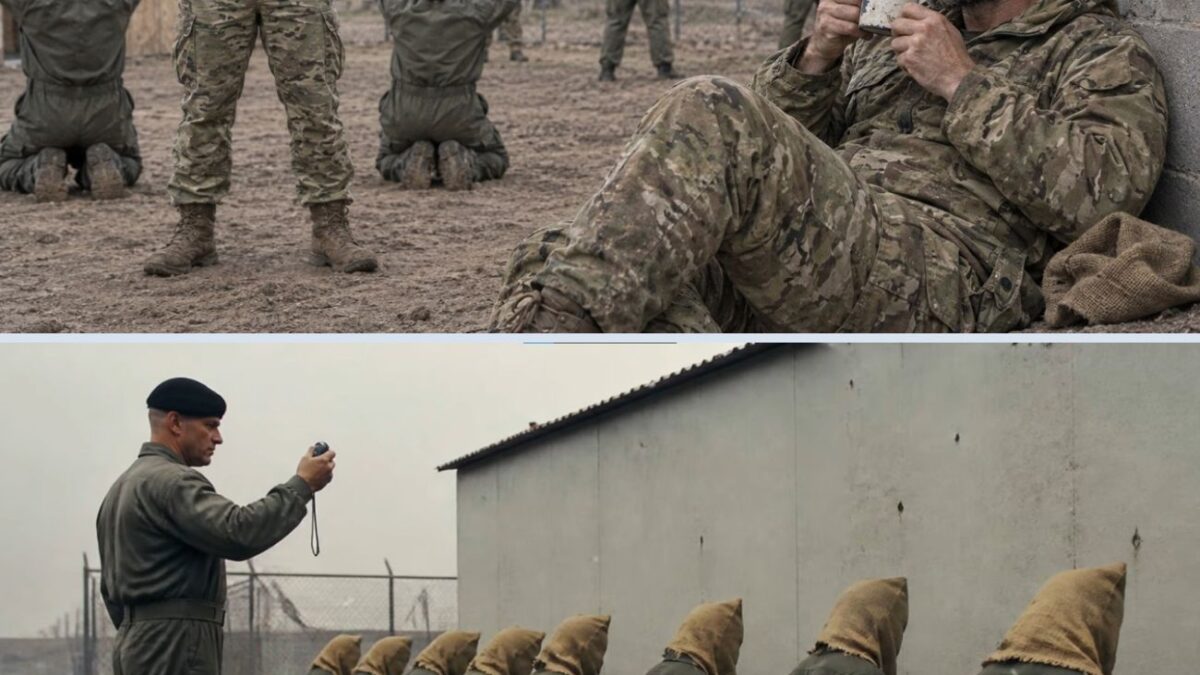
There is a stopwatch in this story, and it is going to turn on the man who wears it. He is wearing it now on a bootlace round his neck in a pinewood training compound in the Eastern United States under a sky the color of wet slate, and he is clicking it slowly between his thumb and forefinger because he is bored, and he wants the room to know he is bored.
The compound is the kind you can picture without ever having been near one, a gravel yard, a low concrete block shed with no windows, a chain-link outer with three strands of barbed wire tilted inward at the top, pine trees ranked behind the fence like a second wall. Four men in olive coveralls kneeling on the gravel with burlap sacks over their heads, and their hands laced on top of them, not his men, somebody else’s course left out there as scenery while the briefing goes on.
The man clicking the stopwatch is Master Sergeant Curtis Vanek, United States Army senior cadre on this interrogation serial, and the men sitting on the benches opposite him are a half troop from the British Special Air Service Mountain Troop D Squadron on loan from Hereford for a 2-week exchange. Badged men, plate carriers off, mugs of coffee in their hands because the coffee is the one thing on the compound they will admit is good.
Vanek leans back. He clicks the stopwatch once more. He looks at the Englishman nearest him, who is holding a plain white enamel mug of tea he brewed in his own billet and carried across the yard, and he says it: “You’ll crack in an hour, you tea-drinking Brits always do. We put you in the chair, we take the mug out of your hand, and you fold inside 60 minutes. I’ve seen it. I’ve timed it. 1 hour.”
He taps the stopwatch against his sternum when he says the word timed. He is not shouting. He is not angry. He is a man saying something he believes to be a weather report.
Four of his own cadre are in the room. One of them, a chief warrant officer named Ortiz, lifts his eyes from a green write-in-the-rain notebook, sets his mechanical pencil down, and does not say anything, which is itself a kind of saying. A female sergeant first class behind him, Kutu, keeps her face perfectly still. Captain Berner, the liaison, finds something interesting to look at on the far wall.
Vanek does not notice any of it because he is watching the Englishman for the small flinch he has watched for 320 times before. The flinch does not come. The Englishman with the mug of tea takes a long, slow swallow, sets the mug on the bench beside his thigh, and says mildly: “An hour, you reckon?”
Vanek grins. He clicks the stopwatch. He will remember clicking it. He will be made to. He has just said the sentence that is going to be read back to him in his own compound, in his own voice, in front of the men he said it about, and he does not know it yet. The clock he is so proud of is already running, and the only person on the gravel who does not understand what time it is is him.
What follows is a fictional account built on the real texture of how British and American special operations communities actually run joint survival and resistance training. The ranks, the kit, the geography, the doctrine. The men you are about to meet are invented. The world they move through is not.
To make this story work, you have to understand that Curtis Vanek is not a fool, and that is the hardest and most important thing about him. He is 46 years old. He has been on the SERE cadre at this facility for 14 years, and before that, he did 6 years as a long-range reconnaissance NCO with a line infantry regiment. And before that, he did 4 years as a parachute rigger, which is how he got onto an airborne roster in the first place.
He has a Bronze Star with a V device for a night in a wadi outside a town the public does not know the name of, and he does not talk about that night, which is one of the few things he does not talk about. He has instructed, by his own count, that nobody in the cadre disputes 320 full-level C serials.
He has sat on the hard side of the table opposite aircrew, Rangers, Marines, agency staff, foreign liaison officers, and the softer half of two allied special mission units, and he has, by his own careful record, taken something out of every single one of them inside the first 90 minutes of pressure phase. The number inside the first 60 is not every single one, but it is most of them, and the ones who held out longer did so by minutes, not hours.
That is the ground he stands on. It is real ground. He has earned the right to be certain about the mechanics of a chair, a hood, a cold floor, a repeated question, a withheld meal. He knows how a human face goes when it is about to give something up. He has seen it so many times he thinks he can read it through canvas.
What he has not seen is what is sitting beside him on the bench in enamel mugs, drinking the tea he thinks is a weakness.
The briefing room is a prefab with strip lights and a whiteboard. On the whiteboard, somebody has written the course serial number and the dates and a line that says day zero orientation in squeaky marker. The British are sitting on one side, the Americans on the other, which is nothing to do with hostility and everything to do with where the coffee urn is.
Vanek has run the orientation brief for 20 minutes. He has shown the layout of the compound. He has walked them through the medical triggers, the safe words, the hard limits. He has done it well because he always does it well. And then at the end, when he should have put the cap back on the marker and sent everyone to the billets, he did the other thing he always does, which is tell them in advance how it was going to go.
He said the sentence from the cold open. He said it with the stopwatch clicking. Three of the US cadre around him laughed. Two of them laughed because Vanek is senior and the room will laugh at the senior man’s line. One laughed because he genuinely thought it was funny. The others did not.
Ortiz, who is senior to Vanek in grade if not in reputation, closed his notebook in a small deliberate way that only Ortiz’s notebook knows about. Kutu, who ran interrogator role play for 11 years before this posting, and speaks English more cleanly than anyone else on the compound because she learned it on purpose, did not change her expression at all, which is her version of a wince. Berner, the liaison officer who had flown in from the embassy in London, and who had in the car on the way up told Vanek twice that these particular Brits were worth looking at, found the far wall very interesting.
On the British side, the reactions were quieter and worse for him, had he known how to read them. Captain Hugo Lennox-Fraser, the OC of Mountain Troop, a lean soft-spoken Rupert with the sort of face that looks 10 years younger than it is, lifted one eyebrow about 3 mm and lowered it again. Staff Sergeant Owain Pridduck, the troop staff, Welsh, broad-shouldered, took one slow breath through his nose. Sergeant Edwin Haymore, who everyone in the troop and most of the regiment called Teddy, kept humming a hymn so quietly only Allenby next to him could hear it. Four bars, the same four bars, a thing he does when he is thinking. Corporal Reece Allenby, missing two front teeth from a rifle stock in Oman in 2004, smiled with his mouth closed. Trooper Niall Bessant, the youngest newest badged man on the exchange, who takes four sugars in his tea and has learned to be quiet about it, looked at his captain and found that his captain was looking at the floor.
None of them said a word about the hour, not then, not later that evening in the billet. They did not need to. The man with 300 courses behind him had just handed them a stopwatch and told them which number on its face he was most proud of. They were going to hand it back.
Day one on the compound begins at a quarter to 6:00 in the morning in a mist thick enough that the pines at the back of the fence are a mere suggestion. The gravel is wet. The concrete shed is darker than the sky. Somewhere at the back of the main hut, a generator starts, coughs, and settles into a hum that will not stop until Friday evening.
The British half troop is already outside in a loose half circle by the fence in olive coveralls now because the orientation phase runs in course kit. Boots laced, belt kit on, no weapons, no watches, no personal effects beyond what the medical annex lists. Lennox-Fraser is at one end of the half circle with a paperback Marcus Aurelius that lives in the lid of his Bergen folded flat in his thigh pocket. Two pages a night, no more. Pridduck is at the other end with his hands behind his back. Haymore is in the middle. Allenby, Bessant, and the rest are strung between them.
They are not doing anything. They are just standing in the half circle in the wet mist, breathing, which is something men of the regiment do a great deal of on exchange serials, and which looks, to a man who has not been on one, like doing nothing.
Vanek comes out of the main hut with a stopwatch clicking and a clipboard under his arm. He has designed today’s practical, as he has designed every day one of every serial for 14 years. It is a mild thing on paper and a wicked thing in practice. He will put the trainees through a stress inoculation, short bursts of role-play capture, hoods on, hands laced on the back of the head, kneeling on the gravel, repeated harmless questions shouted at them from close range at random intervals for 90 minutes.
The point is not information. The point is to log a baseline, pulse, respiration, the first flinch, the first swallow, the first time a man moves his weight off the knee that hurts most. Vanek’s clipboard has a column for each trainee and a column for the time of their first observable tell. He has a column headed first speech for the moment the trainee first says anything at all beyond name, rank, service number, date of birth. He expects the British column to fill up fast. He has watched Allied trainees fill it up in 6 minutes before.
He walks the half-circle and he hoods them one by one. Burlap sacks, loose weave, no restriction on breathing. He makes them kneel in a line facing the concrete wall of the shed, hands laced, back straight. He steps back three paces. He clicks the stopwatch to start.
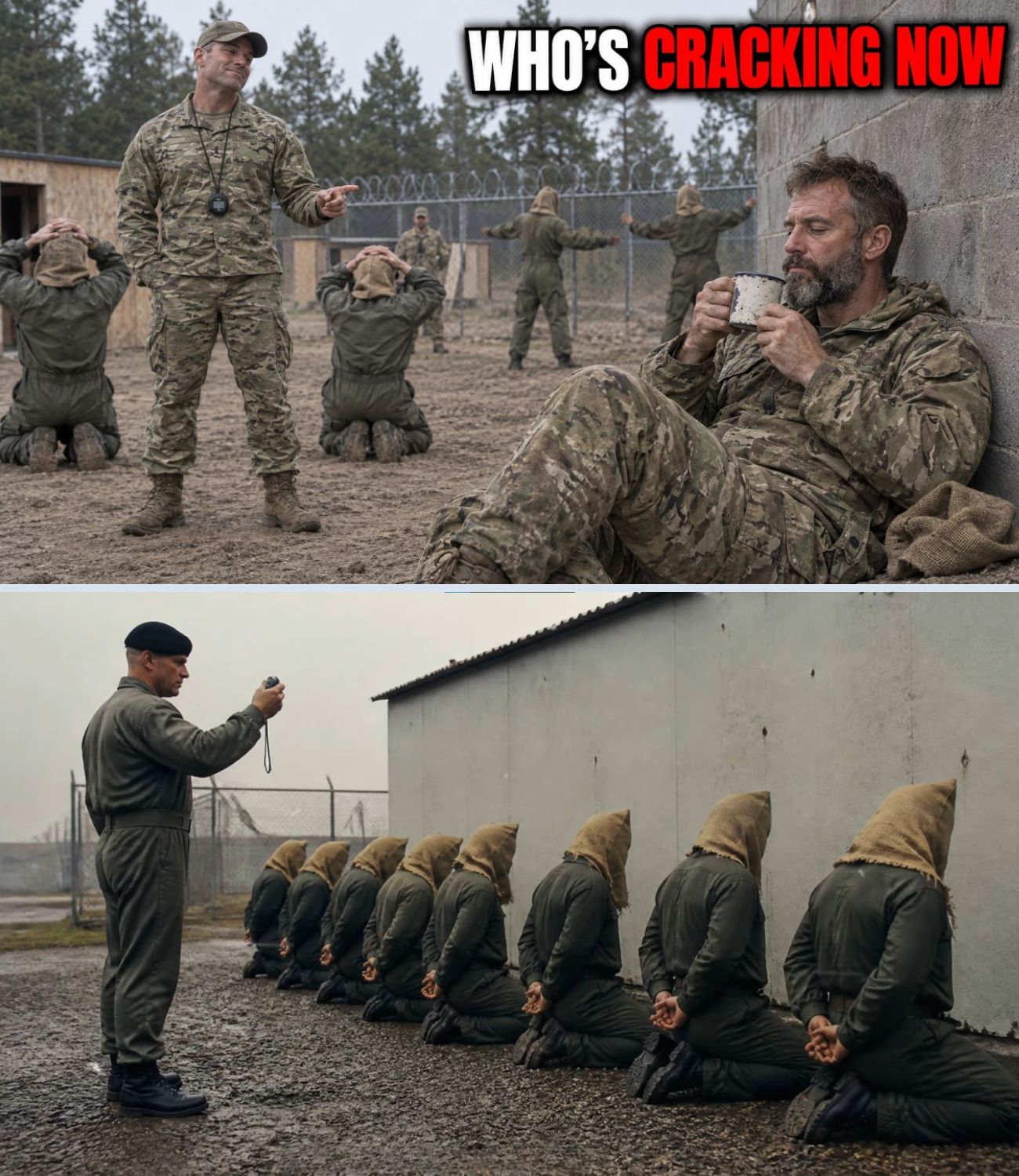
Kutu starts the questioning. In her clean, flat English, she asks each man his unit, his unit’s base, his unit’s commanding officer. She asks about girlfriends. She asks about mothers. She asks what town they grew up in. She asks the questions she is supposed to ask in the tone she is supposed to use because this is a baseline, not an interrogation. She is good at it. Vanek is behind her with the clipboard.
Here is what he sees. He sees Lennox-Fraser’s shoulders drop a quarter of an inch and settle. He does not know that is a thing a man does when he is deliberately slowing his heart rate because he has not been taught to look for it in a man who is doing it on purpose because the people he usually watches do not know how to do it on purpose.
He sees Pridduck take one long slow breath in through the nose and let it out through the mouth without ever moving his chest. He writes it down as slow respiration, likely sedated med check. He is wrong. Pridduck is not sedated. Pridduck is doing a 4-7-8 breathing cycle he has done every day of his adult life since he picked it up on a tri-service resistance course in 1999.
He sees Haymore’s shoulders moving almost imperceptibly up and down and he hears through the burlap a very faint tuneless sound, humming. He thinks the trainee is cracking in the first minute and he nearly puts a tick in the first speech column. Then he realizes there are no words. It is four bars of a hymn he does not know. Haymore has hummed those four bars at the start of every stress phase of his career. It is not a crack. It is the thing he does to tell himself the phase has started so that nothing else inside the phase can feel like a beginning.
By the time anyone shouts at him, his nervous system has already decided this is the middle of something, not the start of something, and the middle of things is where he lives. He sees Allenby smile with his mouth closed under the burlap because the burlap is loose and the smile moves the weave. He writes, “Subject appears relaxed. Note for stress phase prioritization.” He is correct that the subject appears relaxed. He is incorrect about what to do with that information.
He does not see Lennox-Fraser’s lips moving two words at a time through two pages of meditations he has memorized and recites to himself in sequence under pressure. He does not see Bessant, the youngest, counting backwards from 1,000 in sevens, which is a technique Pridduck taught him in the Credenhill mess over a cup of tea with four sugars in it 3 months ago.
What he does not see, in short, is the slow pulse, the deliberate, pre-rehearsed, patient pacing that extends the resistance phase by hours instead of minutes. Each of these men has his own version of it. Each of them has used it before in places with no safe word. They are not holding on. They are not even working. Yet, they are settling in.
Vanek finishes his walk of the half circle, taps the clipboard against his thigh, and says over his shoulder to Ortiz: “Give me 90 minutes and I’ll have half of them talking.”
Ortiz opens the green notebook and writes down the time. He writes down what Vanek said, too.
The baseline is supposed to last 90 minutes. By minute 12, Vanek has three ticks in his first speech column. They are all his own men, trainees from a marine reconnaissance company who were already on the compound from a previous serial and were folded in as the comparison group. All three have given up their mother’s maiden name under Kutu’s gentle, patient prompting, which is normal, which is the baseline doing exactly what it is supposed to do, which is why those three ticks mean nothing to the day.
What Vanek wants is a tick in a British column. By minute 20, there is none. By minute 30, there is none. By minute 45, Kutu looks over her shoulder at Vanek, and he gives her the small, flat, palm-down gesture that means push harder. She pushes harder. She stops asking about mothers and starts asking about the troop’s last operational deployment, which she has been briefed on because the exchange serial requires it. She asks Pridduck by name through the burlap whether it is true that the troop lost a man in a crevasse on a glacier training phase two winters ago.
It is a question that would, in a normal baseline, break any trainee who had not been trained for it because it violates the baseline rules and arrives from nowhere. Pridduck does not move. Pridduck does not even change his breathing cycle. 4 seconds in, 7 seconds hold, 8 seconds out. He has been doing it for the whole 45 minutes. He is going to do it for 90.
By minute 60, Vanek has written and crossed out three things on his clipboard. The gravel under his boots makes a small, irritated noise every time he shifts his weight. He walks behind the kneeling line slowly, boots crunching, which is a technique he teaches other instructors. The audible pacing that tells the hooded trainee a predator is somewhere he cannot see, and he does it to each man in turn. And none of the five British coveralls so much as twitches a shoulder. Haymore is still humming the same four bars for an hour.
By minute 75, Kutu has run out of baseline questions and has started repeating them, which is the thing that is not supposed to happen in a baseline because repetition is a pressure phase tool. Vanek has not told her to stop. He is watching the Englishman at the far right of the line, Lennox-Fraser, the captain, the Rupert, the one with the book in the thigh pocket, and he is watching him because the captain is the youngest-looking face in the line, and in his experience, the youngest-looking face is the first face that goes.
Lennox-Fraser’s shoulders are still exactly where they were at minute one. His hands laced on his head are not white at the knuckles. His breathing is slow. Through the burlap, if Vanek could see it, his lips are moving in silent sequence, two words at a time, through the second paragraph of the fourth book of the Meditations, which he started at minute one and will finish, if the phase runs its full length, with 11 minutes to spare, at minute 84.
Ortiz speaks. Ortiz is the chief warrant officer, the senior cadre, the man with the green notebook, and Ortiz is not a man who says anything unnecessary. He has been standing against the wall of the main hut with his pencil for the entire 90 minutes. He has written things in his notebook that only he will ever read. He says: “Curtis.”
Vanek turns. Ortiz says, in a voice flatter than the sky: “You’ve got nothing on the Brits. Not a tick. You want to call it?”
Vanek looks at the clipboard as if the clipboard might have changed its mind in the last 6 seconds. The British column has five names in it and no ticks against any of them. 5 minutes of baseline left. In every serial he has ever run, the trainees who have not ticked by minute 85 do not tick before minute 90. He knows this because he designed the curve. He says: “Run it to the horn.”
Kutu runs it to the horn. She asks the last of the baseline questions. She asks them twice. She asks Bessant, the youngest, who takes four sugars in his tea, whether he is warm enough, whether he needs water, whether his knees hurt. A sideways human question that in a baseline frequently gets a trainee’s first sentence out of him because it feels like kindness.
Bessant does not answer. Bessant is on 763 counting backwards in sevens and he is not going to stop for a question about his knees. The horn goes at 90 minutes exactly. Kutu steps back. The five British coveralls remain kneeling, hands laced, shoulders square until Pridduck, who has an internal clock that is apparently calibrated to the second, says one quiet word through his hood: “Up.”
And the five of them stand up together as if the hooding had been a stretching exercise. Vanek looks at his clipboard. There is nothing in the British column but five clean names. Ortiz closes the green notebook. He says: “That’s the baseline.”
He does not say anything else, which is the thing that bites because the baseline is the thing Vanek said half of them would be talking in. The baseline is the thing he put a number on in front of a senior warrant officer who writes everything down. And that was only the first time that day he would be wrong.
The afternoon practical is evasion. Vanek briefs it himself in the prefab with a drawn map on the whiteboard and a laser pointer that keeps slipping its focus. The task is simple on paper. The trainees will be released at a start line on the north edge of the compound into a 6-mile corridor of pinewood with a stream running down the eastern boundary and a dirt service road running down the western. They will be hunted by a team of eight, four marines, two cadre staff, and two scout-trained reservists from a local sheriff’s office who come out for the exercise because they enjoy it.
The trainees will carry nothing but what they have on them. The hunters will have radios, handheld thermal, and the daylight. The task runs until dusk. The scoring is pass/fail per trainee. A trainee is counted as evaded if he reaches an extraction point on the southeast corner of the corridor without being hands-on. Vanek has designed this task. He has run it 90 times. The pass rate across those 90 serials is 31%. He tells the British, with the stopwatch clicking, that to make it interesting, he is going to give the hunters an extra pair, and he is going to shorten the window by an hour. 31% on a normal day. He would like, he says with a flat smile, to see what the number looks like with a thumb on the scale.
Lennox-Fraser nods once. He says: “That’s fair.”
They go to the start line. They are hooded for the move, so they do not preview the ground. The hoods come off at the start line. The pinewood opens in front of them. Ranked trunks, soft needle floor, a wet gray light coming down between the branches. The kind of ground a troop from the mountain troop has been bred on in a hundred compressed little variants from Brecon to Norway to the Cairngorms. The hunters are released 5 minutes behind.
The British do not run. This is the thing that Vanek, watching from a pickup on the service road with the two reservists and a radio, does not understand for the first 35 minutes. He has watched evasion starts for 14 years. The first thing a trainee does is run. The second thing a trainee does is get picked up 90 minutes later within half a mile of a track he should not have been on. The British do not run. The British walk. Not slow, not fast, in pairs at 110 paces to the minute, which is a troop walking pace, and which does not raise a thermal signature a sensor can pick cleanly out of the pines’ own ground cooling.
Pridduck and Haymore split west after the first 400 m and do not come east again. Lennox-Fraser and Allenby take the stream in boots full of water they do not complain about. Bessant goes alone straight down the central spine of the corridor which is the one direction no evader in 90 serials has ever taken because it is the direction the hunters hunt hardest.
At 40 minutes the hunters have no contacts. At 55 minutes one of the sheriff’s reservists on the eastern flank radios in with a sighting of a figure moving through the stream bed. The team converges. They find a boot print in the gravel at the stream’s edge and another at the next bend and another at the bend after that and the boot prints keep going for a quarter of a mile and then stop in the middle of a pebble bar with no exit point visible.
Lennox-Fraser has left the boot prints. Lennox-Fraser has at that pebble bar turned around in his own tracks and walked backwards 50 m into a side gully where he and Allenby are sitting against a log perfectly still waiting out the inevitable sweep. At 80 minutes the hunters sweep the side gully. They sweep it twice. They do not find them.
At 110 minutes Pridduck and Haymore cross the service road 300 m behind Vanek’s own pickup which Vanek does not see because Vanek is looking the other way through the thermal at a hot deer. At 140 minutes Bessant, the trooper who takes four sugars in his tea, walks straight past a hunter sitting on a stump eating a protein bar because Bessant has been moving tree to tree in a careful shifted rhythm that puts a trunk between him and any single sightline every 11 paces and the man on the stump is a reservist who has only ever hunted trainees who ran.
At dusk, Vanek is standing on the dirt road with the radio in his hand, and he is counting trainees he has brought in, and he has brought in two, both Marines from the comparison group. Not a single Englishman. The pickup comes down to the extraction point at the southeast corner of the corridor, just as the sky loses its last light, and five figures in olive coveralls are already there, sitting on the hood of the extraction vehicle, drinking from a canteen the US driver has given them, because when you have been that quiet for that long, someone will give you water. The schoolboys, he had called them by implication with that word.
Vanek does not say anything on the drive back. The stopwatch does not click. Kutu, when she sees him come in, writes two words in her own notebook that she does not show him. In her clean English, they are: “He’s rattled.”
The night serial is Vanek’s showpiece. He runs it himself. The concrete block shed is as cold inside as it is outside, because he has had the door propped open all afternoon on purpose. A single wire-caged bulb hangs from the ceiling. There is a steel chair bolted to the floor and a plastic bucket with a lid in the corner, and nothing else, because that is the whole of the kit a man needs to make another man give up a sentence he did not mean to give up. He has decorated worse rooms than this in his career, and he has broken men in all of them.
He has chosen Haymore. He has chosen Haymore because Haymore is a sergeant, which is the rank he has had the most success with across his career. Not officers, who often collapse at the officer identity question, and not very young troopers, who collapse at the mother question, but sergeants, who sit in the middle and tend to have the most to protect. He has chosen Haymore also because Haymore is the one who has been humming and the hum has been annoying him for 12 hours and he wants to stop the hum.
Haymore is hooded, cuffed to the chair at the wrists, boots off, feet on the cold concrete. He has been in the chair since 9:00 in the evening. It is now coming up on 1:00 in the morning. Vanek has in the four hours used 11 techniques. He has used what he calls the shuttle, a repeated question delivered from three different corners of the room so the trainee cannot locate the interrogator and cannot develop a conversational rhythm.
He has used the kindness, Kutu, in her clean English coming in with a canteen cup of warm tea placing it on the concrete at Haymore’s bare feet close enough to smell. He has used the betrayal, a staged argument in the corridor outside, two cadre voices, one of them Vanek’s, saying very loudly that the English captain has already told them everything about the sergeant in the chair.
He has used the clock telling Haymore, correctly, the exact time to the minute every 17 minutes so that Haymore can measure his own suffering. He has used the long silence. He has used the pattern break, leaving the shed for 38 minutes and coming back in with a different voice. He has used the specific detail, reciting the names of the two children Haymore does not have and asking Haymore to correct him.
Haymore has in the four hours given him three things: name, rank, service number. He has also, continuously without pause, through the hood hummed four bars of a hymn. Vanek is a professional. He does not lose his temper. He does not raise his voice. He does, at one point around half past 12:00, lean down to within 6 in of the burlap, and ask Haymore in a conversational tone whether he has ever considered that the man on the chair becomes, after a while, the sum of the questions put to him and nothing else. It is one of his best lines. He has broken a selection candidate with it in 2009. Haymore hums.
At 12:42, Vanek tries the thing he does not usually try on day one, because it is a day three move, and because it carries a cost. He steps behind the chair, puts both hands on Haymore’s shoulders, a legal contact under the serial’s medical annex, firm, not painful, meant to introduce the trainee’s body to the fact of a touch he cannot avoid, and he says, very quietly: “Teddy, I know they call you Teddy. Your captain told me.”
The humming does not stop. The shoulders under his hands do not move. Vanek steps back. He steps back further than he meant to. He steps back until his own shoulders touch the concrete block wall, and he stays there for a long moment, looking at the hooded man he has not moved by a single millimeter in 4 hours, and he does what good cadre do when a serial is not going the way they planned, which is call it in his head and move on. He unlocks the cuffs. He leaves the shed.
The corridor outside the shed is a concrete passageway with a strip light that flickers. Ortiz is at the far end of it, sitting on a plastic chair, green notebook open, mechanical pencil moving. Kutu is beside him drinking coffee from a paper cup. Berner is leaning against the wall. The night air coming in through the propped open door at the far end of the passage is colder than the shed. Vanek says: “He’s a tough one.”
Ortiz does not look up from the notebook. He writes, “One more thing.” Puts the pencil down and says: “Curtis, he’s not a tough one. He’s a trained one. There is a difference, and you taught the difference on this course for 2 years before I got here, and you taught it well.”
He closes the notebook. He says: “I’d like you to think about tomorrow.”
Vanek does not sleep. The final day of a level C serial on this compound and on others closes with what the syllabus calls the cadre demonstration. It is a long-standing part of the course. One member of the cadre takes the chair, and the senior interrogator on the staff runs a shortened protocol-correct serial on him in front of the trainees, so that the trainees see in person what trained resistance looks like from the inside. It is normally a dignified thing. It is normally volunteered for weeks in advance. It is normally Vanek, because Vanek is the senior cadre, and because Vanek has, for 14 years, made the demonstration the loudest thing on the course.
The morning of the final day, Ortiz walks into the prefab with his notebook and sits down at the whiteboard end of the table. The British half troop is on one side, in olive coveralls still, mugs of coffee again. Vanek is on the other. Kutu is beside Ortiz. Berner is at the back. Ortiz says: “We’ll run the cadre demonstration at 1300. Master Sergeant Vanek has volunteered, as he does every serial.”
Vanek looks at Ortiz. Ortiz looks back at him with a face that is not unkind and not negotiable, and says: “Haven’t you, Curtis?”
Vanek says: “Yes, Chief.”
He says it in front of Lennox-Fraser, Pridduck, Haymore, Allenby, and Bessant. And he says it in front of Kutu, who will run the chair, and he says it in front of Ortiz, who has already written down the time he said it.
At 1300, the concrete block shed is as cold as it was at 1:00 in the morning, and the single bulb is on, and the steel chair is in the middle of the room. There is one new thing on the floor, a plain white enamel mug of tea brewed by Bessant in the British billet an hour earlier, with four sugars in it because Bessant brewed it, and Bessant has not asked permission to be himself about tea on an American compound, and nobody is going to ask him. The mug sits 6 in to the right of the chair’s front left leg. Vanek is hooded. He is cuffed. His boots are off. The British half troop is standing along the back wall of the shed, hands behind backs, silent. Ortiz is at the door with the green notebook. Berner is beside him.
Kutu starts. She asks his name. He gives his name. She asks his rank. He gives his rank. She asks his service number. He gives his service number. She asks his unit. He gives his unit. These answers are correct and expected. The baseline is the baseline. Then she begins.
She uses the shuttle because he wrote the shuttle. She moves to three corners of the shed and asks the same question. “What was the Bronze Star for?” in three different voices, pitched the way he pitches them for his trainees. He does not answer the first time. He does not answer the second time. On the third, through the hood, he says: “I’m not going to answer that question.”
That is one sentence more than any of the Englishmen gave her in 90 minutes of baseline on day one. The stopwatch on Ortiz’s palm now reads 6 minutes, 40 seconds.
She uses the kindness. She crouches by the chair close to the mug on the floor and she says in her clean flat English: “Curtis, the tea is still hot. I made Niall bring it. Would you like it?”
He says: “No.”
He says it quickly, which is the small mistake because speed is the body being asked the question the mind has not finished answering. 9 minutes, 12 seconds.
She uses the clock. She tells him the time correctly and tells him she will tell it to him again in 17 minutes. She uses the long silence. She leaves him in it for 11 minutes without speaking. He breathes. His breathing through the hood is not Pridduck’s 4-7-8. It is a man’s ordinary breathing. He is a professional. He is not frightened. He is embarrassed, which is a different and faster moving thing.
At 23 minutes, she uses the pattern break. She sheds her role. She leaves the shed. She comes back as a different voice. A technique Vanek put in the syllabus himself and in that different voice she says conversationally: “The British troop are standing against the back wall watching this, Curtis. They have been standing there for 23 minutes. They are not saying anything. The sergeant you had in the chair at midnight is 3 ft behind your left shoulder.”
Haymore, 3 ft behind Vanek’s left shoulder, hums four bars. Vanek’s breathing changes.
At 29 minutes she uses the specific detail. She says in that same conversational voice: “Your stopwatch is on the chief’s palm. It is still running. Would you like to know what it says?”
He says: “No.”
29 minutes, 51 seconds. At 34 minutes, she asks the question that the whole 14-year career has been designed to prevent her from being asked back. She says: “Curtis, how long did you tell the British sergeants on day zero they would last in this chair?”
The hood is still. The hands on the arms of the chair are not still. He says nothing for 2 minutes and 11 seconds. Then, through the hood, in a voice none of the men along the back wall have heard before, he says: “1 hour.”
Kutu does not say anything for a long moment. She lets the sentence sit in the cold concrete room with him. She lets the four bars of the hymn, which Haymore is still humming behind his left shoulder, sit with it. Then she says: “Thank you, Master Sergeant. We’re going to stop there.”
Ortiz lifts the stopwatch off his palm. He reads the face of it in the yellow light of the single bulb. He does not raise his voice. He reads it the way he writes in his notebook, which is to say the way a man reads a weather report: “38 minutes, 4 seconds.”
He clicks the stopwatch. The sound of the click is louder in that concrete shed than any of the 11 techniques Vanek used on Haymore at midnight.
The hood comes off. Vanek blinks into the single bulb. The shed is as cold as it was. The chair is bolted to the floor the way it has always been. The British half-troop is along the back wall where they have been for 38 minutes and 4 seconds. Hands behind backs, silent, in olive coveralls, looking at him the way men look at a thing that was explained to them in advance and has now, on time, happened.
Ortiz opens the green notebook. He turns to the first page. He reads from it in his flat weather report voice. He reads what Vanek said at the end of the orientation brief on day zero. He reads it in full: “You’ll crack in an hour. You tea-drinking Brits always do. We put you in the chair, we take the mug out of your hand, and you fold inside 60 minutes. I’ve seen it. I’ve timed it. 1 hour.”
He closes the notebook. He does not add anything. Vanek does not say anything. There is a thing he could say in theory. He could say it was a demonstration, that demonstrations are not fair, that he was not prepared, that Kutu used his own syllabus against him. He could say the Englishman had been training for this for 20 years, and he had been administering it for 14. He could, if he wanted to, say any of those things, and some of them would be true. He does not say any of them, because the thing that is sitting in the shed with him is not those arguments.
The thing in the shed is a number, read out in front of five men of the regiment, and three members of his own cadre, by a chief warrant officer who writes everything down. The number is 22 minutes shorter than the number he put on the Englishman on day zero. He put the number on them. The compound put a different one on him. Both are now written down in the same book, in the same mechanical pencil, in the same hand.
Bessant, the youngest, the four sugars man, steps away from the back wall. He walks across the concrete floor. He picks up the enamel mug of tea, which is still warm because the shed is cold and the mug is heavy, and he puts it carefully into Vanek’s hand. He does not say anything. He steps back to the wall.
The mug is in Vanek’s hand. He is sitting in the chair. His other hand is on the arm of the chair. The stopwatch, which Ortiz has returned to its bootlace, is around Vanek’s neck again, and it is still, and silent, and heavier than it was.
Kutu, for the record, says the sentence a senior interrogator says at the end of a demonstration. She says it in her clean, flat English, and she says it the way she would say it about anybody: “For the course log, the demonstration subject reached first observable speech at 6 minutes 40 seconds. The demonstration serial was terminated at 38 minutes 4 seconds per protocol on the subject’s statement of his own prior assertion. The British trainees on this serial have not reached first observable speech at any point in the course, baseline, afternoon practical, or night serial. End log.”
She closes her own notebook. Haymore, behind Vanek’s left shoulder, stops humming. It is the first time in 3 days he has stopped. The absence of the four bars is louder than the four bars were.
Pridduck, from the back wall, says one quiet thing. He says it in Welsh. He says it the way he would say it on the camp payphone to his dog. The Americans in the shed do not understand it. Lennox-Fraser, who learned enough Welsh in 10 years of standing next to Pridduck to understand this one, does not translate. The sentence is: “There you go, boy. There you go.”
It is not a victory. It is a thing a man says to something small that has done a hard thing. The man he says it to, in the chair with the mug of tea in his hand, is the man who said the Englishman would crack in an hour.
Lennox-Fraser steps away from the wall. He does not hold out his hand. He does not say, “Well done,” or “Hard luck,” or any of the small kindnesses one professional might in theory offer another. He stops two paces short of the chair. He looks at Vanek for about 3 seconds, which is longer than it sounds. Then he nods, once, the quarter of an inch nod he gave in the prefab on day zero, when he lifted the eyebrow and lowered it again, and he turns, and he walks out of the shed into the gray afternoon.
The rest of the troop follows him. Vanek is left with the mug, the chair, the bulb, and his own cadre. Ortiz, as he closes the door, says one sentence over his shoulder: “You were a good instructor on this course for 12 of the 14 years, Curtis. Two of them were the loud years. We’ll talk about it on Monday.”
The door shuts. The shed is very quiet. Last light on the compound is the color of a wet stone.
The British half troop is at the gate. Bergens packed, coveralls folded and returned. In their own kit again, the Diemaco slings empty because the weapons are already back in the US armory where they came from, waiting to be released on the exchange paperwork in the morning. A minibus is coming up the service road.
Lennox-Fraser is at the front of the line with the paperback in his thigh pocket. Pridduck is at the back counting heads, which is a thing a troop staff does without noticing he is doing it. Haymore is standing beside Bessant, who is drinking the last of a mug of tea with four sugars in it before he has to give the mug back. Allenby, who lost two front teeth in Oman, is smiling with his mouth closed.
Nobody has said the number out loud since the shed. They do not need to. The number is in the green notebook, which is in the chief warrant officer’s locked drawer, and it is in Kutu’s course log, which goes up the chain on Monday. It is also in Vanek, who is somewhere in the main hut, not visible from the gate, not likely to be visible from the gate for a while.
The man with the stopwatch had been right about the tea. The British do drink it. They drink a great deal of it. One of them takes four sugars. He was wrong about the men who drank it. He was wrong about them in a way he could not walk back, and the thing he was wrong about was not their toughness, because toughness was never the question.
It was that resistance, the real kind, the kind that holds a chair for a night and a wood for an afternoon, and a baseline for 90 minutes without so much as a tick in a column, does not look the way loud men think it looks. It looks like a slow breath. It looks like four bars of a hymn. It looks like a captain reciting two pages of Marcus Aurelius to himself under a burlap sack. It looks like a Welshman counting other men’s heads without being asked.
The men who shout about breaking other men tend to be the men with the shortest clock. The minibus pulls up to the gate. The half troop climb aboard. The gate closes behind them. The pines take the last of the gray light out of the sky.
If stories told the right way, clinical, counted, witnessed, are the kind of stories you want more of, there is a good deal more of this where it came from. The compound stays. The stopwatch stays. The men who think they know how long an hour is keep coming through, and now and again one of them finds out.
You Might Also Enjoy

“We Thought They Would Negotiate”—What Argentine Soldiers Said When The British Attacked Goose Green

“You’ll Never Finish My Ruck March, Limey” — US Sergeant Who Challenged the SAS, Then Fell Out First






