“You’ll Salute My Flag” — The US Command Sergeant Major Who Tried to Drill the SAS in Basra
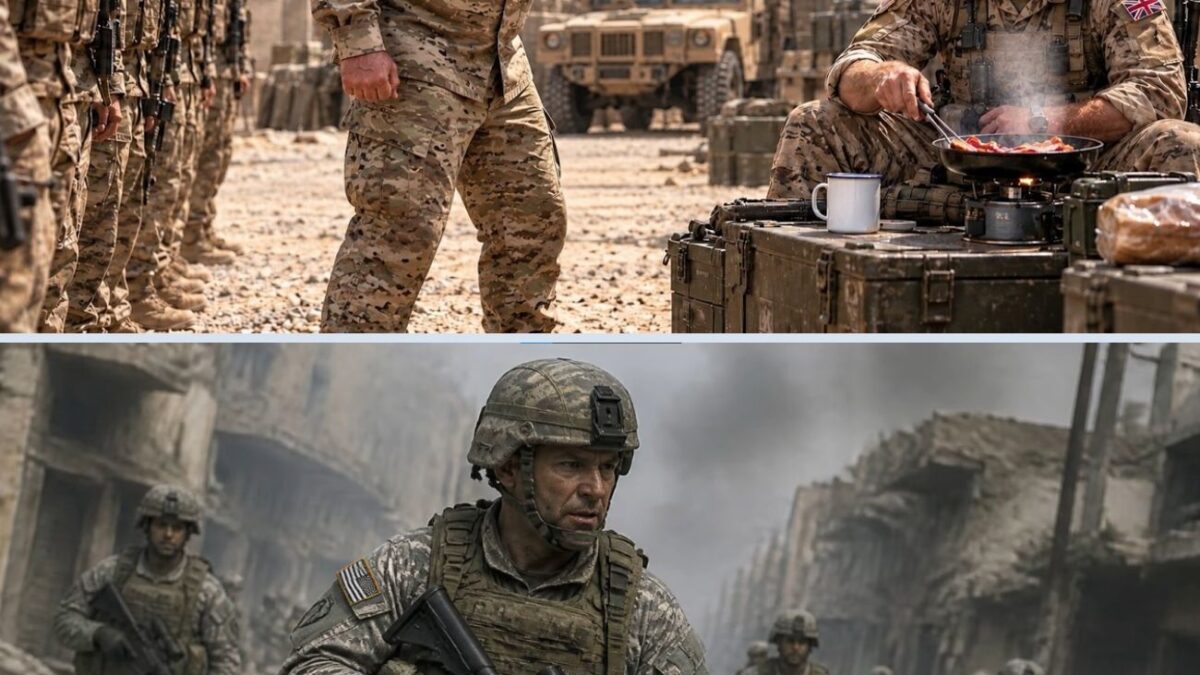
Nobody moved. The command sergeant major was standing in direct Iraqi sunlight at 10:09 in the morning on the shared pad at contingency operating base Basra, pointing one blunt finger at a bearded man sitting cross-legged behind a stack of sandbags, and he was shouting loud enough to be heard across the Hesco wall. The bearded man was cooking bacon. He had a steel frying pan balanced on a blue hexi stove, a white enamel mug of tea at his knee, a loaf of white bread in a plastic bag at his hip, and a small Union Jack sewn to the shoulder of his desert smock. He was smiling, not meanly, the way a man smiles when a dog he does not own is barking at him from the other side of a fence. In a line to the command sergeant major’s left, eight United States soldiers in helmets and dark glasses stood at the position of attention and tried to look at nothing. In a line to his right, nothing stood at all. The British pad was 20 m away across a strip of gravel, and the four other men on it were doing precisely what the man with the frying pan was doing, which was to say they were doing nothing. One was cleaning a Diamaco upper on a towel. One was lying on a cot with his cap over his eyes. One was writing in a notebook. One was watching the command sergeant major. The way you watch weather you have already decided you can walk through.
“You’ll salute my flag, Sergeant,” the command sergeant major shouted, and he jabbed his finger up at the stars and stripes, snapping on the pole above his own pad. “Or you’ll stand in front of it until you do. You are not elite. You are a tea drinking circus in beards and I am going to drill you until you look like soldiers.”
His name was Dale W. Brantley. He was a command sergeant major in the United States Army. He had been in uniform for 28 years and he had earned every inch of the chest he was wearing. He had come to Basra 3 days earlier with a plan to tidy up what he had been told was a slack coalition footprint. And this morning, in his first full working day on the ground, he had decided to begin with the long-haired men on the far pad, who had not stood up when he walked past them. He would remember saying it. He would be made to. By last light, on a day neither pad would forget, the command sergeant major would be standing at the edge of a helicopter landing site with a stopwatch in his hand, reading one number off its face, and he would not be able to make his mouth form the shape of it. The bearded man would walk past him off the ramp of a Royal Air Force Puma, and he would not look across. That is where this ends. This is how it got there.
A note before we go on. The incident, the men and the dialogue in what follows are invented. The ranks, the kit, the ground, and the way each force actually works are not. This is a fictional story built on real texture. To understand why a man like Brantley said what he said, you have to understand what a man like Brantley actually was. Because the easy version of this story, the one where he is simply a loud fool, is both wrong and boring, and the slow version is the one worth watching.
Dale W. Brantley was 51 years old. He had enlisted into the United States Army as an infantryman at 19 and had not been out of uniform since. He had done his first combat tour in the second battle of Fallujah as a first sergeant with a line infantry battalion and had come out of it with a Silver Star citation for leading a dismounted platoon through two city blocks after his lieutenant was shot through the plate carrier and could not continue. He had done a second Iraq tour as a sergeant major in a mechanized brigade. He had done Afghanistan as a command sergeant major in the mountains and at some point during that tour he had been photographed without smiling standing beside a general who was smiling and the photograph had gone into a frame on the wall of a Fort Benning corridor. Before any of that he had been named drill sergeant of the year as a staff sergeant and the men he had trained in that period were by 2006 running their own companies. He was by every measurable standard that mattered inside the United States Army exactly what the United States Army wanted him to be.
He was also, and this is the part the easy version leaves out, correct about a great many things. He was correct that discipline wins fights. He was correct that saluting is a form of discipline. He was correct that a shared compound in a hostile city with four separate uniformed cultures walking across the same gravel every day is a compound that needs rules. He was correct that there were elsewhere in theater coalition footprints that had become sloppy and he had been sent down to tighten one of them. He kept a laminated photograph of his first platoon sergeant inside the cover of his notebook, and before any dressing down, he tapped it twice. Because the man in the photograph had taught him that discipline is a kindness administered in advance.
What he was wrong about was a very specific group of men on a very specific pad. He had been briefed on arrival that there was a British special forces annex inside the United States perimeter at the contingency operating base. He had been briefed that they operated on a separate chain of command, that they wore beards and civilian trousers under their smocks, that they did not stand to when officers passed, and that they were not his to administer. He had listened to the briefing. He had thanked the lieutenant colonel who gave it, and he had walked out of the briefing with a private certainty, which he did not say aloud, that if these men were any good, they would not need to look like that.
He raised a flag on the second morning. He had a pole put in beside his own command tent, and he had the Stars and Stripes run up it at 0600, and he passed the word through his senior non-commissioned officer, Milo Diva, that any uniformed man crossing the pad was to salute the colors. Diva, who had served under Brantley twice and trusted him, carried the order to the United States company. He did not carry it to the British annex because it was not his to carry.
On the third morning, Brantley walked the pad himself. Three men from the far side crossed the gravel in front of him. None of them turned their heads. One of them had a mug of tea in his hand. One of them was wearing flip-flops. One of them had on a bush hat with the brim turned up on one side and a Union Jack on his sleeve, and he did not even look at the flag, let alone acknowledge it. Brantley stopped. He tapped his notebook twice. He looked across to the British pad, saw the man with the frying pan, and walked.
The eight United States soldiers who formed up behind him did not form up because he asked. They formed up because when a command sergeant major moves with that face on, the men in his line of sight move with him. Specialist Ortega, who was 19 and from El Paso and polished his boots because his mother had asked him to, was third from the left. Captain Vance, Brantley’s aide, who wrote everything down in a green Rite in the Rain, was two paces behind his right shoulder. Diva was at his left. Diva did not want to be there.
The British major in the ops tent, Hugh Ashbrook, saw the formation cross the strip through the open flap. He put his paperback down face up on his cot so he would not lose the page. He did not stand up.
“Kez,” he said to the warrant officer at the map board, “he’s walked over.”
Warrant Officer Class 2 Daniel Kazayiah, who leaned a half inch to the right because he had lost most of the hearing in his left ear in Sierra Leone, looked up from the map, listened for about two seconds to the noise coming from the pad, and said, “Rows cooking. Let him finish his bacon.”
Then Brantley opened his mouth and said what the whole base would be quoting by lunchtime. Half the men around him nodded. The other half, the half who had been in Basra longer than three days, looked at their boots.
The contingency operating base at Basra in the spring of 2006 was a compound the size of a small town built in a loop of wire and bastion wall on the edge of the city, and it housed four armies that did not share a chain of command. The United States ran the perimeter. The British ran a brigade footprint of their own. The Danes and the Italians and the Australians had their own corners, and on an inner square of gravel the men called the strip, two pads sat 20 m apart. One of them was a United States infantry company’s forward element. The other was a half troop of the Special Air Service from a squadron with elements of Mobility Troop and Forward Air Troop on call and a lieutenant colonel somewhere up country who did not need to be told anything today.
You could tell the pads apart without reading a sign. The United States pad had the flag, the tent lines dressed, the vehicles parked at exactly the same angle, and a shaving mirror on a strand of wire with a razor hanging off it. The British pad had a frying pan.
The man with the frying pan was Staff Sergeant Roth, who everybody called Row, and who was the ground level second in command of the team on rotation. He cooked bacon on a hexi stove in the morning because the cookhouse eggs were gray, and he did not fancy them. He was 38. He had been in the regiment for 11 years. He had been a Royal Marine before that. He was built like a middleweight boxer in late training, which is to say he looked ordinary with his smock and dangerous when it came off, and the only thing that marked him out from a hundred other British soldiers on the base was the small Union Jack sewn to the right shoulder of his smock, which he had put there himself with a sailmaker’s needle.
Behind him, cleaning a Diamaco C8 on a folded towel on a camp table, was Corporal Jaime Lynwood. Lynwood was the breacher. He hummed one bar of the same hymn before every stack up, and had never explained to anyone which hymn it was, and the men around him had long since stopped asking. He was pulling the upper apart with his hands, and not looking at them, because he had done this often enough that his hands knew the way home.
Lying on the cot with his cap over his eyes was Sergeant Owen Trescott, the sniper pair lead. Trescott had a child’s drawing of a stick figure father folded into his range card wallet. His cap was over his eyes because the sun on the pad in April was already too bright for sleep, and he had been up on an observation shift the night before and was going up on another one that evening. He was awake. Men who have spent a career in a certain kind of job do not actually sleep on cots in the sun.
Writing in a notebook at the back of the pad was trooper Ben Hallam. Hallam was 26 years old. He had been a paratrooper before selection, had passed selection four months earlier, and was still, when he was alone, running his hand across the sand-colored beret in his Bergen, and not quite believing he was allowed to wear it. He was the newest blade on the team, and he was writing a letter to his mother that he would not send.
In the ops tent, Major Ashbrook was reading. Kazayiah was running his finger along a street map of a district in southern Basra called Al-Jubula and making a very small pencil mark at an intersection that was not yet a target but was becoming one.
This was what the pad looked like at 9 in the morning on the day Brantley walked across the strip. And this was what Brantley saw. And this was what Brantley did not understand that he was seeing. He saw men who did not stand up. He saw hair that was too long. He saw a frying pan where there should have been a weapon on a sling. He saw a major reading a paperback instead of standing to meet him. He saw a trooper writing a letter instead of cleaning a rifle. And he did not know that the trooper had cleaned the rifle at 4 in the morning on the pad in the dark by feel. He saw a staff sergeant frying bacon with a flag on his shoulder. And he decided that the flag on the shoulder meant the man was proud and that pride without discipline was not pride at all.
What he did not see was that the men on the pad had between them cleared 26 premises in Basra City in the previous three weeks. He did not see that Trescot had on the shift the night before called four separate movement patterns through a particular doorway and had been correct on all four. He did not see that Lynwood’s hands could do by feel in the dark something most line infantrymen could not reliably do in daylight on a bench. He did not see that Roth’s frying pan was 2 ft from his belt kit, that his belt kit held his pistol and four magazines and a field dressing, and that the smock laid across the sandbag behind him had the C8 inside it, loaded, safety on, and could be in his hands in under two seconds. He did not see any of that because the men on the pad had made it impossible to see.
The thing the regiment does that no training film captures is this. It presents to the outside eye a studied ordinariness. It does not advertise. It does not pose. It does not produce a photograph for a corridor. The men on the pad looked at 9 in the morning on that day like men who had drifted. They had not drifted. They were sitting on top of a readiness that a stranger could not read without being shown. And Brantley was a stranger.
He had been told by the lieutenant colonel who briefed him that the annex was not his to administer. He had heard the words. He had not accepted them. He had an idea of what a soldier was supposed to look like, and the men on the far pad did not match the idea, and the gap between the idea and what he was looking at was growing in him like a cold stone. And by the third morning the stone had become a decision.
He crossed the strip. He stopped three paces from the sandbag line. He pointed at the pole over his own tent. He said what he said. Roth turned a rasher. Lynwood did not look up from the bolt carrier. Trescot did not move his cap. Hallam, the new one, who did not yet know what the correct answer was, looked at Roth, saw Roth turn the rasher, understood, and went back to his letter. Not one blade stood up. Not one blade turned his head. The silence from the British pad went on for long enough that the United States soldiers in the line behind Brantley began one by one to look at the ground. In the ops tent, Major Ashbrook turned a page. That was the loaded gun. Everything that followed was Brantley pulling the trigger on himself.
Brantley did not back down from the pad that morning. He turned after 38 seconds of silence in which nobody on the British side acknowledged his existence, and he walked back across the strip at the same pace he had come. Because to walk faster would have been to concede, and he did not concede. He went into his own tent. He tapped the laminated photograph in the cover of his notebook twice. He sat down. He thought about it. And then he did what a man of 28 years in uniform does when he has been shown a problem. He scheduled a solution.
He scheduled it in writing. He had Captain Vance type up in the format of a brigade training note a one-page document headed Marksmanship Basics Refresher, All Dismounted Personnel, Contingency Operating Base Basra. It specified a range date, a range time, a weapons list, a zeroing drill, and a 100 m, 200 m, and 300 m shoot on standard infantry silhouettes. At the bottom, in a sentence Vance would later remember writing with a small cold feeling in his stomach, it said, “Attendance is mandatory for all uniformed personnel on this compound, including attached specialist elements.”
Vance walked the document across the strip himself. He gave it to the warrant officer at the map board. Kazayiah read it, folded it in half along the horizontal, folded it in half again along the vertical, and put it into his breast pocket.
“We’ll come,” he said.
Vance, who had been expecting an argument, said, “You will?”
“We’ll come,” Kazayiah said. “We won’t bring the kit the sergeant major is expecting.”
“Is that going to be a problem?”
Vance said it would not be a problem.
Kazayiah said, “Good, lad,” and went back to his map.
The range was on the east side of the compound, a cleared strip against the perimeter berm with butts dug in and lanes marked out in white paint on the sand. Brantley had arranged it himself. He had the United States range officer, a sergeant Hoyt, there with a megaphone and a shot timer. He had Diva on the firing point. He had 30 of his own soldiers from his own company stood off in two ranks behind the firing line in full plate helmets with weapons slung. He had Vance with the clipboard. He had brigade lieutenant colonel Marcus Reinhardt standing at the back of the line because Brantley had asked him to come and watch and Reinhardt had decided it would cost him more to refuse than to attend.
The men from the far pad arrived five minutes before start in three. Roth walked at the front with his C8 slung muzzle down across his chest and a soft cap on. Lynwood walked behind him with a notebook under his arm. Trescot walked behind that, carrying a long canvas slip over his shoulder that nobody could see into. Hallam came last with a C8 of his own and nothing to say. They did not form up on the firing line. They stood off to the right of it in a loose group of four. Roth put his cap down on a sandbag.
Brantley said, “Firing line, Sergeant.”
Roth said, “After yours, Sergeant Major, we’ll shoot last.”
Hoyt ran his own line first. The 30 soldiers put up decent groups at 100 and 200 m. Nothing to be ashamed of and nothing to write home about. And at 300 m the groups opened up as groups do, because 300 m is the range at which an infantry rifle in untrained hands begins to tell the truth about the hands. At the end of it, Hoyt called the far pad element forward.
Roth looked at Trescot. Trescot walked up to the firing line alone with the long canvas slip and lay down. He did not use a C8. He unslipped a bolt-action long rifle in a British service configuration, and he laid it down on a bipod on the mat, and he did not say a word to the range officer, and he did not look at Brantley. He patted the breast pocket of his smock once, very lightly, where he kept the folded drawing. He adjusted the scope. One click. He put his cheek to the stock.
Hoyt, who had been about to call standard infantry 300 meters, looked at the rifle, looked at Roth, looked back at his own officer, and said quietly, “Range?”
Roth said, “Cold bore. 300. Four rounds. Fifty group.”
Hoyt said again, “Four rounds?”
Roth said, “Group the size of a 50p piece. Call it.”
Hoyt looked at Brantley. Brantley nodded once, because to refuse would have been to lose the shape of the morning.
Trescot fired four rounds in 11 seconds. There was no theater to it. There was a pause, a crack, a pause, a crack, a pause, a crack, and then he put the safety on and lifted his head half an inch to let the barrel settle. He did not look through the scope at the target. He did not need to.
Hoyt walked down to the butts himself. He took a long time about it. He stood at the target. He bent at the knees. He put his thumb against the group. He straightened. He walked back up the lane in the sand, past the 30 soldiers in their two ranks, past Diva, past the lieutenant colonel, and stopped in front of Brantley, and he had to clear his throat before he spoke.
“Call is four, Sergeant Major,” he said. “Four rounds group measured at 21 mm center to center of the outer two. I had to read it twice. It’s inside a British 50 pence piece by more than I’d like to say in front of my own line.”
Brantley said nothing. Reinhardt at the back of the formation said four words which were the first four words he had spoken all morning.
He said, “Thank you, Sergeant Hoyt.”
Trescot stood up. He unloaded the rifle. He slipped it back into the canvas. He walked back to the loose group of four. He did not look at Brantley on the way past.
Roth said to Hoyt, pleasant as a man in a pub, “Shall we do 200 as well, or are you all right?”
Hoyt said, “We’re all right, staff.”
The 30 soldiers in the two ranks were every one of them looking at the ground. And specialist Ortega, who was 19 and from El Paso, was looking at Trescot the way a boy looks at a thing he did not know existed. The man who had wanted the salute had not been given the salute. He had been given instead a group of four rounds inside a British coin at 300 m from a cold barrel, delivered without ceremony by a man who had not raised his voice. The circus in beards had put the first round on top of the second and the third on top of both and the fourth so close that the range officer had to put his thumb against it to be sure, and that was only the first time that day the command sergeant major would be wrong.
The range day ended at 11. Brantley did not speak at the debrief. Diva ran it. The 30 soldiers filed back to their lines. The far pad element walked back across the strip in the same loose group they had come in, and Trescot put the long canvas slip back into the stores tent, and lay down again on his cot, and put his cap over his eyes, because he had an observation shift that night, and he intended to sleep whether the sun allowed it or not.
Brantley did a thing a lesser man would not have done. He accepted the morning. He went into his tent. He tapped the laminated photograph twice and he sat down with a yellow pad and he wrote three lines. The first line said, “They can shoot one man.” The second line said, “The rifle is a specialist rifle, not an infantry rifle.” The third line said, “This changes nothing about discipline.” That is the sentence a competent man writes when his certainty has taken a hit and he intends to protect what is left of it. It is not the sentence of a fool. It is the sentence of a man beginning to lose who does not yet know he is beginning to lose.
Over the next 4 days, Brantley doubled down on his own patch. He had the company run drills on the vehicle park. He had Vance publish a daily movement sheet. He had the flagpole repainted. He had the shaving mirror on the wire moved to a higher strand so that men crossing the pad would see themselves at eye level and adjust their own grooming. He did not cross the strip. He did not have to. The British pad was going about its own business on the far side of the gravel. And the British pad’s business that week was a house.
The house was in Al-Jubula. It was the intersection Kazayiah had marked with a pencil on the first morning. It was a two-story Basra townhouse on a street with a narrow approach and a single rear exit. And it was becoming interesting because a particular man was coming in and out of it in a particular pattern that the signals people on another compound had begun to notice. What the United States side knew was that there was an area of interest in Al-Jubula. What the United States side did not know was that the far pad already had eyes on the specific house and had done for two full days and were about to put eyes on it for a third.
Trescot and Lynwood went in on foot on the night of the fourth day. They did not go in in full assault kit. They went in in local shirts under civilian waistcoats with their weapons under long thin bags with Hamid Alaraji, the interpreter who was once a chemistry teacher and still smelled of chalk even after a year on the wire. Walking three paces ahead, they moved through the market at the end of the street an hour before last light. They went up a stairwell in a building two doors down from the target. They let themselves into a flat, the owner of which had been paid in cash by Hamid two weeks earlier for the use of a window. They set up behind the window with the shutters half closed, cushions on the floor, a scope on a low tripod, two water bottles each, and a radio on a long wire. They did not come out for 93 hours.
In those 93 hours, they logged every face through the door of the target house. They logged every vehicle on the street. They logged a laundry pattern. They logged a visitor who arrived on foot on the second night with his face uncovered. And they put him into the system, and the system came back the next afternoon with a name attached to him that made Kazayiah, back at the ops tent, put his pencil down.
In those same 93 hours, two things happened on Brantley’s pad. The first was that the company ran a joint cordon exercise in a part of Al-Jubula that was two streets away from the target house and they did it on the Thursday in daylight with four Humvees and a loudspeaker. Trescot through the shutters watched them. He radioed back one line to Kazayiah, which was, “Yank cordon two streets north four vehicles nothing on our target.” Kazayiah said, “Noted.”
The second was that Brantley on the Friday morning received a brief from his own intelligence section at the brigade which included a flagged area of interest in Al-Jubula and a note that there was coalition special forces activity in the vicinity. He asked Vance where exactly the activity was. Vance did not know. Brantley sent Diva to ask. Diva came back 10 minutes later and said, “The major says they’ll tell us when they need us.”
Brantley said, “On my compound.”
Diva said, “Yes, Sergeant Major. On the compound; they are, however, in the city.”
Brantley sat with that for a long moment. He opened the notebook. He tapped the laminated photograph twice. He wrote a fourth line under the three on the yellow pad. He wrote, “They are good at hiding. That is not the same as being soldiers.” That is the sentence of a man who is now losing and still protecting what is left.
On the Sunday morning, Trescot and Lynwood came off the observation post. They walked out of the flat by a different stairwell at 4 in the morning with Hamid in local clothes, and they were back inside the wire at the compound by 6. Trescot went to his cot. He slept for 4 hours with his cap over his eyes.
The brief Kazayiah delivered to the ops tent at 10 was clean, dense, and complete: faces, times, vehicles, patterns, confirmed presence of the named man. On the second night, Major Ashbrook put his paperback down face up on the cot. He said, “We’ll pass the top line to the Americans. We’ll keep the rest.”
Kazayiah said, “Agreed.”
Vance, who had come across the strip to drop a courtesy copy of the latest movement sheet, overheard the top line being passed. He wrote it down in the green Rite in the Rain. He walked back across the strip. He gave Brantley the one line. Brantley read it. He looked up. He said, “They were in that house?”
“Overlooking it, Sergeant Major,” Vance said.
Brantley said, “We ran a cordon exercise two streets away on Thursday.”
“Yes, Sergeant Major.”
Brantley said nothing else. He tapped the photograph. He did not write a fifth line.
They had been called a circus in beards. They had in the days since put four rounds into a British coin at 300 m from a cold barrel, and they had sat on top of a Basra house for 93 hours in local clothes, while the command sergeant major’s own company drove around with a loudspeaker two streets away. The gap between the idea Brantley had of what a soldier looked like and the thing the far pad actually was had widened. It had not yet broken. It was about to.
The intelligence that came out of the 93-hour observation began to move up the chain at a British headquarters nobody on the compound could see. Somebody looked at the named man on the second night and ran him against another list and the list came back with a column that said three names and the word hostages beside them: two British contractors and a Danish engineer taken from a convoy a week earlier. Last known indicators now putting them inside the target house in Al-Jubula or in a second building 40 m behind it which Trescot and Lynwood had also logged. The call out was coming. The ops tent knew it was coming. Kazayiah pulled Lynwood off the pad on the Sunday afternoon and sat him down with a chinograph and a blown-up aerial of the two buildings, and the two of them began to walk the plan.
Brantley did not know any of that yet. What Brantley knew was that on the Monday morning the British were going to use the compound’s shoot house, and he had decided over the weekend that he would be there.
The shoot house at the compound was a plywood two-story structure the engineers had thrown up inside a berm on the north side of the base. It had nine rooms over the two floors, a central staircase, two external doors, and a corridor the blades called the funnel because it narrowed in the middle. There were hostage silhouettes bolted into three of the rooms and threat silhouettes bolted into six, and the configuration could be reset in under 10 minutes by moving the hinge plates.
The British were going to run live. The United States company had been invited to watch. Brantley brought his handpicked squad with him—a six-man element Diva had been training for close-quarters battle—and he brought his own stopwatch. He had bought the stopwatch himself in Fort Benning years earlier. It had a steel case and a dial he could read in the dark.
The British team was five men: Roth in the lead, Lynwood as breacher, Hallam third in the stack, two others—a corporal called Innes and a trooper called Peak—behind them. They did not come to the shoot house in a line. They came in a loose group with their kit on and their helmets under their arms, and they put the helmets on without ceremony, and they stood at the external door and waited for Kazayiah to call it.
Lynwood put his hand on the frame. He breathed in once. He hummed one bar of a hymn under his breath. And Hallam, who had never heard the whole of the hymn and never would, took a quarter of a breath with him, because he had learned over the last four months that whatever that bar did for Lynwood, it would by proximity do for him.
Kazayiah said, “Stand by, stand by, go.”
Lynwood put the door off its hinges with a flash and a thump that made the United States soldiers watching from the berm step back one pace in unison, and the stack went in.
What Brantley saw over the next 4 minutes and 11 seconds was something he had not previously in 28 years seen done at that speed by that few men. He saw the stack flow through the ground floor in a way that did not look like clearing. It looked like water finding the shape of a glass. Roth broke left. Hallam went right. Innes stacked at the funnel. Peak peeled to the stairs. Lynwood followed Roth and then collapsed back and went up with Peak. Each room was two cracks, sometimes three, never more. No shouting, no announcements. The threat silhouettes in the first three rooms went down with holes grouped in the upper chest. The hostage silhouette in the fourth room did not have a mark on it, and the two threats behind it did, and the plywood behind the hostage was unmarked.
On the first floor, the funnel narrowed and the team narrowed with it. And when Peak went into the end room by himself, because the geometry would not allow two men in, he did it with a kind of movement that said he had done it before in a real building with real people on the other side of the door, and the three threats inside that room went down inside two seconds. The hostage silhouettes—all three—came out of the shoot house in the arms of two of the blades with Peak and Lynwood walking out in front and behind, and Roth came out last with his weapon up, scanning the berm.
Kazayiah hit the stopwatch.
“4 minutes 11,” he said. “Three hostages recovered, nine threats down. No friendly contact with silhouettes.”
Brantley’s own stopwatch read 4 minutes 12. He put it in his pocket. The United States soldiers on the berm did not clap. Diva had told them not to before they came up. There was a long silence, the kind you get on a range after a shot everyone has to think about. And then Brantley did a thing nobody had asked him to do.
He said, “I’d like my team to run it.”
Kazayiah looked at Roth. Roth looked at Kazayiah.
Kazayiah said, “Reset. 10 minutes.”
The engineers moved the hinge plates. The silhouettes came back up. Diva’s six-man team put their helmets on. They stacked at the external door. Diva put his hand on the frame.
They were not bad soldiers. They were a trained close-quarter battle element from a line infantry brigade, which is to say they had done the course. They had run houses before. They had cleared actual rooms in actual Iraqi cities earlier in the tour. The problem was not that they were bad. The problem was that they were not blades. They did not have the four months Hallam had just come off. They did not have the 11 years Roth had. They did not have the specific muscle for the specific speed.
They went in at Diva’s call. They cleared the ground floor in a shade over 3 minutes, which by any ordinary infantry standard was good. On the first floor in the funnel, two of them hesitated at a corner because they could not read who was going where, and in the hesitation, one man drifted across his partner’s muzzle for a half second, and the drill stopped itself. Diva from the berm called a reset. They started again. They finished the second time at 7 minutes 42. One of the hostage silhouettes had a round in its shoulder.
Diva did not look at Brantley. He walked down off the berm. He went into the shoot house. He looked at the hostage silhouette. He came back out.
He said, “Hostage casualty, Sergeant Major.”
Brantley said, “Noted.”
Reinhardt, who had come up to the berm halfway through the second run and had not spoken, now said four words. He said, “Thank you, Sergeant Diva.”
Brantley did not say anything for a long time. He looked across at Roth, who had taken his helmet off and was wiping sweat out of his beard with the back of his hand. He looked at the hostage silhouette being carried out of the chute house by two engineers. He looked at the stopwatch in his own pocket without taking it out. He had come to drill them. He had been drilled in front of his own men by a demonstration he had asked for. He did not say anything because by now he had understood something and the understanding was that whatever happened next was going to be worse.
The call came at 6 minutes past 4 in the afternoon on the Monday. The signals people had put the three hostages inside the second building, the 40 m one behind the target house, with a confidence they were prepared to put in writing, and the window for a safe entry was narrower than anyone wanted, and the lieutenant colonel at the British headquarters up country made the call in under a minute.
The ops tent on the pad moved. It moved the way the pad had sat still: without theater, without voice. Kazayiah went to the map. Ashbrook put the paperback into his cot locker, face down this time because he had finished the page. Roth pulled his assault kit off the hook. Lynwood pulled the breaching bar. Trescot, who had been asleep under his cap, was awake before Kazayiah said his name and had the long canvas slip over his shoulder and his sniper partner, a trooper called Finch, moving beside him before Kazayiah had finished the sentence.
Brantley heard the Puma spin up from his own tent. He stood up. He crossed the strip without his notebook. He got to the helicopter landing site at 12 minutes 4. The Puma was already lifting. He could see through the open side door five men sitting on the floor in the back with their weapons across their knees. He could see Hallam closest to the door, looking straight ahead, a muscle moving in his jaw. He could see Roth opposite him with a chinograph aerial of two buildings in his hand. He could see Lynwood with the breaching bar across his boots. He could see Trescot and Finch, who were peeling off to a different insertion point in a second helicopter he had not seen yet. The Puma turned. It went low across the bastion wall. It was gone over the rooftops in 20 seconds.
Reinhardt came up beside Brantley on the landing site. He did not say anything. Vance came up on his other side with the green notebook. Diva stayed back by the strip because somebody had to run the pad.
Brantley took the stopwatch out of his pocket. He had not intended to. His thumb moved on the crown and he pressed start because he had told the whole compound in a voice loud enough to be heard across the wall that these men were a circus, and the honest part of him, the part that had tapped the laminated photograph twice every morning for 30 years, wanted to know how long it took them.
The second hand began to sweep. Here is what happens in the time it takes the stopwatch in a command sergeant major’s hand to run from 0 to 4 minutes and 19 seconds.
The Puma puts the five men down behind a cemetery wall two streets from the target block. Roth is first off the ramp. Lynwood is second. Hallam is third. The two others go left and right. They move through an alley Trescot has walked in his head six times over the last 93 hours. They do not speak on the radio. They do not need to. Each man knows the shape of the next doorway.
Trescot and Finch are on a rooftop four streets back in position in under a minute because they inserted 22 seconds earlier at a different grid. Trescot has the long rifle on a bipod on the parapet. He has his cheek on the stock. He has the folded drawing in his breast pocket. He is breathing out.
At 1 minute 30 on Brantley’s watch, Roth is at the external door of the second building. Lynwood is at his shoulder. Lynwood puts his hand on the frame. He breathes in once. He hums one bar of the hymn. Hallam takes a quarter of a breath with him. The door comes off.
At 2 minutes 11, the first threat is down on the ground floor. He does not have time to shout. The second threat in the corridor behind him is down 4 seconds later. The hostage room is on the first floor.
Trescot on the rooftop four streets back sees a figure appear at the first-floor window of the second building with a long weapon. He sees the figure for less than a second. He puts a single round through the figure’s upper chest at a measured range of 311 meters. The figure goes down inside the window.
At 3 minutes, Roth is on the first floor. Hallam is behind him. There is a short corridor with three doors on the right. Behind the second door are the three hostages. Behind the third door are two threats. Behind the first door is a man with a radio who is about to say something urgent and is not permitted to.
The first door comes off its hinges with a flash and a thump. The man with the radio goes down. The radio hits the floor, still transmitting a half syllable.
The second door opens from the inside, which is not something anyone expects because one of the hostages, the Danish engineer, has been working on the latch for 6 days with a bent screw he found under a mat, and he has, in the exact moment the first door comes down, chosen to try. He opens the door, sees Roth, understands, and sits down.
The third door comes off. Two threats down in under 3 seconds. Hallam calls clear in a voice so level his own mother would not recognize it as her son’s.
At 4 minutes 19, Roth is at the external door of the second building with one hostage on his shoulder and two behind him, and he says into his radio for the first time since the stack went in, “Jackpot. Three all walking.” The word all is important. It means none of them are being carried.
The second Puma comes in low. It touches down on a cleared square at the end of the alley. The five men and the three hostages and the two snipers are on it in under a minute. It lifts. It turns. It goes back across the rooftops the way the first one came.
Kazayiah at the ops tent on the pad logs the time of departure. He logs the hostage count. He logs the threat count: six threats down inside the second building and the first-floor window Trescot cleared; zero friendly casualties; three hostages recovered; 4 minutes 19 seconds from the moment the first door came off to the moment Roth said jackpot. Hamid Al-Daraji, who has been in a car two streets back the whole time with the United States liaison, confirms the hostage count to the United States side over the compound net. He says it twice in English because the liaison asks him to say it twice.
On the landing site, Brantley’s thumb has not left the crown of his stopwatch. He is still pressing it. Reinhardt beside him is not saying anything. Vance beside him is writing in the green Rite in the Rain and the pen is not steady.
The Puma comes back in sight at 9 minutes 5. It touches down at 9 minutes 40. The ramp drops. The three hostages come off first, walking with blankets around their shoulders into the hands of a medical team Diva has had standing by since the first spin-up.
The five blades come off next: Roth first, Lynwood second, Peak, Innes, Hallam last. Trescot and Finch come off the second helicopter 20 m away. Hallam, the newest blade on the team, who passed selection four months ago and still cannot quite believe he is allowed to wear the beret, comes off the ramp with his helmet under his arm and his hair stuck to his forehead with sweat. He does not look across at the United States element on the landing site.
Brantley reads the stopwatch in his hand. The dial says, “From spin-up to touchdown, 44 minutes.” He is not interested in 44 minutes. He already knows the number that matters. He heard it on the compound net over Kazayiah’s voice when Kazayiah logged it: 4 minutes 19 seconds.
He tries to say the number out loud because Vance has asked him for it for the log. He opens his mouth. The number does not come. He closes his mouth. He opens it again. The number still does not come.
Reinhardt says quietly, so only the three of them hear, “I have it, Captain. 4 minutes 19 seconds.”
Vance writes it down.
Brantley puts the stopwatch into his pocket. The circus in beards is walking off the ramp past him 20 ft away in silence with three living hostages behind them. A command sergeant major by the standards of the army he has served for 28 years is not a man who stands silent on a landing site with a stopwatch in his pocket while men he has called a circus walk past him with hostages. He is a man who moves. He is a man who speaks. He is a man who meets eyes. Brantley did not do any of those three things. He stood where he had stood for the whole 4 minutes and 19 seconds and the 40 minutes on either side of them, and he watched.
Roth walked past him first. He did not look across. He had a hostage’s blanket in his left hand and his C8 slung muzzle down across his chest in the position it had been slung in when he crossed the strip the week before to go to the range. He did not look tired. He looked, if anything, exactly as he had looked frying bacon at 9 in the morning on the day Brantley had crossed the strip and pointed at a flag.
Lynwood walked past second. He was humming under his breath the second half of the bar of the hymn he never finished before the stack-up. He finished it now. Nobody heard what the hymn was. He did not look across.
Peak, Innes, Trescot, and Finch coming off the second helicopter and crossing to the main group. Hallam last with the helmet under his arm and the hair stuck to his forehead. 26 years old, 4 months in the regiment, and the youngest man on the pad. Hallam was the only one who looked across at the United States element on the landing site. He did not do it for long. He did not do it to be cruel. He did it, Brantley understood later, because he had not expected to see a command sergeant major standing on a landing site watching him walk off a Puma, and he was simply registering that the command sergeant major was there. Then he looked ahead again, and he walked past, and he did not look back. Brantley watched the youngest one go past last. He had been in uniform since before Hallam was born.
On the pad behind the landing site, Diva had set up the medical station in the right place at the right time and had the Danish engineer sitting on a crate with a blanket around his shoulders and a bottle of water in his hand. The engineer kept trying to stand up to shake Roth’s hand, and Roth kept gently pressing him back down with the heel of his palm on the collarbone. The two British contractors were on their feet, both of them, and the taller one was weeping without any sound coming out, which is a particular way a man weeps when he has decided for 6 days that he was going to die and is now finding out that he was wrong. Hamid Al-Daraji was standing to one side with the United States liaison and he was repeating in his careful chemistry teacher’s English the hostage count because the liaison was writing it on a form.
Reinhardt turned to Brantley on the landing site. He said, “You were wrong, Sergeant Major.”
Four words. He had been building up to them in the way he built up to any sentence longer than four words over the course of a week. He did not raise his voice. He did not point. He did not perform. He said the four words and he said them loud enough for Vance to hear and for Diva, who was walking back up the landing site with a clipboard, to hear, and he turned his head back to the pad, and he did not say anything else.
Diva came up level with the two of them. He had the clipboard in his hand. He looked at Brantley and he looked at the clipboard and he said, “Three hostages recovered, Sergeant Major. Six threats neutralized. Zero friendly casualties. 4 minutes 19 on the ground. Signed off by their major and by the brigade. Do you want to co-sign the acknowledgement?”
Brantley took the clipboard. He looked at the number on the page. His mouth moved. The number did not come out. He signed the page. Diva took the clipboard back.
Vance, who had been writing in the green Rite in the Rain since the Puma lifted, closed the notebook. He put it in his cargo pocket. He did a thing he had not done before, which was to meet Brantley’s eye and not look away.
Brantley said finally. One sentence. He said it to Diva, not to Reinhardt, because Reinhardt had already said what Reinhardt was going to say.
He said, “Milo, take the flag down at last light.”
Diva said, “Sergeant Major.”
Brantley said, “The flag on the pole over my tent. Take it down at last light. Put it in the stores. Fold it properly.”
Diva did not ask why. He said, “Yes, Sergeant Major.”
The flag came down at 1800, folded into the regulation triangle by two of Brantley’s own soldiers, and went into a locker in the stores tent. The pole stayed up. There was no replacement flag. There did not need to be.
Brantley never said another word about the salute on that compound for the remaining 3 weeks of his rotation. He also did not cross the strip again. He stayed on his own pad. He ran his own company. He did his job, which he had always been good at, and he did it well, which he had also always been. But he did not cross the strip. He did not stand on the landing site when the team spun up for another call out 4 days later. He did not go to the shoot house when they ran it again. He did not look across at Roth’s cot when he walked past the strip to the vehicle park, and Roth on the far side of the gravel did not look across at him. The man who was wanting the salute was not now going to be given anything at all. He was going to be, for the rest of his time in Basra, left alone with what he had said.
Command Sergeant Major Dale W. Brantley left Basra at the end of his rotation 3 weeks later. He flew out on a transport at 4 in the morning with his notebook in his cargo pocket and the laminated photograph of his first platoon sergeant still inside its cover. He did not shake hands with anyone from the far pad on his way out. He was not asked to. He went back to the brigade. He finished his 30 years. He retired on time with the pension he had earned in a ceremony that was dignified and proper and attended by his wife and his two grown sons, and he never by any account anybody on either compound would later put on record mentioned the week in Basra again.
Roth stayed in theater for another 4 months. He went up and down the strip in the mornings, and he fried bacon on the hexi stove, and he put the frying pan into the stores at the end of the rotation, and signed it out again at the start of the next one. The Union Jack on the shoulder of his smock faded in the Basra sun. He did not replace it. He said once to Hallam that a flag was worth more faded than new, because faded meant the man wearing it had been where the flag was meant to go. Hallam was still in the regiment at the time of writing.
Trescot kept the folded drawing in the breast pocket of every smock he ever owned. The child who had drawn the stick figure father grew up. The drawing did not. Lynwood never told anyone what the hymn was.
And so we come back to the sentence a man said at 10:09 in the morning on the shared pad at the contingency operating base in Basra in direct sunlight, pointing one blunt finger at a bearded man with a frying pan on a hexi stove. He said the men on the far pad were a tea-drinking circus in beards. He was right about the tea. He was right about the beards. He was right about the frying pan on the hexi stove and the white enamel mug and the Union Jack on the shoulder of the smock. He had seen those things clearly. He had in his 28 years in uniform trained his eye to see those things and to draw a conclusion from them, and he had seen them and drawn the conclusion his training had taught him to draw.
He was catastrophically wrong about the men who drank the tea. He had wanted a salute to his flag. What he was given instead was four rounds inside a British coin at 300 meters from a cold barrel and 93 hours in a Basra flat two streets from his own cordon and a shoot house in 4 minutes 11 he could not match in 7 minutes 42 and a stopwatch in his own hand reading 4 minutes 19 on a landing site with three living hostages walking past him in blankets. That is the salute the far pad gave him. It was more honest than the one he had asked for.
If stories like this one are the ones worth sitting with, the unhurried ones, the counted ones, the ones that end with a stopwatch and not a speech, there are more of them coming.
You Might Also Enjoy

“We Thought They Would Negotiate”—What Argentine Soldiers Said When The British Attacked Goose Green

“You’ll Never Finish My Ruck March, Limey” — US Sergeant Who Challenged the SAS, Then Fell Out First






