Uncategorized
Charles Asked Diana to Smile — Her Reaction Said Everything
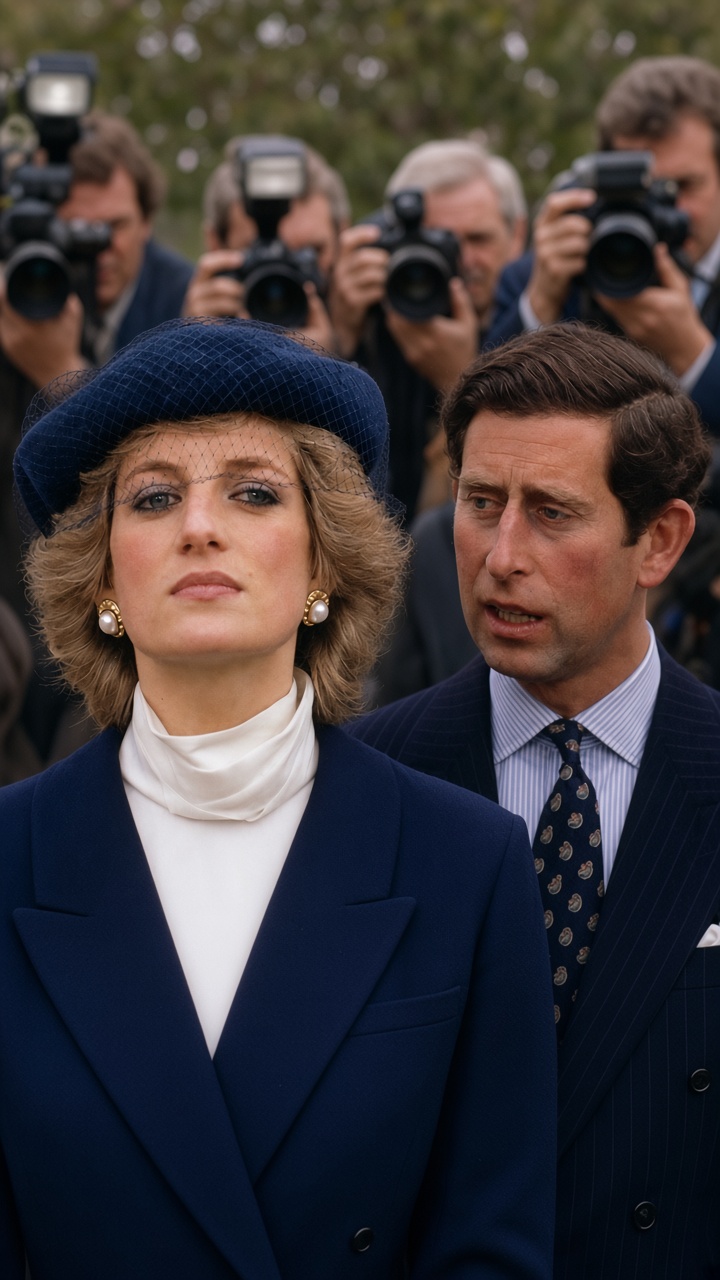
Charles and Diana produced countless images of the second kind.
From the beginning of their public life together, the Prince and Princess of Wales were surrounded by cameras. Their wedding became a global television event. Their appearances were photographed from almost every angle. Their clothes were analyzed, their expressions examined, their gestures interpreted, and even the distance between them could become the subject of public fascination.
In that environment, a smile was never simply a smile.
For Charles, Diana, and the people responsible for presenting the royal family to the public, appearances mattered enormously. A photograph could become tomorrow’s newspaper front page. A few seconds of television footage could shape public perception for days. A moment of warmth could suggest harmony. A moment of distance could raise questions.
That was the world in which Charles and Diana learned to perform their public roles.
Historical photographic records confirm that Charles and Diana were repeatedly photographed together smiling for the cameras. One archived ITN image from 1981, for example, records the couple standing together while Charles placed his hands on Diana’s shoulders as they smiled for photographers.
But behind those images was a much more complicated reality.
The story of Charles and Diana has been retold so many times that it is tempting to reduce it to a collection of famous photographs: the wedding dress, the balcony appearance, the royal tours, the charity engagements, the family portraits, the moments of laughter and the moments when one of them appeared uncomfortable.
Yet the fascination lies precisely in the difference between the photograph and what viewers imagined was happening outside its frame.
Imagine the scene.
The cameras are already waiting.
Photographers are calling for attention. Flashbulbs are firing. People in the crowd are watching. Every movement is potentially being recorded. Charles knows what is expected. Diana knows it too.
They have to stand together.
They have to look composed.
They have to acknowledge the crowd.
And, above all, they are expected to appear happy.
For Diana, that expectation became particularly significant because the public was rapidly developing an extraordinary fascination with her.
She was young. She was visually distinctive. She possessed a natural ability to connect with ordinary people. Her expressions could communicate something even when she said nothing. A smile from Diana could dominate a photograph.
That made her both enormously valuable to the public image of the monarchy and increasingly difficult to control as a simple part of a carefully managed royal presentation.
The cameras loved Diana.
The public loved Diana.
And eventually, Diana seemed to understand the power that came with that attention.
This is where the familiar story of Charles asking Diana to smile becomes so compelling.
Whether one treats the scene as a literal documented exchange or as a reconstruction of the atmosphere surrounding their public appearances, the underlying tension is unmistakable: royal life demanded a performance, while Diana increasingly became a person whose emotions were visible even when she attempted to hide them.
The contrast was striking.
Charles had spent much of his life being prepared for the responsibilities of monarchy. Diana entered that world at a comparatively young age and suddenly found herself at the center of an international media machine.
She had not merely married a prince.
She had become one of the most photographed women in the world.
Every smile mattered.
Every frown mattered.
Every glance mattered.
And sometimes, doing nothing at all could become a statement.
The pressure was especially obvious during royal tours.
When Charles and Diana traveled abroad, they were not simply a married couple going on holiday. They represented Britain. Their clothing, body language, speeches, public engagements, and interactions with crowds were all part of a much larger diplomatic performance.
The cameras followed them relentlessly.
During one 1983 visit to Canada, for instance, archival material records Charles and Diana at a barbecue in Ottawa, where Charles interacted informally with the press and more than a thousand people were present.
These occasions could appear relaxed, but the photographs produced from them were anything but casual.
The public saw smiles.
They saw waves.
They saw Charles and Diana standing side by side.
They saw a young royal couple apparently representing a modern and approachable monarchy.
What they could not see was everything that happened before and after the shutter clicked.
That distinction would become increasingly important.
Diana had an instinctive understanding of the emotional language of a camera. She knew how to look directly at people. She knew how to soften an expression. She could appear vulnerable without saying a word. She could turn a simple wave into something personal.
The more photographs appeared, the more the public began to feel that they knew her.
This was one of the great paradoxes of Diana’s public life.
Millions of people believed they understood her because they could see her.
But seeing someone is not the same as knowing them.
And the royal family operated within a culture in which personal feelings were often secondary to duty.
The expectation was simple: whatever was happening privately, the public face had to remain controlled.
That is why the idea of Charles telling Diana to smile carries such symbolic power.
The request itself is ordinary.
A husband might tell his wife to smile for a photograph.
A public relations adviser might remind a public figure to acknowledge the cameras.
A photographer might call out, “Smile!”
None of these things is remarkable by itself.
But when the people involved are Charles and Diana, the meaning becomes much larger because their marriage eventually became one of the most scrutinized relationships of the twentieth century.
Every public appearance was interpreted through the knowledge of what came later.
A photograph taken early in their marriage can look completely different when viewed decades afterward.
A smile that once appeared romantic can later seem carefully constructed.
A moment of physical distance can suddenly appear significant.
A glance that nobody noticed at the time can be transformed into evidence of tension.
This is one reason the Charles-and-Diana story has remained so powerful.
The audience knows the ending.
The people in the photograph did not.
At the beginning, there was enormous optimism surrounding the couple.
Diana was young, fashionable, and immediately captivating. Charles was the heir to the throne. Their wedding attracted worldwide attention. They were expected to become a symbol of continuity and stability.
But expectations can be dangerous.
When millions of people expect a marriage to represent something larger than the two individuals involved, the couple is no longer allowed an ordinary private life.
Their marriage becomes a public institution.
Their disagreements become potential headlines.
Their smiles become reassurance.
Their silence becomes suspicious.
Their movements become material for analysis.
And their photographs become historical documents.
That is why the cameras were never simply cameras.
They represented an audience that was constantly waiting.
Waiting for affection.
Waiting for conflict.
Waiting for a glimpse behind the official image.
Diana’s relationship with the press was complicated by this enormous public fascination. The more people wanted to see her, the more photographers wanted access to her. The more photographs were published, the more valuable new photographs became.
The cycle fed itself.
And Diana became one of its central figures.
At times, she appeared to embrace the attention. At other times, the relentless scrutiny seemed overwhelming. Her public role required her to remain visible while her private life increasingly demanded protection.
That contradiction was impossible to solve.
She could not be both completely accessible and completely private.
She could not control every photograph.
She could not control every interpretation.
And she certainly could not control what the public imagined when they looked at her.
This makes the supposed “smile for the cameras” moment so interesting.
The most important part is not necessarily the exact words spoken.
It is the pressure contained within them.
Smile.
Look happy.
Stand here.
Wave.
Turn toward the photographers.
Do it again.
The public wants to see you.
The monarchy needs you to look comfortable.
The newspapers need the photograph.
The crowd needs reassurance.
And somewhere underneath all those expectations was a woman whose private emotions could not always be hidden.
That became one of Diana’s defining characteristics.
She was extraordinarily expressive.
Even when she attempted to remain composed, her face could reveal uncertainty, sadness, amusement, discomfort, or affection.
The camera captured those details.
Sometimes unintentionally.
Sometimes perfectly.
That was part of what made her so compelling.
She did not always look like someone performing royalty.
She often looked like a person trying to navigate royalty.
There is an enormous difference.
Charles, meanwhile, had been raised within a completely different understanding of public duty.
He had spent decades learning that the monarchy depended on continuity, restraint, tradition, and discipline.
The emotional language of royal life was therefore complicated.
A royal could be friendly without becoming too familiar.
Warm without losing authority.
Personal without becoming vulnerable.
Approachable without appearing ordinary.
Diana’s natural style frequently pushed against those boundaries.
She touched people.
She hugged children.
She made prolonged eye contact.
She laughed openly.
She could appear spontaneous.
The public responded to that.
And the more successful she became at connecting with people, the more attention she attracted.
The photographs became more powerful.
The contrast between Charles and Diana became more noticeable.
This did not necessarily mean that every public disagreement was evidence of a private confrontation. Nor does every photograph reveal what was happening emotionally between them. Images are fragments, and later interpretations can easily impose meanings that were not visible at the time.
That caution matters.
The temptation to read an entire marriage into a single expression is enormous.
But it can also be misleading.
A photograph captures one second.
A marriage contains years.
Still, some images endure because they seem to represent something larger.
Charles and Diana standing together.
Diana smiling toward a crowd.
Charles looking toward the photographers.
The two of them performing the public role expected of them.
And behind the performance, an increasingly complicated relationship between duty, fame, marriage, and personal identity.
By the mid-1980s, the public fascination had reached extraordinary levels.
Diana’s fashion choices became international news. Her charity work attracted enormous attention. Her appearances could generate crowds wherever she went.
She had become a global celebrity in addition to being a member of the British royal family.
That distinction mattered.
Traditional royal publicity had depended heavily on ceremony and controlled access.
Diana’s celebrity operated differently.
People wanted proximity.
They wanted emotion.
They wanted photographs.
They wanted to see her laugh.
They wanted to see her interact with children.
They wanted to see the person behind the title.
And Diana gave them glimpses of that person.
The result was a transformation in the way royal images were consumed.
A royal photograph was no longer merely a record of an official engagement.
It became a story.
What was Diana wearing?
Who was she looking at?
Was she smiling?
Was Charles smiling?
Were they standing close together?
Did they touch?
Did they appear happy?
Did they appear distant?
The questions multiplied.
And every answer generated another photograph.
The famous royal smile had become part of a much larger machine.
Yet perhaps the most revealing aspect of the story is that Diana eventually learned how much power could exist inside a single expression.
A smile could reassure.
A smile could charm.
A smile could distract.
A smile could make a photograph look perfect.
But refusing to smile—or simply failing to produce the expected smile—could create an entirely different kind of image.
The camera would still click.
The photograph would still exist.
And the public would still interpret it.
This is why the title of the story feels almost larger than the incident itself.
“Charles asked Diana to smile.”
It sounds trivial.
Until you remember everything that came afterward.
The collapse of their marriage.
The increasingly intense media coverage.
The separation.
The interviews.
The competing public narratives.
The eventual divorce.
And Diana’s continuing transformation into one of the most recognizable figures in modern history.
When viewed backward, the smallest moments can appear prophetic.
But history rarely works that neatly.
People do not know which moments will become famous.
They do not know which photograph will survive.
They do not know which ordinary exchange will later be examined by millions.
Charles and Diana could not have known which images of their marriage would still be circulating decades later.
They could not have known that future generations would pause photographs and analyze their expressions.
They could not have known that their relationship would become the subject of documentaries, books, television dramas, biographies, newspaper investigations, and endless public debate.
They were simply living through it.
And the cameras were watching.
That is perhaps the most haunting element of their story.
The world saw so much of Charles and Diana—and yet so little of what was truly private.
The cameras recorded their public smiles.
They recorded their waves.
They recorded their entrances and departures.
They recorded moments of apparent affection.
But they could not record every thought.
They could not explain every expression.
They could not tell viewers what either person was feeling at the exact moment the shutter clicked.
The photograph could only show the surface.
And that surface became the foundation for decades of interpretation.
The archived 1981 photographs are a perfect example. The record describes Charles and Diana standing together and smiling for cameras, with Charles’s hands on Diana’s shoulders. To someone seeing only the photograph, the image can look like a straightforward representation of a young royal couple.
But knowing what happened later changes how people look at it.
That is the strange power of historical photographs.
They do not change.
We do.
The photograph remains frozen.
The viewer brings new knowledge to it.
The same smile can look hopeful in one decade and poignant in another.
The same gesture can seem romantic to one person and formal to another.
The same moment can become a symbol of a relationship that history eventually proved was far more complicated than any photograph could show.
Perhaps that is why the story of Charles and Diana continues to fascinate.
It was never only about a prince and a princess.
It was about the collision between private emotion and public expectation.
It was about what happens when two human beings are required to become symbols.
It was about the extraordinary pressure created when millions of people believe they have the right to see inside a marriage simply because the couple is famous.
And it was about the camera.
Always the camera.
When Charles and Diana appeared in public, they were never entirely alone.
There were photographers.
Reporters.
Officials.
Crowds.
Television crews.
Millions of people waiting to see the next image.
A smile could become tomorrow’s headline.
A frown could become a question.
A glance could become a theory.
A moment of silence could become a story.
That is why a simple instruction such as “smile for the cameras” carries so much symbolic weight when placed inside their history.
The request itself may have been ordinary.
The world surrounding it was not.
Diana eventually became famous for many things, but one of her most enduring legacies was the way she changed the emotional language of royal public life. She demonstrated that a royal could be photographed laughing, crying, embracing, listening, and appearing genuinely moved.
She made emotional visibility part of her public identity.
And once the public had become accustomed to seeing that side of her, the traditional expectation of the perfectly controlled royal image became increasingly difficult to maintain.
Charles and Diana therefore became an extraordinary study in contrasts.
Tradition and modernity.
Duty and emotion.
Privacy and celebrity.
Institution and individual.
Photograph and reality.
And somewhere between all those contradictions was the unforgettable image of the two of them standing before the cameras, expected to smile.
Perhaps Diana smiled.
Perhaps she hesitated.
Perhaps the exact exchange has been embellished over time.
What can be established is that Charles and Diana repeatedly stood before cameras and performed the public duties expected of them, while surviving photographs from the period continue to preserve those moments. The ITN archive contains numerous records of their public appearances, including their 1981 photographs and later royal engagements.
The deeper story, therefore, is not simply whether Charles once told Diana to smile.
It is what that request represents.
A young woman entered one of the most powerful institutions in the world and quickly discovered that millions of people wanted to see her.
They wanted the smile.
They wanted the wave.
They wanted the perfect photograph.
But Diana gradually showed the world something more complicated: behind every royal image was a real person.
And sometimes the most memorable photograph was not the one in which everything looked perfect.
It was the one in which something unexpected appeared.
A hesitation.
A glance.
A change in expression.
A moment when the polished royal image seemed to crack for just one second.
Those seconds are precisely why old photographs continue to fascinate people today.
The camera captured the image.
History supplied the context.
And the public supplied the questions.
Charles and Diana’s story ultimately became one of the most intensely photographed relationships of the modern royal era. Their smiles were documented. Their disagreements were documented. Their triumphs were documented. Their difficulties were documented.
But no camera ever captured the whole truth.
That remains impossible.
A photograph can show where someone stood.
It can show whether someone smiled.
It can show who was beside them.
It can preserve a gesture forever.
But it cannot tell us everything that happened inside a person’s heart.
Perhaps that is the real reason the old images remain so powerful.
We keep looking at them because we know there was more beyond the frame.
And when Charles and Diana stood together before another wall of cameras, the world wanted the same thing it always wanted from them: a perfect royal picture.
Diana’s extraordinary legacy was that she eventually made people look beyond the picture.
The smile was only the beginning.
The story was everything that came after.
Disclaimer: This story is fictional and created for entertainment purposes only.
Any names, characters, places, or events are fictitious or used fictitiously.
No real person or organization is intended to be portrayed.
