Uncategorized
What Diana whispered to her bodyguard the night she met Dodi — he kept it quiet for 30 years
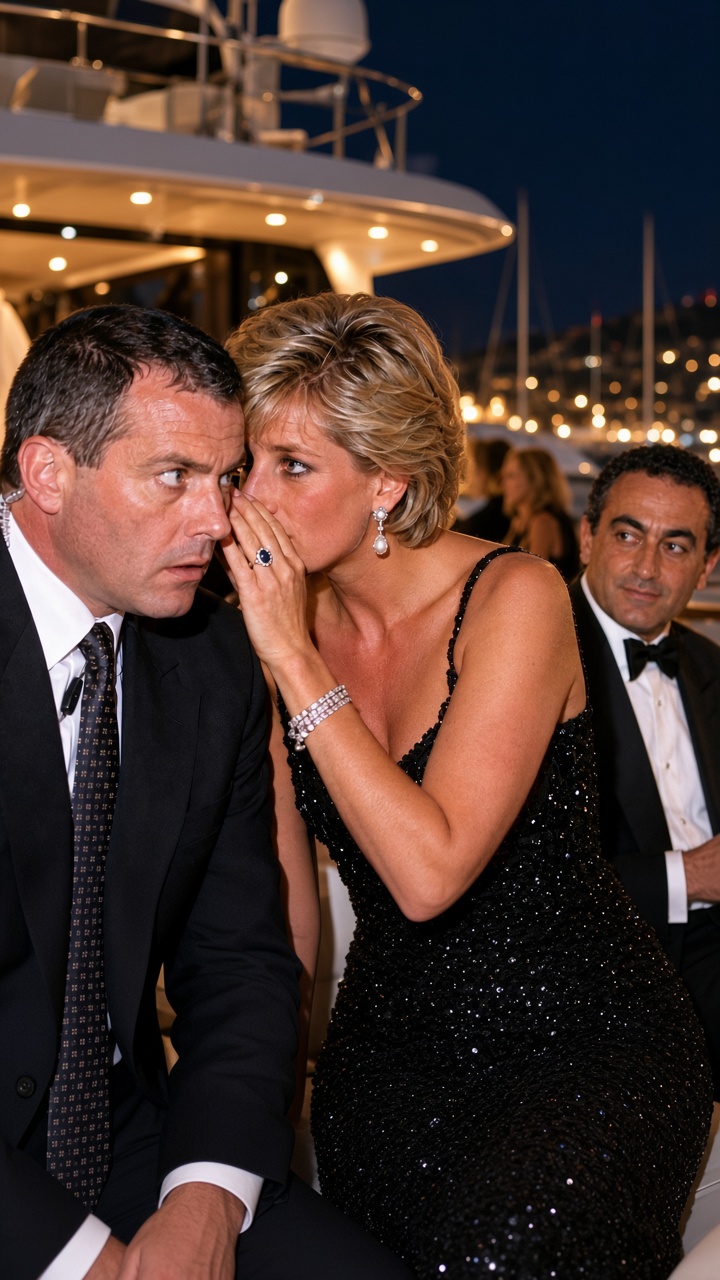
For almost three decades, one image has remained irresistible: Princess Diana, surrounded by secrecy, leaning toward a trusted bodyguard and revealing something about Dodi Fayed that she never intended the public to know. The story sounds almost cinematic. A private confession. A loyal protector. A secret carried for decades. And then, suddenly, the tragedy in Paris.
But when the dates are placed side by side, the story becomes far more complicated.
The man most often associated with Diana’s years of close protection was Ken Wharfe. He knew her intimately in the professional sense. He had protected Diana and her sons, William and Harry, during some of the most turbulent years of her life. He understood her habits, her frustrations, her desire for freedom and her complicated relationship with security.
But Ken Wharfe was no longer Diana’s personal protection officer when she met Dodi Fayed.
That single fact changes the entire story.
Wharfe’s resignation came in 1993, and Diana subsequently requested the withdrawal of her regular Metropolitan Police personal protection. Operation Paget later recorded that Diana asked for her police protection to be withdrawn in December 1993. By the summer of 1997, nearly four years had passed.
So the dramatic image of Wharfe standing beside Diana during the beginning of her romance with Dodi cannot be reconciled with the documented timeline.
Yet this does not make Ken Wharfe irrelevant. Quite the opposite.
His importance lies in what he knew about Diana before Dodi ever appeared in her life.
When Wharfe entered Diana’s world in the 1980s, he was not simply assigned to protect a distant royal figure. He became part of the daily environment surrounding a young mother raising two boys who would one day occupy an extraordinary place in British public life.
William and Harry were still children. Diana wanted them to experience something resembling normality despite the enormous machinery surrounding them. She took them to amusement parks, cinemas and ordinary restaurants. She wanted them to see life beyond palaces and official ceremonies.
Wharfe’s job was to make those moments possible without allowing the risks surrounding the royal family to disappear.
That required an unusual balance.
He had to remain close enough to react instantly but distant enough not to intrude. He had to understand Diana’s movements without controlling them. He had to anticipate when she might suddenly stop to speak to someone in a crowd, change direction or abandon a carefully planned route because she wanted to connect with ordinary people.
Diana was unusually comfortable with people. She could turn a formal encounter into a personal conversation within seconds. That quality became central to her public image, but it also created difficulties for the people responsible for protecting her.
The more visible the security operation became, the more Diana sometimes felt that the machinery designed to protect her was also restricting her.
And that tension would follow her for years.
There was another, more painful history behind Diana’s distrust of protection.
Barry Mannakee, another former close protection officer, had developed a particularly close relationship with her. He was transferred from his role in 1986. In May 1987, he died in a motorcycle collision in London.
The investigation at the time treated the death as a traffic accident. Operation Paget later reviewed the circumstances and found no evidence supporting a conspiracy. Yet Diana’s feelings about Mannakee became part of the complicated emotional background surrounding her relationship with security.
Wharfe told Operation Paget that Diana had once joked that perhaps “your lot” had eliminated Mannakee, while also saying that she did not actually believe his death had been anything other than an accident. Hasnat Khan, however, later recalled that Diana had become convinced that Mannakee had been murdered.
The difference between those recollections matters.
It demonstrates how memories of Diana’s fears could vary depending on who was remembering them and when.
By the early 1990s, Diana wanted more control over her own life. Her separation from Charles in 1992 intensified that desire. She was no longer simply trying to function within the role of a royal wife. She was building an identity independent of the marriage.
In 1993, Ken Wharfe left her personal protection service.
Later that year, Diana asked for her regular police protection to be withdrawn.
This decision would become one of the most heavily debated elements of the years leading to her death.
But it is important to distinguish two separate questions.
The first is whether Diana wanted more freedom from official protection.
The second is whether that decision caused the Paris crash.
The evidence allows the first question to be answered clearly. Diana did choose to withdraw her regular police protection.
The second is far more complicated, because the circumstances of August 31, 1997 involved numerous factors: the private security arrangements, the driver, the pursuit by photographers, the route, the speed, the lack of seatbelts and the decisions made during the final minutes.
Operation Paget examined the broader conspiracy allegations and found no evidence supporting the claim that Diana and Dodi were victims of a murder plot. The later British inquest concluded in 2008 that Diana and Dodi were unlawfully killed, attributing the deaths to the grossly negligent driving of Henri Paul and the pursuing paparazzi.
But years before the final investigation reached those conclusions, Diana herself had expressed fears about road accidents.
In 1995, according to evidence gathered by Operation Paget, Diana spoke to her lawyer Lord Mishcon about information she had received concerning the possibility of a staged car accident. She was concerned enough for the matter to be recorded.
After her death, a note associated with Diana and later published by Paul Burrell became another major element in the conspiracy debate.
But the investigation did not simply accept the note as proof.
Witnesses questioned aspects of it. Ken Wharfe noted that it did not contain the sort of greeting he would have expected from Diana if it had been intended as a message to Burrell. Rodney Turner recalled that Diana generally dated her writings. Other witnesses could not connect the contents convincingly to the chronology suggested for the note.
The distinction is crucial.
Diana’s fears were real.
That does not automatically make the feared scenario real.
And this is precisely where the story of the supposed whisper becomes fascinating.
Because there really was a conversation.
It just wasn’t the conversation the popular version suggests.
On August 27, 1997, four days before Diana’s death, she spoke by telephone with Lucia Flecha de Lima, one of her close friends.
Lucia asked Diana whether Dodi might be “the one.”
Diana’s answer was strikingly restrained.
She said that he might be, because he was very kind to her.
Lucia later told Operation Paget that the wording seemed unusual for Diana. She expected a woman in love to speak differently. Lucia also wondered whether Diana might have been cautious because someone else could potentially hear the conversation. Most importantly, Lucia said Diana never mentioned marriage to Dodi during that call.
That is the real conversation behind one of the most intriguing pieces of evidence from Diana’s final days.
There is no documented confession to Ken Wharfe.
There is no evidence that Wharfe was present during the beginning of Diana’s relationship with Dodi.
There is, however, a documented conversation between Diana and Lucia.
And the wording is revealing precisely because it is so understated.
“He’s very kind to me.”
Not “I’m going to marry him.”
Not “He’s the love of my life.”
Not “We’re engaged.”
Just kindness.
For Diana, that word may have carried enormous emotional weight.
Her relationship with Charles had shown her that grandeur and affection were not the same thing. Her relationship with Hasnat Khan had offered emotional intimacy but created enormous practical obstacles. Dodi entered her life at a moment when she had already experienced both extremes.
With Charles, there had been status without the emotional security she wanted.
With Hasnat, there had been privacy and emotional depth, but a shared future was extraordinarily difficult to construct.
With Dodi, there was attention, generosity and immediate affection.
But there was also uncertainty.
That uncertainty becomes even clearer when the story of the ring is examined.
By August 1997, Dodi had obtained a ring from the Repossi jewelry house in Paris. The piece was associated with the phrase “Dis-moi oui,” meaning “Tell me yes.”
That name was almost irresistibly dramatic.
But the name of a piece of jewelry does not prove that the person receiving it agreed to marry.
The ring became a symbol around which later narratives were constructed. Mohamed Al-Fayed maintained that his son and Diana were engaged and intended to announce it.
But the evidence from Diana’s own circle presented a much less certain picture.
Rosa Monckton, one of Diana’s closest friends, later recalled conversations about Dodi’s gifts and the ring. Diana was reportedly uncomfortable with the implications. She considered wearing the ring on her right hand rather than her left.
That detail is small, but extraordinarily revealing.
It suggests an attempt to separate gratitude from commitment.
She could accept a gift.
She could appreciate affection.
But she did not necessarily want the public meaning attached to an engagement ring.
Paul Burrell also recalled Diana discussing the issue and considering how she could accept the gesture without creating an unintended promise.
This fits with what Lucia heard on August 27.
Diana was not speaking like someone who had settled the question of marriage.
She was still evaluating.
And the chronology of that summer makes the story even more complicated.
Diana’s relationship with Dodi did not begin in a vacuum.
Dodi had been connected to Kelly Fisher, an American model who said they were engaged and planning a future together. A property associated with Dodi was purchased in Malibu shortly before the summer romance with Diana became public.
When photographs of Diana and Dodi appeared, Fisher publicly announced a lawsuit for breach of promise. She later withdrew it after Dodi’s death.
None of this proves what Dodi privately felt for Diana.
But it shows that the public romance emerged from a complicated private situation.
And Diana herself was not simply waiting for a new relationship.
She had her own life.
In January 1997, she traveled to Angola with the British Red Cross and became a highly visible advocate for the campaign against landmines.
In June, her dresses were sold at Christie’s in New York, raising millions for charity. The auction became both a philanthropic event and a symbolic break with aspects of her former royal identity.
She was becoming increasingly independent.
Then came Dodi.
On July 11, 1997, Diana arrived in Saint-Tropez with William and Harry as guests of Mohamed Al-Fayed.
The holiday was luxurious, but it was also practical.
The boys had royal protection.
That meant Scotland Yard officers were present during the family vacation.
The situation changed after William and Harry returned to Britain.
Diana remained free of a permanent Metropolitan Police protection team.
The difference was significant.
The official royal security system had experience, established procedures and a defined chain of command.
Dodi’s protection came through the private security structure employed by the Al-Fayed family.
The man who became most important on the final night was Trevor Rees-Jones.
Not Ken Wharfe.
Trevor Rees-Jones was the bodyguard who was actually in the Mercedes when Diana and Dodi left the Ritz.
That distinction is at the heart of the entire story.
Ken Wharfe knew Diana’s history.
Trevor Rees-Jones was present at the end.
One man understood years of her relationship with security.
The other was physically beside her during the final journey.
Confusing the two creates a perfect narrative, but history does not work like a screenplay.
The summer continued at extraordinary speed.
Diana and Dodi traveled on the Jonikal.
On August 4, photographer Mario Brenna captured the famous image of Diana and Dodi embracing on the yacht.
The photograph exploded across the international press.
Suddenly, their private relationship had become global entertainment.
But while newspapers focused on the photograph, Diana continued her humanitarian work.
Only days later, she traveled to Bosnia with the Landmine Survivors Network.
She visited people whose lives had been devastated by landmines.
The contrast was extraordinary.
The world saw a princess apparently caught in a glamorous summer romance.
Diana was simultaneously using her public influence to focus attention on people living with the consequences of war.
The press, however, needed another photograph.
Then another.
The romance created a commercial race.
A kiss could become an engagement.
A ring could become a wedding.
A photograph could become a pregnancy rumor.
A vacation could become a royal scandal.
Diana had lived inside this machine for years.
She knew how quickly an image could become a story.
But even she could not fully control what millions of people would project onto a photograph taken from a distance.
By late August, Diana was speaking with several friends.
Those conversations are perhaps more revealing than any photograph.
Lucia spoke to her on August 27.
Rosa Monckton was also in contact with her.
Paul Burrell spoke with her.
On August 29, Diana spoke with her sister Sarah McCorquodale and Lady Annabel Goldsmith.
On August 30, she spoke with people including Susan Cassem, Rita Rogers and journalist Richard Kay.
If Diana had been preparing a secret engagement announcement, this network of conversations would have been the natural place for clues to appear.
Instead, the conversations point toward uncertainty.
Lady Annabel asked Diana about the possibility of marriage.
Diana reportedly responded with humor, saying she needed another marriage about as much as she needed a rash on her face.
The joke was consistent with a woman who had already endured a highly publicized marriage and divorce.
Richard Kay later recalled no major announcement from Diana.
Susan Cassem remembered Diana looking forward to returning to London, her routine and her children.
Rodney Turner recalled that Diana expected to return to work in early September.
These details matter because hindsight changes how people hear ordinary words.
After a tragedy, every conversation becomes a possible farewell.
Every plan becomes a prophecy.
Every joke becomes a hidden warning.
But the people speaking to Diana at the time did not know that she had only days to live.
They heard a woman making plans for the future.
That future included her children.
It included work.
It included London.
And apparently, it included figuring out exactly what Dodi meant to her.
On August 30, Diana and Dodi arrived in Paris.
They visited Villa Windsor, the same property connected to the earlier story involving Kelly Fisher.
Dodi also visited the Repossi jewelry store in Place Vendôme.
The ring became even more significant.
But again, the evidence does not establish that Diana had accepted an engagement.
The ring existed.
Dodi had obtained it.
But a ring is an object.
An engagement is an agreement between two people.
Those are not automatically the same thing.
Later that evening, Diana and Dodi planned to leave the Ritz.
Photographers were waiting outside.
A plan was developed to confuse them.
One group of vehicles would leave through the main entrance while Diana and Dodi would leave through the rear.
The idea was intended to give the couple privacy.
Instead, it became part of the chain of events leading to the crash.
Operation Paget examined the security arrangements in extraordinary detail.
The report includes testimony about the decision to use another vehicle from the rear entrance, the absence of a backup car and the objections raised by security personnel.
Trevor Rees-Jones was inside the Mercedes.
Henri Paul was driving.
Diana and Dodi were in the rear.
The vehicle left the Ritz shortly after midnight.
The photographers followed.
The Mercedes accelerated.
And then came the Alma tunnel.
The car struck a concrete pillar.
Henri Paul and Dodi died at the scene.
Trevor Rees-Jones survived with catastrophic injuries.
Diana was taken to Pitié-Salpêtrière Hospital.
Doctors fought to save her.
She died in the early hours of August 31, 1997.
She was 36 years old.
The tragedy generated an enormous number of theories.
Was Diana pregnant?
Was she secretly engaged?
Was the ring proof of an impending marriage?
Had the British establishment wanted her dead?
Had the paparazzi deliberately caused the crash?
Had the security operation failed?
Had Diana’s earlier fears predicted what would happen?
These questions were investigated.
Operation Paget, established to examine allegations of a conspiracy to murder Diana and Dodi, reviewed an enormous body of evidence. The investigation examined witnesses, documents, forensic evidence, vehicle movements, security arrangements, intelligence allegations and the circumstances of the crash.
The National Archives also preserves the records of the later inquests into the deaths of Diana and Dodi, including the evidence database and related materials.
The investigations did not establish that Diana’s death was the execution of the conspiracy she had feared.
Instead, the evidence pointed toward a disastrous combination of circumstances surrounding the journey from the Ritz.
And that brings us back to Ken Wharfe.
Why does his name remain so closely attached to the story?
Because he represents something Diana lost.
Not a secret.
Not a prophecy.
A structure.
Wharfe had spent years learning how Diana behaved under pressure. He knew that she wanted freedom but also needed protection. He knew that she disliked feeling controlled. He understood that telling her simply “no” could be counterproductive.
The challenge was to protect her without making her feel imprisoned.
That balance was difficult.
But it was precisely what professional royal protection was designed to achieve.
Wharfe’s later comments about Diana’s security therefore carried weight because he could explain what a professional protection structure was supposed to look like.
But his authority had limits.
He could speak about the years when he protected Diana.
He could analyze the security circumstances of 1997.
He could not honestly be presented as the bodyguard who stood beside Diana during her relationship with Dodi.
He was not there.
The real bodyguard in the final car was Trevor Rees-Jones.
And that distinction is more powerful than the legend.
There was no need for an invented whisper.
Diana had already been speaking.
She told Lucia that Dodi might be “the one” because he was kind to her.
She told friends that she was not looking for another marriage.
She worried about the meaning of the ring.
She discussed returning to London.
She planned to see her children.
She was still thinking about work.
Those statements do not create a perfect romantic ending.
They create something much more human.
Diana was uncertain.
She was curious.
She was affectionate.
She was cautious.
She was still deciding.
That may be the real reason the supposed bodyguard secret became so attractive.
People want tragedy to have a final sentence.
They want a last confession.
They want one sentence that explains everything.
But Diana’s final days do not offer that simplicity.
They offer fragments.
A telephone call.
A joke about marriage.
A conversation about a ring.
A plan to return home.
A humanitarian mission.
A photograph taken from a distance.
A security decision made late at night.
A driver.
A car.
A tunnel.
And then silence.
The most important phrase may therefore be the simplest one.
“He’s very kind to me.”
Lucia heard it four days before Diana died.
The words were not a declaration of marriage.
They were not proof of an engagement.
They were not a secret message to Ken Wharfe.
They were one woman’s description of how another person was treating her.
And perhaps that is why they remain so haunting.
Diana had spent much of her adult life surrounded by people who wanted something from her.
The monarchy wanted duty.
The press wanted access.
The public wanted an image.
Security wanted compliance.
Her family wanted stability.
Her humanitarian work demanded commitment.
Her relationships demanded decisions.
In the middle of all of that, she noticed kindness.
That does not tell us whether Dodi was the love of her life.
It does not prove that she intended to marry him.
It does not prove that she did not love him.
It simply tells us what she chose to say to Lucia at that moment.
And that is where the famous story should end—not with an invented whisper in the ear of a bodyguard, but with Diana’s own documented words.
Ken Wharfe knew Diana.
Trevor Rees-Jones protected her on the final night.
Lucia Flecha de Lima heard one of her last conversations about Dodi.
Rosa Monckton heard her concerns about the ring.
Paul Burrell heard her uncertainty about how to respond to it.
Sarah McCorquodale heard her thoughts about the future.
Richard Kay heard no engagement announcement.
Susan Cassem heard plans for returning to normal life.
These voices do not tell exactly the same story.
But together, they make the picture more complicated—and therefore more believable.
Diana was not simply moving toward a wedding.
She was not simply escaping from her past.
She was not simply falling blindly into a new romance.
She was trying to work out what came next.
And she believed there would be a next chapter.
That may be the most heartbreaking detail of all.
Because on August 30, 1997, Diana still had plans for the days ahead.
She expected to return to London.
She expected to see her children.
She expected to continue her work.
She expected to make decisions about her life.
She did not know that history was about to stop her from making them.
So the real secret is not that Ken Wharfe supposedly kept a whispered confession for 30 years.
The real revelation is that the famous story gets the wrong man, the wrong moment and the wrong kind of secret.
Ken Wharfe was part of Diana’s past.
Trevor Rees-Jones was there at the end.
And Lucia Flecha de Lima was one of the people who actually heard Diana discussing Dodi in those final days.
What Diana revealed was not a wedding promise.
It was uncertainty.
She was still asking herself what Dodi meant.
She was still separating kindness from commitment.
She was still protecting her future.
And she was still, in her own way, choosing.
That is far more complicated than a whispered secret.
And perhaps far more revealing about the woman Diana really was.
Disclaimer: This story is fictional and created for entertainment purposes only.
Any names, characters, places, or events are fictitious or used fictitiously.
No real person or organization is intended to be portrayed.
