Uncategorized
Diana Removed Her Gloves in a Leprosy Ward — The Photo That Changed Everything
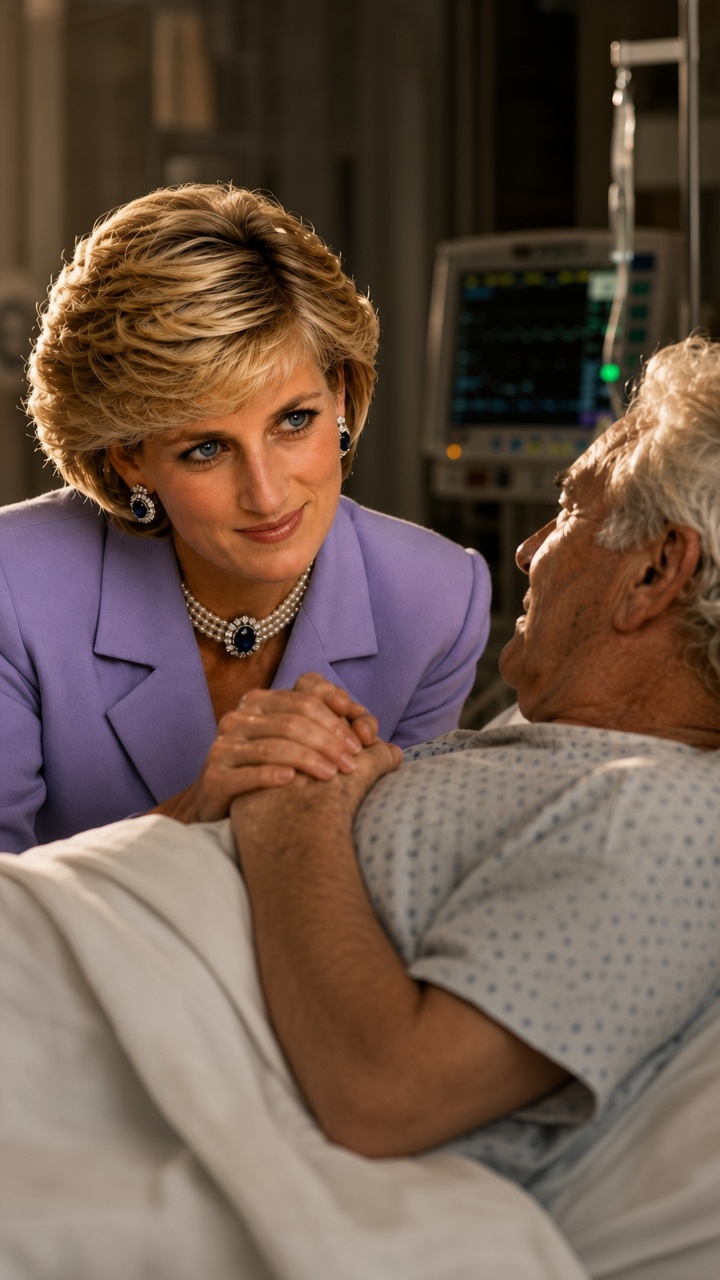
She reached out her bare hand and shook the hand of a man with leprosy.
There was no glove between them. No protective barrier. No dramatic announcement. Just one human hand meeting another.
The simplicity of the gesture was precisely what made it so powerful.
To understand why the photograph attracted such extraordinary attention, however, it is necessary to understand what leprosy represented at the time. The disease itself was not new. It had existed in human societies for thousands of years, appearing in ancient writings from different civilizations and becoming deeply associated with fear, exclusion, and religious ideas about impurity. Across centuries, people diagnosed with leprosy were frequently separated from their families and communities. In many places, special institutions and colonies were created for them, reinforcing the idea that the disease belonged behind walls and away from ordinary society.
By 1990, medical knowledge had changed dramatically. Leprosy was treatable, and effective multidrug therapy had transformed the outlook for patients. The scientific reality was very different from the ancient fears that had surrounded the disease for generations.
But social attitudes often move more slowly than medicine.
A diagnosis could still carry enormous consequences. Families could become frightened. Neighbours could distance themselves. Employment and housing could be affected. Even when a patient was receiving treatment, the word “leprosy” could trigger an immediate emotional reaction based on centuries of cultural memory rather than contemporary medical facts.
That was the environment Diana entered.
She had already become one of the most recognizable women in the world. Every movement could attract cameras. Every expression could become a newspaper photograph. Her clothing, her marriage, her public appearances and even her private struggles were routinely examined by the press.
That extraordinary visibility could be exhausting, but Diana gradually discovered that it could also be used for something else.
It could make people look.
And sometimes, she understood, making people look was the first step toward making them see.
When she arrived at the Indonesian hospital, Diana did not simply move through the ward at a distance. Accounts of the visit describe her stopping beside patients, speaking with them and asking questions. Rather than treating the patients as anonymous figures in a medical institution, she engaged with them as individuals.
What was your name?
How long had you been there?
Did your family visit?
Those questions might sound ordinary. In a place where people had spent years experiencing social distance, however, ordinary human attention could have extraordinary meaning.
Then Diana reached one particular patient.
A camera captured the moment.
In the photograph, Diana leans slightly forward as she clasps the man’s hand. Her attention is directed toward him rather than toward the camera. Her expression is focused and open.
The image does not show a complicated medical procedure or a dramatic speech. It shows a handshake.
Yet millions of people understood immediately what made it unusual.
The princess was touching someone whom society had taught them to fear.
The photograph travelled quickly through international media. Newspapers reproduced it. Television reports discussed it. The image became associated with Diana’s approach to humanitarian work: rather than standing behind institutional barriers, she repeatedly placed herself physically close to people who were frequently avoided or forgotten.
For many observers, the image challenged an old assumption. If Diana, surrounded by advisers and accustomed to royal protocol, could stand beside a patient and shake his hand without a barrier, perhaps the public’s instinctive fear deserved to be questioned.
That distinction is important.
Diana was not curing leprosy with a handshake. She was not replacing medical treatment with symbolism. The medical facts already existed. What she was doing was communicating those facts in a form that millions of people could understand emotionally.
A medical document could explain transmission.
A public-health campaign could explain treatment.
A photograph could show something in an instant.
The message people took from the image was simple: this patient was not someone to recoil from.
He was someone to greet.
The moment also fit into a broader pattern in Diana’s public work.
Three years earlier, in 1987, she had visited an AIDS ward in London. At the time, HIV and AIDS were surrounded by intense fear and misunderstanding. Many people incorrectly believed that casual contact could transmit the virus. Patients could experience rejection from friends, relatives and even members of the wider community.
Diana entered that environment and again used the simplest possible gesture.
She shook a patient’s hand.
The image became widely discussed because of the public misunderstanding surrounding AIDS at the time. Diana’s action communicated that physical contact with a patient was not something to fear.
The similarity between the two moments was striking.
Different disease.
Different country.
Different patients.
But the same basic human gesture.
A hand extended toward someone whom many others were afraid to touch.
That pattern became increasingly associated with Diana’s humanitarian work. She visited hospitals, hospices, shelters and institutions where many people lived on the margins of ordinary public attention. Sometimes the cameras were present because the visit was official. On other occasions, accounts from people who worked in such institutions described a more private Diana, one who could spend time beside patients without the ceremony associated with royal appearances.
This is one reason the Indonesian photograph became more significant than a single publicity image.
It was not entirely isolated from the rest of her work.
Diana had discovered that visibility could work in two directions. The same press attention that made her personal life difficult could also draw public attention toward causes that were normally ignored.
She knew what it meant to be watched.
She also knew what it meant to feel unseen.
That apparent contradiction became central to the way many people understood her.
Diana had been famous from a young age. Millions of people knew her face. Yet enormous public attention did not necessarily mean emotional connection. Behind the photographs and ceremonies, she experienced the pressures of a highly scrutinized life.
This may help explain why she appeared particularly attentive to people who had been pushed outside ordinary social circles. That interpretation should not be treated as a proven explanation for every decision she made, but it became part of the way people around her and later observers understood her humanitarian style.
She seemed especially comfortable approaching people whom others avoided.
The patient in the Indonesian ward represented precisely that kind of person.
For years, leprosy had created an almost physical boundary between patients and the rest of society. Even when treatment made the medical danger far smaller than many people imagined, the social boundary could remain.
Diana crossed that boundary with her hand.
The photograph therefore worked on two levels.
At the surface, it showed a princess visiting a hospital.
At a deeper level, it showed a public figure refusing to participate in the instinctive distance surrounding a stigmatized disease.
And that distinction mattered.
Stigma is difficult to photograph.
Fear is difficult to put on a newspaper front page.
But a hand is easy to see.
The picture gave an abstract issue a human face.
Instead of discussing “leprosy patients” as an anonymous category, viewers could see one man and one woman standing together.
The man was not simply a diagnosis.
He was a person receiving a greeting.
That may be why the photograph remained so memorable.
The image also demonstrated something important about Diana’s understanding of public communication. She did not always need a long speech to make a point. Sometimes the physical action itself became the message.
She could sit beside someone.
She could listen.
She could hold a hand.
She could remain in a room that others wanted to leave.
And because she was Princess Diana, those ordinary gestures were transformed by the enormous attention surrounding her.
The effect was amplified by the cameras.
A private citizen shaking a patient’s hand might have affected the patient deeply but would probably have remained an unnoticed moment. Diana’s handshake became a global image.
That created an unusual relationship between compassion and publicity.
Her humanitarian work benefited from visibility, but the visibility also risked turning personal encounters into symbolic events.
The Indonesian photograph succeeded because the gesture itself appeared natural rather than theatrical. Diana was not standing at a podium delivering a carefully constructed statement. She was physically interacting with another person.
For viewers, the absence of distance was unmistakable.
And there was another important detail.
She looked at him.
The photograph captured more than physical contact. It captured attention.
That matters because people experiencing stigma often describe another form of isolation beyond physical separation: being reduced to a condition, a label or a stereotype.
To look directly at someone is a small act.
To remain present can be an even smaller one.
But together they communicate recognition.
Diana’s supporters and humanitarian observers later viewed such moments as part of a broader philosophy of engagement. Her public work increasingly involved causes that required people to confront subjects they might otherwise avoid: HIV/AIDS, homelessness, addiction, terminal illness, mental-health issues and social exclusion.
The common element was not a particular medical condition.
It was human isolation.
She repeatedly appeared in places where suffering was difficult to make glamorous.
That was significant for someone whose own public image was often surrounded by glamour.
Diana could have spent her public life almost entirely within the traditional ceremonial world of royal engagements: hospitals, schools, charity galas, official receptions and carefully managed appearances.
Instead, she increasingly sought out environments where the people she met were unlikely to have access to the powerful.
This was part of the transformation of her public identity during the 1980s and early 1990s.
She was no longer perceived solely through the traditional image of a royal princess.
Her humanitarian work became a major part of how the public understood her.
The leprosy hospital visit demonstrated why.
There was no complicated policy proposal.
There was no parliamentary debate.
There was no law to pass.
There was a person.
And there was a hand.
The broader public-health context is also essential. By the time Diana visited Indonesia, effective treatment for leprosy existed. The challenge was not simply discovering whether the disease could be treated. It was reaching patients, ensuring access to treatment and confronting the social consequences of the diagnosis.
That meant stigma could become a barrier in its own right.
A person afraid of being identified could delay seeking treatment.
A family afraid of social consequences could conceal a diagnosis.
A community influenced by ancient misconceptions could continue excluding patients despite advances in medicine.
The photograph could not solve those problems by itself.
But it could challenge one of the assumptions feeding them.
It could make people ask why they were afraid to touch someone who was receiving medical care.
And that question could be more powerful than a lecture.
The patient in the photograph reportedly remembered the encounter for years. Accounts attributed to him describe his surprise when Diana reached toward him and his sense that, in that moment, he was being treated simply as a human being.
Whether every detail of later recollections can be independently verified is less important than the larger significance of the image itself: the photograph documented a moment of direct contact at a time when social distance still carried enormous meaning.
That distinction between the documented image and later interpretations is worth preserving.
We know the photograph exists.
We know Diana visited a leprosy hospital in Indonesia in 1990.
We know she shook a patient’s hand without gloves.
We know the image was widely circulated.
The wider claims about exactly how much the photograph changed public behaviour, donations or attitudes are harder to measure precisely. Humanitarian organizations can point to increased visibility and public attention, but the influence of one photograph cannot always be separated from broader public-health campaigns, changing medical knowledge and developments in treatment.
Nevertheless, images can shape public conversation.
History repeatedly demonstrates that a single photograph can become a symbol far larger than the event itself.
Diana’s handshake became one of those photographs.
It represented a particular kind of royal visibility.
Instead of asking people to look upward toward the palace, it directed attention downward and outward, toward people who were rarely included in glamorous images of public life.
That was part of Diana’s unusual public appeal.
She could enter a room filled with officials and photographers, but her most remembered moments often involved one-on-one contact.
A patient.
A child.
A person living with illness.
Someone dying in a hospice.
Someone who had become invisible to the wider public.
The contrast was powerful because Diana herself was almost impossible to make invisible.
Everywhere she went, people watched.
Every gesture could become news.
She turned that reality into a form of advocacy.
The Indonesian handshake therefore belonged to a much larger story.
It was connected to the AIDS ward in London.
It was connected to her hospice visits.
It was connected to her work with people facing homelessness and addiction.
And it was connected to her increasingly direct approach to subjects that traditional royal public relations might once have treated more cautiously.
Yet perhaps the most remarkable aspect of the moment is how little she actually did.
She did not give a grand speech.
She did not make an elaborate promise.
She did not attempt to explain centuries of stigma in a single sentence.
She simply reached out.
That is why the photograph remains so easy to understand even decades later.
A hand is universal.
A handshake requires no translation.
It says: I am here.
I see you.
I am not afraid to stand beside you.
For a patient living under the weight of a stigmatized illness, that message could carry a significance far beyond the few seconds captured by the camera.
For the public watching from newspapers and television screens, it offered another message: perhaps the distance between “us” and “them” was not as necessary as people had assumed.
Diana died in 1997 at the age of 36, only a few years after the Indonesian visit. Her life ended before she could see how her humanitarian work would be remembered over subsequent decades.
But the photographs remained.
Some images document what happened.
Others become shorthand for what people believe an era represented.
The photograph of Diana shaking the hand of the leprosy patient became the latter.
It came to represent compassion, visibility and the challenge of stigma.
Its power did not come from Diana being medically qualified to treat leprosy. She was not.
Its power came from her ability to draw attention.
Millions of people who might never have read a medical paper saw the image.
Millions of people who might never have visited a leprosy hospital saw a patient being treated with dignity.
And millions of people were forced, however briefly, to confront an old fear through a new image.
That is the paradox of Diana’s humanitarian legacy.
Her greatest influence often came not from changing laws or designing medical treatments, but from changing what people were willing to look at.
She brought visibility to people who had been pushed out of view.
In 1987, she reached for the hand of a man with AIDS when fear surrounded the disease.
In 1990, she did something remarkably similar in Indonesia.
Different diseases.
Different circumstances.
Same refusal to let fear dictate the distance between two human beings.
The famous photograph therefore tells only part of the story.
The more revealing story is what happened before the camera captured the moment: a princess entering a ward, slowing down, meeting patients, asking questions and choosing to cross a boundary that society had spent centuries building.
The photograph froze her hand in mid-gesture.
But the meaning of that gesture continued moving long after the camera stopped.
For the patient, it was a moment of recognition.
For the photographers, it was an extraordinary image.
For newspapers, it was a headline.
For humanitarian organizations, it became a powerful visual reminder of stigma.
And for the public, it became one of the clearest examples of how Diana used her extraordinary visibility to direct attention toward people whom many others preferred not to see.
That is why the image still resonates.
Not because a handshake magically changed medicine.
It did not.
Not because one princess could erase centuries of fear.
She could not.
But because, for a few seconds in an Indonesian hospital in 1990, an ancient boundary disappeared.
There was no royal and patient.
No princess and leprosy sufferer.
No famous person and forgotten stranger.
There were simply two people, standing together, holding hands.
And a camera happened to be there when it happened.
Disclaimer: This story is fictional and created for entertainment purposes only.
Any names, characters, places, or events are fictitious or used fictitiously.
No real person or organization is intended to be portrayed.
