Uncategorized
The Tiara That Triggered William’s Fury
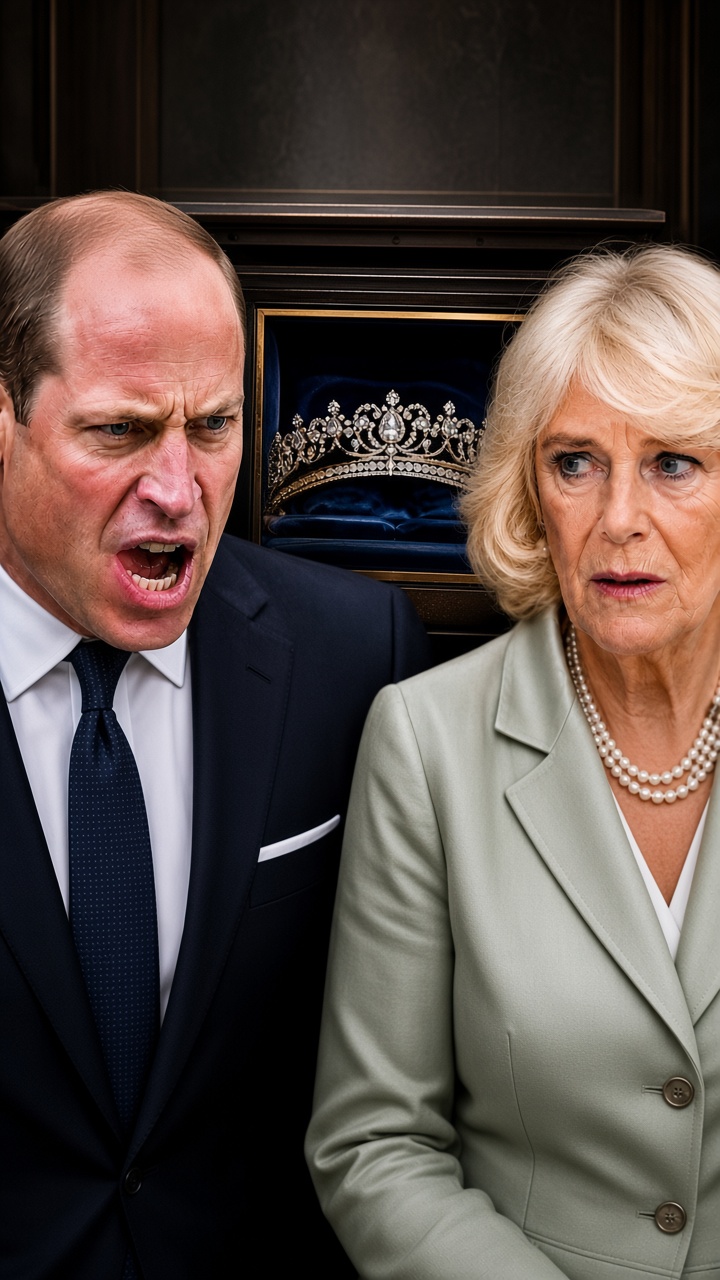
According to the story presented in the transcript, the discovery was not the result of a dramatic investigation or an accusation of theft. It began with something much less exciting: paperwork. The Royal Collection contains an enormous number of objects, including jewelry, artwork, furniture and historic pieces that move between royal residences and households. Items may be stored, displayed, loaned for official occasions or prepared for royal appearances. Because objects move, records are essential. When an item leaves storage, there should be a corresponding record showing where it went and, eventually, when it returned.
The problem arose when someone tried to reconcile the records concerning a particular tiara associated with Diana.
The paperwork reportedly suggested that the piece remained within the collection and was available in storage. Yet when the relevant records were checked against the physical inventory, the tiara was not where it was supposed to be.
At first, that did not necessarily mean anything dramatic had happened. In a collection of such enormous size, a misplaced record, delayed return or incomplete movement entry could explain an apparent discrepancy. The natural response would be to check the reference number, examine the movement history and determine where the piece had last been sent.
That is reportedly what happened.
And that was where the mystery deepened.
The movement history apparently showed that the tiara had been sent out many years earlier for royal use. But there was no corresponding record showing that it had been returned to the collection. The trail effectively stopped.
The piece had gone out.
The paperwork never properly brought it back.
Eventually, according to the account, the trail led toward Camilla’s household and, more specifically, a private safe.
That discovery transformed what initially looked like an ordinary administrative problem into something far more sensitive.
The story insists that this was not a case of someone breaking into a vault during the night or secretly stealing a valuable piece of jewelry. There was no dramatic disappearance. Instead, the alleged problem was much more complicated: a piece belonging to the Royal Collection had apparently remained outside the official storage system for years because the paperwork surrounding its return had never been properly completed.
That distinction matters.
The Royal Collection is not simply the private jewelry box of whichever individual happens to be monarch. Historic objects belonging to the Crown are treated differently from personal possessions. An individual member of the Royal Family may be permitted to wear an item without becoming its personal owner. The item remains part of the collection and is expected to return after its use.
That system depends heavily on documentation.
And documentation was precisely what appeared to be missing.
According to the transcript, the tiara had originally been sent to Camilla’s household to be worn. That in itself would not have been unusual. Royal jewelry moves between residences and households for official engagements. A dresser or member of staff prepares a piece, ensures that it fits correctly, and oversees its use. Afterward, the jewelry is supposed to return to the appropriate collection or storage location.
But the alleged problem was that this particular tiara never properly made that final journey.
Instead, it apparently remained where it had been sent.
Years passed.
Then more years.
Eventually, almost two decades had gone by.
The significance of the discovery became even greater because the tiara was associated with Diana.
For William, according to the narrative, this was not simply an item listed on an inventory spreadsheet. It was something connected to his mother.
Diana wore numerous pieces of jewelry during her years as a senior member of the Royal Family. Some became closely associated with particular public appearances and photographs. For millions of people, those objects became visual reminders of Diana herself.
For William, the emotional meaning would naturally be different from that of an ordinary member of the public. Diana died in 1997, when William was only 15 years old. Objects that belonged to the world she inhabited can carry an obvious personal significance for her sons.
The transcript therefore presents the discovery of the tiara as the moment when an administrative discrepancy became something deeply personal.
According to the account, William was informed of what had been discovered and reacted with unusual anger.
The story describes him as someone who generally prefers controlled, structured responses rather than dramatic confrontations. That is why the alleged reaction becomes the central point of the narrative.
Rather than treating the matter as an ordinary inventory correction, William reportedly wanted to know exactly how the tiara had ended up in the private safe and how long it had been there.
Most importantly, the question allegedly directed toward Camilla was not whether the tiara was currently in the safe. By that point, the records had apparently established that.
The question was about knowledge.
How long had she known?
That distinction sits at the heart of the story.
If a piece of jewelry is accidentally left somewhere for a short period because of incomplete paperwork, it can plausibly be described as an administrative oversight. But if the same object remains in a private safe for years, the circumstances become much harder to explain.
The transcript claims that William confronted Camilla directly.
It portrays the meeting as tense and uncomfortable, with William allegedly making clear that he did not accept the explanation that the situation was simply an accident.
The account further claims that Camilla’s explanation was essentially that the situation had been overlooked—that nobody had deliberately decided to keep the tiara and that the paperwork had simply failed.
Whether that account accurately reflects a real private conversation cannot be independently established from the transcript itself. No direct recording or verified official statement is provided.
Nevertheless, within the story, this alleged exchange becomes the turning point.
William reportedly did not stop at a private confrontation.
Instead, he allegedly did something much more consequential: he put the issue into writing.
The tiara’s status was reportedly formally documented as a discrepancy within the collection, and a request was allegedly made for the piece to be returned.
That move changed the situation completely.
For years, according to the narrative, the missing paperwork had allowed the situation to remain ambiguous. There was apparently no active document demanding the return of the piece because the original movement record had never been properly closed.
Once the discrepancy was formally recorded, however, ambiguity became much harder to maintain.
There was now a documented issue.
There was a documented object.
There was a documented location.
And there was a documented request for its return.
That is why the transcript portrays the paperwork as more powerful than a confrontation.
A private argument can eventually disappear behind closed doors. A formal record is different.
Once an item belonging to an institutional collection is officially recorded as being somewhere it should not be, the matter becomes administrative rather than personal.
This distinction is also important in understanding the story’s portrayal of Charles.
According to the transcript, Charles could not simply decide that Camilla should keep the tiara. The story emphasizes that the collection is not equivalent to the monarch’s personal property.
That means a documented collection discrepancy cannot simply be erased because the king happens to be married to the person currently holding the object.
The narrative therefore portrays Charles as being caught in an unusual position.
On many royal-family disputes, the monarch might theoretically have considerable influence over how a disagreement develops. But this particular situation, as described, was supposedly governed by the rules surrounding the collection itself.
If the official record states that a piece belongs within the collection, changing that record would itself require documentation.
The transcript even suggests that Charles was privately unhappy—not necessarily because Camilla would lose access to the tiara, but because the audit had created an official record of an embarrassing situation.
Again, these claims are presented by the source transcript and are not independently verified here.
The most interesting element of the story, however, is what William reportedly did not do.
He apparently did not ask for the tiara to be transferred directly to Catherine.
That would have been an easy narrative to imagine.
Catherine, as Princess of Wales, has worn historic pieces from the Royal Collection on numerous official occasions. One of the most famous examples is the Lover’s Knot Tiara, strongly associated with Diana and later worn by Catherine.
Because Catherine already wears historic royal jewelry, transferring another piece associated with Diana directly to her could have been interpreted as a family victory: William recovering something connected to his mother and placing it with his own wife.
But according to the transcript, that was not what happened.
Instead, William reportedly wanted the tiara returned to the Royal Collection.
That detail is significant within the narrative because it changes the meaning of the dispute.
If William had demanded the tiara for Catherine, critics could have characterized the situation as a struggle between two royal households over valuable jewelry.
But returning the piece to the collection creates a different principle.
The object does not become William’s.
It does not become Catherine’s.
It simply returns to the institution to which it reportedly belonged.
In that sense, the story frames William’s alleged decision as an attempt to remove the personal element from the dispute.
The goal, according to the narrative, was not to acquire the tiara.
It was to ensure that it was no longer sitting inside Camilla’s private safe.
That distinction also explains why the paperwork became so important.
The alleged dispute was not ultimately about who should wear the tiara next. It was about where the object should officially reside.
Once the piece returned to the collection, future members of the Royal Family could potentially wear it under the same rules governing other historic pieces.
The story then takes a broader turn.
The discovery of one missing or improperly recorded item naturally raises another question: was the tiara an isolated case?
If an item could remain outside the expected storage system for nearly two decades, what other objects might have similarly incomplete records?
That does not mean that other missing items actually exist. The transcript does not provide evidence establishing that they do.
But it presents the possibility as the new concern inside Camilla’s household.
Every historical collection faces challenges involving inventories, transfers, loans and incomplete documentation. The larger and older the collection, the more complicated those records can become.
A single discrepancy does not automatically prove a broader pattern.
Yet from a communications perspective, the discovery would still be uncomfortable.
Once an audit identifies an unexpected item in a private location, staff may naturally review other records to determine whether similar discrepancies exist.
The story imagines this process as particularly tense because any attempt to correct an old record could draw attention to why the original documentation was incomplete.
That is the trap described in the transcript.
If an object is discovered and quietly returned before anyone notices, there may be no public story.
But once an audit identifies it, moving the item can itself create another documented event.
The very process designed to correct the records also creates a permanent record of the correction.
That is why the transcript presents William’s alleged approach as a strategic change in how disagreements are handled.
Instead of arguing over intentions, the narrative says, he focused on documentation.
Instead of trying to prove what someone knew privately, he focused on where the object was officially supposed to be.
Instead of demanding a personal reward, he allegedly demanded institutional compliance.
There is an important factual caveat, however.
The transcript provides no official palace documentation, no named auditor, no verified inventory record and no direct statement from William, Camilla or Buckingham Palace confirming that this specific confrontation occurred.
The story is therefore best understood as an unverified narrative rather than an established account of an actual royal incident.
That distinction is especially important when discussing private conversations involving members of the Royal Family. Claims about what William allegedly said to Camilla, what Camilla allegedly knew, or what Charles allegedly thought privately cannot be independently confirmed merely because they are repeated in a dramatic account.
The strongest verifiable part of the underlying context is the broader distinction between personal possessions and objects held as part of the Royal Collection. Royal jewelry has historically been used by different members of the family, and famous pieces associated with Diana have subsequently been worn by Catherine.
That makes the central idea of the story—an object moving between royal households—plausible in a general administrative sense.
But the specific claim that this particular tiara spent approximately 20 years inside Camilla’s private safe remains an extraordinary allegation requiring primary evidence.
The same applies to the claim that William personally confronted Camilla and ordered the matter documented.
The transcript tells the story with certainty and dramatic detail, but storytelling confidence is not the same thing as independent verification.
Still, the narrative explains why the supposed discovery would have emotional resonance.
Diana remains one of the most recognizable figures in modern British royal history. Jewelry associated with her is not simply valuable because of its precious materials. Its cultural significance comes from the moments in which she wore it, the photographs that captured those moments and the memories attached to them.
For William, such an object would inevitably carry a different emotional weight from an ordinary royal artifact.
That is what gives the alleged confrontation its dramatic force.
The story is not really about diamonds, metal or a locked safe.
It is about memory, ownership, institutional responsibility and the complicated legacy of Diana’s relationship with the Royal Family.
And there is another irony at the center of the account.
According to the transcript, William allegedly did not try to keep Diana’s tiara for himself.
He did not demand that Catherine receive it.
He did not seek a personal possession.
He wanted it returned to the collection.
That makes the final image particularly striking.
After more than two decades, the tiara’s journey would supposedly end not in William’s hands, not in Catherine’s jewelry box and not as a personal trophy for anyone.
It would simply go back to where the records said it belonged.
If the story is accurate, the most consequential thing William achieved was not recovering a piece of jewelry for his family.
It was turning an ambiguous situation into a documented one.
And that may explain why the transcript treats the tiara as only the beginning.
The larger question is what happens when an institution starts reviewing old records with greater scrutiny.
A forgotten loan can remain forgotten for years.
A missing signature can remain missing.
An incomplete return can remain invisible.
But once someone begins checking the paperwork line by line, those gaps become visible.
The alleged discovery of Diana’s tiara therefore becomes symbolic within the story. It represents the moment when something that had existed quietly for years suddenly became impossible to ignore.
Whether that dramatic account reflects an actual confrontation inside the Royal Family cannot be established from the available source.
But the underlying lesson of the narrative is clear: when an object belongs to a historic institutional collection, the paperwork surrounding it can matter almost as much as the object itself.
And if a piece associated with Diana really were discovered after years inside a private safe, the obvious questions would extend far beyond the tiara.
Who authorized its original loan?
Why was its return never recorded?
Who knew where it was?
When was it last physically inspected?
Why did subsequent inventories fail to identify the discrepancy?
And, perhaps most importantly, how could an object with such a recognizable history remain outside the expected collection records for so long?
Those questions—not the dramatic confrontation—would be the real substance of the story.
Because jewelry can disappear from a display case and eventually be found.
Records are harder to recover.
Once a gap of twenty years appears in an institutional history, filling it requires more than returning the object.
It requires reconstructing what happened.
And that is why, in the story presented by the transcript, the tiara becomes much larger than a piece of royal jewelry.
It becomes a symbol of everything that can happen when an old system relies on assumptions, incomplete paperwork and people remembering what someone else was supposed to record.
The alleged confrontation between William and Camilla may be the most dramatic moment of the story.
But the quiet audit is what supposedly started everything.
One line on a record.
One object missing from its expected location.
One trail that stopped years earlier.
And one discovery inside a private safe that suddenly forced everyone to look back at two decades of paperwork.
Whether the full story is eventually confirmed by official records remains another question.
For now, the most dramatic claim remains the same one that started it all: a tiara associated with Diana was allegedly found inside Camilla’s private safe after years of being treated as part of the Royal Collection.
And according to the account, when William learned where it had been, he did not simply ask for an explanation.
He reportedly made sure the matter was written down.
Disclaimer: This story is fictional and created for entertainment purposes only.
Any names, characters, places, or events are fictitious or used fictitiously.
No real person or organization is intended to be portrayed.
