Uncategorized
The Secret Letters of the Firm: Prince Philip’s Hidden Nickname for Diana and the Unseen Bond That Defied the Crown
To compound the chaos, the press splashed excerpts of the infamous “Squidgate” tape—a secretly recorded, intimate telephone conversation between Diana and James Gilbey—across airwaves and hotlines. The royal apparatus seemed to be closing ranks around the heir to the throne, leaving Diana floating in an ocean of institutional hostility.
According to every major royal commentator, tabloid reporter, and palace observer of the era, Diana had one absolute enemy inside the palace gates: Prince Philip. The Duke of Edinburgh was universally caricatured as the stern, uncompromising patriarch of the House of Windsor—the blunt enforcer whose sole directive was to keep the volatile young princess managed, contained, and quietly silenced. The public narrative was clean, sharp, and irresistibly dramatic: the rigid, old-world Duke versus the modern, vulnerable Golden Girl.
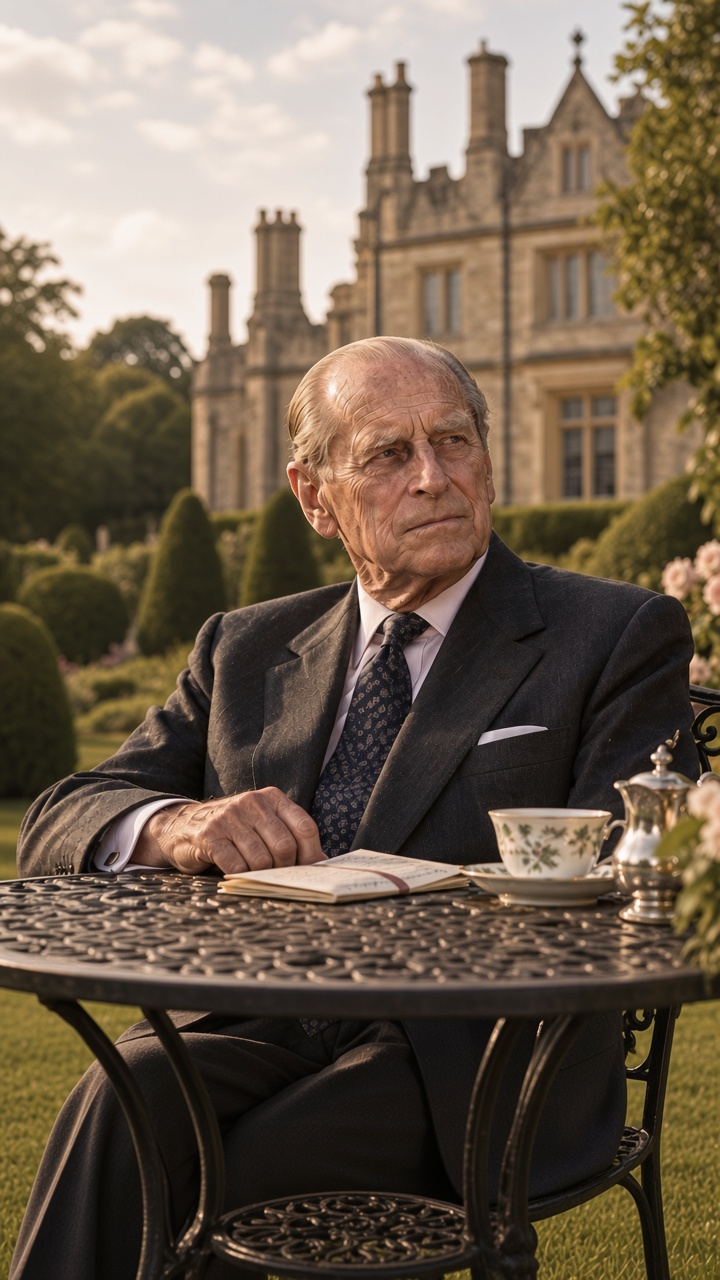
Yet, at the absolute lowest point of Diana’s life, a package of handwritten letters landed on her desk at Kensington Palace. They were not delivered by a palace aide, nor were they official directives drafted by a royal press office. They were written in the personal, flowing script of Prince Philip himself. And at the top of the page sat a private nickname—a tender, intimate form of address that no press secretary had ever released to the public.
That single private name, along with the extraordinary text written beneath it, cracked the carefully constructed caricature of the “Frosty Duke” wide open.
The Myth of the Cold Duke
To understand why these private letters sent shockwaves through royal circles when their existence was later revealed, one must examine why the world was so ready to believe the worst about Prince Philip. The caricature of the harsh, unfeeling Duke was not entirely fabricated; Philip had spent a lifetime earning parts of that reputation. He was notoriously blunt, famously short-tempered with press photographers, and wholly unwilling to perform emotional warmth on command for the cameras.
However, his sharp exterior was born out of a childhood defined by severe trauma and extreme instability. Born Prince Philip of Greece and Denmark on a kitchen table on the island of Corfu in 1921, his early life was upended almost immediately. Within a year of his birth, political upheaval forced his family into exile. The infant prince was carried off the island in a makeshift cot constructed from a wooden orange crate.
What followed was a childhood devoid of warmth or a settled home. His father drifted to the South of France, abandoning family responsibilities. His mother, Princess Alice of Battenberg, suffered a severe mental breakdown and was forcibly institutionalized in a psychiatric clinic while Philip was still a young boy. His four older sisters married German aristocrats and scattered across Europe. Young Philip was passed around between relatives, boarding schools, and foreign countries—a royal orphan with no family table to return to.
In response to a world that constantly shifted beneath his feet, Philip learned the harsh art of emotional self-reliance. He built an iron armor, locking his feelings down, expecting the next sudden eviction, and training himself never to show vulnerability.
When he married Princess Elizabeth in 1947 at Westminster Abbey, he was a Navy officer with a foreign background and virtually no personal wealth. To serve the British Crown, he abandoned his active military career, surrendered his family name, and accepted a lifetime role walking precisely two steps behind his wife. For more than forty years, he stood in her shadow—hands clasped behind his back, jaw firmly set—becoming the ultimate symbol of rigid duty and stoic sacrifice.
When Princess Diana entered the royal family as a radiant 19-year-old in 1981, the contrast could not have been starker. Diana captured the hearts of millions overnight. Her shy glances, emotional transparency, and intuitive warmth drew every camera lens in the world. Royal watchers assumed that Philip naturally resented this glamorous newcomer who consistently upstaged the traditional monarchy. When the royal marriage fractured in 1992, the public assumed Philip would lead the charge to suppress her.
The public assumed wrong.
Across the Divide: The Hand-Written Bridge
The documented reality of the summer of 1992 completely defies the tabloid caricature. As Diana felt increasingly trapped and abandoned inside the palace walls, Prince Philip did something that shocked those few insiders who knew about it: he sat down at his desk, picked up a pen, and reached out to her directly.
This was not a single, formal stern warning. It was the beginning of an intense, highly personal correspondence that spanned months. The existence of these letters was later confirmed by biographer Giles Brandreth, who spent years around Prince Philip and examined the nature of the exchange, as well as by former palace staff and Diana’s own close confidantes.
If Philip had been acting purely as the cold voice of the firm, the letters would have contained strict ultimatums: Get back in line. Think of the Crown. Stop embarrassing the monarchy.
Instead, the Duke of Edinburgh did something the institutional palace had never done: he crossed the room as a fellow outsider.
Philip recognized in Diana the exact emotional drowning he had experienced forty years earlier. He knew in his bones what it felt like to be a foreign element entering the rigid, centuries-old machinery of the House of Windsor. He understood the immense, terrifying cost of marrying into the British Royal Family and being swallowed by the institution.
According to Brandreth’s detailed accounts, Philip used his personal letters to tell Diana something he had never admitted publicly: he shared his own past struggles with the firm. He wrote candidly about the pain of losing his identity, the compromises demanded by royal life, and the profound loneliness of living under constant public scrutiny.
More astonishingly, Prince Philip placed a confession on paper that no head of the royal family was ever expected to yield. In his own handwriting, he explicitly acknowledged that Prince Charles had behaved horribly regarding his long-standing affair with Camilla Parker Bowles.
Philip did not offer vague, protective parental excuses. He named the fault directly and laid the blame precisely where it belonged—on his son. The patriarch of the House of Windsor explicitly told his daughter-in-law that her husband had let her down over another woman. There was no press officer in London who would have allowed that sentence to be typed, let alone sent. It was a raw, unfiltered admission meant solely for Diana’s eyes.
“Dearest Diana”: The Private Salutation
Beyond the startling admissions regarding Charles and Camilla, it was the framing of the letters that truly revealed Philip’s private heart. Every official document from the palace addressed Diana with formal, distant protocol. Publicly, she was the Princess of Wales or Her Royal Highness.
In private, however, Philip opened his letters to her with a affectionate name reserved exclusively for their correspondence: “Dearest Diana.”
On other occasions, he affectionately addressed her in connection to the Sovereign, referring to her in warm, protective familial terms. At the bottom of these lengthy, handwritten pages, where a cold bureaucrat would sign off with formal titles or stiff regards, Philip closed his letters with genuine tenderness, signing himself: “With fondest love, Pa” or “Your affectionate father-in-law.”
This was not a PR strategy. There were no cameras in the room, no journalists waiting outside, and no expectation that the public would ever glimpse these pages. When a man who spent seven decades concealing his emotions chooses words like “Dearest” and “Affectionate” in a private letter to a struggling young woman, it represents a genuine, unforced reflection of his true feelings.
Diana’s reaction to these letters speaks volumes. She did not burn them, nor did she hand them over to her divorce lawyers to use as weapons against the royal family. She cherished them.
During quiet, private dinners at Kensington Palace with her closest, most trusted friends, Diana would carefully retrieve Philip’s handwritten letters and read whole passages aloud. She read them with a sense of immense relief. In a world where she felt constantly gaslit, cornered, and accused of being unstable, those pages served as physical proof that she was not crazy. The most formidable figure in the royal family had looked at the situation, seen the reality of her broken marriage, and validated her pain in his own handwriting.
Years later, in the secret audio recordings Diana made for her personal memoirs, she reflected on Prince Philip’s role during the collapse of her marriage. When describing her father-in-law, she did not describe a tyrant or an enemy. She reached for a word that stunned listeners: she stated firmly that Philip had been “fairer” to her than almost anyone else inside the palace walls.
The Dual Nature of the Crown: Ally or Institution?
It is tempting to look at this remarkable correspondence and rewrite the history books completely—to declare Prince Philip a secret guardian angel and dismiss his harsh public reputation as a complete myth. However, royal history is rarely that simple, and to ignore the paradox hidden within those envelopes would be to miss the true complexity of Prince Philip.
The very same letters that offered Diana deep sympathy and validated her grief also carried an unyielding, unbreakable message: You are expected to stay.
Inside the same pages where Philip condemned Charles’s behavior and signed off as her “affectionate father-in-law,” he made the stark terms of the monarchy crystal clear. A return to the marriage was assumed. Duty came before personal happiness. Walking away from the future King of England was simply not an acceptable option. The preservation of the Crown, the protection of the line of succession, and the stability of the state were paramount.
This presents a profound psychological dilemma that historians and psychologists still debate today:
The Compassionate Ally: Was Philip a lonely, old prince who recognized his own traumatic past in a vulnerable young woman, stepping up to offer the only genuine comfort and honesty anyone in the palace could provide?
The Master Strategist: Or was Philip acting as the ultimate institutional operative, utilizing emotional empathy, mild concessions, and affection as a sophisticated containment strategy to keep a rebellious princess from tearing down the monarchy?
The truth is that both interpretations are entirely correct. They are not contradictory forces; they were the fundamental components of Prince Philip’s core moral code.
Since 1947, Philip had lived by a relentless philosophy forged through exile, war, and total surrender of personal ambition. He had suffered immense personal sacrifices for the Crown, and he expected everyone within the royal fold to endure the exact same hardships. To Philip, telling Diana that he understood her pain while simultaneously telling her she must endure it for the sake of duty was not cruelty—it was the highest form of love and respect he knew how to give. He was handing a drowning woman his honest sympathy, and then handing her back the heavy anchor of duty, expecting her to carry it just as he had carried it for half a century.
Exposed in Room 73: The Courtroom Revelation
For fifteen years, this delicate, extraordinary exchange remained a tightly guarded secret between two people. But heavy secrets within the royal family rarely stay buried forever.
In 2007, a decade after Princess Diana’s tragic death in Paris, the long-running official inquest into her passing reached Room 73 of the Royal Courts of Justice in London. Under the direction of Lord Justice Scott Baker, the private papers and personal correspondence of the late Princess of Wales were formally entered into the legal record.
For the first time, fragments of the confidential letters between Prince Philip and Princess Diana were read aloud under oath in an open courtroom. Tabloid reporters, legal teams, and members of the public listened intently, expecting the letters to expose a cold, vindictive institution attempting to crush a fragile princess.
Instead, the courtroom was met with an astounding revelation.
The physical evidence presented under oath shattered the decades-old tabloid caricature once and for all. Lawyers and investigators reviewing the correspondence found no evidence of threats, cold detachment, or institutional malice. What they found on the record was a patient, deeply concerned father-in-law attempting to navigate an unprecedented marital catastrophe with frankness, empathy, and remarkable warmth.
Biographer Giles Brandreth subsequently published detailed accounts of the correspondence, bringing the true nature of Philip’s private words to light in print. The handwriting on the paper was undeniable: the man the world thought it knew was merely a public armor. The man underneath was someone almost no one in the general public had ever been allowed to see.
The Legacy of the Final Word
When looking back at the long, turbulent history of the House of Windsor during the late 20th century, millions of official words were generated. There were formal press releases, carefully vetted Christmas broadcasts, polished speeches delivered from podiums, and calculated leaks from competing royal camps. Almost every single one of those words was measured, drafted by committees, and designed to manipulate public perception.
Yet, outlasting all the official statements of the British Empire was a single private word written at the top of a handwritten letter in the summer of 1992: “Dearest.”
Prince Philip never intended for the world to read that word. He did not write it to shape his historical legacy, defend his reputation, or satisfy the curiosity of future generations. He wrote it in private for an audience of one—a frightened, isolated young woman who felt entirely alone inside a cold stone palace.
Diana recognized the immense truth packed into that small, automatic gesture of affection. She kept the letters safe through messy separations, a bitter divorce, and the chaotic stripping away of her royal titles. In holding onto those pages until her final days, she preserved the warmest, most human words ever extended to her from the top of the British monarchy.
Behind the sharp gaffes, the scowling portraits, and the terrifying reputation of the Duke of Edinburgh stood a father-in-law who, when the palace walls were closing in, quietly picked up a pen, addressed his daughter-in-law as “Dearest Diana,” and signed his name with love.
Disclaimer: This story is fictional and created for entertainment purposes only.
Any names, characters, places, or events are fictitious or used fictitiously.
No real person or organization is intended to be portrayed.
